
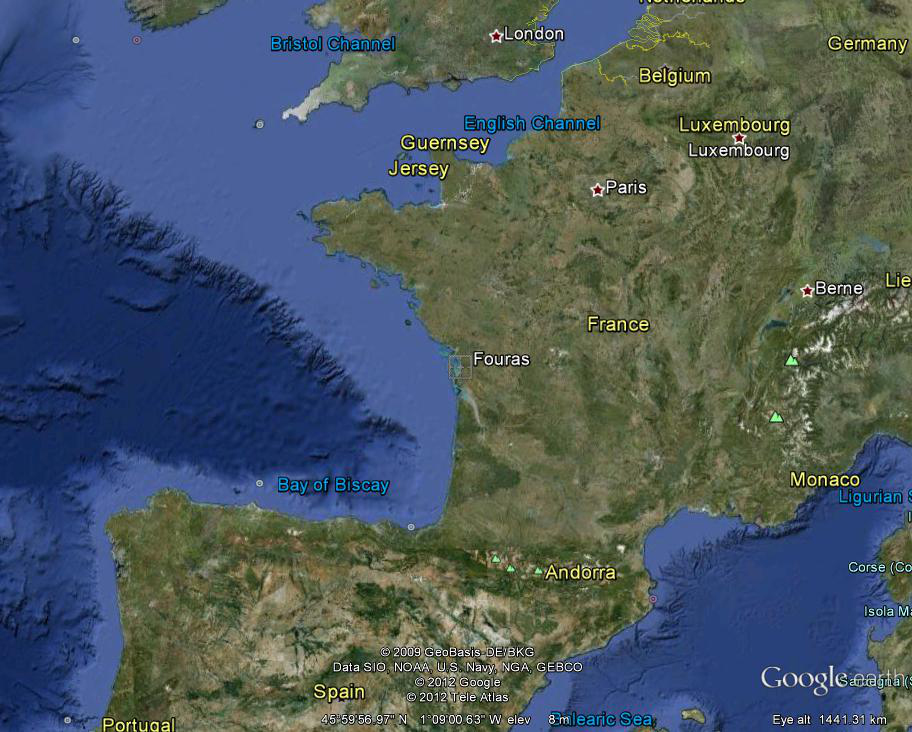
We returned to Normandy from our three weeks holiday at Fouras in the Charente Maritime. We were located in a sheltered bay between the Ile d’Oléran, the mainland and the Ile de Re to the north, today linked to La Rochelle by an amazing road bridge.
My wife and I camped at the town’s camp site just by the beach. The experience of camping with about 2,000 men, women and children from all walks of life was interesting, to say the least. It was quite a study of humanity, from the noblest to the most base and selfish. I was able, for a small fee, to park my boat at the local sailing club to the north of the north beach.
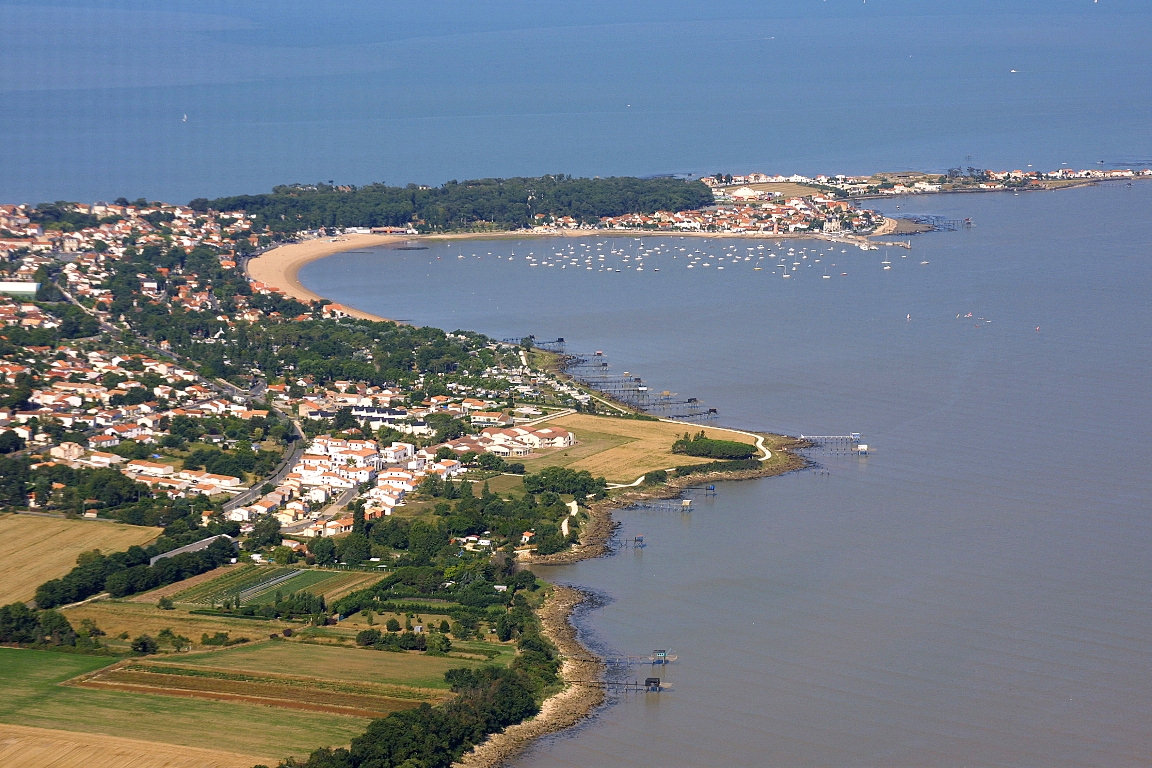
Surely an image of paradise in the Dog Days of August! The pier-like structures are called Carrelets, platforms for fishing with a big square net hanging from a simple wooden crane. Sailing is only possible 3 hours each side of high tide, because when the tide is out, one is confronted by acres of mad flats. You sink into the mud up to your knees if you try to walk on it! Sophie, my wife, went to the spa at Rochefort for a cure, and that left me plenty of time for sailing on my little ten-foot boat with its red sails.
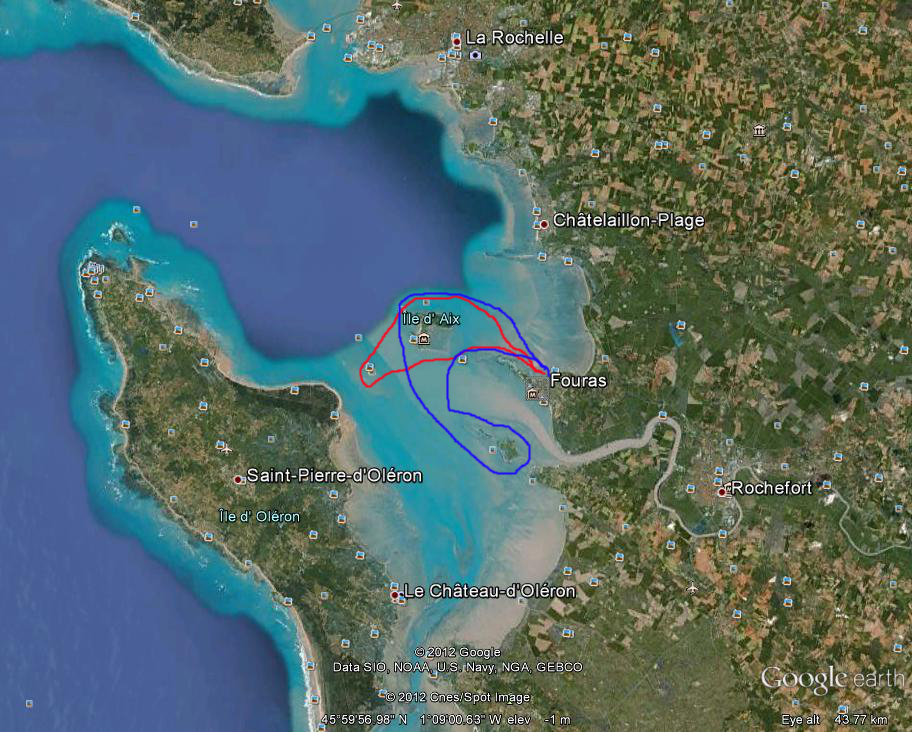
Feeling adventurous and faced with little in the way of waves and swell, I could go much further in a moderate wind. I went on three long cruises, the first to and from the Ile D’aix, the second represented in red and the third in blue. The red and blue trips would have been about ten nautical miles, and each took three hours on the round trip.
The first outing involved a simple landing on the Ile d’Aix.
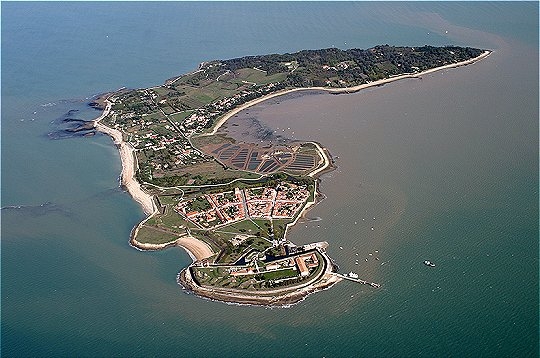
This place is absolutely fascinating, and not only from the point of view of sight-seeing. The first thing that strikes the visitor is the absence of cars.
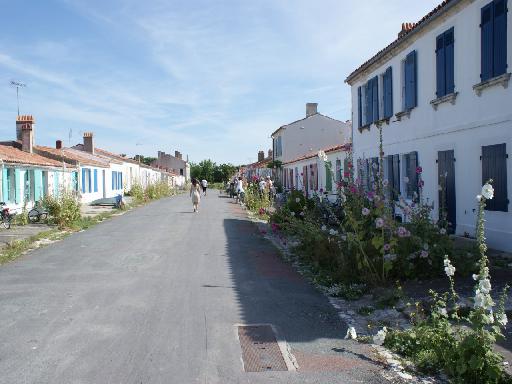
The history of this little piece of an old world is long and fascinating. In 1067, Isembert de Châtelaillon gave the island to the monks of Cluny, who established a priory. From the end of the twelfth century the island became a strategic naval site for England. We are confronted with centuries of conflict between England and France, culminating in the Hundred Years War. The fortifications were ordered by Vauban to defend La Rochelle, Rochefort and the mouth of the Charente.
The most harrowing piece of history is found in the remains of the priory church – a memorial stone marking the grave of hundreds of priests who died in the most dreadful conditions under the Revolution in 1794. They were imprisoned in hulks of ships, and they died of starvation and disease. Some of those priests were beatified by Pope John Paul II.
This Isle also marks the end of Napoleon as Emperor. In 1809, the British fleet blocked the ports of the Empire, Rochefort in particular. This island was Napoleon’s final abode in France, and it was here that he surrendered to the British in 1815. The Fort Liédota has been used as a prison, mainly for political prisoners, and as recently as 1961 following the Algeria War.
On my red trip, I passing the north cardinal buoy of Fouras and the Fort Enet.
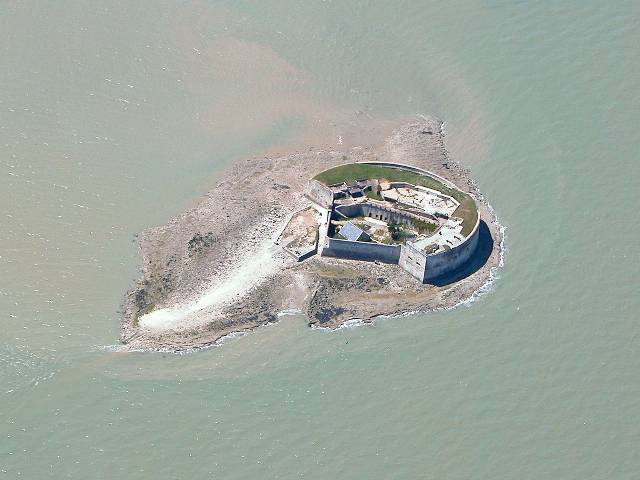
Fort Enet is a difficult landing, as there are many nasty rocks, and the gate would be firmly locked in any case. I didn’t attempt a landing, but I passed this interesting monument several times. I passed to the south of the Ile d’Aix and made my way to the Fort Boyard. Was it possible for such a tiny boat to go so far? Who dares wins. I set sail and made it.
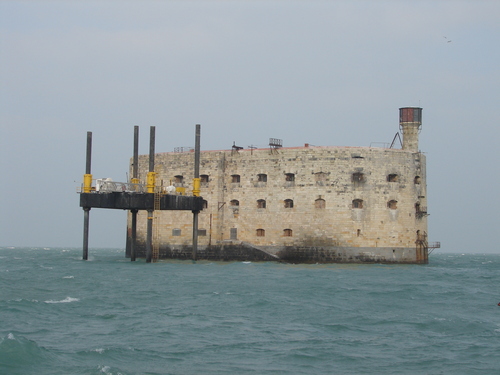
This amazing pile of stone that served absolutely no useful military purpose is impressive. In the nineteenth century, it served as the “Alcatraz” of France for the worst and hardest criminals and escape artists. Today, it serves as a TV game show. It can also be gawked at by people in sailing boats and the many passenger carrying steamers. I had to heave-to to avoid being mown down by such a vessel. The skipper gave me a hoot on his horn to thank me for doing the right and most seamanlike thing. As he crossed my path, I hauled in my sails to continue my way, and was struck by the smell of the passengers as I crossed the ship’s wake. When you are at sea, smells seem to be multiplied many-fold, and the slightest thing bowls you over. Here it was cigarette smoke and women’s perfume!
I circumnavigated the Isle d’Aix by the north and took the deep water channel back to Fouras.
My blue trip took me round the Fort Anet and south to the Isle Madame.
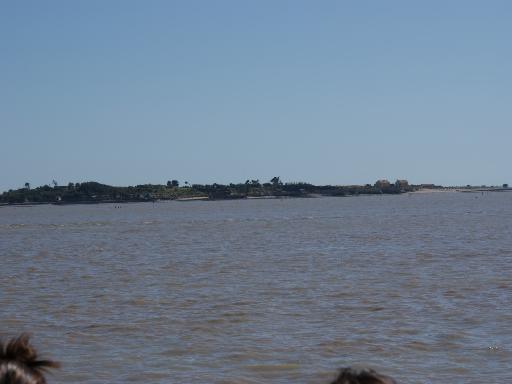
This island is accessible by car at low tide by a very narrow causeway.The photo above shows the north coast of the island. The causeway is off the photo to the left.
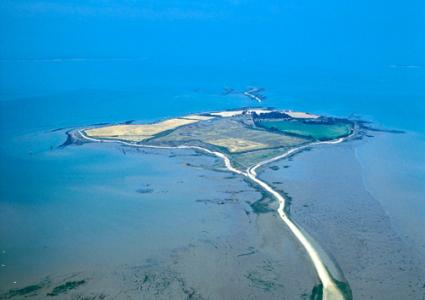
As I went along the island’s north coast for reasons of a favourable wind, I had the causeway to contend with. It was not fully high tide, so the solution was simple. I beached the boat on the causeway, dragged her over and launched her the other side. I had to go upwind, so tacking from the first. Time precluded a visit to the island, as I had to be back at Fouras before low tide and a mud bath!
The Isle Madame is one of the less known islands of the Charente-Maritime coast. It is also the smallest. There are only three buildings on the island, but another monument to the seven hundred priests who died of starvation in 1794 in the hulks of Rochefort. As I went round the south coast of the island, the wind became increasingly favourable and gave me a fast beam reach to the Isle of Aix, so I took Aix by the north – but I had to close haul the east end. That was quite hard going with little wind and a strong tidal current. I was fighting against the clock. Finally, the wind was kinder for the return to Fouras.
There you have it, a fine holiday, and the remembrance of those priests who died by man’s cruelty and hatred of the faith.


 The Blue Flower
Many thanks for such an uplifting post: besides making me feel homesick (in a sense) for the Vendee coast from many years ago, it has the effect of grounding us more soundly in the real world, and those things which are important, rather than the human constructs which we humans consider to be ‘important’…and, regretfully, the church is full of those.