
It is late October and the yellow and red leaves on the trees begin to fall. The weather alternates between the first cold winds from the north-east and north-west and the warm and stormy weather from the south-west. The days on which we can go out on the sea get rarer, as bad weather begins to take over from the shreds of the Indian summer and the few sailable days tend to coincide with working commitments and jobs to be done at home.
And so the time comes to “pull” the boat.

A few days ago, I took the trailer to Veules, hoping for a sail, but there was very little wind and a heavy fog over the sea and land. I took the mast down, packed away the rigging and got everything ready to bring home. A young man who works as a fisherman at Veules must have been able to detect the sadness of the occasion, as I must be the club member who has spent the greatest number of hours at sea on a sailing dinghy that year. Men of the sea are incredibly intuitive. He came out of their fish-processing workshop with a plastic bag in his hand, two gutted and skinned rock salmon ready for cooking. My wife and I ate them that very evening in a nice shrimp and garlic sauce.
The skipper of the fishing dory is a wonderful and kind fellow near retiring age, and he nicknamed me Lord Nelson! I just hope I don’t get shot up somewhere and have to be brought home in a barrel of brandy. What an ignominious waste of brandy! As I sit (or whatever) comfortably at home this winter, he and his men will be taking the dory out each day to eke out a living from the fickle sea. Salt of the earth!
So Sophia is now home, lying up on my trailer.
The following day, the fog had just about cleared and there was a light wind of about 10-14 knots from the south-east, fickle and unstable, but better than nothing. I had an English lesson to give in the morning of last Wednesday for an employee of a company near Le Havre, and the light-bulb lit up. I hitched the boat to my van, and after my job for the day was done, my time was my own. I drove on to the great port of Le Havre, and rigged the boat. I launched from the beach, not knowing that there was a launching ramp for dinghies inside the port – but ports can be notorious for blocking the wind! The boat can be paddled or rowed out and then you get wind for the sails.
The sail was uneventful, though the cliffs to the north of the port were quite beautiful in the still hazy air of the Norman autumn. The huge cargo ships are impressive, as long as one stays out of the shipping channel, marked by the usual green starboard and red port buoys. I also had to watch for their wake waves. A small boat can cross the shipping channel, but it needs to be done quickly, and having made sure that nothing is coming in from the sea or out from the port. Mercifully, the shipping channel is quite narrow and can be crossed in about five minutes in a good beam wind, the distance between the port and starboard channel buoys.
Of course, I have not forgotten my little adventure of last April – Seine Estuary – when I sailed from the other side of the estuary to the beach of Le Havre by crossing the port entrance.
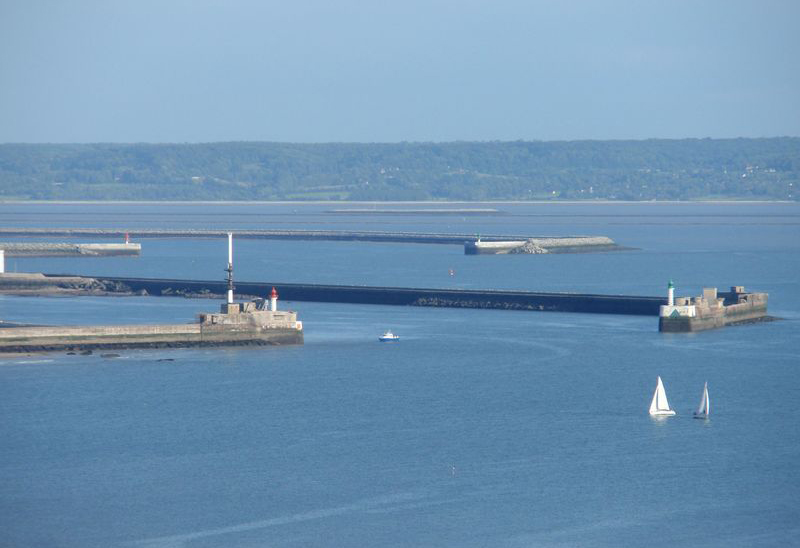
In the foreground is the older and main port, and the entrance behind is the new Port 2000 with the most amazing lifting equipment and facilities for handling incredible volumes of freight. The ferries that go to England are berthed in the old port, and the yacht marina and dinghy ramp are just behind the north port wall. This time, I stayed on the same side of the estuary. The south side of the estuary wasn’t even visible, and I would have been crazy even to consider a crossing in those conditions!
Now the boat is back home, and perhaps I might be able to get a sail on the Seine above the first lock upstream from Rouen. Downstream from Rouen, the Seine is dangerous and there are nasty currents. A boat without an engine is pretty helpless. Upstream on the Seine in the Eure Department, it should be very pleasant if I can find a free and pleasant day with a fresh breeze to go trailer-sailing. There, the Seine is wide enough to tack if the wind is parallel with the river. The advantage of a transportable boat is to find the conditions to suit the boat.
In a couple of weeks, the boat will have to be properly wintered. The hull needs practically no maintenance – just turned upside-down and covered, checked for any weak spots, but the spars will need to be varnished, the sails washed and carefully repaired where any stitches have come out. Then will come the long cold months of sticking out winter and waiting for the first sailing days. Last year, I took the boat out in late February, but in a full wetsuit.
Just a bit of advice – – – don’t capsize when the water is so cold!
We’ll see what next year brings…


 The Blue Flower
I do love your sailing posts, Fr Anthony. I have no competence to comment on them, but I read them avidly.
You wrote “What an ignominious waste of brandy!” Actually not; the sailors tapped the barrel and drank up all the brandy by the time the ‘Victory’ had returned to England. Nelson would have been proud of them!