
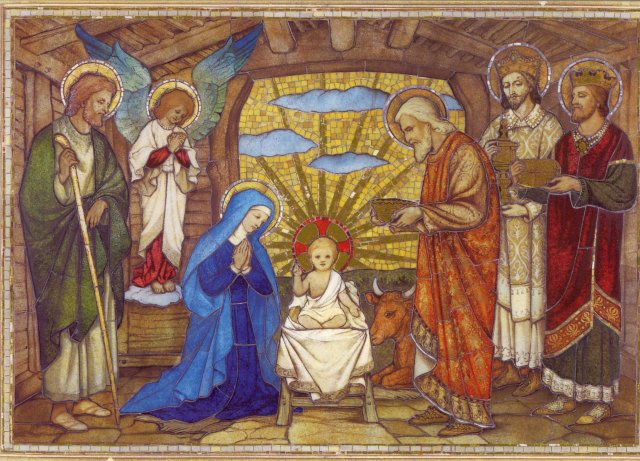
 I would like to send my warmest wishes to all my readers on this holy day of Christmas. Since yesterday evening, I celebrated Midnight Mass with my wife after having blessed the crib and placed the infant Jesus in the manger. We sang the Mass with simplicity and joy.
After that, we ate a dozen of our local oysters from Veules les Roses. We had been to buy them on Christmas Eve morning from la criée on the edge of the sea. With a south-west wind, the sea was to lee, and therefore only with waves from the sea swell. The sailing club lay forlorn with the doors protected by heavy wooden planks, and only the fishing dory on its launching trailer. We yachties take our boats out when the weather is clement. The fishermen go out to make their living in everything other than the most dangerous conditions – and in mid winter.
This Christmas Eve was also a time for some to and fro between things I said on this blog and a series of responses from a diverging point of view. As some reminded me, it was a pity that such things had to come up on the Vigil of Christmas. The clash brought me to think about a number of things. I have written enough on ecclesiological questions not to want to go over the same boring old things time and time again. I was dealing with a new convert, who, I remember, applauded the idea of a “Eucharistic fast”, which would underline the rupture between one spiritual life and a new one. All within the logic of an inner and outer conflict I myself went through for much of my adult life.
This notion of rupture has been the most painful for many of us, and what made Rome’s propositions suspect in our eyes. Pope Benedict XVI has gone on for years about hermeneutics of continuity and organic development, but such cannot apply in some spheres. There has to be rupture. This observation also causes intense pain to some of those who felt morally obliged to run this particular gauntlet.
As I celebrated the Mass of this Christmas morning, the thoughts raced through my mind. Should this Mass be the last Christmas of my priestly life, or even as a Christian? I am not so cock-sure about the TAC as to defend it or its bishops unconditionally. My former blog collaborator attaches great importance to men sacrificing their vocations for the truth. Indeed, if that is the truth, and the only truth, then you give everything with heroism and utter generosity. I sometimes find the priesthood a terrible burden, and I often think how good it would be to share the lot of most humanity – and spend life as a spiritual seeker. There are many different spiritual and religious traditions on this earth like Gnosticism and a few shards of the Celtic tradition, and new ones are emerging as men of science begin to discover that materialism is a false understanding of our world, and quantum mechanics point to a spiritual understanding of all things we know and still don’t comprehend. I’m not concerned with “playing church”, but I am concerned with keeping sacramental Christianity going in some way, however futile it might seem.
Also, many members of the TAC are former Roman Catholics, who left for what they believed to be serious reasons. Some of them became priests in the TAC or joined the TAC as priests ordained in the Roman Catholic Church. Archbishop Hepworth was the highest profile of clerics in this category. There were others, including yours truly, ordained a deacon after having been a convert from Anglicanism and ordained in vagante land.
The history of the TAC over the past five years is of Byzantine complexity, but whatever went wrong with the aftermath of the bishops’ meeting in Portsmouth in October 2007, one thing that lacked was solidarity in the body of the clergy. I had many conversations with Archbishop Hepworth about what would happen to the irregulars in view of the complementary norms of November 2009 that clearly stated the categories of me would not be considered for the priesthood in the Ordinariates. I think he believed what he said to me – he was expecting special rules from Rome to cover the irregulars. There were none, not even for himself. By the time the Archbishop thought of setting up a Fraternity of Saint Benedict to create a pastoral provision for irregulars for the years it would take to make canonical appeals to the Roman canonical law courts, it was too late.
All that is left of the TAC, poo-pooed by the new converts, is what was regrouped in March 2012 under Archbishop Prakash and the organisational skills and energy of Bishop Michael Gill of South Africa, together with input from the American bishops and Bishop Botterill. What is more or less affiliated to this regrouping is difficult to fathom, in particular the TAC in Australia, Torres Strait and many local Churches in Africa and South / Central America.
There are ongoing attempts to define the regrouped TAC. Some are far from being impartial or laced with bitter reflections. The way Archbishop Hepworth was dealt with (at least what we know) has caused a lot of pain. The whole process of the ACA splitting away from the Ordinariate movement in 2010 was also painful and confusing. People are wounded and would like to settle old scores. It has almost become a blood feud. Is God anywhere in all that? Is there anywhere where God would feel at home?
Should I leave the TAC and go back to my ecclesial life (or lack thereof) of before August 2005 when Archbishop Hepworth took me into the TAC? Have I to begin negotiating with men who don’t know me and to whom I am just an administrative unit? How do I deal with this blood feud, maintained also by some of the new converts who are still smarting after having been “persecuted” by the ACA bishops? Where in the Church is there not a mixture of saints and sinners? Is there not still something good and ecclesial in the TAC alongside the sins and failings of human beings? This is going to be a major question this coming year. Either the TAC is cursed and everything should be done to destroy it and squeeze the toothpaste tube dry, a few more converts for the Ordinariates and the rest relegated to the abyss – or there is something to be rebuilt and put to the service of the Christian mission. That is the essential choice each of us has to make. The choice each of us will make will bear consequences.
I am not going to go on with the blood feud or seek guilty persons to settle scores with. There may be some despicable clergy in the TAC, as there are in all churches and ecclesial communities. We either reject the faith or ecclesial life, stick our heads in the sand, or come to terms with the human reality. Alongside the sin, there is also ecclesial communion in Christ and a sense of solidarity, loyalty and obedience to those we believe are more likely to be right than ourselves.
So, what do I propose? I am going to try to make a survey of the TAC and find out what we have and how many we are – bishops, dioceses, parishes, priests, laity, religious communities. In places, there may be pitifully few as our critics underline in their writings. Where two or three are gathered together in my name… In other places, there may be entirely intact communities judging by pre-Portsmouth 2007 standards like in South Africa, and – as far as I can tell – in Torres Strait. One thing is sure, we are not 400,000! We may well not be a hundredth of that number.
Some information is available on the various official sites of TAC local Churches. There are the names of the bishops and local parishes, and in many cases the names of the priests and parish websites. I plan to write an article about each local Church of the TAC once I can find reliable information. It’s likely to be a tough job, and the recent events have driven heads into the sand and made the weak of heart retreat into silence and fear.
I intend writing articles on the present state of the local member Churches of the TAC in the United Kingdom, Australia, Torres Strait, Canada, the USA, the African continent, the Central and Southern American continent and India. I expect there will be a small and scattered diaspora in other countries, like myself in France. I will look for official communications, information bishops and vicars general are prepared to share with me for publication and other information from private persons if I am convinced of its reliability. I intend to perform this task in the spirit of casting the TAC in the most favourable light possible. I believe this would be of service to the TAC and would help complete and close the painful separation process between it and the Ordinariates.
I would appreciate all the help I can get for the preparation of each of these articles. You can write by way of comments or privately by e-mail (anthony.chadwick AT wanadoo.fr). Thank you in advance, and wishing you a happy Christmas Octave, celebration of the New Year and a holy Epiphany.


 The Blue Flower
Pingback: A Survey of the Traditional Anglican Communion (TAC) | Fr Stephen Smuts