
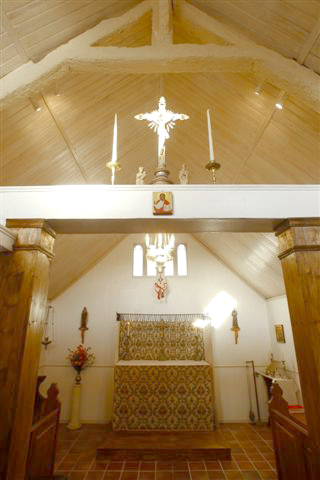
A nice posting has come up on Anglican Patrimony – The English Use by Fr Matthew Venuti of the US Ordinariate. My own experience as a cleric was much different from theirs, having been ordained to the diaconate at one of the spikiest and most baroque seminaries of the RC Church – Gricigliano. The picture above is of my own chapel, fundamentally English with a few later French influences.
The conversation is courteous. Fr Bartus has written an article in the past about my preference for the Sarum Use, and was quite hurtful in places. I am happy that an Ordinariate priest in America is gently pushing for more “medieval” English ways.
I am quite puzzled to read that the Eastern liturgies are a key to understanding some of the less clear rubrics. It is true that we use a rood screen (when we have one) and there is a procession with the Oblata. I see the roots of the Sarum liturgy over this side of the English Channel, and they are apparent in many medieval churches in our Norman countryside and in the city of Rouen. The Norman liturgical tradition extended all the way through the Evreux area to Paris, over the other side of the Seine to the Pays d’Auge and the Bessin. The essential of the Sarum Use was taken over to England with the Norman Conquest. Our English culture is Norman more than anything else, with a smattering with what is vaguely Germanic in us.
This gives some idea of a French cathedral liturgy in the early nineteenth century, still in a very eighteenth-century style.

Sarum in Salisbury Cathedral would have been little different, except for the baroque trappings. There may have been some influence from the Orient, but my guess is that most of it is native to our Franco-Roman culture.
Fr Venuti takes inspiration in this little altar in the guest house chapel of Ealing Abbey. So did I to some extent, as my chapel shows, especially for the exact appearance of a hanging pyx. Downside Abbey in England is also very English.
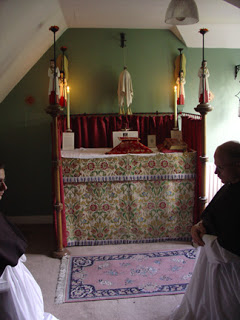
I wish this Ordinariate community every blessing in this work of fostering the English (Norman) tradition.


 The Blue Flower
I remember that guest house chapel being created. As a novice I was, naturally, forbidden to enter it.
What was liturgy like in England prior to the Norman invasion, to you know?
Here is an interesting article: http://haligweorc.wordpress.com/2011/01/02/on-the-sarum-rite-beginnings/
It is indeed interesting to note that Fr Venuti mentions that his Anglo-Catholic formation was at Ascension and S Agnes in Washington, D.C. That city has two large flagship Anglo-Catholic places of worship. The one mentioned in the article and St Paul’s K Street. St Paul’s was very Sarum in all of its appointments and liturgical usage, whilst Ascension and S Agnes was very, very Tridentine in inspiration.
Pingback: Anglican Patrimony has sprung alive with two back to back posts | Foolishness to the world
What a fascinating picture. The choir rules appear to be holding tridents of some form. Are they cantors’ wands I wonder?
A blessed Epiphany/Theophany/Nativity to you and all readers!
I can recommend this site in French, but which seems unable to explain the trident-like staffs. There are some fascinating details of this painting.
This cathedral choir (Amiens in the Somme) remains unchanged apart from the novus ordo altar facing the people.
Note the hanging pyx.
Do they represent ‘harps’ for heavenly music? I have seen similar as finials above an altar, many years a go. They do look like cherubs harps as well. Perhaps they represent the choir and the making of sweet music!
The French article does suggest the image of harps but without being able to say so conclusively.
Mmmm. Fathers Anthony and Ian: the article seems to clearly explain the “curious trident forms” [the cantoral batons] to me. It says that though it is hard to see, one would expect to see [faut-il voir] without a doubt a little statuette of a patron saint flanked by a support [‘construction’] and goes on to say since the end of the Renaissance, a little capital [‘chapelle’] in gilded wood consisting of [‘contenant’] the statuette of a saint usually formed the tip/end of [‘termine’] the French cantoral baton. It then goes on to point out that this was the forerunner of the orchestral leader’s baton (and I am reminded of the story how the famous French composer Jean-Baptiste Lully struck his own foot when beating time with his large baton, and died from the resulting infection).
Thank you, Rubricarius, and the same to you! I was, for the first time, struck by your juxtaposing of ‘Epiphany’ and ‘Theophany’ and wondered why the feast is more commonly known, in the Proper sense, as the generic ‘Epiphany’ (the ‘Manifestation’) rather than the more theologically specific ‘Theophany’ (the revelation of God). (Or is Theophany more general? I am minded to think that the Nativity is a Theophany also).
Do you or any other reader know why this is so? My otherwise wonderful Protestant Dictionary (1904) simply says that “The feast of Epiphany is of considerable antiquity but cannot be traced to the Apostolic Age……..The festival is first alluded to by Clement of Alexandria, AD 200 etc.”
I have a copy of the Enchiridion Patristicum, edited by a M J Rouet de Journel SJ, with three or four brief letters by Clement, but my initial cursory scan did not identify any such reference in those works. I’d be interested to know which word he used.
Pingback: Interesting Thread | As the Sun in its Orb & New Goliards