
On my first day on the Vilaine, I took advantage of the Cran bridge opening at its scheduled time and motored towards Redon, a town in Brittany but inland. These are photos I took which give something of the Breton character. I enjoyed my visit.

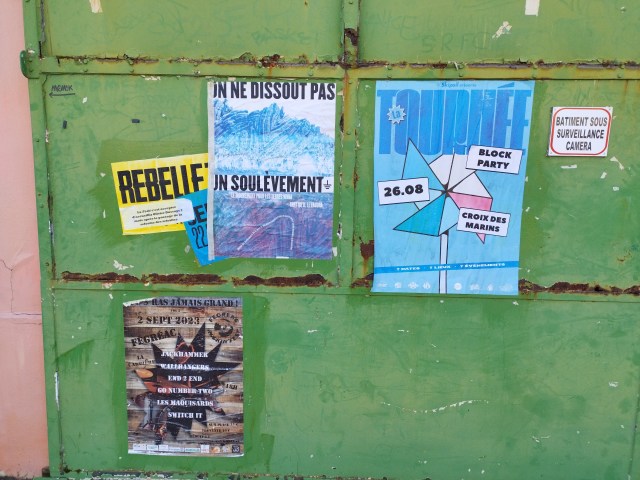
It was a comfortable night with still water and electricity. The next day I took a walk, and my attention was drawn to things that do not generally attract tourists. The times I have spent in Douarnenez have shown me the radical political views of some Bretons in their reaction against metropolitan France since the Revolution. These are paintings on the walls of a disused industrial building. A relationship of solidarity between Brittany and Louisiana, with a women hanging doves to dry on a washing line.

This is an odd one with a kingfisher chasing some letters away, but I find it difficult to understand.

These clearly express left-wing rebellion movements, presumably against M. Macron’s policies.
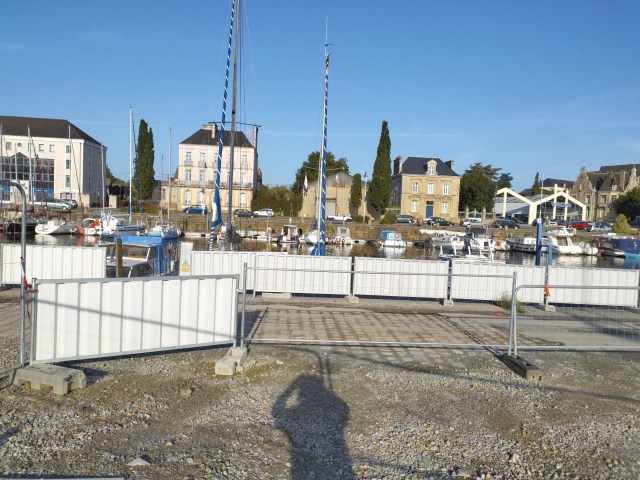
Across this ugly side of the port, some splendid bourgeois houses.
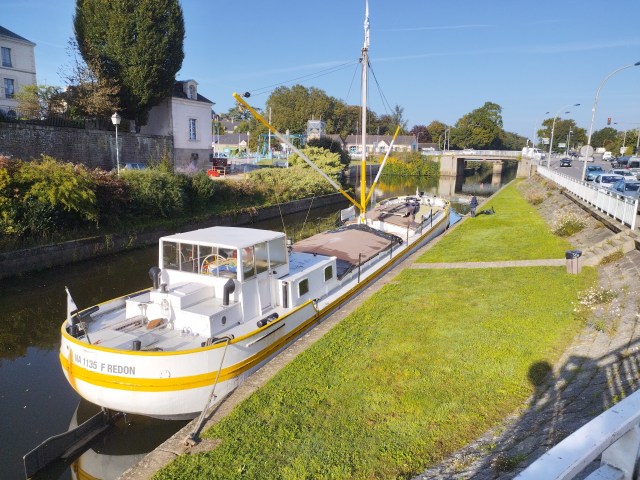
The top end of the port with a lock.

A cargo barge on one of the upstream canals.
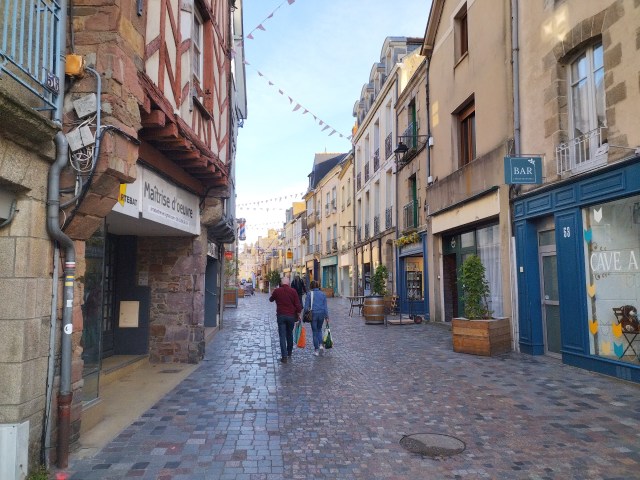
A nice little street with no cars.
The old Abbey.
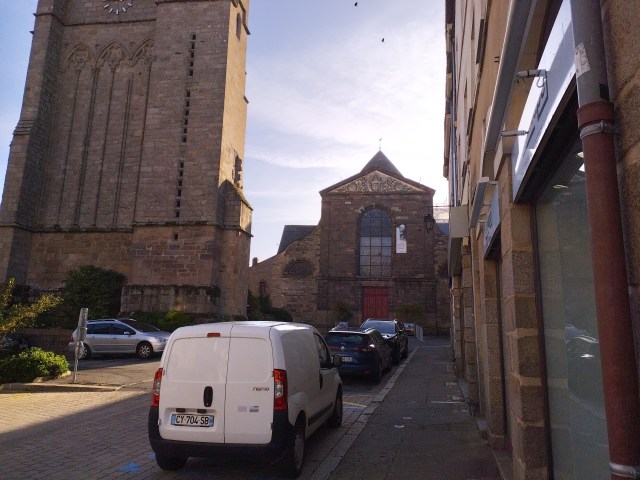
The bell tower.

The cloister, which is open to the public. The former monastery is a school.

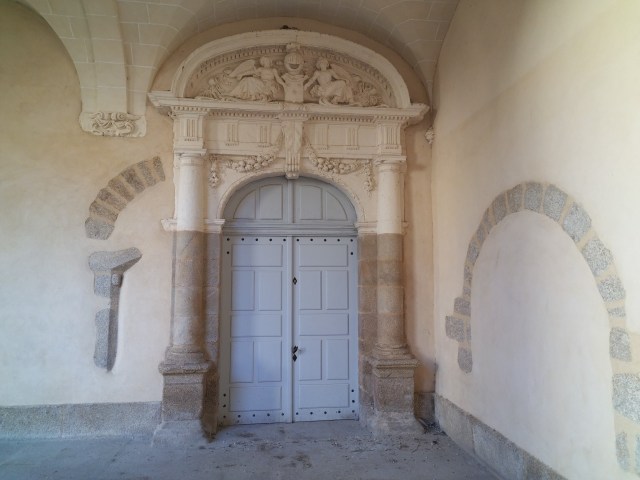
Lovely door from the cloister to the church – locked.
The church is closed for renovation work. Some photos were available with the description of the work.

A close up of the choir and sanctuary.

Another angle of the spire and bell tower.

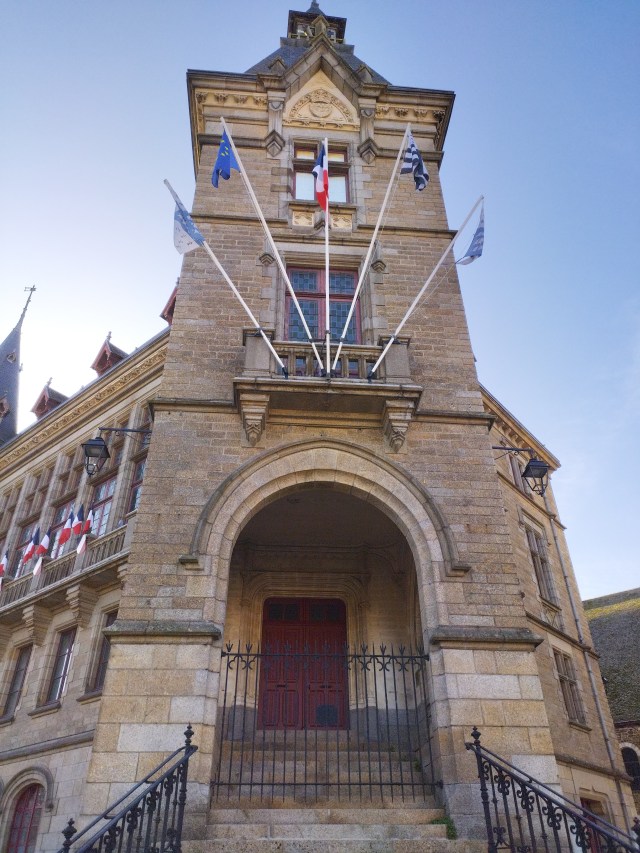
The Hôtel de Ville.
The old railway bridge, disused and permanently open to boats.

A beautiful town house.


 The Blue Flower
Thank you for this! Variously fascinating and lovely! Wondering what the acoustic of that Church might be like, I found a recording of Dominique Ferran playing “Fantaisie Tournemire” on its organ on the YouTube channel Christophe Bidaud (uploaded 12 years ago next Monday). Now to catch up with your video… I’ve lately gotten interested in Tolkien’s adaptive translations of two lays in the Vicomte Hersart de la Villemarqué’s Barzaz-Breiz in the two-volume 1846 edition – of which there is a scan in the Internet Archive from the National Library of Scotland, including the tunes. Both of these turn out to have been used by Charles Koechelin in his Chansons bretonnes sur des thèmes de l’ancien folklore, Op. 115, Vol. 3 No. 13 and Vol. 1 No. 2 respectively, recordings of which I found on YouTube: I suspect Tolkien’s translations of ‘Ar Bugel Lac’hiet’ and ‘Aotrou Nann Hag ar Gorrigan’ might even be singable to the tunes with some adaptation!
I was sad not to be able to go into the abbatial of Redon, which is closed for renovation (I hope not wreckovation). I have heard the organ recordings and the organ is forthright with brilliant mixtures and beefy reeds. I have never connected much with Tournemire’s music. I must give it more of a go. Now that this year’s sailing season is over, I still need to get on with some writing in search for that spiritual Christianity that has been forgotten by conservative integralism and woke bureaucracy alike.
Yes, let us hope not wreckovation – which I fear is sadly still an ever-present danger! (The former Dutch Old Catholic Archbishop aspired to major wreckovation in a Church also used by the C of E, a few years ago, but happily only a minor one was executed, depriving the Anglicans of the handy altar rail.)
I’ve enjoyed what Tournemire I’ve heard (an old history teacher who was also an organist and let us up into the organ loft with him during services is a great lover of 19th-20th-c. French organ music and convinced me!).
I’ve lately finally (and joyfully) caught up with St. Athanasius’s Life of St. Anthony in the Ellershaw translation, which got me reading Derwas Chitty’s Letters of St. Anthony and rereading around in Benedicta Ward’s Sayings of the Desert Fathers translations – and checking the Wikipedia daily list of Saints Days has led to some striking examples of later Western hermits. Without underestimating the difficulties of all sorts, I can imagine a fruitful growth of varieties of lay and priestly eremiticism.