
I offer these reminiscences of the seminary of Gricigliano on this twenty-fourth anniversary of my Tonsure by Cardinal Pietro Palazzini in Rome. My experience there leaves me without any bitterness towards my former superiors, given that the Institute continues and grows to this day. With better understanding of my own person, I would never have gone there in the first place – but as always, lives cannot be remade and the clock cannot be turned back.
From the beginning, the Insstitute of Christ the King was intended to contrast with the bulk of traditionalist Roman Catholicism by its devotion to the Italian way, the gentleness of Renaissance saints like St François de Sales and St Philip Neri. This “softness” of approach would attract men who would exploit their environment and provoke tensions between La Dolce Vita and the square-bashing caricatures and quasi-military rigorism inspired by the last embers of Jansenism in the SSPX and other traditionalist communities. I will present this subject candidly without saying anything bad or unjust, even about people who have in fact caused me psychological and spiritual harm.
As with my failed marriage, I asked the question of what was my problem. Clinically, it turned out to be Aspergers autism, which does not dispose someone towards teamwork, but rather to a much more solitary life. The priestly ministry in nearly all institutional churches is made for neurotypicals.
I wrote these recollections in something like 2000 when my memories were relatively fresh. They have been edited.
* * *

In 1990, I met a dapper of a French priest visiting Lausanne, who was about to establish his priestly institute in Italy, in a Florentine villa that had been abandoned by a community of French Benedictine monks who had attempted a monastic foundation in the old Villa Martelli in a place called Gricigliano. It had been founded by two French priests incardinated in an Italian Archdiocese, who had obtained their doctorates in Rome. One of these two priests had in the same year obtained canonical recognition for the new priestly institute from an African bishop. Having been appointed Vicar General of the diocese (some feat, since he was living outside the diocese), the young priest was able to style himself as a prelate with the title of Monsignor. After my theological studies at Fribourg University, I joined this young community of priests and seminarians, but not without difficulty.
I had already been for a retreat at the house where the seminary was located in February 1986 when the place was still a contemplative monastery, and bitterly cold everywhere in the decrepit 18th century villa in the beautiful Tuscany countryside. There was a small baroque chapel, very plain on the outside, adjoining a small clearing between the trees and the way leading to the main building. The stucco on the walls was peeling away, showing many years of neglect.
The first person I met was called Arsène, an Oblate of the Benedictine community. He had studied law in France and seemed to know just about everything. He was recovering from having given up drinking and was still unable to enter the monastic life on account of being unable to stop smoking. A rough man in his late forties, he was indeed a friendly fellow, constantly helping with heavy work and welcoming guests. I spent about four days in a freezing guest room near the old chapel. The main community offices were in a large room of the main house, and the old eighteenth century chapel served only for the monks’ private Masses. Next to the room that served as the main community chapel, there was a hall with something like a minstrel’s gallery. The whole room, apparently some kind of private theatre, was painted in trompe l’oeil to imitate Renaissance niches and statues of pagan goddesses, but everything was covered in a coat of dust, and much of the paint had peeled away or was damaged by the crude installation of central heating.
After returning to Rome from Switzerland for the semester of 1986, I thought little more of the monastery high up in the Tuscany hills, having seen and visited so many Italian buildings. Little was I to know that only four years later, I would live there for two years. The application process for the new priestly institute took from May to October 1990. I finally received a telephone call during the October of that year to say that I was accepted into the seminary.

Arriving at the seminary in the November of 1990, I was pleasantly surprised to be greeted by the same Arsène and a young deacon who was completing his studies in Rome. We nicknamed the latter Don Vibraco della Traspontina on account of the time he spent in Rome doing his university studies with Msgr Piolanti. It was like a reunion of long-lost friends. Arsène had opted to stay at the monastery that had become a seminary, whilst all but two of the monks had returned to France. I found here another world of another time, somewhere between the era of Voltaire and Benedict XIV to the gilded rooms of the time of Leo XIII and Verdi’s La Traviata. I arrived on a sunny autumn day when the golden leaves on the olive trees could rival the candlesticks of this august House! I was shown my room and seminary life began.

It was curious to see so much more of a building of which I had seen very little when it was a monastery. The rooms are the ground floor were spacious and had high vaulted ceilings, all painted in white. There was the old theatre I had seen before, which had served as a refectory. There was an impressive main hall with a beamed ceiling, the walls painted with scenes of Italian cities and Tuscany villas. For most of the time I was there, it was used as a classroom. On occasions, it became a throne room for a visiting Cardinal or bishop who came to ordain deacons or priests. The large room used by the monks as a chapel was rapidly turned into the refectory as the old chapel was cleaned and appointed for daily use. Monsignor Wach had a very pleasant room for his office, protected from curious ears by soundproof doors. Adjoining this office was the secretariat where privileged seminarians could find out what was going on, or at least get some idea. Two fine stone staircases on opposite sides of the quadrangle led to the upstairs corridors, long and paved with red clay tiles. Most of the seminarians had their rooms on the upper floor. Across the front entrance with a fine wrought iron gate and a bridge going over the moat of what was a building on very ancient foundations was another building containing a baroque fountain. This was a front to the more utilitarian buildings used for producing wine and olive oil. The gardens were very pleasant, especially the fine grounds adjoining the orangery.

The chapel was small and plain on the outside. Inside, the baroque altar was singularly harmonious and beautiful, crowned by a curved apse with large statues of the holy Apostles Peter and Paul either side of a large painting in a gilt frame. The communion rail was in marble. The organ, on which I had worked and which I played each day, was up on a gallery. Various experiments were made with the pews in order that the community of seminarians could face each other like in the choir of a church. Two years of praying and singing the Office in this little baroque chapel left a lasting impression on me. Indeed, to some extent, it inspired the chapel in my present house.
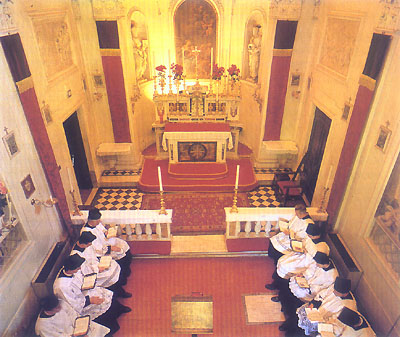
This seminary was quite unlike anything I had known in the traditionalist world, indeed close to my earlier aspiration of joining the Oratory of St Philip Neri, in which I saw an informal “monasticism” without the sadness and rigorism. The founding ideal was to emphasise the spirituality of Saint Francis de Sales and the Italian spirit like in pre Vatican II Italian dioceses. There was something very human in those early days of this seminary. We prayed and we worked, combining the gentleness of St Francis de Sales, the intellectual rigour of St Thomas Aquinas and the devotion to the liturgical life of St Benedict. These were our three Patron Saints, who were to guide our spirit and new hope for traditional rite Catholicism.
Life was quite chaotic in those early days, as the monks had left the house in a mess. About thirty sickly chickens lethargically moved about in the run next to the orangery. None of them had laid an egg in years. They were later discreetly dispatched by Arsène and one of the seminarians, and thrown into the freezer after plucking and gutting. No amount of cooking would make their meat tender! The outbuildings were filled with junk and rusty woodwork tools, and the kitchen looked like something out of The Name of the Rose, with its blackened walls and antiquated equipment. Rotting vegetables were strewn on the floor. Even the old chapel was in a state of neglect, everything covered with a layer of dust. The organ was unplayable due to the pipes being choked with dirt. I wondered what kind of monastic community had lived in this place!
The seminary was a beehive of activity for those first months. Seminarians in their old work cassocks were dismantling and moving furniture, cleaning, clearing rubbish for the bonfire. The new kitchen with modern equipment was professionally installed, one of the highest priorities – hygiène oblige. I had the interesting task of dismantling and overhauling the organ. I removed the pipes and methodically stripped down the instrument. The mechanism, typical of Italian instruments of the mid eighteenth century, was very simple to repair. A name was visible inside the wind chest “Tronci di Pistoia 1766”. The pipes were quite unlike any I had seen in English organs: the metal was very thin and easily damaged from a light pressure of the fingers. Without the use of an air compressor, I had to wash the pipes in whatever I could scrounge from the kitchen, and then leave them in a row to dry on a table. I was able to clean the mechanism using a jury-rigged nozzle on the end of a vacuum cleaner tube. The organ was ready to fine-tune and play after about two weeks. The superior would have me go and play a piece on the organ whilst showing visitors around the chapel.

My peaceful and painstaking work on the organ did not isolate me from community life. We had a full day of breviary offices and the community Mass. Washing-up and refectory service teams were appointed for the meals. As in the monastic fashion, meals were eaten in silence with a reading from a book of piety. Unlike the way some seminarians thought, I found the seminary well organised, considering the amount of work needed to make the place fit for human habitation. Whilst I was cleaning organ pipes, others were painting walls, washing floors and polishing furniture. Several lorries arrived from France carrying furniture given by benefactors and retired priests. Boxes full of books also arrived, mostly junk but with some useful theological works.
The work continued through until December, when it was relegated to Saturday afternoons, the traditional time for having seminarians do useful and practical things. We were after all a missionary institute. What good would a mission priest be in Africa if he could not repair his house or mend his truck?
The superior outlined the essential philosophy of the Institute during his lectures spirituelles on Sunday evenings before Vespers. He spoke of Cardinal Siri, of Saint Francis de Sales, another approach from that of the rigorists of the Society of St Pius X. He spoke well, and certainly caught my attention. Gricigliano seemed to be almost paradise; though I knew full well that paradise does not exist on this earth. The academic life of the seminary was not as yet well organised. It was not particularly my problem as I had my own work continuing with the University of Fribourg. I had still to finish my written work on liturgical history and to prepare for my final examinations in dogmatic theology, moral theology and my chosen subject.
The first dissensions began to occur in mid December 1990 as some of the first-year seminarians (those in civil dress) began to leave mysteriously. One had refused to obey the rector and was dismissed. A subdeacon and a young seminarian got into their car during the night and were half-way back to France by the time it was noticed that they were gone. It would seem that the problem was partly caused by a prefect of discipline, a singularly immature young Frenchman. Most of us were relatively unconcerned, but tenseness reigned. It seemed that some of these men had not done a stroke of work in their lives, and could not understand why everything could not be done by paid servants! Such was their idea of the Catholic priesthood! There are many in the clergy who could not care less about anyone else, just like those who hang around religious houses, who waste no time in idle gossip! One priest wants a frilly pair of curtains. Others want antique furniture. This one complains that the sacristy door is squeaking, that the carpets are dusty. In any case, it’s always for someone else to do the job! In seminaries like in monasteries, one is judged by one’s capacities for work. You have it or you don’t! We seemed to be surrounded by swinging moods and whims of immature young boys!
Gricigliano was the subject of much gossip in those days. The essential is that it was a house of prayer. There was no denying that! It was truly a lovely place to live in, whichever the season. Perhaps, the “high camp” character in the more secular parts of the house was a little over the top! We should leave each man to choose his Louis XV armchair and Bertillon gilded mirrors in peace. Surprisingly, it was not all “high-camp”, since most of the seminarians made an honest effort in contributing to the work and devoting themselves to the service of God.
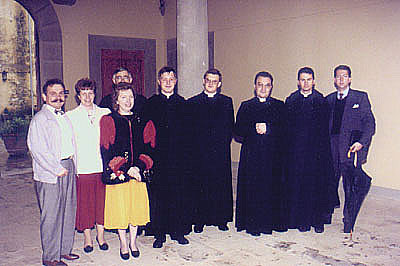
Towards Christmas, I was to be tonsured in Rome by Pietro Cardinal Palazzini together with another seminarian. The ceremony was supposed to have taken place at S. Girolamo della Carità, the Cardinal’s titular church where Saint Philip Neri has established the Oratory more than four hundred years before. Instead, the Cardinal didn’t turn up, because he had forgotten the appointment, and the ceremony took place in his apartment in a tawdry little private chapel. Our superior showed us the Eternal City with great pride, although I had already spent a year there. On returning to the seminary, it was announced that Cardinal Stickler was to come from Rome to ordain a priest and a subdeacon. This was to be the first of a series of highly complex Pontifical ceremonies in a chapel that had been designed for little more than Low Mass for an Italian aristocratic family. Within two weeks of the ordination, the newly ordained priest and subdeacon left Gricigliano to join a French “independent church”. The whole community, in January 1991, was in shock. The superior came to see each seminarian in private to ask us whether we had any idea that they were planning to leave. Only one knew something, the lay brother working in the kitchen. We were truly in a house of the blind. The “apostate” priest was replaced as prefect of discipline who was a former army officer, a fair and kind young man.
The deacons of the house were frequently called for secret meetings in Monsignor’s office, which caused no small perplexity among the seminarians. One problem in the house seemed to be caused by the hypersensitivity of the seminary rector. I never had any problem with him. A seminarian’s duty is to obey without question and to trust that his superior is fair in his decisions and requirements of his charges. Men who answered him back were sent to Santa Maria Novella, the in-house euphemism for the railway station of Florence, with a one-way ticket home. I saw others leave the seminary, many of whom were liars and dishonest men without the slightest inkling of a vocation. One sacristan, so it was alleged, was found out to have stolen albs and surplices from the sacristy to sell them to an antique dealer. The dealer in question knew the superior, and the sacristan was the next to take his train home. One first-year seminarian was discovered to be married, and was also quickly sent home!
I was still there after the “storms”, and was judged to be ready for all the minor orders in June 1991, which were conferred by Cardinal Stickler in the seminary chapel. After the ordination, I had to return quickly to the organ to accompany the rest of the Mass. Being the only organist in the house, I was more or less indispensable. I accompanied Vespers and Compline each day, and Solemn Mass on Sundays and Feast days. Though the old Tronci organ was playable and reasonably well tuned, it was difficult to play accurately on the narrow touches on the keyboard. The superior, appreciative of baroque music and good cigars, was very demanding of good organ playing, and I was able to remedy the difficulty to some extent by strengthening the springs of the organ’s mechanism. That year, a young lady, a semi-professional mezzo-soprano was invited to come to Italy from Paris. It was interesting to accompany something other than Gregorian chant, especially parts of Vivaldi’s Judith Triumphans and other baroque favourites of our superior. She came for the big occasions like the visit of the Cardinal Archbishop of the local Archdiocese and ordination days.
Gricigliano was a place of gossip and secrecy that would provoke idle curiosity that much more. Seminarians were leaving or asked to leave for unknown reasons. Each incident was followed by a secret meeting and more empty stalls in the chapel. Sometimes, the cook caught something, and would usually give me shreds of precious information during a visit to the Via Nicotina, an alley between two outbuildings where seminarians could go and smoke discreet cigarettes. I kept away from these intrigues. It was advisable not to seen to have an ear to the ground, and above all to keep one’s mouth shut! Loose lips sink ships!
I was still at the seminary the following year, and my turn came for the subdiaconate with five others. The seminary was joined by an American deacon and an English seminarian who had left the Fraternity of St Peter in Germany. The subdiaconal ordination was conferred by Cardinal Stickler in March 1992, and it felt a relief at last to be in Major Orders. It carried the obligation of reciting the breviary, but we could in theory be dismissed only for serious canonical reasons and no longer for “not having a vocation”. Life in the seminary had its ups and downs. Life was relatively calm in the spring and summer months of 1992.
It was on my return to seminary in the autumn of 1992 that the superior sent for me. I was behind time with my university work, partly because I was being asked to attend classes at the seminary instead of being allowed to study. I had finished my written work and sent it to Fribourg, but the final examinations still needed to be prepared, thesis-by-thesis. The superior seemed sympathetic to my explanation, and then proposed me a rapid ordination for a ministry that he was not prepared to divulge to me. It was a big secret. This would be done if I would agree to cease my work with Fribourg University. I later learned from a priest that he was going to send me to Africa as a prelude to eliminating me from the Institute. I was sent instead to serve at one of the Institute’s chapels at Marseilles run by a lay organisation.
I learned after my diaconate that my way to the diaconate was cleared by the influence of Fr François Crausaz, with whom I had been friends for a number of years. I returned to the seminary in March 1993 for the retreat and the ordination, which was conferred by Cardinal Palazzini. The day after, I had to return to Marseilles to continue assisting this priest in his more than limited ministry.
The day arrived for my diaconal ordination, a fresh and sunny spring day. There had been five of us at the retreat, the other four for the subdiaconate and myself for the diaconate. The vestments were neatly laid out in the sacristy with the folded dalmatics to be put over our left arms. The chapel was immaculately clean, and a strange stillness reigned in the little baroque chapel. The Cardinal’s vestments were laid out on the altar, as the strong smell of beeswax polish pervaded the scene of the ceremony. As the time approached for the ceremony, two future subdeacons and myself were vested and ready. The minutes ticked by, and the other two were not present. How can a man be late for his own ordination?
Finally, the seminarians arrived and everyone was vested. Still no sign of the missing ordinands. I ventured a question, but was told that there was no problem. We entered the chapel, and finally, Cardinal Palazzini arrived in cappa magna, accompanied by the ministers, servers and Monsignor wearing a cope. As the ceremony began, it was clear that the two missing ordinands were not going to be there. The feeling of confusion continued throughout the ceremony. I could feel the tenseness in my superior, and would notice the same thing afterwards when looking at photographs of the ceremony.
It was an almost unreal feeling as the sun shone in through the window high up to the side of the chapel, and I realised that I was actually going to be ordained a deacon. After the long Litany of the Saints, the two subdeacons were ordained, and I was finally called. The confusion filled my soul as I knelt before the Cardinal and he intoned the prayer of consecration. The right hand pressed firmly onto my head as the formula was recited: Accipe Spiritum Sactum ad robor… I received the stole and dalmatic, and had to lay my right hand on the book as I received the power to proclaim the Gospel in the name of the Church. The sun continued to shine through the smoke of the incense, as I read the Gospel and took the book to be kissed by His Eminence. There was a great joy within me, but an inability to forget the missing ordinands. Even after the ceremony, no information was forthcoming.
The missing ordinands had been expelled for some kind of intrigue, and one was eventually recycled through a stint in Africa and his ordination some two years later. The most shocking thing was to see him that very evening in Marseilles, where the confusion increased. The other ordinand simply disappeared, never to be seen again.
My main worry with this Institute was not so much the internal affairs of the seminary. A man is trained at the seminary for a few short years, and then the Way of the Cross begins after the Bishop has laid hands on him. I even dared to ask such questions. These priests must have been truly blindfolded to turn themselves into ostriches with their head in the sand! As time went on, everything began to decompose with the secret meetings in Monsignor’s office, mysterious departures of unhappy seminarians, intrigues, everything that has nothing to do with baroque elegance or Evangelical simplicity!
* * *
I have been unflattering about my experience in this seminary and indeed my time as a convert to Roman Catholicism. No one ever leaves the KGB! – a line from an old James Bond film. I survived and was unable to go the way of atheism. The Institute of Christ the King has apparently flourished since those days, and its continued existence is proof of a certain solidity. I have taken care to avoid saying anything for which I could be accused of libel or slander. It was not for me, and others have got on well there. A few from my time are still there, at the seminary or in any one of the outside ministries in many countries of the world.


 The Blue Flower
Dear Father Anthony,
Thank you for this, and for all your postings over some 15 years. I share with you: 1. Crossing the Tiber – but…