
I have been very quiet as of late in the current controversies surrounding the inauguration of Donald Trump, Europe, the UK, Net Zero, electric cars, China and Russia, Islam, terrorists and grooming gangs, the Church and Pope Francis, American “woke” bishops and the list never ends. I spend far too much time on YouTube, even though I can generally spot “click bait” or a video intending to provoke emotions and anger. There are psychological studies about conspiracy theories, and a little self-criticism will reveal that I have allowed myself to be influenced more than I would like to admit.
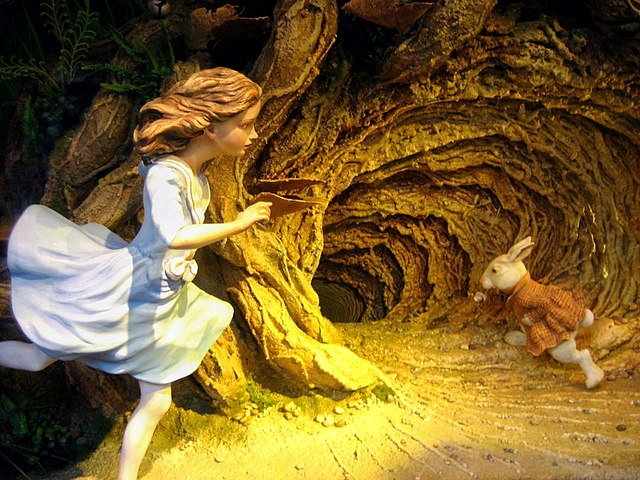
Lewis Carroll, who wrote Alice’s Adventures in Wonderland, understood something out of the common in human nature. This image of following a narrow path of thought is remarkably intuitive. From Carrol’s tales for children, the rabbit hole analogy is widely used – and abused. I am not a psychologist, just someone with a little experience of human foolishness and the disenchantment and burn-out we suffer on reaching the limit of our illusions. The analogy comes from this passage:
Alice started to her feet, for it flashed across her mind that she had never before seen a rabbit with either a waistcoat-pocket, or a watch to take out of it, and burning with curiosity, she ran across the field after it, and fortunately was just in time to see it pop down a large rabbit-hole under the hedge. Down went Alice after it, never once considering how she would get out again. The rabbit hole went straight for some way, and then dipped suddenly down, so suddenly that Alice had not a moment to think about stopping herself before she found herself falling down what seemed a very steep well.
The rabbit hole that entraps us is an increasing descent, and we lose our sense of reality and reason. In some novels and films, the notion of the Matrix or the object of desire in the Romantic mind can be quite positive. Alternative narratives are often intuitive and are needed to counter the domination of the archons who rule us.
President Trump’s inauguration and the storm of executive orders has given a sense of euphoria to many. Like when the French Revolution broke, Wordsworth would cry out:
Bliss was it in that dawn to be alive,
But to be young was very heaven!—Oh! times,
In which the meagre, stale, forbidding ways
Of custom, law, and statute, took at once
The attraction of a country in romance!
The Romantics of Jena also admired the tumultuous change in France in the 1790’s – until Robespierre and the guillotine appeared, a worse tyranny than the old aristocracy and elites. Already, there seem to have been injustices in the choice of people to expel from the country. Change seems to be what is happening, but how far will it go? People with rigid belief systems will fall victim more easily, whether it is the Republicans or Democrats who are holding the megaphone.
I have noticed very unhealthy tendencies on Facebook, and I have to be very careful not to get into a race of memes. Commentaries about politics in England often oppose the “minorities” and the “far right thugs” – or the virtue-signalling of “wokery” and the frustrated working class. Reading articles of opposing points of view help me to get somewhere near an idea of fact and truth. In medio stat virtus, to quote St Thomas Aquinas as he took the idea from Aristotle. Is “two-tier policing” a reality in England? What about allegations of corruption around Islamic “grooming gangs”? I look on it all with profound disgust from my quiet little village in the Mayenne. Were things better in the past when we had no internet and computers, mobile phones, telephones, television and the wireless? The powdered wig toting philosophers of Jena sought for information about the world and had ways to find it, even if it took longer!
Tribalism is also a temptation, the narcissistic tendency to seek energy in others. Nationalism, like cosmopolitanism, are ways that people look for identity. Psychologists go on about conspiracy theories, but are probably themselves down the opposite rabbit hole.
Personally, I find myself looking towards the Romantic yearning for change and an inaccessible truth. I tend to be sceptical and repelled by systems claiming to represent truth. My approach to God and theology seems to be relatively unaffected. Perhaps my Aspergers autism gives me an antenna to detect sophistry in reasoning, the Bullshit ‘o’ Meter. Six months as a working guest in a Benedictine abbey taught me the value of silence, not only holding one’s tongue but keeping the spirit and soul calm and receptive to God. I was divided between the view of the monastery as a garden of spirituality – or just another collective system to destroy personality. Even the Abbot admitted that the dividing line was extremely fine.
I have come to a stage in life, in my mid sixties, of learning to live solitude and self-reliance. Individualism is mercilessly discouraged. We are expected to live in relationships, but some of us are not made for them. As a priest, I hear that I should be founding a community – but if I try it, I will be a “sect guru”. Ralph Waldo Emerson (1803-1882) was heavily influenced by the Jena Idealists and Schiller’s Ich und Non-Ich. We find enlightenment in our own existence and being. We have to break with the crowd and trust ourselves. Never mind what others think and say! We need to be kind to others and show courtesy and respect, but they are they and I am the one with experience of my own being. Even if we are surrounded by others and concerned for their good, Emerson writes: “the great man is he who in the midst of the crowd keeps with perfect sweetness the independence of solitude“. This was the essential message of Oscar Wilde in In Carceris et Vinculis:
It is tragic how few people ever ‘possess their souls’ before they die. ‘Nothing is more rare in any man,’ says Emerson, ‘than an act of his own.’ It is quite true. Most people are other people. Their thoughts are some one else’s opinions, their lives a mimicry, their passions a quotation. Christ was not merely the supreme individualist, but he was the first individualist in history. People have tried to make him out an ordinary philanthropist, or ranked him as an altruist with the scientific and sentimental. But he was really neither one nor the other. Pity he has, of course, for the poor, for those who are shut up in prisons, for the lowly, for the wretched; but he has far more pity for the rich, for the hard hedonists, for those who waste their freedom in becoming slaves to things, for those who wear soft raiment and live in kings’ houses. Riches and pleasure seemed to him to be really greater tragedies than poverty or sorrow. And as for altruism, who knew better than he that it is vocation not volition that determines us, and that one cannot gather grapes of thorns or figs from thistles?
But while Christ did not say to men, ‘Live for others,’ he pointed out that there was no difference at all between the lives of others and one’s own life. By this means he gave to man an extended, a Titan personality. Since his coming the history of each separate individual is, or can be made, the history of the world. Of course, culture has intensified the personality of man. Art has made us myriad-minded. Those who have the artistic temperament go into exile with Dante and learn how salt is the bread of others, and how steep their stairs; they catch for a moment the serenity and calm of Goethe, and yet know but too well that Baudelaire cried to God — “O Seigneur, donnez moi le force et le courage De contempler mon corps et mon cœur sans dégoût”.
As I mentioned about the Benedictine monastery, I had the impression of a totalitarian society, but I also saw the opportunity for each monk to grow spiritually and find this solitude in the community. Perhaps I needed to stay a little longer to mature in this transition of thought. Like politics, a lot of institutionalised religion hinders the ability to grow mentally as an individual if it browbeats with apologetics and “one true church” ideologies. I am very fortunate to belong to a very small conservative and traditionalist church, whose footprint on the world is very humble. My priestly vocation can thus thrive through reading, study and writing.
Perhaps Emerson went too far with his “solipsism” as his critics said. It was not selfishness like the two boys fighting over a toy, but a relationship with the divine that far transcends human socialising. We have to find re-enchantment and the sense of wonder to clean the poison of ideology from our souls. This is self-reliance and our way out of the rabbit hole.


 The Blue Flower
Re-enjoying T.H. White’s The Sword and the Stone again for the first time in I know not how many years, I was struck by Merlyn saving to the young Arthur (nicknamed ‘Wart’) on their first instructive adventure “Education is experience, and the essence of experience is self-reliance.”