Contrasting Notions of Redemption

I have been running this blog for a good long time and I often have to use the search function to find out how many times I have written about a subject. One I have certainly written about is the Redemption in relation with the myth (in the meaning of an allegorical image of an unknown history) of Original Sin and the idea of a Nationalsozialistische Himmelreich Arbeiterpartei together with a demons looking after hell dressed in SS uniforms taking souls to gas chambers and fiery pits for the millions of damned. Please forgive my cynical satire about a certain notion of a very sick and distorted Christianity which is certainly the delight of atheists. It is not by Godwin’s Law that I make a comparison with Nazism, because Hitler’s ideology was a caricature of a certain notion of Christianity!

I am a Christian and a priest, concerned that my faith in Jesus Christ as the Incarnate Word of the Father may continue to inspire generations of seekers and gentle folk seeking a different spiritual way to that of the clang of arms and the loud brash voices of our time. Since my fifteen years as a Roman Catholic, I struggled with the notion of vicarious atonement and the notion that the sins of humanity would be forgiven through the Son of God dying a horrible and lingering death at the hands of the Romans after having been judged for “blasphemy” by the High Priest of Judaism. Surely Christ gave more through his Incarnation and life than through his death. The theology of sacrifice is complex as we consider the covenants and sacrifices of the Old Testament. Ultimately, sacrifice is the ultimate of self giving in love, the giving of our best to God to create a more loving relationship. Some of us have risked our lives to save the life of another person. It is our duty if we find ourselves in that kind of situation. Sometimes, life ceases to be worth living under the conditions in which we find ourselves. I think of the many martyrs of history up to the score of Coptic Christians having their heads sawn off by Daesh barbarians only a few days ago. A certain journey along the Christian way takes away our fear of death, and it is something we understand or that we don’t.

The centre of a notion of Christianity that underlines authority, no salvation outside the X Church and heartless collaboration with any political regime that promises to uphold its totalitarian agenda is the notion of the Redemption and salvation we find in St Augustine, Calvinist Puritanism and Jansenism. The article Another narrative is fascinating and a scathing condemnation of Augustinian theology (in favour of what?). Only today, I republished the link to John Gielgud’s dramatisation of Dostoevsky’s parable of the Grand Inquisitor. It rings a bell in me when I consider that much of what passes for Christianity is all about “might is right” instead of compassion and empathy, considered as signs of weakness and lack of manliness.

We are so used to Augustine’s explanation of Atonement and Redemption that we take it for granted on both the Roman Catholic and Reformed sides. It is one thing that remained unreformed in the sixteenth century. When we stop and think of it, someone we “know” to be excluded from God’s “elect” can be treated as a sub-human. The twentieth century and our own times make hay of that idea! You don’t have to treat a “sub-human” to the respect with which you would hope someone else would treat you. What is as bad is accepting the idea that we are ourselves sub-humans – and that we can have some influence on God by submitting to the right authority and “true church”.

What happens if we dismiss Augustine’s theories? The validity and credibility of Christianity will have to be based on something other that sanctifying man’s thirst for power, money and being the first. We seem to have no further to look than the Gospels to find the Beatitudes and the other teachings of Christ, the sign of contradiction.

The Eastern Orthodox narrative of θέωσις has its expressions in post-Reformation pietist spirituality and in twentieth-century Roman Catholicism. Pope John Paul II mentioned “the teaching of the Cappadocian Fathers on divinization (which) passed into the tradition of all the Eastern Churches and is part of their common heritage. This can be summarized in the thought already expressed by Saint Irenaeus at the end of the second century: God passed into man so that man might pass over to God. This theology of divinization remains one of the achievements particularly dear to Eastern Christian thought“. It seems to me to be a more beautiful explanation of what God does for us through Christ than some notion of some bloodthirsty demiurge wanting to be appeased by suffering and death.

St Augustine is behind the exaggerations of both Calvinism and Jansenism in affirming that some or most human beings are predestined for damnation. The Another Narrative article is much more scathing of St Augustine than I would be, but it cannot be denied that there is a whole Manichaen side of Augustine’s teaching that is not one that reveals a loving God, but rather the Demiurge of the Gnostics, an emanation that would not be the true God. Luther and Calvin were products of their time, and God for them was the ultimate authority, a divine emperor. Original sin is seen as refusal of obedience to that authority. Then that authority is delegated to the Church and perhaps also to some of the most evil men in history.

The patristic, Eastern Orthodox and Anglican (Lancelot Andrewes, John Wesley and others) notion of divinisation by grace brings joy, love and freedom. It takes away our fear of death and all the evils that go with it.

(…) there is no insulted “God,” no infinite offence, no atonement, no compensating for the disrespect to “God’s” authority, no universal guilt, no “double predestination,” no moral impotence, no infants condemned to  eternal torment.

It is perhaps this aspect of Christianity in the west that has been its undoing. With a notion akin to that of the Orthodox and our Anglican divines, together with the more enlightened modern Roman Catholic theologians, there is light, beauty and love. Obviously, that is not all, since many Orthodox folk hate each other. I am sure my Orthodox readers will tell me that belief in θέωσις is only a minority belief and that most have a much more primary notion of Christian spirituality. In any case, one doesn’t become Orthodox for θέωσις any more than you become a Lutheran because you like Bach’s music! We can have both in the Churches to which we belong.

It is Lent. Some are engaging in rigorous fasting and giving up pleasures. Others are taking something up. A revision of some of our fundamental assumptions may truly be our salvation! Let us go up to Jerusalem…

Posted in Uncategorized | Tagged , , , , | 8 Comments

The Three Temptations

On this first Sunday of Lent, I bring my readers another slant on the three Temptations Christ faced in the wilderness, from the mouth of the Inquisitor of Dostoevsky and interpreted by John Gielgud. I make no comment. Just watch the video and be attentive to the subject of the three Temptations coming up.

Posted in Uncategorized | Tagged , | 1 Comment

Boom Tent

Dinghy cruisers are among the most ingenious people in the world – when it comes to using a very small boat as a cruise ship. Over the last couple of days, I have been busy making a boom tent for my boat – especially with the Semaine du Golfe in mind, also for other occasions when I need to camp for a night or two in my boat.

Everything in a boat needs to have several uses, and the tent structure is the rig of the boat. One end of the tent is supported by the mast, and the other is held up by a wooden support in the stern. In this way, no extra stress is put on the shrouds and forestay. The tent folds away into a very compact package and is lightweight, only the polytarp.

boom-tent01The tent covers the boat’s cockpit but not the foredeck. It is held at the sides by brass hooks screwed into the boat’s gunwale.

boom-tent02Here the tent is open at the stern showing the wooden support, that folds and is easily stored in the boat.

The next thing to go into is a compact mattress to go into the port side between the buoyancy tank and the centreboard well. The space is narrow, but I have tried it. My legs go under the thwart if the mattress isn’t too thick. I would be positioned with my head to the stern where there is the full width of the boat. I have a sleeping bag for summer use and clothing can be used as a pillow, all packed into a dry bag designed to keep clothing and bedding dry. The adventure is getting exciting!

After that, I will be making a small stern locker for everything to do with navigation (charts, Portland plotter, dividers, binoculars and sighting compass) and communications (VHF radio). The rest of the boat needs to be organised with a box for the galley and what will go into the fo’c’sle – which has to be lightweight and not exactly the ship’s riff-raff to kept in order under the threat of four dozen lashes of the cat! There will be some confusion between the crew, the midshipmen and the captain’s cabin. All that in twelve feet of length and five feet of beam!

Posted in Uncategorized | Tagged , | 4 Comments

Our Bishop’s Silver Jublilee

Solemn Votive Mass of Christ the Eternal High Priest
(According to the Anglican Missal)
To Celebrate the Silver Jubilee of Ordination to the Sacred Priesthood of The Right Reverend Damien Mead.
17-02-1990 – 17-02-2015
St Augustine’s Anglican Catholic Church, Best Lane, Canterbury, Kent CT1 2JB
on Saturday 14th February 2015

Preacher: The Venerable Raymond Thompson
Server: Mr Roy Hipkiss
Organist: The Reverend Anthony Chadwick
Cantor: Miss Catherine Begley
Camera: Miss Megan Young
www.anglicancatholic.org.uk

This celebration took place last Saturday in Canterbury. It was a happy occasion for our Bishop in his devoted service to our Diocese and the pastoral care of us his clergy and laity. I managed to coax the ageing electronic organ and try to make it sound as “pipe-like” as possible, especially by not using too many stops. I a reader wants to see me on the video, this is possible as I go and receive Communion from my Bishop’s hand.

For a small Church with so few resources, I think we do rather well, each of us putting in our little bit. That’s what being Christians is about!

Posted in Uncategorized | Tagged | 4 Comments

Going into Lenten Array

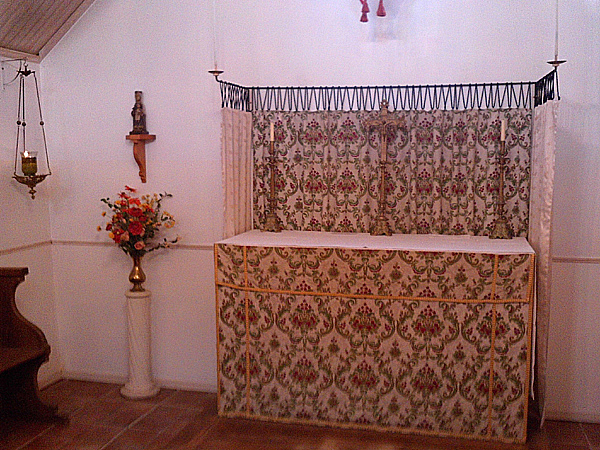
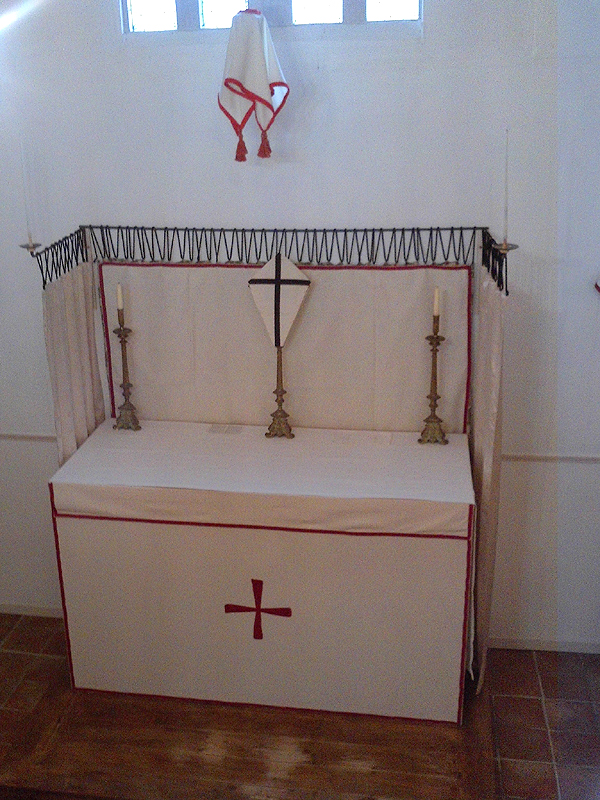
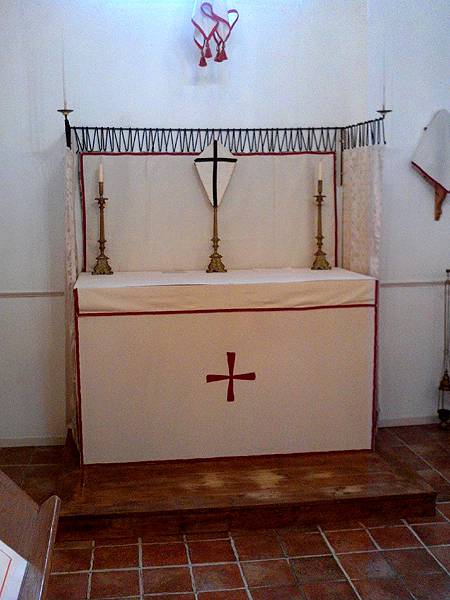
Here are links to what I have already written about Lenten Array and its use in the English and other northern European traditions. It would be pointless to repeat what has been said in those postings and elsewhere on the internet. I changed into Lenten Array today. It should normally be done on Shrove Tuesday, but I have things to do in town tomorrow – so today was the day. I only have last year’s palms to burn to make the ashes, and then everything is ready to begin Lent.

lent-array2015-01Here is the chapel just before I began the “operation”.

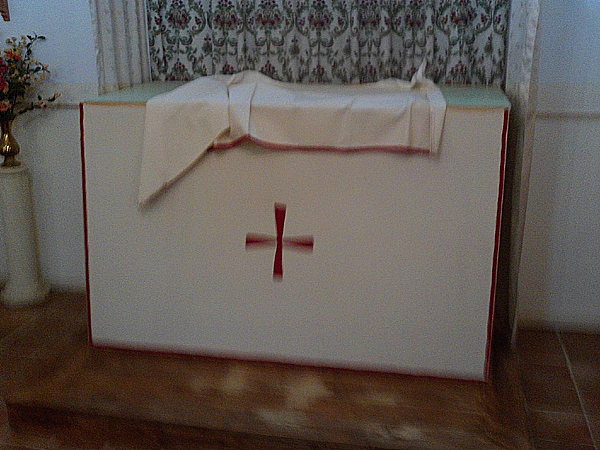
lent-array2015-02The frontal is changed and the antependium is ready to be installed.

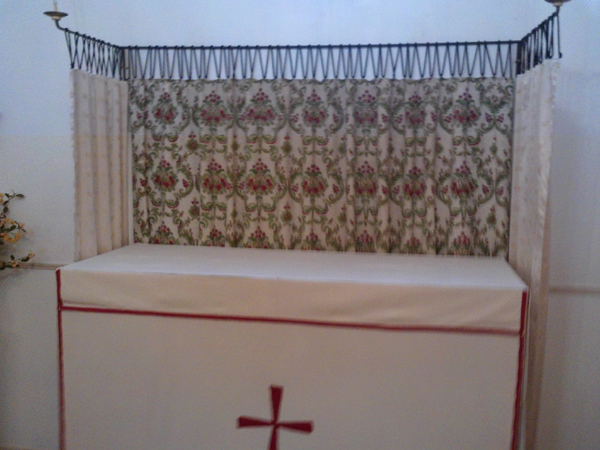
lent-array2015-03Only the dossal remains to be done, by the lenten cloth being pinned to the dossal.

lent-array2015-04Only the cross remains to be veiled.

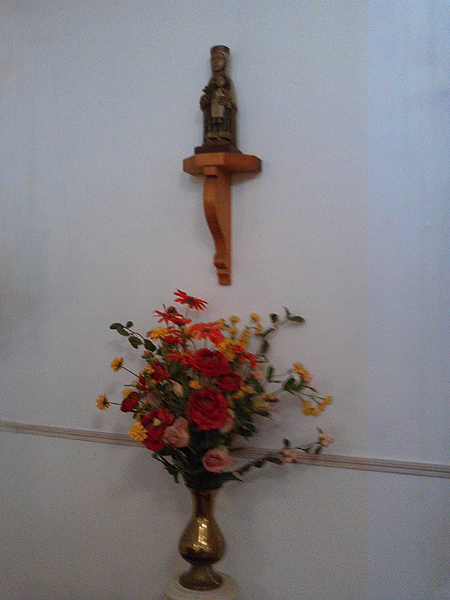
lent-array2015-05Here is the statue of Our Lady with a vase of flowers. The flowers are removed.

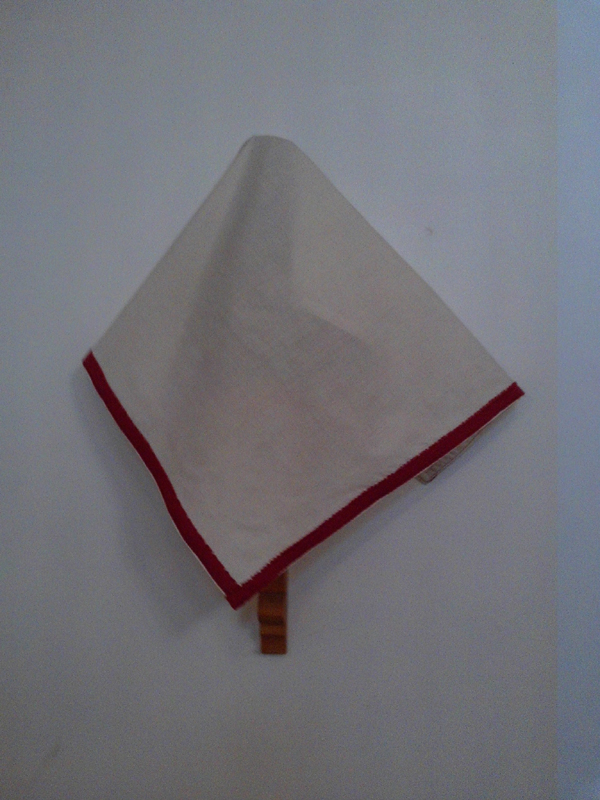
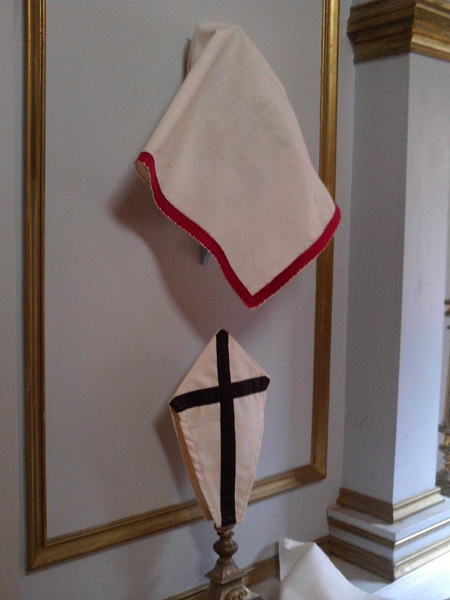
lent-array2015-06This an all the other statues are veiled. With a square cloth, one corner is passed behind the statue’s back and no pinning is needed. The veils all come off beautifully and easily on Holy Saturday.

lent-array2015-07

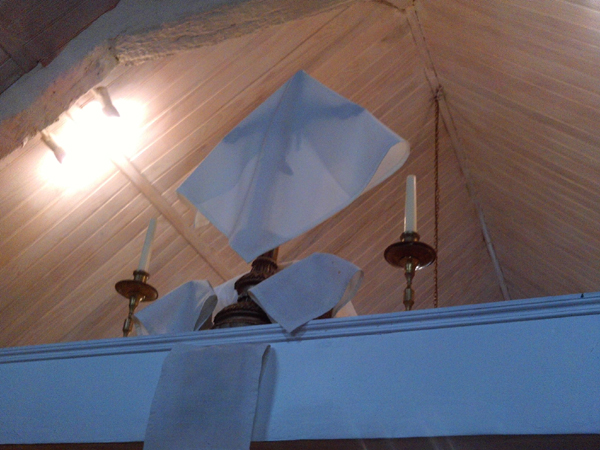
I then climbed up a stepladder to veil the Rood and the little statues of Our Lady of Westminster and St Edward, King and Confessor. Whilst I was up there, I took a photo of the altar from above. The hanging pyx is clearly seen.

lent-array2015-08Here is the rood screen with the veils.

lent-array2015-09The altar of Our Lady of Walsingham, with the statue and altar cross veiled.

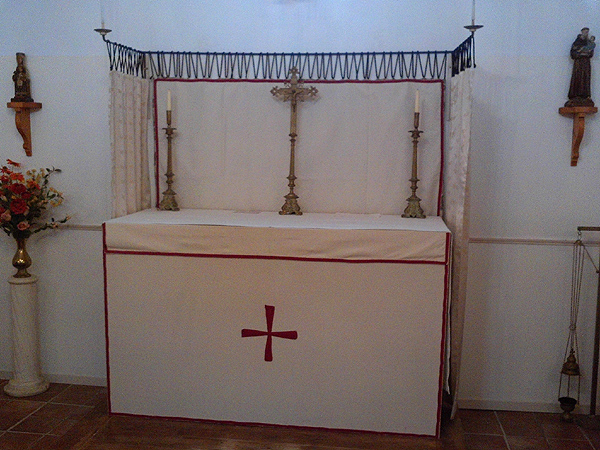
lent-array2015-10High altar in complete Lenten Array

Posted in Uncategorized | Tagged , | 2 Comments

Help! I’m in the quicksand!

It must be the most horrible death imaginable! You’re walking on the quicksands around the Mont Saint Michel in France and other estuaries in the world – and your leg disappears into the ooze. As you try to pull it out, the other leg goes under, and then you begin to sink… You might be lucky and get rescued. Again, you might have been foolish enough to go out alone. That is for the various situations in nature that present a danger for the unwary.

Is there a way to trudge out of the mire? The latest article on that blog presents something of a quandary. Don’t let the atheists get hold of it! For my part, I have agonised for long enough, and did myself a lot of good by getting rid of the infallibilist underpinning that creates the dilemma between Tradition and Papal authority. Read the article for yourselves. What about the conclusion to be drawn?

The article does attempt a suggestion of a couple of solutions. The first is to create a community, but the problem is that many have tried and failed. Firstly, you’re dealing with human beings who might have different ideas and priorities, and secondly you do need a raison d’être other than simply the liturgy. No one has ever founded a “Sarum” community. A rite fits into the life of a parish, a chaplaincy or some kind of monastery (through monasteries had their own liturgical traditions). The second idea is to become Orthodox. For the question of whether a soul might ever find peace in Orthodoxy, I recommend spending a good while studying the comments, discussions and exchanges on the Orthodox Blow-Out Department.

I have read many articles about the Western Orthodox experiment in the USA, but I have no personal experience of it. Some believe in it and others have been as disillusioned with it as with Roman Catholicism. Some of the worst trolls I have dealt with recently on matters of politics have been or are converts to Orthodoxy. I don’t find that exactly encouraging. There is no significant movement to Orthodoxy outside the USA, certainly not in France or England.

I see things differently, an alternative to dismissing Christianity en bloc. There seem to be two other alternatives. One would consist of accepting the modernising movement to “sentimental” Christianity, which might prove to be a useful “moral police” department of the State in countries like the USA. Such “protestant” and non-sacramental Christianity would be split according to criteria of moral ethics. Some people see the point in it. Why not?

The other alternative is the monastic-inspired view of Christianity and tiny communities drawn together by friendship and a desire to continue the old liturgical tradition and a higher view of Christianity. The danger is what some mistakenly call “gnosticism” (because historical Gnosticism was something else) or the “remnant true church” ideology. It is also possible to assemble a small community that remains motivated by Christian love and openness of heart. I am very lucky to have found this desirable spirit in my diocese of the Anglican Catholic Church.

We in our little Churches have responsibility for what we are trying to preserve and keep alive. It is particularly important to ensure the quality of bishops and priests in terms of their serious preparation, their sense of reality and devotion to their liturgical ministry. Continuing Anglicanism has had many difficulties with unsuitable men in the Episcopate and other causes of instability, and has been understood as meaning the continuation of different strands of churchmanship within Anglicanism from strict Calvinism to an imitation of post-Tridentine Roman Catholicism. There is not the unanimity for which some would have hoped. The best some of us can hope for is a certain breadth of tolerance for the old English pre-Reformation Sarum liturgy – celebrated as authentically as possible according to the extant documents of the early sixteenth century. We are more likely to find it in Continuing Anglicanism that anywhere else, short of setting up our own “Old Catholic” church, most of which are abject failures.

One thing that has besmirched the image of the small Church is the phenomenon of the episcopi vagantes or bishops at large. It is incredibly difficult to pursue a high ideal whilst being under flak from jealous mainstream and establishment church authorities. The weaknesses of the bishop or priest in question are exploited to the full as history has seen with the examples of Arnold Harris Mathew and René Vilatte among other less-known men who were ordained by the Dutch Old Catholics or various oriental churches. When dishonesty and impure motives get mixed into the salad, that is generally the undoing.

There aren’t many options. One can of course resort to nihilism or a person’s idea that he is the only true Christian left in the world! Go too far down, this road, and something has gone very wrong. We are brought to consider how square pegs can be driven into round holes. Are we so far from original Christianity that what we see as Christianity today is something else? Has the Christianity of Jesus been smothered? If so, by what? Politics or influences from philosophies and other religions outside Jewish monotheism? You can’t restore what has been lost and we can’t relate to what passes for “modern Christianity”.

What do we do? We can’t control other people or force them. I believe that our job is to work on ourselves and discover the inner self. At the same time, we need to discern what Christianity really means, whether it has become so distorted that it needs to be discarded or whether there is some survival of the Mystery or Sacrament of Christ that made Christianity valid for two thousand years. We are called to prayer and Christian discipline, but also to study.

We approach Ash Wednesday and Lent. Perhaps it is not so much about giving something up but taking something up: Bible reading, the Divine Office if we have been getting a bit negligent, and certainly some good heavyweight theology. Perhaps we might get somewhere…

Posted in Uncategorized | Tagged , , , | 6 Comments

Patricius on Trolls

This began as a comment to Patricius’ recent posting on Trolls… When I attempted to post it, I found that the site limited the number of characters allowed. It is understandable, so rather than edit the comment to fit the limits, I decided to put it on my own blog and adapt it in a few details. Patricius asks his readers whether we think he is a troll. I would say right away that he is not – from the evidence of his transparency and honesty of identity.

In my experience, trolling is something that comes and goes. It has its emotional impact no matter how used to it we think we are. I had been free from it for quite a while, and then one struck a few days ago. The pattern is fairly constant. A troll is one who tries to drag a conversation to a very low level, pretending to “out” someone’s purportedly secret sins, usually of a sexual nature. There is nothing positive in troll messages. Trying to discuss with a troll is something like trying to negotiate with evil spirits. They will turn everything you say against you. Most often, you can’t even communicate with them, because the e-mail address they give isn’t a valid one and they use sophisticated means to give a false IP address. Their hatred is one-way and the only defence we have is to delete their messages before they get anywhere near our blogs. As always, don’t feed the trolls.

Trolling is a major problem on the internet. It is found in blogs, but also on Facebook, Twitter and anything that allows readers’ comments. Some trolls are so vicious that they cause a person to commit suicide. It is heartening to know that some such trolls have been arrested and sent to prison. There is a vast difference between trolling and flaming or even reasonable debate of a non-obsessive nature. I frequently allow comments of people who think I am wrong about something. I respect their freedom of speech. Flamers are often obsessive people with their pet single-issues. The real characteristic of the troll, on the other hand is anonymity and evil expression.

Trolls tend to have personality issues like psychopathy and sadism. What they do on the internet is no different from the antics of the school-yard bully, the rapist who stalks women in the street and people who are really sick and horrible. In short, the “virtual Ted Bundy”… Don’t feed the trolls is a bit of advice that is useful for those who find it difficult and spiritually / emotionally draining to deal with this kind of pure evil. I have recently been attacked because I chimed in on the Charlie Hebdo issue and opposed the “hyper-masculine” agenda of some conservative folk who would like to challenge atomic bombs and heavy artillery with pistols and blunderbusses! We need to stop being naive, get street wise and see that there are some very odd people out there.

Unless you are a real computer expert, which I am not, trolls are impossible to identify. They use false handles and give false e-mail addresses. My blog is configured to maintain new e-mail addresses on moderated status unless I approve them. It keeps my blog clean. There is a way to route communications through false front IP addresses. My recent pet troll used an IP address based in the Netherlands which is notorious for being used by trolls. The person in question certainly does not live in that country but probably in England or the USA. Google can get quite a lot of information, but there are limits you can break only when you are skilled in hacking and other illegal activities and low-down skulduggery.

It sometimes happens that a former friend becomes a troll. The e-mail is invalid and the IP address indicates a place you know to be elsewhere from the place he lives. The referrers make the identification easy. I knew one such former friend almost twenty years ago in England. He had had a hard life, a failed marriage and an attempt to live a religious life. We spent good and amusing times together. He was a gifted cartoonist and caricaturist, and will probably read this posting. He got involved in sedevacantism, as I did to an extent at the time. The difference is that my critical thinking evolved and I found it to be an untenable position intellectually, and he became very aggressive with it in the same way as people with political ideologies or who become fanatics. Going by recent conversations with people who know or who have known this person, there is no evolution of thought or personality. He is caught is some kind of vicious circle or prison. We find bitterness and jealousy as motivations of a distorted personality. I think anyone can fall into this predatory way of life, and especially if one has predispositions to narcissism or psychopathy.

A troll will often try the destabilising tactic of claiming freedom of speech, freedom to criticise. If I refuse the criticism and take the troll’s words at face value, I lower myself to the same level of ideology and obscurantism. One thing I learned from the Charlie Hebdo episode, apart from empathy for the families of those who were so cruelly murdered, was that freedom of speech has its limits. I don’t mind people criticising my views, joking about me or even being ironic, but there are limits like expressions of pure negativity and evil. That is the difference between a critic and a troll, as in the mainstream world when considering racial hatred, defence of atrocities and other such deviations.

Returning to Patricius, I have sometimes vowed never again to comment on his site on reading certain articles which I found hateful or at least exaggerated. On the other hand, I find him asking questions about himself and trying to understand his own failings in life. I have a lot of sympathy for Patricius, as we share a common friend in London.

We live in a pitiless world, but one that has always been that way. A certain amount of prudence is called for in deciding what we write. We might be horrified about the dominant alpha males of our own time, but there have always been such men who owned the world throughout history. God alone knows how they fare beyond the death that awaits us all. I take pride in being a man of softness, gentleness and aspiration to be kind and loving in the place of hatred and violence. Jung taught that we are all biological males or females (with some biological exceptions because of genetic errors, etc.) but with male and female sides of our souls and personalities. We all need to work on this in our lives to emerge as integrated and free persons.

I am not threatened by trolls, because I don’t allow them on my blog. They have no freedom of speech because their purpose is manifestly evil and negative. They have their work to do on themselves as we all have. Long consideration of evil personalities has led me to go though many years of self-questioning, questioning of my Christian commitment and vocation in a way that is very different from classical spiritual discernment. Jung has his limits, but he established a very sound psychoanalytical method by which we could each find our own personalities and souls, all the things that “float our boats”. We all have our archetypes and inspirations from our childhood. Individuation is what enables us to free ourselves from the snares laid by evil spirits and the prison of our own making. This is perhaps the most meaningful understanding of evil: it brings us to seek good by the high road and doing positive and beautiful things.

We have to lift ourselves out of the mire to soar and do what we are good at doing, what gives us a sense of vocation and purpose. We all have to run the gauntlet of those miserable characters at their keyboards. It is worse when they can do greater spiritual harm or even physical injury. It is better for us not to know them, but rather to pray for them that God may bring them light and deliverance. That now seems to be a part of my ministry in spite of my weakness and sensitivity.

Pray for me as we prepare to enter Lent and the arid desert.

Posted in Uncategorized | Tagged , | 9 Comments

Church and Culture

I would like to draw your attention to an article from a blog for which I have a lot of esteem – Sitz im leben.

It is good to see this blog come out of a long bout of writer’s block. As I read this article with greater attention, I don’t doubt I’ll have something to write.

I so hate February and the seemingly unending winter. One very good blog I have recently discovered does one post a week, but one that is very well thought out and written. I am thinking about moving towards such a routine myself.

That’s all for now…

* * *

A few hours later…

I have been giving some thought to this article (mentioned above) and also to the state of Catholicism in Belgium. Some would whittle the whole thing down to sexual morals and the euthanasia issue. Others blame Muslim immigration. Exceptional situations become blown out of all proportion, admitting only all-or-nothing answers, so I will not go into these issues.

Naturally, I am interested in the liturgy and more from a theological and historical point of view, and less about the fine points of rubrics. The real issue is the reality of a sacramental Church – less the institution and the enforcers of canon law, but more the aspect of the Church continuing the Incarnation of Christ through the Mass and the Sacraments. Liturgy can no more be separated from the Church than particular issues of morals and social teaching. We too easily lose sight of the whole.

Now, the question is that of knowing what is left of the Church. I don’t see much of it where I live. It is only visible in churches on Sunday mornings – and nowhere else in life. We keep getting reminded that this is a secular country. Churches have to consider problems of cultural relevance. When they do, they melt into the secular landscape of political correctness. There is another and higher dimension, but which is generally not found in parishes.

The Church originally evangelised through the ambient culture, the most challenging examples being ancient Greece, China and Japan. Those who went to those countries had to be selective in their approach, so that the Christian message should not simply become dissolved in the culture in question. Many stories of evangelisation and early Christianity are doubtlessly myths, and Christianity only had success with large numbers of people through political means and constraint. I have been under illusions as to the idea of Christendom or a Christian society. Western civilisation is partially influenced by Constantinian Christianity, but mostly by combinations of political circumstances and the old paganism.

How do we compare the French Church under Louis XV and the Church in a world owned by billionaires and vast business corporations? Surely, the feudalism is the same or at least has many points of comparison. In our own day, the Church in Europe has evaporated, and it is going the same way in the USA. It might be prospering in Africa or China, but that is no concern to us unless we go and live in Africa or China.

One thing the blog article has noticed is that modern society, apart from those who are convinced atheists, are open to belief in God and some form of spirituality. The stumbling stone is an organised hierarchical Church, liturgy and institutionalism. On the other hand, plenty of people still attend disciplined and organised churches with both traditional and modern styles of liturgy. The loser here is the liturgy, at least the liturgy for its own sake outside contemplative monasteries.

Our friend targets post-modernism, a very nebulous expression and one that is difficult to prove empirically. I have often used the term without being able to give it a clear meaning. Like existentialist philosophy, it does not lend itself to the use of reason and logic. In my own experience of life as a late Boomer, I see it as a reaction from the hyper-rational industrial age called modernity, something going back essentially to the era of the dark satanic mills of the eighteenth century. By way of analogy, some people nowadays react like the Romantics did from about 1790 until 1830. But, this phenomenon is far from being general as in the earlier period in the wake of the French Revolution.

I don’t know how many people are interested in esoteric sects. I have not heard of the Rosicrucians or the Martinists attaining any significant growth in recent years. They became very popular in the early twentieth century, when many people were lapping up crank philosophies. New Age is hardly ever talked about these days. On the other hand, quite a few spiritually-minded folk like to read books and work on their inner life in some kind of psychoanalytic approach. I see nothing wrong with that, and that has been my own approach to a great extent. That might be called narcissism or navel-gazing by some, but we can only love other people when we love ourselves.

It is interesting to note the growth of non-liturgical churches of Protestant inspiration, even in countries like Papa Bergoglio’s Argentina and Brazil. They are often aligned with authoritarian and conservative political tendencies and provide a moral and spiritual framework to the conservative vision – whatever that means. Those communities can be every bit as authoritarian as Rome. I don’t think people have a problem with something bordering on totalitarianism. To the contrary, like the German people in the 1930’s, they lap it up. I don’t see a preference for individuation, at least at the level of society in general.

Our friend has a highly germane point: The substance of the monastic teaching was never diffused into normal Christian life. Liturgy only has meaning in a context of complete commitment to Christian living through asceticism and contemplation. Many efforts were expended in the nineteenth century to bring monastic influence into mainstream church life, the prime example being Dom Prosper Guéranger, founder of Solesmes and a product of Romanticism like his friends in the Liberal circle of La Chesnay. Most of us are not called to that degree of asceticism and are much more Epicurean and pleasure-loving. We run the danger of an overly erotic attachment to God and beautiful things! On the other hand, a Stoical equal and opposite reaction is fruitless – is Christianity is merely about foregoing pleasures that are not necessarily sinful, or even about obeying authority and foregoing “private judgement”?

Our world is in a dangerous polarising movement, seemingly unable to learn from history. Christians blame “private judgement”, individualism or claiming one’s own personality and consumerism when we all live in the same society and are forced to buy our food in the same supermarket. It took me a long time to emerge from my denial of the fact that conservative Catholicism and Protestantism share the same indifference to the liturgy. Another valuable point:

This fact, that Christianity should actually have to answer for something, that it should be able to justify its adoption, shakes traditional churches to their core. Whereas many branches of Orthodoxy had to justify their existence under centuries of Muslim rule, Western Christianity, until recent times, had unparalleled success. It is now in a position of having to justify itself. This is a role that the Western Church has long since forgotten how to play.

What better justification for Christianity than the liturgy as a vehicle of contemplation and erotic love of God and the world above that of the Creator and all forms of determinism? That is what one would think, but a notion that does not seem to correspond with reality. The western liturgy has been the victim of so many ideologies in both the Roman and Reformed systems. It was no longer a “given” in the Christian community, but something like a French garden or a styled head of hair, controlled and rationalised. I return to my analogy of the “industrial revolution” in the Church together with the philosophy of Kant and Descartes, as dry as the powder they used to put in the wigs!

One problem of Christianity is one of intellectual credibility as science affirms its own autonomy. Where is the west going? It’s a good question, especially in these days of uncertainty and the possibility of war. I fear that if we get a war now, our industrial civilisation would go the way of the Pyramids in Egypt! Or worse…

Christianity cannot relate to modern corporate feudalism or the cultural vacuum that seems to be the lot of most people these days. Can it relate to any kind of culture? Perhaps an answer to that question is that we live according to vastly different cultural references and we are multi-cultural. That is not an euphemism for a society that has assimilated Islam or other foreign cultural references. A certain class of people in this country has the television on for the whole day, even when they are not actually watching it. Many have no books in their houses. My wife and I hardly ever have the television on, and often watch a film on our computers. Our entertainment is classical music and blogs. She plays computers games, and I do not. In this country, we have “culture” departments in our supermarkets. They sell, books, CDs, DVDs, games and “creative arts”. We need to reflect on our culture and what it means, because it is not only our life of leisure outside our duties of working to earn a living and doing jobs around the house. It is our entire way of thinking, reasoning, feeling, imagining and living. I suppose my wife and myself are of a “sub-culture” outside the sterile bounds of modern corporate and compartmentalised life. Where do spirituality, faith and religion fit in? For most of our contemporaries, religion is an optional extra, something nice, but not part of “life”. We return to the monastic theme, a world to which most of us do not belong.

Religion is condemned to be counter-cultural and self-consciously conservative, and this is a self-destructive mechanism. The only way out is not at the level of society or politics, whether authoritarian or liberal, but small groups with something in common binding the members together – choral groups, a bunch of friends going sailing together , artists or anything. Christianity is all about friendship, community, communion and transfiguration in Christ. The modern corporate world has little use for friendship. Little Continuing Anglican Churches work on the same basis as other associations and free groups, except that the thing in common is specifically our Christian commitment and desire to live as a sacramental and Eucharistic community. Friends and disciples – that’s how it all started.

Friendship and humanity are a culture with which the Christian ideal and Sacrament can relate.

* * *

A day later:

I find this haunting passage of Fr Ratzinger from many years ago in The future of the Church. One advantage of being in a small and marginal Church is our almost total lack of bureaucracy or corporate management. I reproduce the quote in its entirety (leaving the American spelling):

“The future of the Church can and will issue from those whose roots are deep and who live from the pure fullness of their faith. It will not issue from those who accommodate themselves merely to the passing moment or from those who merely criticize others and assume that they themselves are infallible measuring rods; nor will it issue from those who take the easier road, who sidestep the passion of faith, declaring false and obsolete, tyrannous and legalistic, all that makes demands upon men, that hurts them and compels them to sacrifice themselves.

To put this more positively: The future of the Church, once again as always, will be reshaped by saints, by men, that is, whose minds probe deeper than the slogans of the day, who see more than others see, because their lives embrace a wider reality. Unselfishness, which makes men free, is attained only through the patience of small daily acts of self-denial. By this daily passion, which alone reveals to a man in how many ways he is enslaved by his own ego, by this daily passion and by it alone, a man’s eyes are slowly opened. He sees only to the extent that he has lived and suffered. If today we are scarcely able any longer to become aware of God, that is because we find it so easy to evade ourselves, to flee from the depths of our being by means of the narcotic of some pleasure or other. Thus our own interior depths remain closed to us. If it is true that a man can see only with his heart, then how blind we are!

How does all this affect the problem we are examining? It means that the big talk of those who prophesy a Church without God and without faith is all empty chatter. We have no need of a Church that celebrates the cult of action in political prayers. It is utterly superfluous. Therefore, it will destroy itself. What will remain is the Church of Jesus Christ, the Church that believes in the God who has become man and promises us life beyond death. The kind of priest who is no more than a social worker can be replaced by the psychotherapist and other specialists; but but the priest who is no specialist; who does not stand on the sidelines, watching the game, giving official advice, but in the name of God places himself at the disposal of men, who is beside them in their sorrows, in their joys, in their hope and in their fear, such a priest will certainly be needed in the future.

Let us go a step farther. From the crisis of today the Church of tomorrow will emerge a Church that has lost much She will become small and will have to start afresh more or less from the beginning. She will no longer be able to inhabit many of the edifices she built in prosperity. As the number of her adherents diminishes, so will she loose many of her social privileges. In contrast to an earlier age, she will be seen much more as a voluntary society, entered only by free decision . As a small society, she will make much bigger demands on the initiative of her individual members. Undoubtedly she will discover new forms of ministry and will ordain to the priesthood approved Christians who pursue some profession. In many smaller congregations or in self-contained social groups, pastoral care will normally be provided in this fashion. Along-side this, the full-time ministry of the priesthood will be indispensable as formerly. But in all of the changes at which one might guess, the Church will find her essence afresh and with full conviction in that which was always at her center: faith in the triune God, in Jesus Christ, the Son of God made man, in the presence of the Spirit until the end of the world. In faith and prayer she will again recognize the sacraments as the worship of God and not as a subject for liturgical scholarship.

The Church will be a more spiritual Church, not presuming upon a political mandate, flirting as little with the Left as with the Right. It will be hard-going for the Church, for the process of crystallization and clarification will cost her much valuable energy. It will make her poor and cause her to become the Church of the meek. The process will be all the more arduous, for sectarian narrow-mindedness as well as pompous self-will will have to be shed. One may predict that all of this will take time. The process will be long and wearisome as was the road from the false progressivism on the eve of the French Revolution — when a bishop might be thought smart if he made fun of dogmas and even insinuated that the existence of God was by no means certain — to the renewal of the nineteenth century. But when the trial of this sifting is past, a great power will flow from a more spiritualized and simplified Church. Men in a totally planned world will find themselves unspeakably lonely. If they have completely lost sight of God, they will feel the whole horror of their poverty. Then they will discover the little flock of believers as something wholly new. They will discover it as a hope that is meant for them, an answer for which they have always been searching in secret.

And so it seems certain to me that the Church is facing very hard times. The real crisis has scarcely begun. We will have to count on terrific upheavals. But I am equally certain about what will remain at the end: not the Church of the political cult, which is dead already, but the Church of faith. She may well no longer be the dominant social power to the extent that she was until recently; but she will enjoy a fresh blossoming and be seen as man’s home, where he will find life and hope beyond death.”

Posted in Uncategorized | Tagged , , , , | 10 Comments

Haircuts as Punishment

Someone truly understands the historical and psychological symbolism of long hair and cutting or shaving it to degrade victims! The French did this to women who had been involved with German soldiers or officers in 1944. Throughout the ages, prisoners and slaves had their heads cropped, and the tonsure is a part of monastic asceticism.

Georgia barber offers free ‘old man’ haircut as punishment for misbehaving kids

I suppose this is another bright idea from the Christian right, from the kind of red-necks I had to deal with not so long ago when discussing the Islam question.

I came from a country when the punishment in vogue in schools at the time of my childhood was the old-fashioned six of the best with a cane or slipper, or at home, a couple of smacks by my father’s hand. Corporal punishment has rightly been frowned upon – now illegal in many places – due to the many abuses that happened, not excluding the possibility of adult perversion in some cases. Parenting is not one of my skills, but I believe that better results can be usually obtained via positive character building and instilling a sense of care for other people.

This barber proposes a service that involves making a child look like a bald man! What is the child in question to think of bald men? Do men become bald because they did something wrong in life? Is their baldness shameful? Of course the barber squirms out of scrutiny by saying that it was to be a very extreme punishment, but less so than spanking or whacking. Shaming a child has been standard practice in schools, such as having the child stand in the corner. Shaving the head leaves the child punished for at least two months, the time it takes for one inch of the hair to grow back.

The more I hear about things like this, the more I encourage men to grow their hair long if they feel it to be a part of their identity and way of life. Mine is coming on just fine, thank you…

Posted in Uncategorized | Tagged , | 5 Comments

Mirror Mods 3

Mirror Mods 3 by courtesy of David Sumner is now up and running.

It shows the standard Mirror dinghy with a true gaff rig (as opposed to the original gunter rig). The mainsail is more easily reefed for strong wind sailing and is increased for light wind conditions with a topsail not requiring its own halyard. It is clipped in two places to the top of the gaff, and is raised with the mainsail. It would be interesting to see this done at sea. As it is a device for light conditions, I see no essential problem. It’s a rather interesting setup. He had a mainsail specially made to replace the original cut-down Mirror mainsail.

My immediate concern about this gaff rig is its complexity, more things to go wrong or get damaged or tangled in rough conditions. I’ll need to see this video a few more times and find out more about how well David’s boat does in time.

It is very interesting to know that what I call the “chicken gybe” is actually called “wearing ship”. In strong wind conditions, gybing can expose the sailor and the boat to a broach and a capsize. Instead of gybing, the boat is eased up to the wind, tacked and then reaches or runs on the other tack. I have found the term “chicken gybe” from the idea of using an easier or safer manoeuvre because a gybe would be risky.

Here are some examples of gybe-broach-capsizes in racing dinghies in a 25-knot wind. Cruising does not involve this kind of “thrills and spills”, because this is where reefing the sails comes in. With the equipment we carry on-board, we avoid capsizing at all costs (speed for example).

Posted in Uncategorized | Tagged , | 4 Comments