The Liturgical Organist

The craft of the church organist is an old one. I first accompanied a hymn in my school chapel in 1973 – and made a mess of it. I was totally nerve-racked and little less than racked by my housemaster and fellow pupils of the Junior Common Room.

I have known many organists in my time, from Dr Francis Jackson at York Minster to my own teachers at school and many musicians of prestigious churches. A youth can have the impression that being the titular organist of a church confers status and stature. This is above all true when there is a fine and large instrument. I have been lucky in my time, and have played many cathedral and parish church organs in England, and a few here in France. The rest depends on our musical training.

Myself, I started piano lessons when I was eight in something like 1967 after having heard the mighty Wilkinson organ in our parish church in Kendal (St George’s). The most impressive was hearing this instrument accompany the hymns. I started the organ in 1972 on going to St Peter’s School in York and joined the choir at the same time. I still had a year left of my unbroken boy’s treble voice. That was the beginning of my initiation into English church music. We also had lessons in musical theory including harmony, counterpoint and musical analysis. I became a good sight reader, which means that, within the limitations of my keyboard technique, I can play pieces without having to practice them. Obviously, a piece needs to be refined in terms of flawless playing, phrasing and registration.

I reached my limit and was brought to understand that I was not going to be a professional musician or attain the exalted world of cathedral organ lofts. In England, you have to be really good to get through the ARCO and FRCO, a university course up to the B.Mus or M.Mus, a polishing-up course at the Royal College of Music with the best teachers in the country. One must be humble and be grateful for the level we have attained. One can be a good parish organist without being the best, but there are conditions.

The most important is to have a passion and a feeling for music, not only church music but a wide range of the “classical” repertoire. There is a difference between an organist and a musician who plays the organ. The latter often sings and works with choirs, and sometimes plays another instrument, not necessarily keyboard. There is also a quality called musicianship – not just playing pieces either learned and polished or sight-read, but also open score reading, transposition and accompaniment. There is a difference between following the choir and its conductor – or leading congregational hymns, using the organ to set the rhythm and to lead. All this takes a lot of feeling and empathy for the clergy, choir and congregation.

The next thing is to be aware of one’s place. The organist serves the liturgy, so has to understand what it is about. When I was a young church organist, I understood little about the liturgy, and had to follow it in a book. It helped when the Rector would announce the hymns for the benefit of the congregation. Surely, it isn’t difficult for an organist to read Proctor & Frere’s history of the Prayer Book and learn a thing or two about the structure of the western Mass and the Office.

It then helps to be a believing Christian, and not just to be there to have the use of a large church organ free of charge! The purpose of liturgical music is to be a part of the liturgy. We are not there to entertain the faithful or show off our skill. The Christian organist is modest and keeps as much as possible in the background. Many organ consoles are hidden behind curtains or are even inside the organ case like at Ripon in Yorkshire. To direct the choir, we put on a cassock and surplice and stand to one side of the stalls, conducting with subtle hand movements, just enough to keep the singers together. There is no applause, and the choirmaster leaves the scene when his job is done, silently and modestly. Non nobis Domine, sed nomini tuo da gloriam!

One cross the organist has to bear is the unsympathetic clergyman, one who does not appreciate music or even beauty in the liturgy. I would like in this article to encourage a truce between the vicar and the organist. It is a difficult compromise, but the organist has to show modesty and humility as a servant of the liturgy, and so must the priest! Eastward celebration is a great help, as is saying the black and doing the red. An organist is generally happy with a priest who does his job properly and without imposing his extroverted personality. This is the feeling I had last Sunday as I accompanied my Bishop’s liturgy in Canterbury. They have a rather tired electronic instrument (a good clean of the contacts with a special spray would do wonders), and some rather out-of-tune voices, yet I managed to do something. After Mass, I heard of other organists having to practice hymns, getting them wrong, using too much organ. Honestly, for a handful of faithful, I just use a few 8 foot and 4 foot stops, occasionally a 2ft for a final verse.

I also have the benefit of the Roman Catholic tradition of choral music and plainsong. I was responsible for the music at the seminary of Gricigliano for more than two years, and taught myself to accompany Gregorian chant using extremely soft registration and simple harmony. I was writing a while ago about Perosi and the Cecilian Movement which advocated the restoration of Gregorian chant and Renaissance polyphony together with contemporary music written in traditional tonal harmony and inspired by the old music. It discouraged the excessive use of the “operatic style”. I would not be so absolute, as I have accompanied little Mozart masses at St Alban’s, Holborn, and I find them no less suitable for the liturgy than Palestrina or Byrd. Nevertheless, the Cecilian Movement advocated the subordination of music to the spirit of the liturgy. Many organists would do well to drink from this fountain.

I don’t think I need to make any apologia for the organ in church. It sustains singing and is a beautiful complement to choral music, depending on the setting in question. At the same time, we need to appreciate unaccompanied polyphonic music and the sensitivity of composers of such music. This is my own speciality, though I will doubtless write music with accompaniments by the organ and other instruments. The organ has a long history from the Roman circus to the mighty symphonic organ to the current revival of baroque instruments. I have myself worked in organ building and am familiar with their mechanisms and the practical aspects of maintaining them. The organ can accompany as it can lead congregational singing.

There is no reason to insist that the congregation should sing everything, otherwise such would reduce the repertoire to what is known by heart and what can be sung by the musically untrained without any rehearsal. The choir has its legitimate place, as has the congregation and its old favourites.

I am now out of date with what they do at the Royal School of Church Music or the Istituto della Musica Sacra. I was never very impressed with the “brand” of a parish choir as RSCM affiliated. Choir work is demanding and it is difficult to find good singers unless you pay them, and even then they are often out of sympathy with church services and religion.

One solution for small churches is the quartet, requiring only four persons, including the organist. I work with a quartet here in France, but which is not a church ensemble. We mostly sing secular music, but also some pieces of sacred polyphony. We need to be confident singers with training in music and singing in particular. It takes good vocal technique and an ear for all the other singers. In our rehearsals, we often change the order in which we stand, and not always SATB in a row: tenor with soprano and bass with alto. Intonation and good tuning is vital, as are good breathing and support of the diaphragm and lungs. It helps to work with a good teacher, as we do. It is another experience of vocal music. If we accompany a quartet on the organ, the registration needs to be moderate to avoid drowning the voices.

We need to work to restore a musical tradition in the ACC and other churches. For next year’s Synod in Bolton, we already have plans of a quartet, just so long as we can get a bass. Electronic organs can be hired, and we’ll do something really good. It all needs planning and for each of us to make sure we know our voice and part. I would very much like to be of help to whoever takes over the organ at our church in Canterbury. If he or she has a good musical basis, there are certain things for being a good church musician.

I finish this article with the work of one of the greatest English church musicians of the twentieth century, Dr Boris Ord of King’s College in Cambridge. Here is the Carol Service of 1954. Sorry, the recording isn’t brilliant.

Posted in Uncategorized | Tagged , , | Leave a comment

Numbers

I can just about handle my finances, calculate dimensions and angles, anything with a practical application. My confrère Fr Jonathan Munn is a true mathematician, but even for him, numbers aren’t everything.

He has just written Synod 2014: Crunching the Numbers. I myself heard our Bishop relate the story of the Establishment clergywoman dismissing our little Church as “pathetic”. I have often been asked why I don’t minister “where the people are” or at least to relinquish the priesthood and worship in live churches where there are people. Want to be cured of that way of thinking? Just come over to my village and attend the once-monthly Mass in the parish church with some eight to twelve elderly folk who all know each other and keep together and the retired priest who helps out in the pastoral sector. I once tried it with my wife, and went in civil dress to avoid attracting attention. I don’t know what would have been worse than that experience – going to the dentist, the barber or the guillotine!

Perhaps, if numbers are truth, then the most attended churches are the mega-churches in America and the charismatic parishes in the big cities. As I said the other day, there is a contrast between aristocratic and democratic. Religion involving large numbers appeals to a certain type of soul, often closer to God than those complex people who think too much. That being said, the genie cannot be put back into the bottle, like a priest cannot become an innocent and naïve layman.

In the Anglican tradition, there was always a difference between the worship of the cathedral and the parish church, and the Romantic movement brought cathedral worship in a reduced and simplified form to parish churches. Before the early nineteenth century, parish churches were little more than preaching barns. In the Roman Catholic Church in Europe, cathedral worship is reduced to the level of the average parish novus ordo – and the higher worship is found in distant abbeys. English cathedrals and French abbeys have one thing in common: they attract but few churchgoers. We can only conclude that the sacramental Church is not the way of Christ and the Gospel, or that there are two levels of Christianity, one that is little more than a moral code and rule of life for an essentially materialist mind, and the other at a contemplative and mystical level.

In the recent controversy in a long succession of e-mails surrounding Cardinal Kasper and the question of admitting divorced and remarried Catholics to the Sacraments, I found this poignant notion:

For the Catholic tradition, however, growth in grace and righteousness is expected of every Christian. And that probably means what Kasper thinks is impossible for the “average Christian”: heroism, which for those civilly divorced and remarried means living like brother and sister. Like Mary and Joseph. It’s somewhat ironic, I think, that Kasper here isn’t being so much modern as he is medieval, for he’s essentially suggesting we return to a two-tiered system of Christianity in which the highest demands of the gospel (especially as reflected in Jesus’ Sermon on the Mount) are for the elite, while the masses are expected merely to muddle by.

Should those who are not of the elite be sent into the outer darkness because of their lack of heroism or gnosis? Can they be allowed to live in a common way with little expected of them? These are the big questions in contemporary Roman Catholicism, Anglicanism, Lutheranism and most other western Christian communities. The next question is whether the numbers are even there in the “masses” part. Even Evangelical mega-churches where the faithful are expected to have an experience of saving faith and to make a commitment are a form of elite.

This would seem to be another perspective on the question of numbers. Another crisis we experience is how the modern world has even taken humanitarianism out of the hands of Christians – and does things that much better. Most of us have access to medicine with the various social security systems we pay into. The poor, at least in Europe, have the benefit of universal health coverage schemes. Every child goes to school and all classes, at least theoretically, have the same educational opportunities. The dying have hospice care that respects all religious beliefs or other philosophies of life. Christians have only to give money in addition to their taxes and social security contributions to the various charities! Your money will do very nicely, but keep anything else well away! Perfect cynicism (modern meaning of the word)! Churches and Christians are left high and dry in a world that has taken the cultural and humanitarian aspects away from Christianity and left us to survive in a different way. We have to redefine our raison d’être.

There are two ways to face the institutional failure: give up and look for something else, another religion, a political ideology, materialism, etc. – or find another meaning of Christianity. One way is an aristocratic church that doesn’t seek to feed on the masses, but is ready to welcome those who come, or a democratic church that follows the media and the politicians. We are truly at a watershed.

Fr Jonathan’s mention of the Parable of the Sower is poignant. Most of the grain we sow fails to germinate and is wasted. He also comes up with this:

At the level of the individual, as long as faith, hope and love have not been buried but are put to God’s work, growth will happen, both within the individual and flowing from that individual.

Genius resides in individuals, not in group thinking. This is something I have discovered through Romanticism and every work of art in the world. Each was the work of an individual person, not of a committee or a synod or a council. This is something that needs a lot of thought for the Church, since we make most of our decisions as a community. We have meetings, and decisions are proposed, seconded and voted upon.

I am not discouraged by our small numbers, since I am alone in France. Even my own wife is a Christian believer, more or less, but clearly attracted to a “democratic” religion I cannot give her. I suppose I could do Mass facing the people and set up a faith-healing and exorcism mill – but that would attract the “common” people (or would it?). You can’t win. Christianity finds itself so vilified and fed to swine! If we hit the “kill switch”, is there anything we can do to rebuild afterwards?

It is indeed down to us individually. We just have to keep going, because the alternative is spiritual death. There is no alternative to what Christ gave us, so we carry on at all costs. We have to remain open to all, ready to share the secrets of life. We are not Freemasons or an exclusive club, yet we are the aristocracy of the spirit. We have a big responsibility. Celebrating Mass in our Bishop’s church last Sunday was refreshing for me, for the door was open and many people passed by in the street. Some had the curiosity to glance into the church. That alone is a witness to the gift offered to all.

The door is open…

Posted in Uncategorized | Tagged | 2 Comments

Christian Country?

Update: I am grateful to read this article inspired by mine. The article is courteous and shows respectful disagreement with my tendency to reject the Throne and Altar Alliance out of hand. I recommend reading the article, as this will provoke discussion. The end of the article reads “It is time to start again, but why reject the past?” I do not reject the past, but I see the seeds of the present decay and death in what seemed healthy in the past. We should not reject out of hand, but keep a critical attitude.

I understand the temptation to use political power against persecutors. The prime example is Spain during the 1936 Civil War or Mexico at the time of the Cristeros. Christ said at Gethsemane that those who live by the sword will perish by the sword. In a situation like that, the only thing to do is go underground, pray and suffer – or emigrate. It may sound simplistic, but history shows that Christians who defended themselves by violence became oppressors in their turn.

I for one will be sad to see the last churches secularised, demolished or turned over to other religions – but it seems inevitable. A sinking ship can only be left to sink, with all the lovely carved furniture – and the priority is to survive, get back to land and start again (with lessons learned).

* * *

Thank you, Fr Jonathan, for Post-Christian Britain and “Wishy-washy” Christianity. Fr Jonathan was in the Church of England much more recently than I (I left it in 1981 in my misguided Tiber-swim, or the crossing of the part of the Rhône that flows past the seminary of Ecône). I was never very involved in parish life outside choral and organ music. I probably learned more about Anglicanism after getting wet than before.

As I left London last Saturday after having dinner with a couple of friends, I took the Embankment and headed for the City and the East End, finally through the Dockland development and the Rotherhithe Tunnel. I no longer recognised Lewisham as I drove on under the guidance of my GPS set on Canterbury via the M2 and A2. Some of the sights during this short journey filled me with foreboding.

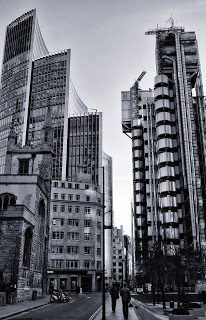
Whatever may be said in praise of modern architecture, the impression on me is one of those dystopian science fiction films. The medieval church and pre-war office block are dwarfed by the new monuments to Mammon and the abolition of humanity.

Here is one of the Gherkin soaring in the distance above buildings next to Liverpool Street Station:

Is this the iconography of a Christian England? In fact, it isn’t even most of England, just the financial and business empire of the City. Where is the Church? It is crushed and dwarfed, buried under the weight of history and a world that has moved on towards something to which many of us would prefer death! The way of Christ is within us. It does not need political power, whether at the beginning of the Church’s history or now.

What does the notion Christian country mean? These are old questions going back to the Peace of Constantine and the establishment of the Church in the Roman Empire. Ever since then, kings, emperors and popes have vied for power and ultimate control over their people. The question of disestablishment goes back to the French Revolution, otherwise known as separation of Church and State. In France, the final act of disestablishment took place in 1905 when the Pius VII / Napoleon Concordat of 1801 was repealed. It was an anti-religious act perpetrated by atheistic socialists like Emile Combes, Jaurès and Ferry. Many Christians and even priests like Lamennais had campaigned for it since the early nineteenth century. How can you tolerate the Church being dominated by atheists and anti-clericals who hate it? The response of Gregory XVI was to keep establishment and work for the restoration of the old régime. Some of the traditionalists still dream of restoring the French kingdom with notions of the social kingship of Christ (a fascist junta would do).

Our English experience of Erastianism is another example of how political power corrupts the ecclesiastical structure from within, abolishes the spirit and just leaves the institution intact. We can all see through it. Whilst we have establishment, it is only natural that the institutional Church should simply obey the hand feeding it and keeping it afloat financially. The alternative is what is happening to the French Church as more dioceses go into serious financial difficulties and find themselves with no priestly vocations.

I am grateful to belong to a small Church that has no more ties to any political authority than the Methodists or the Roman Catholics, or the Unitarians or Plymouth Brethren. Our religion and faith are not built on political authority but on God’s Word and Sacrament. Our churches are our own, built with our own hands and / or money, and are tailored to our tiny numbers. We become again an intimate family of priests and people knowing each other. We cannot impose our ways or morals on others in society. All we can do is set an example and live in the light – so that others may be illuminated by it and come to experience love and beauty, not repression and violence.

For us in the Anglican Catholic Church, as with all “dissenting” and “non-conformist” communities, we can rejoice in our freedom and the common religious freedom that is guaranteed for us by the law by virtue of fundamental human rights. We are free from persecution, and our place is humble. We should see this as an opportunity. No one is going to persecute us for our faith and our religious practices, only for interfering in politics and trying to impose our principles on others. It is time to retreat, take stock and find spiritual strength through spiritual means, and rebuild the Church anew amidst the ruins of the old.

In history, the greatest inspiration has always come from individuals. All art and philosophy are the work of individual persons. The Christian Gospel is no exemption. Genius is the work of the spirit, of persons who soar above Leviathan. I leave it to others to blow up abortion clinics and campaign against homosexual “marriage” laws, and get arrested for it. The world will go its way in history, probably towards some new form of Nazism – and there is nothing we can do about it. We may have to suffer horribly and bear our passion in prayer. We will certainly not see the Promised Land at the end of it all.

Christ’s teaching is simple – one day at a time. Take what comes and remain pure within ourselves, help the sick and needy, the victims of man’s inhumanity to man as much as we can. I can think of no better way to die, in prayer and tending someone in need and giving my own life…

Who needs State Churches? I don’t.

Posted in Uncategorized | Tagged , , | 4 Comments

Papal Absolutism

There is a new article by Fr Hunwicke – The Montini years: a sadly maximalising Papacy. May it rest in peace. He makes a point that Vatican I defined the limits of papal power. The Pope’s office is limited by his office and ministry in the Church. He can’t just do what he wants by “feeling infallible”.

The big test will be seeing whether Paul VI will also be canonised to complete the post-Vatican II cycle.

* * *

Only this morning, someone sent me links to the harrowing situation of the Church’s death in France – La Grande Misère des Diocèses de France and a summary in English – The Terrible Misery of the French Church (and not just that Church). One advantage with the big close-down is that people will be less scrupulous about going to liturgies outside diocesan jurisdiction – when the dioceses get closed down. In the end of the day, the Church isn’t about getting people into the pews to keep paying for the old dinosaur – but the spirit of Christ.

Perhaps the light will return only after a very long dark age. We have to rely on ourselves and God.

Posted in Uncategorized | Tagged | 17 Comments

Aristocracy of the Spirit

The term aristocracy of the spirit may seem pretentious or arrogant, especially if it comes from those who think they are better than others or have a right to flout the laws that bind “lesser” mortals. The notion can lead to the worst spiritual pride imaginable. I have found this term in the various writings of Nicholas Berdyaev and others who were interested in an orthodox Christian form of Gnosticism as expressed in the Alexandrian school. This theme is implicit in the whole Romantic way, whether in the early nineteenth century properly speaking, or at any other time when spiritual humanity reacted from the excesses of reformations, cruelty, rationalism, technology and socialism.

I always like to define words carefully. Aristocracy, in its classical meaning, describes those who are born of noble families close to or even related to the royal family of a country. The word comes from the Greek ἄριστος meaning excellent or best. Aristocracy means rule by a small elite of the best. In ancient Greece, it was thought of a rule by the most meritorious and best-qualified, contrasted to rule by an individual who was born of a royal family. Later, aristocracy was contrasted with democracy. Berdyaev uses these terms by way of an analogy to describe the human spirit and contrast those who live above the common materialistic life of most people.

I had a long conversation with two friends in London a few days ago about the notion that the Church, in particular the Roman Catholic Church was, using computer language, in a state of complete system failure. No amount of work would repair the system other that a complete hard reboot. Roman Catholicism has painted itself into a corner with its notion of Papal infallibility that no amount of apologetics can save it from inevitable decline. Perhaps such a view is exaggerated, because it seems to be finished in most of Europe, but an evangelical and charismatic form seems to be growing in China, Africa and South America. A good thing or a flash in the pan? Who knows, but many of us are not attracted to that kind of “mass” democratic religion any more than popular variety shows on television. Why? Some of us see something different, understand something deeper, yearn for what is not there. I have discussed this to a great extent when writing about Romanticism. Shelley professed to be an atheist, but his poetry reveals a profound spirituality and yearning for the transcendent.

In my examination of Romanticism, I see a massive split between the yearnings and aspiration of the few against the unshriven majority of people in the world and milling in the places of pilgrimage like Rome and Lourdes. Some turned away from Christianity but not for power and money. Nietzsche asked the most agonised questions of Christianity, and many of his reproaches were justified. There was Christ and Christianity – and then there was the pitiful inadequacy of Christians. Does such a notion cast a doubt on the very validity of Christianity? Religious institutions throughout history have chased and stoned prophets, artists and creators.

Those who have become Christians in freedom and through suffering cannot pretend to be the average lukewarm cradle member of their Church. A free soul knows no compulsion or laws, and his faith comes from experience. Christianity becomes spiritual and mystical, escaping all the stereotypes. It is born of spirit, not matter – a perfect expression of gnostic dualism. At the same time, the soaring spirit is bound to its vocation of raising the lower to the higher, sanctifying the soul (anima) and material things which are part of God’s creation.

Berdyaev speaks of three main stages of religious growth: popular and social natural religion, what Jung would call individuation, and finally, the heights of spirituality. It is the first dimension that is undergoing the greatest crisis – the Church, dioceses and parishes. The Church has always had to live with the tension between spiritual aristocracy and looking after the ordinary folk. Different periods of history have varying judgements of aristocracy and socialist movements. The usual presumption is that the small minorities (today the ultra-rich) exploit the majority and should be made to pay for it. Socialism as a political ideology seems to be prevailing, yet the rich still get richer as the political left converges with the holders of ultimate power. Yet I am not talking of politics or money, but another dimension altogether. The world is made for the majority that lives at a democratic level, the average man, the collective, the state, the law and so forth. It is only to be expected. Actually, history works out in favour of the majority, not for the aristocracy.

Those who are of the spirit see through the world in which they live, and their anarchism exists at another level. We can’t do away with the world, law or authority, but we can be above it. We all have to compromise with the world, with society, with the Church and with our own bodies, and these things prevent us from flying off into the worst of spiritual pride and the evil dark side. We develop a love for the world we are called to duc in altum, to lead high and sanctify. We have to have compassion for the poor, the sick and the distressed because we share their mortality. Aristocrats of the spirit are those who suffer the most and can become very unstuck. Only yesterday, I was looking at the failed marriage of Wesley as he was divided between domestic life, a woman with unreasonable expectations and his vocation as a Christian missionary. The aristocrat lives according to values that are of no use to most people, still less understood. He suffers from barbarity, ugliness, banality and many of the things that are just part of the life of “ordinary” people.

This notion was central to the drama of the Gnostics. Many of those people were genuine aristocrats of the spirit, but failed to compromise with the “system” or the popular church. As Berdyaev says, “had the Gnostics won the day, Christianity would never have been victorious. It would have been turned into an aristocratic sect“. On the other hand, the ecclesial reaction was excessive. Must a complex and spiritual type of person be brought down to a level with which he cannot identify? One is brought to think of the parable of the talents or hiding lamps under bushels. St Paul talks of meat and milk. Most Christians need to be fed on milk and pastored like sheep, but this spiritual fare is not enough for the spirituals. Often enough, paradoxically, spirituals have no pretence of greater holiness or virtue, often less than the man who works hard in the ordinary way. Greater responsibilities are met with heavier contradictions. The temptation to spiritual pride is always just round the corner, the reason why the Church condemned the Gnostics.

Salvation is for all and Christ came to transfigure the lower into the higher. A study of Valentinian Gnosticism will reveal a lack of understanding about freedom and the possibility of transfiguration. For some years, I have been quite fascinated with Gnosticism and some of its present-day proponents. Some of them have even tried to build up Gnostic churches and associations, including Freemasonry, Rosicrucianism and Martinism. Perhaps the lay associations are stable and abiding, but I have never seen a stable and sensible gnostic church (there are plenty of “phantom” ones on the internet!). Mainstream Christianity has to navigate a delicate course between the Scylla of spiritual elitism and the Charybdis of materialism and positivism. The Church is in one heck of a mess!

As I discussed with my friends, no one can do anything about the Church. We can join a smaller Church that has everything for the Universal Church to subsist in it. We have to become ourselves and work as individual persons in what we do best. I look at John Wesley, but also at Keats, Shelley, Tolkein and Vaughan Williams where the highest is found, where beauty is an icon of love and truth. We lament when the Church imitates the kind of socialism that seeks to crush the spirit in the name of conformity and political correctness, and to quench every last form of spiritual aristocracy.

Those of us who find ourselves in this aristocracy despite ourselves find life very hard. The reason for this is that we have been in some way let into the secret (no dark covens or funny handshakes. Don’t get me wrong – I belong to no association other than my Church and my sailing club). We still have to work, pay bills and relate to wives and friends. The difference it makes is our whole system of priorities and values. We have no spiritual father to fall back on. We are on our own and have to manage, and shipwreck is only one tiny manoeuvre away, just like beaching my boat at high tide with a strong sea swell! We become that much more aware of our sinfulness. All we can do is to go forward and create in mind of the Parable of the Talents. From he who has received, much will be expected. I fear God’s judgement! At the same time, we have to have complete confidence in Christ’s love and that thing that connects us with the sanctified world – which is the Church. The effort has to be made to connect and relate, so that the lower may be transfigured into the higher.

It is certainly this latter thought that brings meaning to my priestly calling and my daily Mass for the application in time of the eternal Mystery of Christ and the redemption of the poorest and lowest. Nothing is too humble for God’s love.

Posted in Uncategorized | Tagged , , | 2 Comments

Pius V

The Roman rite today celebrates the feast of Pius V, a great favourite of traditionalists. In his honour as Grand Inquisitor before he was elected to the Papacy, I give you the immortal sketch of Monty Python.

Posted in Uncategorized | Tagged , | Leave a comment

John Wesley

Not being a Methodist, I have not taken much notice of that “renegade” Anglican cleric from the eighteenth century. However, being a north countryman, I have had quite a good deal of contact with Methodists. The first thing that struck me is that they were such good and enthusiastic hymn-singers. This comes from their piety, moral integrity and the emphasis they place on the experience of the faith. Their chapels resemble those of most non-conformist denominations in England and the reformed churches on the Continent. The seating arrangements are designed for large numbers of worshippers, including side galleries, and the church is dominated by a pulpit and the organ behind where the choir would sit. In front of the pulpit, you would find the communion table in an area marked off by front and side communion rails with lots of little holes. Those holes are for the little glasses for giving communion under the species of wine (or grape juice in some places) in individual glasses. Methodist worship is close to pre-Oxford Movement Anglicanism, and I have just heard that one Superintendent Minister of Westminster Central Hall celebrated a fairly middle-of-the-road Anglican Eucharist and even wore vestments. In this, Methodism is not foreign from the high-church movement of Lutheranism and even in some local parishes of Swiss Calvinism.

The one thing we have to remember about Wesley is that he remained an Anglican to the end of his life. Even if he forced to conduct most of his ministry of evangelism outside Anglican structures, he never formally broke with the Church of England. I refer you to this article for an introduction to John Wesley.

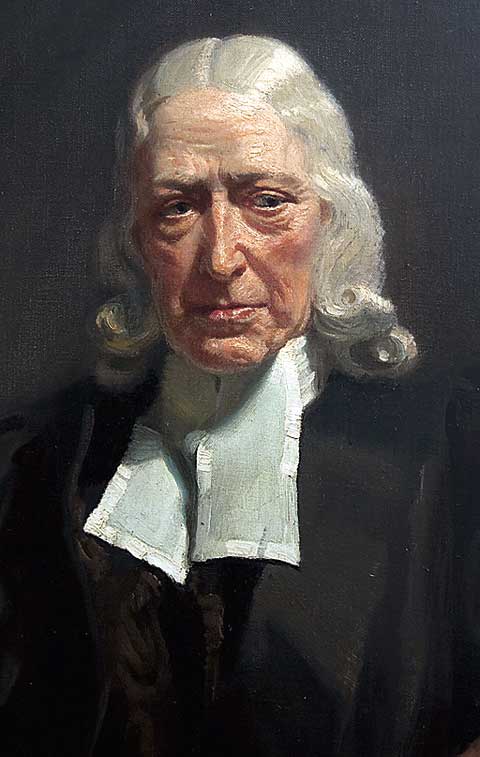
One thing about Wesley that impressed me as I saw the life-sized statue at Westminster Central Hall is his long hair. I have no reason to believe that he ever wore the powdered wig of gentlemen, as was in fashion in those days. His coiffure always seems to have been his natural hair, as in the younger portrait of him from before he went grey.

(c) Epworth Old Rectory; Supplied by The Public Catalogue Foundation

[John Wesley]

The style is quite surprising for a man of strict ascetic life. The rolled curls seem only to be possible by means similar to what women use to achieve the same kind of effect. The third portrait shows curly hair, not unlike my own, and falling more naturally. Certainly, he saw sprucing himself up as important before preaching to a crowd and leading his movement.

Having commented on some aspects of Romanticism, I see much in common between Wesley and someone like William Blake whose life spanned into the early nineteenth century. Blake rose against the Industrial Revolution and the way it treated human beings as expendable commodities. Romanticism was really a reaction against “classical” rationalism and an appeal to the heart and the imagination. These, like in the spirituality of Francis of Assisi and Ignatius of Loyola, would define pietism and the quest for Christian spirituality and the individual person. Wesley’s theology had much more in common with the Lutheran and Moravian traditions than with the Calvinism of the Established Church.

I also admire the way he reached out to Christians of all traditions. His problem with the Church of England was canonical and disciplinary – he disregarded institutions and jurisdictional boundaries. Wesley and the first Methodists  worked among the poor as did the later Oxford Movement Romantics. They were even accused at times of trying to reintroduce Catholicism! The reasons were obvious: institutional inertia, self-interest in the clergy and spiritual apathy, inordinate wealth. One has only to compare Wesley with Francis of Assisi. What good is a Church that doesn’t put God and prayer in first place? We all have lessons to learn about our missionary duty.

What did Wesley say about the relationship between faith and reason? The issue is discussed today in the discipline called fundamental theology. In the history of Christianity, there have often been excesses of rationalism on one hand and fideism on the other. He seems to have taken a moderate position, provided that everything is justifiable by the words of Scripture. Wesley was opposed to the Calvinistic teaching on predestination. Wesley was familiar with the notion of Theosis in Eastern Orthodoxy – salvation being something progressive and beginning in this life.

Another Romantic trait in this man from before the Romantic era was his humanitarianism. Like Wilberforce, Wesley was opposed to slavery and was influential in its abolition. I read in the Wikipedia article:

He is described as below medium height, well proportioned, strong, with a bright eye, a clear complexion, and a saintly, intellectual face. Wesley married very unhappily at the age of 48 to a widow, Mary Vazeille, and had no children. Vazeille left him 15 years later, to which Wesley wryly reported in his journal, “I did not forsake her, I did not dismiss her, I will not recall her.”

Going by the life-sized statue, he was small, hardly coming up to my chin – a bit like me standing next to my Bishop who towers above my head. I read about his wife being an absolutely horrible woman, consumed by jealousy and capable of dragging her husband around by his hair. He was certainly glad to see her go!

What really is of interest is Wesley’s fundamental philosophy other than being a pious Christian. He was a logical thinker and a born leader. He wrote prose and poetry, and of course, his immortal hymns for singing in church. It would be an anachronism to call Wesley a Romantic, but several characteristics show the fundamental tendency in his thinking, his feeling – and the individual personality so beautifully symbolised by his hair.

Wesley needs a lot of study, and we all have many lessons to learn from his example as a witness of Christ’s love.

Posted in Uncategorized | Tagged , , , | 20 Comments

My trip to England

I returned home last night via the ferry from Dover to Calais after five days in England including travelling time. I set off on Tuesday evening in my Renault van full of all sorts of useful things including a camp bed in the back. This would save me hundreds of pounds in hotel accommodation!

My first night was spent in Calais prior to boarding the following morning for my passage to Dover. As usual, the northbound motorways were slow, especially round Birmingham and Manchester. I reached my father’s house in the late afternoon, where I stayed until Friday morning with my father and two sisters.

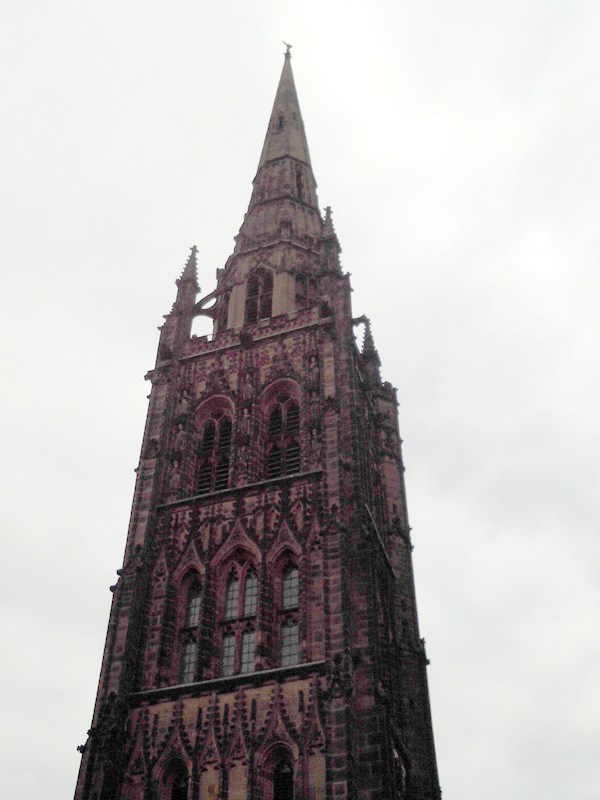
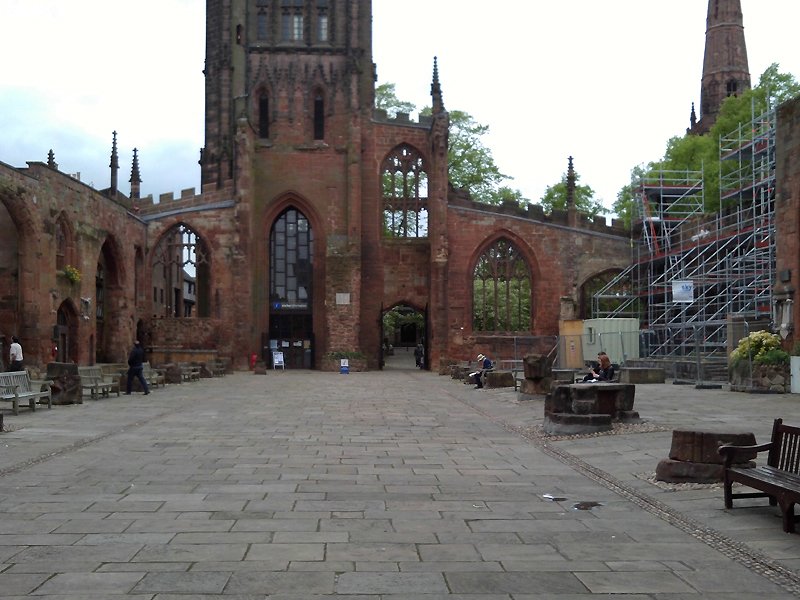
In England, we have an expression – sending someone to Coventry. It means that the person has behaved in such a way as he will be shunned, not talked to or listened to as a kind of social sanction. I was driving in the Midlands, and saw the sign to this city. I had given myself plenty of time in case of road hold-ups. I had never been to Coventry before, but I knew that this city was sacrificed in World War II by confusing the German bomber navigation systems so that they would think they were bombing Birmingham and the vital production of arms to fight the war. The plan worked, but Coventry was flattened, including the fine medieval cathedral. Given what happened, I was amazing to find that many old buildings had survived well enough to be repaired and restored.

Here is the old cathedral from the outside.

coventry01The bell tower is entirely intact.

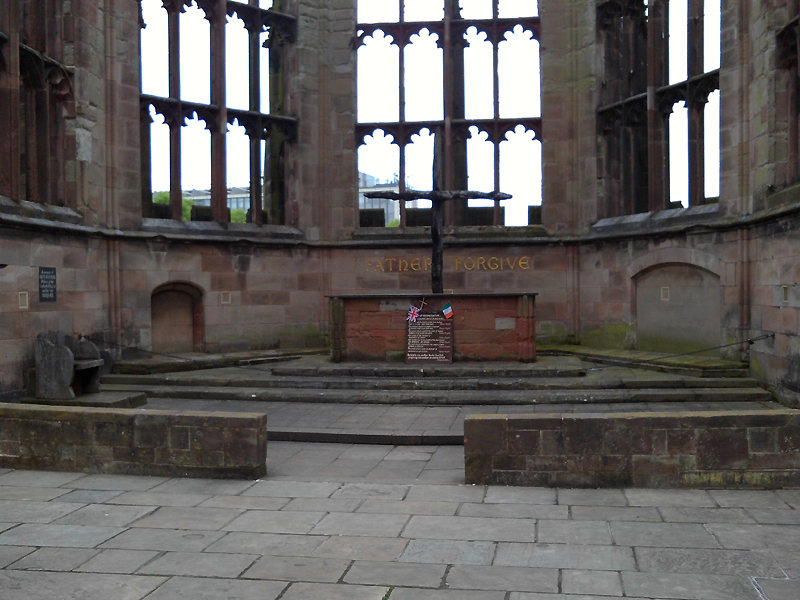
coventry02The scene is familiar to many.

coventry03Father, forgive. Not only the Germans who did the bombing, but the British also who had no alternative but to sacrifice Coventry. Wars are insane and the hardest decisions have to be made. Who would take their place!

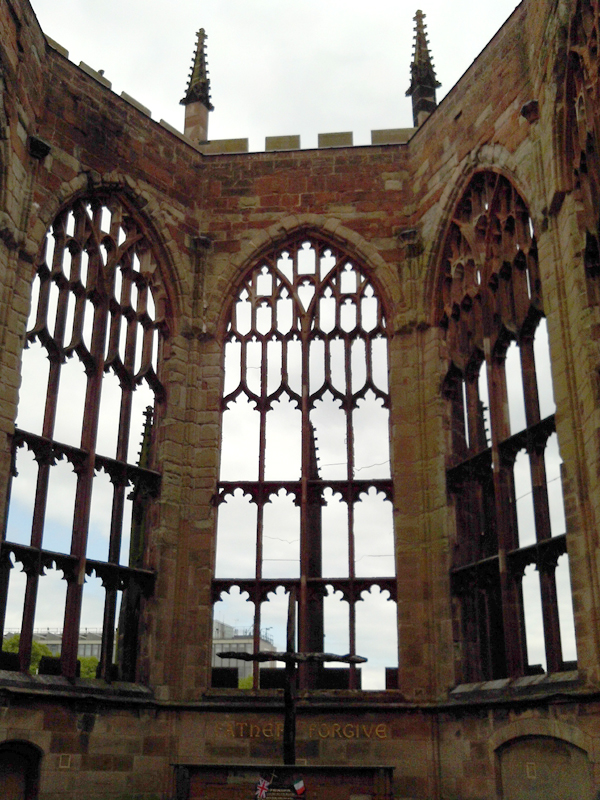
coventry04The sanctuary is so poignant. There are even tiny bits of stained glass in the windows – still there.

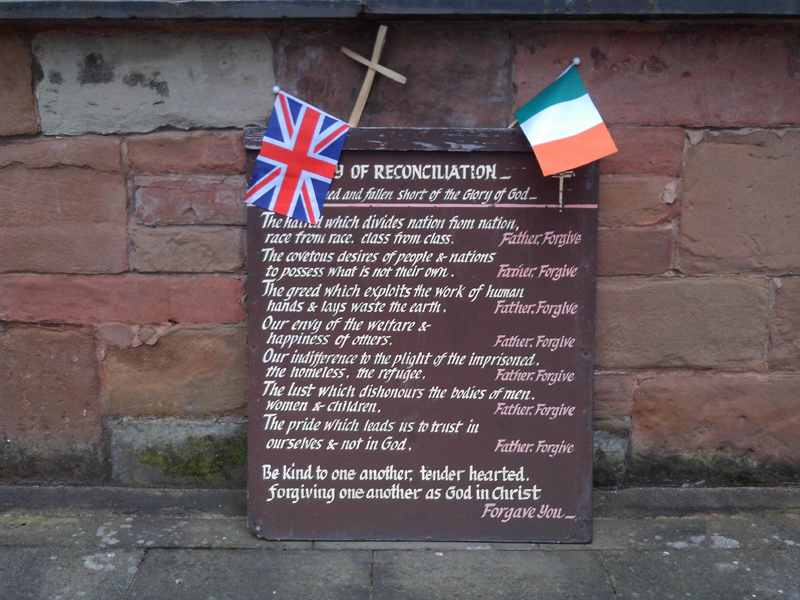
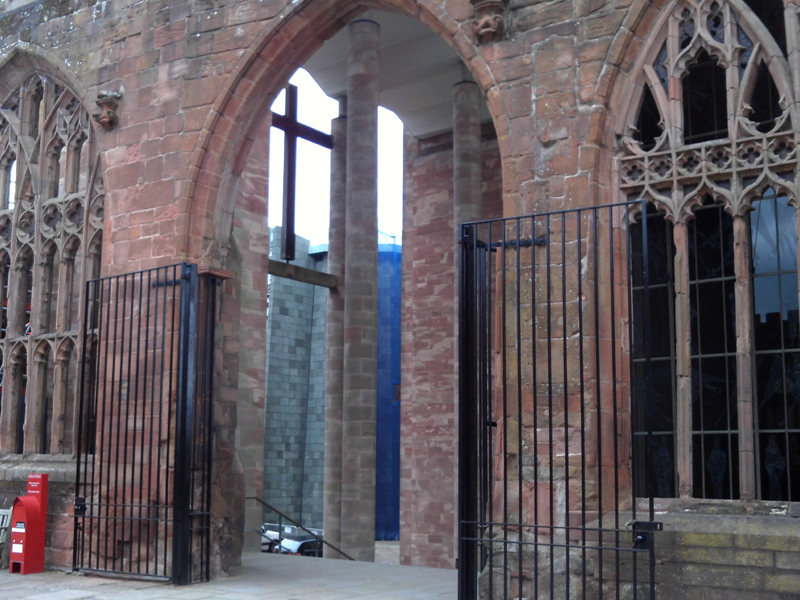
coventry05This is in front of the high altar. Stop for a moment to pray this litany of reconciliation. It seems so simple, but it would stop all wars and bring us together in peace.

coventry06A ruin still has to be maintained, even more so than an intact building.

coventry07Here is the way through to the new cathedral built in 1962.

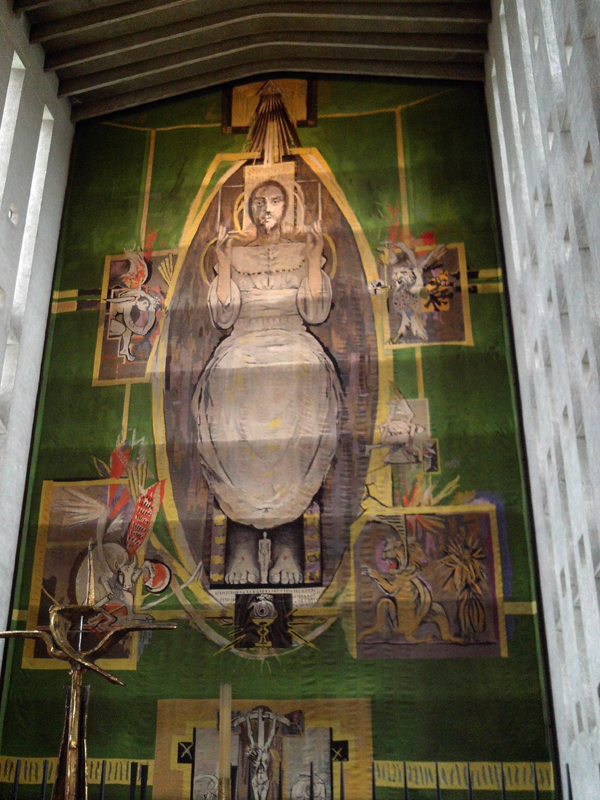
coventry08I thought I would hate the new building, but it is impressive and full of atmosphere. The big tapestry over the high altar and the two columns of organ pipes do everything. The plan is traditional with the nave, choir, sanctuary and Lady Chapel in the retro-choir.

coventry09This  high altar must be eighteen to twenty feet long! I do think this is a little exaggerated. Two-thirds of this length would have been quite enough. The bronze cross and candlesticks on brackets are very stark.

coventry10Here is the famous tapestry of Christ in glory, and an explanation.

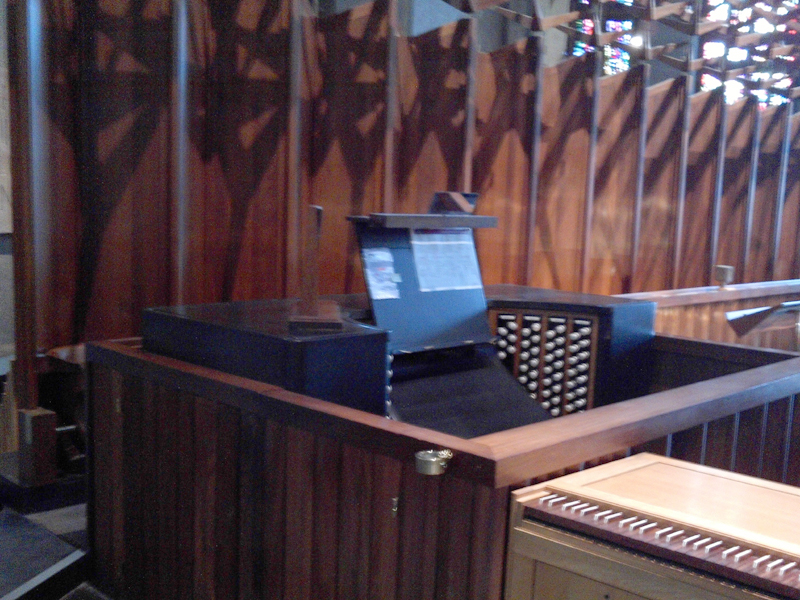
coventry11The organ was built by Harrison & Harrison of Durham and has four manuals and an extremely comprehensive specification. I didn’t hear it on this visit, but I have heard recordings. It’s an impressive instrument.

coventry12On leaving the cathedral, I visited Holy Trinity church just next door. It was badly damaged in the 1940 bombing, but it survived. It is truly a gorgeous church.

coventry13I reached London in the evening late enough to avoid the congestion charge levied during the week, and found a parking slot in Great Russell Street. There was a pre-Synod dinner at a hotel in this street with my Bishop and several clergy and laity of our Church. That was most enjoyable. After that, I made my way to Westminster and parked in a side street between Westminster Abbey and Victoria Station. I camped in the van, very discreetly as there are strange vagrancy laws in England!

I slept reasonably well and rose bright and early for the Synod. There was the altar to set up, and solutions to find to get the temperature down in the hall we used for the Synod Mass. The radiators, on full blast, were electronically controlled – and the maintenance men were off work for the weekend. The only solution was to open a downstairs door and block it with a chair to get something of a draught through the hall – and it worked. Otherwise, we would have sweltered through the Mass!

My job was to act as Bishop’s chaplain and crozier-holder. That was simple enough. At Communion time, I put the Bishop’s crozier aside and went to help the choir sing Byrd’s Ave Verum, since I had noticed that the tenors were on the weak side. That attracted a chuckle or two, but I think I did make some difference. The choir was rather good, as was the very able organist.

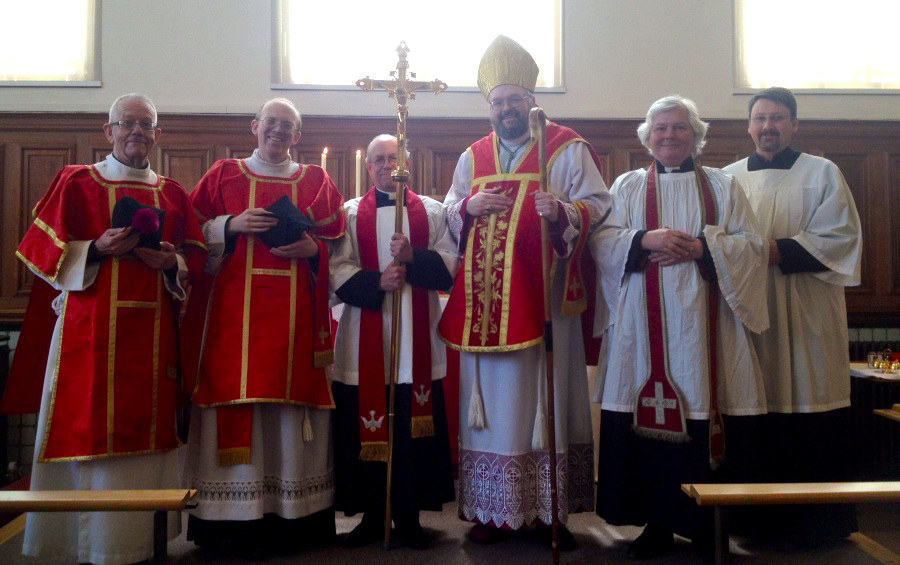
Here is the customary photograph.

synod2014Some of my fellow clergy could not fail to observe my lengthening hair, and that it was obvious that I am growing it and not neglecting to have it cut! John Wesley himself come to the rescue, since we were meeting in the high place of the Methodist Church, Westminster Central Hall! A life-size statue of the man himself is in the lobby – and it is obvious that Wesley was not wearing the usual powdered wig of a gentleman of the eighteenth century, but his natural hair. That was confirmed by one of the people working in the Hall’s office. The curls are amazing, putting my own to shame!

He was a very small man with his determined chin. The statue, as does the portrait below, seems to show Wesley in his 60’s.

john-wesleyI am impressed, seeing Wesley in Anglican priest’s attire, since that is what he was. The face looks gentle. He must have been a saintly man of God, a Romantic as a priest and evangelist as others were as poets and musicians. Wesley’s theology is high church and very much in the Anglican tradition of the seventeenth century. I mean to study his life. I have always held the Methodists in high esteem for their piety and complete integrity as Christians.

The official report of our Diocesan Synod – Lift High The Cross! XXIII Diocesan Synod. It was held on the feast of the Finding of the Holy Cross.

After Synod, I met up with two friends, known in the blogging world as Rubricarius and Patricius. I hadn’t seen the former for twenty years! I met the latter for the first time, a dapper young fellow who, in my opinion, has it – but has his life to lead and learn from. We had a pint together at a local pub, and moved on to a nice little Italian restaurant in Victoria Street. We spent rather a lot of money, but it was worth it for the high-quality conversation and the enjoyable time. Some of us “others” also have “blognics” in London!

I then moved on to Canterbury. On driving through the docklands ultra-modern office and business developments, I had the impression of dystopia from the science fiction films. The buildings are gigantic and ominous, built in black and dark-coloured materials and tinted glass. London has changed so much since I lived there in the late 1970’s and early 80’s. I was only too glad to be through the Rotherhithe Tunnel and bound for Kent! I reached a service station on the A2 a few miles short of Canterbury. I had better conditions than in London, including the use of a toilet and without the risk of getting into trouble for illegal camping.

Again, on the bright and sunny (though a little on the cold side) Sunday morning, I was up bright and early. I could take my time before driving into Canterbury and to the Pound Street car park. I had arranged to be at the church, so that I could say my Mass in particular. It must have been the first Sarum Use Mass said in Canterbury since 1549 – since the ACC’s official rite is the Anglican Missal, which is slightly more “Sarum” / Prayer Book than the pre-Vatican II Roman rite. It was a somewhat different experience from my own chapel, with the door open to the street and people walking past and occasionally looking in.

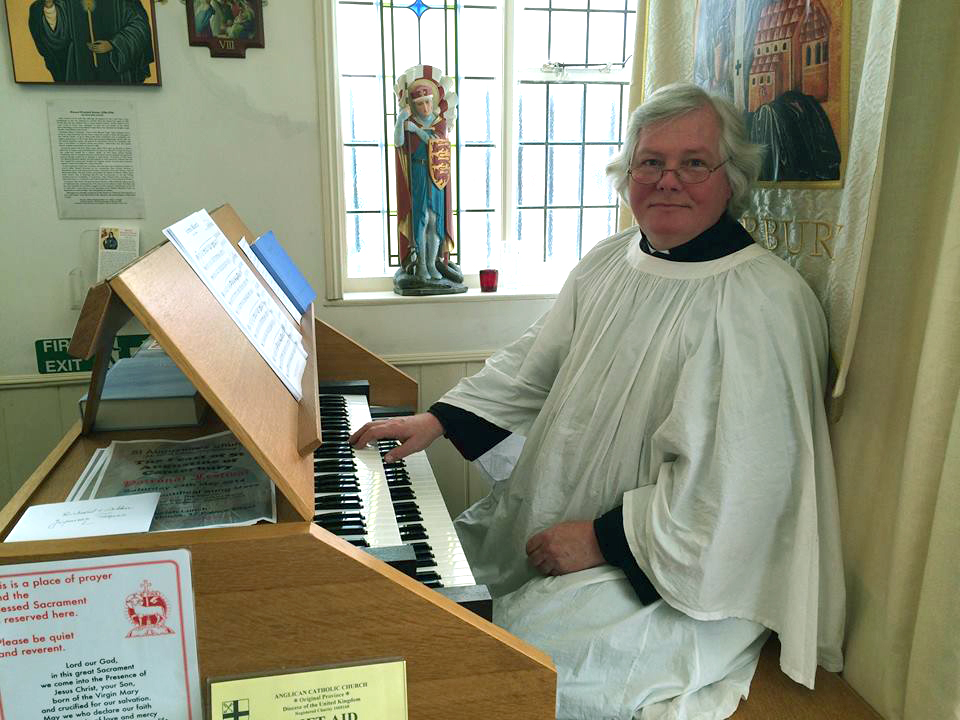
After that, we had the parish Mass celebrated by the Bishop, and St Augustine’s church no longer has an organist. I did the job yesterday, the way I have always done my job as a liturgical organist from my days in the Church of England and my seminary at Gricigliano. The music is determined by the liturgy, and is a part of it. Organists who show off have no place in the liturgy. After Mass, my Bishop said that he had never heard it played so well. I am not a virtuoso, and there were plenty of “bum notes” as I am no longer used to a radiating and concave pedalboard. Simply, I know the liturgy and am very much influenced by the Cecilian Movement I wrote about some time ago in connection with Fr Lorenzo Perosi. I know how to accompany and suit the various pieces of music and improvisations to the liturgy. That church needs an organist, and one who can work in the kind of spirit I expressed yesterday morning. If there is anyone reading this who is interested, for the sake of the kind of liturgy we do in the ACC, I would be prepared to help him or her get adapted.

I got photographed at the end of the Mass – with my “Liszt” hair! I should imagine that it will be like Mozart’s hair next year!

canterbury-organAfter Mass, my Bishop treated me to lunch at the Pilgrim’s Hotel in Canterbury, a real traditional Sunday roast. We talked of many things of concern to us all. We need new and younger priests with fresh ideas, like those of the Bishop, Fr Jonathan Munn and myself. There will be much work to do. It has helped for me to have been elected by Synod to the Bishop’s Council of Advice, which will take me to England at least four times a year. These are challenging times for bring out new and fresh ideas in such a small ecclesial jurisdiction. I think we will do it, gradually, progressively and with pastoral sensitivity. Many lessons have been learned from the experience of Continuing Anglican fragmentation due to petty-mindedness, power-seeking and lack of empathy for others on the part of bishops who began by being inadequate men. I am immensely optimistic for the future of the ACC in England and a renewed way of living in the Catholic Church of all times. With God’s grace, I committed to doing all I can for this noble and Christian cause.

Posted in Uncategorized | 8 Comments

Off to England

I’m offline for a few days to visit my father up in the north of England. I will then be at our Diocesan Synod in Westminster next Saturday. This is a temps fort for our communion around our Bishop and there is much to discuss, especially in private, about the future growth of our apostolate.

I ask your prayers for a safe journey, for our Church, and I should be back online perhaps with a photo or two on Monday 5th May.

Please continue to be good Christian gentlemen in the comment boxes! Be good… Thank you.

Posted in Uncategorized | Tagged , | 1 Comment

Vocation

I have been in a discussion on the longhair forum, and a poignant message came in:

I been getting stressed over growing long hair and so far to me I feel it’s not worth it. I thought of positive and negative things about long hair. I came up with mostly negative things about long hair like worrying about split ends, damaging hair, peoples reactions and maintaining it. The only thing I came up with that is positive is you like long hair. When I shower I can’t enjoy hot showers any more since I worry if it’s going to damage it and so far I feel when I have short I can relax and not worry about this. When my head itches I think I am damaging it when rubbing my head. I really want long hair and don’t know what to do and feel just giving up so I don’t worry about all this. I try not to think about this but it’s hard since I don’t want my hair looking horrible so I don’t give long haired guys a bad reputation. Because a lot people don’t like long hair on guys and want to show everyone they are wrong about long haired guys. I really need some advice in case I overlooked some positive things and in case others worried about things like this before.

I answered on a fairly practical level:

You seem to have a problem of self-confidence. Of course, I don’t know anything about your age, lifestyle, job and philosophy of life. Those are things that “provide the context” about choices like growing hair and affirming your identity and personality in different ways.

The bottom line is that it is your choice, and no one will blame you if you choose to keep your hair short. I did that for many years. If you want long hair, there are several “usual reasons” like following the fashion of a subculture or because you “feel” it is part of you.

Growing hair and going through the “awkward stage” is not easy. That’s where I am at 7 months since my last haircut. We need to avoid being self-conscious. Just act natural, or be natural.

Hair is often tougher than we think. Just look after it normally without getting worried about it. Use good shampoo and conditioner and let it dry in the air without using an electric hair dryer. You can still have a hot (or warm) shower and either wash your hair or tie it back to keep it dry on the other days.

There’s a lot of anxiety in your message. Hair is something we need to enjoy, otherwise there’s not much point to it if it’s an ordeal. You seem also to be worried about what “others will say”. You can’t please everybody, and it still won’t be good enough if you fit exactly into the mould. Be yourself.

My advice is to get the basis straight. Is long hair your way? If it is, you have to take the awkward with the good and persevere with it. There are all sorts of practical things people can help you with on this board, but the essential has to come from you.

It felt incomplete to me, so I added another message:

Another thought came into my mind as I was showering and washing my hair this morning. It is all to do with our attitude in life and our expectations.

Some people are constantly worried about their health, constantly seeing the doctor for minor problems and looking for remedies on the internet. Life has to be lived, even when we do have problems. Our friend Ted on this board is a heroic example of this. We just go on, whether it is life in general, health, money problems and poverty – or the minor inconvenience of growing hair and keeping it reasonably clean and tidy.

Another analogy is saving money to buy a new car. We deprive ourselves of other things to be able to afford what we really want. That being said, the greatest gift in our life – beyond possessions and things that make us feel powerful – is our happiness and freedom in being ourselves, whether or not we believe in any kind of God or some other “being” beyond ourselves.

For many on this forum, growing hair is a journey, like exploring the sea or an unmapped piece of land. It is an exciting challenge, but there are difficulties we have to face and overcome.

My own experience over the past few years has been illuminating. I look back at my own desires and beliefs of when I was about 12, and I find many things I have missed over the years. One thing was sailing, and another was the long hair of poets, artists and musicians in the early 19th century, another (which I never put aside) was music and organ playing. Another was composing polyphonic vocal music, and all these things are adding up into something beautiful and whole.

I went up many blind alleys from my teens and up into my forties, so it is important to take up threads where we left off. This is even more so when we begin to get older and see the sand running through the glass – there’s no stopping it.

You are not me, and you have another experience in life. Look at your “reference age” and you will see the answer. You will then never let go of the precious pearl!

It occurs to me that I am simply reflecting on the notion of vocation and purpose of life, two somewhat inscrutable notions for us all, believers and non-believers alike. In the end it isn’t about hair or personal vanity, but who we are and why we’re here. Churches need to deepen the notion of vocation and the idea of a person serving God and the Church by being himself, and not fitting into a conformity mould. One has to have courage to allow people to be themselves, because we become disturbed in our own certitudes and fear of the sinfulness of others.

I have probably discovered more about the notion of vocation in the longhair world than in all my years at seminary and listening to teaching coming from many wise men. We arrive at a time when many of the things we older people knew are being swept away and replaced by nihilism and vulgarity. On the other hand, a seed is bringing forth something new and I refuse to believe that the future is only ugliness and death. There is something in the way of a reaction from The Machine and the dictatorship of exaggerated rationalism. Look beyond the tattoos and heavy rock motives, and some of those souls are opening to grace and light. Yes, I believe in miracles!

Posted in Uncategorized | Tagged , | Leave a comment