Harsh Judgement on Romanticism

My attention was drawn to this quite heavy philosophical piece – Carl Schmitt on Romanticism as a Form of Occasionalism, with a hat tip to David Sullivan who sometimes comments here.

I won’t go into the philosophical details or try to refute this, but I’ll raise a couple of points and leave the reader to sort it out for himself, assuming he is interested. Read the article and see if you understand something.

I do take exception to the idea of Romantics refusing the absolute and any kind of final authority to substitute oneself for God, the non serviam of Satan, Lucifer, Mephistopheles or whatever you want to call the Fallen Angel. Some Romantics might have lost faith in God and became narcissistic, by not all by any means. I find sweeping statements unsettling. Of course, the issue is invariably not the absoluteness and authority of God, but of the institutional Church and its power over the “secular arm”! Of course, no church has such influence nowadays, except perhaps the Patriarchate of Moscow. Even there, Russia is quite independent from anything when it wants to, including American capitalism…

Romanticism is a metaphysical attitude that places the individual subject at the centre. The romantic does not free himself from divine control in order to submit to some temporal power such as the state; his attempt is to free himself from every external power. Romanticism puts the individual human being in the place of God.

Eek! The early nineteenth century was still groaning its way out of Robespierre’s Reighn of Terror and Napoleon’s exploits were hardly reassuring. Perhaps Gregory XVI from his Pontifical throne in Rome was happy for the Church in France to labour under the “authority” of the dying embers of the Revolution and the short-lived restorations of the Monarchy. Actually, some of the Romantics appealed to the authority of the Pope. Yes, the Liberals were the progenitors of modern Ultramontanism, and Lammenais got excommunicated for his trouble. Seeking authority was a theme of many Romantics, until they discovered that there were higher things than authority, and that was not always “private judgement”.

If we were to accept the sweeping statements of this article, every work of art would have to be trashed, because man is doing the creating, not God.

Posted in Uncategorized | Tagged , | 16 Comments

Humility

In Christian spirituality, humility is one of those almost taboo subjects – if you think you’re humble, you’re not humble. It would seem that you can really get tied in knots thinking about it! I have found this psychological and “secular” point of view which seems to be a refreshing change from some of the churchy hyperbole we are used to.

I do think we would be suspect if we went around telling people “I’m humble”. On the other hand, there are things to examine about our general attitude to life. Humility is almost as high as Prudence in the hierarchy of virtues. Pride is ultimately the root of all sin.

A lot will depend on our personality and our weaknesses in the way of narcissism, seeking attention, having a high sense of entitlement. Some of us will have less of a struggle against these tendencies. It is very stressing to be in competition against others, tail-gating the car in front in a show of impatience and anger. For some, it is not difficult to be humble and take a back seat. Having high status in life also involves responsibility and risk. The higher you climb, the harder you fall.

Humility is also being ourselves, not some kind of caricature or copy of someone else. We always have to accept our limitations. Humble people are less anxious about our mortality. We all die of something, and that is a certitude. My wife worries that I would have a stroke whilst out in my boat. It can happen at home, and we can die of other things. We can also get cancer or die of an accident. Anything can happen. We just have to live from day to day. When we are Christians, we believe in being prepared for it and being right with God.

With a lower sense of entitlement, it isn’t so bad when things don’t turn out as we expect or would wish. We become open-minded, less prejudiced, more tolerant and less defensive about what we believe to be true. This is a constant theme with me.

In the end, it isn’t a question of being humble, but keeping a humble attitude in life. There isn’t much left of Lent, but it isn’t too late for something new.

Posted in Uncategorized | Tagged , | Leave a comment

Serious Romanticism

I have discovered this blog which is of great interest in the matter of historical Romanticism (early nineteenth century), its literature, art, music and philosophy – Catherine Redford’s Romanticism Blog.

I particularly recommend looking at the Romanticism Resources page.

We live in a time when many of us fear cataclysmic events and the breakdown of society, and have a distinctly apocalyptic frame of mind. The Romantics also went through such fears – 1816, Byron’s ‘Darkness’, and the end of the world. Dr Redford is also highly interested in Mary Shelley (author of Frankenstein) and the darker themes of Romanticism.

After washing my hands of the caricatures, it is refreshing to return to something serious and worthwhile in our study of western culture.

Posted in Uncategorized | Tagged , | Leave a comment

Gay Marriage

I read on some blogs and in the news that the UK has passed laws allowing same-sex marriages. The same happened in France about a year ago, and there were fierce demonstrations organised by Civitas.

The big problem is that the world we live in is secular and no longer refers to Christian morality. We can only try to have spiritual influence, and only then will people make their moral lives consistent with their faith and spiritual lives. Gone are the days when churches had secular authorities in their pockets and could impose Christian moral laws on all.

It may sound anathema to Christians, but I advocate tolerance for those who are not of our faith. We have no choice in the matter. The world has passed us by, and the only place where we can insist on Christian morality is in the confessional.

Same-sex marriage is clearly an aberration in terms of the Christian family. However, there is the legal question of adopted children. A single person can legally adopt a child, and that child has the right of inheritance. If that single person is living in a relationship with another person, the filiation is not transferred to the partner when the adopting parent dies. This can lead to serious situations for the children. A marriage between the two partners, even if they are of the same sex, might be justified in this kind of situation to ensure the civil rights of the adopted children. This is a dimension that seems to be overlooked by Civitas and other conservative pressure groups.

The only justification for such an arrangement (civil marriage) would be this legal question of filiation. Here in France, our heterosexual marriages are first done before the Mayor of where the fiancée lives, and only then in church. In England, people can have a civil wedding at the Registry Office or at the church where the priest or minister has the legal faculties from the secular authorities as a registrar for marriages. There is no justification for attempting to marry a same-sex couple in church, as only heterosexual marriage was given the standing of a Sacrament by Christ.

There can be a good counter argument. You don’t change the law because of a fait accompli, because same sex couples are adopting children. Otherwise people can kill and steal, and then get the law changed in their favour! A couple involving a single person who has adopted a child and his/her partner knows that the child can only inherit from the adopting parent. Another problem with changing the essential definition of marriage is – Whatever next? There are many agonising moral problems that cannot be resolved by legislation. One is euthanasia. Legalise euthanasia and it will go down the slippery slope to killing people for their money or on a whim – or starting the Nazi Holocaust over again. Keep it illegal and allow judges and juries to look at each case carefully and have the power of discretion in matters of sentencing and mitigating circumstances. Killing is always killing, always intrinsically wrong, but sometimes can be justified in extreme cases of suffering. You can’t legislate for hard cases or base the law on exceptions. Likewise, same-sex marriage is not marriage. However, judges could allow the surviving partner to adopt the children when all the circumstances have been examined.

When examining questions of this kind, we need to see the legal dimensions, the human aspects, and we also need to have a clear sense of what is right and wrong. Wrong does not become right on the passing of a law that is not designed first to obey the natural law and Christian morality. It would be bad to see some kind of conservative blow-back happen and for homosexuals to suffer the kind of treatment they got in Victorian England and Europe in more recent times. This is what may happen if the gay lobby pushes too hard.

We live in a highly polarised world where politics and law no longer have the common good as their objective. The politicians are in it for money or their own egos, and laws are twisted according to the agenda of the day. This is the real problem. We are watching our civilisation crumble, not only from this single issue, but from a general environment of everything being questioned and contested. The argument is for greater freedom, but the reality is less freedom and the death spiral towards a totalitarian society such as Orwell prophesied in Nineteen Eighty Four.

Everything seems to be determined by mass hysteria and stupidity, surely the strongest argument against democracy. No doubt, I will be classed as homophobic because I do not recognise the possibility of two persons of the same sex to contract sacramental marriage, even if they can enter into a legal union for the sake of adopted children. I believe in tolerance for those who wish to live in a discreet homosexual lifestyle, respectful of others, when they are not of our faith. People have tattoos and piercings which make me cringe, but that’s what they like – and they do it to themselves. We have to be tolerant, but we can’t recognise it as “normal”.

With the degree of pressure on the majority of society not to be homophobic, racist, sexist, etc., there is bound to be one day a conservative blow-back. When reactions happen, they don’t go to a moderate position but to the other extreme. It happened under the Nazis after the “mad” years in Berlin in the 1920’s. We seem to be looking at a civilisation that will go out in a blazing Götterdämmerung or out with a whimper. I am afraid. Might Vladimir Putin help us? That’s another problem, and the man is former KGB. I don’t trust any of them, Cameron, Obama, Hollande or any of them.

We have to keep our heads down at present, but for how long? May the Lord give us not only the virtue of prudence, but also of courage.

When the Nazis came for the communists,
I remained silent;
I was not a communist.

When they locked up the social democrats,
I remained silent;
I was not a social democrat.

When they came for the trade unionists,
I did not speak out;
I was not a trade unionist.

When they came for the Jews,
I remained silent;
I wasn’t a Jew.

When they came for me,
there was no one left to speak out.

Posted in Uncategorized | Tagged , , | 36 Comments

The Lighter Romantia

I ought to mention in all seriousness that the kind of Romanticism I have written about is not connected with a subject on which I have written in my lighter moments. One such article is The Invisible Empire of Romantia. The following articles also indicate my curiosity about the eccentric ladies and their particular “methods of education”.

Here is an interesting history of this whole movement loosely based on Guénonian traditionalism, which merits a study of its own. The historical link between philosophical Traditionalism and Romanticism in the nineteenth century in undeniable. That being said, it would be sad if everything were tarred with the same brush with this quite cranky feminist movement with sado-masochistic tendencies!

Some more old stuff has been published on Romantia, featuring Imperial Angel, New Century, The Romantic and the English Magazine. There are also various other written pieces and essays. I wish they would publish sound files of the cassettes they used to publish, and which you would put on a cassette player hidden in the shell of an old 1930’s wireless set! This kind of stuff can only come from English eccentricity, and it is very amusing in its absurdity.

On a more serious note, it takes a considerable amount of delving to discern what the Romantic Ladies want(ed) to convey. Much of it seems to be an appallingly shallow form of conservatism refusing modernity from about 1960, yet accepting the modernity of the earlier part of the twentieth century. It is quite dotty, and I don’t really consider these persons as very fréquentables given their record of using corporal punishment in their “school of manners” – which looks suspiciously like sado-masochism. They seem to be still in business under a different name.

Here are some “Aristasian” sites:

For me, Romanticism is a whole philosophy of life and a temperament of personality, as I attempted to describe in my previous article, which has nothing to do with British Imperialism, using feet and inches instead of metres and centimetres, running boards on 1920’s motor cars, 1930’s wireless sets or women’s fashion in the 1900’s! We need to make this vital distinction between a whole part of artistic and philosophical culture over the past 250 years and this caricature.

There is occasionally some depth in some of the Romantic Ladies‘ writings, mixed up as it is with home-made religion and almost cynical mockery. Nevertheless, one can find articles worthy of being read in a more serious mood, but we need to be critical.

Romanticism frankly deserves better than this standing joke! As I said in another article, it’s best not to try to create movements – best to live and work, and just be oneself.

Posted in Uncategorized | Tagged , | Leave a comment

A Further Reflection about Romanticism

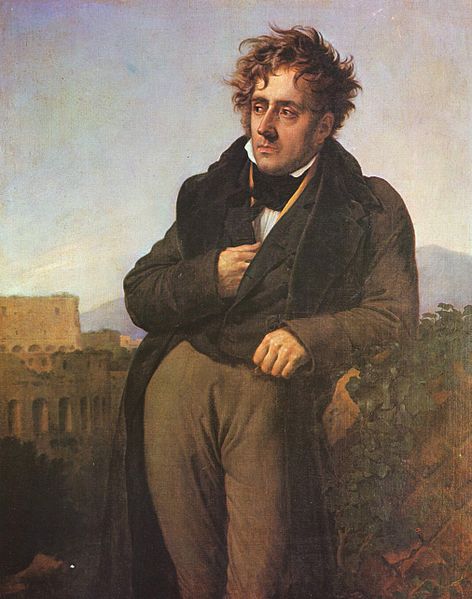
chateaubriandThe more I think about the question of Romanticism and the way this theme has popped up time and time again in history, the more I see it not as a movement or anything to promote in general terms, but rather something to identify in individual persons. The Wikipedia article on Romanticism is a good introduction to the various themes that make up this historical, philosophical cultural and psychological phenomenon.

Continue reading

Posted in Uncategorized | Tagged | Leave a comment

Question about the Tonsure

The Tonsure is not in use in the Anglican Catholic Church, nor, unfortunately, are the Minor Orders and the Subdiaconate. Some of those ministries are fulfilled by Lay Readers. I hope there will one day be a reflection in our Church in view to their restoration.

Personally, I received the Tonsure and the Minor Orders in the Roman Catholic Church in a seminary where they are in use. I received the Tonsure in Rome from Cardinal Pietro Palazzini in December 1990 in his titular church of S. Girolamo della Carità, where St Philip Neri first established the Oratory. The same prelate ordained me a deacon in 1993. The Tonsure for secular clerics is a symbolic ceremony in which five tiny amounts of hair are cut away with a pair of barber’s scissors: from the back of the head, from the front, from each side and on the top, in the form of a cross. Afterwards, there is no visible difference to the new cleric’s hairstyle.

Until about the 1960’s, secular clerics (they became clerics through receiving the Tonsure from the Bishop) would have a small circles shaved from the crown of their heads about the size of a large coin. It was a miniaturised version of the medieval tonsure, which a bishop would have shaved for the day of his consecration. This is the reason for the skull cap, violet for bishops and black for the “low” clergy. Of course, some clerics do not need the tonsure because they are going bald at exactly that part of their heads! In the middle ages, priests did not usually wear cassocks in the street but civil dress. What distinguished them as clerics was the tonsure and the skull cap covering it. In the eighteenth century, when powdered wigs were in fashion, the skull cap was worn over the wig. Below, Cardinal Altamirano in The Mission set in the 1750’s, wearing what would have been normal gentlemen’s street dress for a high-ranking prelate.

A question was entered into my search box – how to grow hair faster and neater after tonsure. This question referring to the clerical tonsure would seem to of little sense. The word tonsure is French, and the corresponding verb is tondre meaning to crop, shear or mow, depending on whether the object of this act is a human head, a sheep being fleeced or a lawn of grass. People have their heads shaved or their hair cut very short for any number of reasons that are not always religious. The French word for shaving is raser or se raser which involves leaving no length of hair above the surface of the skin.

I am not really qualified to answer this question since I am not a hairdresser, a barber or a member of the medical profession. As someone who has taken interest in the symbolism of human hair, I would venture to say that a person grows his or her hair by ceasing to cut it – just letting it grow. If there are scalp problems, then one should see a doctor or try various non-prescription skin ointments or shampoos that can be bought at a pharmacy. At half an inch a month, “hair farming” is a very slow process, and it takes patience and character.

Neater? From about four months to over a year after a short haircut, a person can expect his or her hair to go through an “awkward stage”. It is too long to style and too short to tie up. Cutting and trimming only prolong this part of the growth process. The alternative is painfully simple – cut it or grow it. Cutting does not stimulate growth. The speed of hair growth depends on the genetic make-up of each person. The average is half an inch or a tiny bit over one centimetre per month – nothing to get impatient about. The person can take biotin, keep himself in good health and favour a good head of hair (if he’s not going bald), but there is no miracle substance that makes hair grow faster. It grows at its natural speed, healthy or sickly. After eighteen months, with most people, the hair can be tied up via a ponytail or other styles. After that, the person can decide on a target length or go for terminal length, the maximum length determined on the time a hair remains attached to the person’s head before falling out.

It is for each person to assume his choices in life and their consequences.

Posted in Uncategorized | Tagged , , | 2 Comments

Popular and Elite

This morning, Dr William Tighe sent out an e-mail with some links about people who become Orthodox and leave. Leaving the Orthodox Church is a poignant posting, as are several others on this blog that reveal some of the same problems as any expression of Christianity in contact with modern western culture.

It gets me out of my recent little bout of “writer’s block”!

There is even a posting Abusive Hierarchy and Breaking Orthodoxy that recommends a kind of aggiornamento and advises Orthodox priests to shave and get haircuts in order to fit into the modern western world! Perhaps the long hair might fit into some circles of modern life, other than American middle class suburban life. The Orthodox have other reasons, and I don’t intend to discuss them here.

I came across the same problems – in analogy – when I was in the Institute of Christ the King. Here in France, buzz cuts and black cassocks mean extreme right-wing politics. Wearing fringes, lace and baroque trappings makes it even worse. We are brought to the idea of the priest being close to the people. Putting it the most simply, a priest can take off his cassock and choose his secular style – businessman or hippie – and still be a bastard. Alternatively, he can simply his style moderately and work on his sense of empathy for other people and be a human being!

The first article I mentioned speculates on reasons why people leave Orthodoxy, but it can also apply to Roman Catholicism, Anglicanism or anything.

Abusive Hierarchy and Breaking Orthodoxy

First of all, people will leave their church to be atheists, spiritual-but-not-religious or to join another church. The posting considers the case of converts more than those born into a family that is a part of the community. Orthodoxy depends most on the ethnic community (Greek, Russian, Serbian, Syrian, etc.) but Roman Catholicism does too to an extent. In the USA, ethnic Roman Catholicism was made up mainly of expatriate European communities, the Irish and Italians in particular, fortified by Eastern Europeans and Hispanics from across the border. In England, it was traditionally a matter of the “old” Catholics, descended from recusant families, and the Irish immigration. It is sure that an ethnic minority in a foreign country where people have immigrated for political or economic reasons will use religion to bolster its identity. Religion is strongest where the ethnic identity is strongest.

A convert to Orthodoxy or Roman Catholicism will feel very much like a gate-crasher into someone’s private party, and may be perceived as one by the “owners” of that particular community. The convert became convinced that the Church he was joining was the “true Church” (outside of which there is no salvation) and that he would be welcomed as a kind of prodigal son. Not so, he can believe the doctrines that Church teaches, be attracted to the liturgy and popular religious practices – but he doesn’t belong because his family is not a part of the community. This fact of Orthodoxy is just as true in French traditionalist Roman Catholicism. The best way to get on in French traditionalist circles is to have been born in Versailles in a minor aristocratic family from a father who is an army officer. The boy goes through the right schools and the Scouts, and has his place carved out in the old way. His Saint-Cyr shaven back and sides is just as stereotypical as the long hair and beard of the Greek, Russian or Serbian immigrant.

The fact is that religion is a part of a social identity marker, and it practically does not exist outside these limits. This is perhaps the source of a “religionless Christianity” – surely Christ broke out of his Jewish mould to address the Gentiles, and all the Apostles went far away from Israel to propagate the Gospel. Surely, the idea was to separate Christianity both from ethnicity and tribalism and from the religious instinct. I am personally unable to buy “religionless Christianity”, because it would be atheism in its purest expression, perfectly suited to a global “civilisation” where no one has any right to any sense of identity.

Christianity is tied to the sense of identity, because religion supplies a fundamental human need. But, perhaps there are other forms of culture and social identity in which Christianity can flourish. We have to find them. I myself write as a “failed convert”, having been received by the SSPX, having spent 1983 to 1995 in the “official” Church and then having been a “hanger-on” from late 1996 to early 1998. My own experience was not having difficulties with any particular dogma or moral doctrine or the liturgy of the traditionalist groups. I just didn’t belong and I was told as much. My own alienation became complete as I was never a part of the conservative ideology of the traditionalists, nor of the “ordinary” parish and diocesan system. What remained was a kind of mixture of high Anglicanism and the last shreds of French rural Catholicism where I actually did find a warm welcome. The TAC and then the ACC seem to have been able to accommodate my own eccentricities and messed-up religious instincts as a priest.

I can easily understand the drama of the individual convert making up his own foundational myth and seeking support for it is some kind of “lost paradise”. Many, perhaps even most, converts assimilate the reality they find, and they “stick”. The problems are the same for the 23-year old Englishman who ventures out to France and someone who seeks the “myth” in Orthodoxy. One thing that many of us ignore is the fact that all churches and indeed all human communities are imperfect and limited. Perhaps the church can be a stepping stone of the soul’s journey, until a community that tolerates difference and eccentricity is found, or the individual ventures out into uncharted waters.

Do we have the right to be different or to seek perfection? All human communities would say – If you want to stay with us, the answer is no. That community can be a Church, the business corporation we work for that requires absolute conformity to be a part of the team or simply the conventions of modern society. We can go the way we feel driven, but that will bring loneliness and suffering. That suffering can be the consequence of our selfishness and sin, or our quest for the Absolute and the way of prophets and saints. The dividing line is all too brief.

This article is fascinating – The antidote to this malaise would seem to involve restoring a tribal basis for personal identity. What about a “medieval village”? I don’t think it’s something I would fancy, and I know of no attempt that has succeeded. I can only think of William Golding’s Lord of the Flies, the famous story of a bunch of plane-wrecked English schoolboys turning to darkness and evil. We humans are fragile, and the attempt to found the medieval village would consist of rigid legalism and formalism, an obsession with externals. We cannot be born in the modern world and return to pre-modernism – containing the destructiveness of individual autonomy that modernity has unleashed.

Bonhöffer’s ghost returns to taunt us with the idea that we are modern and post-modern. Here in Europe, religion has nothing to do with society, a society which has become secular. Religionlessness is not an option, but a fact of life. Not only has the convert’s experience in a Church failed, but the Church itself is dis-incarnated from a world that no longer tolerates its eccentricity and “anti-social” values. The convert is doubly alienated – from the Church and from secular society. No amount of praying will get the genie back into the bottle. Christ uses the analogy of being “born again” and even gives an explanation to the obvious question asked by Nicodemus. It would seem that you can only be “born again” once!

I have also mentioned the elite basis of Christianity, the monastic life. That might seem a romantic idea, until one actually acquires some experience of the gritty reality of forty or sixty men living in a large building and going about their daily routine. There is the family side, and there is another side that makes the abbey resemble an army barracks – down to the pervading smells of boot polish, masculine sweat and boiled cabbage from the kitchen. Certainly, there are inspirations to be taken from the Rule in our attempts to live and survive, but somehow, it doesn’t quite fit. Perhaps we can consider ourselves to be inspired by the Rule when we take as much care of our kitchens, workshops, tools and everything as our chapels and sacristies!

We need local societies in which Christianity can flourish, as it cannot in globalist modernity. The Nation? Throughout the twentieth century, Roman Catholicism sought the support of totalitarian, national socialist and fascist dictatorships in its combat against atheistic Communism and its desire to restore the “social Kingship of Christ”. The French traditionalists still have this dream by supporting the National Front of Marine Le Pen. If they can’t get a king back on the throne, there has to be some way of bringing people back to Christianity by making them observe Christian morality! We find ourselves confronted with the drama of the Grand Inquisitor. We can’t be forced to be good! Or can we?

I’m certainly “preaching to my own parish”. I can only see the world through my own experience, knowing that others have become good Orthodox and Roman Catholics. I am not originally from the Church to which I now belong. I was baptised in the Church of England and only became a regular Christian from age 13 through school chapel and my interest in church music and architecture. I was always part of some kind of elite, whether latterly in the clergy (Roman Catholic) or formerly in the choir or engaged as an organist. I have never really known parish life at a popular level.

I am brought to the notion of elite Christianity, that of construct common interest groups: music, the liturgy, high culture, art, &c. When I use the word elite, it doesn’t to me mean exclusivity and a snotty attitude in regard to those who are not in the group. I do mean defining the group by the common interest and ability of the group’s members. To belong to an orchestra, you have to be able to play an instrument to the required standard. If the group is defined by a common interest, you need to be interested in it. The group becomes an elite by definition. We can find our identity in this way where all the other social ties we have are changed or have become something that repels and alienates us.

In working out something to promote the Use of Sarum, I have tried to identify some kind of social context in which such an endeavour could be made to work, to avoid being self-destructive through too many differences of culture and ecclesial affiliation. Perhaps an atheist would feel out of place in a Sarum study group, as I would feel in a charismatic renewal group, however much effort I put into it. Diversity and small groups seem to be the answer. My sailing club is an elite – though we welcome all comers. The only thing is that not everyone is interested in boats. The common interest is its own limiter.

Many are alienated by “normal” parishes and modern life in general. We priests need to become involved with clubs and associations of people interested in different things, preferably those associations that promote things we are interested in too. Some “non-religious” matters of interest are most compatible with Christian spiritual growth. One is art. Another is music. Spiritual life needs to be open to beauty and harmony, as the latter often lead souls to the former. Artists often feel excluded from churches, which is nothing new!

I am interested in the idea of common-interest groups that are outside the institutional Churches, outside their control, so that no one may feel that he walking into a trap. I do believe that priests need to belong to an institutional Church, as I do, because the priesthood implies a notion of mission. We are called by being sent. We do not send ourselves. At the same time, we are called to exercise initiatives beyond the parish boundaries and in alternative forms of communities as they form around man’s aspirations and ability to affirm his identity in a world that want to strip him of it.

I get a little further with my thought about these things. We need to change and adapt. The question has always been – To what? The answer is any form of human social and personal life open to God and the Absolute. There is the clay waiting for the potter’s hand.

Posted in Uncategorized | Tagged , , , , , | 3 Comments

Hoc Sacrificium Novum

Update: Hoc Sacrificium Novum (2) However …

* * *

Fr Hunwicke is coming up with a new set of articles, for his piece Hoc Sacrificium Novum (1) has the number one between brackets.

When I first began to use Sarum some six years ago, I had scruples about In nomine Patris et Filii et Spiritus Sancti, acceptum sit omnipotenti Deo hoc sacrificium novum. One accusation by the Protestants about priests celebrating the old liturgy was that they claimed to make a new sacrifice, distinct from the unique Sacrifice of Christ. I was faced with the alternative of renouncing Sarum as a suspect rite or removing the word novum from the formula. If I did that, surely I would be committing the same error of modifying the liturgy for theological reasons.

My instinct is to follow a liturgy and not invent something of my own. Therefore, I had no alternative than to interpret this prayer as asking God to accept the sacrifice of the New Testament. Therefore, the Sacrifice of Christ is unique, but the Mass enables this unique Sacrifice alongside the entire Mystery of Christ to be made present for those of us who were not contemporaries of the earthly Christ. The liturgy gives us something that secular or religionless Christian moralism could never give.

Fr Hunwicke concludes this first part of his article by saying – “Calvary … and the Eucharist … conjointly, in that sense, are a new Sacrifice in as far as they are the Sacrifice Novi et Aeterni Testamenti.“He leaves us with the teaser of beginning a second part with the word “However”. That promises to be interesting.

We are forced to observe that no liturgical form or rite is perfect or perfectly coherent in a rationale. All rites are relative and contains defects in theological terms, or simply because of copyists’ errors, and those errors became almost of the same status of inerrancy as the Scriptures! I will also finish with a however, but certainly different to that which Fr Hunwicke intends to publish in the next day or two.

However, we need to have something, and meddling and tampering only make things worse. Certainly, leaving it untouched lessens the multiplication of corruptions and “accretions”. We humans have forgotten how to tolerate imperfection and approximation. That could be the subject of some very interesting discussion…

Posted in Uncategorized | Tagged , , | Leave a comment

Religionless Christianity

This is a theme that emerged from an exchange of comments with Stephen K. A search on Google brings up quite a few articles related to Dietrich Bonhöffer. This one is an example – Bonhoeffer’s Religionless Christianity.

What does the idea of “religionless” Christianity mean? The closing down of all churches? The running down of the priesthood and finally the suicide of institutional churches? My own mind asks one further question – Why not forget about Christianity once an for all and worship our bank accounts, cars and electronic gadgets? The thing we often hear is “I’m spiritual but not religious“. Very often, people are just that.

Is it, or should it be, the proper of Christianity to break with both Judaism and Paganism and express itself in a secular life guided by some moral ideas of Christ from the Gospels? It is not easy to get at what Bonhöffer is really trying to get at in the quote in the posting linked to above.

First of all, the scandal of churches collaborating with evil regimes just to keep their influence and property is one of the greatest obstacles to faith. It appears that Pope Pius XII is innocent of accusations of collaborating with the Nazis, but many bishops did and many innocent people died. The plug is pulled for what we believed underpinned our faith. Once that is gone, only atheism remains – or does it? Bonhöffer asks the question differently:

The questions to be answered would surely be: What do a church, a community, a sermon, a liturgy, a Christian life mean in a religionless world? How do we speak of God–without religion, i.e., without the temporally conditioned presuppositions of metaphysics, inwardness, and so on? How do we speak (or perhaps we cannot now even “speak” as we used to) in a “secular” way about God? In what way are we “religionless-secular” Christians, in what way are we those who are called forth, not regarding ourselves from a religious point of view as specially favored, but rather as belonging wholly to the world? In that case Christ is no longer an object of religion, but something quite different, really the Lord of the world. But what does that mean? What is the place of worship and prayer in a religionless situation?

I too have asked this question, and the only answer I can come up with is a kind of silent monastic or quasi-monastic witness. Do we have a right to withdraw from the “world”, or do we have to trash religion, go and live in a city and get involved with politics and humanitarianism?

Was the Redemption and salvation about being free from religion, ie: the empty ritualism of the Scribes and Pharisees? It’s a thought that can come into our minds. Was that the intention of Christ? No one has one single answer. On the other hand, religion seems so fragile, especially in a world that has trashed it. Our living in a godless world devoid of beauty or even humanity would bring us into a state of sharing Christ’s sufferings. Perhaps I would recommend that some religious bigots should live in places like Evry or the “working (unemployed) class” suburbs of Paris, Lyons and Rouen and spend their Lent in complete nihilism, far from churches. Perhaps they would be nearer to God in that desert than ever before.

How does the slogan go? Wear a hoodie!

To be a Christian does not mean to be religious in a particular way, to make something of oneself (a sinner, a penitent, or a saint) on the basis of some method or other, but to be a man–not a type of man, but the man that Christ creates in us. It is not the religious act that makes the Christian, but participation in the sufferings of God in the secular life.

Perhaps it all seems rather boring. We trash churches and religious art, all the monuments that lie around us. Alternatively we resign ourselves to the “museum of religion” being a permanent reproach, taunting us and forever bringing our sins before us. The idea that the Gospel is simply being about being good persons, law-abiding and with qualities of empathy and compassion, seems to reduce it all to a tedious moral code. Yet another moralising sermon and a return to the eternal hollowness.

Such thoughts make us relativise issues of liturgy and church furnishings. Should religion be hidden? I continue to celebrate Mass and do my priestly duties, but my religious life is hidden because it is absolutely senseless to make it public, provocative, and add to the scandal of religious symbols meaning something completely different and opposed to my inward convictions. For me to walk about with a cassock and very short hair would convey the message to many people here in France of far-right politics – to which I am opposed in the name of humanity, freedom and life. I experience many of the things that drove Bonhöffer to such a radical way of thinking, stopping a little way short of the nihilism of Nietzsche.

One of the themes of Lent is making our inner spirituality and humanity match what we do outwardly. Religion is vain when empathy and all human qualities are absent, when it is incoherent – as with the Pharisees or a “religious” person collaborating with the Nazis or other totalitarian regimes in the century of my birth.

Certainly, if religion is not to be trashed, we need to go through a real scouring-out and renewal of our inward life and our willingness to be human and humane. We need to heed the criticisms made against Christians, for our hypocrisy, intellectual dishonesty, cognitive dissonance, lack of care for others and our general “your death is my life” attitude. It is up to us. Very little is left.

Perhaps, some American soul might challenge me and ask me why I remain in Europe. Why not go to America where people are still religious and would pay me to be a full-time parish priest? I answer like the Germans who did not flee in the 1930’s because it was their country, like the Russians who stayed and suffered from persecution under the Communists. I am an Englishman, a European, and have no desire to move to America. Apart from the fact my wife would be against it, I find the present economic and political tendencies in the USA very frightening. The present situation with the US and Russia over Crimea is also very scary. The worst part is not knowing which side is the real enemy.

I go on because I know no better way. Perhaps I should have lived my life a different way, but I didn’t. I can only be where God has called me to be (otherwise I would be elsewhere). Why rack ourselves with that much speculation? Life is irrational at the level of our defective and fallen powers of reason. Sometimes we get the short end of the stick. It happened to Bonhöffer as he bravely walked to the gallows at Flossenbürg. Thus we participate in God’s suffering – and his Resurrection.

Posted in Uncategorized | Tagged , , | 5 Comments