Evelyn Waugh on the 1950’s Liturgical Reforms

This comes with a hat tip to Patricius in his new posting on Evelyn Waugh – Waugh…

During the last few years we have experienced the triumph of the “liturgists,” in the new arrangement of the services for the end of Holy Week and for Easter. For centuries these had been enriched by devotions which were dear to the laity – the anticipation of the morning office of Tenebrae, the vigil at the Altar of Repose, the Mass of the Presanctified. It was not how the Christians of the second century observed the season. It was the organic growth of the needs of the people. Not all Catholics were able to avail themselves of the services but hundreds did, going to live in or near the monastic houses and making an annual retreat which began with Tenebrae on Wednesday afternoon and ended with midday on Saturday with the anticipated Easter Mass. During those three days time was conveniently apportioned between the rites of the Church and the discourses of the priest taking the retreat, with little temptation to distraction. Now nothing happens before Thursday evening. All Friday morning is empty. There is an hour or so in church on Friday afternoon. All Saturday is quite blank until late at night. The Easter Mass is sung at midnight to a weary congregation, who are constrained to “renew their baptismal vows” in the vernacular and later repair to bed. The significance of Easter as a feast of dawn is quite lost, as is the unique character of Christmas as the Holy Night. I have noticed in the monastery I frequent a marked falling-off in the number of retreatants since the innovations or, as the liturgists would prefer to call them, the restorations. It may well be that these services are nearer to the practice of primitive Christianity, but the Church rejoices in the development of dogma; why does it not also admit the development of liturgy?

This is quite amazing, since he was writing in 1962 at the same sort of time as Msgr Léon Gromier’s The “Restored” Holy Week. This was before Vatican II and the rest, but of course the Council came out of its background of hundreds of bishops and theologians with their bees in their bonnets. Of course, Waugh was a brilliant writer and I am certainly a fan of his – but he was something of a cantankerous character who lived a very unhealthy life!

I have already discussed questions of the timetable of Holy Week services. It is a difficult one. Why the changes? To be frank, it seems odd to sing O beata nox in the bright sunlight of a spring morning. On the other hand, the long Paschal Vigil with baptisms and everything on a Saturday night is awfully tiresome. My Sarum vigil is much shorter, since it has the same four Prophecies as the Parisian, Rouennais and Dominican missals. I have not conferred a baptism since when I was a Roman Catholic deacon in a parish. For me, it makes sense to begin at dusk or just after dark, which in late March or April is about 9 pm depending on whether the clocks have gone on (last weekend of March). On the other hand, Tenebrae in the morning seem odd.

Though I use an unreformed rite (Sarum), I use the following timetable:

  • Spy Wednesday – Tenebrae of Maundy Thursday at about 9 pm.
  • Maundy Thursday – Mass In Coena Domini at about 6 pm. We “Sarumites” don’t use an altar of repose but put the two hosts in the hanging pyx.
  • Maundy Thursday – Tenebrae of Good Friday at about 9 pm.
  • Good Friday – Mass of the Presanctified and Burial of the Cross and the Blessed Sacrament in the Easter Sepulcre at about 3 pm.
  • Good Friday – Tenebrae of Holy Saturday at about 9 pm.
  • Holy Saturday – Paschal Vigil at 8 – 9 pm.
  • Easter Sunday morning – Opening of the Easter Sepulcre (Christus resurgens) and Mass of Easter Day.

It works for me, because I am either alone or have only my wife in attendance. She generally comes only to the Maundy Thursday Mass and the Paschal Vigil. It would be better for her to come to Good Friday too, but she is free.

That’s for the timetable, which isn’t everything. I find the Pius XII / Bugnini rites plainly silly and of no pastoral value. Waugh was clearly sensitive to what was going on, and the “liturgists” had been playing their games for years. This is a very interesting testimony like the talk given by the then Papal MC, Monsignor Gromier. I see the two together. Men of that generation, or a little later (born 1910-1920) and ordained just before or during World War II, often followed the “pastoral” liturgists with the idea that people were unable to relate to the liturgy and needed special adaptations. But they thought critically and discussed things intelligently. I spent whole days with Fr Pecha, and his distinctive line, when talking about the traditionalists, was that “We weren’t then what they are now“. Waugh was a convert with well-defined ideas, and he just wanted it left alone – as I do with Sarum, taking very few conservative liberties.

Patricius has taken this one on with confidence, and it is to his credit. Perhaps he might follow Waugh’s example by writing beautifully but driving himself into the ground! I’m sure he will be more sensible than that. Having known men like Fr Quintin Montgomery-Wright, Fr Jacques Pecha and some of the priests of Opus Sacerdotale who came to visit us at Gricigliano, there was a change. It was imperceptible, but as attachment to the Tridentine rite became more mainstream from about 1984 (date of the John Paul II indult), traditionalists and American-style (and stuffy English style too) conservatives started to mix together – and traditionalists took the ultramontanist ideology onboard. They were no longer “Lefebvrist” dissidents but conservatives with a preference for the old rite. In comes the rubricism and the tightening screws, and the result is a caricature of the pre-Conciliar Church. Eventually, as the Society of St Pius X started its dialogues with Rome, they also took on the conservative spirit.

The problems come in with ideology and unwillingness to think critically in regard to the mounting totalitarianism – or perhaps one that is being dismantled by Pope Francis as Benedict XVI began to do. We must not answer this with emotions and counter ideologies, but with kindness and original thinking. That’s where we eccentrics come in!

Posted in Uncategorized | Tagged , | 2 Comments

Sedevacantism

I came across two fair-minded articles on a way by which some Roman Catholics try to get round the fallibility of the Pope and the modern Church without dismissing it all as nonsense. These recent articles are Sedevacantism and Solution for Sedevacantists! Obviously the author of this blog called Rad Trad is a convinced Roman Catholic and I won’t dispute him on that. How he balances it all out and stops himself going mad is his concern. I respect his freedom.

I have had a little experience with this way of thinking. In spite of the theological jargon and the use of proof texts, the logic is cogent. The Popes up to the death of Pius XII were running a “perfect” Church that never failed to teach true doctrine due to the charisma of infallibility. Not only solemn definitions would be “covered” by this “guarantee”, but also the ordinary magisterium, the various Papal teachings not referred to as “infallible” ex cathedra definitions like the Immaculate Conception in 1854 and the Assumption in 1950. Whilst everything seems to be going well as the Pope looks like a deity for the pious faithful, that’s the way it looked. God was up there in his heaven working the controls, and would follow anything the Pope said or did, with all the binding and loosing.

Now all of a sudden, we get Vatican II and Paul VI. The Council affirms religious freedom in direct contradiction of Quanta Cura by Pius IX. Paul VI gets the man who has been in charge of liturgy since 1948 to do his stuff, and he promulgates the new rite of Mass, completely fabricated, and trashes liturgical tradition. We know the rest by heart.

Contradiction! Everything is in this word.

The principle of non contradiction is a fundamental principle of logic and the scholastic method of theology and apologetics. Two contradictory statements cannot both be true. One is false and the other true, or they are both false. That principle applied to the Church shows that an infallible Pope is not infallible because he has contradicted an infallible Pope. There is a scene in Star Trek where Spock succeeds in getting a robot to admit that everything it said was a lie. Going to the end of the logic, the machine had only to blow its circuits.

Also, a heretic cannot hold office in the Church and is automatically deposed, and this principle is applied to the Pope. If he is a heretic, he is not the Pope. The sedevacantists usually use Pius IV’s Cum ex Apostolatus Officio of 1559 as a proof text.

If there is no Pope, there is no source of authority on which the bishops depend. The Church has collapsed, or is there a way priests and laity can continue having Mass, the Sacraments and something like a normal Catholic life? The answers range from a flat no to yes, but according to certain rules. In the second article to which I linked, a suggestion is made to restore authority – by electing a Pope in an alternative way. This has been attempted, and the results have been quite colourful. See Conclavism and Palmar de Troya.

That is about it in a nutshell, and you can get quite a lot of information about the precise arguments on the internet. There are different ways we can react.

The first is my own. The doctrine of Papal infallibility and the ideology that emerged around the person of Pius IX in the nineteenth century and perpetuated itself up to our own times – are nonsense. The Church is founded on the Episcopate and the bishop in his own diocese, and there are historical primacies of honour associated with sees directly established by the Apostles. The Pope has a role, but no more than that of the Patriarchs of Antioch, Alexandria and certain other sees. This role is historical and symbolic. The Roman Catholic Church needs to be rid of this nonsense once and for all, and revive the old view of conciliar ecclesiology, learning some lessons from Anglicanism and Eastern Orthodoxy.

Sedevacantism has gone nowhere, and conservatism that tries at all costs to defend infallibility whilst the Pope approves of Anglicanism, Orthodoxy and the Reformed and Evangelical denominations (namely contradicts the belief that the Roman Catholic Church alone is the one true church and no one can be saved unless he was a formal member of it in good canonical standing) stretches credibility beyond the limit. If the Pope is infallible, the sedevacantists are right. Get rid of Papal infallibility, and the legs are chopped of the stool of many Catholics trying to do a balancing trick. Then we can “limit” infallibility to try to establish that Pius IX, Pius XII, John Paul II and Francis had everything in common. In a certain way, they did, as leaders of a communion that gradually and as a whole departed from Catholic orthodoxy longer ago than many of us would like to admit. The dried-out old corpse is beginning to crumble, and nothing is replacing it in many places.

It should be noted that I am analysing the problems of an ecclesiastical system and not criticising the sincere Christians who happen to belong to that Church because they were brought up in it or subscribed to its claims in good faith and innocence. Many clergy and faithful of that Church are Christ-like and do a lot of good in the world and holiness is found everywhere. Precisely, there is something above and beyond the ecclesiastical system, and the source of something great would come from there. I’m not saying the ecclesial body I belong to is “the true church”. We unworthily participate in the truth but we don’t own it.

Here is an article I wrote a long while ago about the problem of ecclesiastical authority as it relates to Anglicanism – Sessio and Missio.

Posted in Uncategorized | Tagged , , , , | 4 Comments

Flying Sparks!

Our friend Patricius has just written Censorship… as a result of having crossed the line on the New Liturgical Movement blog. It was only to be anticipated. It is a long time ago that I ceased to be respectable for any of those conservative and “party line” traditionalist Roman Catholics. I have been subscribed on the ctngreg list on Yahoo Groups for about ten years. I am a lurker because the moderator told me not to send any posts – because I am a schismatic (and perhaps a heretic and apostate too).

Patricius reminds me of something I read about Fr George Tyrrell, that pugnacious Irishman without a shred of tact. The former got himself banished by the more respectable conservative Roman Catholics on the internet, and the latter by the Pope (Pius X). That is his freedom, and he takes the responsibility of calling people riff-raff, morons, etc. It is not my way, especially since I am a priest and am accountable to my Bishop. I am also English, not Irish, and am not attracted to brawls in spite of any number of righteous people who would see me silenced and taken to Room 101 for an encounter with my worst nightmare.

Patricius was brought up a Roman Catholic. I wasn’t. I spent the best part of fifteen years in it and had to look reality in the face. I looked for Tradition expressed through beauty and sanctity, and found authoritarianism and bourgeois conventionalism. It took me a long time to find some kind of stability as a priest and come to terms with my own profound alienation from Roman Catholicism. At the same time, recognising my own shortcomings and ill-advised commitments, I refrain from blaming those I met along my way or those who had authority over me as superiors. I should not have “swum the Tiber” unless I was prepared to accept the reality.

He, I and others are dissidents. We found ourselves alienated for different reasons. There were figures in the past who engaged the RC Church in polemics like Fr Vladimir Guéttée who became Orthodox. Fr George Tyrrell ended up as a hanger-on with a religious community and died a premature death of kidney disease. Those men faced considerable suffering, as did those who fell foul of the Inquisition in earlier times, who were tortured and died horrible deaths. Each man took his responsibility and suffered. Nowadays, we can move to other Church bodies where we find acceptance, or we can lapse altogether and not be thought any the worst for it in society.

A couple of years, the French traditionalist scene got wind of my being a priest in the TAC, and that Rome was about to receive the TAC and make an Ordinariate of it. I was invited to be interviewed on the radio – Radio Notre-Dame and Radio Courtoisie, interviewed for Catholic magazines and invited to talk at conferences. It didn’t go to my head. I just went about it simply and without fanfare, believing I was rendering a service. When things ended up as they did end up, I ceased to exist. In a letter to someone, I sincerely referred to myself as a “nobody with the grace of the priesthood“. The less we think we are, the less disappointed and bitter we will be in life. My life is quieter without those milieux, including some of my old confreres from the Institute of Christ the King. My wife suggested wanting to see the face of my old superior seeing me as a star of the Ordinariate. I was more sober and sceptical, and it is of no concern to me if they enjoyed a moment of Schadenfreude.

Why stir up the hornet’s nest, rather than go the way God is calling us to do something good and positive? That is a guiding principle of my blog, but Patricius is free to do what he believes to be best, if he has the strength to take on the opposition. I don’t believe he has, but he does… I see no sense to prolonging conflicts with the NLM moderators, who would just ignore him. There is no answer against a wall of silence.

For the substance of these questions, to which I alluded in my recent article on the liturgy. There needs to be some serious work on the nature of liturgical tradition, auctoritas, custom and the role of episcopal authority in regulating it and on the basis of which criteria. It’s no good simply calling the Pope and Bugnini nincompoops or other insulting names. Some of us have the same convictions in common, Patricius, Rubricarius and others. I have used the Sarum missal for the past six years one having figured out the rubrics in a practical way. I may not have all the academic justifications to hand, but this is what I do with my Bishop’s knowledge and consent. If Rome ever decides to take the question of the liturgy seriously, everything except the saints’ feasts should be rolled all the way back to the first revision of the 1570 missal (Clement VIII in 1604), at least, and then allow good vernacular translations and other similar pastoral concessions. Local uses should be fostered and revived to the maximum. That is very unlikely to happen, and frankly it’s not my problem.

A good point is made that Bugnini was named and mandated in 1948 by none other than Pius XII, and it is known that there were already designs for a form of the liturgy akin to the ideas of the Jansenists and the Synod of Pistoia. The keynote of such a liturgical reform was to favour the rational dimension or the word over the mystery and liturgical symbolism.

The conservative and traditionalist milieux seem forbidding. They have their entries into official institutions, if that matters to us. I have long ago ceased to be intimidated to those who hurl the words schismatic, heretic and apostate in my face. I went through times of anxiety, anguish and depression when they played cat and mouse with me, promising everything with one hand and taking away with the other. Some are kind and sincere people, doing what they believe is right. We have to respect them for that. There are all kinds of personalities in that world that is no longer mine – and was never really.

I saw the way things went with the English Catholic blog and the beginnings of this one. I could never imagine so much hatred from people claiming to be Christians and orthodox Catholics. I am glad I had that experience after all I went through with the Institute of Christ the King and others. Yes, it was my fault. I should never have gone there in the first place. Lives are lived: they cannot be remade, so it is useless even trying.

I know the patter by heart, like a good Communist knew the works of Karl Marx and all the stuff about the exploiting capitalists and the ever-suffering proletarian workers. Even valid theological categories and terms become slogans, but again, it isn’t my problem. I don’t fight against all that, because I am elsewhere. It isn’t my war.

We need to find peace within ourselves and cease fretting about the rest. The kind of traditionalism I have left, with which Patricius is still at war, is essentially the French bourgeois reaction against the French Revolution and the alienation of the popular classes. There is a class and cultural dimension I could never overcome, even by speaking good French and being le plus français des anglais, as one priest called me at Gricigliano.

I do not comment on traditionalist RC blogs. They are none of my business. I do not belong to their milieux. They are welcome to read my blog for anything they might find to be of interest. The only thing that causes me to moderate comments is a rude tone or behaviour intended to cause emotional reactions – commonly known as trolling. I am a priest, and my duty is to teach and come to the help of anyone who asks my guidance. My blog is my parish, and that needs to be something positive and worthwhile. I cannot allow my energies to be dissipated through shrill polemics and conflict.

Posted in Uncategorized | Tagged , , | 24 Comments

Death of Sarum?

Update: Fr Hunwicke’s posting (link just below) is getting quite a few comments as he asked. Some information is coming out about the survival of the Use of Sarum among the Recusants.

* * *

I have just found this by Fr John Hunwicke – The Death of Sarum.

I don’t think I can answer his historical questions without an afternoon in a distant library. He’s nearer the Bodlean than I am!

He neglects to point out that Sarum and the Use of the Roman Curia are both ultimately Roman and Latin, but by different routes. The Use of the Roman Curia which finished up as the “Tridentine Missal” comes largely from the Germanic countries through Franciscan influence to combine with the Ordines Romani and the Sacramentaries. The Sarum Use comes from the Norman-French family of which the Dominican rite is a member along with Paris and Rouen. The Lyons rite is more Gallican, but there are also many similarities. It is also “Roman” but with divergences that are more than what can be compared with different local accents in England. The Mozarabic liturgy is the least Roman of the lot, and one would do well to consult Monsignor Klaus Gamber’s work (which is mostly in German). A friend of mine and student of Monsignor Gamber, Fr Martin Reinecke, did his Licentiate at Fribourg on the old Hispanic liturgy and pointed out the many themes in common with the oriental liturgies.

What did Sarum look like in 1570 or 1580? Those were penal times, and the liturgy could only be celebrated with any kind of fulness in a great country house if they were sure that Topcliffe wasn’t watching from behind the hedge! Perhaps it might have been like my own celebration of the Sarum Mass on the tailgate of my van, on a rock on the Glénans islands or on a makeshift table in a tent. It was certainly very similar to the Dominican rite with the preparation of the chalice at the beginning of Low Mass and a short and simple offertory. I would have preferred him to give the year 1530, but he seems to want to know how it was done in “difficult” times like the French uses in the 1790’s by those refractory priests who still had their heads. That is understandable.

Many of the rubrics are obscure, but come to light when compared with the Dominican rite. For my own celebration of Mass, I have tidied up what is done at the consecration by doing it the Roman way except with deep bows instead of genuflections. I have been celebrating Sarum now for some six years. I was still using the 1570 Roman rite (Latin) in 2007 when I went to Portsmouth for the TAC bishops’ meeting at St Agatha’s. I have had no reason to celebrate the Roman rite since. I may however be called upon to use the Anglican Missal somewhere in the ACC’s English diocese at some time. I’m sure it will come back to me if I don’t rush it and get into a panic! I was brought up on Roman and adapted to Sarum (in the light of the Dominican rite). So it was the reverse for me, trained in the Tridentine rite at Gricigliano and self-taught (recycled) in the Sarum ways.

Fr Hunwicke finishes by asking the question:

Fortescue (pp 202-3 fn 4) tells how Dr Lawrence Webb arrived from Rome at Douay in December 1576 and taught the young men how to do the new rite. He cites Records of the English Catholics under the Penal Laws, London, 1878, p118. Does anybody have that to hand? Are then any suggestive details?

Anybody have any actual evidence about how the laity reacted? Is there any bibliographical evidence about the survival of Sarum or the introduction of S Pius V? And Fortescue had been told, but had been unable to verify the claim, that some priests brought Sarum back into use in the happy reign of our late Sovereign Lord King James II. Anybody know anything?

I’m sure Fr Hunwicke would welcome comments to this effect on his blog. I’ll keep on looking over there. I would also be most curious to know.

Posted in Uncategorized | Tagged , | 2 Comments

The Neutron Bomb

Tracey Rowland contemplates Belgium by Deborah Gyapong, which she took from the Crisis Magazine article is worth contemplating.

I haven’t been to Belgium since my short trip to Gent in 2000, and even then, I had no contact with Catholic intellectuals. However, I am reading about how the Belgian Church is in an even more ruinous state than France. The fact that Belgium has legalised euthanasia has little to do with the Church, since Belgium is as secular a state as most countries in Europe.

When a town is hit by a neutron bomb, as Dr Rowland pointed out in her article, it kills people but leaves buildings intact. This is something I find here in France. I look out of the  window of my study where I am typing this, and I see the church tower and spire. The Angelus bell rings three times a day. The bell is also rung when there is a funeral and the occasional wedding on a Saturday. There is one Sunday Mass celebrated per month, by a retired priest living in the town a few miles away. My wife and I once attended this service. The priest seemed to have little to do other than the consecration. A couple of women did the rest to their tastes. My wife really prefers the modern style of services, but this one left her cold. I might as well have been having a nice cup of tea in Pickering. Dr Tracey Rowland would have had the same experience with a formerly Catholic university faculty in Belgium. The buildings and monuments are there, but the people are gone. Here in France, the rate of practising Catholics nationwide is about 5%. Given the higher average in the cities, this reduces the mean figures in the countryside to almost nothing.

The monuments are all still there, but the soul is gone. I can understand what made people want to trash the Counter-Reformation Church, especially with the paedophile priest scandals. Many conservatives blame the homosexuals and the feminists. There is a very aggressive ideological build-up, and it is looking very ugly indeed. Let us consider feminism.

I am personally favourable to women having a greater role in the Church, especially as theologians and advisers, respecting the more prophetic role that fits the feminine stereotype. What I detest is a woman deciding to “become a man” and oppress men as she believes men used to oppress women. Being married myself, I see and feel these dynamics in the relationship. Many things my wife says and believes are of an amazing depth of perception, and she finds many women utterly contemptible through their lack of personality and character.  We men find that if we stand our ground and show character, women respect us the more for it. A man who obeys his wife, even if the wife says that this is what she wants, will despise an over-compliant husband. One must avoid extremes, or violence. It is “give and take” all the way.

Many of these things appear in the way “empowered” women are trying to de-construct the so-called “patriarchal” Church. If that Church cannot be feminised, then it must be destroyed. A wife with that kind of attitude is left behind at the side of the road, or clapped in the scold’s bridle! Joking apart, if the opposites cannot work together, then the strongest is the winner. The Old Testament, even in its poetical and prophetic mood is not very sympathetic to perverse woman.

And I find more bitter than death the woman, whose heart is snares and nets, and her hands as bands: whoso pleaseth God shall escape from her; but the sinner shall be taken by her.

In the context, these somewhat misogynistic sayings refer to the woman of loose morals, the harlot and the one who seeks to exploit. It was not so long ago that I commented on one of the most extreme examples of fallen womanhood – Irma Grese and the many other examples of evil and sadistic women. Feminine psychopathy has been studied and it is quite chilling. When they are bad, they can be as bad as evil men, and sometimes worse.

I say this to situate the mindset of some forms of feminism in its ambition to make men the oppressed gender. It was bound to happen, and we will find the role and position of women has changed throughout history, from the days of Saint Hildegard of Bingen and the most sublime to the days when women were accused of witchcraft on the flimsiest of evidence and burned at the stake after being horribly tortured.

I have a great amount of sympathy for women of quality who try to live in symbiosis with their opposite sex. Personally, I make great efforts to avoid telling sexist jokes and showing the kind of attitude discussed between the “guys” over a pint of beer in the pub. We do have efforts to make, and so have they. It is appalling to see how women are treated in the Muslim world, but they got just about the same in fourteenth and seventeenth century Christianity, in both Protestantism and Catholicism. So much has been gained in the twentieth century: education, employment, equal pay, rights under the law, freedom from discrimination and oppression. However, is a day coming when men will be deprived of education, medical care, any work other than brute labour and discriminated against? If my wife cracked this kind of joke, I would take her up for it too.

What would some feminists do to Christianity? It seems that they want to get rid of it to replace it with something else. They would get rid of all gender-specific language. We have Father, Son and Holy Spirit, but if they talked of Mother and Daughter, they would be just as sexist. Parent and child? Perhaps, but we talk of boys and girls in common language. All rather hypocritical if you ask me…

Perhaps some feminists would take us back to Paganism. The idea is interesting, and I would attend one of their prayer services to see what they do. I haven’t found any in this country. Perhaps I haven’t looked hard enough. I don’t imagine many of that sort of stuff in the countryside and I don’t often go to Paris.

Women in churches are very variable, from the most busybody and vulgar to the most delicate and compassionate. Just yesterday, I reproduced a couple of clips from Brideshead Revisited with Cordelia speaking of her brother Sebastian. This character is a devout Catholic who keeps simple in her life and gives her life in the care of the war wounded and maimed. She is a most attractive personality in her plainness. This does not seem to be someone under the domination of men, but confident, open and innocent.

Those feminists who would bring about George Orwell’s 1984 and Big Sister (oops, Big Sibling! 😉 ) seem to be bent of de-constructing Christianity on the pretext that it cannot be manipulated into the meaning they would like to make of it. According to various articles I have read, the radical feminist ideology takes a number of forms, some with which I would sympathise, and others I see as no less reprehensible than masculine sexism. It is thing to affirm the dignity and value of women as human beings, and another when they want to redefine the world in the same way as militant homosexalists.

One of the greatest fallacies is the blanket condemnation of western culture. The assumption is that everything has been devised by men, from a masculine viewpoint. A sane mind would seek to balance masculine institutions by allowing women to take a part in a dialogue to restore balance. Actually, for many, the fact of a masculine underpinning makes something intrinsically wrong.

Interestingly, some feminists refuse the term feminist, for it reinforces the feminine stereotype. What do they want? The abolition of God and Christ? Gnosticism? We can ask ourselves which religious traditions are more sympathetic to women. Most are not. Some forms of Hinduism burned widows alive with their deceased husbands. We know what happens to women in places like Afghanistan and Iran. They are not easy places for feminists! What about Buddhism? It looks to me as though traditional Christianity is the kindest to women. Christ did much more for women, and not only saving their lives, than most religious men of those days.

Women who treat men kindly are more likely themselves to be treated with kindness. If my wife starts yelling at me, I’ll just give her a “time out” or ask her what “all that” is supposed to be all about. Just give it to me like a human being. Reason it out and express it in language, then I’ll listen and try to do something about my shortcomings. It can surely happen on a bigger scale too. We have just got to get on together.

I think there is no doubt that there are differences between men’s and women’s brains and our psychology. There are the old stereotypes, and it is good to read and study. The man tends to see the whole and the purpose of something. Women go straight to the details and tend to believe that rational explanations are unnecessary. Things are “just so” depending on what is most convenient. On the other hand, I often find my wife trying to assert herself as a man and reasoning – though often (at least from my perspective) off at a tangent. I have learned a lot about Jungian psychology and how it is helpful for men and women to be less clear-cut about their gender, and integrate characteristics of the opposite sex into their lives. A man needs to be more home-loving and attentive to details and feelings, and a woman needs to discover reason, faith and spirituality, a sense of liturgical symbolism which is often lacking.

Neutron bomb or renewal of humanity in a perspective of empathy and care for other people? It’s a good question, and a lens through which we might discern the future of traditional Catholic Christianity.

Posted in Uncategorized | Tagged | 9 Comments

Continuing Anglican Unity

I usually feel at a distance from church meetings, especially ones for discussing unity and ways getting around differences of doctrines, practices and personalities. I will be attending my own Diocesan Synod in early May, for which I have already sent a report of my priestly ministry. We tend to discuss essential business. Fr Jonathan Munn looks after the money and gives his detailed accounts. Each priest reports on his parish. Our Bishop will have much to tell us about the church shop in Canterbury. All these things are a part of our family life and witness to the life of Christ within us. I am not much of a meeting enthusiast, but they are important for any community.

Fr Jonathan Munn has just written Defragging the Anglican Church, using the analogy of a computer reorganising its hard disk. A fragmented hard disk is like dividing up the books in a library and putting the sections into the shelves in a more or less random fashion. To read a book, we would have to find and read the first section, and then search for the other sections and read them in order. Fragmentation slows a computer down, even if it searches through its hard disk much faster than our efforts in a disorganised library. In French, the computer is called an ordinateur, an organising machine that puts information into order. That’s what it does. I’m not sure such an analogy describes the efforts of bishops of different Churches to resolve their differences and work for unity. Obviously, the word fragmentation is something in common, which inspired the use of this analogy.

However, the method does not consist of merely organising information into a rational order. Fr Munn’s article points us to the blog of Bishop Chandler Jones of the Anglican Province of America. There is a certain amount of reorganising and rationalisation to be done with church constitutions, but the important part was discussing the existing problems in view to working out a solution.

In the most tumultuous days of the TAC’s ordinariate movement, mostly in early 2010 and through 2011, the ACA resisted the most and came under the criticism of the ordinariate-bound parts of the TAC. I remember reading the arguments accusing the American bishops of duplicity and infidelity to their promises made in Portsmouth to go along with any plan proposed by Rome. I will not go over it all, especially now that memories are fading and documentation is indeed fragmented, but I will say that Americans are more concerned for pragmatic considerations and self-preservation than anyone else. The experience was a kind of catharsis that caused the Continuing Anglican remnants to become a little more serious about saving the entire Continuing Anglican idea. Not all Anglicans want to remain with the “revisionists” or become Roman Catholics or Orthodox. Continuing Anglicanism is not a shipwreck to be exploited for spare parts and things useful to other agendas. It has its own integrity and ecclesiology as an expression of Catholic Christianity.

Institutional instruments like constitutions and codes of canon law are important, but there is a human, pastoral and theological basis that is not being neglected. We are too thin on the ground, but the American Continuing Anglican Churches, at least the ones generally recognised to be legitimate, look much more mainstream with their church buildings and schools for the children. The clergy over there are generally stipendiary and that makes a big difference, making a priest much more available for his ministry – just as long as it doesn’t all become too “corporate” and with the same bureaucratic blight as with the old mainstream churches. There are real ideas for collaboration and unity without absorption.

The Episcopate is being seriously professionalised, and this can only be a good thing. I understand that our own Archbishop Metropolitan is involved in the discussions. They are working on an assembly of bishops to help distinguish between the genuine and the “false”, since there are bogus internet churches, looking very big and official (yet no one has heard of them), but lacking substance. People need to be educated in the notion of predictability and likelihood. The real churches are known about and there are no “lost worlds”.

It is important for particular Churches to retain their autonomy and freedom. This is conciliar ecclesiology, not ultramontanism or Papal imperialism! We will continue to have overlapping jurisdictions for some time to come. Such collaboration could bring about the sharing of the most costly resources like seminaries for the training of new priests. Importantly, this kind of plan would reduce the risk of rogue bishops and amateurism in the Episcopate.

This is not the first time such meetings have been held, but the ongoing effort leads to hope. What about Continuing Anglicans outside North America. Personally, before joining the ACC, I took care to resign from the Traditional Anglican Church honourably and with respect and courtesy. It is incredibly difficult for any of us to make much headway in England and Europe. I understand that the Traditional Anglican Church in England is getting back together again, now they have a Bishop and a few of the confused clergy who returned. We need to look at other Churches as positively as possible.

Many problems remain to be solved, and they cannot be minimised or dismissed as insignificant. I do believe that the ACC has been right to hold to certain principles that other churches find difficult to follow. However, we can be thankful that dialogue and work are under way.

Indeed, we look forward to the fortieth anniversary of the Congress of Saint Louis, and to much progress having been made to recover from bad experience in this process of Christian healing and reconciliation.

Posted in Uncategorized | Tagged | 10 Comments

Libenter suffertis insipientens : cum sitis ipsi sapientes.

For ye suffer fools gladly, seeing ye yourselves are wise. I read this amazing Epistle of St Paul this morning at Mass of Sexagesima Sunday. In this piece of writing, Paul shows his complete break with conventions and all the suffering that could afflict him in his apostolic labours. He was shipwrecked, taken prisoner, punished by whipping and many other adversities. I was brought back to a theme on which I wrote just a year ago – Fools for Christ. I also remembered my article Stages of Spiritual Life.

I thought of this subject as I recently re-read Evelyn Waugh’s Brideshead Revisited and the character of Sebastian Flyte. Sebastian is the eccentric student at Oxford who becomes an alcoholic. In this following clip, Cordelia relates Sebastian’s sad fate in northern Africa.

She continues:

Evelyn Waugh wrote some of the finest portraits of characters I have ever read, through his use of satire and going to the very depths of the soul. He painted each character in his unique way – the agnostic Charles in his army uniform kneeling to pray in the chapel, Cordelia’s innocence, Julia’s guilt. Sebastian is the fool for Christ, one whose very human dignity is stripped away. Cordelia is the voice by which Waugh showed his profound understanding of humanity.

The 1981 television series is very close to the book, beautifully acted and produced. I know nothing about the more recent dramatised version, and I don’t want to know. I have nearly finished reading this tattered book for maybe the tenth time since I bought it in a London bookshop some thirty years ago. Holiness, yes holiness, exists where it is least expected. It is a contradiction of worldly wisdom, something that St Paul understood very well when he wrote to the Corinthians.

We are fools for Christ’s sake, but ye are wise in Christ; we are weak, but ye are strong; ye are honourable, but we are despised.

This foolishness is not merely the condition of someone who is suffering from a mental or spiritual illness. It is not merely a voluntary act of abnegation. The Eastern Orthodox recognise this state as a style of asceticism, of contemplative life, something chosen and stylised. An example would be a sane man pretending to be insane for the purpose of ascetic abnegation. Most people in this world go by conventions and conformity to norms. They are a part of our culture and civilisation. However, not all conventions are right, and disobedience to them is a sign of contradiction. This is the essence of Christian Cynicism.

We are all born as fallen and imperfect beings, and we are the products of our upbringing and experience in life. Some go on to be great and famous. Others leave their mark through creation, art and music. Most of us struggle through life, obscure and unknown, and many struggle against tougher odds than others. Some try to become great in spite of their inability to do so. Others accept their limitations and gave away what they have to follow their way. The more “conventional” might join a monastery. A few end up as vagrants and good-for-nothings like Sebastian Flyte.

In my earlier article, I above all described those who went out to shock society as a form of Christian witness – between the fools of Holy Russia to the prophets of American revivalism with “fire in their bellies”. This tradition also exists outside Christianity. Some of the stories about these crazy characters can be quite revolting. This sign of contradiction is there to challenge conventional values when they depart from Christian morality or good spirituality. When these conventional values involve hypocrisy, lust for power and money and intrigue, they have to be challenged. This was the whole point of Christ challenging the Scribes and the Pharisees. I also described Francis of Assisi and the description of him by Oscar Wilde from his prison cell at Reading. The aesthete and poet also have their say as well as the lawyer and the theologian.

I return to Sebastian Flyte, for he is not an ascetic in the way that would make Eastern Orthodoxy recognise him as a saint, or anyone for that matter. His life would seem to be more the result of vice and sin than virtue and selflessness. We might judge him for having everything – aristocratic birth, Eton and Oxford and a loving family – and blowing it all on booze! We think with the wisdom we were taught. What about the Parable of the Talents? Are we not here to use those talents in God’s service and achieve to the maximum of our potential? I ask this question of myself as did my parents, my teachers, and now myself as I move through middle age.

Waugh’s Sebastian is a complex character, and I need not fear discussing him because he is fictitious. At the same time, he is so plausible and exists in a number of people I know – whether or not they are drunkards. The symbolism is all there. Sebastian is a beautiful young man, in love with his youth and childhood, and is unable to grow up. There is another side to childhood, that of innocence and the total lack of sophistry – a quality Christ insists on for being made capable of sanctity. At the same time, we are called to adulthood, responsibility and seriousness. In the novel, we don’t see Sebastian grow old, though it can be argued that the timespan of Brideshead Revisited extends from 1923 to 1939 – only sixteen years. Waugh makes him nineteen years old in 1923, so he was thirty-five at the outbreak of World War II when the novel begins and ends.

As a young man, Sebastian is an aesthete as were many foppish upper class university undergraduates in the nineteenth and early twentieth centuries. Beauty and charm are the windows through which the whole of life is seen. He is also eccentric in his exaggerations and imperatives, a distorted sense of reality as the reader might judge. His charm is heavily insisted upon in the way the outrageously camp Anthony Blanche describes it.

I took you out to dinner to warn you of charm. I warned you expressly and in great detail of the Flyte family. Charm is the great English blight. It does not exist outside these damp islands. It spots and kills anything it touches. It kills love; it kills art; I greatly fear, my dear Charles, it has killed you.

I find Anthony Blanche creepy, and I cannot relate to his camp affectation. In spite of his grotesque sophistication, he is not entirely wrong in what he says. Is there any substance to Sebastian Flyte, or is he just superficial tinsel and lack of personality? The character study of these two men is fascinating.

We find a contrast between charm and the profound character of a mature and balanced personality. I find the word charm fascinating. What does it mean? There are lucky charms, snake charmers, magical spells and that sort of thing. As a human quality, it is not easy to understand in Blanche’s description. I find that person charming – this is usually a compliment and a kind thing to say. It is a quality of the person that makes us like him. The person fascinates, delights and attracts. So then, why should such a quality kill everything it touches? Perhaps it is a superficial quality, and there must be a depth of character Blanche found missing in Sebastian. The reader cannot bring himself to dislike Sebastian, as he might wince upon reading Blanche’s camp patter. Again, Anthony Blanche is one of those lost souls who keeps coming back, and we find some affection for him. Waugh obviously wants us to see through charm and seek more profound human qualities. This is the quality of Anthony Blanche. On the other hand, charm can attract unconditional love in spite of all the character faults and vices like the alcoholism and immaturity.

Sebastian’s religion is a whole subject of study. Charles Ryder is unable to understand it from his agnostic point of view. I am impressed by Cordelia’s observation that he could not fit into either the secular world or a monastic community. He recognises his own limitations and lack of will to come up to the mark, to make the required standard. Are not these things so familiar to many of us, certainly to me. Going by Cordelia’s story as she relates it to Charles, Sebastian’s values have completely changed. He wants to look after a destitute German, leave his English aristocracy behind and escape his past. Then Cordelia speaks of Sebastian’s holiness. How can this be for a man who failed to use his talents, sunk into a life of vice and booze – almost worthy of Hogarth’s Rake’s Progress?

I’ve seen others like him, and I believe they are very near and dear to God.

I too have come across such men. Worldly wisdom would shun and banish them. Conventional Christian morality would condemn them for any number of vices and sins, yet something makes them loved and lovable. It would be improper to name any real persons, but I imagine that many of us know a Sebastian, be it our own son, a pupil we are teaching at school, whoever.

We are all fools and worldly wise at the same time. We hesitate between our conformity to society, to what makes us feel safe, and our prophetic instincts that make us want to break with it all and follow our calling and deepest instincts. This is the message of Christ, of the saints and the many hidden souls no one knows about – and perhaps ourselves…

Posted in Uncategorized | Tagged , | Leave a comment

The Broken Liturgy

I would like to point you to a very interesting link on the question of the reform of the reform, theme so dear to Pope Benedict XVI, and what we Anglicans have been doing with the Prayer Book for quite some time.

Would the solution be a wholesale return to the liturgy of Pius V with the various modifications between 1570 and 1965? The comments are worth looking at. In the early 1980’s I had a discussion with a young man whose opinion was that the Roman liturgy was broken to such a point that the only remaining legitimate liturgical tradition was the Byzantine rite. I cannot subscribe to such a narrow notion of liturgical tradition, but I can understand it in a perspective according to which any discontinuity entails the destruction of the rite.

I feel no longer qualified to say to Rome that it should get rid of its Novus Ordo. My own intuitions on the matter are known, that we need to “feed” the liturgical tradition with local uses and rites, even those that have been out of regular use for a few centuries and would be about as familiar as the Dominican rite. We find many similar ideas in the mind of Benedict XVI, even though he had to tow the party line with the so-called “ordinary form”.

There is also a very real problem with using versions of the old Roman liturgy with the first elements of the Bugnini reform, taken for granted by most traditionalists willing to two the party line sufficiently so as not to be taken for “extreme” traditionalists or cranks.

Time will tell. Benedict XVI was asking questions that just no longer seem to be on the agenda. Some might say that we have returned to the 1970’s. Forty years ago, there were people who remembered the 1950’s. People now no longer had the references they had in 1974. How much influence could the various traditionalist institutes and societies have? As a former member of the Institute of Christ the King, I would venture to say – precious little.

The conservative Roman Catholic media – paper and electronic – still try to maintain the myth of a conservative Pope. Benedict XVI was / is no conservative. He is very open as a theologian and interested in the liturgy for reasons different from that of many conservative traditionalists.

Two French articles are interesting. They are both by Fr Claude Barthe, a priest of vast intellectual stature for whom I have a great amount of esteem:

Posted in Uncategorized | Tagged , | 10 Comments

Two Fine Articles by Fr Jonathan Munn

I always appreciate my brother in the priesthood Fr Jonathan Munn and his keen intellect. Here’s a couple of recent articles, just in case they have gone unnoticed.

Protestantism, like the word Anglicanism, has many meanings – both intellectual and emotional. In both words, we find the noble and the trite, broadness and mean pusillanimity. We study the history of the Reformation, and we look at the scores and hundreds of Christian communities which either claim to represent truth or aspire to greater freedom of spirit. Roman Catholics often criticise Protestants because they do not submit to the infallible authority that alone can keep a Church together. Experience has shown that authority alone is not enough.

At its root, Protestantism seems to be a movement of emancipation from clerical and institutional control, which is understandable as a reaction against corruption, power politics and cruelty. There were revolutionary movements before and since the Reformation. The problems came with the theological justifications. Fr Munn rightly observes that fragmentation is not proper to Protestantism: it is also a property of Orthodoxy and Roman Catholicism. It is a part of human nature.

Here in France, Anglican means something like English Protestant. At the best of times, the French have a collective memory of the Hundred Years War and the Napoleanic Wars. French Huguenots got protection from the occupying English in places like La Rochelle and Bordeaux. They find it very difficult to comprehend the notion of Anglican Catholicism (Anglo-Catholicism, which I consider as synonymous). Anglicans are Protestants because they are not in communion with Rome. However, the use of the name Anglican is important in France, otherwise you get accused of being “false Catholics”. People don’t reason. They go by prejudice and slogans, something very frightening as we begin to compare our own times with the 1920’s and 30’s!

The use of names and titles comes from the separation of groups of Christians from each other due to human grievances and very real institutional evils. They are an attempt to recover some kind of legitimacy and credibility, and the cycle begins anew as evil, narcissism and control freakery take their toll.

If Christianity has to be defined by institutionalism and human generosity, it hasn’t much of a leg to stand on. We Christians try to grab on to whatever gives us credibility with ourselves, assuming that matters were better in the early centuries, in the days of the Roman Empire and the dispersion of the Jews. Perhaps the small communities held together under persecution like British families in the air raid shelters during World War II. Pressure from the outside tends to be a maker or a breaker! However, historical evidence points to the early Church being extremely divided by political questions and justifying theological issues. However, we need to grant that people talked theology at the market stalls, and wouldn’t care less about “that load of bosh” nowadays.

Private judgement and infallible authority? It’s an old one, amply illustrated by Dostoevsky’s Great Inquisitor:

Unity can be ensured by taking freedom away through totalitarian means, but it is the end of Christianity as this parable shows. We can’t get around human freedom and our capacity to find holiness, however fragile that state might be. We still look for references, and this is healthy – in the Bible, the Church Fathers, the Ecumenical Councils, church history. It is like a mariner carefully plotting his course with the help of charts, his navigational instruments, the sun and the stars – or GPS nowadays, making the whole thing much easier. The authority is there but non-oppressive. We are free to follow, or not to follow at our own risk. There is a dividing line between such authority and someone like Hitler or Torquemada!

We need to see this problem at a much more human level. The theological issues were invariably devised to justify political and human disputes. We try to cling onto our notion of Churches and authorities because we know nothing else as believers, but I do think the battle to conserve these models is being lost. Christianity will prosper in another form. But which? I like Fr Jonathan’s conclusion in resisting sectarianism. Embrace rather than reject, if we do not perceive a real threat against which our instinct will bring us to defend ourselves, for example from someone who lives to control others. We have so much to learn about tolerance and respect for freedom, but radically and within our deepest selves. Inclusiveness and exclusiveness are buzz words these days, and difficult to use because they are made to refer to narrowly defined groups of people, who often want to get control themselves over everybody else. Nevertheless, we need to find other words to describe that wideness of spirit.

We live in awful times. For example, here in France, we have a nice dish called quenelles. My wife and I are going to eat some this evening in a nice sauce. Now, in France, there is an entertainer called Dieudonné, an Islamist who has uttered some beastly things about Jewish people (as the late Noel Coward might have put it) during his shows. He invented a form of salute involving placing your left hand on your right shoulder and stretching your right arm downwards. This has been interpreted as a dissimulated Nazi salute. Whether or not it is, this gesture is called a quenelle. Are we going to have to think about such things when we buy innocent foodstuffs? Eventually, manufacturers of this foodstuff will have to change the name to something else. This is the kind of thing we find due to human stupidity and ideology. This is what happened to the priestly cassock in France. People associate it with extreme right-wing political movements. When ideology creeps into religion, it merely fuels the atheist argument that people are religious because they cannot or will not reason and use their brains.

We need to detach ourselves from movements of ideology and slogans in order to use our brains and capacity to feel the emotions of other people – empathy. With such a basis, it becomes possible to discuss theology and a healthy notion of the Church.

Fr Jonathan’s second article is more about philosophy:

I haven’t read much Camus, or Sartre for that matter. French atheism goes back to Revolutionary times, but were particularly accentuated in the late nineteenth century with the alliance between Grand Orient Freemasonry and Socialism. France is radically divided by this kind of hard atheism and the aspiration to restore authority, the Monarchy and the Church. As the Great War of 1914-18 came and went, leaving death, destruction and hopelessness, the sails of the radicals lost much of their wind.

Diplomatic relations were improved between the Holy See and the French Republic after World War I, and the Church was better tolerated than under the anti-clerical regime of the 1900’s. The Church became much more reactionary, and under the Occupation (1940-44) French bishops went along with the Vichy government which collaborated with the Nazis. This is the dualism that impregnates French Catholicism to this day.

That is something of a backdrop that enables us to understand the philosophical cafés of the Quartier Latin in the 1930’s, between Jean Cocteau, Sartre, Camus and many others. I meet many people of this kind of mentality, formed in Socialist teacher training colleges. It is really difficult to get down to the bottom of their formatage, even when I find them often to be beautiful people with whom I can relate through my own contact with 1960’s counter culture.

Again, before looking at the ideas themselves, we need to understand the historical context. For me history is far more important than philosophy or even theology. We truly understand things in their historical context, and then the ideas are wrested away from ideology and prejudice. Real work becomes possible, leading to communication – and reconciliation.

The radical socialists of the late nineteenth century, in France like in Italy and many other European countries, reacted against the obnoxious bourgeois Church of the nineteenth-century restoration. Anyone who has read a little Léon Bloy can understand the dripping hypocrisy of that kind of religion as it often manifested itself, alongside undoubted sanctity and heroism. How do we wrest ourselves away from the competing ideologies? Perhaps with a healthy dose of scepticism and a good study of history.

If we see Sartre and Camus as reacting against a particular kind of religion and piety, the idea of God’s non-existence and the acceptance of chaos appear self-evident. Science at the time was Newtonian and evolutionary, and all the odds were stacked against belief and religion.

Fr Jonathan seems to have read the texts in question more than I have. Existentialism bores me, but that is what Existentialism is, almost a study of boredom and states of depression. An existentialist philosopher would dispute me on that and say that I am a victim of prejudice and ideology too. He wouldn’t be entirely wrong, except that I see a lot of chaos and lack of meaning in life. We have to have some way of surviving adversity. There is such a thing as Christian existentialism as found in Kierkegaard and Pope John Paul II.

We Christians have our faith, and science is increasingly coming out in support of a rational logos holding the entire universe together. I know nothing more about quantum physics than what I read in “popular” articles, but it does sound exciting and stimulating. Continuity of life of the spirit after death, radical ontological unity of all things in the universal energy which gives the illusion of matter. Eventually, radical atheism and materialism can only go the way of the dinosaurs, and new strength for both faith and reason will emerge. Fr Jonathan, as a mathematician, will certainly understand the nuts and bolts better than I do.

There are strange things in mathematics, which we see as an exact science with only the correct and incorrect binaries. Probability is a branch of mathematics: our chances of winning the Lottery with a single ticket or order coming out of chaos. Water is disturbed in a random way, and ordered waves appear. Where does this order and rationality come from?

The old apologetics for the existence of God are being vindicated by science and discoveries of outer space and the heavenly bodies. Belief respects rationality. Atheism can only bring us boredom and depression, for we need a reason, a logos, to live. That logos is within us, outside us, everywhere and a part of ourselves.

Let’s clear our minds of ideologies, and we will get somewhere!

Posted in Uncategorized | Tagged , , , | Leave a comment

First Sail on the Sea in 2014

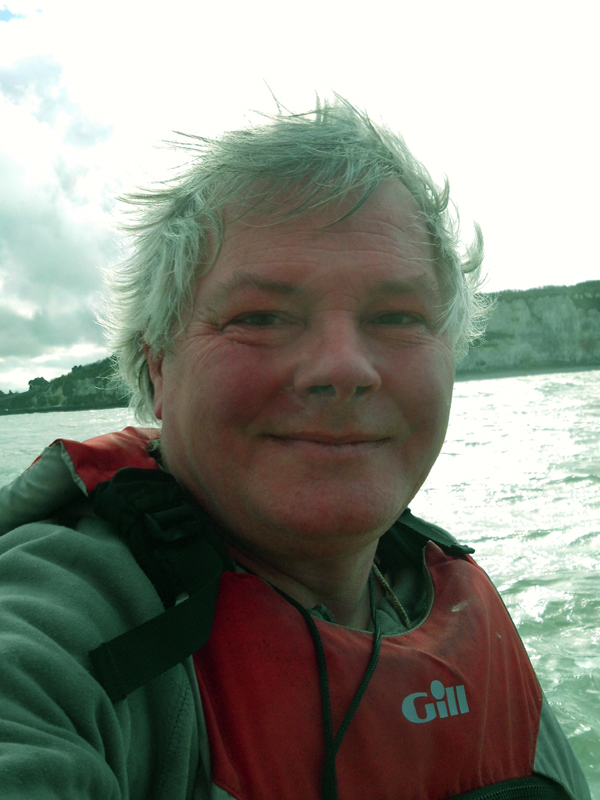
At last, a day came when the wind was at a reasonable level (10 to 14 knots) and the temperature was tolerable (9°C). I took the boat to Saint Valéry en Caux, and here are some photos (commentaries under the images).

sail190214-01This is the outer port where transportable boats can be launched. Yachts and other powered vessels go to the inner port, not shown in this photo. The advantage of launching here is having smaller waves, but this port can be a so-and-so when the wind is from the north-west. The westerly wind, just off the axis of the channel, made life a little bit easier.

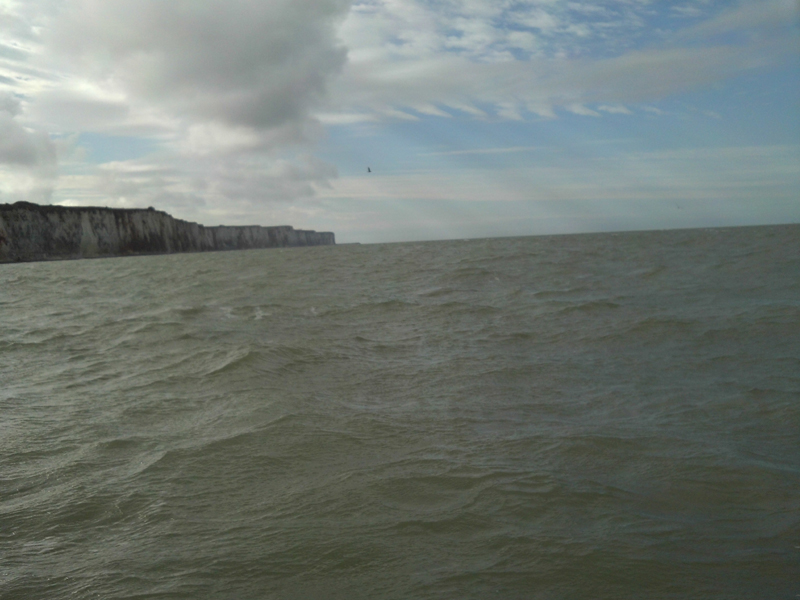
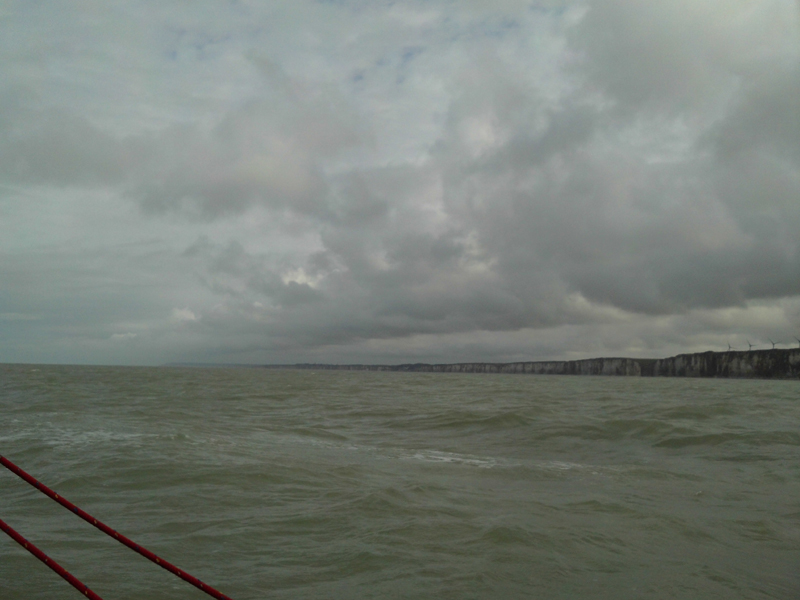
sail190214-02I was now out to sea, and the tide was still coming in, in the same direction as the tidal current, and gave a fairly smooth swell. The wind was quite unstable and gusty and the waves gave some quite exciting surfing as I ran to the east with the almost high tide. This view looks to the east with Veules les Roses. The headland in the furthest distance is Varangeville near Dieppe.

sail190214-03This is a rather dark one of Saint-Valéry en Caux, taken as I was hove-to. The starboard lighthouse can just be seen under the cliff.

sail190214-04We now look westwards towards the nuclear power station of Paluel (not seen from here) and Veulettes sur Mer. The weather is fairing up, but with the wind freshening as can be seen on the water.

sail190214-05Parry could have written Never Weather Beaten Hair, since my mainsail was doing just fine! You’ll “get” the corny jibe when you open the link. Parry was not only a composer and eminent music teacher, but was also a mariner. Sorry for my atrocious sense of humour!

sail190214-06In the centre of the photo is Veules les Roses, and Sotteville sur Mer is barely seen on the cliff top to the left of the photo. The tide is turning and the waves are getting quite choppy, often breaking.

sail190214-07This is practically the same view showing the waves beginning to build up as the wind freshens and the tide turns.

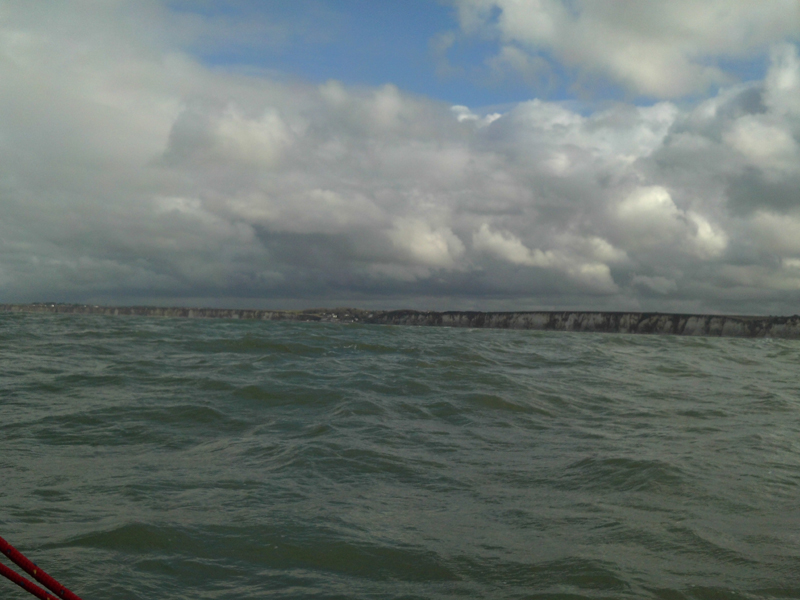
sail190214-08I was hove-to as I took the Varangeville headland just behind my mainsheet. The weather looks quite nasty over Dieppe.

sail190214-09This is almost the same view with heavy rain to the south-east.

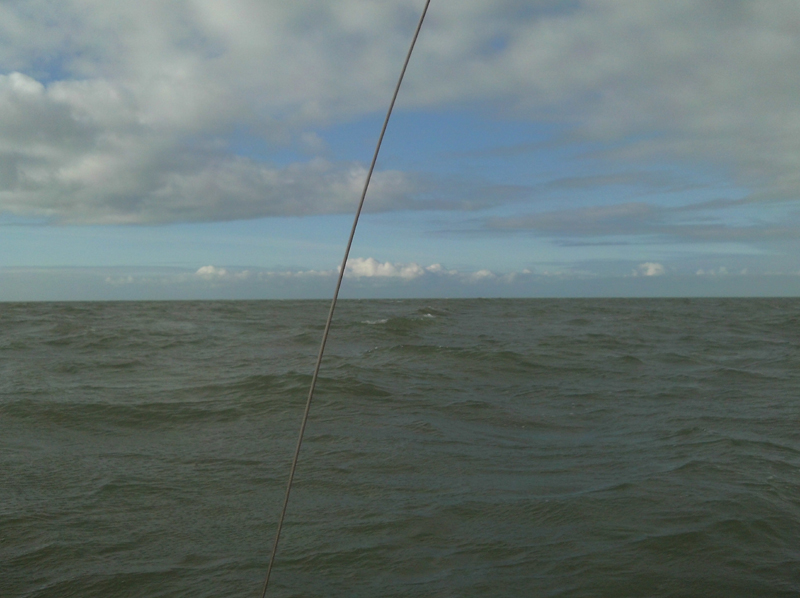
sail190214-10This last one looks out to sea. England is over the horizon, and the camera is looking to the north-west.

As I began to return to port upwind, but in the direction of the ebbing tide, the chop started to get quite nasty. I needed to be well off the wind to maintain speed against the waves. The tide was in my favour, so that didn’t worry me. I was quite cold, having taken a few waves in my face in these unsheltered waters, and a couple of hours at sea was enough for this first time this year. I put into port a little earlier than I had intended, to avoid the mid-tide chop otherwise known as the wind against tide state, which can be quite dangerous. I was on my own, in a 10-foot boat, with only a fishing boat a couple of miles away. In that kind of situation, one is pretty careful even with a reasonable amount of experience.

Here is the extreme example of the kind of conditions I began to face at my own small scale. This is the Race of Alderney or the Raz Blanchard between the Cotentin peninsular (Cap de la Hague) and the Channel Islands. Many ships have gone down in those waters. Definitely not for dinghies! If you don’t respect the sea…

Posted in Uncategorized | Tagged , | 2 Comments