As we enter Septuagesimatide

I saw something a short while ago on Fr Stephen Smuts’ blog, and I have been waylaid by irksome things like work. He quoted some maxims of spiritual life from Living In A Strange Land, Fr Stephen’s blog, Glory to God For All Things.

As we draw towards Septuagesima, we should read them and meditate on them and put them into practice. I could say it the way we put it up in Yorkshire “Easier said than done“. I’m not going to reproduce them here, but rather encourage the reader to refer to the appropriate link above. Some of these rules refer to disciplines that are more rigorously observed in the Eastern Orthodox Churches than in Roman Catholicism or Anglicanism. Though they are all of importance, there are some that strike me more profoundly.

3. Have a keepable rule of prayer that you do by discipline. The emphasis seems to be on keepable. It is easy to go to excesses from Ash Wednesday, like on January 1st, but fail miserably within a few days. It is better to be more moderate and successful than take on too much and fail.

9. Spend some time in silence every day. Silence is not merely the absence of noise, but it is also the quietening down of our own thoughts and imagination. In modern language, we talk of unwinding after work. We might find that listening, I mean really listening, to some music can bring us into receptiveness to the voice of God. 13. Do not engage intrusive thoughts and feelings. Cut them off at the start – says just about the same thing.

10. Do acts of mercy in secret. This comes directly from the Gospel. It is no good being ostentatious about prayer and humanitarian acts. We just do what is needed and efface ourselves before anyone can come and say what good persons we are. Hit and run – do good and skedaddle.

18. Be an ordinary person. We should live in the world around us and find out how ordinary people think and talk. We are not asked to conform to every wind that blows or every fashion, but none of us should think he is special. Even if we are priests, we pay for things like everyone does, and nothing is due. That was a bitter lesson for me as I left the Roman Catholic clerical life and began to stand on my own two feet. This maxim applied especially to priests, and is closely related to humility. Just be ourselves – ordinary guys. Yes, we have a gift from God, but it is God’s.

21. Have a healthy, wholesome hobby. Sailing, anyone? Seriously, the health of the body is the health of the soul. Climb mountains, take to the sea, walk, get a dog and go for walks – or a bicycle and leave the car at home whenever possible. There is not only sport, but things that help us to be creative. There’s also the garden to dig and the cladding on the house to re-varnish. Lots to do…

23. Live a day, and a part of a day, at a time. It’s the only way we can deal with worries. Just deal with today’s, and the rest won’t be so overwhelming.

24. Be totally honest, first of all, with yourself. You can’t kid yourself, still less God. That might be the Lenten scouring many of us will have to do. It’s just a question of truth, not denigrating ourselves or aping other people – just being ourselves and being straight with it. Self knowledge is the way to humility.

25. Be faithful in little things. Yes, the washing up, household chores and all the things that seem insignificant to anyone else.

26. Do your work, and then forget it. We often get into a twist about  work or having a row with a colleague or the boss. Just let go as soon as you get home, or even when you leave the office.

28. Face reality. This one is related to 24 above. I’m not going to fly to the moon, circumnavigate the world or become a Cardinal. This was something I had to deal with against various points of view from others, including those who would say “You’re going to be all right. Bishop Elliott has said so“. Reality is sometimes dictated by our sober intuition, our conscience, what we have to follow or regret the consequences later. Reality usually feels right. Stick to that and you won’t go wrong.

Another thing to watch out for is the person who claims to have a secret and a special privilege with, for example, the Vatican. It goes with the instinct of looking for lost worlds and secret knowledge. If it’s true, it is known about. People with secrets tend simply to be liars or deluded. Stick to what is known and common knowledge!

31. Be simple, hidden, quiet and small. 32. Never bring attention to yourself. Yes, but be yourself. Don’t just fall in with the grey amorphous mass of humanity like sheep. We have our gifts and our philosophy of life, and that might sometimes draw attention. Deal with the remarks in an effaced way and without fanfare. The balance is difficult to find.

33. Listen when people talk to you. This is one I found particularly difficult as a teenager. This is all a part of our training in empathy, being interested in what other people have to say rather than imposing our own ideas and interests. We avoid being a party bore that way. This isn’t just spirituality, just common courtesy and good manners. Related to this is 35. Think and talk about things no more than necessary. People sometimes repeat things over and over again, and are quite put out to hear “I find your conversation most stimulating, so if you would excuse me…

36. Speak simply, clearly, firmly and directly. With my Yorkshire origins, we do call a spade a spade, and there’s not a lot to say. Even when talking about highly technical things, simplicity is the best way. Think of Occam’s Razor. Entities must not be multiplied beyond necessity is one way of expressing it. Another expression is Simpler explanations are, other things being equal, generally better than more complex ones. We communicate better and are more peaceful in ourselves. Also, don’t blind others with technical jargon, better to put things in everyday language.

39. Don’t complain, mumble, murmur or whine. When we hear this in others, it just makes us angry. It’s just the same thing the other way round. If we’re ill or in pain, just take the medication and / or see a doctor, and spare other people the aches and pains! We English have the stiff upper lip – it sometimes comes in handy!

40. Don’t compare yourself with anyone. This is all a part of the cult of celebrities in cinema, sport and just about everything. The big shots set the fashions, and people follow like sheep. Perhaps we wouldn’t when we realise that they have their problems as human beings and so do we. Perhaps our cross is lighter than theirs, and we can be content that we are who we are rather than being them.

41. Don’t seek or expect praise or pity from anyone. How right! The world, especially in towns but also in the country, is a pretty bleak and uncaring place. Most decent people will help someone in danger, but that’s about all. Would we do much more for someone we don’t know? We have just got to get on in life without worrying about humans being humans and not caring. This is what enabled me to go on as a priest. We just carry on even if no one else is interested. That doesn’t mean that what we are doing is any less true or good.

43. Don’t try to convince anyone of anything. Indeed, not even of the truth! It’s like trying to get a smoker to stop cigarettes. The person will only stop by his or her own motivation. Truth comes from within or at least through within (if we want to be pedantic).

44. Don’t defend or justify yourself. OK, but this can be exaggerated. If we are accused of a crime, who wouldn’t get a lawyer and at least argue for mitigating circumstances if not complete innocence?

46. Accept criticism gratefully but test it critically. Oh yes! Other people are no more infallible than we are. As in 44, we might not think too much of ourselves, but the one doing the criticism shouldn’t think he is doing so free of charge. Advisers should be payers. For example, someone who thinks I should be doing parish work instead of blogging should provide the means for me to take up a vacant benefice in a place where there are lay folk in need of a priest. 47. Give advice to others only when asked or obligated to do so. The same goes for us. Before giving advice, think what it will cost us – not just money – but in terms of helping the person follow through with a good resolution.

48. Do nothing for anyone that they can and should do for themselves. Respect the other person’s self-esteem. But don’t hesitate to offer help if the person is obviously floundering or if he asks for assistance. Alternatively, people need to learn self-reliance like we have to. In that case, leave them be.

51. Have no expectations except to be fiercely tempted to your last breath. That’s the surest cure of depression, which happens if we have high expectations and are disappointed. Be modest and realise that nothing is free in this world. We have to earn it. If that sounds like Pelagianism, well it’s just too bad!

52. Focus exclusively on God and light, not on sin and darkness. 53. Endure the trial of yourself and your own faults and sins peacefully, serenely, because you know that God’s mercy is greater than your wretchedness. 54. When you fall, get up immediately and start over. 55. Get help when you need it, without fear and without shame.

All these are related. Doing ourselves down is often a greater sign of pride and inverted snobbery than being grandiose. Orthodox spirituality can be so much more healthy from than the Spanish stuff involving blood, gore and whipping in profusion. It’s not flogging that we need, since it breaks a good man’s heart and makes a bad man even worse. We need light and food for the soul, which helps us get up again when we sin and do something about it.

Just a few reflections…
Posted in Uncategorized | Tagged , , | 1 Comment

Great Peter of York

I was looking for some old York Minster choral and organ music from the Dr Francis Jackson days, and I came across something that really brings back old memories.

It is nothing other than Great Peter, the bourdon bell of York Minster. I heard it ring every day at noon from my school classroom. The recording doesn’t do it justice, and you don’t really hear the Eb fundamental very well. The microphone was set up in the stairwell next to the bell chamber, and it had to be done in mono.

There is a dissonant harmonic that gives the character of this bell cast by J. Taylor in 1927. This bronze bell weighs 10,800 kg (nearly 11 metric tons) and the diameter is 264,1 cm. It occupies the north tower of the Minster alone. Great Peter is rung manually, and it takes a few minutes of pulling the rope and building up kinetic energy before the massive clapper inside the bell begins to do its work.

It is nice to know that David Potter is still ringing master at York Minster.

Here’s the whole York peal with Great Peter joining in (it’s a pity you hear wind in the microphone):

This is how they do the Grandsir Cinques:

Posted in Uncategorized | Tagged , , | Leave a comment

Liturgical Diversity Revisited

This is a subject not entirely unknown on this blog. It is related to some recent questions in comments, between the wholesale reform of ancient liturgical traditions, such as in the Roman Catholic Church since about 1950 (Holy Saturday rite) and a balance between conserving older rite and their justification by bringing negative judgements to bear on the new rites.

It is a difficult balance – between liturgical integrity and perceived pastoral needs. One such pastoral need would be the adoption of the typical times of services for the Triduum, customary since the 1950’s, and that improvement being used to justify the introduction of new rites.

Here are some articles I have already written about this and related subjects:

In the Roman Catholic Church, nothing is allowed if it isn’t expressly permitted. However, “pastoral” experimentation tends to be tolerated more in the less conservative dioceses than traditional liturgies under the old Indult or Summorum Pontificium. Perhaps this idea is not as objective as we might think. Some dioceses are very strict about the liturgy “from both ends”, and others more or less let you do what you want. That is as far as I will go in Roman Catholic terms, because I haven’t been in communion with that Church for the best part of twenty years.

We have an analogical situation in Anglicanism, with the Prayer Book having been imposed as standard and mandatory. In the 1960’s, new services came in as experiments, and clergy were bringing in “unlawful” modifications from the mid nineteenth century. In the early twentieth, such “advanced” high churchmen were introducing an English translation of the Roman rite (with a few Prayer Book bits and pieces) in the form of the English Missal and the Anglican Missal. These are the missals we use in the continuing Churches.

Myself, I have been using the Sarum liturgy since about 2008. I was trained and ordained in the old Roman rite and joined the TAC in 2005. I continued to use the Roman rite as being an Anglican priest in France would be of no interest to Roman Catholic traditionalists, for whom the word Anglican is synonymous with English Protestantism. Archbishop Hepworth didn’t like me using Sarum but he tolerated it. I have always been clear with my present Bishop, and he accepts that Sarum has a place in our liturgical tradition, even though our diocese uses what is essentially the post-Tridentine Roman rite translated into Prayer Book style English. My own usage is therefore by way of tolerance.

Liturgical tolerance comes hard for English-speaking Roman Catholics and many Anglicans. In their anxiety to keep the old rites, traditionalists can be very unkind about the new ones. It is not a problem in the Anglican Catholic Church, since our rites are traditional with more or less use of the Prayer Book, and we do not use modern liturgies at all. The problem exists in the Canterbury Communion and the official Roman Catholic Church. Those are large institutions having bureaucratic bodies with vested interests.

Under Benedict XVI, the question of liturgical diversity was on the agenda. The most important milestones were Summorum Pontificium of 2007 and Anglicanorum coetibus of 2009. Prior to that, Rome gave authorisation for adaptations of the Novus Ordo for non-European contexts and for the older Anglican Use. It would seem that those who ask for tolerance need to tolerate the “other side” of the spectrum. If you want your Tridentine Mass, don’t criticise the balloon and clown mass in the other church down the road. It was the state of affairs in Anglicanism as I knew it in the 1970’s, between York Minster, St Michael le Belfry and All Saints in North Street – high church Prayer Book, Evangelical and practically Pre-Reformation respectively.

Benedict XVI certainly had this idea in mind, aware as he was of the disunity in the Church due to insensitively implemented liturgical reforms and the closing of minds. Open up liturgical diversity and let organic development do its work once the polemics have dissipated. What a wonderful idea. The Pope resigned and was replaced by the present Pontiff, who apparently is totally indifferent to the liturgical question and is allowing the “old guard” liturgical bureaucracy to get back its old levers of influence and control.

There is still a considerable amount of ignorance about liturgical diversity as existed in the western Church until the time of the Reformation and the Council of Trent, and until much more recently in France and some other parts of Europe (eg. Milan, Braga, Toledo, etc.). The world has changed and everything is standard, unlike in those days, we are told. Would such liturgical diversity be right for us now? The usual notion put about is that diversity of liturgical rites would cause confusion and cause people to get into disputes. Therefore the only way to maintain ecclesial unity would be to compel liturgical uniformity by force, as was done in Anglicanism from the Elizabethan Settlement to the nineteenth century. What is generally unknown is that Pius V, when he promulgated the official missal in 1570, left open a loophole for any rite that had at least two hundred years of usage. Thus, pre Vatican II liturgical uniformity was never as strict as after the reform of Paul VI and the deliberate sweeping away of all western rites escaping the control of the liturgical bureaucrats.

These considerations are familiar to Roman Catholic traditionalist polemicists, and much less apparent to others. A significant consideration about the Use of Sarum is that is was not suppressed, even in recusant times. It was simply replaced by the Roman rite and it fell out of anything other than very occasional use.

All these things considered, it is my opinion that the onus should be on those wishing to impose new liturgical forms to justify themselves rather than on those who simply seek to keep their liturgical patrimony under threat from the bureaucrats. We in the ACC don’t have to accommodate modern liturgies, nor does the TAC – but we are aware of the conditions Roman Catholics have to survive.

I encourage readers of this blog to inform ourselves about the issues and keep an air of kindness and tolerance about ourselves, even if many conservatives think that Anglicans got ourselves into a mess by being too “nice” and not sufficiently “muscular”. Perhaps we might make ourselves a little less marginal and eccentric-looking if we work on our kindness and tolerance, and allow others the freedom we claim for ourselves.

Posted in Uncategorized | Tagged | Leave a comment

ἀναστόμωσις

Another sympathetic blog is linking to mine – ἀναστόμωσις.This is a Greek word from the verb ἀναστομόω (1st person singular), meaning to furnish with a mouth or outlet. In medicine it means a connection between two blood vessels (other channels in the body too) or a surgical procedure intended to create one. The author of this blog is obviously meaning an analogy of this notion applied to two channels of grace, the western Catholic and Anglican traditions. In his words:

Anglican liturgical patrimony is that which has nourished the Catholic Faith, within the Anglican tradition during the time of ecclesiastical separation, and has given rise to this new desire for full communion.

This blog appears to be new, but has got off to a good start with some thoughtful articles.

Posted in Uncategorized | Tagged , , | Leave a comment

We can’t all be perfect!

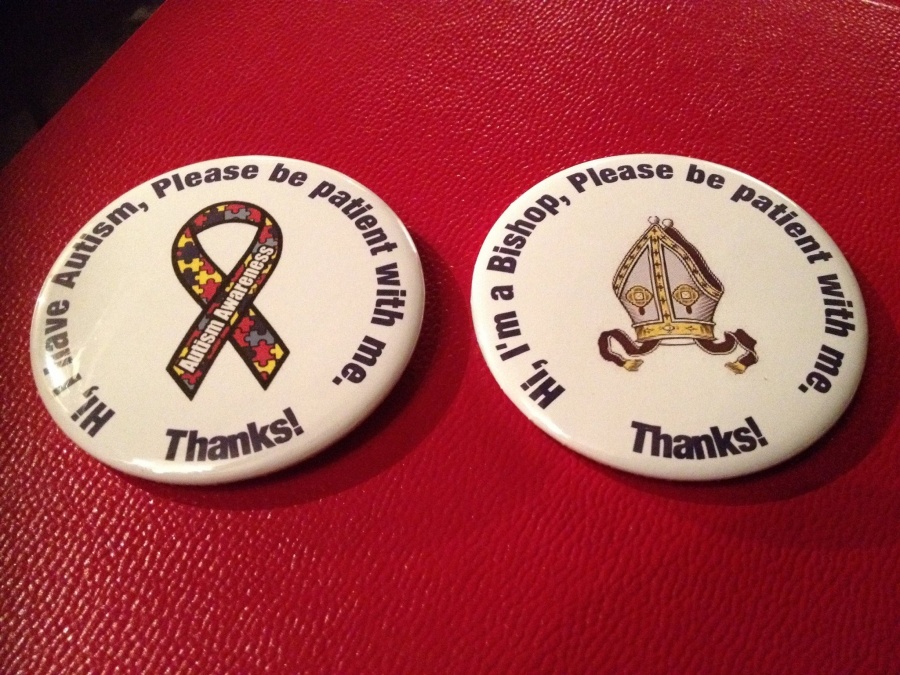
I thought this is wonderful, from our diocesan website.

please-be-patientBishop Damien Mead does a lot of work for autistic kids. I love the way he does so without patronising! So he came up with this idea. He and some of his autistic children are working in the shop in Canterbury to give the usual shop manager time for her holidays.

Indeed, we clergy need patience and indulgence as we struggle to do all we can to serve the communion of the Church.

Posted in Uncategorized | Tagged | 1 Comment

Can Mass be celebrated outside a church?

I got this question today in my search box:

Can a catholic orthodox priest celebrate mass outside a church?

The person might have been looking for an older article, and perhaps found it.

The ideal is that Mass is celebrated in a consecrated church building. It can also be celebrated in a simply blessed oratory or chapel. It can also be celebrated in a home or a suitable secular building for pastoral reasons (eg: for the sick or a congregation of people unable to afford a dedicated church building).

In a way, where Mass is celebrated, that place becomes a church even if only for a short time. I have celebrated Mass outdoors, for example on a rock on the Glénans islands on on the tailgate of my van using my tuck box chapel. Many priests have done so, because no consecrated church was available to them.

Posted in Uncategorized | Tagged , | 3 Comments

Relating to the World

I had a strange dream last night, a conversation with an English-speaking Benedictine monk in the south of France. The person exists, and he and I have had warm and cordial correspondence over the years. He and I share a passionate interest in liturgical studies. The dream was a conversation in which it was concluded that I had nothing to offer the Church. No doubt, this bleak judgement came in my subconsciousness from the time when I was still in the TAC and Archbishop Hepworth was telling me it was “going to be all right” and the facts were saying just the opposite.

I woke up fully and thought it through. We are here to achieve something and offer it to the world. We all seem to have read the Parable of the Talents. It can be anything like writing a book or setting out on a voyage, or engaging in humanitarian work, just continuing with a ministry of intercession and the Mass. There are so many possibilities, including this modest blogging. I thank God for not having “writer’s block” for more than a few days at a time or a week at most. The conversation in the dream amounted to my death, or spiritual death, the death of a vocation – whilst there is still life in my body. I am active and in good physical health. The Benedictine monk was good, warm and pleasant – but could have nothing to offer.

What I seem to have discovered is that the Church has something to offer us and to everybody, and that we have something to offer to the Church and the whole world. Fortunately the Church is not an institution or a “perfect society”, but a Sacrament of Christ. Like the Blessed Sacrament, the Church can be visibly broken and yet retain its unity as one Body of Christ. We try to manufacture unity and get all the eggs into a single basket, but the unity is already there and lives in us all.

Churches are certainly brought to the same apparent impasse as when I was conversing with the monk in Dreamland. They are told that there is nothing to do, nowhere to go except submitting to death and oblivion. The world is changing and we Christians flounder like so many fish as the water drains away. We continue in our “true-church” claims and jurisdictional squabbles, the Orthodox like Roman Catholics, Anglicans and other communities.

The Church and Christendom have had their long histories characterised by asceticism and beauty. Now, in the western world, and in many parts of the east, north and south too, we can’t drive for a few minutes without seeing a church in a village or at the side of the road. The symbols are all there: the wayside calvaries, statues on street corners in our towns, the relics of bygone popular piety. City parishes do quite well, but it’s dead out here in the countryside.

Christians often think that the solution is marketing and advertising – in the same way as businesses compete for customers potentially needing (or thinking they need) their products and services. Some churches still send people in twos to sell the goods door to door in the way glitzy salesmen used to push vacuum cleaners. In other eras, the Church came to the help of the poor and the sick. We now have a welfare state, and giving to it out of our earned income is mandatory. Here in France, we not only have the French equivalent of Obamacare, but also for our pension fund and what finances unemployment benefits and benefits for children and handicapped people. That doesn’t include income tax levied by the State. We are charged so much that we barely have anything left to give to charity after paying our bills and the ever-spiralling costs of energy and food. What can the Church offer there? Little more than words now that the liturgy has been taken away from most parishes…

I come back to my question – What have we to offer? There are holes in the welfare state and needs they don’t cater for. These have to be looked for. One area secular society is not interested in is death, from caring for the dying to caring for the bereaved. Hospice care is expensive and can be more than short term, and the quality of care decreases when priority has to be given to curables. The cost of funerals and undertakers is staggering. The Church used to have confraternities for burying those whose families couldn’t afford expensive obsequies organised by firms of undertakers. Most of us would want something simple so as not to be a burden on our families. A niche seems to be open, but such things in our modern world are increasingly regulated, so that (like health care) the only way is to insured for the colossal costs.

There is a need, not for charity or moralising, but for spirituality and beauty. Those who are attracted to such things are, like myself, greying and ageing – and who are used to thinking in such terms outside the pressures of the materialistic world of money and social status. These things are matters I have already discussed, and perhaps a church that has nothing to offer, no raison d’être, has only to fade away. Many Christians hope for a return of the old ruling class, empires and kingdoms, or failing those, authoritarian military junta regimes. But all those things are in the past. Christianity can no longer depend on the old models of society. What would the “Benedictine monk” say on behalf of the world? You are canonically irregular and  nothing can be done about it. Is that not the sentence pronounced by the judgement of secular society?

Coming out of this, we would find the notion that Christianity is there for those who want it as an ideology and philosophy of life. There are many others, old and new. Many of our contemporaries feel that we kept our captive audiences in the past through irrationality, which has since been cleared away by science and rationalist philosophy. Of course, the further science goes, the less it fits into the secularist’s world view, and again we are faced with mystery and the transcendent. The materialists have also reached the end of their tether. They have nothing to offer, and they have been overtaken by their own science.

The only thing the Church has to offer is a vision of transcendence through the beauty of holiness, through the liturgy. I have often suggested the idea of some kind of monastic life adapted for married people and families as well as celibates and ascetics. Such communities do exist, like the Amish and various Catholic charismatic communities like the Chemin Neuf. Not everyone is made for hothouse life or yet another life involving competition, social status and the strong lording it over the weak. Even if all we want to do is offer a solemn liturgy, there has to be a full “crew”, not only at the altar but in the organ loft and the choir stalls.

Something has broken. Churches and anything more than individual costs money. That money has to be earned or collected from people who are already overtaxed and overcharged for the welfare state. We have no alternative to carrying on with the old “baggage”, because we know nothing else. We are attached to our liturgy, artistic culture and we ways we do things – but few others are interested.

What we offer is not going to be in exchange for people coming to our churches. Our gift has to be gratuitous and invisible, the left hand not knowing what the right hand is doing. I am made to think of the grain going into the ground as the only condition of it growing and producing fruit. Nisi granum frumenti cadens in terram mortuum fueri… There are still places in the world where churches have a market among greying people of my age and older with a religious culture and interest in “churchy” things. Whether that market is increasing or decreasing in those place, who can tell.

We have to be faithful. I may indeed have little to offer, as I answered that question from my Bishops board of ministry when it interviewed me last year. I told them I would be of no use to them whatsoever except what I can do as a priest – offer the Holy Mysteries of the Mass for the redemption of the world. Say that to anyone other than a Church, and they won’t give you the time of day. That is the difference between the Church and the modern world. The Church welcomes useless people like myself, and the world throws away its trash when it is no good any more.

We have everything to offer to those who have nothing to offer! Blessed are the poor in spirit…

Posted in Uncategorized | Tagged , | 4 Comments

Blaming Hippies

I occasionally look at Fr Zuhlsdorf’s blog, and find his articles worth what they are worth. This one hit me – Are the aging-hippies burying Benedict’s legacy?

As I mentioned in an article a few days ago, I have never been a hippie, even though I had some contact with the trailing edge of that subculture in the very early 1970’s as an early teenager. Fr Z is talking about churchmen and so-called “experts” in liturgy, albeit of a “progressive” ideology.

First of all, the hippies eschewed all institutional religion or any symbol of what they perceived as institutional oppression. Progressive churchmen are anything but  freedom-seeking anarchists and “artists”, but rather are conservatives and bureaucrats maintaining a status quo or neo-orthodoxy. They are establishment men, defending something they believe should be permanent in the Church.

Fr Z’s article would deflect the blame from conservatism for the way the so-called liberals wish to “bury Ratzinger” and bring back the anti-traditionalism of the 1970’s. To be a good Catholic, you have to be conservative (and conformist).

In my experience of life, I just see one kind of conservatism in conflict with another kind of conservatism, whilst creativity and freedom are suppressed both by some traditionalists and those who would impose the type of liturgy that has been in vogue over the past forty years and more.

Catholic tradition is not conservatism, but rather spiritual communion with the whole of the Church in space and time. Many of the saints’ lives were marked by eccentricity and unconventionality. Their law was that of grace, love, beauty and freedom.

I defy some of those Catholic liturgist bureaucrats to grow their hair long and eschew the establishment. Some of those men are rather more like the dull grey characters one would find on the Board of Directors of your bank!

Update: I had already written this reaction to Fr Zuhlsdorf’s article when I saw Deborah Gyapong’s The divide among Catholics. She approaches the question more from the point of view of how different groups of conservatives live with a liberal status quo in terms of the kind of democracy and religious freedom on which the American Constitution is built. Here in Europe, conservatives tend to appeal to the old union of the Throne and the Altar, the Catholic Kingdom.

I won’t go into these questions that I find very tiring and energy-consuming. No form of government is perfect, and all forms of authority and politics work against the freedom and dignity of the human person. In terms of art, and even technology and science, man’s genius was always manifested in persons who had the courage to break with the “system” and the “mould”.

The Sabbath is made for man and not man for the Sabbath.

This being said, I see a healthy sign in some companies and their methods of designing new products and organising projects. Instead of crushing conformism, they begin to reward unconventional thought and “brainstorming” in the awareness that human progress comes from individual persons of talent and not from group thinking. This is interesting. Perhaps Churches will take another fifty years to catch up with the leading edge!

Posted in Uncategorized | Tagged , , , | 2 Comments

Brother Charles Vockler RIP

I have received the sad news of the passing away of Brother John-Charles Vockler at the age of 90. He was the predecessor of our present Metropolitan Archbishop Mark Haverland. We thank God for his life and ministry, and pray for the eternal repose of his soul.

Please see RIP: The Most Reverend Brother John-Charles, F.O.D.C. by Bishop Damien Mead which contains a message by Archbishop Haverland.

Posted in Uncategorized | Tagged , | Leave a comment

Liturgy, Saint Agatha and Fr Hunwicke

I’m really happy that Fr Hunwicke is in back in full production. I really do appreciate his erudition and vast experience as a parish priest. I certainly would not like to cause him any pain in this blog, still less quote him out of context. His blog is there for the reader to examine the articles fully and draw his or her own conclusions.

Fr Hunwicke has his own experience and I don’t know the guys in Brentwood. However, this article reminds me of some of my old liturgy classes at Fribourg University. Liturgical history and liturgical theology are matters you can’t do too much harm to. When it comes to learning to compose your own Eucharistic Prayers, I have to admit it goes rather too far. I had the impression of being in a cookery class with the meat, vegetables, spices and herbs and all the various pots you use to turn the ingredients into a dish! We had the anamnesis, the epiclesis, the words of institution, the diptychs – and I wonder if we were any the wiser at the end of it all. There was a religious sister in my class who always said how things made her feel. Perhaps it would have been kind to give the poor lady a fine silk blouse and tell her to enjoy wearing it!

As the old joke goes, you can negotiate with a terrorist, not with a liturgist.

I too have my memories of St Agatha’s church in Portsmouth. The big “do” there was the TAC College of Bishops meeting in October 2007, where the big item on the agenda was the movement towards the Ordinariates. Those few days were quite electrifying as we had Mass and Office in that fine church and heard rousing addresses and speeches by Archbishop Hepworth. This Letter was signed by the TAC College of Bishops in this church on 5th October 2007.

What did I think of such prospects? Certainly, it was all exciting as things seemed then. I really believed that the legalistic and bureaucratic underpinning of the Roman Curia was in some ways being dismantled by Benedict XVI in a kind of Catholic perestroika and glasnost. It would have been the only way the TAC could have become some kind of “uniate church” of Anglican tradition. Surely, the Church could dispense from canonical irregularities for the sake of a noble objective. Furious Curial and Papal backpedalling combined with the wishful thinking of Archbishop Hepworth, who one moment was leading a respectable-sized international ecclesial body, and was nobody the next moment. I was present at the meeting, but as a humble priest with no say in anything or decision-making power.

I returned to St Agatha’s in October 2010 for the Diocesan Synod presided over by Archbishop Hepworth and Bishop Moyer. I still have recordings of the speeches, which I have not had the stomach to listen to since then. Fr Maunder allowed me to celebrate an early morning Mass at the Lady altar, which I did in Latin according to the Use of Sarum. It was the feast of Saints Simon and Jude, and there was an elderly Church of England priest from Oxford in attendance. I remember the peace of those moments in that lovely church. Such a privilege would be denied me now if I asked for it, since I am not in communion with Rome as they are now.

St Agatha’s to me is a little like the Victorian house in which I spent my childhood. I would never go back, because I could not face the changes that have happened, either physical or moral. I am happy for the priests of the Ordinariate, but I suffered in those years 2010 to 2012. I did what I believed to be my duty by blogging the way I did. I was bitterly disappointed by Archbishop Hepworth when his impassioned words come to nothing, at least for him and many who stayed in the TAC. I will not return to St Agatha’s, ever.

St Agatha, the Virgin and Martyr who was horribly mutilated and killed for keeping her virtue, is one I now associate with my late mother. They share the same dies natalis, at least symbolically (I think of the change from the Julian Calendar to the Gregorian in 1752). May they be together in singing the Liturgy of Heaven!

Posted in Uncategorized | Tagged , , | 8 Comments