Diocesan Synod

logo_dukOur Diocesan Synod is announced – Synod 2014. It will be occurring at the usual place preceded by a Pontifical Mass celebrated by our Bishop in a lovely bright hall that lends itself very well as a church. I have already booked my sea passage and will be attending.

It is important to keep in contact with my brother priests and Bishop, and with the faithful who give dedicated service to the Church, year after year. The meeting will discuss routine business, but this is all part of our family life and the future we are trying to build.

Posted in Uncategorized | Leave a comment

One Year On

mum

Today is the 5th of February, the feast of Saint Agatha and the first anniversary of my mother’s passing. I will be specially remembering her at Mass today.

Requiescat in pace.

Posted in Uncategorized | Tagged | Leave a comment

Grenouilles de Bénitier

This is a lively one from Patricius – Parish squabbles…

My wife has often mentioned three ladies who sang in her childhood parish at Chouzy sur Cisse near Blois, actually, where she and I were married by Archbishop Hepworth with permission from the local Roman Catholic authorities. They were nicknamed La Moustique Femelle, La Chèvre et La Tarte. Sophie does a wonderful imitation of their warbling vibrato voices, constantly singing flat and completely absorbed by the task in hand.

The French have the term grenouille de béniter to describe very devout and bigoted ladies who tend to get the upper hand in a parish if the parish priest and men let them. The image is dramatic, that of a neglected church and a holy water stoup that is green with algae, and a pair of amphibian eyes popping up now and again above the surface. This image is unconnected with the fact that frogs’ legs are eaten in this country (a bit tasteless and awkward to eat, even with a garlic butter sauce, in my opinion).

grenouilleThis odd holy water stoup in the collegiate church of St Paul in Narbonne is carved with a representation of a frog. The legend goes that the frog was a real one and started croaking during Mass and was petrified by God. C’est minion!

I have known some real characters along the way, but it would be unkind of me to mention names. Hell has no fury like a woman scorned.

Actually, I am very modern about many of these questions. Whatever is wrong with one sex can be found with the other. Where you get dominant men, bullies and guys without any empathy for other people, you get the equivalent in the feminine sex too. Both men and women were guilty of heinous crimes against humanity in the Nazi concentration camps. Many women were tried and executed after World War II, one of the most notorious examples being Irma Grese. When women are evil, it is that much more shocking, since we expect men to be evil, but surely women are soft, gentle, compassionate and tender. Not always. The problem is not gender or sex, but simply human nature.

Parish priests can be just as plagued by interfering men as women. The only difference seems to be that men and women in a parish usually have different interests. Men would be more fastidious about the liturgy, and women about what “feels” best to them and what is most “relevant”. I am married, and think I have some experience of relating to the opposite sex. I don’t think men and women will ever really understand each other, but they do respect us if we stick to our guns and show character – and the other way round.

angry-wifeDomineering women can be terrible. My wife and I know one who runs a choir here in France, and also runs her local parish. My wife stuck it out longer in that choir than I did. I managed to get the nickname Whacko stuck on her – because of the double meaning between the ever-punishing English comedy schoolmaster and the meaning of the word without the “h” – someone who is a little soft in the head! Nicknaming is something we do to relieve tension and relativise the tyranny a dominant person exercises over others. The lady in question is in her 60’s, about five feet tall if that, and you can imagine the rest…

I have had quite a bit of experience of parish life, and some people can be real “control freaks”. Certainly some men are more interior and self-effacing, but no all by any means. Some women are dragons, but not all by a long chalk.

We can get awfully cynical (modern meaning of the word) about women and excessive emotions, whims, attention to detail to the detriment of the whole. For example, Sophie and I decided to give the kitchen a complete clean last Saturday (yes, we do the household chores together), and she launched into all the details. My question to her was how much time we were going to put into the job. When that was agreed, she realised that some kind of compromise between getting the job done and doing it well had to be made. For most things, it just takes a bit of communication and reasoning things out. But we men can get tired of having to negotiate everything! That is when we get impatient.

There are female characteristics in terms of psychology as well as the physical differences. They have different hormones than we do, and they relate to children and pets differently from men. I’m not talking about stereotype “macho” men, but just ordinary guys like most of us reading this blog. When women get “bad” in church, like in married life, they can really put us off. The essential thing is communication, and when that is not possible, the technique of the “time-out”. When children are naughty, you send them to their rooms until they calm down. With a wife, you walk out of the room and refuse to feed the poison (or whatever image you choose). Women often forget everything the next morning, and a domestic tiff is not worth a vendetta. They too have their self-justifying devices, and you sometimes just have to ride it like a roller coaster.

I would not like to be a dominant man who dominates women and other men. I have a profound belief in gentleness, softness and tenderness – qualities usually attributed to women (except when their hearts are as hard as industrial diamonds). We all have our animus and anima (as in C.G. Jung’s theory) and we seem at our happiest when we find the balance. Many of these problems can be solved by communication and reasoning out a conflict, even if a time-out is needed to get over the emotions.

The important thing for us all is having a sense of empathy and the other person’s good at heart. When someone is so self-absorbed that no empathy is possible, then it doesn’t seem to matter whether the “poison” is male or female.

Posted in Uncategorized | Tagged , , , | 2 Comments

Hobbyists and Tolerance

I think most of us get passionate about the things that interest us, and we occupy our spare time with hobbies. I am no exception. I do not have a full-time “professional” ministry as a priest, and have a fairly boring self-employed job as a technical translator. Life is fairly full living a married life and the upkeep of our house. During the season, I take the boat out to sea and enjoy sailing. I have kept up this blog now for two years, which is my main teaching ministry as an Anglican priest. My wife and I both sing in a quartet, a choral group and have singing lessons. The little pipe organ in our house still gets tuned, maintained and played. Music is a big part of our life. We still have a dog and two cats, so life is reasonably full as for most people.

Most of us who are Christian believers would place our spiritual life above “hobbyism”. For us, Christianity is a philosophy of life that governs our political opinions and other decisions we make in life. Ideally, we live in a community that is inspired by Christian ideals of authentic humanism and humanitarianism. Christianity is to our lives what a rudder and sails are to a boat. Our hobbies are activities that enrich our lives, since they teach us new things and open our minds to fresh ways of seeing our world, whether in terms of people, human culture or nature. Travel and contact with other cultures is also a way to enrich one’s spiritual life and mind, bringing us into greater empathy with “the other”.

There is a more unfortunate side to “hobbyism”, by which people become narrow and intolerant. We get interested in something, and because we are social creatures, we tend to look for others who like the same thing. Thus we have associations and clubs for everything from stamp collecting to football, to collecting and driving vintage cars to my own “thing” – sailing boats and sailing. For religious people and those who interested in theology, liturgy, etc., there are churches. The internet has opened up a whole new world. Diversity is both a wonderful gift and a challenge, because it challenges our own “truth system” and relativises it. Someone who believes in a “truth” also believes that everybody should conform to it. Otherwise they have to accept that there is some kind of greyscale between true and false, black and white, etc. This blog tend to attract those with classical liturgical and cultural tastes, though with differing degrees of commitment at one end and fanaticism at the other end. The balance is very fine and difficult to find without oscillating between one extreme and another.

An article came up from the keyboard of a friend – Women…. His words:

Call me whatever you like but I have yet to meet a woman who knows the first thing about Liturgy…

I wonder how many patients in the surgical ward at the hospital know as much about their own bodies as the surgeons. These words are provocative (I like Patricius, but he sometimes makes me wince!), and some of the comments are revealing. There must be some women who have become knowledgeable about the liturgy when they study theology at university. They have another view of liturgy, as the closest they get to the liturgy (in churches that don’t ordain women) is the choir loft or their place as churchgoers in the nave. Most women have the same amount of knowledge about the liturgy as I have about what a surgeon did to me (I was under a general anaesthetic) when he repaired my hernias! He gave me an explanation beforehand and showed me diagrams and photos, but in a way as I could reasonably follow. Women, like any Christian lay person, go to a church service that encourages them to pray and affords them a certain amount of dignity in keeping with even the most moderate feminist aspirations. I might be called a renegade by some, but I do allow women and children to read the Epistle (Old Testament reading or from the New Testament outside the Gospels) at Mass. We also sing the sung parts of the Mass together. In the absolute, I see no reason why they may not serve Mass, except that we live in a politically-loaded world and anything granted at a general level tends to lead to other things. We have indeed to be careful that our own hobbyism doesn’t take away from common sense, a pastoral sense and a spirit of tolerance.

I think my readers are familiar with the possibilities this blog gives for finding old articles, especially the “search” box and the cloud of themes in the right-hand side bar. I have striven to keep this blog at the highest possible quality, notably by keeping the trolls out. We recently had a problem with anonymous posters pretending to have organised a kind of private inquisition to purge the clergy of various major and minor churches. That seems to be another hobby, a “sport” of those who would do the same thing to blogs as young city vandals do to the very public telephone that could save their lives in an emergency. I try to be fair, and gave those trolls a chance to explain themselves and write something credible. They failed miserably, so the best thing is simply not to feed them.

This blog is mainly about my commitment as an Anglican (ACC) priest and things I like to share with others without wanting to make them mandatory. I love sailing, but if everyone did it, the sea would become as miserable a place as our roads where some very unpleasant people sit behind the steering wheels of their vehicles. Already, there are some unpleasant people in boats, but most I know have the instinct, not only of saving lives in danger, but being of help. Perhaps the tolerance comes from fewer of being interested in that particular hobby.

Failure to respect and tolerate diversity gives Christianity a very bad reputation with atheists. Atheists tend to believe (or at least say) that nastiness and intolerance are intrinsic characteristics of religion, a least until we find them to be even nastier than we are! In our life journey, in terms of spirituality, the other “serious” things of life and our hobbies, we need to explore and find our own way, our own identity and aspirations. We don’t need any other justification than fulfilling our own vocation and inner aspiration, being what we have always been. Such ideas certainly sound “post-modern” and not characteristic of a conservative Church, but our Church has learned many lessons over the past couple of decades. We are here to follow Christ’s calling, not to conform to someone’s half-baked ideology of what he thinks of as a mandatory truth for all.

When people fail to see the whole of the human experience, or at least more of it than what is in our little universes, we tend to get angry with other people who have other ideas and seem to challenge our own. One thing about running blogs for the last ten years or so is learning to be thick-skinned. There are many people out there with a connection to the Internet for whom religion has become an ideology, an all-consuming hobby. They would be better without it, at least for the time it takes for them to “get a life” and integrate their light and darkness, animus and anima, or however one wants to put it.

Certainly, I have made as much of a hobby of blogging as anyone else. The important thing to realise is that the outside world is bigger and more diverse. This idea should be the tool we use to keep ourselves within limits by a healthy dose of asceticism. If we show ourselves to be intolerant of the diversity of others, others will show less tolerance to our claims of freedom and diversity. I have seen some of the stick my friend Patricius has had to deal with. Generally the critics identify the wrong issues and they are totally à côté de la plaque. It doesn’t help to call someone who prefers the liturgy of before 1950 a Gallican or a spook from Peter Anson’s Bishops at Large. Perhaps those critics should be given the possibility of going to the Novus Ordo or being burned at the stake! Tolerance narrows and narrows until it disappears up its own *%@!*§?…

Should England revert to Sarum? I certainly wouldn’t be against it. However, if that happened, it would be like millions of boats queuing up outside ports and navigation channels, pooping their horns at each other and getting angry, instead of the sea being a peaceful place. We are a more populated world than in times gone by. Personally I prefer the freedom of diversity to having to suffer the consequences of everybody being made to do things “my way”. I would hate it! Anything becomes ghastly when it is generalised and commercialised like Christmas.

Aesthetics above doctrine seems to be another thing that gets people going. They sometimes fail to see that without aesthetics, many people would never have had anything to do with churches. I don’t think I would have. Some very unhealthy trends sprang up as a result of Anglo-Catholicism, to the point of a character in Evelyn Waugh’s Brideshead Revisited talking of sodomites with unpleasant accents. Does that give complete reason to Protestantism and philistinism? No, it doesn’t. Does the fact of one person shoplifting in a supermarket justify the systematic searching of all customers?

It is indeed a temptation for some of us to enjoy living in isolation. As some have suggested, living in isolation from a church community, except those times when I get over to England for our Diocesan Synod and other special occasions, is not particularly good for good judgement and spiritual life. There’s not a lot I can do about it, unless (as I pointed out a short while ago) someone pays for my emigration to a country where someone is offering me a stipendiary benefice with all the perks. Whilst I am living on my money and work, then I can only do the best where I am, be it in a spiritual desert. When the game was over for Archbishop Hepworth, I agonised about becoming a Roman Catholic layman. I have yet to find out what good would come out of that. Rocks and hard places, I suppose. I am happy in the ACC and I keep in contact with my brethren and Bishop outre Manche.

Imagining our own church is a great temptation, and I have found that the best antidote is living in secular society and relating to people on a basis of candour and simplicity. The ACC means precious little in France, much less than the idea of the TAC being the basis of the then-future Ordinariates. From late 2009 until late 2011, I used to be invited to meet up with the French celebrities of the traditionalist world, speak on the radio, be photographed and interviewed for magazine articles. Now I am nobody, and I think that is better. I just got used to it and get on with life – and remember that I am still a priest. I am under the jurisdiction of a Bishop, like I used to be under Archbishop Hepworth. We serve God where we are.

As the years pass, the lustre wears away. If we age gracefully, we mellow and worry less about things. It is good to take a step back and not assume that we know everything about our particular “thing”. I often envy those with la foi du charbonnier and the simple womenfolk and their devotions. Last time I was in Lisieux and seeing busloads of Spaniards making for the bondieuserie shop and making a lot of noise, I wondered – like any good Protestant – whether their pilgrimage did them any good as Christians. At the same time, who am I to think myself as any better or more virtuous?

Some of us, in all modesty, have a certain “prophetic” sense and fear the intolerance of the “hard-line” traditionalist. Those people feel really challenged when their idea of all the problems starting with Vatican II is called into question. I do believe that most churches lost their savour at differing times in history. I do believe that the liturgical and sacramental dimensions of the Church are vital, if we believe this is the way by which Christianity continues to be something real through the presence of its incarnate God. If that dimension is eroded, then Christianity seems to be at best a noble variation of Cynical philosophy, and at worst yet another political ideology. Problems go back a long way, and probably to the very foundation of the Christian Church. Christ saved us through human imperfection, a mystery we find it so hard to come to terms with.

Some do make a very good point of what can happen when a young person with strong convictions flip-flops and goes to the other extreme. As we get older, we begin to give priority to other things in life or integrate our passions and hobbies, so that they become facets of a beautiful diamond. There are many young men (few women) who are extremely zealous. Perhaps when we hear no more from them, it is because they converted to Islam! There used to be a young man in England who went from traditionalist Roman Catholicism to neo-Nazism (!) and Jansenism. He developed a website that is still up – Rigour. He used to write unpleasant comments just about everywhere, but he seems to have disappeared. Fair enough. Perhaps he is discovering wisdom and the joys of self-questioning.

I hope the experience of life has enabled me to find the balance between writing things of interest, and integrating everything into life that can be lived in relationship with others we either love or at least put up with.

Posted in Uncategorized | Tagged | 4 Comments

A Most Amazing Musical Instrument

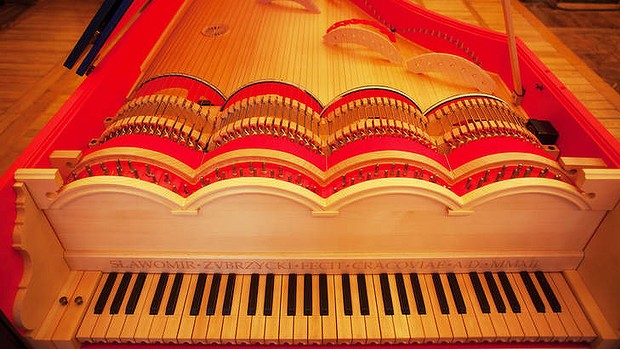
Many years ago, I did a course in harpsichord making in London, with some experience as an apprentice organ builder. Naturally, I became quite knowledgeable in keyboard instruments, their technology, building and tuning. The Viola Organista is one I had never heard of. It is described in Leonardo Da Vinci’s wacky piano is heard for the first time, after 500 years.

viola-organistaThis instrument actually is not a piano, nor is it a harpsichord, nor an organ. The pianoforte hits the strings with little wooden hammers covered in felt. The harpsichord plucks the strings with a jack containing a hinged plectrum made from a turkey feather quill. The organ blows wind into flue and reed pipes by means of a wind generating system and a mechanism operated by the keyboard.

This keyboard instrument was devised by Leonardo da Vinci, but it was never built in his time. Most of his other inventions also had no practical application at the time, like for example his helicopter and other flying machines. A Polish instrument maker and musician by the name of Slawomir Zubrzycki has built this instrument called the viola organista.

It bows the strings by means of mechanically operated wheels. The keys press the strings down onto the bowing wheels, and the sound is like the baroque viola da gamba. The notes are sustained like those of a pipe organ.

Here is the instrument being played in a concert.

The sound is very beautiful, and the instrument is beautifully built and decorated. Several instruments other than the organ and wind instruments have means of sustaining the notes. One is the hurdy gurdy that bows its strings with a wheel whilst the player presses the strings down onto the fingerboard. Another is the glass harmonica made famous by Mozart. We have all rubbed fingers on the rims of fine crystal glasses and listened to the pure notes. The glass harmonica takes it all a step further.

Posted in Uncategorized | Tagged , | 1 Comment

Retro 1950’s

This is an interesting article with photos – The people who are STILL living like it’s 1951: Captivating portraits take a look inside America’s Rockabilly community. My hat tip goes to John Beeler for this link. History is characterised by forward and retro-revival movements. Often, the revivals had little idea about the underlying principles, philosophies and cultures. An example is nineteenth-century medievalism. Even that developed into a beautiful yet short-lived movement around the Arts & Crafts and Modernism – laid waste by two world wars.

Some time ago, I wrote Retro-futurism in which I offered musings about alternative cultures. In that article, I described a tendency to revive old cultures, and yesterday I looked into one of the more modern cultural movements that had its influence on many of us. The downside is often an attraction to trappings and eye-catching symbols and a serious misunderstanding of the philosophical underpinning of a given movement.

Comments by Stephen K and Ed on my article of yesterday are particularly illuminating:

But generational influences only go so far. It is not whether one is a pre-War, boomer or X or Y-er, but what you think and feel. When I was young, I imbibed the implicit or subliminal values of the contemporary society that came about as a result of the confluence of the influence of many things, but in some ways many of those values were conservative and less selfish than today’s. Today’s young religious conservatives forget that their traditionalism is a revision and extrinsic to a large degree – like a pasteurised confectionery – and not mother’s milk, and the two taste quite different, if you know what I mean. My own outlook is that there’s little that’s new under the sun, that one age’s problems are no more or less diabolical than another’s and that no religion or political party has all the truth. There’s a part of me that is drawn to the non-materialist life. I have two ideal holidays – one to sit around a pool at a tropical resort just reading books and drinking ice-cold beer; the other, to spend time in both a quiet Cistercian monastery and a Buddhist monastery (the former for depth; the latter for expansion).

Pastiche is always something rather questionable, especially when the underpinning is weak or absent. This was something fascinating about the rise of Nazism in the 1930’s and its attempted restoration of old Germanic mythology and the half-baked medievalism of the Nuremberg Rallies.

We do well to avoid following movements. Instead, we need to look within ourselves and our world for a good philosophy of life and spiritual health. There are many movements around us including caricatures of the future. We just need to be ourselves and connect with cultures and spiritual philosophies as they still exist among us.

We fear the future and misunderstand the past. Sufficient unto the day is the evil thereof.

Posted in Uncategorized | Tagged , | Leave a comment

The World of the Hippies

hippie-caricatureOver the past few days, I have been reading bits and pieces about popular sub-cultures in the 1960’s and 70’s, from teddy boys to the rival gangs of Mods and Rockers in the 60’s. There are other sub-cultures today, usually associated with types of popular music and stereotyped fashions of dress and other visible identifying marks.

Why take an interest in such a subject? Chiefly, I read a traditionalist article Now it’s a Trifecta about the possibility that Pope Francis would allow progressives in the Vatican, religious orders and educational institutions to take the Church back to the 1970’s. I would like to examine some of the fundamental ideas some people have about the 1970’s. It is assumed to be a time when young people became morally degenerate, started doing just what they wanted and – when such a mentality affected the Church, it caused the liturgy to be secularised and banalised and heresy to be taught in the place of sound dogmatic and moral theology. I have a feeling that many of these judgements, caricaturing the attitudes of the pre-war generation (sometimes called “the silents”), the parents of the baby boomers (c.1948 to c. 1962), are made by those of the “X” and “Y” generations. At the end of this article, there was a description of Rolling Stones fans as people who all have grey hair,  are a bit paunchy and are all in their 60s and 70s. In other words, “You old codgers have had your day and a new generation will take over”. That is indeed so as the years pass, and we all take our turn in seeing our hair drop out or go grey, having moments of alarm and embarrassment on the bathroom scales and seeing young people living a different life – or perhaps not so different apart from the technology.

I mused the other day in an article that probably most of the folk reading this blog are boomers. The baby boom came in two phases, according to the cultural referrers of people coming of age in the late sixties or the late seventies. Boomers were born after the war, but were still soaked in the aftermath, knowing parents and grandparents who were in it as children or young adults. Someone born in 1948 came of age (today’s standards – 18) in 1966. I was born in 1959 and was 18 in 1977. The Americans lived that period very differently from we British. I had a sheltered childhood, but I did not miss the signs. In the 1960’s, I heard the music, the Beatles and other groups and saw groups of young men riding motor scooters. My brother, born in 1953, went to university in 1971, in the thick of the youth sub-cultures. By 1968 (aged 9 years) I began to understand that there was a movement challenging the old order.

In 1971, my parents sent me to a school in Yorkshire that was founded during World War II to resettle the kids of the Blitz, founded by a remarkable man, Kenneth Barnes. This establishment was called Wennington School, which when I went there was headed by Brian Hill. This remarkable social and educational experiment is the subject of many reminiscences of aspiring and noble souls. I was only there for two terms, since the “experiment” did not go to my parents’ satisfaction. Ingmanthorpe Hall near Wetherby is a place of many memories in its many uses from being a country house to its use as a school. Naturally, I was fairly well exposed to the changing ways which I did not yet fully understand. Looking back at this experience, I have mixed feelings, having read books like Lord of the Flies, about the best and worst of human nature when freed from the constraints of coercive authority. To this day, my old sympathies with anarchism have never left me, though they have had to be tempered with a dose of “realism”. The sixth form had the privilege of being allowed down to the cellar of this big house. The dominant personality was called Barkis, an eighteen-year old who would have been about a year younger than my brother. His style of dress and manner of talking was entirely hippie. The cellar was painted with psychedelic lettering and images in the style of the time and was to us juniors almost a place of mystery. Of course, drugs like LSD or cannabis were strictly forbidden, as they were (and are) illegal in England.

There seemed to be an extreme expression of the sub-culture in Barkis’ Cellar, and a hint of it in the mainstream of the school. We had no uniform, but there were rules we had to obey. Infringements were sanctioned by “community service”. We called teachers by their Christian names. In keeping with the Quaker philosophy behind the school’s foundation, daily assembly consisted of a poem, a reading of a newspaper article that Mr Hill thought was important for us, and a moment of silent prayer. We could either pray to our God or look at the birds in the trees outside the window! I was away from there by Easter 1972 and prepared for a more classical education.

This experience of mine at this time taught me what the 1970’s were really about. Those years were a kind of transition between the old order, in which people could be extremely bigoted and cruel, and a particular interpretation of the movement. The world would go from that cruel bigotry to new forms of bigotry, fear and discrimination. The 1970’s were also a time of aesthetic brutalism, contempt for the classical and the beautiful. Everything had to be modern. This struck me particularly in the north of England where I lived, the equivalent of our time of the dark satanic mills of William Blake’s Jerusalem. I was brought to yearn for a life in the south of England where I expected to find more liberal attitudes.

I think my experience equips me for an intuitive examination of this sub-culture of so-called hippies – of then and now. My first impression of hippies like Barkis at Wennington was that they are not bad or degenerate people, but immature and extraordinarily naïve. The foundation is noble, and corresponds with many movements in history with which I sympathise, but the appearances were of varying levels of value from the hand-painted Volkswagen campers to long hair, the use of drugs like cannabis, free sex, the kind of popular music they listened and danced to and their rejection of institutional religion. There seems to be two levels – one much more philosophical, akin to (ancient Greek) Cynicism and anarchism, and the other as a childish revolt against authority and the trappings of the sub-culture.

What interests me is the philosophical dimension, the bedrock which can adapt to changing times and fashions. Like my brother, I have always been interested in “saving the planet”, doing everything possible to resist everything man does to lay waste to our environment. We love nature, whether it is on the sea, in the mountains, the forests or the North York Moors, where my brother has taken me for many killing walks of more than fifteen miles! The essence of this kind of philosophy is a simple life rejecting “conventional” desires for things like power, wealth, fame, power and material possessions. It is what we read in the Gospel, the simple life taught by Christ, a kind of archetypical Socialism. Such a notion would condemn sexism, racism, hate speech and discrimination. It would promote our education into a new paradigm, one of the highest level of self-sufficiency and equality between persons and peoples. This is cynicism in the philosophical meaning of the word, and not that of knowing the price of everything and the value of nothing, to quote Oscar Wilde as he hit out at the modern cynic.

There are several core principles of cynicism which can be found in the world in which I spent my childhood: the purpose of life being the quest for happiness and harmony with nature, a new way of thinking in a positive attitude, freedom from money, power, greed, etc. Self-sufficiency is found in living virtuously and in agreement with nature. Suffering is caused by bad judgements of value, leading to what we Christians would call sin and negative emotions. Money is given too much importance in “the world”.

In their heyday, hippies lived in tents and vehicles, but yet remained close to mainstream society.  I have no idea about whether people of this frame of mind would call themselves hippies. I have many sympathies with this world-view, but I am not a hippie and have never been one. I can’t stand their music. I stopped smoking tobacco in 2006, and only ever shared in with a joint a couple of times in my life. I heeded my father’s warnings never to go anywhere near hard drugs. I was quite fascinated with “tie and dye” tee-shirts when I was at Wennington, but never wore one. I’m sure that hippies went by various political ideologies and more or less assimilated Marxism or a more libertarian economic idea. Others were (and are) closer to the old Cynical ideas and eschew party politics and wanting to impose anything on anyone.

I imagine there are some who would like to revive that way of life that went with revolt of the kind of society that brought about the Second World War and the Depression. I haven’t really looked into it. Some of its “tentacles” came into my own life, though I was too young to be affected profoundly beyond some of the trappings. There are still young people who would like a simple life, but they have other identifiers and references. The hippies came up with the provocative slogan Make Love, Not War. My brother understood much more about the Cold War than I did, but the idea of nuclear holocaust in an all-out war brought me many nightmares. I remain a pacifist to this day, even though I understand the classical explanation of the “just war”.

One of the greatest intuitions of the movement was that peace can only be found when we have inner peace. That is possible both in and outside Christianity and other spiritual traditions. Community life is very difficult and requires a degree of self-discipline and self-denial that perhaps many of those people lacked. Their use of meditation and a vegetarian way of life was no different from strict Catholic monasteries. However, they rejected celibacy / chastity and obedience to authority. The movement was a reaction against conservatism and authoritarianism, and as with many revolutionary movements, it went to the other extreme. Their sexual freedom was a real challenge to the traditional notion of marriage and family, and this remains a controversial theme to this day.

The aspect that is most appealing and influential in our modern life is the hippie’s reaction against consumerism, conformity and drabness. This would be manifested in the highly colourful garments they wore and unconventional fashions. They eschewed fashion trends and the same spirit of conformity as in the past.

The hippie movement was already dying in the 1970’s and I saw the pendulum turning during my life as a student in London from 1978 until 1981, after which I came to France. Life has moved on from the 70’s, and a certain neo-conservatism has prevailed since about the time when John Paul II was elected Pope in 1978. Many ideas are born and die like dreams.

Are we going back to the 60’s and 70’s? No, I don’t think so. There are many indicators of the future, almost in the image of Gattica, the imaginary world in which humans are second-class citizens next to genetically modified supermen. Mainstream culture has been conservative since about 1979 and becomes increasingly conventional, conformist and drab. I almost see a return in some ways to the 1930’s!

What is it that some Cardinals allegedly wish to restore? Perhaps, they should grow their hair, smoke pot and listen to the Beatles and the Rolling Stones! Then I’ll believe they want to go back to the 60’s. What is more likely is that what they hate most is the liturgy, beauty and colour rather than the drabness and conformity of the more totalitarian religious communities like so many clones in a Star Wars film. Perhaps.

I think the 1960’s as a cultural movement was a victim of its superficiality and naïvety. Like John Lennon, we imagined, but were powerless to build. Our expectations were of an impossible utopia and the philosopher’s stone of the anarchical society. We were dreamers, whether we we were schoolboys or men and women in garish attire trying to live the ideal. Yet it is the dreamer who is able to create and find freedom, peace and happiness. I don’t think that is the idea of Curial bureaucrats who seek pledges of conformity to an idea they don’t themselves understand.

Hippiedom is gone, but some of their themes abide. Between the time of the ancient Greeks, I think of the second title of this blog – the Goliards who were marginal clergy who enjoyed life and sought to do good by challenging the established order. St Francis of Assisi did the same thing, as many who were sent to the auto da fé as “heretics”. Many of these themes come through on reading Umberto Eco’s The Name of the Rose.

What goes around comes around.

Posted in Uncategorized | Tagged , , , , , | 6 Comments

Fr Jonathan Munn on St Vincent of Lerins

Further to my previous article Vincent of Lerins and Organic Development concerning our understanding of Tradition in the Church, Fr Jonathan Munn has written Reflexive Catholicism. He sets Vincent of Lerins in the historical context, which is important for any theological development in the Church. The Church of the seven Ecumenical Councils must have been fascinating, though conflictual. Ordinary people talked theology in the fifth century as the Church strove to understand the mystery of the Hypostatic Union and in what manner Christ’s divinity was linked with his humanity. These questions mattered very deeply, because they would determine in what way man could be united with God and find holiness. These questions are now confined to theological faculties and seminaries, and knowledge of these questions by ordinary lay folk is scant.

The fundamental intuition of St Vincent is the consensus of the Fathers and indeed of the body of the Church. It is a supernatural notion of communion and community, the idea of Собо́рность – sobernost, meaning exactly this universal communion of the Church. The term was coined by the Slavophiles, of whom the best known was Aleksey Khomyakov. He desired to emphasise the need for being together rather than discrete individuals. This idea is present in all communities, including the western Church. This is certainly the kind of notion that drew Newman to the Oratory of St Philip Neri, a community of priests relying on friendship and common life more than authority and obedience.

Nikolai Lossky was a part of the Russian emigration to Paris that founded a most extraordinary school of theology and philosophy around the St Sergius institute of theology. These thinkers pushed for a middle way between several opposing ideas. It sounds amazingly like the via media of Anglicanism or the in medio stat virtus of Aristotle and St Thomas Aquinas. The Russians went further, looking to Hegel’s thesis, antithesis, synthesis. Lossky sought to make this idea support the common notion of the Church rather than individualism. This notion of ecclesial communion would, in the mind of Vladimir Solovyov, provide the basis of an ecumenical movement between Orthodoxy, Roman Catholicism and the Reformation. In this vision of things, the individual is called to the asceticism of putting the community before his own interests.

In this way, the individual believer submits his own beliefs to the communion of the Church and acquires a sensus ecclesiae. If this community works perfectly, there is a sense of consensus in time and space. The more belief is held in common, the more it is likely truly to be the faith of the Church and reflect the Revelation of God conveyed by the vehicle of Tradition. The ideal, though imperfectly realised, is attractive and inspiring.

On the other hand, history seems to support the notion of genius and creativity found in individual persons rather than the group. People in a collectivity (bureaucracy or party politics for example) often seems to show less intelligence and capacity for thought than the individual person of a spiritual or intellectual elite. This idea needs thought and development.

Fr Munn’s article shows this dimension of the Church as a communion. Infallibility, or infallible consensus, would be the result, not of a decision reached though negotiation and compromise, but rather through a higher level of communion in Christ. Humanity is elevated by divine grace and transfigured in one of those moments when “normal” human group behaviour does not get the upper hand. How do we tell the difference?

One way is the analogy of the tree and its fruit. Good fruit comes from a good tree. Where there is love, there is God. Ubi caritas et amor, Deus ibi est, as we sing on Maundy Thursday. Where there is no love, everything else is worthless, as we read in the great Hymn to Charity of St Paul (I Cor xiii). Fr Munn makes this vital point of our understanding of the Church.

Posted in Uncategorized | Tagged , , | Leave a comment

Fr Hunwicke and Orders

Clarification: In writing this article, I wish to make it clear that I assume readers to have consulted the following articles by Fr Hunwicke and read them fully.

I believe in Fr Hunwicke’s complete integrity as a priest and the honesty of his move to the Ordinariate.

I also assume that readers have read his articles on the Society of St Pius X for the purposes of a discussion of this subject in this article.

Furthermore, I believe that Roman Catholic orders conferred according to the new rite are valid, and that, logically, Anglican orders are also valid. I do not discuss the question of the ordination of women in this article.

* * *

Fr Hunwick’s Mutual Enrichment blog is something that should never be neglected in our morning round of the blogs. It suffered a lull at about the time Father Hunwicke was waiting for re-ordination in the Ordinariate and when he had a dreadful accident whilst on pilgrimage to Rome. I have never met Fr Hunwicke, but I esteem his way of thinking and writing.

The moral dilemma suffered by Anglican clergy who become Roman Catholics and are required to receive unconditional ordination by virtue of Apostolicae Curae is not new. Only last night, someone wrote to me on Skype, having quoted Father Hunwicke on his certitude of having received valid ordination in the Church of England:

My question is if he holds this, that he was certain that his Anglican ordination was valid. Then what was his intention in receiving the second ordination from the RC Church? Had he the intention to receive ‘Orders’ or NOT, or just go through the motions?

If his intention in the second ordination of the RC Church was not to receive Orders because he said he ‘never doubted his Anglican Orders’ then that could have serious consequences!

In sacramental theology you know that would invalid the second ordination if he had not the intention to receive it because he ‘was certain he already had it’!

I find this argument tiresome, because the reality according to Roman Catholic theology is simpler. If his priesthood was valid in the first place (from the Church of England), then the Roman Catholic ordination added nothing regardless of the intention. The person who wrote this message to me seems to have something of an obsession about validity, something like some of the characters described in Peter Anson’s Bishops at Large.

We could look at another hypothesis. The priest in question believes his original ordination valid, but it was not objectively valid. He then “goes through the motions” and believes the Roman Catholic ordination would add nothing. He would emerge from that ordination just as “invalid” as before. We therefore get invalid Ordinariate priests because they were not sufficiently “purified” from their belief that they were priests in the Church of England, TAC, etc. It’s an interesting hypothesis, but one I have never read expressed by any mainstream RC authority. Of course, if you apply Apostolicae Curae to the post-Vatican II rite of Orders in the RC Church, they become just as invalid as some of the “extreme” traditionalists claim. Perhaps it would be simpler to go to the Eastern Orthodox view, and that would set the cat among the pigeons. Perhaps no one is valid! Those ordained “in the Church” but in the new rite by a bishop consecrated in the new rite are invalid, and those ordained in the old rite by the traditionalists are invalid because they were “outside the Church”.

Uuurgh! My head hurts. Let’s go and get drunk! As the Germans said to English servicemen they captured during World War II – For you the war is over. Sobering…

Rome and Orthodoxy fight over two different conceptions of the priesthood: something which has an ontology of its own and is irreversible, and is distinguished from its canonical exercise, on one hand, and a channel of grace that can be turned on and off like a tap because sacramental grace is the property of the Church. The latter is characteristic of Eastern Orthodoxy, and the former was expressed in the anti-Donatist writings of St Augustine.

I’m not inviting debate about this subject, because it gets about as tedious as a wasp in September whilst you are having afternoon tea in the garden. No matter how many times you try to swat it, it always returns to the same place on the rim of the jam jar. The implication about some of the priests who joined the Ordinariate is that they betrayed moral integrity to go where they felt they should go. I’m not going to go down that road. At the same time, it is good to read Fr Hunwicke’s reflections and discern the golden thread going through it all.

He also discusses the SSPX and their situation in respect to the Pope and Rome. Again, I don’t want to go into the exhausting polemics, but Archbishop Lefebvre needed to be cut some slack back in the 1970’s. Now, it is too late, and those people are used to their independence and their Roman Catholic identity to maintain credibility with their own tithe-paying faithful with their large families.

Frankly, I find it more honest to affirm a Catholic identity that does not attempt to equivocate on being in communion with Rome, yet disobedient to its authorities in the direction of the 1960’s and 1970’s reforms. At the same time, I know the French mentality – laws and authorities are one thing and everything is forbidden, but there is always a way round everything. The Italians call it La Combinazione. Here in France, it’s Tout est interdit, mais tout s’arrange. This is how it was possible that many French parish priests carried on with the old liturgy and resisted attempts of their bishops to remove them from their parishes. It sufficed to be popular with the people, and they would stand in front of the church door with tractors and pitch forks! That was the old spirit of the SSPX that I admired. As it became institutionalised, I find its message much less convincing.

Obviously, scrupulous Roman Catholics are not going to become Anglicans or identify with us, but if they find that what we are doing is Catholic, they won’t worry about some of the finer points. I don’t turn away Roman Catholics from the Sacraments, though I do make sure they are informed. No one is deceived or misled. That is what is important, and everyone commits his or her moral conscience.

The articles are interesting. Some say that the SSPX should have caught the bus whilst Benedict XVI was Pope before it all swung the other way, as in the wake of a General Election in most western countries. We get the Labour Party this time with more public spending and higher taxes because the Conservatives were in last time round. There is a more profound way of seeing the Franciscan papacy, but many of us feel a strange detachment and lack of motivation about it all.

Fr Hunwicke’s blog is worth reading, and don’t forget to look at the comments. With so little information from the Ordinariate world, this blog gives us a look at the “weather report” – if you get my meaning.

Posted in Uncategorized | Tagged , , , , , , , | 34 Comments

Writing Comments

I thought I would ask readers who post comments to make their writing transparent and easy to read. Nearly everyone who writes here expresses himself or herself in good grammatical English. I have occasionally moderated readers for rudeness or worse, and I believe in the lightest and most tolerant and moderate “censorship”. I have already written on “trolling”, and I won’t repeat myself here. Nearly all my readers are not moderated and are trusted to write constructively and with the whole “community” at heart.

I warmly recommend that texts should be in relatively short paragraphs. A long text with very long paragraphs can strike the reader as a mass of text, and can thus be discouraging to read. Some very great authors write with very long sentences and paragraphs. Long sentences with too many subordinate clauses are difficult to write and “pull off”, and can tend to be “run-on”. This is often what I find translating from French, especially when the author is trying to impress his readers. A technical manual isn’t a piece of literature, just something to make sure the factory worker operates the machine properly. This blog is a little more literary than that, but my technical translating work does influence me in the way I write. Keep things concise and simple. The style might seem to be terse and less “learned”, but it will be much easier to read. This is all the more the case when a text contains a rich and instructive content.

I also ask that between paragraphs, you hit the enter key twice. WordPress will automatically separate the paragraphs like in a formatted Word document text. Otherwise, the text appears like an opaque block, even though there are paragraphs, simply because there is no space between them. I often edit comments in this way whilst endeavouring to respect the author’s style and content.

Another thing to be recommended is to write the comment in a MS Word (or similar word processor) document without formatting. For example in this way, you don’t get breaks in lines, sentences and paragraphs. Proof reading is made easier and the result is more attractive to the reader.

You can use html code to italicise texts or put them in bold type. The respective codes are:

<em>text</em>

and

<strong>text</strong>

This greatly enhances the appearance of a comment.

Thank you.

Posted in Uncategorized | Tagged | Leave a comment