Museum Christianity?

I have no desire to speculate on the ins and outs of western Christians who decide to embrace Orthodoxy. Many do and find happiness in the eastern liturgical and spiritual tradition, especially with the Russians, a half-way house between Byzantium and Western Europe. I do not wish to discuss the doctrinal or apologetic aspects. Normally, people belong to their traditions of origin or none at all. I and many others discourage “conversion” from one church institution to another. That is not the subject of this article.

I focus in onto a notion of “museum Christianity” which may have been a characteristic of some western rite Orthodox initiatives. In forming the Ordinariates, the liturgical specialists in Rome considered the Use of Sarum – but have rejected it in favour of seeking to continue much of what is generally the practice in those circles. The problem with the notion of converting to Orthodoxy and claiming the western rite is the assumption that western Orthodoxy was extinct from 1054 until the 1970’s or any time until now.

Where is the dividing line between using the latest Novus Ordo or Book of Common Worship revised-revised rite and seeking to revive an eighth-century Gallican or pre-Gallican Roman liturgy? To solve this problem, the Antiochians opted for the Tridentine liturgy (something like our English Missal or Anglican Missal) whilst recognising its imperfections and the difficulties faces by scholars. The Byzantines would say that there is no need for either choice, since the Byzantine Liturgy (which can be celebrated in any language) is traditional and in constant uninterrupted use. The pre-Pauline Roman Catholic liturgy seemed to be the lesser of “evils” to those Orthodox bishops disposed to entertain western rite Orthodoxy in more than theory. Of course, there would have to be modifications like the insertion of an epiclesis in the Canon, the removal of the Filioque from the Creed and the removal of any words associated with scholastic theories connected with Pelagianism.

These and similar considerations have certainly influenced my own choice of the Use of Sarum in a non-Orthodox context. The “foundational myths” concerning the Use of Sarum in a Russian Orthodox context have sometimes stretched historical fact. Personally I use a nineteenth-century edition of a Sarum missal based on pre-Reformation usage in the early sixteenth century, a sort of “Sarum 1962”, a recent and fully documented rite for which no conjecture or speculation is needed. There may be some “accretions” but surely nothing that would offend faith or morals!

In my own mind, I am not far from the Antiochian or Continuing Anglican way of doing things, only with a stronger idea of diversity of western rites. The Dominicans were still celebrating their rite up to the 1960’s and 70’s, and some priests of that Order have resumed their old liturgy. There are celebrations of the Lyonnais and Ambrosian Rites, often published on New Liturgical Movement. The late Sarum Use is sufficiently close to these other local traditions to still be a living tradition, like the Norman uses and variations. I have already made the argument at length. Naturally, there is a “museum” approach and a practical / pastoral way. I don’t have any apparelled albs and amices. I use the same vestments and silverware as when I celebrated the Roman rite as I was taught at seminary. Those are secondary things that are of relative importance, because it is a question not of liturgical symbolism but artistic expression that changes from era to era.

I have always shrunk from the approach of some western Orthodox aspirants. There is in France a number of “non-canonical” offshoots of the Eglise Orthodox Catholique de France (ECOF) that have united with the Celtic Orthodox Church. They have tried to restore ancient Gallican and Celtic rites, but perhaps in reality they are new rites. Those Churches have lay people attending their liturgies and deriving spiritual benefit. Perhaps we should come to terms with perpetually-evolving and new liturgies alla Bugnini? After all, all the Churches are at it and have been for the past fifty years. The Roman Catholic liturgical reform of the 1960’s was based on extreme archaeologism (Hippolytus, etc.) and innovation according to trends in theology and perceived pastoral needs. We really have to know what we want!

Organic development? That is something that has been the buzz term since the election of Pope Benedict XVI in the Roman Catholic Church. The hermeneutic of continuity? It doesn’t seem to be the style of most conservative Eastern Orthodox. Either way, the assumption is that the Church did nothing good between the eleventh and the sixteenth centuries. That period was just a big black hole of graceless heresy!

Is the Byzantine Liturgy right for westerners? Perhaps, for those interested in converting to Orthodoxy, and there are very few. So, for the rest of us, the question is academic.

I come to the conclusion that there is no satisfactory answer for all. Should we have a liturgical / sacramental notion of Christianity at all? Should we not simply be a religion of the Book and remember Christ as someone of the past who simply gave us good ideas for leading a moral and spiritual kind of life? When we do one thing and call what someone else is doing archaeologism or innovation, are we not projecting our own intellectual dishonesty.

To be perfectly frank, what is the right thing to do. How many people will see or understand the idea of diversifying liturgy according to eleventh to sixteenth century standard? Should we use the 1662 Prayer Book and pretend that is a fourth-century liturgy from the so-called pristine church? Should we go Novus Ordo or enter the competitive fray of traditionalist Roman Catholics with the 1962 liturgy?

I am open to ideas, but the situation I see at present just about everywhere I look isn’t very healthy. Am I any healthier? All I can suggest is priests and lay people spending more time together and working these things out in common.


Posted in Uncategorized | Tagged , , , | 3 Comments

Dum esset Rex

rex

This was an old joke, referring to an antiphon of the Vespers of Our Lady, between a liturgically articulate friend and myself when talking about my dog Rex. Dum esset rex in accubitu suo, nardus mea dedit odorem suavitatis. We were once singing these Vespers together and the dog was lying on the carpet in the chapel. He raised his head and pricked up his ears on hearing his name when the Latin word for King was pronounced.

Rex was a boisterous crossbreed between the Doberman and the Labrador, for whom life was one big game of running after cats and enjoying the great outdoors. He had had a cancerous tumour in the left eye for more than a year and his hips were getting worse and worse. We finally had him put down by our vet today and he is buried in our garden next to Frimousse, one of our cats who died back in 2007. He was thirteen years old.

It was in February 2001 when I decided to get a dog, and went to the animal shelter. They are grim places full of abandoned dogs, two to a cage, row after row. I had set out to find a Labrador or Border Collie puppy or a near mongrel equivalent, but animal shelters don’t work like that. Different dogs react in different ways as you approach their enclosure – some hurl themselves at the bars in a frenzy of defensive aggression, and others see their visitor with curiosity and hope. You offer the back of the hand for the dog to take a sniff. They either like the smell or they don’t. I must have walked around the place at least three times, each time passing in front of the cage containing Rex and some little spaniel-type dog. The word Doberman put me off, making me think of the old Nazi concentration camp guards and their dogs as sinister as electric fences with 50,000 volts! Later research would show that this breed, invented for attack and aggression, had progressively degraded into a much gentler and playful dog. The Army and Police no longer use them – Belgian and German Shepherds do the job much better! But Rex was a mutt with a docked tail, but fortunately with his natural floppy ears, a beau bâtard as our dog training instructor once said to me.

rex1I think Rex chose me rather than I him. I adopted him and took him to the vet for a good check-over. He was eight months old and had apparently never been trained, apart from being clean at home. That was already something! He was a hard so-and-so, and pulled on the lead like a shire horse! He once pulled me off my feet and dragged me on the ground as he saw a rabbit and the chase instinct clicked in. Obedience classes were a must! Rex was a long and hard walker, tireless, as he and I would walk entire beach-lengths on the Atlantic coast of the Vendée. His favourite walks were in forests. It is just as well both he and I were in love with the great outdoors. He has shared our life, year after year, often irritating with his incessant barking in the garden. He was never much of an eater, and never so much as threatened a person. He was great with children. His objective in life was to chase other animals and enjoy himself at play. Dogs’ minds are as simple as our human minds are complicated!

On our return from the vet (he died in his basket in the back of my van parked just outside the veterinary surgery), I buried him in the garden wrapped in an old sheet and emptied a bag of quicklime over the body (eliminates the smell and stops foxes digging up the body). It was very hard to take the decision to have him put down, but it was the only thing for him. I am inclined to believe in the survival of animal souls like those of us humans, especially pets that have shared life with humans. They are outside the “economy” of Christian salvation, but the liturgy speaks in many places of beings other than human praising God in their own way. Whatever happened to this dog after the two chemical substances snuffed out his life, I ask your prayers for those of us who miss him. We humans become attached to our pets, and it is always a trying moment – after the sheer will of doing one’s duty in the old-fashioned English way.

Rex is at peace wherever his spirit is, and life has to go on.

Posted in Uncategorized | Tagged , | 10 Comments

The Underlying Aspiration

Update: increasing numbers of comments here – some incredibly intolerant, others on the mark – you decide… The Roman Catholic Church at least has a system of canon law designed to be both predictable and equitable. The only kind of rudder I want to know anything about is the one on my boat!

Whatever is the problem, it is certainly six from one and half a dozen from the other.

* * *

As I have mused over the news of yesterday about the Russian Orthodox western riters, it brings home to me many of the thoughts that have gone through my own mind over the years.

The nearest I ever got to Orthodoxy was occasionally attending the Byzantine Liturgy with the Moscow Patriarchate Russians in London, my friendship with the late Dr Ray Winch and correspondence with Fr Anthony Bondi. I was quite keen on the idea of western “uniate” Orthodoxy in the 1980’s, but I saw that it had a limited practical application in the USA and none in Europe. I met up with Bishop Germain of the Eglise Catholique-Orthodoxe de France on a couple of occasions, but I was never attracted to their way. More recently, there has been a ROCOR western rite community in England, and someone has thought I was airbrushing it. I now fear it will go the same way as the Americans, since its canonical basis is now removed. I have seen the idea that it grew too fast for its own good, and am inclined to agree.

Can we westerners relate to an ecclesiastical tradition that is so far removed from our experience? I have always liked what I have read of their theologians. I studied ecclesiology and trinitarian theology at Fribourg largely from an Orthodox and ressourcement point of view. But the click never happened. I have only seen things as an outsider and from a distance, so I keep out of Orthodox discussions.

I have been an observer of this particular world since about 1988, but I have not had any contact with the American Antiochian communities. All the same, I see two tendencies – one being an aspiration to an older and more traditional form of liturgical life than is found in the Reformation and Counter-Reformation traditions, and the other being the search for a “true church” and a foundational myth. I have often reflected about the foundational myth, a form of self-justification and attempt to keep one’s religious life focused and identifiable. All Christian communities have this foundational myth to justify their existence and legitimacy (as opposed to “imitations”).

I have been reading over these last few days the same foundational myth as I read in some of Dr Ray Winch’s writings – that western countries were once Orthodox. They were in a way, through being in communion with Rome and Rome still being in communion with the other Apostolic sees until the schism of 1054. The procedure is to airbrush everything between 1054 and our own times out, and then restoring what little is known about western Catholicism prior to 1054, and attempting a little in the way of “creative anachronism” – how things might have been had there been no schism in 1054. We all do this to an extent.

Many Anglicans speculate about how things would have been in England had there been no Reformation. My own answer is – more or less what happened in France (though there were the Wars of Religion over here that destroyed and pillaged monasteries and churches). I have often discussed “northern Catholicism” and “conciliar Catholicism”, and commenters will often show how imperfect these foundational myths are. Christianity itself rests on a fragile foundational myth.

We need to get beyond foundational myths and find a more robust basis, which I fear would entail our being more “honest to God” in many respects.

Like with Rome or any institutional church, there is the dilemma between doctrine and liturgical rites and traditions. Some Orthodox have (rightly) observed that those former Anglicans and Roman Catholics going to them wanted only a canonical basis (foundational myth) for their previous Catholicism and high-church Anglicanism, and had little interest in the mainstream Orthodox spiritual, theological and liturgical tradition. This is a situation that is compared with multiculturalism and the acceptance of Islam in western Europe and North America. In very low concentrations, eccentricities can be tolerated, but not in high concentrations.

Anglo-Catholicism indeed seems to be a kind of Roman Catholicism without the Pope (and dioceses and Vatican bureaucracy) and I see the generalised use of the Roman liturgy as codified just after the Council of Trent, translated into English and “harmonised” with the Book of Common Prayer. Thus the English Missal and the Anglican Missal. Perhaps this is a good thing…?

In the Orthodox world, this is what the Antiochians do, as they (rightly?) fear creative anachronisms and where that tendency can logically lead. We are caught between another manifestation of Tridentine / “Old” Catholicism and the kind of archaeologism that seeks beyond 1054 in time, a totally academic exercise. What there was between 1054 and 1570 seems a little forgotten. Five centuries is a quarter of our era since Christ! It is closer to our own experience and does something to give a link between the two separated “parts” of tradition.

One thing that is evident is that you can’t separate liturgical practices from other aspects of Church life. With the liturgical life, we have our study of doctrine and theology, our prayer and contemplative life within the tradition we were brought up in. Christians are displaced because of the upheavals in Roman Catholicism, Anglicanism, Lutheranism and the Protestant denominations – ordination of women, the homosexuality question, changes in the liturgies and intolerant “liberalism”.

Perhaps we have to get over our thirst for anachronism and come to terms with modernity, as in the Roman Catholic Church à la Pope Francis. Maybe that’s fine with those who were brought up Roman Catholics. It doesn’t attract me. Likewise, Orthodoxy is someone else’s Church. Some westerners seem to adapt well, and perhaps they are more or less happy. Fine. There is the option of Protestantism and Pentecostalism or Evangelicalism. There are many choices in the religious supermarket. Some of the consumer products might be attractive, or utterly and bitterly repulsive!

I am interested in this middle way between extreme (pre-1054) archaeologism and having to come to terms with Counter-Reformation or modern liturgical styles. The real issue is unifying the entire temporal Catholicity of the Church. I am frank in being inspired by the spirit than emerged in the nineteenth century among intellectuals and aesthetes. True, these two categories do not make a Church, but should surely be included in an existing ecclesial structure. I think this current of thought and aesthetic sensitivity that was cruelly halted by World War I should be revived and allowed to subsist within the Churches people belong to.

The events around the ROCOR western rite communities, their collapse, will cause us all to think. Perhaps we should embrace a-cultural “pure gospel” Christianity, or conclude that Christianity has had its day. There is also the saying that Christianity has not failed but has never been tried. Only caricatures have ruled over men and women over the centuries. Is Christianity still possible or even accessible – the whole point of sacrament and liturgy?

We have all to reflect very deeply on these things, and the only conclusion that seems to come out of all this is that we need to stop looking for “true churches” and foundational myths that fall under the most casual critical thought. A more solid basis would be living our aspirations in our micro-communities or on our own and sticking with it, persevering and living our secular life in a Christian way. We must not forget Blessed Charles de Foucauld – surrounded by Muslims and who did not make one single convert. He just did good where he was. There are certainly many like him in the Russian and Greek traditions like St Seraphim of Zarov, the holy fool for Christ.

We seem to have our priorities inverted, for the Church is spiritual and sacramental before being institutional. Perhaps this is the lesson we have to learn.

Posted in Uncategorized | Tagged , , , , | 17 Comments

Russian Orthodox Church Outside Russia Rains on the Parade

Update: a couple of blogs discussing the question with some interesting comments:

HT – Young Fogey on ROCOR stops its Western Rite

* * *

I put his link – ROCOR Synod meeting – on the Orthodox Blow-Out Department. Given the importance of this new development, I decided to dedicate a brief article to the question.

I leave readers to interpret the decision of that Church’s Synod the way they think is right. I am not sufficiently well-informed to offer an intelligent judgement.

We live in a time when communities, people and priests are going to go through a lot of pain – and those who are responsible will be entirely unconcerned. Now where have I heard that one before?

The only thing I can suggest is that we were all born into different traditions and ways of going about things. The Roman Catholic Church is for “cradle” Catholics and Orthodoxy is for people of those ethnic origins and cultures. Anglicans are even worse – we’re not easy to “convert to”. The grass may seem greener on the others side of any fence, but that is usually an illusion.

We generally do better to stick to our original culture with the small amount some of us may have picked up from cultures to which we have been exposed. We have not to stay in the same institution – for example if we cannot accept the ordination of women – but we do better to stick with the same tradition.

We cannot expect the Roman Catholic Church to acculturate Anglican liturgical customs and the general spirit more than a small extent. The Orthodox are a Church of eastern and Byzantine tradition. Some of us Anglicans are Protestants and want rid of the Anglo-Catholics, and the other half are Anglo-Catholics wanting rid of the Reformation baggage. Why should they (or anyone) welcome “refugees”?

An example of a modern parable. Going to the supermarket with my wife this morning, we used two caddies since we needed packs of bottled water and a big bag of dog food, the other for our general groceries. I had to park my van on a sloping part of the car park, and the caddies had to be stopped from rolling away until I could find a piece of rope to attach them to the van to enable me to unload them. A man on one side offered to help by holding the caddies whilst I opened the van to get my piece of rope. The man on the other side said that he wanted me to clear the way immediately so that he could get his car out of its parking slot. These represented two different attitudes and responses to a single situation in one place and time. What an amazing study of human nature!

Maybe the Russians outside Russia had good reasons. Perhaps they over-reacted to a situation they did not understand. It reminds me of the way many Roman Catholic bishops and Curial officials reacted to Anglicanorum coetibus. The parallels are exact, so it seems. I don’t blame them – I can’t let just anyone into my home. They might turn me out and leave me homeless as they were!

The signs of the times, as I see them, indicate extreme prudence and sobriety. Conversion is conversion, and I no longer see any way to get around it. You go to another Church – you adopt their way and you leave your own behind. Fine if that is what you want or think to be the right thing for you. The little Continuing Anglican body I belong to may wither and die, as some of my critics point out, and I have no cause for triumphalism. We also have to decide to what extent it is all worth it. Noses back to the grindstone! If the will of God can be discerned from reading the signs of the times, it seems as though Christians have missed the train centuries ago and are condemned to the torture of Tantalus! That is at least the impression I get.

Please keep comments on this precise subject (the decision of the ROCOR hierarchy about the WR community) or use the Orthodox Blow-Out Department.

Posted in Uncategorized | Tagged | 4 Comments

Pristinos dies?

The title comes from the Vulgate version of Hebrews x.32:

Rememoramini autem pristinos dies in quibus inluminati magnum certamen sustinuistis passionum

But recall the former days in which, after you were illuminated, you endured a great struggle with sufferings

This text come into my mind as I celebrated the Mass of the Seven Brethren last Wednesday. The word pristine was used by both popes Pius V and Paul VI in the missals they published with the idea of rendering a “pruned-back” and more healthy liturgy. When we talk of something pristine, we generally mean in as-new condition, very clean, pure and something eminently desirable.

As human beings, we tend to idealise the past and imagine that life has gone downhill. A grumpy old English gentleman would be wont to say – Broumpf! Damned country’s gone to the dogs! Was life really so perfect then? Perhaps between then and now, things are no better or worse – just the same but different.

Similarly, we ask ourselves whether there was ever a time when Christianity was “normal” or “pristine” (pristine meaning first, not necessarily purer). Was there ever an ideal Christianity? The evidence seems against such an idea – which would either condemn Christianity out of hand or bring us to seek an ideal derived from the whole of church history. Attempts to “restore” an “ideal” from any one time seem to be condemned to failure.

The idea we get from reading the Acts of the Apostles is that after Pentecost, everything was perfect and united in the power of the Spirit. Jesus’ disciples started to convert masses of people around them, and the mission worked smoothly until it got clogged up with “accretions” in some way.

I haven’t time to do a complete historical study here, so I will have to give some notions from my general knowledge. It would seem that the Christian movement was very diverse from the very beginning, and that there is evidence of disunity in the New Testament. For example, there were those who believed that only Jewish people could become Christians and had to continue observing the old Law. I think of St Peter with his dream about the sheet full of food animals that Jews are not allowed to eat.

Other Christians were more open to admitting non-Jewish people into the community without imposing all the Laws of the Torah. There were many ambiguities about Baptism, the role of John the Baptist, and many more things.

As the second and third centuries came, Christianity still didn’t seem to be a unified movement. There were some organised congregations, which would become the first dioceses. There was also Gnosticism as evidenced by the Nag Hammadi scrolls found in the 1940’s, which give us greater knowledge of this phenomenon, together with Πίστις Σοφία, than the polemical writings of Irenaeus of Lyons.

There were many other “heretical” groups, which were contested by the early Ecumenical Councils. Who was (is) Christ? We are still attempting to answer that question today. The greatest threat to “orthodox” Christianity was Gnosticism.

How “mainstream” were the bishops who attended the Ecumenical Councils and defined the dogmas most of us take for granted? What did it take to eliminate the diversity and the “other” views?

Saint Paul’s missions were incredibly successful, and their growth was explosive. But the “style” was not uniform. They didn’t all have the same liturgies and hymn books! Paul was constantly appealing for an end to the squabbles that made believers unworthy to receive the Body and Blood of Christ.

We often have a problem with the experience of diversity. Why so many denominations instead of one Church, one liturgy, one set of beliefs and everyone doing the same thing like in the early Church? But it was not so – ever. They were fighting each other, killing each other, right from the beginning. If groups collaborated, it was for things like looking after the poor. Diversity is hated by many, because it relativises one own self-justification.

I was writing about mystery religions a few days ago. Many of them influenced various forms of Christianity other than the more purely Jewish models. We already see the divergence between strict monotheism and the influence of paganism. This fact also influences the way we think about other Christians, other religions and non-religious people. There were probably more versions of Christianity in ancient Rome and Corinth than in the present-day USA! The downfall of Saddam Hussein showed the explosive divisions of different kinds of Islam in Irak – they all hate each other over differences of interpreting the Koran and other doctrinal and moral matters similar to the Christian world. Islam began as a kind of Jewish-inspired pagan Christianity!

Diversity seems to be like having four Gospels, all with a different slant, but generally confirming each other as testimony of Christ. Christians were always calling for unity, yet constantly squabbling over the kind of unity there should be. Pristine Christianity? Was there ever such a thing? Too many are saying that the early Church was perfect, idyllic (except for the persecutions coming from outside) and pure, and only little by little did heresies and conflicts arise, and then the waters were muddied by the dreaded “accretions” – so that the golden era has to be restored. The problem is that had such a “golden age” existed, we would all be agreed on its being a standard to which we should all conform.

We often feel that there should be one institutional and visible Church (or that we should identify that true church and join it). The notion is inherited from Judaism (whilst Islam settles for its diversity – and they kill each other for it), a single people of God. From there comes the desire to find a place of truth. I have noticed that authors like Soloviev and Berdyaev had discovered that the very drive for unity causes division and schism. It is ironic that the various ecclesial bodies in schism from each other are witness to the unity they think they should have.

The original line of division was whether Christianity was something new, prepared for by Judaism and the pagan mystery religions, or a continuation and “fulfilment” of Judaism with the observances of the Torah (circumcision, no pork, etc.). This divergence continues to govern our basic religious instincts, so that the Catholic tradition has tended to pursue the mission of Christ to the Gentiles, and the Reformed tradition tends to pull Christians back to the Old Testament and pure monotheism.

Church history, as any history, is written by those who prevailed over the “others”. Thus the Gnostics were heretics and the Ecumenical Councils taught the truth as revealed by God through the Church. All too often, truth was enforced by persecution, violence and force. If we got anywhere near what really happened – which we probably won’t – we will find a story of political power and domination by the strongest.

Perhaps instead of hankering for unity, or compliance with a single standard of orthodoxy, we need first to learn tolerance and then to welcome diversity, and then engage in a dialogue of love (which may not be reciprocated). Many of us refer to past periods of church history, and some may find the fact that I use a liturgy as used in the tenth to the sixteenth centuries a sign of considering that era to be a golden era. No era is more or less golden than another. I use a liturgy that gained stability and was widely loved in the culture of those who used it. Our Anglican Missal is essentially the Use of the Roman Curia with a few Sarum variations via the Prayer Book. That too represents a rite that was not invented yesterday.

There is a world of difference between attachment to a tradition and the desire to restore a golden age that never existed. I have given thought to this problem for years. Newman came up with the idea of doctrinal development to solve this problem of a Church that is both traditional but in and of its time. Many books have outlined the difference in the view of tradition between Newman and Bossuet, for whom change and variation were a sign of heresy and heterodoxy. There are clearly problems with either view. It is the fatal flaw in “classical Anglicanism” that seeks to project itself on the Church of before about the fifth century. To me, this view holds no credibility.

I come increasingly to the view that Christianity is not something to be spread everywhere, even less being an instrument of political power and ambition. It is something – a spiritual and moral way of life – to live individually and in small communities, serving the world in an essentially Cynical and Anarchical philosophy of love and self-sacrifice. Justin the Martyr defended the Christians by exclaiming – See the love they have for each other – not See how they have organised their Church to offer a single truth to the world.

This is why I insist so much on the human side of Christian life and its appeal through beauty and love, more than through force and the enforcement of standards of orthodoxy. Maybe I sound like a liberal, but those we usually call “liberals” are intransigents on the opposite end of the ideological spectrum to the conservatives or traditionalists. We have to transcend these categories, all in leaving people where they are to make their own discoveries and experiences.

Let us love and serve, remaining loyal and faithful to our own Christian communities, and let the others too get on with what they believe to be right. Perhaps in this way, we may be closer in spiritual Communion than if we tried to get all the eggs into a single basket.

Posted in Uncategorized | Tagged , , , , , | Leave a comment

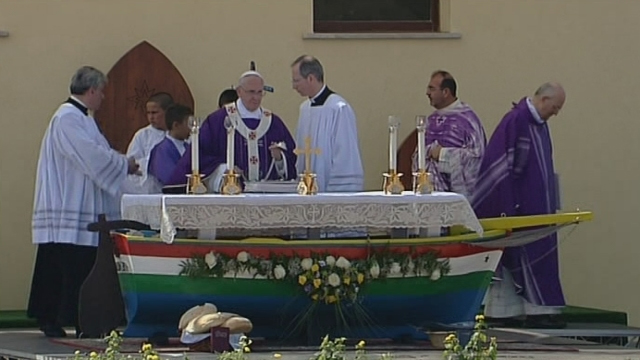
The Barque of Peter?

cutter-rig-altarI love this one! Pope Francis celebrates Mass on the island of Lampedusa and someone seems to want the celebration to be relevant to seamen.

Well, let’s see. The vessel seems to be about eight feet in length excluding the bowsprit, maybe with a beam of a little over three feet. Now could the rudder be the famous Pendalion, the main source of canon law in the Eastern Church? I would design the rudder to be a little longer to be effective and to avoid broaching in a heavy swell.

The bowsprit looks authentic, and is used to get the jib well forward for a cutter-rigged vessel. The problem is that I am scratching my head wondering whether this is a simple basis of a cutter rig with the original mast down – or a four-masted barque with a cross-shaped capstan amidships! Now, where would they haul up the sails and yards if it is a barque?

The colours are nice above the waterline, those of the Italian flag, with blue below the waterline.

This might be a real fishing boat with a simple lug sail rig, and perhaps the bowsprit is used for the haul down the luff, to allow as much space aft as possible for fishing. The rudder looks “fishy” to me, as it looks as if it were cut out of a single piece of plywood for both the rudder and the tiller.

All that being said, the Mediterranean Sea can be a rough place for such a small boat. Even my gaff rigged sloop is a ten-footer, but this barque of Peter does have a decent amount of free board. I have celebrated Mass in many places, but not on my boat!

Posted in Uncategorized | Tagged , , , | 4 Comments

Mystical Aestheticism

I come to a subject that is quite related to some other posts I have written on Romanticism and “neo-medievalism” in the nineteenth century and up to the outbreak of World War I. This term is coined by Embryo Parson in his criticism of my posting on the Anglican Catholic.

I have looked into this movement as a wider phenomenon in western culture, especially in England. The world before the 1914-18 “Great” War was more optimistic and more human, reposing on a notion that the lower could be brought higher, transfigured by grace. It opposed another notion of Christianity, not unlike certain aspects of Gnosticism, according to which the elect could rightfully gloat over the fate of the common masses of humanity born for damnation.

After all, the Renaissance emerged from the Middle Ages, attaching great importance to values like the Transcendentals of Plato, a Hellenic notion of Christianity to offset the austerity of the more Judaic vision of Christianity.

I have seen something of what some fear in Anglo-Catholicism as it was in late nineteenth-century England – homosexuality and a lack of asceticism and depth in one’s Christian commitment. Indeed, the Gospel is one of self-denial and suffering accepted in union with Christ’s Passion. It is also one of joy in the Resurrection and our transfiguration through grace bringing hope to every soul that ever came into this world.

Aesthetics is an important part of philosophy and medieval theology. Thomas Aquinas attached great importance to beauty. Beauty is found both in nature and human creation, and it is through this creativity that man participates in the creative work of God as a kind of “icon”.

It is quite strange how the word mystical is associated with aestheticism. The association is not mine. The one who makes this association affirms that it has nothing whatsoever to do with the apostolic and Catholic faith. Really? Many people are attracted to the Church through beauty and art, and then discover the complete picture which also involves asceticism, tears and penance. There is Eastertide and Christmas, but there is also Lent and the meditation on our mortality. How tedious it must be to be in a church and find a perpetual Good Friday, as it would also be if one did not, in the words of Evelyn Waugh in Brideshead Revisited – “beware of the Anglo-Catholics who are sodomites with unpleasant accents“.

It would appear that a certain kind of sub-culture grew in the fin de siècle era around the personality of Oscar Wilde and others. There were various branches of this aesthetic movement, beautifully satirised by Evelyn Waugh as he painted his portrait of life in England among the well-to-do in the period between the two world wars. Some of this aestheticism was merely affectation and shallowness, and I can understand this being found to be symptomatic of moral weakness and lack of virtue.

I have never seen anything of this kind in the ACC or any of the other Continuing Anglican Churches. On the other hand, I am concerned about the development of a philistine spirit with a tendency to despise anything that represents the finer and more “feminine” traits. American fundamentalists talk of “muscular Christianity”, which seems something of a euphemism of the Übermensch of Nietzsche and the New Soviet Man of another ideology.

Neither the Church I belong to nor I aspire to any particularly “masculine” or “feminine” dimension of Christianity, but a balance between aestheticism and asceticism. There need to be both, as love is both ἀγάπη and ἔρως, love for the sake of the other and the relationship motivated by pleasure experienced by the spirit and body.

Embryo Parson defines “mystical aestheticism” as my suggesting that the Church should, in my words –

appeal to a more subtle level through art and culture, through beauty and philosophy (love of wisdom), through what some people find attractive about traditional liturgies.

and that my suggestion is –

– in keeping with the perennial Romanticist underpinnings of Anglo-Catholicism,  is pitching the case for Christianity-as-aestheticism, reminiscent of the unhappy medieval legacy of the Mass as “spectacle.”

So, what we are talking seems not to be people like Oscar Wilde and characters out of Evelyn Waugh novels, but the “medieval legacy of the Mass“. That is what is really tickling our friend – the abomination of the Popish Mass, which I celebrate each day in my chapel with a clear conscience according to the Use of Sarum. It isn’t the homosexuality or “camp” affection of some men living in cities and leading a dilettante life, but what the Puritans and earlier Reformers sought to stamp out. We are no longer dealing with Romanticism or the Pre-Raphaelite or Arts & Crafts, but the polemics about getting rid of the priesthood and the Sacraments – quite a quantum leap!

And then, more words are put into my mouth, saying that –

– one finds salvation principally (if not only) by incorporation the Church and receipt of her sacraments, and the apostolic soteriological emphasis on Word, power and Spirit be damned.

Those are not my words, even by implication. Where do I deny the need for the word of Scripture? He uses two other words – power and spirit, which I will not comment on, because the meanings of those words are likely to be different for him and me. Probably, he means the power of God over man for whom grace is either irresistible or inaccessible, and spirit as some kind of boost in the emotions of the believer. He will probably write another posting on that subject.

I know many who are alienated by “muscular” Christianity and seek Christ in beauty. The replacement of Benedict XVI by Pope Francis in the Roman Catholic Church is highly symbolic, as was the nomination of Archbishop Welby to the See of Canterbury. The cracks in the Christian edifice are there between traditionalism, liberalism and the possible return of a rigorist and anti-humanist version of Christianity corresponding with ideologies very close to the extreme right-wing of the early twentieth century. This would not so much be in the official Roman Catholic Church and the Anglican Communion, but certainly in groups of radical traditionalists and fundamentalist Protestants. (Here I use the word fundamentalist as a synonym of the French word intégriste).

I suppose we can say all we like, and the fact remains that the sacramental / liturgical vision remains non-negotiable on one side as do the tenets of the English and Continental Reformation on the other.

I suspect that the real objective of Embryo Parson was to use my so-called “quasi-official” blog to embarrass the Anglican Catholic Church and push it into a corner. Either the ACC is hypocritical in calling itself Anglican or has no control over its priests usurping positions of authority – if that really is his thought in the matter. I don’t think our Archbishop and Bishops will be impressed, and the same amount of diversity that has existed until now will continue to exist. The ACC has become very unified and stable after the bad experience it has suffered in the past with cantankerous bishops, and on this solid basis can afford to allow a certain amount of diversity between the neo-Arminianism of some and the full English-style Anglo-Catholicism on the other.

It should also be remembered that Embryo Parson is no longer a member of the Anglican Catholic Church.

* * *

Update: The Amazing Predictive Powers of Father Anthony Chadwick

I only publish this back-and-forth from a point of view of its provoking reflection and thought. Unfortunately, the new article brings little in the way of intellectual value and merely shows that he is simply using my writings to accuse the ACC of some kind of anti-Protestant “pogrom”. Supposedly, I would be a spokesman for this kind of policy in the ACC in its conspiracy against “true Christians”! Truth to be told, I am simply not interested in any such thing and I belong to a Diocese where these questions are just not an issue.

I am not interested in continuing with this argument, but I would be interested if American readers could tell me how “mainstream” this kind of thinking is in the already marginal Continuing Anglican world.

Posted in Uncategorized | Tagged , , , , , | Leave a comment

Herding Cats and Continuing Anglican Ecumenism

I often get comments lamenting the disunion of various jurisdictional bodies of Continuing Anglicans with their various emphases in matters of theology, notably the appeal of historical Catholicism on one side and fidelity to the rigour of the Reformation on the other.

Well, how do we go about it? I have been into this already in Suggestions for Anglo-Catholic Union. Our Bishops can meet up, as they have done for this very purpose, and negotiate concordats of intercommunion or even complete mergers into a single jurisdiction. There is also dialogue at a more parochial level in which people from different Churches and parishes can meet up. There is also what I am doing on this blog, encouraging dialogue, reasoning things out and being open-minded.

The big problem, the elephant in the room, is the impossibility of reconciling the pure and hard Protestantism of some with either the Anglo-Papalism or aspiration to historical Catholicism of others. One side must accept the position of the other and give up his own. Otherwise, one can develop the art of “fudging” and equivocation – saying something that will be understood in two different ways by two different people.

A peaceful parting of the ways? Perhaps not necessarily. Christians have always collaborated with other Christians with whom organic union is impossible, but on the level of humanitarianism, education or other things related to faith and religion without being directly a part of the ideology of a particular ecclesial tradition.

My commenter maintains – “I don’t see a middle ground. No disunion within the Church is really acceptable“. We are getting close to discussions that may have to be limited to the Blow-Out Departments of this blog. We can have strings of ideas without any possible resolution. This is the problem of theological amateurism.

Why do I bother writing on this at all? I think we could look at the history and ideas of the mainstream ecumenical movement and treat these differences in exactly the same way as between Roman Catholics, Eastern Orthodox and Protestants (ie. of the Calvinist tradition). The ecumenical movement originated in the Roman Catholic Church and the desires of many of its clergy and laity to reconcile with Protestants and Orthodox. The World Council of Churches was set up in 1948, motivated by the desire to reconcile mankind in general after the hardship caused by the war. The first thing was a sense of unity in helping the victims of the war and building a new foundation of peace.

There are several approaches to Christian unity. The highest aspiration is reconciling different denominations by overcoming the historical divisions on account of theological differences. One approach is that of “comprehensiveness” basing what is held in common on “mere Christianity” as C.S. Lewis would have put it, and treating the more “accessory” conditions as negotiable and “optional”. Another approach is basing the possibility of union on acceptance of the sacramental and liturgical nature of the Church – these aspects are not negotiable, but there may be different possible uses of terminology to discuss them. What is the Church? This is the capital question to which there are answers ranging from a vague notion of an “invisible” body to the dogmatic rigours of Rome and the more conservative Orthodox Churches.

There is a two-stage process: the “dialogue of love” and the “dialogue of truth”. The first is Christians being courteous to each other and abstaining from the customary language of heresy, schism and apostasy. The second is the serious theological study of questions like the Council of Chalcedon, the Filioque, justification, salvation, grace and works and so forth. As scholarship has developed over the centuries, we discover that many difficulties were caused by terminology and language.

It occurs to me that many clergy members of Continuing Anglican Churches have an insufficient level of theological education. For those charged with questions of this nature, and especially senior priests and bishops, I can’t see how many of these problems can be discussed by “amateurs”. Perhaps this sounds snotty on my part, but rigorous reasoning and scholarship are essential, and those generally come from having studied theology at university standard.

I would certain propose that each Church should have a commission of clergy and lay people with a university-level theological education, and work through the questions that divide. This is not a job for amateurs? Many of the problems in Continuing Anglican are theological – the classical problems between Catholicism and Protestantism, but not all. Most difficulties are probably caused by ignorance, prejudice, conservatism and refusal to study more recent scholarship than the late seventeenth century!

There’s the challenge. Some of us are getting our act together with serious blogging and writing books, and above all reading about the things we uphold and defend, all too often emotionally. Let’s get our act together!

If Churches get together, it won’t be by magic or one party knuckling under the strongest opposition – but rediscovering books and libraries, and having the self-discipline to concentrate on the essentials.

For the time being, let’s get on with the dialogue of love, and that means getting rid of our bigotry and rudeness. Goodness me! Wouldn’t that be progress before the theologians get busy!

Posted in Uncategorized | Tagged , , | 12 Comments

New Blow-Out Departments

I thought I had better set up the pages in case anyone would like to use them. Try to keep it civil and I will only moderate trolls (one sent a really juicy comment yesterday, containing swear words and profanities, and it went straight to the trash bin). The thing about being an experienced blogger is that this kind of thing no longer makes me emotional or angry. I just keep them out in the same way as I keep spam out!

The best thing is for people to be better individuated, better informed, so that they can take part in the more interesting postings of this blog.

So, as I said in Housekeeping and New Page keep the polemics to the “blow-out” pages!

Posted in Uncategorized | Tagged , | Leave a comment

New Article on The Anglican Catholic

An Alternative to the Church of England? by Deacon Jonathan Munn

Posted in Uncategorized | Tagged , | Leave a comment