Writing on the Wall

What seems to be transpiring is a “council of the crown” around the Pope, with cardinals from the five continents. Names? Timothy Dolan of New York, Odilo Scherer of São Paulo, Brazil, Christoph Schönborn of Vienna, Peter Erdö of Budapest, George Pell of Sydney, Luis Antonio Gokim Tagle of Manila.

Benedict XVI was beaten by the opposition and worn down. If Pope Francis co-governs with an elite group of prelates, then perhaps he will have the strength needed to clear out the stables. I’m surprised to find Cardinal Pell on the list!

The problem is whether some of those prelates are part of the problem. Comments would be welcome to sift through Roman exorcist tells Pope to beware a quick death and the Freemasons. I’m always sceptical about Masonic conspiracy stories, but the mainstream world follows the money!

We’ll see.

Posted in Uncategorized | Tagged | Leave a comment

Back to the 1970’s?

The traditionalist blogs are fretting about the possibility of the Roman Catholic Church going back to the 1970’s, airbrushing not only Benedict XVI but also John Paul II. The idea is sobering, but it depends on our idea of the 1970’s and the fact that history does not repeat itself exactly.

How did each of us live the 1970’s in a different ways according to our age and which Church we belonged to? For me, in 1978, when it was still Paul VI, I was 19 and working in a music shop. I was organist at a Church of England parish in York, St Clement’s with a fine Willis organ and worked with a small men and boys’ choir. Our parish was liturgically conservative with Sung Eucharist each Sunday, celebrated facing the east in English-style vestments according to something like the English 1928 rite. We still had Evensong from the standard Prayer Book. Christian commitment? I seem to have been attracted by the idea of prayer and learning something about Christian teachings, but I had other priorities in my like as a young adult.

I cared little about Rome in those days. All I knew about Paul VI is that he was against contraception and had got rid of the old Latin Mass. Someone told me about Archbishop Lefebvre, but a French bishop was of no relevance to me. Back in the 1970’s, many things were changing, but we still had conservative values. We still unkindly called homosexuals queers, poofs and fairies! They were brutal years. New buildings were systematically extremely ugly and we had The Sweeney on the television. It seemed to be a time of exaggerated masculinity. Andropov reigned in the Soviet Union, and like in the 1950’s up to the Cuban crisis, we feared the spectre of nuclear holocaust.

Naturally I don’t look back at the 1970’s like my father would see the 1940’s or my late grandfather would see the time of World War I. It would seem that none of these three generations had much to be nostalgic about when considering their teenage years. There was no war in my 1970’s, but it was a time that alienated me.

Now what is it about the 1970’s that seems so attractive to the progressives? Was it the TV cops and robber shows, Dad’s Army, the pop music which for all its ugliness was more melodic than the present day “rap” or “techno”? We were in financial crisis then under Harold Wilson and Jim Callaghan before Margaret Thatcher’s Conservatives were voted in in 1979. We are in financial crisis now, and we don’t have Thatcher any more. Perhaps our time is in logical progression from the 1970’s, through the 80’s, 90’s and 2000’s. It is as banal as that.

Is a return to tradition, whether it is a matter of liturgical trappings or general attitudes, a “back to the future” movement? Did the Benedict XVI Papacy really represent the future? I have nagging doubts as to whether he was really the person writing those inspiring books in the 1980’s and 90’s or someone playing an elaborate game. Was he a visionary or a cynic?

I repeat the question: what is it about the 1970’s that seems so attractive to the progressives? The era was before John Paul II and Benedict XVI. It was the era of Paul VI. But Paul VI was a conservative who believed as much in his infallibility as Pius IX when he bashed in the nails of clerical celibacy and outlawing contraception. He was viscerally opposed to homosexuality and, if one reads his encyclicals, he was as theologically orthodox as Pius XII. He was no progressive, but as far as I can see, a man with divided loyalties and who could be pushed around and manipulated as Benedict XVI was.

OK, so Paul VI is not the reference. So, between him and the reactionary Pius XII, there is only John XXIII. There’s a big problem – he was interested in the liturgy and kept the “high church” Papal and liturgical trappings. But John XXIII was late 1950’s and early 1960’s, hardly an era for today’s super progressives. Things were bubbling with optimism in those years, but it was all fleeting.

The 1970’s were an era of pessimism and fear, as the hard line took back control of the Kremlin after a few years of detente. Perhaps this is the inspiration of Küng, Mahoney, Kasper and others, not the openness and optimism of the 1960’s but the “party’s over” hard-line “realism” of the 1970’s. They were the years when Paul VI complained of the smoke of Satan and had regrets that his Church was less disciplined and “in order”.

What those people love about their idea of the 1970’s was the authoritarian side of Paul VI – expressed in his decision to forbid the celebration of the old liturgy. That is really what tickles them, because John Paul II and Benedict XVI went in the direction of including traditionalists. Paul VI was a tight-fisted so-and-so! The vision is that anything goes for the liturgy but everyone must be in lock-step for everything else, especially morals and looking up to the clerical and papal dictatorship. Now that’s just what a nineteen-year old Anglican church organist drawn by beauty and things that inspire would not be interested in. I didn’t even give the RC Church the time of day in 1978, except occasionally playing the organ at St Wilfrid’s church in York where there was a nice acoustic and quite a nice organ up on a very high west gallery.

I am not sure whether the model of Paul VI is that of Pope Francis. Paul VI was a curialist and a diplomat, a Francophile, a European. Francis is something else, and we will need time to put our finger on it.

Do we remember the cynicism of Cardinal Kasper, the railway analogies apart?

We are on good terms with the Archbishop of Canterbury and as much as we can we are helping him to keep the Anglican community together, Kasper said in 2010 referring either to the TAC or the Forward in Faith leaders in England. He snottily added, It’s not our policy to bring that many Anglicans to Rome. This is not affirming the freedom of God’s people but keeping the tin lid on the institutional status quo that didn’t care shit about conscience or spiritual content!

Perhaps Francis would take us back to the 1960’s. The problem is that my childhood years were full of optimism about technology and progress, the end of the Vietnam War, detente with the Commies in the Soviet Union (but they invaded Czechoslovakia in 1968). They were the years of Vatican II and Populorum Progressio – the “first” Paul VI and not the self-hating Hamlet of the late 70’s. They were also the years when the Novus Ordo rites were first experimented with and published. It was also the time when the old liturgy was not yet strengsten vorboten!

Reform of the reform of the reform? Now this is getting confusing. Don’t expect papal speeches and magisterial documents. Everything is going to be in appointments of Curial officials, especially if we find the likes of Kasper and Mohoney being favoured for their bubbling enthusiasm. Watch episcopal appointments in the dioceses and if there are differences in general orientation from those of Benedict XVI. Watch out for the new 12-bishop super-synod! Who’s going to be on that? We can doubt that Francis will ever discuss the liturgy or the incomplete Benedictine legislation for the old Latin liturgy or Anglican “patrimony”. Also, look at the altar where Francis will celebrate Mass, and see if you get three candles at one end, the crucifix on the other end (or on a stand) and a microphone in the middle. That would be the end of the “Benedictine arrangement”. But it hasn’t happened yet.

What’s going to happen to Mahoney and Kasper? They are both old men. Are they going to be gracefully retired, or are they going to make a comeback? Those two need to be watched. Apparently, they have both blown Conclave secrets, but so has the Pope himself.

I have noticed a certain paralysis in the blogosphere, or at least that part of it in which I have been involved over the past few years. The atmosphere and the clouds of deceit are thickening, though the air was never really clear during the Benedict XVI pontificate. Personally, I am definitively alienated from that Church in which I spent only fourteen years as a layman, seminarian and deacon. Prognostics for independent Churches like the Continuing Anglicans differ, but there is an enormous paradigm shift that will bring in a new justification – as lifeboats, like in the early days.

If Pope Francis has misguidedly begun his Papacy in illusion, we will see his spiritual vision overclouded by pragmatism and “realism”, by opaque bureaucracy far exceeding the gay cliques of the Benedictine and Joannine-Pauline eras. Many will be alienated and a few may want to connect with small and bureaucracy-free Churches built on the Episcopate, the Sacraments and the Apostolic Faith. Most will die spiritually from thirst and hunger.

Some of us may yet feel that we have no reason to continue living in the part of the world where we are, and where only emptiness remains after Christ has been rejected or simply forgotten. Move on? But where? We have to realise that this drama is being played out within each one of us, as we agonise over our choices. We just need to know what we want.

Posted in Uncategorized | Tagged | 7 Comments

Rigorism,Tutiorism and Probabilism

I wrote this article in the defunct English Catholic blog. At the time, I was concerned for matters which are of no relevance today. Simply, I thought it would be of interest in light of the fact we have a Jesuit Pope. Tutiorism and probabilism are two attitudes about the application of law, moral principles and punishment. They are categories that can equally be applied to canon law and moral theology.

These old theological discussions enable us to understand what some have for or against the Jesuits along with the old disputes between Jesuits or Franciscans and Dominicans. The former places the will (the heart – emotion or the spiritual being) over the intellect. This will be seen to be the most significant difference between Benedict XVI the intellectual and champion of reason informed by faith (fides quaerens intellectum) and the Franciscan / Ignatian position exemplified in the line in The Name of the Rose:

Goodbye, dear child. Try not to learn too many bad examples from your master. He thinks too much. Relying always on the deductions of his head. Instead of trusting in the prophetic capacities of his heart. Learn to mortify your intelligence. Weep over the wounds of our Lord. Oh, and do throw away those books!

There is a side of Ubertino that I truly envy.

I have seen simple faith in places like Lourdes and Fatima – so edifying and moving – yet so fragile…

* * *

I give you a short commentary on this subject, in an educative and not a polemical perspective.

Essentially, tutiorism is a position in moral theology which holds that when there is a conflict of two opinions, one in favour of the law, the other in favour of liberty, the law must always be observed, even if the opinion in favour of liberty is the more probable or very probable one as compared with its opposite.

Rigorism is found in many periods of the Church’s history, especially in the seventeenth century with the Jansenists. Jansenism kept people away from the Sacraments, especially in France during the seventeenth and eighteenth centuries. What was termed as absolute rigorism (or tutiorism, the safer course) was condemned by Pope Alexander VIII on 7th December 1690. A most instructive book about this general tendency, beginning with the Montanists (Tertullian was their champion), is Enthusiasm by Monsignor Ronald Knox. He went into the history of Jansenism in great detail, and Knox’s treatment of the subject is admirable. Here is an excellent introduction to the opposite of tutiorism, which is Probabilism. It is a way to approach difficult matters of conscience (and canon law by extension) allowing some flexibility if the “solution” can be found to be based on the teaching of the Fathers of the Church. An extreme form of probabilism was advanced by the Spanish theologian Bartolomé de Medina (1527–1581) and defended by many Jesuits such as Luis Molina (1528–1581). It was heavily criticised by Blaise Pascal in his Provincial Letters as leading to moral laxity.

Probabilism is perceived by some to be the beginning of a slippery slope into laxism and “anything goes” to the scandal of principled Christians. Tutiorists stress that the only way to preserve Catholic morality or canonical discipline is to reject any form of probabilism and apply the rigour of the law to all without distinction. Burn them all and God will recognise his own! That is a particularly extreme form of Dominican tutiorism in the hands of the Inquisition. Here is a much more “advanced” and detailed explanation of both probabilism and its nemesis tutiorism.

There is no easy solution to any moral or canonical difficulty, and the key is invariably prayer and discernment in the Holy Spirit. There it is, the core of a problem we have been discussing, and we remember that Christ showed no signs in the Gospel of a tutiorist attitude, which, for example, would have condemned Mary Magdalene to be stoned as prescribed in the Mosaic Law. There would have been no healings on the Sabbath. Need I say more?

I think there are better ways of discerning right and wrong than by such complicated remnants of Scholasticism.

Posted in Uncategorized | Tagged , | 3 Comments

Conclave Secrets Blown

Loose lips sink ships – but perhaps not balsa wood dinghies! 🙂

* * *

The whole thing was about blowing away the Italian establishment and opening the way to reform. The story is based on “leaks to the Italian press”. I can’t see Pope Francis excommunicating Cardinals just for blabbing to the press!

For what it’s worth…

Posted in Uncategorized | Tagged | Leave a comment

Vatican Declares War Against the British Empire

mouse-that-roaredFollowing the audience of the Argentinian President Cristina Kirchner yesterday to request that Pope Francis should intervene in Argentina’s long-running dispute with Britain over the Falkland Islands, the Pontiff declared war against the British Empire.

That very day, the Vatican Air Force  prepared its rubber band powered balsa wood aircraft loaded with Galtieri’s remaining exocet missiles. The Swiss Guard sent a task force of speedboats and sailing dinghies through the Strait of Gibraltar, hoping they wouldn’t be picked up on radar. Hostilities were expected to be long and hard.

Immediately prior to the declaration of war, Prime Minister Cameron recalled the British Ambassador to the Holy See and the Vatican ordered the mobilization of the Swiss Guards. The British Task Force had already been sent from Portsmouth to enter the Mediterranean Sea on the perilous voyage to the Italian coast to the west of Vatican territory. The Air Force was already circling, being careful to stay out of friendly Italian territory. The pilots had to be commended for their ability to fly at Mach 2 within an airspace of only one square mile!

President Barack Obama dispatched former President Bill Clinton to mediate the dispute between the Vatican and the British Empire. This morning, there were still hopes the parties could reconcile their differences. He urged the Pope and Prime Minister to attend a two-hour peace conference in Geneva. But talks broke down before they began when an Imperial agent discovered that the Vatican had secret plans to invade the British Empire.

Some of the Vatican Naval dinghies were becalmed before they entered the Atlantic and had to be towed to enable them to make better speed in spite of the weight of their armament. They found better conditions once they met the favourable Gulf Stream winds from the south-west. Swiss Guards were sent on bicycles through Italy and across the Alps into France to face the British Empire from across the Channel. They hoped to establish a beachhead the next day once the fleet of dinghies had arrived off the French coast. The French Government took it all as a big joke and decided to let them get on with it!

Kirchner and Pope Francis accused the British Empire of continuing to colonize and oppress the secretly Spanish-speaking inhabitants of the Malvinas, as they call the Falkland Islands. Prime Minister Cameron paraphrased Winston Churchill, saying: “We shall fight them on the beaches, in the churches, convents, confessionals, and everywhere else to defend our sacred Empire“.

Bloodshed was averted at a very late stage, given the slowness of the Pontifical dinghies running before the wind at a stately six knots. The Prime Minister’s bulldog has asked for an apology from the Vatican – Argentina alliance, and the United Nations passed a resolution to ratify this request if the Papal dinghies and balsa wood planes returned to their bases.

The British fleet, worried that a mere sneeze would blow away the formidable foe, prayed for divine intervention. Hope lies ahead as dialogue is restored.

Armageddon has been averted – Phew!

* * *

Update (serious): According to this and other sources, the Vatican’s policy is to stay out of this matter that concerns only the United Kingdom of Great Britain and the Republic of Argentina.

Posted in Uncategorized | Tagged | 2 Comments

Passion Veiling

Some Anglican and Latin rite churches veil the crucifixes and statues from Passion Sunday in violet cloth. Of course it is a non-issue since we in the English tradition have the Lenten Array from the beginning of Lent.

Also, for Passiontide, we go into bull’s blood red vestments with black orphreys, or black with red orphreys.

Also, in the Use of Sarum, the Gloria Patri is dropped at masses of saints as of the feria, we haven’t uttered the Gloria in excelesis any more than the Alleluya since the day before Septuagesima Sunday – nor Ite missa est. This is one domain where it seems the Roman rite is mistaken. In the older uses, the sanctoral is under the “authority” of the temporal cycle.

Next Sunday, Palm Sunday, the crucifix on the Rood Screen will be unveiled.

Posted in Uncategorized | Tagged , | 1 Comment

Cardinal Kasper has Steam Up

train

HT to Catholic Conclave – but nothing about the Ordinariates.

Pope Francis will return the Church to its roots in the Gospel, in the struggle for justice and against poverty: This was the impression of the German Cardinal and former Bishop of Rottenburg-Stuttgart, Walter Kasper who in the conclave on Tuesday and Wednesday had co-elected the new Pope. In an interview with our Editor Ludger Moller, Kasper describes the expected future developments to the church.

SZ: Your Eminence, you have emerged the conclave. How do you feel about the new Pope Francis?

Kasper: Cardinal Bergoglio was from the beginning my candidate and I have from the beginning of the Conclave voted for him. He represents a new beginning in the Church, for a humble and fraternal church that is there for people which returns to Her source, the Gospel. His name as Pope, Francis, is a program, which is reminiscent of St. Francis of Assisi, who heard the call of Christ: “Re-build my Church!”

SZ: What developments can we expect?

Kasper: We can expect a new style. The new Pope will forgo pomp and circumstance, he lives plainly and simply and is thus a personal role model. A small example: After the conclave, the Papal limousine was waiting for him. Francis, however, after all the newly elected pope, along with us cardinals, climbed aboard the bus that took us back to the Santa Marta House: “We have come together, we go together.” The Papal limousine drove away empty. And in his first speech, he asked the people to first ask for God’s blessing for him before he even blessed them.

SZ: What is personally important to the new Pope?

Kasper: He will be a bishop of the poor. He will fight against corruption. He is concerned above all compassion. In the pre-Conclave, I handed him my new book called “Mercy”, which has just been published in Spanish. He said to me: “Compassion is the name of our God! Without it we are lost. ”

SZ: Francis: What program lies behind this name which the new Pope has given himself?

Kasper: Saint Francis of Assisi lived in an age in which the Church was very powerful. But he wanted to live the Gospel with the poor. He made a significant reform. The Franciscans are called to this day “Friars Minor”. And we must understand the choice of name of the new pope: He is concerned with apostolic simplicity, simplicity, poverty. He wants to reach the heart, and he does so with a simple, but impressive language.

SZ: Did the idea of the message of the integrity of creation played a role in the election of the Pope?

Kasper: Of course Francis stands for ecology and preservation of creation. Nobody disputes that these ideas are important. They however did not play a decisive role in the Conclave.

SZ: Where does the new Pope stand theologically? Is he conservative? Or more liberal?

Kasper: Theologically, he is on the line of John Paul II and Benedict XVI. But he will proclaim this teaching in a different style and make the original content of the Gospel shine forth.

SZ: You have spoken out early for Cardinal Bergoglio. On what basis did you do this?

Kasper: The new Pope and I have known eachother for many years. I have been at least three times to Buenos Aires, where we met. We spoke Italian to each other. Only now I have learned that he has studied in Germany and speaks German. Immediately after the election of a pope, when we cardinals promised him loyalty, he spoke to me in German. By the way we lived during the conclave on the same corridor, he had his own room diagonally across from my room.

SZ: In Germany there are high expectations of the Pope. Keywords are celibacy, ordination of women, participation of the laity. What should can the Germans expect from Pope Francis?

Kasper: He will listen to the desires expressed in Germany with assured attention. But I doubt that he can fulfill all these requirements. At the center, are probably more the concerns of the southern hemisphere, where existential questions matter such as justice, fundamental human rights, war and peace.

SZ: The conclave was soon over. Many observers had expected a lot more ballots!

Kasper: I myself was also surprised to find that we have agreed so quickly. At the beginning of the Conclave the votes scatter, then they pile up. More and more candidates drop out. That was the case in 2005 when Benedict XVI. was elected, as it was now.

SZ: Were there any reservations about electing a Pope who does not come from Europe?

Kasper: No, quite the contrary. Two-thirds, if not three quarters of Catholics now live in the southern hemisphere. There the Church is growing, while ours shows clear signs of fatigue. Those are powerful arguments. Therefore it is appropriate to choose a Pope from Latin America, where nearly half of all Catholics live. The time of Eurocentrism in the Church is over.

SZ: You, too, have called for a new beginning before the conclave in the Vatican. How strongly is this desire shared by the other cardinals?

Kasper: There is a very large desire for Curial reform among the cardinals , almost unanimous. The crises of recent years have cost us a lot of confidence. Even if what has been discussed and written about is not all true, the talk itself is enough to destroy trust.

SZ: Can Pope Francis establish this trust again?

Kasper: He is very assertive, has a strong will. It was important for us the Cardinals that the new pope can govern and create order, even if not everything will be possible from today until tomorrow.

SZ: A new beginning without new staff is not conceivable. What do you expect here?

Kasper: Francis is certain to appoint a new Secretary of State Cardinal and also make new appointments to some other important posts in the Curia. Equally important is a change in mentality. Even for that, time is needed. But a new beginning there will be.

Source (German)

Posted in Uncategorized | Tagged | 10 Comments

Twenty Years of Diaconate

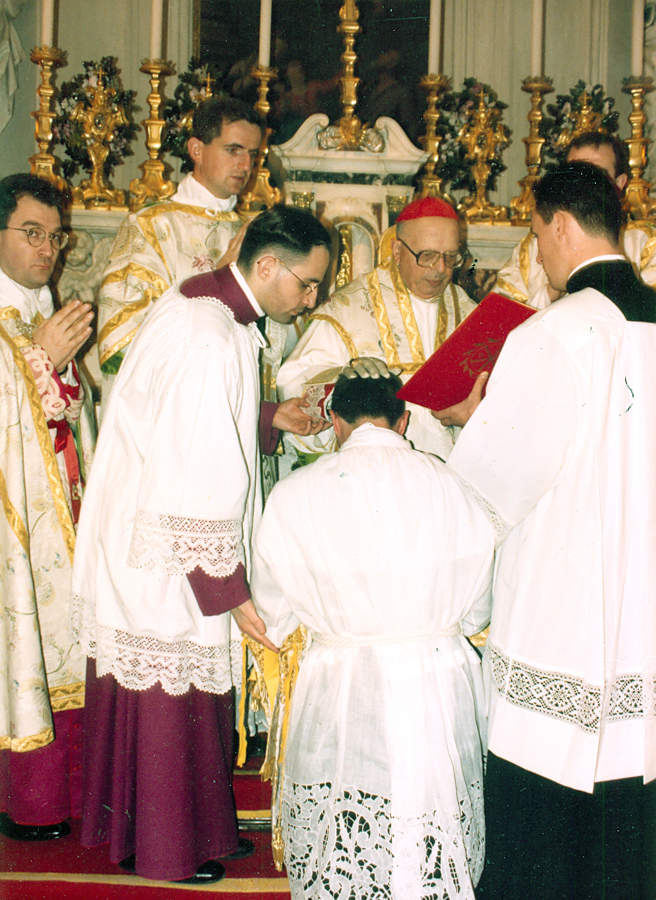
It was on the Feast of Saint Joseph 1993 that I was ordained a deacon for the Institute of Christ the King in Italy by Cardinal Pietro Palazzini, one of the last of the Sacred College to have been consecrated a bishop in the old rite (John XXIII in 1962). I decided to publish my own celebration a day ahead, as greater men than I will have more to celebrate tomorrow!

In my day, we didn’t wear all the blue “stuff” they wear now. We just dressed as secular clergy in ordinary black cassocks and surplices and we were just called Monsieur l’Abbé. Some of the sights to behold these days are quite “head-turning” to say the least.

About ten years ago, I wrote a reminiscence of the day.

The day arrived for my diaconal ordination, a fresh and sunny spring day. There had been five of us at the retreat, the other four for the subdiaconate and myself for the diaconate. The vestments were neatly laid out in the sacristy with the folded dalmatics to be put over our left arms. The chapel was immaculately clean, and a strange stillness reigned in the little baroque chapel. The Cardinal’s vestments were laid out on the altar, as the strong smell of beeswax polish pervaded the scene of the ceremony. As the time approached for the ceremony, two future subdeacons and myself were vested and ready. The minutes ticked by, and the other two were not present. How can a man be late for his own ordination?

Finally, the seminarians arrived and everyone was vested. Still no sign of the missing ordinands. I ventured a question, but was told that there was no problem. We entered the chapel, and finally, Cardinal Palazzini arrived in cappa magna, accompanied by the ministers, servers and Monsignor wearing a cope. As the ceremony began, it was clear that the two missing ordinands were not going to be there. The feeling of confusion continued throughout the ceremony. I could feel the tenseness in my superior, and would notice the same thing afterwards when looking at photographs of the ceremony.

It was an almost unreal feeling as the sun shone in through the window high up to the side of the chapel, and I realised that I was actually going to be ordained a deacon. After the long Litany of the Saints, the two subdeacons were ordained, and I was finally called. The confusion filled my soul as I knelt before the Cardinal and he intoned the prayer of consecration. The right hand pressed firmly onto my head as the formula was recited: Accipe Spiritum Sactum ad robor… I received the stole and dalmatic, and had to lay my right hand on the book as I received the power to proclaim the Gospel in the name of the Church. The sun continued to shine through the smoke of the incense, as I read the Gospel and took the book to be kissed by His Eminence. There was a great joy within me, but an inability to forget the missing ordinands. Even after the ceremony, no information was forthcoming.

The missing ordinands had been expelled for some kind of intrigue, and one was eventually recycled through a stint in Africa and his ordination some two years later. The most shocking thing was to see him that very evening in Marseilles, where the confusion increased. The other ordinand simply disappeared, never to be seen again.

* * *

As the years condemn for those of us who grow old, I ask my readers’ prayers for some of those I have known in that august House and for those who are no longer with us:

  • Pietro SRE Cardinal Palazzini (1912-2000)
  • Monsignor Gilles Wach – founder and Prior General of the Institute
  • Fr Philippe Mora – seminary rector
  • Fr Benoît Jayr – ICR provincial in France
  • Fr Frank Quoëx (1967-2007) – MC and professor of liturgy
  • Fr José Apeles Santalaria de Puey y Gruells – Spanish television
  • Fr Timothy McDonnell – now on the staff at Vienna Cathedral, Austria
  • Fr William Richardson- now working for the Dublin Archdiocesan Curia
  • Fr François Crausaz (1958-1994) – chaplain in Marseilles and Port Marly
  • Deacon Sylvain Tzuan – laicised, and Gerhard Eichhorn who went on to an academic career at Fribourg University, the two subdeacons who were ordained when I was ordained a deacon
  • Fr Roger Banet (1937-2011) – once a prelate’s valet and verger for big ceremonies at Gricigliano, ordained elsewhere
  • and just a couple of names I have been unable to retrieve from my memory
  • and all the others I knew, who are now priests in the Institute, elsewhere or who were mistaken in their vocation…

I have also learned that a former seminarian of this ICR has recently died, Scott Gibson, known in England for his expertise on baroque art and his love of the Oratory. Of my subdiaconate class in 1992, not one remained with the Institute.

diaconate1

diaconate2

diaconate3

diaconate4

Posted in Uncategorized | Tagged | 12 Comments

The Traditional Ministry of the Bishop of Rome

This is an impressive article by Bishop Chandler Holder Jones SSC Anglican Province of America). I reproduce the article in its entirety.

The First Millennium Church and the Bishop of Rome

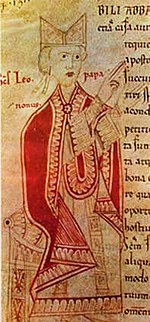
Pope Leo IX, Last of the Bishops of Rome in communion with the rest of Christendom.

The Bishop of Rome is historically the first Bishop of the Church, the primate and chief representative of the Church Catholic. These are all positive and endearing characteristics, from which neither Orthodoxy nor Anglicanism has ever formally dissented: the Roman Church deserves our honour and respect, and all due devotion and obedience as guardedly allowed and mandated by the Undivided Church of the First Millennium. We accord to the Bishop of Rome that which the First Millennium Church accorded his office. Saint Ignatius of Antioch, Saint Irenaeus of Lyons and Saint Cyprian of Carthage proclaim that the Bishop of Rome ‘presides in love and honour.’ Anglicans honour the Roman See as primus inter pares, first amongst equals in the undivided and consentient Catholic episcopate. But there are serious problems with the Roman Communion, impediments and barriers which forestall the possibility of Anglicans entering into the Papal fold. We believe Rome fails the strict litmus test of universality, antiquity and consent, the Canon of Saint Vincent of Lerins, in several key areas of Christian doctrine and practice.

The Anglican Tradition does not believe, as Rome does, that the totality and completeness of the whole Catholic Church on earth is contained in and comprehended by the See of Rome. We cannot say, as Rome does, that the Papal Communion is coterminous and coextensive with the One Holy Catholic and Apostolic Church.

The Church Catholic is not identified with or synonymous with the Roman Communion in an exclusive sense, and yet this is precisely what Rome claims for herself. According to Rome, those Churches in communion with the Pope are the Church, and uniquely the Church qua Church. We find that proposition an inadmissible and flatly anti-historical claim. The Papal Church also professes that the Bishop of Rome is infallible ex cathedra, from St Peter’s Chair, and exercises a ministry of infallible teaching in faith and morals apart from the consensus of the Catholic episcopate. Rome also contends that the Bishop of Rome possesses universal and immediate jurisdiction over every Church and Christian on earth, disregarding the ancient sees and dioceses which have historically constituted Catholic communion. We maintain that papal infallibility ex consensu ecclesiae and papal universal jurisdiction are contrary to Scripture and Apostolic Tradition. We assert that the Pope is not above Tradition and the Ecumenical Councils, and cannot legislate doctrine in opposition to received universal Tradition or the consensus patricum and consensus ecclesiae.

Saint Augustine of Hippo, in common with all the Church Fathers, teaches that the Church is built upon the Faith of St Peter’s Confession in Jesus Christ as True God and True Man: it is the Apostolic Creed, the Faith of the Incarnation professed by Peter, on which the Church is built (St Matthew 16). ‘The rock’ refers to Our Lord Himself, St Peter’s person, St Peter’s ministry, and St Peter’s confession of faith. There are many equally correct interpretations of Christ’s words to Peter.

Saint Cyprian of Carthage teaches that the Chair of Peter, the Petrine ministry, is really the Apostolate, the undivided episcopate of the whole Catholic Church: every bishop of the one Church is ‘Peter’ and shares in the Petrine commission and authority because of episcopal consecration. No one bishop can claim to be the successor of St Peter in an exclusive sense, because it is the episcopate itself, the apostolic college of bishops, which holds the priesthood, authority and consecration of St Peter.

Saint Gregory the Great, a Bishop of Rome, states there is no such thing as a ‘supreme bishop’ or a ‘bishop of bishops’ above the episcopal college.

The Bishop of Rome is indeed the Bishop of Rome, no more, no less, a chief representative bishop of the Catholic world. His role is analogous to that exercised by Peter amongst the Twelve. He is a representative voice, a spokesman, a primate, first amongst equals, primus inter pares. He holds the ‘primacy of love’ proclaimed by St Irenaeus of Lyons, the ‘primacy of honour’ affirmed by Saint Cyprian. The Pope is a Vicar of Christ, but not in a unique or exclusive sense again, for every bishop, every latter-day Apostle in the episcopal college, is a Vicar of Christ, the sacramental representative of Our Lord in his local particular Church. For his Diocese, every bishop is Peter, every Bishop is the Apostle. And, according to Sacred Tradition, all bishops are equal in sacramental power and jurisdictional canonical authority within their own local Churches. Such has always been the consentient teaching of the orthodox and catholic Church of Christ.

The modern Papal Claims are just that, modern. The dogmas of papal infallibility ex cathedra and the immediate and universal jurisdiction of the Pope were created at the First Vatican Council of 1870. They are neither universally-received nor ancient. They are novelties, innovations added to the Catholic Faith. Rome has the essential Faith of the Catholic Church, but has added to it that which it should not.

From the Encyclical of the Patriarchs of the Eastern Churches to the Pope of Rome, 1895…

No doubt every Christian heart ought to be filled with longing for union of the Churches, and especially the whole Orthodox world ardently longs for the unity of the Churches in the one rule of faith, and on the foundation of the Apostolic doctrine handed down to us through the Fathers, ‘Jesus Christ Himself being the chief corner stone.’ Agreeably, therefore, to this sacred longing, the Orthodox Church is always ready to accept any proposal of union, if only the Bishop of Rome would shake off once for all the whole series of the novelties that have been privily brought in to his Church, and have provoked the sad division of the Churches of the East and West, and would return to the basis of the Seven Holy Ecumenical Councils, which, having been assembled in the Holy Spirit, of representatives of all the holy Churches of God, for the determination of the right teaching of the faith against heretics, have a universal and perpetual supremacy in the Church of Christ.

For the practical realisation of the pious longing for the union of the Churches, a common principle and basis must be settled first of all; and there can be no such safe common principle and basis other than the teaching of the Gospel and of the Seven Holy Ecumenical Councils. Reverting, then, to that teaching which was common to the Churches of the East and of the West until the separation, we ought, with a sincere desire to know the truth, to search what the One, Holy, Catholic and Orthodox Apostolic Church of Christ, being then ‘of the same body,’ throughout the East and West believed, and to hold this fact, entire, and unaltered.

And indeed for the holy purpose of union, the Eastern Orthodox Church is ready heartily to accept all that which both the Eastern and Western Churches unanimously professed before the ninth century, if she has perchance perverted or does not hold it. And if the Westerns prove from the teaching of the holy Fathers and the Ecumenical Councils that the then Orthodox Roman Church, which was throughout the West, even before the ninth century read the Creed with the [filioque] addition, or accepted the doctrine of a purgatorial fire, or sprinkling instead of baptism, or the immaculate conception of the Ever-Virgin, or the temporal power, or the infallibility and absolutism of the Bishop of Rome, we have no more to say. But if, on the contrary, it is plainly demonstrated, as those of the Latins themselves, who love the truth, also acknowledge, that the Eastern Orthodox Church holds fast the anciently transmitted doctrines which were at that time professed in common both in the East and the West, and that the Western Church changed them by innovations, then it is clear, even to children, that the more natural way to union is the return of the Roman Church to the ancient doctrinal and administrative condition of things; for the faith does not change in any way with time or circumstances, but remains the same always and everywhere, for ‘there is one body and one Spirit,’ it is said, ‘even as ye are called in one hope of your calling; one Lord, one faith, one baptism, one God and Father of all, who is above all, and through all, and in you all.’

Having recourse to the Fathers and the Ecumenical Councils of the Church of the first nine centuries, we are fully persuaded that the Bishop of Rome was never considered as the supreme authority and infallible head of the Church, and that every bishop is head and president of his own particular Church, subject only to the synodical ordinances and decisions of the Church Universal as being alone infallible, the Bishop of Rome being in no wise excepted from this rule, as Church history shows. Our Lord Jesus Christ alone is the eternal Prince and immortal Head of the Church, for ‘He is the Head of the body, the Church,’ who said also to His disciples and apostles at His ascension into heaven, ‘Lo, I am with you alway, even unto the end of the world.’

Each particular self-governing Church, both in the East and West, was totally independent and self-administered in the time of the Seven Ecumenical Councils. And just as the bishops of the self-governing Churches of the East, so also those of Africa, Spain, Gaul, Germany and Britain managed the affairs of their own Churches, each by their local synods, the Bishop of Rome having no right to interfere, and he himself also was equally subject and obedient to the decrees of synods. But on important questions which needed the sanction of the universal Church an appeal was made to an Ecumenical Council, which alone was and is the supreme tribunal in the universal Church. Such was the ancient constitution of the Church; but the bishops were independent of each other and each entirely free within his own bounds, obeying only the synodical decrees, and they sat as equal one to another in synods.

Posted in Uncategorized | Leave a comment

Union of Scranton / Free Church of England update

Please see my earlier post updated – Free Church of England and the Union of Scranton. I have appended an official text sent to me by Bishop Flemestad of the Nordic Catholic Church.

This also was sent to a multi-addressee e-mail (therefore not private and confidential), primarily addressed to Dr William Tighe. What comes out of this is that the Free Church of England has been modifying its doctrinal positions and praxis for a long time and that they had become compatible with orthodox Old Catholicism.

Thank you for this. I am impressed by how updated you are on the FCE.

As I wrote in the previous email, there will be challenges for the FCE. Your word “bouleversement” is not off the mark. However, it is not just “polite words”. The realignment did not start yesterday. Already some years back a group of “Evangelical” parishes jointly broke with main church because of its Catholic reorientation.

Let me try to describe the situation in abstract terms. Social organisms – including religious institutions – are not static. Priorities and strategies may be changed according to the leadership’s private agendas, internal tensions and external exigences. Sometimes this leads to a radical reassessment. In religious terms, I suppose the prime example in our time would be John the XXIII and the Second Vatican Council. Perhaps the Oxford movement can be seen in the same perspective.

Scaled down, the FCE has gone through a similar reevaluation process leading up to the dialogue with the Union of Scranton. After talks on both sides of the Atlantic during which “documentation was presented and discussed” – to quote the statement – the leadership of the FCE has concluded that they can accept the Declaration of Scranton with doctrinal integrity. Consequently, the episcopal conference of the Union of Scranton “anticipates being able to work with the Free Church of England to build a Catholic jurisdiction in the United Kingdom”, to quote again from the statement.

Of course, the devil is in the details and this may take some time. Still, having invested a lot of time and energy in the dialogue, I am quite optimistic.

Posted in Uncategorized | Tagged , | 6 Comments