Ordinariates under Pope Francis

Deborah Gyapong asks the question Could this new Pope pave the way for new Ordinariates?

I suppose nothing is impossible, and we will not have long to wait to find out what the major orientations of the new pontificate are going to be.

From what seems to be possible to guess so far, I would be surprised if Pope Francis would subscribe to the foundational idea of the Ordinariates and any kind of “uniatism”, that of maintaining the famous axiom “no salvation outside the (Roman Catholic) Church” and making conversion imperative.

A comment arrived on this blog, written by Stephen K:

If Francis really said that Anglicans are needed as Anglicans, then I think that is clear-sighted. No religious brand completely expresses the richness of religious Christian humanity at its best. There is something unique about all of them. In my eyes, the Ordinariates are a self-defeating concept: if you are an Anglican and desire to be remain one, you must by definition, so to speak, not be in communion with Rome, however ‘high’ you worship. And so on for anyone else. The moment you join, juridically, Rome, you cease to be what you were.

Nor is it the same converting to a religion or church as being born and raised in it. There is always something different. Every denomination and variant is a reproach to one’s own sense of self-sufficiency, and a corrective to possible pride. I wish more people would open their eyes to see the qualities that each “other” has. In my view, no-one has to stop believing and worshipping what they do and love; they just have to accept that other people see and experience things they don’t.

It seemed such a long time ago that we were running after Cardinal Kasper’s moving train with Archbishop Hepworth beckoning us to run faster! Now, the dust has settled, and I see things how they are. When you miss a train, you either wait for the next one or find another form of transport. I have been thinking of a posting about ecumenism over the last couple of days, but I don’t think I have any newer or better ideas than anyone else. Soloviev had noticed more than a hundred years ago that union schemes organised from the top always fail, because they don’t represent God’s people.

So, if we want to promote Christian unity, to hell with authorities and laws, and with realities hundreds or thousands of miles from where we live! Let’s just be good Goliards, keep the sacramental life going through the Apostolic Priesthood, and make the Sacraments and Christian teaching available to the people regardless of which institution they belong to. When I have people coming to Mass here in France, they are nearly always Roman Catholics. I don’t think I have ever had a single Anglican in my chapel since Archbishop Hepworth’s last visit in October 2010. They knew who and what I am and that I have valid orders and they receive a true Eucharist. They have been let down by their clergy and they seem to trust me. That is where the unity is. That seems to me to be the Church of the future.

To be sure, I think the existing Ordinariates will stay. But, I don’t think they will form an influential part of mainstream Catholicism. Perhaps Pope Francis would give enough encouragement to the Southern Cone Anglicans so that other Anglicans join up with them and leave the progressives / revisionists to their buildings and dwindling funds. That is something I see happening rather than the creation of ordinariates for Evangelicals.

I may be wrong. Let’s see.

* * *

Here is a comment by Dr William Tighe (source) on just about the same subject:

Concerning this reported portion of the then Cardinal Bergoglio’s statement, “He called me to have breakfast with him one morning and told me very clearly that the Ordinariate was quite unnecessary and that the church needs us as Anglicans,” I have real problems. I cite the responses of two friends:

(1) “It sounds like an innocent throw-away line to calm an insecure ‘ecumenical partner’ looking to be affirmed.”

(2) “The worst thing about it is that it is a doctrinally incorrect statement. A Catholic can’t say ‘We need you as Anglicans if it means to remain Anglicans.’ There is only supposed to be one Church, the Catholic Church, and we necessarily must wish for all to be Catholic. We can hope that particular charisms and virtues of various groups of separated brethren may be preserved in Catholic unity, but that is what the Ordinariates are supposed to do for Anglicans.

It also does not bode well for the Ordinariates. I am sure that bishops with no interest in it whatsoever, or even rather negative feelings, have cooperated because they knew it was something the Pope cared about. Without that I feer Msgr.Steenson may receive a less warm welcome in many a diocese than he has come to expect. I hope I am wrong about this, but this is my fear.”

My own belief is that Pope Francis will be better informed about these matters than Cardinal Bergoglio was, if only because the view of Anglican matters from Rome will be rather different than that from Buenos Aires.

Interesting. Someone needs to do some research into what kind of terms Cardinal Bergoglio spoke when in face of aggressive proselytism with Evangelical and Charismatic groups. Did he try getting them to convert to the “true Church”? How far did he go with ecumenism? This remains to be seen, what he said as a Cardinal in Argentina and what he will say in Rome. Conservative Roman Catholics are going to sift every word he says and project Pius IX onto him as they did with Benedict XVI.

I suspect he will continue with blurring the restriction of the “true church” to the Roman Catholic Church. We may find a similar kind of attitude as with John Paul II, and lots of scandals for traditionalists each time he prays with Protestants, other monotheists and people of other religions. Expect an Assisi III!

We may find more warmth to the Southern Cone Anglicans of South America and Africa and more aloofness to the Church of England and mainstream Anglicanism in North America. That might be a “respectable” midway position between the ordinariates and “still outside” Continuing Anglicans on one side and Anglicans who ordain women and support the LGBT agenda on the other. He’ll have to play that card very carefully.

William Tighe is reserved about the Ordinariates. I don’t think Pope Francis will abolish anything instituted by Benedict XVI, but he might neglect them and leave them to the tender mercies of the episcopal conferences. Like the Ecclesia Dei traditionalists (Fraternity of St Peter, Institute of Christ the King, etc.), everything will depend on the local bishop. The Ordinariates may have ordinary jurisdiction, but may continue de facto to depend on the local dioceses. So, good in some places and bad in others.

I fear the rug has been pulled out from under the feet of those who want to affirm nineteenth-century ecclesiology. It won’t work. Many will find ways to be “as Catholic as possible” – or simply Catholic – without Rome.
Posted in Uncategorized | Tagged , , | Leave a comment

Fools for Christ

franciscan

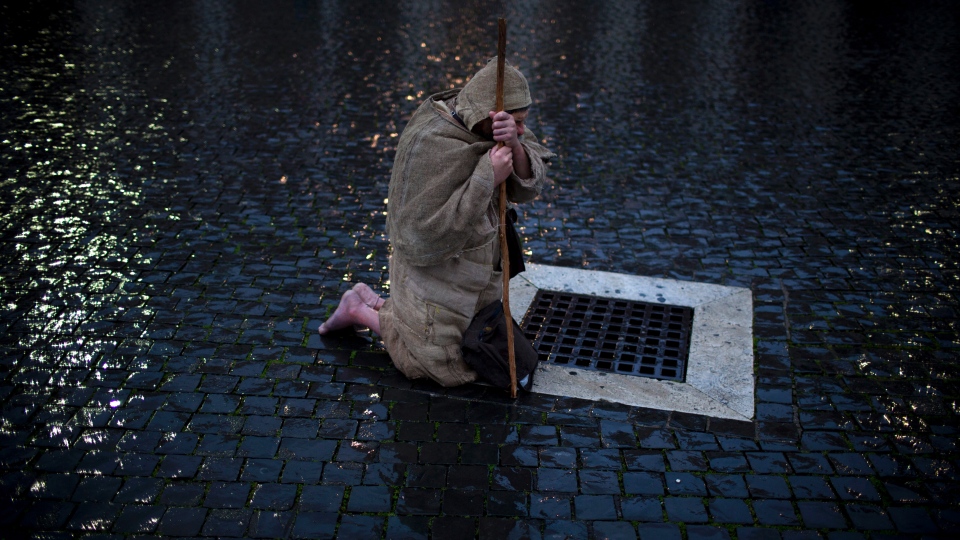
Is this an image of the Church? This moving image shows a person who appears to be a strict-observance Franciscan praying in St Peter’s Square before the white smoke appeared.

The western Church had St Francis of Assisi himself. One of the loveliest things ever said about St Francis was by Oscar Wilde as he languished in Reading Gaol:

There is something so unique about Christ. Of course just as there are false dawns before the dawn itself, and winter days so full of sudden sunlight that they will cheat the wise crocus into squandering its gold before its time, and make some foolish bird call to its mate to build on barren boughs, so there were Christians before Christ. For that we should be grateful. The unfortunate thing is that there have been none since. I make one exception, St. Francis of Assisi. But then God had given him at his birth the soul of a poet, as he himself when quite young had in mystical marriage taken poverty as his bride: and with the soul of a poet and the body of a beggar he found the way to perfection not difficult. He understood Christ, and so he became like him. We do not require the Liber Conformitatum to teach us that the life of St. Francis was the true Imitatio Christi, a poem compared to which the book of that name is merely prose.

Some of those words were in my mind as we saw the back of Benedict XVI and first heard the name Francis. May the new Pope prove worthy of this chosen name and a new period of Romanticism and poetry in our faith:

To me one of the things in history the most to be regretted is that the Christ’s own renaissance, which has produced the Cathedral at Chartres, the Arthurian cycle of legends, the life of St. Francis of Assisi, the art of Giotto, and Dante’s Divine Comedy, was not allowed to develop on its own lines, but was interrupted and spoiled by the dreary classical Renaissance that gave us Petrarch, and Raphael’s frescoes, and Palladian architecture, and formal French tragedy, and St. Paul’s Cathedral, and Pope’s poetry, and everything that is made from without and by dead rules, and does not spring from within through some spirit informing it. But wherever there is a romantic movement in art there somehow, and under some form, is Christ, or the soul of Christ. He is in Romeo and Juliet, in the Winter’s Tale, in Provencal poetry, in the Ancient Mariner, in La Belle Dame sans merci, and in Chatterton’s Ballad of Charity.

There is something Wilde saw in a way that seemed not to be the spirit of Churches, but from elsewhere, from the genius of a wisdom beyond wisdom. Wilde more than paid for his indiscretions! He died in ignominy with only the comfort brought to him by Parisian friends and a Catholic priest.

Francis lived the life of a fool for Christ, the ultimate asceticism. Not only did he give up his worldly wealth but also his reputation as a human being. We find the same thing with St Benedict Joseph Labre, the despised vagrant but holy man in the streets of eighteenth-century Rome.

The Orthodox have a long tradition of fools for Christ and perhaps a greater compassion for the mentally ill and feeble-minded than we do. There are those who have little between their ears, and there are those who give up everything for Christ. The Russian term for this is юродивый. It describes the fool for Christ, one who is known for his apparent but holy insanity or at least eccentricity.

The notion is found in St Paul (I Corinthians iii.18-19):

Let no man deceive himself. If any man among you seemeth to be wise in this world, let him become a fool, that he may be wise. For the wisdom of this world is foolishness with God. For it is written, He taketh the wise in their own craftiness.

Oscar Wilde was a cultured and brilliant man, and he could hardly be called devout, yet there was something he understood in the depths of his suffering as a common prisoner.

The greatest form of asceticism is the combat against pride, which is the root of all sin. To accomplish this, some not only shed their worldly standing, status and possessions, but also their very human dignity. Wisdom in foolishness exposes the evil of this world by humour, symbol and metaphor.

See Diveyevo’s Holy “Fools” for further information about this unusual type of spirituality.

It is partly this notion that has inspired the theme in this blog of the Goliards, as I expressed in The Goliards then and now and my many reflections under New Goliards. The Goliards themselves were outlawed and marginalised clergy and vagante monks, who often made a nuisance of themselves in medieval society, yet remained believers and religious men.

Perhaps it would take a vast melt-down of Rome’s official institution for this kind of spiritual lyricism to find new inroads. Is this what Pope Francis is about? If so, I’m with him in spirit!

Posted in Uncategorized | Tagged , | Leave a comment

Examining Priorities Against a New Standard

As every morning, I opened my e-mail and Internet, just like gentlemen in the old days reading The Daily Telegraph or The Times, or even The Guardian over their breakfast coffee and toast. I pay my fixed fee each month and I don’t have to send the dog to the newsagents! Anyway, to the point.

Someone who has become a blogging friend wrote What things may come…, and he comments on my articles whilst developing his own analysis. Other things came to my attention, but I’ll differ that to a later part of this article. Let’s firstly take things at face value.

I was amused to find I am not the only one to have coined the term Slum Pope whilst thinking of the heroes of nineteenth-century Anglo-Catholicism. As the slums in the west have been demolished and expensive office blocks built in their place, the slums of Buenos Aires, Rio de Janeiro and other cities on that continent remain. Poverty in the west is hidden and covered up – in Latin America it is on show, and the Church still has an “interface” with it for good or for evil.

When I went to my mother’s funeral, my wife and I had a trip by train from Paris to Charles de Gaulle Airport, and there was a sight to behold in the Seine-Saint-Denis area, just by the railway – a bidonville, a slum consisting of derelict caravans and improvised shelters. These people are immigrants without papers and people who excluded themselves from society or have been excluded. And we live in the affluent west. Charity won’t do those people any good, only a thorough reform of politics and the economy will make any difference. Those people have either to be given jobs and food – or killed as some totalitarian “socialist” dictatorship would do.

My blogging friend takes me up on the idea that Catholicism is leaving the West and will undergo change as it caters for the so-called Third World. Catholics will be forced to examine their priorities against a new standard. We will find about the same attitudes to the liturgy as under Paul VI and John Paul II, and may find churches going back to the 1970’s. The so-called “progressives” are not going to fare any better, as they are not going to see the LGBT agenda vindicated or the ordination of women.

Pope Joseph may have shown himself as a simple man when he appeared on the Loggia of St Peter’s, but he was an authoritarian as Jesuit Provincial and Archbishop of Buenos Aires. We can expect nothing different as Pope. He may have the gentleness of a son of St Ignatius and a moral probabilist or Molinist. I see no sign of his being an aesthete – but rather an ascetic. I have known some real Jesuits, like for example the saintly Fr Hugh Thwaites in London, and they are truly either angels or demons!

So, the cause of liturgical aesthetics and even the integrity of traditional rites will be dropped as a “failed experiment” – but we will see… The progressives of Golias are no happier, and there seems to be a real grievance as most of the mainstream press is reflecting. Finally, are we to become Latino Americanos instead of gringos, or is Rome simply pulling the plug?

There is something very disturbing. In the light of all the scandals associated with covering up for paedophile priests, Vatileaks, the Vatican having a major share in a gay sauna in Rome, the so-called Dirty Dozen, we may yet get much worse than under Benedict XVI who was trying to do something about it. The newest shadow is a controversy over whether Bergoglio collaborated with the totalitarian regime in Argentina back in 1976 causing two rebel priests to be tortured and imprisoned by the regime. The allegations have been denied by the Argentine human rights activist and Nobel Peace Prize winner Adolfo Perez Esquivel. There are some links to mainstream press articles to be found with Google. The most forthright positions come from the extremes Links of Pope Francis to military dictatorship (traditionalist) and Habemus papam – François Ier Bergoglio, une ombre au tableau (French left-wing progressive). This being said, these stories are being circulated by a mass media with an agenda which include the desire to eradicate religion. The dice are likely to be loaded, so we have to be careful what we believe without evidence and official statements. Also see Statement by Jesuit priest tortured under the Junta on the role of the Pope, which leaves me with an impression of Bergoglio’s innocence.

Perhaps something we British find most shocking is Pope Francis’ support of the Argentinian government in its continued claims over the Falkland Islands in spite of the majority of their inhabitants wanting to remain British. Argentina’s Cristina Kirchner suggests Pope Francis could mediate over Falklands.

Earlier this week, she [Kirchner] dismissed the referendum in the Falkland Islands, in which residents voted in favour of remaining a British overseas territory as a “parody”, likening it to “squatters voting to continue to illegally occupying a building”.

According to my source, this referendum to which she refers was held on the Falkland Islands according to normal British rules of referendums and elections on 10th and 11th March 2013. Out of the 1,517 ballots cast, only three voters were against keeping the islands’ current status. Turnout was over 90% with 1,650 islanders eligible to vote in a population of 2,841. 99.8% of the people of the Falkland Islands voted to remain British. If Pope Francis has a problem with that, then we can doubt his commitment to democracy and the modern world he wants to evangelise.

New standard? It seems to me that the new standard is transparency and the ability of the Church to stand behind the standard of Jesus and not that of Mammon, Satan, Totalitarianism, you name it. Honesty and clarity need to be the name of the game – so that the Church may be credible and be of appeal not only to those who are crushed by poverty, but also to those of us with the leisure to think.

In any case, if this is not to be and if the Church is entering a new period of darkness and obscurantism, many of us are not under that Church’s jurisdiction, nor do we misrepresent ourselves as such. We can just keep calm and carry on for as long as we need to.

There may be surprises, and it’s too early to judge. Already, most new Popes confirm the old cronys of the Vatican in office within a day of their election. This one hasn’t yet. Let’s see who’s going to be Secretary of State, Prefect of the CDF, Congregation of Bishops, etc. All that’s going to be telling.

We in the west might not be very devout, but we’re not fools. We’ve been ripped off before and we’ll be ripped off again. We’ve has Hitler and the various Communist leaders in eastern Europe. We still have shenanigans galore from our politicians with the same tired-out old stuff. Our world is tired.

If God pulls the plug on us, to whom can we go?

Posted in Uncategorized | Tagged | 3 Comments

Pope Francis and the Liturgy

I found a word from the Chairman of the Latin Mass Society in England who has this to say:

There’s little indication that he has a great interest in the liturgy. Surprising as that might seem, I’m quite happy with that. This isn’t the moment for the Pope to be getting stuck into liturgical minutiae. Let’s leave the whole issue alone for a few years, as long as the legislation we have continues to be applied. And Latin American prelates like to be obeyed.

Source

It could well be that the current legislation is left in place, and those under Roman Catholic jurisdictions preferring to celebrate the old liturgy would do well to keep quiet, refrain from polemics and carry on with life. That’s their problem, but – as so many have said – we live in interesting times

Posted in Uncategorized | Tagged , | 3 Comments

Oh dear!

british-bulldogI was 23 at the time and saw an English warship with a massive hole in the side from one of Leopoldo Galtieri’s Exocet missiles as I sailed into Portsmouth from France on a ferry. We too lost men in that conflict, and I hope His Holiness will pray for ours too, especially as our Armed Forces were sent to protect folk who explicitly wanted to remain British and asked for help from England.

The Argentinians invaded our turf. They started it. I wonder whether Mrs Thatcher made the Argentinians pay reparations! We too have long memories, and I’m English.

Of course, we should pray for the fallen of both sides. The Argentinian men were obeying orders and did what they were told. War is a horrible business, and there are no winners and losers. Simply, they who sow the wind reap the whirlwind as most warmongers like Hitler found to their discomfort.

Posted in Uncategorized | Tagged , | 10 Comments

New Counter Reformation

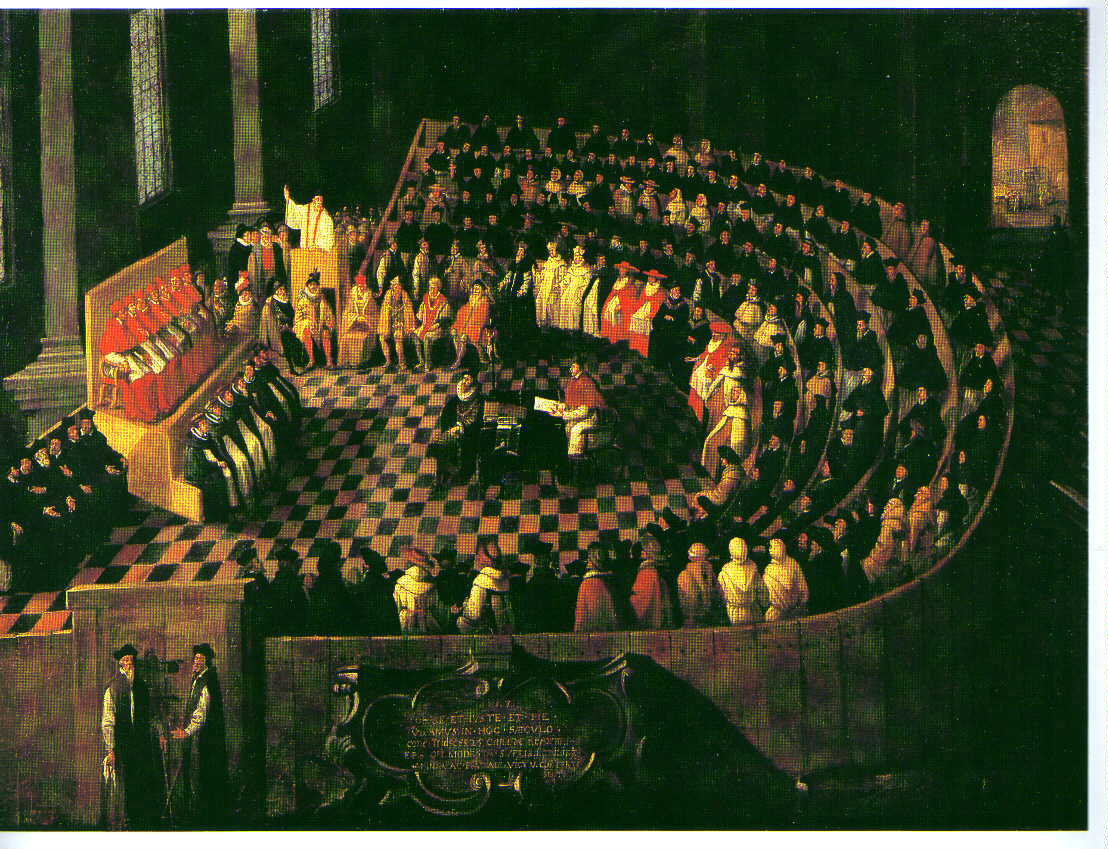
trentThat has been a theme of the Abbé de Nantes and Catholic Counter Reformation in the 21st century for years and decades. Look at the sixteenth century. There were not only popes putting people in dungeons and torture chambers. There were also the saints, like Ignatius of Loyola, Philip Neri and the great bishop Saint François de Sales – yes another Francis. I get the feeling something is happening to melt the hearts of sectarian liberals, traditionalists and all of us.

In many ways, the Counter Reformation did as much harm as the Reformation, by making the Church into an almost totalitarian machine with men marching in lockstep. In spite of the holiness of the saints of that time, intolerance took root, and with it every possible violation of human life, happiness and freedom. And that was from both sides. I don’t want to see that reproduce itself, ever.

I don’t want to go overboard on this or start with the kind of Papolatria we had during the John Paul II pontificate. I’m not interested in the stuff about Peter the Roman. What we need to look out for will be facts. For the moment, we know of Bergoglio as Archbishop of Buenos Aires and have been studying the way he dealt with bad priests, liberation theology Marxism and the dictators down there. We now need to see whether he re-nominates the John-Paul II Curia as Benedict XVI did in 2005 or whether he is really going to clean out the stables. That will be an observable fact over the next month or two.

The next thing to look at will be his episcopal appointments. There are loads of vacant diocesan sees. What about the episcopal conferences? We have seen the Benedict XVI pontificate in terms of brick by brick and unfinished achievements, because he was blocked at every turn. I don’t expect Pope Francis to be any less prudent, but we hope to see energy and determination.

Who are going to get put into the keys posts in Rome? The present guys, or a changed scenery? What will be done about the dirty bishops around the world and the seminaries, all the important things that don’t involve discussion of birettas and lace? Will it now be – Welcome, Good Men?

I think in about a month or two, we will begin to see a new chance for Christianity in our world, or shake our heads in shame in the knowledge that we can only keep our faith alone and at home, in our little micro churches and communities.

Posted in Uncategorized | Tagged , | Leave a comment

The Two Standards of Saint Ignatius of Loyola

Ignatian spirituality can seem rather dry and “methodical” for those of us more attracted by the more Patristic and medieval ways. However, I invite you to penetrate through this rather odd kind of rhetoric and seize the essential of our Christian Resistance. St Ignatius was remarkable in his use of audio-visual catechesis techniques solely through the imagination, long before anyone thought of the possibility of sound and image reproduction.

This is our fundamental choice on which everything else hangs, including our precious liturgy and the things that bring us consolation. It is not too late, as we come close to entering Passiontide.

For those who read French, see also this remarkable article. Those Cardinals must have studied their church history. Is this the beginning of a new Counter Reformation? Your comments?

* * *

TWO STANDARDS

The one of Christ, our Commander-in-chief and Lord; the other of Lucifer, mortal enemy of our human nature.

Prayer. The usual Preparatory Prayer.

First Prelude. The First Prelude is the narrative. It will be here how Christ calls and wants all under His standard; and Lucifer, on the contrary, under his.

Second Prelude. The second, a composition, seeing the place. It will be here to see a great field of all that region of Jerusalem, where the supreme Commander-in-chief of the good is Christ our Lord; another field in the region of Babylon, where the chief of the enemy is Lucifer.

Third Prelude. The third, to ask for what I want: and it will be here to ask for knowledge of the deceits of the bad chief and help to guard myself against them, and for knowledge of the true life which the supreme and true Captain shows and grace to imitate Him.

First Point. The first Point is to imagine as if the chief of all the enemy seated himself in that great field of Babylon, as in a great11 chair of fire and smoke, in shape horrible and terrifying.

Second Point. The second, to consider how he issues a summons to innumerable demons and how he scatters them, some to one city and others to another, and so through all the world, not omitting any provinces, places, states, nor any persons in particular.

Third Point. The third, to consider the discourse which he makes them, and how he tells them to cast out nets and chains; that they have first to tempt with a longing for riches—as he is accustomed to do in most cases12—that men may more easily come to vain honor of the world, and then to vast pride. So that the first step shall be that of riches; the second, that of honor; the third, that of pride; and from these three steps he draws on to all the other vices.

So, on the contrary, one has to imagine as to the supreme and true Captain, Who is Christ our Lord.

First Point. The first Point is to consider how Christ our Lord puts Himself in a great field of that region of Jerusalem, in lowly place, beautiful and attractive.

Second Point. The second, to consider how the Lord of all the world chooses so many persons—Apostles, Disciples, etc.,—and sends them through all the world spreading His sacred doctrine through all states and conditions of persons.

Third Point. The third, to consider the discourse which Christ our Lord makes to all His servants and friends whom He sends on this expedition, recommending them to want to help all, by bringing them first to the highest spiritual poverty, and—if His Divine Majesty would be served and would want to choose them—no less to actual poverty; the second is to be of contumely and contempt; because from these two things humility follows. So that there are to be three steps; the first, poverty against riches; the second, contumely or contempt against worldly honor; the third, humility against pride. And from these three steps let them induce to all the other virtues.

First Colloquy. One Colloquy to Our Lady, that she may get me grace from Her Son and Lord that I may be received under His standard; and first in the highest spiritual poverty, and—if His Divine Majesty would be served and would want to choose and receive me—not less in actual poverty; second, in suffering contumely and injuries, to imitate Him more in them, if only I can suffer them without the sin of any person, or displeasure of His Divine Majesty; and with that a Hail Mary.

Second Colloquy. I will ask the same of the Son, that He may get it for me of the Father; and with that say the Soul of Christ.

Third Colloquy. I will ask the same of the Father, that He may grant it to me; and say an Our Father.

Note. This Exercise will be made at midnight and then a second time in the morning, and two repetitions of this same will be made at the hour of Mass and at the hour of Vespers, always finishing with the three Colloquies, to Our Lady, to the Son, and to the Father; and that on The Pairs which follows, at the hour before supper.

Posted in Uncategorized | Tagged | 1 Comment

A Conservative Evangelical Pope

In a note released after the election of the new Pope, Francis I, on March 13 Bishop Venables wrote:

“Many are asking me what Jorge Bergoglio is really like. He is much more of a Christian, Christ centered and Spirit filled, than a mere churchman. He believes the Bible as it is written. I have been with him on many occasions and he always makes me sit next to him and invariably makes me take part and often do what he as Cardinal should have done. He is consistently humble and wise, outstandingly gifted yet a common man. He is no fool and speaks out very quietly yet clearly when necessary. He called me to have breakfast with him one morning and told me very clearly that the Ordinariate was quite unnecessary and that the church needs us as Anglicans. I consider this to be an inspired appointment not because he is a close and personal friend but because of who he is In Christ. Pray for him.”

How do we interpret this?

The ordinariate was quite unnecessary” – The Ordinariates have concerned only those Anglicans who were disposed to become conservative Roman Catholics, albeit with some Anglican “acculturation”. “The Church needs us as Anglicans” – a Franciscan Papacy is likely to be more interested in conservative Evangelicals as a missionary force among the lapsed, indifferent and unchurched than in ritualist Anglo-Catholics.

Does this really reflect the mind of the new Pope?

I read this in an e-mail reply to one of Dr Tighe’s send-outs:

And, with the paltry numbers that have come into communion, I suspect Anglicans have fallen with SSPX to the bottom of Rome’s agenda.

Schadenfreude is just not my way, and it is far too early to tell what Pope Francis is going to do with Benedict XVI’s incomplete achievements (Anglicanorum coetibus and Summorum Pontificium in particular). My analytical mind is beginning to crystallise Pope Francis not as a modernist or a liberal, but Rome’s version of a conservative Evangelical. Labels and churchmanships have their limits as we try to reason things out and see clearly.

Posted in Uncategorized | Tagged , | 4 Comments

Morning After Round-up

I’m still reeling even though I went nowhere when most of the TAC either crumbled or went by bits and pieces into the Ordinariates. What transpired is that anyone who has an interest in liturgy, Anglican or pre-Pauline Roman, is at the bottom of the list of priorities. As far as the liturgy, traditionalists and Anglicans are concerned, the clock has been turned back twenty years, or more, or less.

From what I have been reading in Sandro Magister (The First Pope Named Francis) and Father Zuhlsdorf (How I received our new Pope.) shows an image of a holy man who obviously has a mandate to clean up the Vatican, the Roman Curia and diocesan bishops whose clerical obfuscation discredits the Church. It is for Roman Catholicism as if someone like Archbishop Greg Venables of the Southern Cone were made Archbishop of Canterbury.

Roman Catholicism of the future is clearly Latino and African. Those peoples form the majority of humanity and that’s where Christianity in a loud, exuberant and Evangelical form are booming. Roman Catholicism competes with Evangelical and Charismatic missions with a similar product – albeit with a different theological content.

I don’t think Pope Francis will actually do anything against the Ordinariates, the Fraternity of St Peter or anyone else. These groups are likely to be left to the tender mercies of episcopal conferences and perhaps a “benign neglect” as some call it. Anglican converts and Latin Mass traditionalists simply don’t matter compared with the millions of Latinos and their social concerns.

What this seems to mean is that those who went over to Rome under the Benedict XVI pontificate and those of us who remain in our independent communities are on our own in human terms. We have to manage without asking for legitimacy from anyone else.

One thing is clear. This is not the nineteenth century. The Pope is not Pius IX and there are no comparisons possible between the conversion of Newman and the stark reality of our modernity and the stakes of the world in which we live. Triumphalism is over.

I believe that Christ, in our messed-up world and churches, will be calling us – from wherever we are – to be with him because we are not against him. Even if I and many others have not the slightest inclination to become members of the Roman Catholic institution, we will be hearing many fundamental truths. I have done Ignatian retreats, and the two things that most stand out are the fundamental choice we make between God and Satan and the discernment of spirits. Saint Ignatius had incredible insight into the human soul. I quote from Magister about the supreme priority:

“The real problem at this moment of our history,” pope Ratzinger wrote in a memorable letter to the bishops, “is that God is disappearing from the human horizon, and, with the dimming of the light which comes from God, humanity is losing its bearings, with increasingly evident destructive effects. Leading men and women to God, to the God who speaks in the Bible: this is the supreme and fundamental priority of the Church and of the Successor of Peter at the present time.”

Everything else that the cardinals discussed before the conclave, the mismanagement of the curia and of Vatican finances, the long onslaught of sexual scandals, the internecine wars among churchmen, is nothing other than the dark side of this which is the Church’s reason for being: “to show men and women the way to God.”

It is the “filth” which must be swept away decisively, if one wishes the Church to be able to dedicate itself completely, without shadows obscuring it, to its sole and true mission: to revive the Christian faith where it is almost extinguished and to propagate it where it has not yet arrived.

We put to sea in our little boats, setting our courses for the same destination. We can only pray for fair winds and God’s grace.

Posted in Uncategorized | Tagged , , | 3 Comments

Prayer Intention

Fr James Schovanek SSC sent out an e-mail to ask our prayers in his distress. I quote:

Of your charity please pray for the repose of the troubled soul of our grandson, Evan Graf, who took his own life yesterday.  Also, please remember his grieving parents, Randy and Felicity, and us his grandparents.

Jim+

Posted in Uncategorized | Tagged | 2 Comments