Bishop Brian Marsh on Portsmouth

I have written to Bishop Brian Marsh of the ACA and asked him in these terms:

It would be very useful for me to be able to publish a testimony in retrospect about what the TAC bishops understood when they (I think you were not among them at the time) when they went up and signed the books and the letter.

The good Bishop replied and emphasised that he is giving his personal reflection, and others may take issue with him.

* * *

Thank you for your good email; I am pleased that you are attempting to discuss the issues of the Portsmouth Petition, the Apostolic Constitution and the Ordinariates in a reasoned manner. A full understanding of this aspect of the church’s history will need the gift of time. Until then, however, we can – and should – offer our provisional understandings of the events that have unfolded since the Portsmouth Petition of 2007, just over five years ago. I would emphasize that this is a personal reflection and represents my own views on the matter. Many of these thoughts have been published elsewhere.

Portsmouth Petition. Although I was not present at the signing of the Portsmouth Petition, Bishops Langberg and Williams signed for the ACA. The text of the petition was not publicized until months later. I did not know of the contents of that petition until it was delivered orally by Archbishop Falk at a meeting of several ACA bishops in 2008. That meeting was held in Fort Worth. Also present were bishops Iker and Wantland of The Episcopal Church. Upon hearing the text, it was my impression that the petition sought “organic unity” with the Roman Catholic Church on a corporate basis. Indeed, that is what I and others had been led to believe was in fact on the table. Archbishop Hepworth had encouraged the belief that the Traditional Anglican Communion would remain intact and that the various national churches would maintain their corporate identities.

The Portsmouth Petition was just that – a petition. To suggest that it was a contract of any kind would be to misrepresent the intent of the document. The Portsmouth Petition was a request on the part of some members of the College of Bishops, a request for a means whereby the TAC might enter into unity with the RC Church.

The fact that members of the TAC College of Bishops signed the catechism of the Roman Catholic Church has caused many to believe that the bishops present were ready to enter the Church of Rome. This is not the case. The signing of the Roman Catholic Catechism as the most complete statement of the catholic faith was simply a statement of fact. The subsequent statement that the bishops aspired to teach that catechism in no way implied their full acceptance of the catechism nor their intent or desire to become members of the Roman Catholic Church. While there were undoubtedly some bishops present who wished to do just that, the simple signing of the catechism does not imply their wish to become Roman Catholics.

Apostolic Constitution. The issuance of Anglicanorum coetibus in 2009 was greeted initially with great rejoicing on the part of many within the TAC. It seemed that our dream of organic unity would be realized. Indeed, Archbishop Hepworth declared that it was a direct response to the Portsmouth Petition and that the TAC should move immediately to accept it. He lobbied extensively for the acceptance of the Apostolic Constitution.

While there are many threads in this part of the story, it became clear to several of us that the Apostolic Constitution did not offer the kind of organic union we had hoped for. Indeed, the Apostolic Constitution offered individual conversion. The corporate integrity of the TAC would not be a consideration. This was not what the Portsmouth petition had requested in its perhaps naive request for corporate unity.

The College of Bishops of the TAC needed to discuss and debate the matter of the Apostolic Constitution. As the highest legislative body of the TAC, such discussion and debate would be required before the AC could be acted upon. Archbishop Hepworth did not immediately call such a meeting. When he did plan a meeting for 2011, he abruptly cancelled it. Finally, in February, 2012, a majority of members of the College of Bishops met in Johannesburg South Africa. By unanimous vote, the TAC College of Bishops rejected the Apostolic Constitution. A petition had been sent to Rome. Rome responded. The response was not accepted.

Ordinariates. Ordinariates were established in the UK in 2011. On January 1, 2012, an Ordinariate was established in the United States. A few hundred “former Anglicans” have entered the Ordinariate established here, along with some former Episcopalians.

The Anglican Church in America has continued as an orthodox Anglican body. It has developed strong relationships with other continuing church jurisdictions and has entered into an agreement of reconciliation with the Anglican Province of America.

Although individuals are welcome to seek membership in the Ordinariates, until now few have chosen to do so. We certainly wish those who have entered Ordinariates godspeed! We pray that they will be happy with the choices they have made. We believe God has called us to labor in another part of the vineyard and we will attempt to do so as best we can.

Again, please know that this is a personal reflection. Others may well take issue with what I have written.

+Brian Marsh

Posted in Uncategorized | Tagged , | 15 Comments

The Regrouped TAC and its presence on the Internet

I am approaching a tender subject, and some of the communications I am receiving suggest that I need to handle this with kid gloves. Some have paid a high price for following Archbishop Hepworth’s ordinariate scheme. Consultative bodies were established during the College of Bishops meeting of October 2007, and seem never to have been convened. There should have been a College of Bishops meeting to discuss and “receive” Anglicanorum coetibus of November 2007. It never happened, either because there was no money or because it was feared that there would be serious conflict between bishops who were “for” and bishops who were “against”. We could speculate on this subject until the cows come home, and I just don’t think we are going to get anywhere.

It seems best not to go over the past, but rather to take stock and look at what can be of value in the future. One thing impeding progress for some of us is the lack of computer literacy, basic technology or awareness of the use of the Internet to communicate beyond one’s own diocesan and parochial boundaries. The admissibility of using the Internet to get the TAC’s message out seems to be acquired. The most computer-savvy are the Americans, and the Canadians give monthly news of what is going on there. The English are presently working on The Traditional Anglican Church, though there still are a few frustrating things to clear up. I have the impression that the site is a standard model designed for business and commercial applications, and the person running the site is learning how to use it.

Very few of us are blogging. It’s really just Fr Smuts and myself. There used to be Christian Campbell of The Anglo-Catholic, but he went off at a tangent and has put the blog into hiatus. Deborah Gyapong posts in support of the Ordinariate movement, which is understandable. The South African website seems to be another standard business template job run by a kind soul with love in his heart but little experience with Internet work. I don’t know that much about html design, so I find the blog format most convenient, and have used the ultra-simple format of Civitas Dei for years. Old-fashioned websites take a lot of will and dedication to keep them up to date and relevant. My site usually gets about one major overhaul a year. This blog updates itself, and its template formula is user-friendly and adaptable for church work as business templates are not. For someone who has not been trained in web design, I don’t think I do too badly. The other thing is enjoying writing.

It’s going to be difficult to evaluate numbers in the TAC. There has been quite a lot of what the Americans would call bullshit! The problem is knowing which arsehole it came out of, and I’m not going to speculate here. Some of my more realistic correspondents estimate that the TAC at its peak (around mid 2007) may have numbered around fifteen to twenty-five thousand in all countries. For the moment, there seems to be no way of getting accurate figures, though I’m open to new information. Perhaps a little less than half the number of clergy and laity in the USA, Canada, England and Australia have remained in the TAC, the others having gone to the Ordinariates or disappeared off the map. South Africa, Torres Strait and India would not have changed substantially in terms of numbers between the pre-ordinariate era and now. For anything like a reliable estimate of numbers, I will have to find informed persons I can trust, and that won’t be easy, especially in the local Churches where the Internet is not used.

Personally, I would like to see Bishop Michael Gill emerge as Primate, as his location in South Africa puts him midway between the western and English-speaking world and the mission territories of Africa, Latin America and India. Above all, we need modern communication and reactivity of the kind one finds in modern business. Another very positive omen is the desire of the Americans to grow into unity with the other Continuers. I have heard nothing but the highest praise for Bishop Paul Hewitt of the Diocese of the Holy Cross. If all those serious churches can be brought together without being dogged by unwise moves or excessive numbers of episcopal consecrations, then Continuing Anglicanism has a future.

It is of paramount importance to let go of the ghosts of the past, try to stay together and perhaps recover some of the “crumbs” that didn’t go to the Ordinariate. My information tells me that the TAC is not in ruins. Far from it! But, damage has been done, and the lack of modern communication is partly to blame.

The most useful sites presently available are (in all modesty), this blog and Fr Smuts. Among the official TAC sites, the most updated are that of the ACA and the American diocesan pages. As mentioned, the Canadians are giving regular and relevant news. Efforts are being made by the Brits, and Fr Gray’s new Advent Pastoral Letter is most uplifting and appreciated. The centralised site, The Traditional Anglican Communion is not bad, giving fairly regular news bulletins and official documents. But, we do need more blogging and interaction, more interpretation and more encouragement to foster a positive and optimistic vision of the future.

You readers can help Fr Smuts and I, and anyone else who decides to launch out into the exciting world of the blogosphere.

* * *

Update: Fr Stephen Smuts has just weighed in with The TAC Presence on the Internet, and his thoughts are most appreciated. To resume, someone commenting on his blog had mentioned how information and communication were strictly policed under the previous regime. I do remember being something of a “scarlet pimpernel” with blogging, and being “negative” and “disruptive“, as some of those ex-Anglo-Catholic commenters still are banging their drums, clinging like accretions to Fr Smuts’ blog and that of Deborah Gyapong. I tend to be stricter with moderating people who lack courtesy or who are outright bores, so I have have had fewer problems with “trolls” as of late – yet my volumes of traffic are little changed. It is strange how those people never thought of setting up their own blogs, as the blogosphere represents free speech within accepted limits.

Blogs do hold people accountable and “bullshitters” have a harder time with it all. There have been Wikkileaks, Vatileaks and even Tradileaks! The Web is a double-edged sword, and every post is a five-minute wonder before it is forgotten.

We can spend our lives denouncing corruption and bullshit, or we can try to use our writing abilities for the Ministry of the Word and re-enchanting the Christian message. All this writing is indeed taxing, time-consuming and often unappreciated work, but people do write to say how they appreciate being informed and encouraged in this long dark night of the spirit.

Posted in Uncategorized | Tagged , | 2 Comments

A Clarification

Deborah Gyapong has written this clarification as a comment in her blog. I reproduce it here in a spirit of fairness.

My concern is not so much trying to convince people of a belief in the One True Church—which is far more nuanced as Norm can explain or the Catechism teaches than the black and white pronouncement “there is no salvation outside the Catholic Church—but to respond to what come across to me as misrepresentations of my position, that of Anglicanorum coetibus and of the Portsmouth event. All I’m trying to point out is this: The Catholic Church defines Catholic in a certain way. Those who call themselves Catholic who are not visible members in communion with the Catholic Church have another definition of “Catholic.” I hold the Catholic Church’s definition. But that does not mean I think those who hold the other position are masquerading, or fakes for their deeply-held beliefs. However, if one wants to come into communion with the Catholic Church, one must hold to what the Catholic Church teaches, not make up one’s own view of what it means to be Catholic. These teachings on ecclesiology were the last to click into place for me, as I still find the “mystical Body of Christ” view persuasive and personally feel more of a Christian bond with devout evangelical brothers and sisters than I do with cafeteria Catholics who may have the membership in the Church but not the faith.

Yes, I do believe she is trying to be nuanced, to her credit. It is evident that if a person freely chooses to become a Roman Catholic, it is on the terms of the Bishop concerned and the Roman Curia. For those who have made this unconditional commitment by actually being received into the RC Church, they are stuck with the conditions offered to them.

What I object to are suggestions that those TAC bishops who did not go through with it have lost all honour and credibility, and that their clergy and faithful are fair game. That is the bottom line.

In short, I do not believe that the TAC bishops in some way contracted the moral and ecclesial obligations of those who have voluntarily gone through with reception into the Roman Catholic Church. Signing the catechism and a letter asking Rome to come up with some corporate solution was not a “consummated” commitment. I believe the message to Rome was the effect of “We take away all doctrinal reasons for you considering us as heretics, and we are open minded to what you as the Roman Catholic Church come up with as a solution, but we reserve the right to pull out if we find we are being taken for a ride.” Therefore, the moral obligation is contracted by those who have actually gone through with it and have been received. Clerics cease to be clerics. Those in Anglican orders are treated as though they had never received orders. Those in valid [ie: Roman Catholic, Old Catholic, Orthodox, vagante, etc.] orders were stricken with canonical irregularities. They accepted the conditions when they went though with it. Not so with those who did not go through with it. The remaining bishops in the TAC have no such moral obligation. They went into the shop, examined the goods for sale and judged that the quality of the goods was not equivalent to the asking price. They had merely expressed an interest in the goods and asked for the price. No contract was ever consummated, and we must all be clear about this.

Perhaps we outside the RC Church need not use the term Catholic, but perhaps the term Sacramental Christian as suggested in other postings on this blog. People are ignorant, and we do need to be clear. Personally, it is no skin off my nose. Protestants and Evangelicals don’t use the term Catholic either, except in a general way as they recite the Creed. What’s in a word? What does “being Catholic” mean? That’s the subject of a very big book!

We have all to do what our conscience bids us to do, and then to assume what we decide. That would seem to make sense.

* * *

Update: Deborah Gyapong weighs in with The conversation continues at Fr. Chadwick’s blog. She is being subtle and making a great effort to navigate through the morass of all the things that have been hacked to death over the past couple of years.

Interestingly, I think, looking back in a spirit of calm reflection, I believe the Catholic Church treated the TAC as if they assumed the TAC bishops were signing with their fingers crossed behind their backs, or at the very  least they exhibited extreme caution towards the TAC and Archbishop Hepworth and drafted Anglicanorum coetibus more with the Church of England groups in mind than with concern about the ecclesial bonds of the TAC.  Thus, Anglicanorum coetibus and its parish-by-parish model of corporate reception was in itself destabilizing for TAC churches.  The Catholic Church did not treat the Portsmouth letter or the signing of the Catechism as a done deal either, but wanted to ensure that every single individual lay person made a choice to become Catholic.

One bishop (not an American) did say to me on the bus between the hotel and St Agatha’s that he was going along with it, because Rome would take fifty years to respond and another twenty years to translate the letter into Latin if it wasn’t all lost in some bureaucrat’s drawer somewhere along the line. There was no will to oppose what Archbishop Hepworth was doing. In other words, for that bishop, it was a meaningless and expensive charade! But, I don’t think all the bishops had the attitude of the particular prelate I spoke with. Perhaps a few really did in their inmost selves make a commitment to accepting whatever came from Rome. There are many questions which I don’t think will ever be answered. God can always bring good even out of human weakness and evil.

Deborah and I agree on the issue of solidarity, and how lightly that communion we had with each other was abandoned, supposedly for a higher level of communion. I also have to agree that much of the TAC is going to be “ragtag” in matters like valid Orders and doctrine. I am personally a (generic) Old Catholic in terms of ecclesiology, and my theology has been shaped by my scholastic and neo-patristic training, but I am personally a one-off. Deborah does bring out some issues that need attention over the coming years. Proper training of priests and the doctrinal formation of the faithful are not the least of them.

To what extent are we still equivocating between the 39 Articles and the more neo-patristic and Anglo-Catholic teachings in the Affirmation of Saint Louis? To what extent is the TAC allowing doctrines to be negotiated and bartered like in the Canterbury Communion. That is also a subject for survey. There are issues of moral teaching, but Deborah holds particularly “conservative” views on contraception, homosexuality and sex outside marriage. These are delicate issues, and become obsessive ideological points.

I remember when I joined the ACCC, Branch Ecclesiology was still taught 12 years ago…

Why did she not swim the Tiber then or go back to the Orthodox or the Evangelicals? Why did we have Archbishop Hepworth on one side with a few bishops devoutly following the agenda, and most being so morally weak they would accept anything?

How Catholic—however this is defined by the TAC now—does its College of Bishops aspire to be from now on?  What does it mean by Catholic?  Episcopal structure? Apostolic Succession?  Sacramental Theology?   Who decides, bishops?

How is it going to go? In the ACA, Canada, England, South Africa? Perhaps it matters less than we think. If some want to be Protestant, why not? Anglicanism since the Reformation has always been “comprehensive” and has placed harmony, peace and “getting on together” over doctrinal unity. That might seem to be a terrible indictment, but tolerance and dialogue have always been a hallmark of Anglicanism as has human freedom itself. Perhaps humanity in general would be better off under a totalitarian regime. Perhaps Hitler was right, but just got “carried away” by killing people!!! I would prefer not to be around if / when that happens. We English are natural sceptics, and perhaps God has his own way of dealing with us! Who knows?

I also hope that in the years to come, those of us in the Ordinariates and those in the TAC will be the best of friends because there will be far more that we share in common than what we disagree upon.

Perhaps ecumenism can be revived and take on a new meaning.

Posted in Uncategorized | Tagged , | 1 Comment

Christmas Greetings and a Couple of Reflections

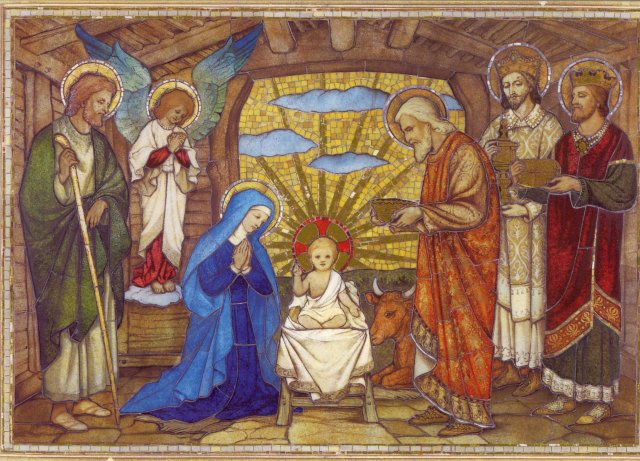
nativityI would like to send my warmest wishes to all my readers on this holy day of Christmas. Since yesterday evening, I celebrated Midnight Mass with my wife after having blessed the crib and placed the infant Jesus in the manger. We sang the Mass with simplicity and joy.

After that, we ate a dozen of our local oysters from Veules les Roses. We had been to buy them on Christmas Eve morning from la criée on the edge of the sea. With a south-west wind, the sea was to lee, and therefore only with waves from the sea swell. The sailing club lay forlorn with the doors protected by heavy wooden planks, and only the fishing dory on its launching trailer. We yachties take our boats out when the weather is clement. The fishermen go out to make their living in everything other than the most dangerous conditions – and in mid winter.

This Christmas Eve was also a time for some to and fro between things I said on this blog and a series of responses from a diverging point of view. As some reminded me, it was a pity that such things had to come up on the Vigil of Christmas. The clash brought me to think about a number of things. I have written enough on ecclesiological questions not to want to go over the same boring old things time and time again. I was dealing with a new convert, who, I remember, applauded the idea of a “Eucharistic fast”, which would underline the rupture between one spiritual life and a new one. All within the logic of an inner and outer conflict I myself went through for much of my adult life.

This notion of rupture has been the most painful for many of us, and what made Rome’s propositions suspect in our eyes. Pope Benedict XVI has gone on for years about hermeneutics of continuity and organic development, but such cannot apply in some spheres. There has to be rupture. This observation also causes intense pain to some of those who felt morally obliged to run this particular gauntlet.

As I celebrated the Mass of this Christmas morning, the thoughts raced through my mind. Should this Mass be the last Christmas of my priestly life, or even as a Christian? I am not so cock-sure about the TAC as to defend it or its bishops unconditionally. My former blog collaborator attaches great importance to men sacrificing their vocations for the truth. Indeed, if that is the truth, and the only truth, then you give everything with heroism and utter generosity. I sometimes find the priesthood a terrible burden, and I often think how good it would be to share the lot of most humanity – and spend life as a spiritual seeker. There are many different spiritual and religious traditions on this earth like Gnosticism and a few shards of the Celtic tradition, and new ones are emerging as men of science begin to discover that materialism is a false understanding of our world, and quantum mechanics point to a spiritual understanding of all things we know and still don’t comprehend. I’m not concerned with “playing church”, but I am concerned with keeping sacramental Christianity going in some way, however futile it might seem.

Also, many members of the TAC are former Roman Catholics, who left for what they believed to be serious reasons. Some of them became priests in the TAC or joined the TAC as priests ordained in the Roman Catholic Church. Archbishop Hepworth was the highest profile of clerics in this category. There were others, including yours truly, ordained a deacon after having been a convert from Anglicanism and ordained in vagante land.

The history of the TAC over the past five years is of Byzantine complexity, but whatever went wrong with the aftermath of the bishops’ meeting in Portsmouth in October 2007, one thing that lacked was solidarity in the body of the clergy. I had many conversations with Archbishop Hepworth about what would happen to the irregulars in view of the complementary norms of November 2009 that clearly stated the categories of me would not be considered for the priesthood in the Ordinariates. I think he believed what he said to me – he was expecting special rules from Rome to cover the irregulars. There were none, not even for himself. By the time the Archbishop thought of setting up a Fraternity of Saint Benedict to create a pastoral provision for irregulars for the years it would take to make canonical appeals to the Roman canonical law courts, it was too late.

All that is left of the TAC, poo-pooed by the new converts, is what was regrouped in March 2012 under Archbishop Prakash and the organisational skills and energy of Bishop Michael Gill of South Africa, together with input from the American bishops and Bishop Botterill. What is more or less affiliated to this regrouping is difficult to fathom, in particular the TAC in Australia, Torres Strait and many local Churches in Africa and South / Central America.

There are ongoing attempts to define the regrouped TAC. Some are far from being impartial or laced with bitter reflections. The way Archbishop Hepworth was dealt with (at least what we know) has caused a lot of pain. The whole process of the ACA splitting away from the Ordinariate movement in 2010 was also painful and confusing. People are wounded and would like to settle old scores. It has almost become a blood feud. Is God anywhere in all that? Is there anywhere where God would feel at home?

Should I leave the TAC and go back to my ecclesial life (or lack thereof) of before August 2005 when Archbishop Hepworth took me into the TAC? Have I to begin negotiating with men who don’t know me and to whom I am just an administrative unit? How do I deal with this blood feud, maintained also by some of the new converts who are still smarting after having been “persecuted” by the ACA bishops? Where in the Church is there not a mixture of saints and sinners? Is there not still something good and ecclesial in the TAC alongside the sins and failings of human beings? This is going to be a major question this coming year. Either the TAC is cursed and everything should be done to destroy it and squeeze the toothpaste tube dry, a few more converts for the Ordinariates and the rest relegated to the abyss – or there is something to be rebuilt and put to the service of the Christian mission. That is the essential choice each of us has to make. The choice each of us will make will bear consequences.

I am not going to go on with the blood feud or seek guilty persons to settle scores with. There may be some despicable clergy in the TAC, as there are in all churches and ecclesial communities. We either reject the faith or ecclesial life, stick our heads in the sand, or come to terms with the human reality. Alongside the sin, there is also ecclesial communion in Christ and a sense of solidarity, loyalty and obedience to those we believe are more likely to be right than ourselves.

So, what do I propose? I am going to try to make a survey of the TAC and find out what we have and how many we are – bishops, dioceses, parishes, priests, laity, religious communities. In places, there may be pitifully few as our critics underline in their writings. Where two or three are gathered together in my name… In other places, there may be entirely intact communities judging by pre-Portsmouth 2007 standards like in South Africa, and – as far as I can tell – in Torres Strait. One thing is sure, we are not 400,000! We may well not be a hundredth of that number.

Some information is available on the various official sites of TAC local Churches. There are the names of the bishops and local parishes, and in many cases the names of the priests and parish websites. I plan to write an article about each local Church of the TAC once I can find reliable information. It’s likely to be a tough job, and the recent events have driven heads into the sand and made the weak of heart retreat into silence and fear.

I intend writing articles on the present state of the local member Churches of the TAC in the United Kingdom, Australia, Torres Strait, Canada, the USA, the African continent, the Central and Southern American continent and India. I expect there will be a small and scattered diaspora in other countries, like myself in France. I will look for official communications, information bishops and vicars general are prepared to share with me for publication and other information from private persons if I am convinced of its reliability. I intend to perform this task in the spirit of casting the TAC in the most favourable light possible. I believe this would be of service to the TAC and would help complete and close the painful separation process between it and the Ordinariates.

I would appreciate all the help I can get for the preparation of each of these articles. You can write by way of comments or privately by e-mail (anthony.chadwick AT wanadoo.fr). Thank you in advance, and wishing you a happy Christmas Octave, celebration of the New Year and a holy Epiphany.

Posted in Uncategorized | Tagged , | 1 Comment

Deborah Gyapong and Trashing

She has been bashing this one for a long time, but I have always treated her as a lady and have sometimes tried to “negotiate”. Personally, I am fond of her, but her decreasing tolerance has made me truly wince.

Here is the latest to take me up on some of the things I write: Fr. Anthony Chadwick’s response to that letter from Continuing Bishops.

I lay it on the line. Here it goes: Anyone calling himself Catholic without being formally in communion with Rome is masquerading. Unless we have converted as she has done, we are bogus and worthy only of contempt.

I have noticed this increasingly intransigent attitude for some time. Fine by me. There would only be sour grapes on my side if I really believed the “one true church” sales pitch, but I don’t. At the same time, the way Anglicanorum coetibus was implemented in the early days deeply hurt her, and we had many discussions – but then she accepted it. That’s fine by me, but I now protest against her intolerance of the continuing existence of some of the Anglican community she once belonged to.

I do give her credit for trying to be reasonable with such men as Bishop Botterill who managed the division between continuing Anglicans and Ordinariate-bound in a more peaceful way than the more heavy-handed Americans. But there comes a time when some of us are going to make an effort to survive or go under. There is no more paste in the tube for the Ordinariates. But she is handling this quite ineptly and pouring more oil on the flames.

Deborah Gyapong is the true reason I closed the old English Catholic blog, since she was on it as a contributor. I didn’t want a bust-up at the time, and I still don’t. But I am now forced to come clean with it.

It is now seems to be the parting of the ways. May God bless her in doing and writing what she feels to be right, but the limit is reached when she began trashing others. And that I cannot accept.

Posted in Uncategorized | Tagged , , , | 14 Comments

Fourth Sunday of Advent

This is the proper from the Sarum missal, which does not correspond with the Rorate Mass in the Roman missal. This Rorate Mass, sometimes called the Golden Mass, was celebrated last Ember Wednesday.

* * *

Fourth Sunday in Advent.

At Mass. Office.

Remember us, O Lord, according to the favour that thou bearest unto thy people ; O visit us with thy salvation ; that we may see the felicity of thy chosen ; and rejoice in the gladness of thy people, and give thanks with thine inheritance.
Ps. We have sinned with our fathers, we have done amiss, and dealt wickedly.

Lord have mercy upon us.

Collect.

O Lord, raise up, we pray thee, thy power and come, and with great might succour us, that whereas through our sins we are sore let and hindered, thy bountiful grace and mercy may speedily help and deliver us. Who livest etc.

Epistle. Phil. iv. 4 to 7.
Rejoice in the Lord … in Christ Jesus.

Gradual.

The Lord is nigh unto all them that call upon him : yea, all such as call upon him faithfully. V. My mouth shall speak the praise of the Lord : and let all flesh give thanks unto his holy name.

Alleluya. V. Come, Lord, and tarry not ; forgive the sins of thy people.

Sequence.

Before the all-creating Lord
Let us rejoice with one accord,
Who made the worlds, the beaming sky,
The stars that glitter variously ;
The sun, creation’s central light.
The moon which softly decks the night,
All other orbs that gleam around.
Sea, land, hills, plains, and deeps profound ;
The air, where fly the feather’d tribes,
The winds go forth, the tempest rides ;
All, now and ever, thee alone.
Ceaselessly praising, Father own ;
Who to this lower earth hast sent
Thine only Son, all innocent.
Bringing salvation from on high,
For our transgressions here to die.
To thee, blest Trinity, we pray,
Guide all our goings in thy way,
Control our wills, our hearts revive,
To our offences pardon give.

Gospel. St. John i. 19 – 28.
The Jews sent . . . John was baptizing.

Offertory.

Be strong, fear not ; behold our God will come with vengeance, even God with a recompense ; he will come and save us. V. Then the eyes of the blind shall be opened, and the ears of the deaf shall be unstopped. Then shall the lame man leap as an hart, and the tongue of the dumb sing.

Secret.

We beseech thee, O Lord, look graciously upon this present sacrifice, and grant that by it we may be purified to take part in the nativity of thy Son, Through etc.

Ferial Preface.

Communion.

Behold, a virgin shall conceive, and bear a son, and shall call his name Emmanuel.

Postcommunion.

Accompany thy people, we beseech thee, O Lord, with the plenteousness of thy gifts, that they being defended from all evil by the virtue of thy sacraments, may be prepared both in mind and body to celebrate the ineffable mystery. Through etc.

Posted in Uncategorized | 1 Comment

What can we learn?

It has been a few days that I have been aware of An Appeal from the Continuing Anglican Churches to the ACNA and Associated Churches. This text is now to be found in a number of websites and blogs. Perhaps we are given a historical reminder of the Affirmation of Saint Louis movement in contrast with those dissident Anglicans whose single issue seems to be homosexuality. Here we find the agreeing signatures of Bishop Marsh of the ACA together with the leading prelates of the Anglican Catholic Church, the Anglican Province of America, the United Episcopal Church of North America and the Diocese of the Holy Cross which keeps close ties with Forward in Faith in England. This issue is proving to be a point of unity between the various acronyms of the so-called “alphabet soup”. It is one of identity and an answer to the questions – Why are we here? and What are we doing?

Was our purpose, from the beginning, providing human resources to bolster up someone else’s deal with Rome? I won’t go though it all. Just open The Anglo-Catholic and read through its 2010 postings, many of them written by yours truly! As the narrative goes, our bishops signed a solemn promise to become Roman Catholics and those who failed to do so reneged and lost any claim to honour or integrity. There is no provision for those “not ready at this time”, and there never was. No matter how thick the sugar coating was, the cold shower was just as cold for those who had been welcomed into the TAC but were canonically irregular for being received into the Roman Catholic clergy in any shape or form. Rome was up front about that.  Archbishop Hepworth was chivalrous enough to sacrifice his own vocation, but he was wrong in sacrificing the vocations of others. The deed is done and the consequences have been suffered. Now we have to try to repair as best as we can, forgive those who have wronged us or led us into illusions, and just get up.

Only a couple of days ago, in response to the TTAC in England doing something to pull itself out of the rut, one neophyte and apparently happy convert pointed out to us that the only ones to have a right to call themselves Catholics are in union with Rome. Challenge that person, and it comes out “I didn’t mean it so absolutely. I wish those who stayed in the TAC God’s blessing and all good wishes“. But the knife still goes back into the wound to inflict more pain and anguish. But, the more one suffers, the less one becomes sensitive to pain. One goes from polemical to survival mode, and then to an effort to rebuild in earnest.

What have they set out to rebuild? That is a very good question.

Obviously, the common goal is continuing the Anglican way of Christianity. What the term Anglican means depends on churchmanship, whether you are high or low church, whether you seek to underline the values of the English Reformation, an English variety of generic Old Catholicism (the ideal and not just the Union of Utrecht) or a spiritual rendering of the Enlightenment. Generally, continuing Anglican communities broke with the Canterbury Communion out of an idea parallel with Roman Catholic sedevacantism and the notion of replacing what is no longer legitimate, or the idea of some kind of survival whilst waiting for better days. The Continuum is also a reaction to the modern secular tendency of reconstructing society without Christian faith and purely on the values of the Enlightenment and other anti-Christian ideologies. I have no need to repeat the comparing and contrasting of the 1977 continuing movement and the newer schism from the American Episcopal Church dating from only two years ago, meaning that the latter accepted many of the things refused in 1977.

The catalysing issue in the 1977 movement is the ordination of women, but encompassing a number of other related causes and effects, whilst for the 2010 movement, the issue is purely homosexuality.

What is most significant is that the Saint Louis movement is that the Continuing Church has failed to present a united front, has failed to grow as we should, and in general has failed to present an attractive alternative to the growing heresy and absurdity of the Episcopal Church. At the same time, the continuing bishops affirm a new will to unite and settle the historical conflicts. The ANCA contains the same fault lines as Continuing Anglicanism ever did, but affecting more fundamental aspects and that much more difficult to resolve.

We have all to examine our understanding of classical Anglicanism and how the high-church vision fits in to provide the basis of the old agreements between Anglicanism, Old Catholicism and parts of Orthodoxy. One aspect of Anglicanism that is difficult is conciliating the idea of the “classical Prayer Book tradition” with the desire to restore the shape of the Eucharistic rites to the best of their pre-Reformation usages. This notion of “prayer book tradition” is something that needs to be clarified by comparison with its own liturgical background. The American 1928 Prayer Book and the Scottish Prayer Book of 1929 represent partial restorations according to Anglo-Catholic principles. Interestingly, the Prayer Books have retained the old medieval liturgical calendar with its Sundays after Trinity and Ember Days.

I would like to see more serious consideration given to the revival of the Sarum Use in the place of the English and Anglican missals based on Counter Reformation Roman Catholic usage. There are two complete translations of the Sarum missal in Prayer Book English, of which the better one is the Warren version of 1911. The two translations share the same sequences. A Eucharist celebrated according to the Sarum Use in English would be perfectly compatible with the Offices of Mattins and Evensong from the Prayer Book as a practical and pastoral alternative to the medieval Breviary. An American 1928 Eucharist would be better supplemented by Warren / Sarum material (English Hymnal of 1933) rather than the Roman material with its tendency to reinforce Anglo- Papalism and the movement in the TAC that led both the joy and heartbreak through a screen of illusion and deception. Anglicanism has, at least over the past hundred years, learned to tolerate a healthy level of liturgical diversity – and that needs to continue.

But Anglican identity is not merely a question of liturgy and what is done in churches. It is also a mentality that involved tolerance and an English sense of fair play. How Anglicanism took off in other countries, I fail to understand. That spirit of respecting diversity has now died in England. Discussion and dialogue are things of the past, and I mourn the passing of many of our English ideals that I had believed to be eternal. There is the pastoral sense and that character of “tolerant conservatism” coined at one time by Archbishop Peter Robinson – which both seem to be on the way out. I sometimes believe that the best place to be would be at sea, as far away from inhabited land as possible! But yet, when all hope seems to be lost, there is a new twitch on the thread, to misquote Chesterton.

Taking note of these difficulties represents a step forward and a reason to hope for revival and renewal in the place of cynicism and decline, attrition and despair. If we want things better for ourselves and our posterity, it is up to each of us not only to rebuff the cynicism, scoffing and naysaying of others, but also to be committed to a positive course of action to offer the world what we consider as sacred and precious. I believe it is possible with this renewal of good will between our bishops.

We may be reserved and sceptical, as we wait for these first New Year resolutions to bear fruit and draw down God’s blessings on the afflicted Christian people. This appeal from our leading bishops is welcome and a bringer of hope.

Posted in Uncategorized | Tagged , | 5 Comments

Nostalgia and Reality

It is an emotion, as close as emotion as written words on the Internet can get, that sticks with us. I read in quite a few places a growing emotional attachment to a vision of the Catholic Church that would afford security and certitude for all.

It is the idea of the infallible Church as forged by the nineteenth-century anti-liberal Church under Pius IX and reinforced over the decades by Pius X, Pius XII and Paul VI, interspersed with the “liberal” pontificates of Leo XIII, Pius XI and John XXIII. It is perhaps not so much the Popes trying to get back the old absolutist image, but the conservative Catholics in the pews.

I have observed things over the past thirty years, ever since a time in my life when religion held relatively little importance other than cultural (it was church music that I liked, and I held a respectful distance from the clergy). At first, I swallowed the conservative apologetics, as they seemed to represent the fulfilment of a dream, the Philosopher’s Stone that brought Truth into an uncertain world. Just convert everyone to the Pope and all will be well. I saw a resurgence of this kind of thing with the Ordinariate movement, except with memories spanning over thirty years. One thing I realise is that I am not alone, but our testimony must be eliminated and trashed. There must be no corporate knowledge, no accumulated experience. Corporate knowledge is a management term. It is something that can be as useful as damaging or threatening to an authoritarian structure whose power depends on innocence and lack of acquired experience.

One difficulty with the TAC was its containing “failed converts”, or those who, like Archbishop Hepworth, had become Anglicans and had assimilated the Anglican ethos. Such people lacked the expected naïveness and failed to go through with the self-sacrifice. And now, some are surprised to see us standing up again after having reeled from the last punch! The thing about pigs in a slaughterhouse is that the poor creatures don’t know what’s happening to them.

Another thing I notice is profound disillusionment with the “optimistic” paradigm of the 1960’s and 1970’s, the years corresponding with the pontificate of Paul VI. In the 1970’s, I knew little about Roman Catholicism, but I had the idea of Paul VI as a reactionary and an authoritarian. I was certainly given a false and distorted idea, but I failed to muster enough curiosity to know any more about this figure. What I did know is that his Novus Ordo was just as bad as our Series III and sex was to Roman Catholics what pork is to Jews!

With this disillusionment, it is natural for us to seek something authentic, and so we project our wishes onto something that just doesn’t correspond. Going by some blog postings, Orthodoxy’s claim to be that “one true Church” seems to have that little bit more credibility in America. Not here in Europe where it remains “foreign” and “exotic”. They seem to have kept their folk religion – precisely by keeping us radioactive western people out!

As Pope Benedict recatholicizes the church…”? We constantly read the words of hope in the blogs – Brick by brick, the Pope wearing the fanon or red shoes, or anything that makes him look like going back to the old days. The Tiara was really too much to hope for. Now the poor man is past the age at which John Paul II died, and the glooming anxiety will be what kind of successor we get. So it will have to be a Pontiff who maintains the ban on contraception and tells us that we would be holier if we were poorer and more respectful of (clerical) authority.

First time round, it seems convincing! Thereafter, it’s too hollow…

Young Fogey has a much more subtle way of thinking than I thought, and sees the hollowness in the conservative line. I quoted something the other day about conservatives conserving the stuff hashed out by yesterday’s liberals and refusing any kind of corrective work. He tries to introduce a distinction between “traditionalists” and “conservatives”, defining the former as adhering to immemorial custom and organic change (as in Newman’s theory of development). He begins to see the limitations of simplism characteristic of so many of his outre-Atlantique countrymen, and I am that much further away from the assumptions I entertained as a cloistered seminarian amidst the baroque splendours of Gricigliano so many years ago. He mentions the quote from my old parish priest – “They (the traditionalists) are not what we used to be”. The Church was strict in the old days, but easy-going. Was it? Certainly the bureaucracy and blockages we have today just weren’t there sixty years ago.

As the years go by, the one thing I am most afraid of in myself is taking on the cynicism and nihilism of the elderly. They were unable to make any difference, so why should the young people? That is probably the thing I fear most about becoming old, and not so much the declining health, not being able to do things as before, becoming dependent and so forth. I fear losing the capacity to marvel, of finding joy and freshness. As some become old, they become curmudgeons and cynical about everything – they wouldn’t be happy even if someone blew up the planet with a thousand atom bombs! I will mention no names of those who trash and shower with contempt as others begin to emerge from their debilitating sufferings and start building.

My thought about the blogging of the usual spots over the past few days can be resumed in a few words – Out of gas! I haven’t heard that one in a long time… The Ordinariate people have embarked on their new course, and I can only pray they will find their joy before cynicism and disappointment set in for whatever reason. I would say the same for anyone else, for those regrouping in the remnant TAC, soldiering on as independent priests, those prepared to jump through the hoops of Church of England bureaucracy.

Every minute of the day, we fight against the spirit of cynicism and nihilism as we see few things that bring us joy. It is easy to envy the “freshmen” as they discover what we discovered thirty years ago and found not to be what they were hyped up to be. I remember a line from Robert Bolt’s The Mission, with the old Jesuit Cardinal musing about whether the native people of South America would not have been happier had the greedy and fanatical Europeans stayed away!

A few days shy of Christmas, I remember what Christmas is to a little child, how parents would go to great pains to preserve the wonder of this day for little children. Now, we are confronted with the sickening sights and sounds in our supermarkets and shopping malls for the entire period of Advent – and we are gorged with it all. The story of Christmas seems so dwarfed, and the probability is that the historical birth of Christ was very different. In the history of the Church, it was all about sanctifying the Sol Invictus, the old pagan feast of the Winter Solstice. It’s strange that no one has been able to commercialise Easter to the same extent. Perhaps the first Sunday after the first full moon after the Spring Equinox has less hold over our imagination than the Sol Invictus.

Is it time for it all to go away? The failure of the end-of-the-world prediction of yesterday must have come as a bitter disappointment to those who thought they would survive an extinction event like mega tsunamis or the earth getting hit by a massive meteorite. This is something about human nature that I find so difficult to comprehend.

The key to the whole thing is within ourselves. It can be nowhere else. We look for reality and truth outside, but neither are anywhere other than in ourselves. I saw this fascinating video on Youtube:

See more about Robert Lanza‘s theories – mind-boggling stuff but also mind-opening.

What if everything we know: matter, time and space – are illusions. The thought may be unbearable for many of us, but it certainly does cast our certitudes and all the things we thought we owned in a new light. We are reminded of that other famous quote from Shakespeare’s HamletThere are more things in heaven and earth, Horatio, Than are dreamt of in your philosophy.

It is from the moment we have the courage to leave Plato’s cave that we will find a new reality, a new light and a new enchantment.

Posted in Uncategorized | Tagged | 8 Comments

Advent 2012 Pastoral Letter from England

All this is very encouraging. Please keep the TTAC, its Vicar General and all the clergy and laity in your prayers.

* * *

Advent 2012

My Dear Friends,

Greetings, to each and everyone one of you in the Name of Jesus Christ.

May I take this opportunity to welcome you to our new Diocesan Journal, The Clarion.

The Clarion has been produced as a direct result from the discussions that were held at our recent Diocesan Assembly, which tool place in Lincoln on October 26th.

It became very evident to me during our meeting that the time was upon us to once again go forth with joy and confidence in proclaiming not just what and whom we are, but to most importantly proclaim the saving message of the Gospels of Jesus Christ.

For several years, the Traditional Anglican Church (TTAC) had become involved with a process that sadly led to confusion and division. That chapter has now closed and our situation has been clarified once and for all. Never again will we allow ourselves to be placed into a position that is neither necessary nor desired.

Let me be very clear about this, what I am not saying is that we are against the unification of the One Holy Catholic and Apostolic Church. The Affirmation of St Louis is very clear on the subject: – “We declare our firm intention to seek and achieve full sacramental communion and visible unity with other Christians who ‘worship the Trinity in Unity, and Unity in Trinity’ and hold the Catholic and Apostolic Faith”.

What we were presented with was not acceptable to us as fulfilling our declared intention and petition on the issue; absorption is not the same as mutual recognition of our treasured place amongst the Holy Church of God, Anglican, Catholic and Apostolic.

So what is the nature of our Church, well again I refer us back to the Affirmation of St Louis as way of a reminder of what we are “we gather as people called by God to be faithful and obedient unto Him. As the Royal Priestly People of God, the Church is called to be, in fact, the manifestation of Christ in and to the world. True religion is revealed to man by God. We cannot decide what is truth, but rather (in obedience) ought to receive, accept, cherish, defend and teach what God has given us. The Church created by God, and is beyond the ultimate control of man.”

“The Church is the Body of Christ at work in the world. She is the society of the baptised called out from the world: in it but not of it. As Christ’s faithful Bride, she is different from the world and must not be influenced by it.”

The Traditional Anglican Church in Britain is a part of the One Holy Catholic and Apostolic Church of Christ, it holds to the Christian Faith as professed by the Church of Christ from the earliest of times and in particular as set forth by the Ecumenical Councils of the undivided Church and embodied in the Creeds known as the Nicene Creed, Athanasius Creed, and that commonly called the Apostles Creed.

Since our formation in 1996, we have maintained resolutely our Canons and Constitution; we will continue to do so until we have the space to undertake a comprehensive revision. However we also need to ensure that we have a standard form of worship throughout the Diocese and use those books as Authorised under the Ruling Principles of the Church. The King James Bible and the Book of Common Prayer (1662). Please see the excellent article on the subject on the Book of Common Prayer by reverend Father Geoffrey Andow.

We have all witnessed the sad and distressing events that have taken place within the Church of England; we need to be clear on the issue of women and the ministry within this Church. I will again for clarity refer to the Affirmation of St Louis,

Holy Orders: – “The Holy Orders of Bishops, priests and deacons as the perpetuation of Christ’s gift of apostolic ministry to His Church asserting the necessity of a bishop of apostolic succession (or a priest ordained as such) as the celebrant of the Eucharist – these Orders consisting exclusively of men in accordance with Christ’s Will and institution (as evidenced by the Scriptures), and the universal practice of the Catholic Church”.

Deaconesses:-  “The ancient office and ministry of Deaconesses as a lay vocation for women, affirming the need for proper encouragement of that office.”

We are not anti women neither are we anti feminist, but we will continue to adhere to the essentials of Truth and Order as defined within the Affirmation of St Louis and the Ruling Principles of this Church. We fully recognise and encourage lay pastoral roles for women within the Church and that includes the ancient orders including that of Deaconess as a venerable vocation. It is a very important role which we should collectively encourage to meet the growing and demanding needs of the Church in the Community that it seeks to serve.

Our Assembly witnessed in the spirit of Love and Unity the views of all of those who were present, I was determined that the voice of everyone should be heard and understood. Everyone has a right within the Church both Clergy and Laity to express their opinions and views on every aspect of the live of the Church and its collective Ministry.

We are here to proclaim and teach the Gospel message of our Lord and Saviour Jesus Christ, so we have to begin to seek ways in which we can make ourselves more visible.

We have made a very good start by first re- establishing our presence on  the World Wide Web. The site is still in its infancy and will be continually developed until we all feel that it is comprehensively meeting the needs of the Church. The review of our publicity material needs reviewing urgently, so that those who inquire of what we are or who we are need to have to hand easily understandable leaflets etc, that spell it out.

The web site will help address this to a certain extent, Michael Wilson our webmaster is making documents assessable in PDF format already, but more needs to follow. We have within our midst one of the finest journalists in the country Father Tony Fry, I pray that in time Father Tony will edit our Diocesan Journal once he has cleared time and space within his busy schedule.

Cathedral, during the Assembly discussions, a point was made that we should consider that St Katherine’s be made our Cathedral Church. In February 2005 our former Archbishop John Hepworth visited St Katherine’s just before its programme of restoration was due to commence. As a result of his visit he issued a Certificate for the Erection of St Katherine’s as the Cathedral Church for the Traditional Anglican Church in Britain. It was conditional that the restoration programme be completed before the said Church could be erected as our Cathedral. After an extensive £2.3 million restoration project the building works are now complete. As a result we can now proceed to formalising the process.

We will form a Cathedral foundation and appoint Canons. The installation of the  Grand Organ has commenced with the 32 foot pedal open now being in place. The work will last several moths but we hope to have this work completed by Easter 2013. We have had a light peal of six bells donated and hope to be able to fund their installation next autumn. The Cathedral will have its own dedicated website with a direct link to our Diocesan site and the TAC website also.

Election of a Bishop, during the Assembly discussions, the question of our having our own Bishop was raised. I want to emphasise that this topic was not on the Agenda, but in the sprit that the meeting was held the subject was raised and debated. We agreed to pass a Motion on the matter in which it was agreed that we petition  the College of Bishops to arrange for such an election to be held as soon as is practicably possible. The Motion also stated, that I be elected to the position. I was very humbled by the outcome. The Motion received unanimous endorsement. The motion will be forwarded to the College of Bishops in accordance with the wishes of the Assembly.

Officers, All of the officers of the Church have been confirmed into office, I am delighted that Paul Jones has accepted the position of our Registrar. Michael Wilson has agreed to continue as our Diocesan Secretary and Christopher Houghton has been appointed as our Diocesan Treasurer. All of our officers are based at St Katherine’s and can be contacted directly by telephoning the Priory  Centre on 01522 579490.

Development All of us want our Church not to simply “continue” but to grow and attain a national presence. We have to reach out wherever and whenever we can. The work of the Kingdom is not an easy one, particularly in a nation that has developed into an insular, selfish and secular society. However that should not act as a deterrent to our sacred mission to proclaim the Gospel Message. We need to encourage men into the ministry and to welcome enquirers with open arms. We are not here to Judge but to save society from raid moral decline.

We must encourage the establishment of new missions and parishes. We need an effectual support system putting in place so that all of our isolated members receive regular Communion, news and relevant information from across the diocese. We are a member Church of the Traditional Anglican Communion, this is a Global Communion made up of 47 Churches throughout the world. We will try to ensure that news and events from around the Communion are assessable and shared by all.  For those of you with the availability of the internet you can log into the TAC web site at www.traditionalanglicancommunion.org

Finance or lack of it is obviously a problem for our Diocese; however I can report that our Diocesan Treasurer Christopher Houghton is making good and steady progress in resolving the historic issues from the past. However if we are to continue to develop the Diocese more has to be done. Good stewardship is essential and regular donations and tithing will help us to support the development of new missions and the training of new priests.

So here we are at the beginning of Advent a word derived from the Latin meaning coming. The Lord is coming and the preparation for Christmas is an important theme for Advent, but it is more involved than that. Advent in the truest sense allows us a vision of our own lives as Christians and what might be possible to achieve in our daily lives.

The vision that Advent reveals is in two parts. In the first instance it allows us to look back to the first coming of Christ at Bethlehem. It then focuses our minds to the time when Christ will come again. It is in this interval between the past and the future that we find meaning for our own lives as Christians.

We acknowledge and celebrate the certain knowledge by Faith of Christ as he appeared amongst us in the form of flesh and blood when he took on our humanity. He came to show us what life could and should be. He gave us a vision of the true principles upon which all of us can build true and valid lives.

When in ordered time Christ left this earth we know that he did not abandon us. He is with us in His spirit, His Church, the Blessed Sacraments, the Holy Scriptures and each other. He is with us and keeps His vision of life before us.

When Christ comes again in Glory and Majesty, his Glory will be revealed. No longer will He be hidden behind the symbols of the Liturgy or the words from the Scriptures. He will be revealed in His fullness in a presence that will continue forever.

This is the greater significance of Advent. In this short penitential season we observe and inwardly digest the time from Christ’s birth to His Second Coming. This season of Advent gives to each and everyone of us the vision of life for the future.

This is the time for the Church to build upon the foundation that we laid in our October Assembly, a time to become more involved, more caught up in the meaning and possibilities of life as a Christian community. Remember we are not only preparing for Christmas but also for Christ’s Second coming. That in essence means that when He comes again, we will be fully awake, ever vigilant, prayerful and watchful.

To Conclude,

Obituary notices for the TTAC were very prematurely written indeed by those who should have known better. Those who were present at our 2012 Assembly will have shared in the incredible Loving and Holy atmosphere in which we conducted ourselves. What a complete contrast to the last Diocesan Assembly that was held in Portsmouth in 2010.

We are all sad by the loss of close friends through the almost inevitable misunderstandings that took place. I want to assure you all that I welcome any who might wish to consider returning to the TTAC. If they make direct contact with me, I will be only too happy to meet and discuss any request. Indeed, we welcome any individual or group that might wish to join us. Simply contact the diocesan office or any member of our Church.

I want to thank each and every one of you for your steadfast and faithful witness. You are all God’s special and Holy people and you’re continued Faithfulness in adversity is indeed truly special and very precious.

I also want to take this opportunity to welcome to our family the Reverend Father Dr. Frederick Jones, Deacon Robin Westwood and Harry Eddowes.

I wish you all a Prayerful Advent and a Blessed and Holy Christmas.

May Almighty God Bless and Keep You all

Yours in Christ Jesus

Father Ian+

Posted in Uncategorized | Tagged , , | 3 Comments

Sickness Strikes and Alien Nation

I have been more or less keeping up with the comments on my recent postings, and sometimes they get lively. Thank you, gentlemen.

Last Tuesday I started one of the most violent bronchitis bouts I have had in my life. My upper respiratory tract and back of my throat felt as if someone had made me breathe World War I mustard gas or evaporated battery acid! I was shivering and sweating, and that was my signal to see my doctor last Wednesday morning to get some antibiotics. It seems to be passing as the fever has gone, and the coughing is still quite painful. My wife caught it a couple of days later, and I have been looking after her too. So I haven’t been very productive on the blog or reactive to some of the cyber happenings – on which I prefer not to comment anyway.

What is more disturbing is the more graver sickness that afflicts my country. I am not a political animal or a right-winger, or a xenophobe – but I am a patriot. England gave me my birth in a good family. I am proud of the language in which I am writing now, even though I have spent more of my life in France than in my native country. I grew up in the Lake District, and seeing the white triangular sails on Windermere made me dream. Ours is a country of freedom and initiative, the encouragement of excellence and achievement. We have or had our schools and universities, and our institutions. Our law has always been firm but fair, and miscarriages of justice are rare, or have been.

The greenness of our land still makes me dream and sick with nostalgia. It makes it worse to play recordings of Elgar or Vaughan Williams, or read Milton, Shakespeare of Evelyn Waugh. I sang in York Minster forty years ago and went to school like so many other young Anglican boys, knowing that much would be expected of us in the way of work, duty and a sense of fair play. I am an Englishman.

Then I read this – Alien nation: The new census reveals a Britain that would be unrecognisable even to our grandparents. Now I know what it was like for Russians fleeing to France and the USA in 1917. I reeled and thought of the lamentation of Jesus over Jerusalem. For the first time in my life, I literally wept over my country! I left thirty years ago to come to France in search of a vocation which I never really found. Like a moth flitting around a lamp, I burned myself and have to live as I can with a wife who has her difficulties in following it all.

My parents are old and may not be around for much longer. They represent my roots in values that were forged in English life of between the wars. My father, once so buoyant and optimistic, can only see storm clouds as in those dark days of 1939. It hurts to hear his cynicism and inner hurt.

Well, what is happening? It’s a whole culture change. Every time I go over, it is with a sense of foreboding, crossing through alien territory on the way to the tiny fragments of England that are the homes of my parents, brother, sisters and a few friends. We have always had a few foreigners, and I am a foreigner in a country where I wasn’t born. I remember the first black kid at my primary school in the 1960’s. My first reaction? Her skin’s a different colour, but Stella is a beautiful looking girl, and she’s just as human as anybody else. I even wished I was black myself! The schoolteachers were so afraid we would tease her for being black! Perhaps some kids did, but that black girl mesmerised me. I love difference and tolerance, but it’s something else now. In London I loved going down Brick Lane for a good curry with friends. It was exciting to meet Indians, Jewish people, Pakistanis. We used to have an Empire, and it’s only natural the peoples we colonised would seek a home in our country. Why not? I’ve always known those people to be hard workers and honest as day.

What is really beastly is that those people are being used for social engineering experiments by our Orwellian politicians and bureaucrats. That is what is transforming our country out of recognition and wrenching our English hearts!

Is it better here in France? Not really, but the country is bigger, less densely populated and easier to find one’s place. Perhaps, one day, it will be “good bye, Europe“, but to go where? Until we know that, we can only stay put, knowing that it is all only for a time.

Come, Lord Jesus!

Posted in Uncategorized | Tagged | 5 Comments