Three Steps to the Gallows

Update: I am withholding the name of my source.

Interesting, but it would make more sense if, in addition to the figure of 26 applicants from the ACA who were refused nulla ostas, we could learn (a) how many applications from priests of the ACA have there been, and (b) how many approvals have been granted.  Off the top of my head, I could think of only three former ACA clergy who have been priested in the Catholic Church: Bartus, Ousley and Seraiah, and Ousely was a priest in ECUSA before leaving for the ACA.  But then a friend sent me this:

Interestingly, Fr. Meeks in the ex-TAC parish in Towson MD was raised Catholic.  And, many of his parishioners, though not all, are ex-Catholics.   He was either a high school or college seminarian (the source wasn’t sure), but dropped out in the 60s-70s (forget when) as a result of the tumult of the times.  (I was told this by someone of some importance working within the Ordinariate).  So, apparently, he was an exception to the general rules about former Catholics being ordained in the Ordinariate.

And another this:

Ed Meeks went through college seminary, receiving his BA from St. Mary’s Seminary, Baltimore, in 1969.

* * *

Without going into endless polemics, I got this amazing piece of information, to which a priest (I am withholding his name) replied:

This is very helpful. But I have to say that it is very sad that so many could get so far in the process without having realized that their applications were futile from the start.

What more is there to say? I simply look forward to my next time out in the boat…

* * *

This letter is from Fr Scott Hurd in response to an enquiry about the way TAC priest applications were being handled in the USA. It had been alleged that Father Scott Hurd was vetting all the applications and that none of the dossiers that were turned down actually got sent to Rome.

Dear X,

Thanks for your kind and understanding response. I am indeed aware of some of the rumors that you referenced. They have been brought to my attention through a number of channels, and often have been expressed in ways that are less than charitable.

N. was mistaken in saying that all dossiers sent to Rome were approved. Many that were sent to Rome were not granted a nulla osta.

Yes, before Msgr. Jeffrey was appointed, I was the one who processed dossiers. I did make recommendations, which were then reviewed by Cardinal Wuerl. Dossiers and recommendations were then sent to the CDF, and were voted on in congresso.

I will be happy to address some of these concerns during my presentation at the Anglican Use Conference in November; I know that Msgr. Jeffrey will touch upon these matters during his address to the USCCB in November.

With regard to the TAC, I am delighted that many fine individuals from that jurisdiction have been ordained or are well on track toward being ordained. However, it must be said that many of the petitions received from that jurisdiction were problematic for the sole reason that they were sent, not by Anglicans who believed that they were called by God to be Catholic, but by Catholics who had left the Church as adults and now wish to be reconciled.

As reflected in the Apostolic Constitution and Complimentary Norms, those who have previously been ordained as Catholics cannot exercise sacred ministry in the Ordinariate. Also, the CDF has made it abundantly clear that dispensations from the delict of schism will be exceedingly rare. We agree with this approach.

Of the 26 dossiers of ACA priests which were not granted a nulla osta by the CDF:

5 were Catholic priests

3 were Catholic deacons

3 were Catholic seminarians

7 left the Catholic Church as adults (the delict of schism)

Thus, 18 of these 26 dossiers were submitted by Catholics in need of reconciliation, not Anglicans seeking reunion. Only eight dossiers were turned down by others reasons. This is not a bias against any institution; it simply reflects an application of the CDF’s criteria in these matters.

Also, I would add that there are several clergy of the ACCC who were turned down for the same reasons. These dossiers did not cross my desk, as they were handled by Cardinal Collins office.

I hope this information will be helpful to you and will help us be at peace about how the Ordinariate is being implemented.

In Christ,

Fr. Scott

Posted in Uncategorized | Tagged , , | 9 Comments

The Anglo-Catholic

Update: Please read Filling in the blanks… by Fr Christopher Phillips.

Update: Deborah Gyapong has weighed in with her article The Anglo-Catholic’s hiatus which somewhat modifies some of the ideas I expressed based too uncritically, in particular from Christian Campbell:

Unfortunately, the powers that be have made it known that our help is not wanted at this time.  In deference to them, this blog will comply and leave them to their business.

Perhaps the so-called “powers that be” are persons other than the US Ordinary, perhaps something not existing at all. To be quite honest, I just don’t care. At the same time, I don’t want to be construed as a conspiracy theorist of some kind on the basis of words coming from a highly partial source.

Deborah Gyapong finds this idea unlikely, and that it would have been out of character for Monsignor Steenson to tell either Fr Phillips or Christian Campbell to put a blog into hiatus status. She writes very reasonably and cogently. I too appreciated my time on the Anglo-Catholic in its better days of late 2009 and early 2010.

I therefore wash my hands of the whole affair and get on with life.

* * *

I anticipate my blog being carefully watched today to see if I would say anything about the announcement by the Anglo-Catholic‘s moderator of a hiatus. I am not surprised either. There is an article on Fr Smuts’ blog – Fr Christopher Phillips Leaves The Anglo-Catholic. So there is no need simply to reproduce what is already written and quoted from the Anglo-Catholic.

I was first contacted by Christian Campbell on 29th November 2009 to ask me whether I would become a contributor on this promising new blog. I accepted, and contributed a number of articles – which are still there. Finally, I discovered that the blog had its own “orthodoxy” and “police”, and my increasing resistance to the pensée unique ended with a rupture. I set up my own blog called the English Catholic, and this met with my expulsion from the Anglo-Catholic in the last days of August 2010.

It now seems to be common knowledge that Christian Campbell went off on his own tangent after his reception into the Roman Catholic Church. I found out very early on that he was going to a chapel of the Society of St Pius X and had adopted the traditionalist ideology. Fair enough, but hardly representative of the Rome-ward movement of “groups of Anglicans”. This culminated with polemics concerning the use of the pre-conciliar Roman rite in the ordinariates, whether in Latin or the Cranmerese English form in the English Missal. This and other issues caused Deborah Gyapong to pull out, since this kind of discussion would tend to discredit other Anglicans on their way over, but less concerned about the exact rite to be used. I have been quite surprised by some things CCCC put on his Facebook page, but they are entirely irrelevant to me and concern only his personal life.

Now, Fr Christopher Phillips has pulled out too, and Campbell himself has announced an indefinite hiatus. We might suppose that Monsignor Steenson has told those who are now Roman Catholics that ordinariate business is private and not to be discussed on blogs. That seems to ring with my recent article on secrecy, but I am not myself concerned with any Ordinariate anywhere. I will not speculate, but with no discussion and no coverage of any kind, the internal business of a “private club” is irrelevant to nearly all of us, as would be the yearly accounts of some provincial golf club in England.

There is an old quip about gentlemen’s clubs in London – that you know a member has died when there is an ungodly stench coming from behind the newspaper!

Fr Phillips, as a priest under jurisdiction, would have seen the need not to provoke problems for himself or his ministry. Similarly, Deborah Gyapong is a respected journalist and maintains excellent relations with the Roman Catholic Church in Canada. It is a question of professional integrity and keeping squeaky clean.

Sic transit gloria mundi. The Anglo-Catholic met a less radical demise than my English Catholic blog which I deleted. Campbell has his personal blog on which he writes about the things that interest him. I do the same thing here, but on different subjects and from another perspective. Should I say Good riddance? I do not take pleasure about negative things, but just find it sad. I have no feelings of “getting even” – I’m just not that kind of person. At the same time, time marches forward, and the religious world is not the same as it was in the heady days of 2007 and 2009.

In 2007 and November 2009, there was an objective to work towards. That is now irrelevant to all but a very few, and the future of the remnant TAC remains uncertain in spite of the rhetoric of the early months of 2012. Archbishop Hepworth wanted to keep something going for the clergy of the erstwhile Patrimony of the Primate who were still waiting for word from the ordinariates or had been rejected. Without a clear justification for any kind of structure, it seems hard to imagine that idea going anywhere. The storm clouds and gloom seem to gather as, for many of us, Godot never arrived and the batteries ran out.

The moral of all this is that Campbell and I made the same mistake, continuing to gnaw on the same bone year after year. My English Catholic blog had become too concerned with the ordinariate question and a continuing coverage of what was happening to Archbishop Hepworth. I ended up buckling under the nastiness of many of the comments and the same “political correctness” that dominated the Anglo-Catholic. This blog was designed to be more educational and intellectual, though I have often allowed myself to discuss the old problem.

The statistics page show that I get many more times read when I discuss the old problem than when I write about other subjects. I am not “in business” to attract attention or advertise myself. This should be a lesson to us all. Christian Campbell had something more gimmicky and full of gadgets than I ever thought about. He was constantly asking for donations. My blogs have never cost me anything and I have never collected a penny. He has his problems and I have mine.

The Anglo-Catholic looks like staying available for the sake of its archives, which can be consulted. My old articles are still there, as are many others of intellectual and historical interest. No Schadenfreude – but life has to go on. The lesson the dinosaurs bequeathed us is that we adapt or go by the wayside!

Posted in Uncategorized | Tagged | 2 Comments

Medieval Liturgy

It is a while since I wrote anything on this blog’s primary subject, the liturgy and the Norman-English tradition. Lee on the BCP has this to say in regard to those who exclude the possibility of using medieval liturgical forms.

The subject of this article is the 1979 American Prayer Book and a book that has been written to present it to readers. We find emphasis on the wholeness of the liturgy in contrast with the more minimalist Anglican prayer books.

Here are a couple of passages dealing with the issue of medieval liturgical forms and modern liturgical forms inspired by the medieval tradition.

Perhaps my central point of disagreement with Lee is in his synthesis of Christian liturgical history and his notion of a single correct primitive pattern of Christian worship from which the past departed, to which the Reformation pointed, until ultimately recaptured by the Liturgical Renewal Movement. Following this kind of a pattern it’s inevitable that the word “medieval” will become a swear word as it represents the nadir of falling away from the primitive pattern. And such is certainly the case throughout this book. As a student of medieval liturgy, this struck me as a bit short-sighted…

It has been fashionable for some time to seek anything other than medieval liturgical shapes in the almost “dogmatised” belief that anything medieval was decadent and corrupt. This prejudice spread into the twentieth-century Roman Catholic liturgical movement.

On one hand, I fault failures in his synthesis. In particular, he falls into the trope (also found in Black’s book) that in the (Western—the East is never in view) medieval period, liturgy and its spirituality became the sole preserve of the clergy and monastic elite who alone inhabited and understood it. First, this ignores the vibrant tradition of lay liturgical spirituality represented by the Books of Hours and prymers. Second, I believe it assumes a much more educated clergy than the sources do. Latin literacy of average parochial clergy would not have been that much greater than many of their congregants requiring a different perspective on the assumed (and perhaps largely constructed) gulf between the understanding of the laity and the clergy.

The author to read is Eamon Duffy, especially but not only The Stripping of the Altars. There is historical evidence of a vigorous tradition of lay spirituality in the fifteenth and early sixteenth centuries. Inversely, we can ask the question of whether churches with other liturgical shapes are any more relevant to people in our world whose religious culture has long since disappeared.

On the other hand, such a synthesis raises again the theological problem of the Holy Spirit. If the entire body of Christendom—East and West—fell into such significant error around our fundamental worship practices, what exactly was the Holy Spirit up to with reference to the Church? Did it take a millennium-long nap and only conveniently wake up for the Western Reformation? Sorry—I have a really hard time buying it… Yes, the Liturgical Renewal Movement did some great work. Yes, there are aspects of our current prayer book that seem to better reflect the spirit of apostolic worship than our caricature of a thirteen century non-communicating High Mass. And yet, I can’t go along with the notion that the medieval liturgical experience, the spirituality that supported it, and the thinking, writing, and praying that came out of it (think Julian of Norwich, for example…) was entirely an aberration.

That is a standard argument – where the Church was before … It is impossible to claim that darkness reigned in the pre-Reformation Church, or, for that matter, in European Catholicism in the 1950’s under Pius XII (though there were already the first changes in the liturgy based on “pastoralism” at the time).

The problem in terms of getting people back to church is not the liturgy, but the fact that most of our contemporaries cannot relate in any way to what has become “church culture”.

No conclusion … but comments are welcome.

Posted in Uncategorized | Tagged , | Leave a comment

Gust of Wind at Veules

As always, nature has to be respected, whether it is the herculean strength of the sea or the fickle wind.

I went sailing yesterday afternoon in conditions I found a little doubtful, but at the same time as a sailing class for youngsters on catamarans taken by a highly experienced sailing instructor, someone I know and greatly esteem. A Zodiac with a 50 HP engine in the neighbourhood is reassuring. So, even if I would get a 20-knot gust from time to time, the conditions were quite good. When you get such a gust, you just release both sails and push the tiller over, which heaves the boat to, and you just wait out the gust. It is a bit wearing on the sails and rigging, as they flap wildly in the wind, boom violently swinging back and forth – but it saves a capsize and a bath!

The sails of the catamarans were not reefed. We were all aware that stormy conditions were not far away, and we are all trained to recognise cloud formations and the warning signs. I would not have gone out alone – this is why we look eagle-eyed at the weather forecast and the conditions we find.

Out of a sense of precaution, I decided that 4.30 pm was time to put in and beach the boat, which I did. I was closely followed by the four catamarans and the accompanying Zodiac. The clouds were gathering, but we were all safely on the beach. I took down my sails and went to fetch the launching trolley. As I approached my boat, the wind whipped up to about what you feel riding a motorcycle at top speed on a motorway. Such a speed would be above 90-100 kilometres per hour or about 40 knots. It made lines in the wet sand and whipped the sea up into foam. My boat started to blow over, which could have damaged the rig, so I reached it in time and pointed it into the wind. The sails were already down and stowed. Three of the beached catamarans, also unrigged, were blown over. They are fairly heavy craft and hardly capsize at sea unless you really want to! I helped to right them. “I’ll pick up the mast. You turn the boat into the wind”. Then the boats were righted without any damage. I said to the instructor “Good job we weren’t at sea!”. “Yes, we would all have gone over”.

The gust lasted for a short time, but remained strong as the clouds came in from the north-west. It settled down to 15-20 knots. We hauled our boats off the beach and packed everything up.

It was a close one! Winds like that are terrifying, and my heart goes out to the people of New Orleans being blown out by a hurricane. Man is no match for God and nature, for the terrifying force of the wind and the sea. As always, the sea teaches us modesty.

Posted in Uncategorized | Tagged , | Leave a comment

Godwin’s Law

There is something I would like to make clear to my readers, in the wake of a recent discussion with my wife. She had me discover the existence of a concept called Godwin’s Law. This is the fallacious use of comparisons of anything to Hitler and the Nazi regime (1933-1945) in order to discredit the opposing argument or any kind of authoritarianism. Invariably, one who uses such an argument fallaciously – for example comparing a policeman booking you for parking your car in the wrong place with the SS or the Gestapo – himself gets discredited. Rightly so.

Hitler was not wrong because he was authoritarian or insisted on discipline, but because he killed people or denied them their fundamental rights to freedom and happiness.

It can happen that comparisons with Nazism are justified, but on the basis of precise criteria. I would certainly recommend a cover-to-cover reading of William Shirer’s The Rise and Fall of the Third Reich. Totalitarianism needs to be studied and understood both historically and philosophically. It is appropriate to study the history of both Nazism and Marxist-Leninist Communism to understand the reductio ad absurdam of concepts like genocide, racial superiority, eugenics and totalitarianism in general. George Orwell and Aldous Huxley both lived through World War II and the Cold War, and the ideologies inspired their dystopian novels, respectively Nineteen Eighty-Four and Brave New World.

It has to be understood that these ideologies did not sprout up out of nothing. There was a philosophical background to the movements for trying to improve the genetic quality of the human species and remove human moral defects from society. It is essentially the attitude consisting of believing that the world belongs to the strongest. We find Darwin’s survival-of-the-fittest theory and Nietzsche’s Ubermensch. The Protestant Work Ethic also had no small part to play. All these were essential elements of the totalitarian ideology, which were taken to their logical conclusion in the 1940’s in places like Auschwitz.

I am not a conspiracy theorist. There are no signs at present of the coming of something like a “Fourth Reich”. Bush or Obama, or any other present-day political leader, is not a new Hitler or Stalin. The evil is within each one of us. This is how analogies of the ideology can spread out into society. The ideology is a constant, arising from the problem of human sin, mental illness and physical deformity. How do the strong deal with the weak? The questions arise anew with current issues like genetic engineering, abortion and euthanasia – and even with religious freedom. Any permissive legislation is such areas always gives a loophole for evil and the slippery slope.

Christianity chooses a “preferential option” for the poor, the sick, the stranger, the orphan, elderly people, the dying and anyone who is weak or handicapped. This is the state of human weakness and the mystery of the Incarnation. Christ chose weakness over strength in order to redeem us and give us hope in spite of our weakness. He did not take the weakness away. We still have physically and mentally handicapped people with us, often the results of genetic defects – but those people have as much right to live as those of us who are apparently more healthy. Who is perfect? I have a couple of twisted toes, and hernias that required the attention of a surgeon.

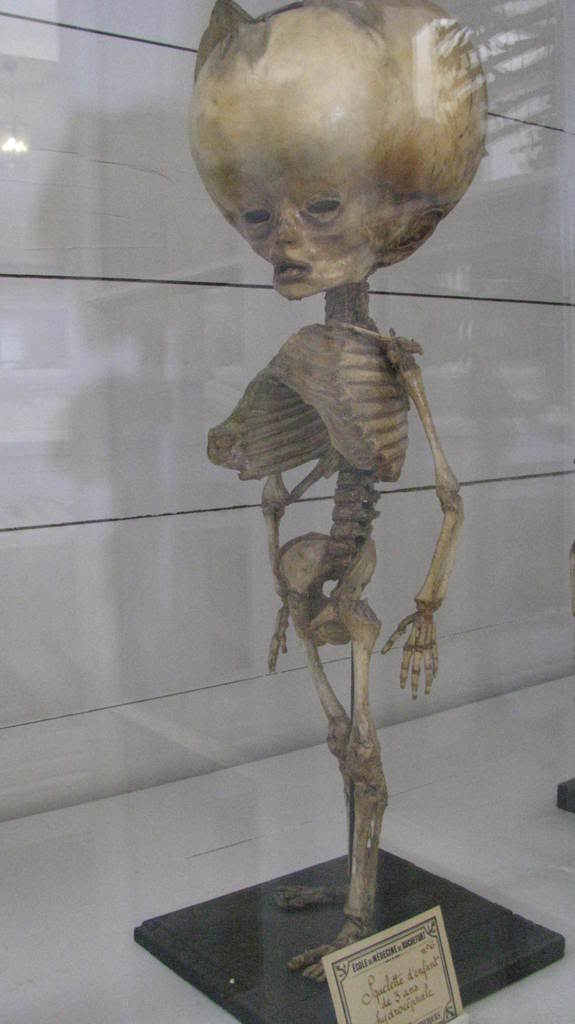
I have visited medical museums that make toes curl as we see the contents of the rows of formaldehyde jars, generally stillborn children with horrifying defects. We can be thankful these babies did not survive birth, but they died naturally. Such a visit is a sobering experience, and the old debate is fired up within us. Do we kill horribly deformed children, or do we find ways for them to live as best as possible despite their handicap? It is the yardstick of civilisation and the authenticity of our Christian faith. Why does God allow such genetic errors, or any other evil or catastrophe? It is the mysterium iniquitatis that we will never fathom. That is our condition. We have to live with it.

The real objective of this post, as with many others, is to make people conscious of this temptation and sin within each one of us. It can be expressed through the totalitarian regime that actually kills people. It can also be expressed in the desires of any one of us to eliminate the opposition to our desired perfection. We have to strive for the better in spite of the imperfection in our way.

George Santayana is quoted as having said “Those who cannot remember the past are condemned to repeat it“. This quotation has a number of variants, for example:

  • Those who cannot learn from history are doomed to repeat it.
  • Those who do not remember their past are condemned to repeat their mistakes.
  • Those who do not read history are doomed to repeat it.
  • Those who fail to learn from the mistakes of their predecessors are destined to repeat them.
  • Those who do not know history’s mistakes are doomed to repeat them.

This is always my concern. There may be nothing in the present-day world that could be remotely construed as a serious revival of Nazism. We can be thankful that the various bands of thugs and bullies here and there, often languishing for a very long time in maximum-security prisons or having been executed – when they committed a crime and got caught by the law – have no political credibility in society at large. They represent sub-cultures that are carefully watched by police forces and security agencies around the world. The real threat comes from an insidious repeat of the various themes around the notion of making the human species perfect by denying the right of life to the weak and deformed, or those who do not belong to the “master race”.

We can be rightly concerned when we read the same kind of anti-Semitic polemics that set off the Dreyfus affair a century ago. For such writers, it is not so much that Jewish people are evil, but that Judaism is just too different and too foreign to our culture. Others say the same thing about Muslims, even those who tolerate other religions and do not resort to violence or oppression of their own kin. In our own conservative Christian polemics, we tend to abhor conservatives or liberals depending on whether we are conservative or liberal ourselves. The opposing side has to be eliminated rather than being seen as a legitimate challenge to our own certitudes.

I find this with church people (perhaps more appropriate than “Christian”) who refuse difference, who refuse to accept people into their churches because there are still differences and they are only “half-converted”. I won’t point fingers, but simply point out a recurring theme found just about everywhere and in all churches. It is the most serious problem, which gives ammunition to men like Dawkins to argue for atheism: religion is harmful for mankind, so we’re better off without it.

It is a matter of degree, but with the same underlying thought that goes more or less far towards the logical outcome. Study your history and your philosophy, and you will see where comparisons and warnings are appropriate or fallacious.

Posted in Uncategorized | Tagged , | 2 Comments

Blogging, secrecy and accountability

A long time ago, I wrote and article on the Anglo-Catholic on Damian Thompson, Blogging and Episcopal Accountability. The article is still there. The essential theme is that in this age of instant information, no public figure can keep dirty secrets secret for long. This is almost certainly how bishops and other Church officials were outed and prosecuted for having aided and abetted child abusers. The article is still there for you to read.

The reason I bring this subject up is my previous article in which Mrs Sandra McColl from Australia calls for discretion and the respect of other people’s secrets:

I’m not talking about suppressing information, just about people regaining the sense of what is, and what is not, their business, and for those who are curious beyond what is not their business to be a little less insistent in demanding to know and to stop trying to make up information that hasn’t been provided.

I would say fair enough. Some things in life are confidential and are not to be fed to the lynching mob. However, we are dealing with human nature and with church organisations of various affiliations that have got away with many things because of institutional secrecy. Over the past few years, many things were secret and under the lid – which turned out to be a euphemism for smoke & mirrors or simply something that didn’t exist. Secrecy is a means of manipulating people, keeping them hooked and hoping for resolution that never comes. Putting it another way, it keeps people waiting for Godot.

To relieve the tension, people can attempt to replace fact by conjecture – or they can say To hell with it all, having seen through the shenanigans and deceit. I’m not pointing fingers, just trying to point out some constants of human nature in the light of some things we have seen play out. It is legitimate for an inventor not to reveal his plans until the invention is found to work and has been patented. There are legitimate uses of secrecy, but people become weary of its abuse. We become cynical and suspicious, and the “conspiracy theory” imagination can so easily run riot. Those who have secrets to keep secret need to practice a little psychology. For example, it is very bad psychology to tell a person “I have a big secret but I’m not telling you“…

The life of churches concerns all those who are interested in churches. In a transparent and honest organisation, there is little need for secrets other than what concerns persons. For example, doctors and lawyers are held to professional secrecy for the good of their clients. It is a misuse of secrecy to make it cover up evil or use it as a tool for manipulation.

One positive thing about the blog is that it is democratised journalism. It may be of lower quality than the work of professional journalists, but I as a blogger try to work ethically – including a minimum of regulation of “trolling” and otherwise calumnious and disturbing comments. I try to use the blog as a ministry of the word, a teaching ministry. A responsible blog can also be used to resist evil and open the windows and doors to let the fresh air in and the musty smells out. It is a part of our freedom of speech as long as we remain within the law, moral principles and the responsible conscience.

We can exhort people to be more Christian and more respectful for other people, but we can’t force them. Where there are grounds for suspicion, people will be suspicious that something stinks. We all have to learn transparency and to behave in such a way as things don’t always have to be secret.

Perhaps there are secrets in Australia? Even now?

Posted in Uncategorized | Tagged | 4 Comments

A couple of snippets…

The end of August is still the Dog Days in terms of church news. There is no public news from the TAC other than the ACCC in Canada as reported by Fr Smuts in The Anglican Catholic Chronicle — ACCC Newsletter (Aug 2012):

The Anglican Catholic Chronicle newsletter of the Anglican Catholic Church of Canada for the month of August is out. It has some good news as well!

I have nothing to add to the news per se except to congratulate the new priests. The habitual commenters are at work, in particular a lawyer by the name of Mourad who seems to be English rather than American. For him, the whole TAC signed up to the John Paul II Catechism in October 2007, so for it to fold up all operations that are not going over to the ordinariates! It is something I have heard before from others. The only purpose of the TAC was as a “convert tank”, and there is no justification for any continued existence as an independent or “schismatic” church. Therefore, those who stay out should be punished in one way or another until they “submit”. Funnily enough, the Roman authorities themselves never expressed such a notion.

One thing that interests me is some kind of “wiggle-out clause” that Mourad seems to endorse – the possibility that consent was given to Archbishop Hepworth’s agenda under conditions of manipulation and false promises. “If people signed up to anything on the basis of incorrect representations as to what might be on offer, then, of course, “thanks but no thanks” may have been an understandable reaction“.

Is there a justification for any continued existence of the TAC? Should we not be going to the Ordinariates or transferring to continuing Anglican Churches whose honest and constant position was “thanks but no thanks”? Mourad would seem to endorse some form of continuing Anglicanism if it is visibly distinct from Roman Catholicism in such a way as the faithful would be deceived by TAC bishops dressing up as Roman Catholic ones. The position colludes with “classical” Anglicans who base their notion of patrimony solidly on the Prayer Book, the 39 Articles and the Anglican theological tradition from the seventeenth century. This is something I noticed long ago. Some see a conspiracy in a collusion between Bishop Elliott and the American TAC bishops – which I think is nonsense. I merely see a collusion arising out of different human reactions to the same problem without there being any “cooperation” between the two sides.

Of course, I have advocated a third approach (one that is obvious to me but eccentric to others) as an alternative to aping post-Tridentine Roman Catholicism or being via media Episcopalian Protestants. But, I won’t go into that here.

I do so hate some of the analogies used like swimming over various rivers in the world and chickening out of weddings! But that is irrelevant. I have for a long time tried to grapple with what really happened to the TAC between October 2007 and very late 2011 when it became clear that Archbishop Hepworth was chopped liver.

EPMS, whoever that is, seems to be answering fairly and calmly. He, like many of us, have had enough of “reiterations of blame for those who signed on to something in Portsmouth or Surrey, BC and then had second thoughts. That happens, sometimes“. Both Deborah Gyapong and I have constantly called for a moderate position about Archbishop Hepworth in the face of those who wanted a scapegoat for all that went wrong. It is certain that, for whatever reason, we were all deceived by the former Archbishop’s narrative of how the TAC was to become almost a kind of Anglican rite uniate Church with himself keeping his position of primate, and that this would get him reinstated in the Roman Catholic clergy “through the back door”. The more critical of us knew that Rome just doesn’t do this kind of thing, but we entertained the notion that Benedict XVI was prepared to go in for creative solutions, and that this idea might just come off! The Pope has some great ideas, but his hands are tied by those who think in the box. He got a compromise, and a touch of propaganda made the round pegs go into the square holes.

What was the origin of the “Hepworth vision”? As I understand it, until a certain point, Archbishop Falk, with Archbishop Hepworth as his successor as TAC Primate, had been in a some kind of on-and-off ecumenical dialogue with Cardinal Kasper in Rome. Being in ecumenical dialogue with Rome gives a church respectability and gets it off the list of “vagante jurisdictions”. But that was not to last. The TAC was under the primacy of a former Roman Catholic priest. As happened with the Polish National Catholic Church, there could be polite chat but no organic union with canonically irregular clergy, together with several other bishops who were divorced and remarried. The file went to the Congregation for the Doctrine of the Faith – which no longer means ecumenism but dealing with canonically irregular former Roman Catholics wanting to reconcile with Rome and negotiate the conditions.

By about 2007, Fr John Fleming, an Australian married Anglican priest who was accepted for re-ordination in the Roman Catholic Church under the Pastoral Provision, and a long-standing friend of Archbishop Hepworth and Bishop Peter Elliott, seems to have been the driving force behind the decision to present the TAC as being in complete doctrinal agreement with the Roman Catholic Church. This would remove all reasons preventing the corporate union of the TAC with Rome. The only problem was that Rome would not overlook the canonical problems. Rome could have given the answer earlier, but was still not sure of getting the various official Anglican Communion prelates over to save face! That is only conjecture, but seems the most rational explanation.

Could someone in Rome have given reassurances of some kind of “amnesty” which would cause Archbishop Hepworth to believe that the door was open to the entire TAC, and not merely to carefully filtered individuals and small groups? What happened would indicate that Archbishop Hepworth was either manipulated by someone in Rome, he did the manipulating as someone unconcerned for the “fallout” and various people left high and dry, or that he was deluded for reasons of poor judgement or of psychological problems caused presumably by his experience as a young seminarian and a priest being sexually abused by priests. There too, I have conjectures which I am not prepared at this time to express publicly. Those seem to be the three possibilities at present.

EPMS‘s final comment is most eloquent:

A number of bloggers and posters, even ones who are still personally supportive of Hepworth, have agreed that he told them things that turned out to be inaccurate; for example, that those who had incurred the “delict of schism” would receive dispensations enabling them to be ordained. The only issue in dispute about this is whether he in turn was misled by someone in the Vatican, or whether he was making it up out of whole cloth as part of a larger promotional campaign. Fr Marriott has given an account of the Portsmouth signing, I think on this blog, which sounded like a classic exercise in achieving false consensus: last item on the agenda, no time for discussion, photo opportunity, etc. Accounts of the 2010 ACCC synod, still up on the AngloCatholic, suggest an atmosphere literally of smoke and mirrors, with many accounts of Hepworth speaking for hours, without notes, creating a compelling vision of a church which, “if not sui juris, looks a lot like it”. The technique was AngloCatholic Elmer Gantry, and the outcome was probably predictable.

I have to admit that I was surprised to see the entire TAC episcopate swept into the fervour of the Archbishop’s agenda. The letter to Rome was offered for amendments, and amazingly, it was treated like a lawyer’s letter and just rephrased a little here and there. No bishop seemed to show any critical attitude other than in private. It all reminded me of the historical accounts of how Pope Pius IX got Papal infallibility through in 1870 and struck dumbness into the opposing minority. It was a classical show of peer pressure and going with the bandwagon.

Was Archbishop Hepworth the bully or Rome’s lackey? I was too involved in the whole thing as a priest observer and as one who participated at some small-group discussions on entirely unrelated matters. The agenda was just not gone over critically.

My feelings are mixed about the remainder of the TAC. The conduct of the American bishops has not impressed me, but they seem to be legitimately concerned about salvaging the wreckage. Bishop Botterill’s position and agenda seem reasonable, coherent and well-intentioned. Why should he and his clergy be coerced into closing down their operation and becoming Roman Catholics when everyone is told that Anglicanorum Coetibus is open-ended and without time limits? No institution in the Roman Catholic Church is without limit, since Benedict XVI’s legislation can simply be abrogated by a future Pope under any convenient pretext. The analogies about being welcomed by Rome with a Prayerbook in your napsack is complete nonsense. It is time people stopped using these asinine analogies of rivers and warm swimming water – and started to talk about real issues.

There is more manipulation going on than ever happened with Archbishop Hepworth! In my estimation, supporting a continuation of a part of the TAC does not denigrate the ordinariates and those who have decided to join them. The big question now is knowing what is left. It is time for the Australian and English TACs to get good-quality websites up with lists of parishes, clergy and something tangible for us all. The new English website is promised for the beginning of September. The Messenger has been gone for a long time, yet its webmaster, Fr Owen Buckton, is now the Australian Vicar General. There needs to be more visibility. The Canadians are giving news each month, but India and the US are sporadic. In the twenty-first century communication is vital, as something like the TAC is so thin on the ground that its only social and communications link is by Internet. Locally-distributed printed media alone is just not good enough. Something not visible on the Internet doesn’t exist for our contemporaries. We might not like the advance of technology, but we keep up with it or go by the wayside.

The TAC may yet crumble through lack of critical mass and a credible foundational myth. That would be a pity, and those who are left would be unlikely to accept being whipped into the ordinariates. Many will lose their faith in churches even if they keep their faith in God. The way things have been done by all those responsible, whether on the Roman Catholic or TAC side, has been a pastoral disaster. Archbishop Hepworth has been deceived or deceived us. To what end, other than to destroy himself? When will we find constant and rational explanations and learn from them?

Personally, I keep waiting. For some of us, nothing more is expected from Rome, but everything is expected from the bishops who obviously regretted jumping on the bandwagons and took a more critical attitude a posteriori. It takes time to reculer pour mieux sauter. Those who believe the Roman Catholic Church is the one true church (no salvation outside it) should go that way. Others of us take a more critical attitude and events have caused us to re-examine the notion of the Church and churches. Every criticism of present-day Anglicanism can also be levelled at the Roman Catholic institution. There are no winners or losers.

At the same time, it is all over – yet we are at the doorway of a new beginning… There is yet something to look forward to.

Posted in Uncategorized | Tagged , | 8 Comments

Prayers for my Parents

I ask your prayers for my parents Jim and Margaret Chadwick on the occasion of their Diamond Wedding (60 years). They were married on 5th August 1952 at Elstead Parish Church in Surrey, the same year as the Accession of Queen Elizabeth II.

Sophie and I will be setting off at 6 am tomorrow morning to catch the boat and drive from Dover up to the north of England. We will be having a big family get-together this coming weekend at a hotel near their home.

Posted in Uncategorized | Tagged | 8 Comments

But before we can start awarding ourselves Victoria Crosses…

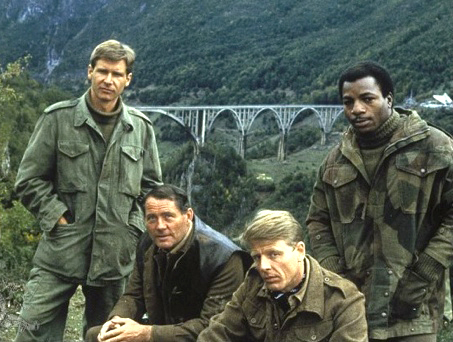
It is a line from a World War II film in which a small group of commandos destroy a dam in Yugoslavia to stop the Germans from getting to a vital strategic place over an almost impossible-to-destroy bridge. Sergeant Miller blows up the dam with some explosives stolen from the Germans and placed in exactly the right places for maximum effect, and the water flow from the breached dam destroys the bridge. As one man congratulates himself and his mates for the success of the mission, the leader brings everyone back to reality:

But before we can start awarding ourselves Victoria Crosses and Congressional Medals of Honor and so on and so forth and such like… I think I’d better point out that one, we’re now on the wrong side of the river. That two, we have no hope whatsoever of rejoining the partisans. That three, this neck of the woods will soon be crawling with very bad-tempered Germans. And that four, I don’t think our little genius Sergeant Miller there has even got a box of matches left in his suitcase. And so I think we can take it, gentlemen, that we’re going to have a very long walk home.

In other words, the war ain’t won until we’re back in London! You don’t count your chickens until the eggs are hatched…

It is my reaction as I consider this article that challenges the opinion of the “New Atheists” than religion causes all the evil in the world. In other words, we believers may have truth on our side, but the war is not won and increasing numbers of people become convinced by the arguments of atheists like Richard Dawkins and the late Christopher Hitchens among others.

Here is something worth reading. Dusting Off God – A new science of religion says God has gotten a bad rap (http://chronicle.com/article/Does-Religion-Really-Poison/133457/) by Tom Bartlett. I have said it again and again, the more we use religion to dominate others and enrich ourselves, the more ammunition we ourselves give men like Dawkins to spread his materialist “gospel”.

The standard assumption of the new atheists is that religion is basically malevolent, that it “poisons everything,” in the words of the late Christopher Hitchens. What is most convincing is not the idea that there is no God or that the bible is bunk, but that religion is bad for us and that we would be better off without it.

Enter the Christian apologists. Christianity abolished slavery, the death penalty in most western countries and many other violations of human rights. Are Dawkins and company more scientific in their criticism of religion that we in our “medieval obscurantism”? That is a good question, and does much to sway minds in favour of religion and belief.

The article describes scientific experiments in which it is ascertained whether people would be more altruistic under threat or invited with notions connected with spirituality and the “nice” aspects of religion. They are not without interest. But are these “comfort words” more something to do with the amount of dopamine in our brains than something about and outside ourselves? Is there less crime in countries where most people are religious than in mostly atheistic countries? Not always.

There seem to be no constant rules of cause and effect. Believers and unbelievers alike are guilty of similar crimes in history. It is impossible to say that either belief or unbelief is entirely toxic or blameless. There seem to be no winners in this game. Unbelievers have done marvellous things for other people and humanity, just as religious people have.

The atheists are very successful because they touch a nerve in all of us, anything who has been dealt with unjustly dealt with by a priest or a diocesan office, who has suffered abuse, who has read reams of diatribe from various armchair theologians and inquisitors as we come to recognise them in the blog columns. If we are confronted with the idea “Attacking obscurantic, cruel, lunatic ideas is always a good idea”. It can seem to us all that religion is rotten to the core. Then it is just a short step to saying that God is bunk and being done with it.

OK, the tit-for-tat argument. The Nazis were hardly pillars of the Church and it was science that produced the atom bomb and genetic engineering. So, atheists are bad too, and often for the same reasons as religious people. So what do you do, blow us all up? All that “proves” is that people are not bad because they are religious!

What about our use of reason? The way Dawkins writes is said to be repetitive and “dogmatic” and requiring more of an ideological adhesion than inviting us to use our own brains. But the fact remains that much of the “bathwater” of religion also is sectarian ideology requiring us to “go along” with it rather than discover its intrinsic truth. This is a point to which I am extremely sensitive.

In the end, we can’t defeat the atheists by calling them stupid idiots or whatever. The war is not won even if we can defend ourselves and survive. They seem to have us in the popular mind by convincing people that people are bad because they are religious, and because religion is an ideology in which there is no room for the use of reason.

What we can do is to retire from the political mindset or the notion of dominating and controlling even out of a motive of serving God and a good ultimate finis operis. Using evil means has been one of the most damning indictments against the Church over the centuries. Depriving man of freedom and the use of reason (some call it “private judgement”) is just one way to convince people that whatever is evil is so because it is motivated by religion. We become our own apologists for atheism.

So then, what? Spiritual experience through love, altruism, compassion, empathy for man in his weakness, things that provoke wonder and awe through beauty – not just the liturgy but the art that goes around it. If love has no part in this world, then life is just not worth living! Love is the αγάπη described by St Paul, the root of self sacrifice and empathy, but it is also expressed in what we leave behind in the wake of our life.

Surely, this was Christ’s way of showing us that there is hope. It is our only weapon against atheism and darkness. Only light can dispel darkness.

Posted in Uncategorized | Tagged , | 1 Comment

Ordinariates and Anglicans keeping their legitimacy

Fr Smuts has reproduced an article – Vatican Prefers Tanks to Talks to Achieve Unity – that Dr William Tighe sent to a few of us. Read the article over there, as I see no point in reproducing it here. It helped to see an essential point – that we don’t have to criticise the ordinariates to remain legitimate Anglicans, and we don’t have to shoot ourselves in the foot to be positive about the ordinariates. The two issues are separate. Benedict XVI has instituted the ordinariates for former Anglicans – and continues the ecumenical dialogue with those who have remained Anglicans.

The implication in much of the barrage of polemics is the idea according to which Anglicans must forfeit their credibility and legitimacy for the simple reason that the ordinariates exist, and that they are bound to make their immediate submissions. Consciences are pricked and goaded, and decisions have to be made. Or do they?

I wrote a comment on Fr Smuts’ blog:

As time goes on, the whole thing becomes clearer in my mind. The problem is not about whether those who decide to adhere freely to the Roman Catholic Church should follow its rules and obey its authorities like the Pope and bishops. Converting to Roman Catholicism or Orthodoxy is exactly that – converting. There is no “political asylum” in a church other than the one we were brought up in.

Even if we went back to our original churches, we would still have to “convert” to them.

The real issue is remaining Anglicans and that option becoming discredited or invalidated by the existence of the ordinariate option. We do seem to have difficulties of conscience, as we each have our part to play in the fragmentation of Continuing Anglicanism. The alternative is remaining in or returning to the Anglican Community in union with Canterbury – and accept what they require, not 50 years ago but now. Is there a legitimate Anglican option? Perhaps to some of us, the existence of the ordinariates has taken away its legitimacy and consciences are prodded and forced, with the help of some sixteenth century or nineteenth century apologetics and their old litanies about “private judgement”.

The third option for those in the spiritual no-man’s land is giving up religion and lapsing into agnosticism and a secular life style. But, that has to be assumed logically.

The real issue is faith and reason, the relationship between authority and freedom, what kind of authority is legitimate. Does faith depend on being threatened by some kind of inquisition and state authority that supports the political ambitions of the Church? I constantly ask the question – if religion can only “work” if it is based on constraint rather than freedom and human dignity, then is it objectively valid. Does man’s aspiration to freedom depend on the rejection of religion? Often, the best apologists for atheism are people who call themselves Christians. The paradox of Dostoyevsky’s Grand Inquisitor is that the Inquisitor is fundamentally an atheist!

I think it is right to say that the ordinariate is a sensitive and generous pastoral provision by the Pope for former Anglicans who are attracted by the cultural accommodation and are convinced by Catholic teaching and disciplinary requirements. What we need to discover is something else, whether there is any kind of Anglican expression outside the official Anglican Communion and the ordinariates that is legitimate – not a sham or something insincere.

We should separate the two issues. Is there any development of thought possible here?

Comments are welcome here or over at Fr Smuts’ blog.

Posted in Uncategorized | Tagged , , , | 15 Comments