More Voyages of Sophia

We returned to Normandy from our three weeks holiday at Fouras in the Charente Maritime. We were located in a sheltered bay between the Ile d’Oléran, the mainland and the Ile de Re to the north, today linked to La Rochelle by an amazing road bridge.
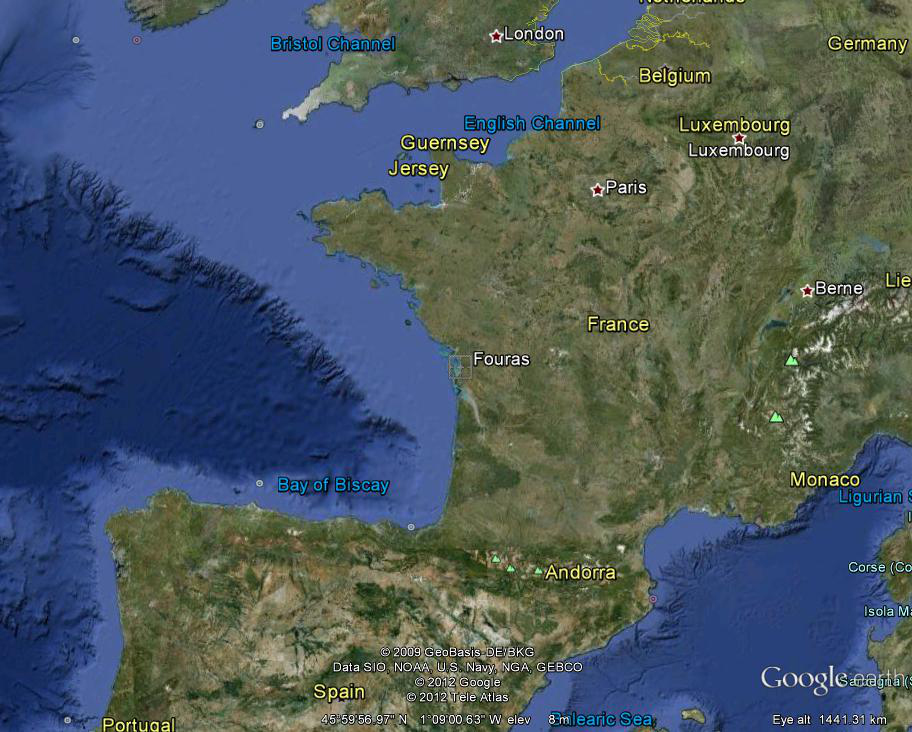
My wife and I camped at the town’s camp site just by the beach. The experience of camping with about 2,000 men, women and children from all walks of life was interesting, to say the least. It was quite a study of humanity, from the noblest to the most base and selfish. I was able, for a small fee, to park my boat at the local sailing club to the north of the north beach.
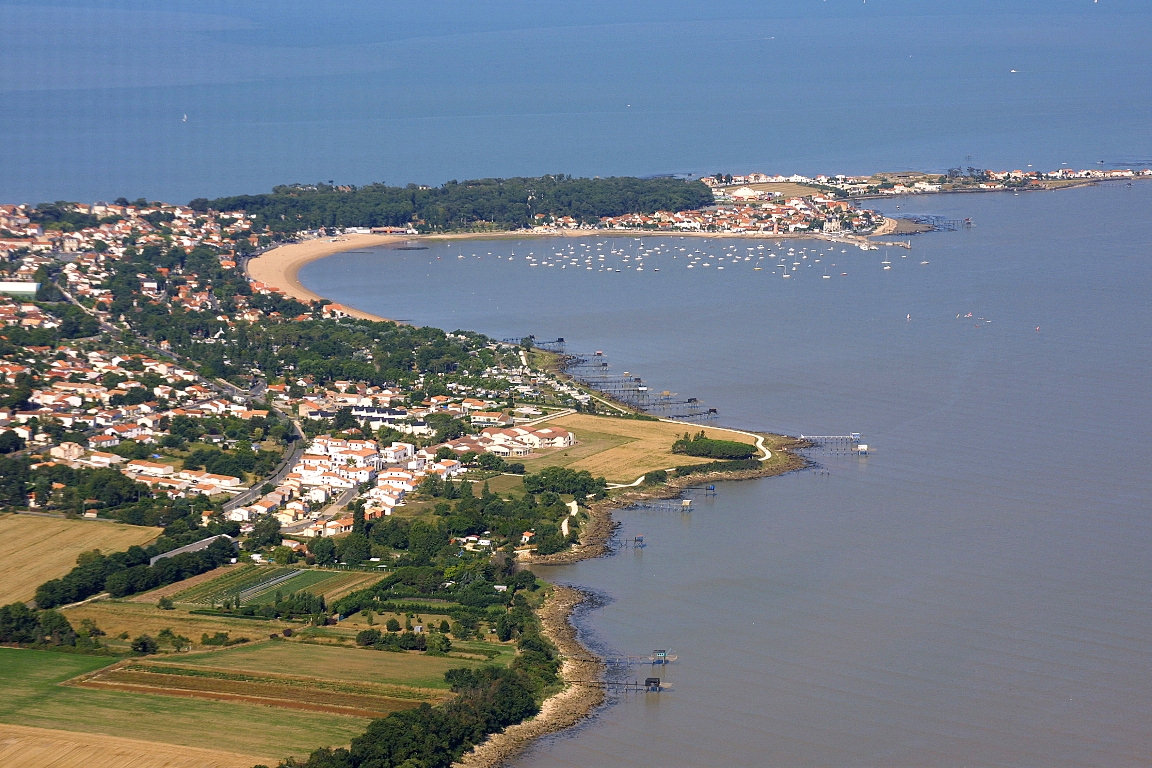
Surely an image of paradise in the Dog Days of August! The pier-like structures are called Carrelets, platforms for fishing with a big square net hanging from a simple wooden crane. Sailing is only possible 3 hours each side of high tide, because when the tide is out, one is confronted by acres of mad flats. You sink into the mud up to your knees if you try to walk on it! Sophie, my wife, went to the spa at Rochefort for a cure, and that left me plenty of time for sailing on my little ten-foot boat with its red sails.

Feeling adventurous and faced with little in the way of waves and swell, I could go much further in a moderate wind. I went on three long cruises, the first to and from the Ile D’aix, the second represented in red and the third in blue. The red and blue trips would have been about ten nautical miles, and each took three hours on the round trip.
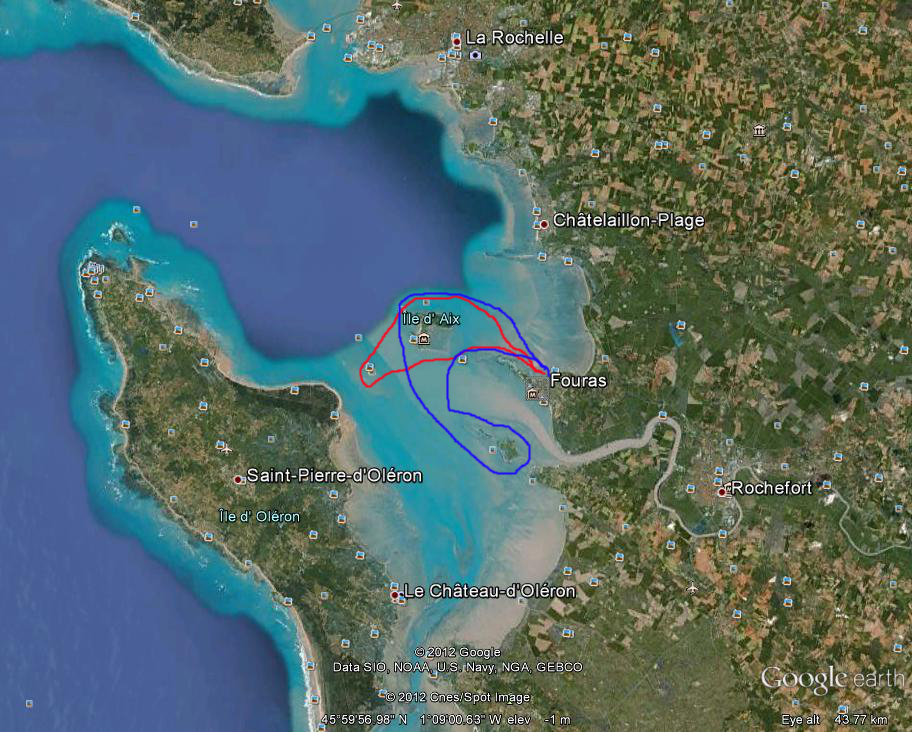
The first outing involved a simple landing on the Ile d’Aix.
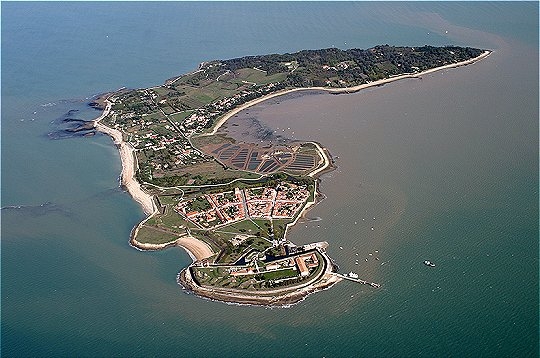
This place is absolutely fascinating, and not only from the point of view of sight-seeing. The first thing that strikes the visitor is the absence of cars.
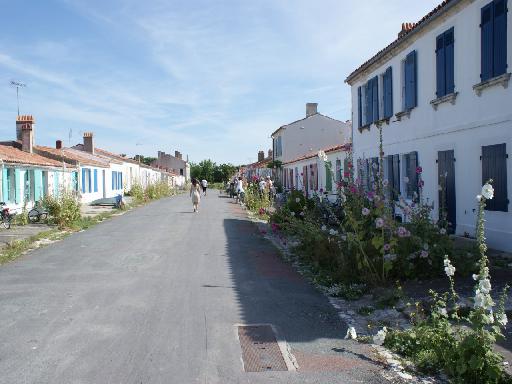
The history of this little piece of an old world is long and fascinating. In 1067, Isembert de Châtelaillon gave the island to the monks of Cluny, who established a priory. From the end of the twelfth century the island became a strategic naval site for England. We are confronted with centuries of conflict between England and France, culminating in the Hundred Years War. The fortifications were ordered by Vauban to defend La Rochelle, Rochefort and the mouth of the Charente.

The most harrowing piece of history is found in the remains of the priory church – a memorial stone marking the grave of hundreds of priests who died in the most dreadful conditions under the Revolution in 1794. They were imprisoned in hulks of ships, and they died of starvation and disease. Some of those priests were beatified by Pope John Paul II.

This Isle also marks the end of Napoleon as Emperor. In 1809, the British fleet blocked the ports of the Empire, Rochefort in particular. This island was Napoleon’s final abode in France, and it was here that he surrendered to the British in 1815. The Fort Liédota has been used as a prison, mainly for political prisoners, and as recently as 1961 following the Algeria War.

On my red trip, I passing the north cardinal buoy of Fouras and the Fort Enet.
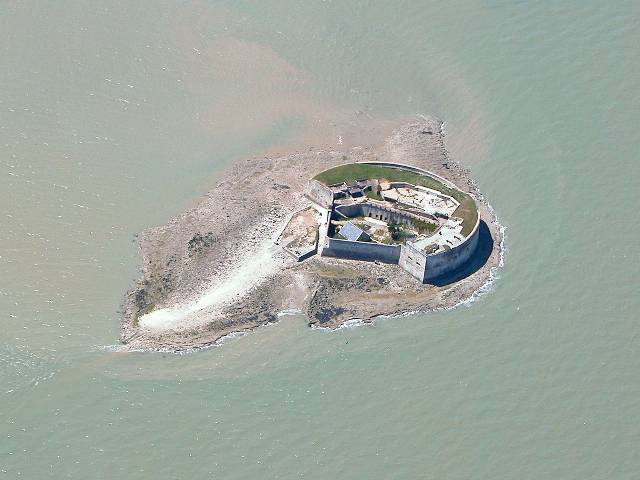
Fort Enet is a difficult landing, as there are many nasty rocks, and the gate would be firmly locked in any case. I didn’t attempt a landing, but I passed this interesting monument several times. I passed to the south of the Ile d’Aix and made my way to the Fort Boyard. Was it possible for such a tiny boat to go so far? Who dares wins. I set sail and made it.
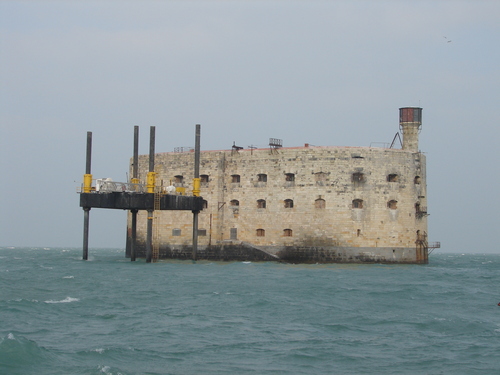
This amazing pile of stone that served absolutely no useful military purpose is impressive. In the nineteenth century, it served as the “Alcatraz” of France for the worst and hardest criminals and escape artists. Today, it serves as a TV game show. It can also be gawked at by people in sailing boats and the many passenger carrying steamers. I had to heave-to to avoid being mown down by such a vessel. The skipper gave me a hoot on his horn to thank me for doing the right and most seamanlike thing. As he crossed my path, I hauled in my sails to continue my way, and was struck by the smell of the passengers as I crossed the ship’s wake. When you are at sea, smells seem to be multiplied many-fold, and the slightest thing bowls you over. Here it was cigarette smoke and women’s perfume!

I circumnavigated the Isle d’Aix by the north and took the deep water channel back to Fouras.

My blue trip took me round the Fort Anet and south to the Isle Madame.
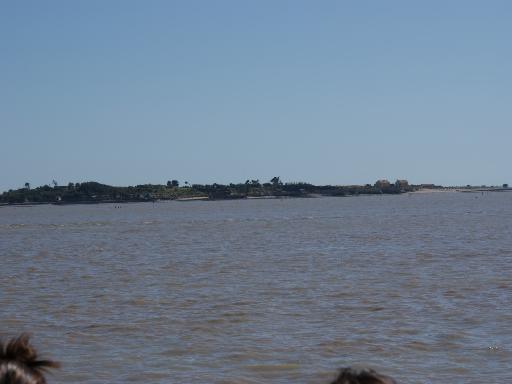
This island is accessible by car at low tide by a very narrow causeway.The photo above shows the north coast of the island. The causeway is off the photo to the left.
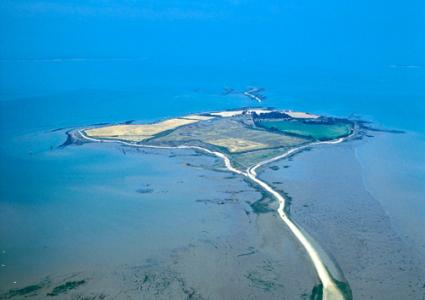
As I went along the island’s north coast for reasons of a favourable wind, I had the causeway to contend with. It was not fully high tide, so the solution was simple. I beached the boat on the causeway, dragged her over and launched her the other side. I had to go upwind, so tacking from the first. Time precluded a visit to the island, as I had to be back at Fouras before low tide and a mud bath!

The Isle Madame is one of the less known islands of the Charente-Maritime coast. It is also the smallest. There are only three buildings on the island, but another monument to the seven hundred priests who died of starvation in 1794 in the hulks of Rochefort. As I went round the south coast of the island, the wind became increasingly favourable and gave me a fast beam reach to the Isle of Aix, so I took Aix by the north – but I had to close haul the east end. That was quite hard going with little wind and a strong tidal current. I was fighting against the clock. Finally, the wind was kinder for the return to Fouras.

There you have it, a fine holiday, and the remembrance of those priests who died by man’s cruelty and hatred of the faith.

Posted in Uncategorized | Tagged , | 1 Comment

Wherefore unsatisfied soul? and Whither O mocking life?

An article by the young English blogger Patricius – Assumption thoughts… – brings me to think of one of my favourite pieces of poetry by Walt Whitman:

Down from the gardens of Asia descending radiating,
Adam and Eve appear, then their myriad progeny after them,
Wandering, yearning, curious, with restless explorations,
With questionings, baffled, formless, feverish, with never-happy hearts,
With that sad incessant refrain, Wherefore unsatisfied soul? and Whither O mocking life?

Ah who shall soothe these feverish children?
Who Justify these restless explorations?
Who speak the secret of impassive earth?
Who bind it to us? what is this separate Nature so unnatural?
What is this earth to our affections? (unloving earth, without a throb to answer ours, Cold earth, the place of graves.)

Yet soul be sure the first intent remains, and shall be carried out,
Perhaps even now the time has arrived.

After the seas are all cross’d, (as they seem already cross’d,)
After the great captains and engineers have accomplish’d their work,
After the noble inventors, after the scientists, the chemist, the geologist, ethnologist,
Finally shall come the poet worthy that name,
The true son of God shall come singing his songs.

Should I dismiss this way of writing as coming from an unbalanced person, someone to be stigmatised as insincere in his religious commitment? Should we dismiss Patricius as an impetuous child who throws tantrums? I take another and more critical view. I don’t know the individual well enough to assess him as a person, and I am not a mental health professional. I may be wrong, but I think I read somewhere on his blog that he had Asperger’s Syndrome – something that makes the sufferer focus on a narrow interest with such intensity that he cannot relate to anything else in life. Asperger’s Syndrome comes in degrees as does any other neurological condition. However, that is not the purpose of my writing today.

I believe that Patricius would like to be a committed Christian, but he – like many of us – cannot relate to the various ecclesiastical options currently available. The thought is simplistic: there was an era when Catholicism was perfect and Papal absolutism came along and ruined everything. There is a truth there under the rubble, but a lot more complex in historical terms. “Roman rite is accursed” – really? At the root of the gripe, we find the various modifications made by Pius XII: a new formula for the Assumption Mass, the use of a standard common of popes instead of celebrating confessor and martyr popes as bishops, the famous Holy Week rites – a general tendency to make the liturgy attest to the primacy of papal authority over truth itself. I have had many discussions with a friend of mine in London, Rubricarius (The St Lawrence Press) who has studied the liturgy extensively. I don’t think a position against many of these modifications is wrong. After all, I have consciously opted for a liturgical rite that has not changed for centuries precisely because it fell out of general use or was abolished by acts of law.

Some comments on Patricius’ blog reprimand him for being an eternally unsatisfied soul. Is that not part of the fallen human condition? Is this dissatisfaction the despising of things earthly for eternity (doceas nos terrena despicere et amare celestia) as the liturgy expresses constantly? Are we not all the victims of the ravages of time, not only on our own ageing bodies but also on the world in which we live and understand less and less as each day goes by? Is this not part of the blessedness of the poor in spirit?

Patricius’ style of writing is intemperate, and this takes away credibility. Many of his commenters tell him to “get a life” and be a Christian with the same degree of indifference to the liturgy as most of his contemporaries. After all, the Novus Ordo is just as valid, so he has only to go to his local church and get his ration each week!

Even if anyone could resurrect the Uses of the mediaeval English Church, it would be empty, shorn of authenticity, and all that’s left would be sentimentalism, nostalgia, and regret about the waning of lore and the passing of the years.

Who is that meant for? I have no idea, but he is not entirely wrong. There is such a rift between life and religion that only counter-cultural religion, pure-and-hard monotheism of The Book can survive. Do we want a form of Christianity that would do the same thing in the west as Islam in countries like Iran and Afghanistan? Would we want to see a kind of Gestapo-Taliban driving around in jeeps and rounding up the heretics? I don’t think so. Freedom is part of the Gospel faith. Finding a freedom-based version of Catholic Christianity with traditional liturgy is about as difficult as finding fishbones in a turkey!

But maybe this was doomed to be. Good liturgy is a thing of the past, gone long into the grave with out catholic ancestors, and all that is left will die out with my generation. Knowledge of Latin and Greek is waning among men, so also is the memory of things past, things needful for the wise to know. There is no hope left, which is why I have disavowed religion – or at least religious people.

Men in the nineteenth century wrote in exactly the same way. What’s new?

We all have to suffer and we grieve over our loss – but the answer is always within our reach. Life has to go on, and we should beware of returning to our nostalgic dreams as a dog returns to his vomit. I have a great deal of sympathy for our young friend Patricius, but if we have something to say, the least desire of relating to the world, then we all have progress to make.

And this is also a symptom of a vast field the official Churches have left to overgrow. Real progress would also be rebuilding the wastelands. Any bishops out there ready to meet the challenge?

Posted in Uncategorized | Tagged | 21 Comments

Anglican Liturgy and Monastic Spirituality

Deborah Gyapong has published an excellent article quoting some private correspondence she was allowed to reproduce if the author’s identity was kept confidential.

What is distinctive about monastic liturgy as opposed to what you get in the average Roman Catholic parish? I would say, simply, the absence of a self-conscious attempt to “bring the liturgy to the people” – what some call “pastoralism”. A monastery simply celebrates the liturgy without messing about with it or wondering whether the service will be understood by the people and “relevant and meaningful”.

That is something of a simplism, as many monasteries tinker with the liturgy more than little boys dismantling their mechanical toys to find out how they work! Here in Europe, there are some very traditional monasteries, especially of the Solesmes Congregation, and their example has much to teach and inspire us.

What is distinctive about monastic life is the primacy of the liturgy – ora et labora, pray and work. Monastic life is the last vestige of “integral” medieval Christian life as is still possible to find in Orthodox countries like Greece and Cyprus. In western parishes, the assumption is that ordinary lay people cannot relate to the liturgy and there are two ways to be Christian – being part of a “religion of the Book”, Protestantism, or in a parallel life of prayer through popular devotions. The ultimate expression of the second tendency was the Gebetsingmesse in Germany in the 1950’s, a “lay” service held simultaneously with a low Mass being celebrated silently at a distant altar. The nineteenth century parish church is not so much a liturgical space, but a “theme park” for lay devotions. Thus, as in the sixteenth century, the laity are indifferent to the religion of the clerics. After Vatican II, when the changes took place, only a very small minority complained that someone was changing their religion. That can be partly put down to scholasticism and the Papal system that puts authority over objective truth, perhaps even the more radical notion I entertain that most people were Catholics because they were under constraint. As in the sixteenth century, their religion was little more than Paganism with a few Christian terms.

I understand Deborah’s concern for the liturgy of the ordinariates. The ordinariates are of no concern to me, but Anglican patrimony is – at least for as long as I belong to a community calling itself an Anglican church, or a church of Anglican tradition. “Full-strength” monasticism is hardly to be found in any Anglican church, Canterburian or Continuing, but each of us tries to keep that ideal before our eyes. I know something of real monasticism, and those of us who are not monks can only live our Christian life with some aspects of monastic influence. For secular priests and laity, these would be “bringing the people to the liturgy”, something like the Liturgical Movement of the 1920’s, an aesthetic reaction away from nineteenth-century kitsch towards the ethos of the Arts and Crafts Movement.

To put it another way, those who regard the Anglican use liturgy as either a step on the way to restoring the Tridentine Mass or as an ethnic inculturation of the post-conciliar Mass are not recognizing the “common identity” that lies at the basis of the Pastoral Provision.

I won’t speak for what they do in the RC Church, but we Anglicans have been aping the Counter-Reformation for all too long. I understand those who react away from Anglo-Papalism to promote the view that prevails among American “classical” Anglicans. My own approach would be to correlate the early sixteenth century with the end of the nineteenth, and devise a “liturgical movement” approach to our Norman-Sarum tradition. It is just one step further than what Percy Dearmer attempted in strict obedience to the ecclesiastical system to which he belonged as a priest.

Posted in Uncategorized | Tagged , | 1 Comment

TTAC website

The website of the The Traditional Anglican Church – UK  seems to have been taken down. Have any of our English readers any information about any new official site as was promised some months ago?

* * *

I have received some information privately. I feel bound to paraphrase to keep sources confidential. The TTAC in the UK appears to have emerged from the crisis in better shape than what might have been believed in the absence of news conveyed by media other than printed periodicals with very limited circulation.

Bishop Craig Botterill hopes soon (this autumn?) to visit the English clergy. If this happens, I would make every effort to be there – since I am a priest of the TTAC. A new official site is being drafted and the Bishop has asked that it be up and running by 1st September.

Posted in Uncategorized | Tagged | 6 Comments

Blessed are the poor in spirit

What an amazing story as I looked at Young Fogey’s blog! I have nothing to add, but draw your attention to the very antithesis of the “prosperity gospel” and “you are worth your success / money / whatever”.

Catholic but mentally ill. A man bears his cross. The thing about mental illness is that it is illness. Like all illness, it does not constitute a judgment from God or a declaration of moral turpitude. To be mentally ill is to struggle with a cross, not to invite advice and catcalls and improving advice from tongue cluckers and Job’s Comforters. St. Benedict Joseph Labré was mentally ill and would have been indistinguishable from many of the people in our homeless population today. He was also a saint. You get to be a saint, not by being a Shiny Happy Person, but by offering whatever you’ve got – including a malfunctioning brain if that’s your lot – to God.

Posted in Uncategorized | Tagged , | 2 Comments

Positive and Negative Thinking

I think I have begun to identify a problem of understanding between my way of writing and some of my readers – that is the sacrosanct dogma of “being positive”. I am not an American, but deeply a European. We might seem to be a dour people, but one that has learned to cope with adversity.

This is particularly brought home to me by a couple of readers who find my postings “depressing to the point of despair”. “It seems to me you’re a man with a broken heart”. I don’t have that impression myself – for as long as I am able to marvel in beautiful things and see good where good is to be seen. Those are my landmarks like the things like lighthouses and church steeples that guide navigators at sea.

I have read one or two things about psychology and about having to avoid negative thinking, lest it should become self-fulfilling prophecy. Keep it positive, and nothing will ever go wrong in life! Never say a negative word about the ordinariates or some other form of conversion of Anglicans to Roman Catholicism, because a depressing word from one will ruin everything for all. I have noticed how those who said a word out of place on the blogs would be shot down. I have often wondered where this tyranny was coming from.

Some researchers in psychology are sceptical about cultivating a belief in guaranteed success and anything being possible on the basis of that. It is the same kind of Manichaeism as those who are constantly fighting their shadow or “dark side”. Jung emphasised the need rather to “integrate” and reconcile the opposites, including good and evil. Such an idea is hardly to be found with the positive thinkers.

No amount of wishing away negativity or bad experience or disappointment will make it go away. I see a rock in front of my boat, and I could believe it would go away if I thought hard enough that it shouldn’t be there. It is simpler to steer away from the rock and save the boat. That rock exists, and has an objective existence independently from our wishes and beliefs. If the boat is dashed on the rock, it will sink.

The ancients understood the need to balance optimism with pessimism, the positive with the negative, with an openness to failure and uncertainty. The Stoics advised anticipating the worst. I remember that being drummed into me when I learned to drive a car. Anticipate the worst in every situation, and you will have fewer accidents that way. Anticipating the worst makes us sober and prepare us for coping with adversity. Recognising the fact that we can lose all we have makes us all the more grateful, and makes life liveable if the worst happens independently of our own thinking.

I have the impression that positive thinking is an effort of the will to stamp out realism and negativity. The positive thinker has to maintain the effort, lest anything negative should creep in and spoil his day. If you eliminate the word “failure” from your horizon, then you will simply be unprepared for when failure happens.

The ordinariates (as this subject absolutely has to be discussed and repeated for the bloggers to be remotely interested in anything) may be a resounding success for some, but are an abject failure for others. This is a dimension that just hasn’t been considered. They were successful for some, so the negative naysayers had to be “shot down” and banished to inexistence. This seems to be about the nerve of the problem, but don’t expect sober reality to get the upper hand anywhere.

I am not concerned for those who have succeeded, and who presumably will never have to face failure and adversity in the future. I write for those whose spiritual and ecclesial life has been ruined by the division of the TAC into “ordinariate spare parts” and smarting wounds in the silence that does not dare to speak up.

Man is at his best when he is struggling to make a new beginning after defeat or when adversity strikes. I believe this is the essential difference between Europeans and Americans, though this is changing with the crumbling of certitudes, security and what was believed only a short time ago to be invincible.

Christianity itself is changing, and can only survive in today’s world by becoming as bloody-minded and intolerant as Islam or turning to spirituality and the revival of prayer and simple living. Institutional Christianity and Catholicism will just not survive these changes. Only, the notion of “church” has to change and will change. That seems to me to be the reality that we prepare for, as infallible popes and magisteriums and all the other ideologies of the apologists fall into irrelevance. That side is over, a fact that will become obvious to Americans in a short time. Over here in Europe, the game is over. Institutionally, the future is dystopia in one way or another – secularism and political correctness. Even Islam will succumb. Spiritually, we are about to be purified as gold in the crucible.

That is what we have to prepare for – living in the brave new world without becoming “of it”.

Posted in Uncategorized | Tagged | 10 Comments

Sarum Use in the Ordinariates

On a Rorate Caeli post, NLM: “The Potentialities of the English Missal for the Ordinariate and the Roman Rite” there appeared an interesting comment:

Actually the only thing that can give the Anglican Ordinariate any long-term prospects is the Sarum rite. I say this as an ex-Anglican myself who went to Book of Common Prayer services during my Anglican days. The ‘Anglican patrimony’ is the patrimony of a criminal organisation, the Church of England, that suppressed the Catholic Church by state terror and lies; and the Book of Common Prayer was put together by one of the leaders of this project. The ‘Anglican patrimony’ will only be important to people who leave the Anglicans and have an attachment to it because of their Anglican past. One the supply of these people is sued up, there will be no-one who will be interested in becoming a priest in an ordinariate devoted to this ‘Anglican patrimony’, and the organisation will eventually die out as a result. If the Sarum rite is adopted as an option for the ordinariate, there will be a real reason for its existence; the preservation of the distinctive liturgical patrimony of Great Britain. That is the basis for a long-term project. The ‘English missal’, as other commenters have noted, is by its nature simply a halfway house between the Roman rite and a ‘reformed’ liturgy; it will not offer anything, and will be used as a weapon against traditionalists who want to have the Latin rite in the Latin language. I am surprised that you do not take this last factor into account, New Catholic.

I had not wanted to go into the fray concerning the English Missal or the use of the “extraordinary” Roman rite in the ordinariates. I was discussing all this stuff two or even three years ago, and no one has got anywhere. Personally, I just don’t care what they do in the ordinariates, as it is just not my problem and never will be.

But, the point about the liturgy is interesting. Either Anglican Catholicism, whether in communion with Rome or not, needs to have a distinctive liturgical identity – or people like Fr Symondson, John Bowles and Robert Ian Williams are right. Just join the mainstream Roman Catholic Church and attend your local parish regardless of how bad the liturgy is. Just stick with your owner and leave your personality and intelligence behind. The more you suffer, the more meritorious it will be!

I have had to realise that there is very little interest in Sarum. It is a taboo subject with some. Square pegs and round holes indeed. Shoot me down for denigrating Rome or the ordinariates if you like, but they are not my problem. There seems little point in preserving Sarum in isolation from an ecclesial communion.

Truth to be told, every time I look at institutional churches, I have that heart-sinking and foreboding feeling. Church begins to leave a heavy and horrible after-taste, and I appreciate more and more how people either no longer go to church or do so without getting the least involved in it. As Young Fogey wrote in a recent post, quoting Monsignor Ronald Knox, the passengers on a ship stay out of the engine room. He has a point.

I’m through with all the controversies. I have nothing to do with the ordinariates, and even little with the church I am told I belong to. I celebrate the Sarum Mass, but it does not matter to anyone. Never mind. That is of no importance to me. It seems to be about God and not the esteem of others.

All being said, this comment highlights a serious problem in the notion of Anglican identity, if that identity is not Protestantism. The false dilemma in place since the Reformation is Protestantism against the reinforced orthodoxy of post-Tridentine and Ultramontanist Catholicism. The western equivalent of “natural” Orthodoxy (conciliar eccesiology) is now a thing of the past except insofar as you have to accept goofy liturgies and “progressivism”.

Is there any point in going on? I’m open to positive ideas outside the old dilemma of the apologists.

Posted in Uncategorized | Tagged , , | 10 Comments

A fresh point of view

I received this message from a priest who was studying in Rome whilst I was in first year philosophy in 1985-86. It would be improper to reveal the identity of this priest, but he has wonderful suggestions here. Comments would be most welcome.

* * *

I came across your blogs again today, after a long absence of keeping up with them, and was particularly struck by your “New Goliards.”  Thank you for setting this up — it is a delicate, easily misunderstood, but very necessary outreach.

I continue to be a Roman Catholic parish priest, content in my vocation and my place, but painfully aware of the situations of friends known to me and brother-priests near and far, who are suffering greatly in the situations of limbo or worse which you write about so eloquently.

In my own small way, I have tried to do what I could for several of these men; for some, it is the simple offer of hospitality for a meal or a “clerical visit.”  for others, it has taken the form of moral and financial assistance for those who have been cut off from all support and have found themselves treated in ways supremely inhuman as well as unchristian.

I do these things while still considering myself irrevocably (pace, Victor
Hugo) Traddy and constitutionally very conservative and orthodox — but with that rather odd sense of humour (perspective?) that you may remember from our Roman days — an attitude shared by many of our friends during those Roman years; and one which I tend to realize now was the incipient sign of the survivor. . .

I write this letter rather hastily, since I sense that you need encouragement to keep the Goliards blog up and running.  Most emphatically do I offer that encouragement:  KEEP THIS WORK GOING!!  It may take a good deal of time to reach even a small number of the priests who can benefit from such a “communion of sacerdotal vocations”, but it is very necessary.

You are casting your net for the benefit of RCs, Anglicans, Old Catholics, etc; it may take a while to find a “voice” that will be inviting and accepted by all, and even more time for such men to find their own voices.

But it would be so good. . .

There are too many independent traddies, both RC and other, even in my liited experience,  who are staggering under the weight of very heavy crosses but who, despite great darkness around them, know themselves to be absolutely and everlastingly, priests.  This is their first, last and comprehensive self-definition; and it has been granted them “forever” by the Church. . . But many find themselves in situations in which there is little or no support or validation for their vocation; or, indeed, they have found themselves, separated, estranged or dismissed from ministry. These men (and all of us) need to be inspired, supported, strengthened and accompanied on their journeys.

As you may remember, I have always been particularly struck by the example of the Church’s saints.  As the years have gone on, I have made it a particular study of mine to devote myself to those whose sufferings — and I dare say, their limitations — make them peculiarly “accessible” to us when we find ourselves in similar situations.

I think that the Blessed Martyrs of “Les Pontons” the priests imprisoned in the slave ships at Rochefort would be particularly important intercessors for your Goliards.  Not only were they priests condemned to a living death of being forgotten and declared “non-persons,” but they found themselves having to support and care for one another in their most extreme human needs and spiritual distress.  The records show that 829 were deported and condemned to this imprisonment, but only 274 survived.  547 died in less than two years; only 62 have been beatified, since we do not have records or descriptions of the deaths of the others.  We do know that while most of the original 829 were non-juring priests who remained loyal to Rome, there were actually others who had accepted the Civil Constitution, others who had apostasized and even some who appear to have married.  They shared the same lot as the others; perhaps some remained “estranged” and isolated; but surely others found the support of a fraternity which allowed them to live their last days in Christian charity and die the death of true martyr priests.  We will only know in Heaven. . .

Among the records they left behind is a moving testament, a pact in which they swore – should they survive – not to seek redress, not to condemn their captors or the state, and not to reveal the faults of any of their number.

It is remarkable. . . Perhaps more spiritual and overtly “holy” than the term “Goliards” might connote, but faithful to the spiritual experiences it seeks to comprehend.

In any case, I am attaching a few things about them that might interest you and provide you with material for another posting or two.  In the future, perhaps I could contribute something.  I think that the contributions of priests themselves might strengthen the bonds of friendship and support.

One suggestion I might make, in order to increase your affiliations and calm the sensitivities and misgivings of the more scrupulous among us:  open your “membership/affliation” to priests who are “on the job,” in good standing, part of the mainstream, etc. — but who want to stand with and among their brothers who are struggling to hold on and would be glad of the strength and friendship of others to support them through silent prayer, sincere communication, and the sharing of burdens, memories, spiritual thoughts and laughter. . .

I look forward to sitting down and reading all the postings at leisure.

In the meantime, dear Anthony, I feel very glad to be back in touch with you again and call on the prayers of our mutual friend, Francois (Fr François Crausaz 1958-1994, a Swiss priest and dear friend), to intercede for you and for all our brother priests who share in the solitude of vocation and seek the Face of of Him who alone can hear our prayers.

Posted in Uncategorized | Tagged | Leave a comment

Update about Archbishop Falk

I received this as a circular e-mail from Dr William Tighe, and have no reason to believe it is confidential:

I am sad and sick at heart about these matters:

and angry, too, if truth be told.  I know something about the background to all this, and I have some opinions about it all (no surprise to those who know me!), but all I will say is that I know something about Abp. Falk’s committment over the years to entering Catholic communion, and with what coldness and unresponsiveness he has met with in return.

On reading this, I went to Fr Smuts’ blog, and found he had weighed in with Archbishop Louis Falk, Unity, Accountability and the Blogs. If I believe what I read, you are driving a car on a road and find an obstacle – and still you should continue at top speed and disregard the obstacle because the road “thinks in centuries”. Obviously, whatever form the obstacle has taken, Archbishop Falk is a careful driver!

I am not informed about the internal affairs of the American Ordinariate and am not inclined to cast any judgement on Monsignor Steenson. I have had a little informal correspondence with him and find the good Ordinary to be kind and gentle. I have no idea about what is going on with the American Roman Catholic bishops either – but there is one thing I find incredible – the rubbish I read on the blogs from “conservative” Catholics and even “ordinariate wannabe” Anglicans. I am not unsympathetic to the comment by Christian Campbell on his own blog, even though I have issues with Roman Catholic traditionalism. The reasons given by neo-conservative “apologists” about why everything going on is positively God’s will are as asinine as lacking in common sense.

And so, holiday time has arrived. My wife and I are finishing our packing today and getting ready to go to the bay of the Ile d’Oléron on the Atlantic coast of France. Naturally, I am taking the boat and the necessaries to say Mass and pray the Office. We have a laptop computer and the camp site has wi-fi – I’ll probably have a look from time to time, but I imagine I will care less than I do now. I think sailing round the bay, practising my navigation and visiting Romanesque churches will take priority!

We all need a change of perspective. I have fears that the only future of the TAC is in India and South Africa – and perhaps in Torres Strait too. I seem to have run out of church like a car runs out of fuel. Let the holidays take their course, and I’ll let the year run to the end. Whatever happens, life has to go on.

* * *

Update: exchange of comments on Fr Smuts’ blog.

I was a little “put out” by Fr Smuts apparently implying that Archbishop Falk was involved in some kind of underhand deception game, and I don’t believe he is. This exchange of comments refers to the posting linked to above.

Fr Anthony Chadwick says:
July 28, 2012 at 08:49

And he doesn’t even have the mettle to stand up and say so. ????

I don’t think the good Archbishop is a coward. Perhaps he has clearly expressed his reasons but not on the Internet. Perhaps he is not ready to go public because he is unsure of which Church he belongs to. Are there going to be two ACAs – one in communion with India and the other comprising himself, Bishop Campese and Bishop Moyer?

I find this article excessive in its tone and unhelpful. Be careful who you trash, Father, because you might end up sawing off the very branch you’re sitting on. I don’t want to be nasty or ad hominem – I am just ill at ease with your tone when you write in this way. You are thousands of miles from the nearest Ordinariate, and there will never be one in South Africa. I just ask you to be a little kinder, and then we might begin to understand things as they might be.

I’m not American either, and I don’t go in there like a bull in a china shop, because I only have second-hand and partial information. Be careful if you want to keep your integrity as a TAC priest.
Reply
Fr Stephen Smuts says:
July 28, 2012 at 09:11

More transparency, honesty, and taking ownership is needed, generally. Blame the blogs if you will, when the call is for transparency. You tell me Fr, where does ++Falk fit in? We should know. People ask questions and the laity are far from ignorant.

Yes, I’m frequently reminded that things in the US concern me not. Fair enough. I am a TAC Priest, following my Bishop, working hard running a vibrant and growing parish. Pastoral work and the cause of the Gospel keep me very busy here in Africa. And then I’m confronted by honest inquirers and have not answers simply because people will not stand up and live in unity and truth? I could shut this blog down today, and bury my head in the sand like an ostrich, and pretend like all is well, when leaders (in the US) are running their own agendas. I do not want to be party to such things.

Again, let me ask you Fr, what is the canonical standing of ++Falk, + Moyer and countless other priest and parishes in the US? And don’t say it matters not! Just yesterday someone asked me about Old/New TAC. What does one say?

Mercifully, I’m able to separate this blog from the reality of daily life and ministry. But that doesn’t mean that I’m oblivious to what is going on out there.
Reply
Fr Anthony Chadwick says:
July 28, 2012 at 11:40

Thank you, Father, for this candid reply and your pastoral concern for all of us who are left confused and disorientated by the fact that nothing seems to fit into place. There are honest inquirers, and some often write to me. I am forced to tell them that I just don’t know what’s going on – rather than speculate, diabolise and go all guns blazing for a solution that may not be all its appears to be.

In your third paragraph, you ask a very good question. They used to be part of the Patrimony of the Primate, and they now seem to be presented with a dilemma: submit to Bishops Marsh and Strawn, as they now rule the ACA roost in the USA – or enter the Ordinariate even if only as dismantled parts for recycling. They also have the option of forming a new continuing Anglican Church or joining another. Neither you or I have the right to lay down the law or dehumanise them in a trashing process. All we can tell people is that they apparently have no canonical status – and that is all there is to it.

What does one say? In every case – be as well-informed as humanly possible, don’t let the imagination run riot – and act according to conscience. I think the problem is speculation and emotionally loading your interpretation of what little information is available. You can’t be simplistic for other people and claim there are good reasons for your not closing down your parish and becoming a Roman Catholic in a parish in Cape Town.The problem of bishops and priests in America is really a problem for Americans, and not for we priests who have no first-hand information because we live elsewhere.

Your job is to be a good parish priest – as you have acknowledged it is. By all means, report what you read or learn, but try to be measured with your interpretation.

Posted in Uncategorized | Tagged , | 3 Comments

Mysterium Iniquitatis – the Aurora Massacre

Over the last few days, I have been reading the news about a horrible massacre that occurred in a cinema at Aurora in Colorado. The cinema was featuring the newest Batman film and a young man opened fire with weapons that he bought legally – not mere hunting arms, but guns that have but one purpose, killing human beings. We are probably all familiar with the photos of a baby-faced young man of 24 with a shock of orange-dyed hair behaving very strangely during his first appearance in court accused of the heinous crime of killing about twelve people and seriously injuring a further sixty.

James Holmes, so we are told by the press, rigged his apartment with booby traps to kill any policeman naive enough to kick in the door. He had been collecting guns and ammunition for the past few months, and the crime was coldly and meticulously planned. Even on the opposite side of the Atlantic, the idea that a man could be capable of committing such evil escapes any comprehension. I find it difficult to kill fish I have caught on a line and hook that I intend to eat or give to others to eat! That boy kills human beings like we swat flies!

Insane? As his jailers said, he has only to keep his act for the jury – and Holmes will probably have a date with the needle after ten to fifteen years on death row. The alternative, as is usual in America, would be life imprisonment without parole. I have commemorated the dead at my daily Mass several times this week, and my heart and prayers go out to their bereaved families. Yet, Holmes holds a certain fascination, and almost a certain sympathy for the fact that he might as well already be dead, even if he doesn’t get the death penalty. This is pure evil.

Fr Dwight Longenecker explained in his article The Aurora Murders and Demonic Possession that what we usually see in exorcism films is really infestation. True possession by the Devil is something much more terrible. The person appears to be normal, but they have voluntarily given their soul to the evil one. He has not lost his free will, and therefore the freedom required to commit a sin, but has exercised his free will in doing the evil the Devil wants done. This concept is known to exorcists as perfect possession. You don’t get perfectly possessed against your will. It is the decision of the person concerned. When that happens, there is no hope for that person. This is what might have happened with Judas Iscariot or someone like Hitler or Stalin.

Many years ago, I bought a book with the title Hostage to the Devil by the late Fr Malachy Martin, a Jesuit priest who exercised the ministry of an exorcist. Though it was fascinating, I was unable to read it – I could not tolerate the blasphemous things the evil spirits were saying during the exorcisms. I still have this book, but I haven’t opened its covers for more than twenty years. There are things we are best to be ignorant of.

Here is what he writes in the preface to this book about perfect possession:

As the term implies, a victim of perfect Possession is absolutely controlled by evil and gives no outward indication, no hint whatsoever, of the demonic residing within. He or she will not cringe, as others who are Possessed will, at the sight of such religious symbols as a crucifix or a Rosary. The perfectly Possessed will not bridle at the touch of Holy Water, nor hesitate to discuss religious topics with equanimity.

If convicted of crimes against the law, such a victim will frequently acknowledge “guilt,” and even the moral “badness” of the acts committed. More often than not, such a person will petition that his physical life be forfeited; that he be executed for his crimes. Thus, in his own way, he voices the insistent Satanist preference for death over life, and the fixated desire to join the Prince in his kingdom.

Because there is no will left to call the victim’s own -and because some part of the victim’s will is necessary for any hope of successful Exorcism – remedy is unlikely to succeed even in the event the Possession should somehow be uncovered and verified as the problem.

This exactly fits the behaviour of James Holmes.

The most extreme state is ‘perfect possession’, when the demon has taken complete control. The perfectly possessed person is totally lost. There is nothing I can do.

An audio series of interviews with Fr Malachi Martin on perfect possession on the Arte Belle show can be found on Youtube. Just type in “Malachy Martin” and “perfect possession“. His testimony is chilling. We have seen that evil is very real, and we scoff at it at our peril!

Posted in Uncategorized | Tagged , | 1 Comment