Old high churchmanship and moving on

I have been giving a little further thought to the notion of “old high church” as opposed to attempts to replicate post-Tridentine Roman Catholicism in an Anglican context. Over the last few years, using internet and the computer, I find dimensions of Anglicanism that I hardly experienced in England in the 1970’s when I was a teenager.

I have the impression that there is a certain amount of historical reconstructionism, especially by Americans, of an idealised seventeenth-century Anglican via media that rejected both Roman Catholicism à la Louis XIV and the fanatical iconoclastic Puritans. The one difficulty about Anglicanism is that it only really finds its stability and unity when founded on the English Establishment. Pockets of “old high churchmanship” can still be found in some of the Guild churches of the City of London and other places where “old fogeyism” and stuffy gentlemen hang out. The dark Jacobean oak panels, the large clocks under the organ gallery, the smell of beeswax polish, old wood and dust, the cracked plaster ceilings of those little Wren buildings that miraculously survived the Blitz of 1940 – it is all tempting for someone who has distant memories of London.

Are there specific tenets about “old high churchmanship” beyond memories of the City of London and the occasional conservative country parish? There is of course knowledge of the Jacobean and Caroline Divines, a vision of late Elizabethan churchmanship, but how accessible is all that to the average churchgoer? How many Roman Catholics are familiar with the philosophy of Aristotle and the Summa Theologica of St Thomas Aquinas?

When I was a teenager, before discovering the “spikey” places in London, I heard about central churchmanship mainly from adverts in the Church Times for organists. We called it “middle of the road”, like some of the churches where I played the organ or sung in the choir. These churches usually had the Prayer Book or at least one of the alternative service books in traditional thee-thou language. The usual hallmarks were two candles on the altar and not six, no incense but usually the use of vestments or at least a coloured stole over the alb and not a black tippet. The Eucharist was usually eastward-facing, though I saw the facing-the-people way coming in, usually by the wooden altar being moved forward just enough for the Vicar to squeeze behind it. The hymn book was usually Hymns Ancient and Modern Revised, which is a very good hymn book, and the Psalms were sung to Anglican chant. That is central churchmanship to someone who hasn’t done all the reading of literature that isn’t easy for people of our time.

One tenet, which is essentially in the doctrinal / scholastic approach, is the notion that everything has to be backed up by the explicit words of the Holy Scriptures. It sets the Bible up as an autonomous magisterium and oracle, over the life of the Church, replacing one “pope” by another rather than a more “communion” approach. It occurs to me that it is just post-Renaissance apologetics designed to beat the Papists at their own game. If we remain stuck in this dialectic, no one is going to get anywhere. We are also no longer in the days of gentlemen wearing wigs and swords and kings getting their heads chopped off!

I have always been quite embarrassed and bored by endless tales of double predestination and other manifestations of baroque scholasticism, from either side of the Tiber or the Medway, whichever way you look at it. Are we not fiddling while Rome burns?

Perhaps central churchmanship can be defined by a spirit of sobriety, plainness, the same kind of thing as you find in monasteries. The church has few statues or other decorations. The lines of the architecture are clean and simple, uncluttered. Beauty can be found in simplicity and symmetrical harmony. We find this spirit also in French and Dutch Jansenism, in a reaction against the excesses of baroque sensualism. I can sympathise with this quest for a moderate position between symbolism and sensuality on one side and sobriety and intellectualism on the other. The purer and contemplative soul has less need of sensual stimulation in order to arrive at contemplation. Perhaps the key to central churchmanship is less the old polemical positions against Calvinism and Roman Catholicism, but an appeal to the spirit of monasticism and its adaptation for those who are not monks.

Many of the preoccupations of Reformation theologians centred on the medieval abuses and simplistic catechesis designed for barely evangelised people. The Church has always had to strike a compromise with the religious instincts it found in the people it evangelised. The Druids were evangelised in much the same way as animists in Africa these days. How far do you go in constraint and punishing the old superstition out to get the “pure Gospel” in? The balance between Monotheism and popular religion goes far back into the Old Testament, and the notion of Israel’s fidelity to the Covenant is centred exactly on this question. The Reformation was essentially an attempt to prune back the accretions of popular religion to impose strict Judeo-Christian Monotheism, and the via media men and the Roman Catholics sought a pastoral compromise.

When this fundamental concept is apprehended, the rest is seen as a coherent whole. While some central churchmen engage in arguments and apologetics in the same way as scholastic Roman Catholics, others seek a more devotional and liturgical approach. Having been brought up to be “moderate” in all things, eschewing extremes and seeking a compromise, this is how I approach my use of the Sarum liturgical rites. I do not engage in historical reconstructionism in the way academic musicians play baroque music using period instruments, but I use the rites in the same spirit that religious priests use the proper rite of their Order.

There are big problems with the mutilated Prayer Book rites, evidenced by the constant attempts to reconstruct and repair them. The 39 Articles reflect a stage of theological scholarship of embarrassing archaism. Theological scholarship has moved on, as in the Roman Catholic Church, the Ressourcement “new” theologians grew out of St Thomas Aquinas, Bellarmine and Cajetan. They were labelled Modernists for their trouble! The foundational idea is great, but there has to be onward movement. The Church is not a club of American Civil War enthusiasts meeting once a year with their horses, uniforms, guns and blank ammunition.

The rite for the Eucharist in an Anglican context is a difficult one. I see no really viable alternative other than a classical English translation (or simply in the original Latin) of the old Use of Sarum or an invented rite. The alternative is that of the Anglo-Papalists using the Roman rite in English (English Missal or Novus Ordo) or constantly modifying and improving their eclectic creations – as has proved the bane of Anglicanism over the past century.

Tolerance is another great intuition in the via media idea, and that can go very far. Do we tolerate sin? On the other hand, do we persecute all those who are not in complete agreement with the strongest and most predatory men who occupy the Church institutions? The dividing line is all too brief.

Do we try to replicate the London Guild churches with their oak panels and fogeys both old and young? One thing that is lost in post-Vatican II Roman Catholicism, and also in the traditionalist communities is the notion of the Divine Office being tied to the church rather than individual clergy. I have not known the full fare of Mattins, Litany and Communion in parish churches. In Kendal Parish Church where I sung in the choir, we had Mattins three times a months and Sung Eucharist once a month (on the other Sundays, the Eucharist was a quiet congregational family service at 9 am – before Mattins). On occasions, we sang the Litany. We naturally had Choral Evensong every Sunday with a full service setting, versicles and responses and an anthem. When a church no longer has the Office, it dies. I see so many churches over here in France with choir stalls and lecterns for the coped precentors – and no one now remembers what all that was for! You now have to go to a monastery to find the fullness of the Office – and even then, not just any monastery.

Historically, there have been the difficulties faced by clergy when opposed by irrational Protestant prejudice and institutional inertia. They stuck to the Prayer Book because they would get further and face less opposition.

What I find very appealing in the central church movement, as I have mentioned, is the sobriety. I am aesthetically attracted to the “Percy Dearmer” type of church restoration or the more exuberant Comper and other architects nurtured in the ideals of the Arts and Crafts movement. I had my fill at Gricigliano of lace albs and overloaded altars – and am “back at home” with plain linen and simple altars. I use the vestments I have, even though some are “Roman” – it matters little.

My schooling was also important in the “central” way – not too much religion beyond daily chapel and divinity classes. Our faith was more on the sports field or hard rowing in an eight on the Ouse. We were being trained for the English Establishment – or what still remained of it in the 1970’s, or more particularly schooled for success in professional and family life, which is what education is all about. I have kept much of that spirit, though I loathe the spirit of competition, and it has inspired me in my love of the sea, managing in life and finding a solution for every difficulty. For me, it is of paramount important to keep a Christian leaven in everything we do and take Christ far and wide outside church. We don’t go about “evangelism” the American way – ramming it down people’s throats, but through trying to aim ourselves for excellence in everything, kindness and every virtue.

I read in a piece by Bishop Peter Robinson:

Ceremonial was deliberately moderate, with the traditional Laudian idea of the beauty of holiness being given moderate rein. The overall ethos was one of orthodoxy, duty and devotion tempered by an abhorrence of fanaticism, the usual British reserve, and a fear of appearing Pharasaical.

That is exactly me. The big problem is whether this way has a future between an increasingly intransigent Roman Catholicism, fundamentalist Protestantism and secular “political correctness”. I look at the Continuing Anglican Churches, and make many allowances for the fact they have to affirm ideas independently from the Establishment I knew as a boy. I have installed my little chapel, but what will become of it after my death! I suppose a few bits and pieces may be left to other priests or sold. Sic transit Gloria mundi! I might be remembered as the eccentric English priest in France who used the taboo Sarum liturgy! It is of so little importance.

We need to be wary of navel-gazing and trying to set ourselves out and above. The fanatics and the secularists are going to win this one, and our vocation is to the contemplative cloister in one way or another, either as proper monks in habits or loners sailing boats on the sea. I am not bothered about whether we are doing things exactly like in the early Church. We know too little about it and how things were in those days. I am not interested in replicating the fifteenth, seventeenth or nineteenth centuries – but in learning from the whole of the Church’s tradition to take the Gospel of Christ into the future.

There are things one can do in America, because people get enthusiastic about things and lack the jaded cynicism of us Europeans. But there are limits as the Continuing Churches find it difficult to find references and landmarks for identity, stability and cohesion. People have to be free and not constrained to follow extremely narrow limits of conformity, something awfully European and not at all American!

I enjoy reading men like Bishops Robinson and Lee Poteet of another less-known Continuing jurisdiction. The ideal is there. It is just that the way of bringing it to fruition is not simple. It is the same with monasticism or rural parochial Catholicism. There has to be a whole social fabric that is now missing, swept away by the influence of fundamentalism (or intégrisme in its most generic meaning) and secularism. Perhaps, ironically, the least unfavourable context for central Anglicanism would be – England and the Church of England. Perhaps more harm is done through separation than by staying put and weathering the storm. I flipped as a young man and swam the Tiber – and have paid for it ever since. Ethnicity is something so easy to throw away and so difficult to recover.

Finally, we will not find the “call” by joining one church or another, because it is within each one of us. The Kingdom of God is within, and it is only when we find peace there that we can spread peace around ourselves. Perhaps my ideas are still a little muddled, as I have been so badly hurt by the TAC fiasco and the subject of my now-defunct English Catholic blog, but I still have peace and hope. As I learned during my months with the Benedictines at Triors Abbey – now fifteen years ago, the essential is our own self-stripping (kenôsis) and silence – and then God can do his work…
Posted in Uncategorized | Tagged | 4 Comments

Your searches on the Web

A special page is available to me to see what some visitors typed into a search engine to find this blog. The most frequent is the title my readers know – As the sun in its orb. I have said in the introduction to this blog that its title is extracted from the saying of Bishop Giles de Bridport about the Use of Sarum – The Church of Salisbury shines as the sun in its orb among the Churches of the whole world in its divine service and those who minister it, and by spreading its rays everywhere makes up for the defects of others. Certainly in the thirteenth century, Salisbury Cathedral fulfilled the role in England that Lyons, Rouen and Cluny did in France by its example in celebrating the Mass and the Office faithfully and with great diligence. Much of the liturgical revival in the nineteenth and twentieth centuries was owed to the Benedictine revival of Solesmes and Dom Guéranger, then by the effects of the Romantic movement in Germany, England and Belgium.

Some of the naughtier fiends on the Internet have referred to my blog as Where the sun never shines – as if I were someone bitter, negative and miserable. I do not recognise myself in such a description, and this is certainly a case of psychological projection of those who wonder why the Torres Strait people have not yet converted. Presumably our friend was not there with his machine gun to make it happen! Passons

The next search term is interesting – a storm on the sea. I often use nautical analogies, and it is part of me as an amateur sailor. I was out on the sea today in a fresh 10-knot breeze and a moderate sea swell without “white horses” or very few of them. The light was absolutely wonderful, just one day after bad weather. The sea turns a deep green-blue and everything is fresh and new. Storms at sea are frightening things, and it is better not to be in a boat or on a ship when they happen! I remember as a boy of 12 on holiday with my family in Portugal, in August 1971, and a storm blew up. The sky turned black, and the wind whipped up the sea to its full fury. I was able to admire it all from a stone pier at the fishing port of Viana del Castelo near our campsite. Certainly the Romantic in me – Sturm und Drang and all that!

I have to remember that some people typing in strings of words are not necessarily looking for my blog. How about – celtic anabaptist false church? I have discussed something of the modern Celtic revival (or caricatures thereof). This string is quite odd, as the Anabaptists were extreme Protestants in Germany and England in the sixteenth century, and most of the Reformers, especially Luther, eschewed their extremism. I see no connection between the Celts and the Anabaptists. False church is an expression often to be found with those who would relish being modern incarnations of Torquemada, Bernard Gui and Heinrich Himmler. Again, I am not concerned with where the sun doth not shine, but rather with beauty and love, not with the kind of “truth” that makes humans hate each other.

The Union of Scranton intrigues not a few, that union comprising the Polish National Catholic Church and the Nordic Catholic Church led by Bishop Flemestad. Whether or not this Union would expand into England or European countries further south than Norway and Sweden, or west from beautiful Bavaria, we still need to be patient and await the outcome of the decisions to be made by the Bishops of the Church of England about consecrating women and making sure everyone assents to it – or, we would hope, pull back from the brink.

Now, irrationality of a vengeful god might have been typed in by the person concerned with Celtic Anabaptists or the Commies under the bed! I deal rarely with the question of the early Old Testament notion of God. Some bloggers have done much more than I in the field of Biblical studies. I have to say that some of those Biblical passages where God is said to have killed people for their sins are hard to accept and reconcile with a notion of forgiveness and infinite mercy. This is a problem that makes the Gnostic “solution” seem attractive: the “god” doing all the harm is the Demiurge whilst the true God is far above – and innocent of evil. But this is not the answer offered by orthodox Christianity. Finally, it is a mystery.

Those who are interested in Norwegian churches do well to keep looking on Google. There are some very beautiful places of worship in that country of the great North. As a kid, my imagination was fired by Grieg’s Peer Gynt and its mythology of mountain giants and trolls. I doubt most internet trolls have flaming red hair, but who knows. Perhaps the sun never shines in those caves in the deep fjords where the trolls bash away on their computer keyboards. I wonder what they eat! I have never been to Norway, but perhaps one day…

Ubi caritas et amor – indeed, the tabernacle of God’s presence is charity and love. I love the little motet by Maurice Duruflé based on the Gregorian melody.

What is the suns length of its orb? That would seem to be a question for an astronomer or a geographer. Of course, the orb is a sphere, and the sun is spherical like the earth, all the planets and their moons. A mathematician would not speak of the length of a sphere, being a multi-dimensional circle, but rather of its diameter. There is of course the sun’s path which is in reality the daily revolution of the earth, giving us the impression that the sun moves. This apparent movement is compounded by the orbit of the earth around the sun, the seasons and the observer’s position on the earth. The title of this blog refers to the liturgy of the Church of Sarum with the brilliance of the sun as a metaphorical image.

I admire inquiring minds, simple innocence seeking knowledge and ever learning. Oscar Wilde said:

Like all poetical natures he [Christ] loved ignorant people. He knew that in the soul of one who is ignorant there is always room for a great idea. But he could not stand stupid people, especially those who are made stupid by education: people who are full of opinions not one of which they even understand, a peculiarly modern type, summed up by Christ when he describes it as the type of one who has the key of knowledge, cannot use it himself, and does not allow other people to use it, though it may be made to open the gate of God’s Kingdom.

Posted in Uncategorized | Tagged | 1 Comment

An excellent paper on liturgical pluralism

I recommend reading FIUV Position Paper: Liturgical Pluralism.

It is refreshing to see that I am not alone in seeing nothing wrong with having a multiplicity of rites and uses in one Church, whether or not in communion with Rome. The more narrow-minded clergy and faithful believe that tolerance in this matter encourages disunity. Perhaps, to the contrary, the more the liturgy is “policed” and uniformity enforced, the more man’s rebellious spirit will enter the fray.

Pope Benedict XVI himself has noticed that some of the faithful have been alienated from the Church by the new liturgy. He could say that those people should be forced, and that the more Catholicism would be ugly, nasty and make them suffer, the more they would become meritorious and holy. There are a few fiends commenting on blogs with exactly this attitude. But, the Holy Father has said many times that he believes in liturgical diversity and peace in the Church.

Liturgical pluralism is a source of vitality and strength, of tolerance and unity in charity. I recommend this article with its wealth of references in the footnotes.

Posted in Uncategorized | Tagged | Leave a comment

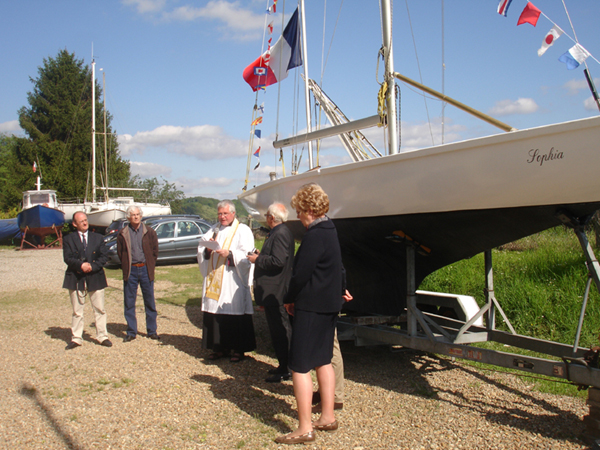
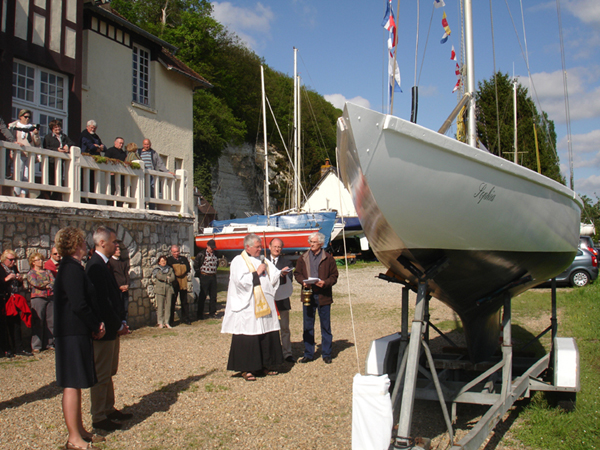
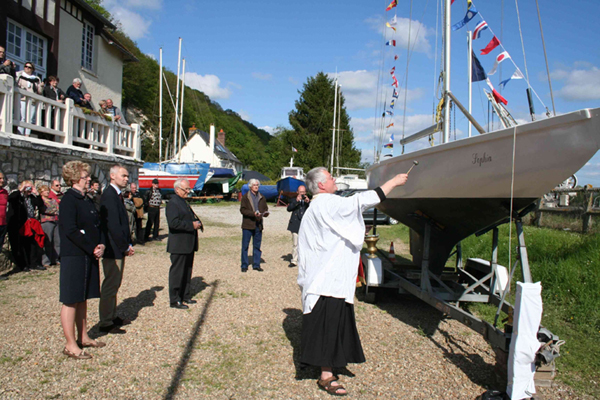
Baptism of Sophia

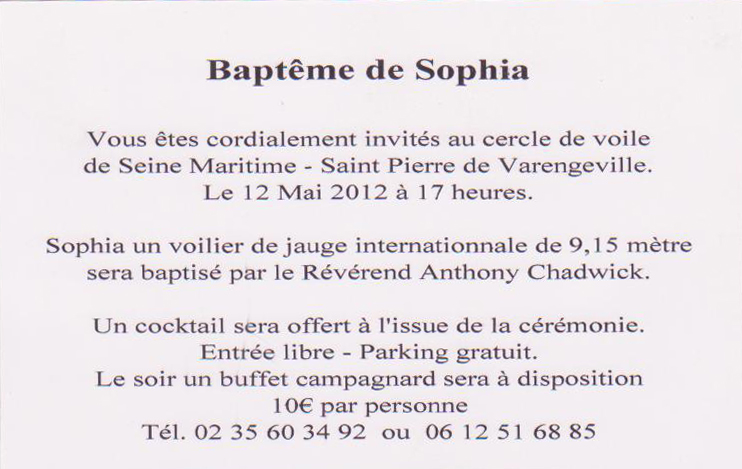
Here in France, the ceremony of blessing and officially launching a boat or a ship is called its Baptism. It goes without saying that this term, also used for the solemn blessing of church bells, is taken in its analogical meaning, since only human beings can receive the Sacrament of Baptism properly speaking. So, when we talk of the Baptism of a boat, it is meant in this way. Properly speaking, it is the blessing and naming of the boat.

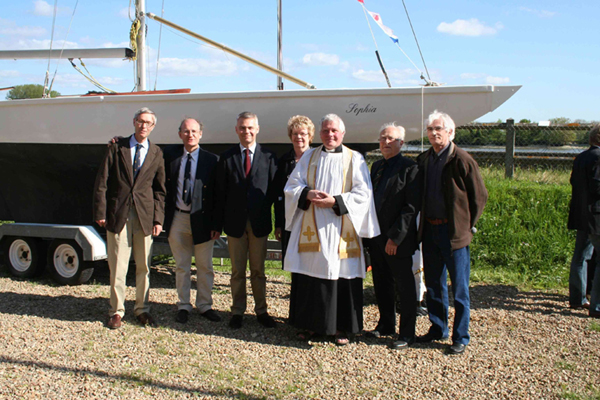
I was invited by some members of my family-in-law to bless a racing yacht that they had just restored by several years of painstaking work. The yacht, originally built in the 1930’s, neglected for many years and bought by its present owners, has been named Sophia, and lies at a sailing club on the Seine river near a town called Duclair, in the commune of Saint Pierre de Varengeville. She has not yet actually been launched, because some modifications still need to be done to the standing rigging and the yacht has no engine. The name has special meaning for me for several reasons: the profound influence of the Wisdom literature of the Scriptures in our spirituality, and the significance of the Divine Wisdom in the Christian tradition. The woman I married is called Sophie, and I named my own little dinghy Sophia. The coincidence brought me a considerable amount of pleasure. It is the second time I blessed a boat, and each time gave the same name – firstly my own, and then this graceful yacht.

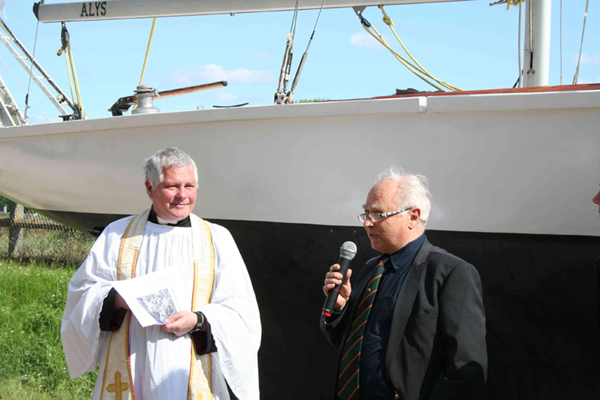
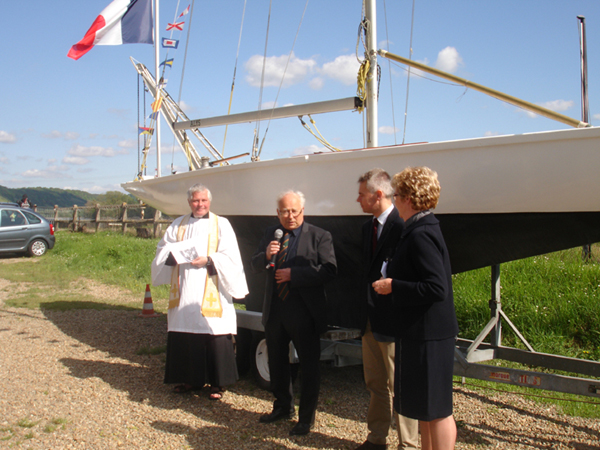
The ceremony was simple, beginning with words of welcome from the president of the yacht club, the association that financed the restoration work and the local Mayor. I then gave my own address from a more specifically spiritual point of view, then blessed the boat using a beautiful Eastern Orthodox prayer, and finally sprinkled her with holy water. The Mayor then officially named the yacht and broke the bottle of champagne against a metal member of the boat’s trailer rather than running the danger of damaging the hull. The bottle exploded with a dull pop, and its contents soaked into the ground. Tradition was followed.

After all, Napoleon didn’t want clever generals but lucky generals. A boat needs to be lucky in winning regattas, and also coming into port safely every time. Wishing for luck though the prayer of bene-diction – well-saying – does not seem to be superstition, but that God’s grace and uncreated energy may remain with the skipper and crew, with the boat itself and on the sea or on whichever inland water the yacht is sailed.

Here are some pictures of the ceremony:

Posted in Uncategorized | Tagged , | 6 Comments

An unpublished “Plan B” paper

Update: I had an e-mail from someone who found me unjust and negative about the ACA.

I find that this person missed the whole point of this posting. I put up a piece I wrote in August 2010 – therefore from the perspective of a time when there were no Ordinariates and there was no determined response from anywhere in the TAC. Things have changed, and I already clearly stated that I was wrong in many ways. This paper merely represents my thought at the time. It is of historical interest. This point was missed by the person who wrote to me.

What I wrote then is not what I would write now. The TAC has reformed itself on the basis of the meeting in South Africa. Some bishops have been conveniently discredited (or discredited themselves? – don’t bother commenting – yawn). A number of former TAC communities, clergy and laity have been received into the Roman Catholic Church. I am shot down for even suggesting that there might be a “third way”, so I’ll just say there isn’t one. End of story.

* * *

At exactly the time when my collaboration with the Anglo-Catholic blog came to an end, at the end of August 2010, I began to think of some ideas based on my analysis at the time of Anglicanorum coetibus. The English Ordinariate was not to be founded for another six months, and it took a further year for the American Ordinariate to be rolled out. An Australian Ordinariate is announced for the summer of 2012 (see Good news from the Ordinariate… and Australian Ordinariate At Last! – 15th June 2012). I will offer no further comment on the present situation.

Since closing down the English Catholic blog, I have refrained from all polemics concerning the TAC and the Ordinariates and continue to maintain silence on this subject. Thus comments designed to “shoot me down”, to embarrass me or demoralise me will be refused or removed.

I also could not foresee the looming showdown between the Society of St Pius X and the Holy See, covered in some detail by the traditionalist Roman Catholic blog Rorate Caeli. There is a distinct possibility of fragmentation, but I offer no speculation outside what you can read from better informed people than I.

Here is my analysis of August 2010, wrong in many respects, but uncannily accurate in a few details. I was more pessimistic than the way many aspects turned out in time, and it is clear that the implementation of Anglicanorum coetibus was designed to filter the clergy according to criteria of canonical regularity or irregularity. Whether a group of clergy of known canonical irregularity could credibly found some alternative structure outside the Ordinariates and a part of the TAC claiming its own canonical regularity, that is anyone’s guess.

I sent this paper to Archbishop Hepworth at the time, but nothing further came of it.

* * *

A “PLAN B” FOR THE TAC

To be expanded and matured over time

Scenario – July 2011:

An announcement had been made on 26th March 2011 in Rome by Cardinal Levada about Ordinariates for groups of Catholics having left the Anglican Communion. The letter sent by Archbishop Hepworth in August 2010 to Cardinal Levada was left without an answer. As was said on several occasions by the former prefect of the Secretariat for the Unity of Christians, Cardinal Kasper, the Apostolic Constitution Anglicanorum Coetibus concerned only Roman Catholics of Anglican origin.

The announcement included a new set of canonical norms and a “clarification” of the Apostolic Constitution. The introduction to the new norms stipulated that the words “in a corporate manner” should be taken to mean “corporate after each individual Anglican is received as a convert in an individual way”. Having been received in a parochial context, after due screening by the diocese, these individual converts will be permitted to join parishes that may be erected for the Ordinariate, conferring a “corporate” character a posteriori. The Episcopal Conference of England and Wales have expressed their entire satisfaction with this decision.

The converts are to be instructed according to the usual methods in their geographical parishes, typically the RCIA. This is to ensure complete integration of the converts leading to their acceptance of locally organised ecumenical programmes. This point was most insisted upon by the local Episcopates.

The clergy have for the most part been placed in the RCIA programmes and may, on a case by case basis – if unmarried – be allowed to enter seminary after some two years of living as laymen. This is held to be of no importance, since the laity will be attending Mass in their local parishes, and the question of priests for the Ordinariates has been left undetermined. Dispensations for married priests are to be very parsimonious and only for those having held positions of prestige in the Anglican Communion.

The TAC, having received no response from Rome, began to disintegrate by the end of 2010. Many of the laity joined other Continuing Anglican Churches, the Anglican Catholic Church (Original Province) in particular. The Churches of Canada and the United States collapsed, leaving the bishops, a few clergy and handfuls of straggling laity, more attached to their pastors than anything else. The bishops, having signed the Catholic Catechism and the letter of October 2007, are discredited. Their only option is retiring into anonymity.

Pope Benedict XVI was forced to accept the fait accompli, and with this collapse of any hope of recovering more than very small numbers of Anglicans, the dialogue with the Catholic traditionalists of the Society of St Pius X and even with the Patriarch of Moscow also foundered. The Holy Father has been rendered incapable of any work of reform in the Catholic Church and the inexorable process of decline continues, and his activity is severely curtailed by the “old guard” of the Roman Curia. He has been reduced to a long wait for death as it was during the final years of John Paul II’s pontificate. There is no hope for a serious reform of the Episcopate and the “Magic Circle”.

Response from the Bishops of the TAC

Not only has the bluff been called, but the goalposts have moved and the dice are loaded. In short, the request from the TAC Episcopate has been repudiated and the various responses by Cardinal Levada to Archbishop Hepworth were either based on unrealistic thinking or hypocrisy. The result is the same. The whole Ordinariate project was undermined by the local Episcopate concerned and the letter of the Papal legislation was emptied of the spirit of the law, the legislator’s intentions. All hope of corporate reunion of Anglicans with the Holy See is irremediably ruined.

Initially, groups of clergy and laity addressed themselves to their local Catholic bishops and parish priests and were received as individual converts. The flow stopped after the first few hundred when it was seen that nothing else was forthcoming. Anglicanorum Coetibus went the same way as Summorum Pontificum – priests from traditionalist societies were denied permission to minister in most dioceses, and diocesan clergy who celebrate the extraordinary form are ostracised and removed from their parishes.

The stonewalled TAC College of Bishops had two options:

1. Dissolve the TAC and instruct the clergy and laity to convert to the Catholic Church

The TAC College of Bishops wagered their life and lost. It was a one-shot deal, win or lose. The winner gets all and the loser loses all. Any attempt to regain credibility will be immediately beaten down. The clergy and laity at their various synods pledged support of their bishops and therefore contract the same obligation and curse: go through with unconditional submission to Rome or cease practising their religion.

The “classical Anglicans” of the Continuum blog were right in all but their nastiness. They are untouched by the “curse” on the TAC, though they are not exempt from the intrinsic splintering of undisciplined communities and bigoted contenders for power.

A few priests and groups of laity in the United States and Canada were able to avail of the Anglican Use provisions with friendly bishops interpreting the “dead” Papal legislation in a generous way. The number of Anglican Use parishes, using the Book of Divine Worship of 1980 has doubled. Such provisions have not been implemented in the British Isles or Australia. In Australia, Bishop Elliott was placed in charge of the procedures for vetting and training clergy and setting up a pastoral scheme within the Australian dioceses, with the promise of an eventual Ordinariate after an initial experimental period of some twenty years. In England, everything has returned to the stillness of the 1990’s and ecumenical relations are beginning to be restored between the Vatican and the Anglican Communion.

Archbishop Hepworth retired into private life with his family and is no longer heard from. The other bishops either removed themselves from any ecclesiastical life. Two of the Canadian bishops and all the US bishops joined the Continuing Anglican Union formed from the old Anglican Province of Christ the King and the Anglican Catholic Church. The small number of clergy who had been Catholic clergy or who had married after ordination, who reconciled with the Catholic Church were quickly rooted out and laicised. They were given strict instructions to behave as laicised clergy, and forbidden any participation in parish life other than receiving the Sacraments and tithing.

Most of the clergy have dispersed. It is estimated that no more than about twenty priests worldwide converted and tried their luck with their diocesan bishops. About a third joined the Continuing Anglican Union and most of the rest have not been heard from. Proportions of laity are about the same, with a slightly higher percentage converting to their Catholic parishes.

2. Dissolve the TAC and form a Pro-Ordinariate

The TAC was impeded from following the Pope’s plan because of obstruction by the diocesan Bishops and Vatican bureaucracy. The Apostolic Constitution failed to take reality into account and was doomed to failure.

The TAC and its bishops retain their credibility through their thwarted intention to unite with the Catholic Church. That intention was impeded, and we arrive at a conclusion that the normal functioning of the institutional Catholic Church is impeded, like Germany being taken over by Hitler and the Nazis in 1933. The Papacy is impeded. This thesis is very similar to that of Archbishop Marcel Lefebvre and the Society of Saint Pius X, hence the extreme caution in the current theological dialogue. It is a thesis based on observation and common sense, and not on complex logical constructions and “proof texts” like sede-vacantism.

The consequence of this observation is to proceed exactly like the Society of St Pius X with the same degree of credibility: go ahead as if the ordinariate had been established by the Pope according to a reasonable interpretation of Anglicanorum Coetibus. This is a matter of transforming the present TAC structures into a provisional structure that is de facto or “materially” Catholic, even though it awaits canonical regularisation.

Many would treat the new pro-ordinariate as a schismatic or pseudo-Catholic structure. However, if the above fundamental justification is sincere and well founded, this is the only alternative to utter humiliation and collaborating in the terminal decline of Christianity.

Plan B – The Pro-Ordinariate

It would seem that the first thing, after the observation of the failure or “poisoning” (removal of the originally intended meaning from the texts) of the Pope’s project, is to take stock of what is left. A small percentage has gone over to Rome (local dioceses and parishes) and a slightly higher proportion has joined other continuing churches that refused anything to do with the ordinariate scheme in the first place. Maybe as many as twenty percent are so scandalised they have ceased all religious practice.

We are probably looking at about a third of the TAC as it stood in late 2010. The TTAC in England is nearly intact. About 1,500 souls remain in Canada and about half that number in the USA. About a thousand remain in Australia and the Torres Strait is more or less intact. India and almost all the African dioceses have joined the Anglican Catholic Church.

The decision is made to curtail the number of bishops severely and create a single ordinariate with one Ordinary and two auxiliaries, all three bishops. Thus, the administration and facilities for training the clergy are centralised. A seminary is established with a residential programme for unmarried students and a mentoring system based at the seminary for married students in full-time employment. Systems of financial aid for disadvantaged priests and pension funds are centralised.

Validity of Orders and the Sacraments

As would have happened on entering formal communion with Rome, it is judged opportune for the clergy to receive a new ordination that would be universally recognised as valid. The solution for this is for the elected Ordinary to receive conditional Orders from a retired Catholic bishop prepared to face the consequences of excommunication like Bishop Cornejo Radavero, Archbishop Ngo-Dinh-Thuc, Bishop Duarte Costa or Archbishop Lefebvre. The alternative is for such a line of succession to be given by a ‘descendant’ from one of these lines in possession of credible documentation.

The justification from receiving these conditional Orders is exactly as receiving such from the Catholic hierarchy. Episcopal consecration and all ordinations should be conferred according to the Roman Pontifical of 1962, and not according to Anglican or reformed Catholic rites.

The Pro-Ordinariate and other Catholics

This Pro-Ordinariate being in the same objectively schismatic state as the former TAC and the traditionalist Catholics of the SSPX, it is the duty of the clergy and faithful to attempt to forge links with Apostolic Churches of good will. Examples of such would be the SSPX itself, ‘canonical’ and ‘non-canonical’ Orthodox Churches and the more serious ‘independent Catholic’ communities such as that of Bishop Cantor in France.

In canonical terms, the Pro-Ordinariate would be alone, with support and help only from the above-mentioned communities, if they are sympathetic to the Pro-Ordinariate and find its foundational “justification” credible.

The Standard of Belief

The standard of belief of the Pro-Ordinate is as expressed: The Catechism of the Catholic Church is the authoritative expression of the Catholic faith professed by members of the Ordinariate.

This reflects the statement made by the bishops of the Traditional Anglican Communion in their petition.   It is a deeply pastoral solution to the question of statements of faith. Many members of our community have been using the Catechism as a reference and a sourcebook for years. Its language is contemporary and its methodology, based on the Scriptures, the Fathers of the Church, and the liturgical Creeds, is already familiar to Anglicans.

Many of the things being denied at this moment in the world have been taken for granted for centuries. The nature of God, the revelation of God in Christ, the nature of holy scripture, the authority of Christian moral teaching about life and sexuality, the attack on the nature of marriage, and the widespread abandonment of holiness of life (especially among some of those consecrated to religious and priestly life), have all posed enormous problems for those who seek to teach and understand the Christian faith. The Catechism is a contemporary document addressing contemporary problems of contemporary unbelief.

Liturgy

The liturgical standards of the Pro-Ordinariate would conform to:

–         The Roman Missal of 1570 and subsequent editions up to 1965 in Latin,

–         The English Missal of 1940 or 1958,

–         The Anglican Missal of 1921,

–         The Use of Sarum in Latin (Dickinson 1868) or in English (Warren 1911),

–         The Roman Pontifical in Latin,

–         The Roman Ritual of 1614 and subsequent editions and translations into English,

–         The Book of Common Prayer for the morning and evening Offices,

–         The Roman Breviary or any other breviary in Latin or English,

–         All traditionally used graduals, antiphoners, hymn books, musical settings, etc.

–         Traditional usages for religious orders in communities of monks and religious

Emphasis should be placed on traditional English cultural characteristics of churches and church furnishings.

Synodal Structure

The Pro-Ordinariate follows the rules laid down in November 2009 for the Ordinariates and the 1983 Code of Canon Law where applicable in these abnormal circumstances.

Clerical Celibacy and Marriage

The Pro-Ordinariate follows the same discipline as in the Orthodox Churches except for the founding clergy. Married men may be admitted to Holy Orders up to the priesthood. Only celibates are promoted to the Episcopate. Widowed priests are not normally permitted to re-marry. For the founding “generation”, married men may be bishops. All priests previously married after ordination are to be ‘grandfathered in’ and allowed to receive conditional ordination (see above) and continue as priests.

Former Roman Catholic clergy

Care shall be taken not to provide a simple haven for Roman Catholic clerics looking for a way around celibacy and who hold opinions and agendas that are not compatible with traditional Catholicism. Those who have received major Orders in the Roman Catholic Church are not to suffer discrimination if they are theologically orthodox and sincerely adhere to the tenets and principles of traditional Anglo-Catholicism.

Posted in Uncategorized | Tagged , , | 7 Comments

The Spirit of the Sea

Preparing my address for the blessing of a yacht has provoked me to research a little into the way the sea builds the spiritual life of those who are called. The prayer for the blessing of a boat mentions two powerful symbols, that of Noah’s Ark and Jesus calming the storm on the Sea of Galilee. The Sea of Galilee is a mere lake, but a large one, and the weather can be fickle.

Sea literature has followed the same biblical symbolism of the barque, the sea and the navigator. The ship represents life and the instrument of the young man’s spiritual formation, from cadet to able seaman, from midshipman to officer. In the old days of sail and the square-rigged ship, life was tough. You made it or you didn’t. You prayed for God’s strength but relied on your own and your cunning for finding a solution to any problem. The sea can be hostile, indifferent, fickle and insincere. Its force is greater than anything we know. The sea is also beautiful, mysterious and mother-like.

The sea makes men of us, because we learn to overcome fear and respect certain rules. My own experience is one of inshore sailing in dinghies and yachts. It is something else when all you see around you in the horizon, and you have only your navigation instruments to know where you are and where you are going. Even within sight of land, the sailor’s navigational skills hone his sense of space perception and anticipation.

The Romantic movement made a great deal of the sea. We have Samuel Taylor Coleridge’s The Rime of the Ancient Mariner. It is a tale of guilt and redemption, narrating the voyage of an old sailor who kills an albatross near the South Pole and lives with its ghost.

The early American settlers shared stories of fishing, whaling and transporting freight. The land had come out of the great waters. The sea was synonymous with freedom and soul-searching, a safe haven far from the evils and distractions of society. In the mind of the Romantic, the sea became a monastery with the ship’s bell fulfilling the same role as that of the abbey church. But life at sea was harsh and dangerous, all part of the young man’s kenosis. Some went to sea and it formed their personality. It all depended whether the Captain loved his men and earned respect, instead of flogging and keelhauling.

After the disuse of sailing ships for transporting cargo, fishing and whaling, the Romantic notion of life at sea evolved into pleasure and sporting sailing. From the end of the nineteenth century, men like Joshua Slocum would take on the might of the sea alone in a small vessel. Working sailors like those in the Navy, freight carriers or fishermen can easily be inclined to have a despising and cynical attitude to those who navigate for pleasure and as a human challenge. They are wrong, and have not understood the gratuity of the contemplative life, whether in the monastery on land or alone at the helm and on watch.

The call of the sea is indeed a form of call to the cloister…

Posted in Uncategorized | Tagged , , | 4 Comments

Simplifying life

I have deleted a blog called The Stoutest Ship were the Frailest Shallop and transferred its contents to this blog. A little thinking about the question will bring out the simple fact that there are many blogs on the Internet about sailing, boats, the sea and other related subjects – but few about the spiritual content of the sea and navigation. That is the aspect that would be of interest to this blog.

Therefore, the spirit of the sea will also be a regular aspect of this blog alongside the liturgy and various out-of-the-box topics.

I have been invited next Saturday to bless a newly restored racing yacht. My wife will take photos, and I will publish them together with my report of the occasion and my address. The boat’s name is Sophia, the Greek word for Wisdom – which is exactly the name I chose for my own dinghy when I bought it three years ago.

Posted in Uncategorized | Tagged , | 1 Comment

Monthly Ordo

I have just decided to publish the Sarum Ordo at the beginning of each month. Over the course of this year, I have found errors and omissions and have pencilled in corrections for next year’s complete ordo. This has not a patch on the famous Ordo from the Saint Lawrence Press for the Roman liturgy according to early twentieth century liturgical norms. This work is not a copy of the St Lawrence Press Ordo because it is for the Use of Sarum, not the Roman Rite.

Here is my humble contribution, which includes some feasts from the Roman rite, missing in the Sarum Use. Those feasts are in italics. Naturally, I am following the Gregorian Calendar. If you find errors or omissions according to Sarum norms, please note this in a comment.

May 2012

Date Day
1 Tues Philip and James, App. Inferior Double
2 Wed Athanasius.
3 Thur Invention of the Holy Cross, Lesser Double, Mem. of SS. Alexander and Eventius.
4 Fri
5 Sat  
6 Sun Fourth Sunday after Easter. John ante Portam Latinam. Trip. Invit. iii Lessons, with Rulers
7 Mon John of Beverley, Conf. Bp. iii Lessons, with Rulers.
8 Tues
9 Wed Translation of S. Nicholas, Conf. Bp. iii Lessons. Gregory of Nazianzus.
10 Thur Gordian and Epimachus, MM. iii Lessons, with Rulers.
11 Fri Cyril & Methodius. 
12 Sat Nereus, Achilles and Pancratius, MM. iii Lessons, with Rulers.
13 Sun Fifth Sunday after Easter (Rogations).
14 Mon Rogations
15 Tues Rogations
16 Wed Vigil of the Ascension
17 Thur Ascension.
18 Fri
19 Sat Dunstan, Conf. Bp. iii Lessons with rulers. Mem. of S. Pudentiana.
20 Sun Sunday after Ascension Day.  
21 Mon
22 Tues
23 Wed
24 Thur Octave of the Ascension
25 Fri Aldhelm, Conf. Bp. ix Lessons. Mem. of S. Urban.
26 Sat Vigil of Whitsun Day
27 Sun Whitsun Day.
28 Mon Whitsun Monday
29 Tues Whitsun Tuesday
30 Wed Ember Wednesday
31 Thur Whitsun Thursday
Posted in Uncategorized | Tagged | 6 Comments

Union of Scranton Website

The Union of Scranton now has its own website. I have already mentioned on this blog that the Union of Scranton presently consists of the Polish National Catholic Church and the Nordic Catholic Church.

The Christ-Katholischen Kirche in Deutschland is an administration under the NCC.

May they go from strength to strength!

Posted in Uncategorized | Tagged , , | 3 Comments

For the First of May

I offer you this lovely and unashamedly baroque representation of the Holy Family. I found it on Rorate Caeli – I acknowledge sources. Where they got it from, I have no idea.

In the Sarum Missal, we celebrate the Feast of Saints Philip and James, Apostles. However, popular piety designates May as the month of Our Lady. Saint Joseph is especially honoured for his virtues as a father* of a family and a conscientious craftsman.

I wish you all a happy May Day.

* I use this word without casting any doubt on the Virgin Birth of Christ.

Posted in Uncategorized | Tagged , , | 1 Comment