The Titanic

I am not going to make any moralising comments like those about God not allowing man to boast his technological achievements or symbols of progress. Some preachers at the time likened the Titanic to the Tower of Babel. What would they say of modern cruise ships like the ill-fated Costa Concordia or other top-heavy vessels of even more outlandish designs?

As with more recent disasters at sea, there have been acts of stupidity, cruelty and arrogance – but also of heroism and self-sacrifice. No vessel is unsinkable once its safety design limits have been exceeded. The Titanic was not designed to withstand the flooding of more than four of its watertight compartments. It is as simple as that.

I am something of a “Luddite” myself and I consider that technological progress often exceeds man’s moral capacities. But, after all, the Titanic was a ship. Most ships do not sink from the day their keel was laid to the day they are sent to India for breaking up. Boats with engines are probably safer than sailing vessels, but any propulsion system can fail. In the case of the Titanic, the hull was cut open. As with the Internet, it is not technology that is evil but perverse humans. Is it not the same thing with an aeroplane, a car or a kitchen knife?

We live in a culture where someone is always to blame – always a conspiracy, a scapegoat where there is not necessarily one. Sometimes, a crisis occurs and circumstances combine and prevail to make the whole thing worse and impossible to recover. This happens with methods of transport, but also with churches – but, umph, I won’t go into that like on the blog I sank a couple of days ago…

* * *

I will offer Mass today for the approximately 1,500 souls who perished when that great ship sank.

Posted in Uncategorized | Tagged , | Leave a comment

English Catholic blog is gone forever

Some former readers of the English Catholic blog might come here to find out what happened. I have simply deleted the blog for my own spiritual health and peace of mind. Only two pages have been kept on the Wayback Machine archive, so that avenue will prove parsimonious for those who have not saved the blog to their hard disks.

I have saved the entire blog to my hard disk, and I am prepared to give copies of single articles on request. I keep it as an archive, which may one day prove useful to anyone writing a book on the history of the TAC, Continuing Anglicanism and the Ordinariates. The data and information have not been destroyed.

I have not done this on a whim or in anger, but after mature consideration. It is true that some cast aspersions on my credibility because I had announced that I was going to cease blogging and resumed when I “felt better”, or however one might put it. The Internet can be addictive for some, but I do not believe I have an emotional or irrational attachment to blogging. For me, it is simply communication with other people, just what journalists and authors do. Time marches on and things change in life. It has been a hard battle, and my intention was educational and pastoral, but one cannot win out against bigotry and hatred. I therefore bring all discussions of Continuing Anglicanism and Anglicanism in the Roman Catholic Church (for want of a better generic expression) to a close. Those subjects are off-topic on this blog, both for me and for those who wish to write comments.

I will ban those whom I deem to be attempting to proselytise for any particular Church or ecclesial community. I will similarly sanction those who behave in the manner of trolls. I ask for little, simply that you behave as if we were in conversation in the physical presence of all involved. It is just a question of kindness and consideration for other people. Anonymity on the Internet is a source of great evil, and I will do everything possible to learn from my experience of the English Catholic. I am more street-wise now, so know what signs to look for.

As the Sun in its Orb is dedicated to liturgy, theology and religious culture, with an occasional spiritual reflection on my favourite non-religious hobby (alongside choral and organ music) – sailing. I ask commenters and readers to help me keep this blog free of nastiness, bigotry, polemics and the factors that compelled me to close the English Catholic blog.

Posted in Uncategorized | Tagged | 8 Comments

Anglo-Catholicism, Modernism and Aggiornamento

The Holy Triduum always has its profound effect on me as on countless other Christians. We are speechless faced with the horror of human wickedness and the contrasting love of God in Jesus Christ – that one last hope for sinful humanity. I also had that “Here we go again…” feeling about the last thread of comments that coincided with the embers of Spy Wednesday. I have that way of bouncing back, but not without learning lessons.

One thing I heard about a considerable amount in my days as a young convert to traditionalist / conservative Catholicism was portrayed as the worst demonic enemy of faith and true religion – Modernism. I am not the sort of person to jump onto a bandwagon and rave about Modernists like Hitler ranted about the Jews. A couple of times at seminary, I had to recite an Anti-Modernist Oath to receive the subdiaconate and the diaconate. This text written in the time of Pius X at the beginning of the twentieth century described barely comprehensible notions of evolving revelations and doctrine reduced to sentimentalism – something not at all difficult to reject. The truth is that the Vatican, as usual, made a mess of the whole affair, blaming so-called Modernists for what was being read in the writings of German liberal Protestants, the very people Modernists opposed! The Modernist “demon” aroused my curiosity. I had sincerely abjured ideas I found wrong or irrelevant anyway, but discovered a whole different world.

See Catholic Modernism (1896-1914) which shows that the notion of a Vatican screwup was not my invention, but there is more information in some books I have in my library, which I would have to root out. It could be said that if Modernism was the ideology Pius X attempted to characterise, there were no Modernists. Remember that this was a time when reactionary and counter-revolutionary conspiracy theorists saw Jews and Freemasons under every bed! Anti-Semitism was not invented by the Nazis!

Very early on in my Catholic life, I asked questions and read about the so-called “synthesis” of all heresies. In the late nineteenth century, there were those who developed the thought of the Oxford Movement and the various offshoots of Romanticism – men like George Tyrrell. Tyrrell was not alone in the abusively broadly-defined Modernist movement, but he worked, thought and lived largely alone. He was not part of a conspiracy or even a movement. The convergence was nothing more than the Zeitgeist, an aspiration to interiority and beauty in reaction against secularism and rationalism in official institutional religion.

I am not going to set out to write a complete essay on Modernism, as more learned men have accomplished this task. Here are a couple of inspiring articles on the Internet, one from the Russian philosopher Nicholas Berdyaev and from the American Kenneth Rexroth. The former wrote Catholic Modernism and the Crisis of the Contemporary Consciousness in 1908. Rexroth wrote two articles a while ago, which I find very interesting, one on The Catholic Modernists and the other on the “proto-modernist” leaven in the Oxford Movement and Anglo-Catholicism – The Evolution of Anglo-Catholicism. I leave you to read these two articles.

In The Catholic Modernists, the author leaves off with the reflection:

It seems to me that there are two drives operating today, two contradictory definitions of aggiornamento. One is the now long dead Liberal Protestantism which is given lip service in the luncheon clubs and all the forums of the Social Lie, the apotheosis of spiritual vulgarity. If this wins, it means the end of Catholicism, Christianity, religion, all interiority. The other is simply a more developed concept of prayer, and the opening of all life to its pervasiveness. This is not new at all, but Patristic, Apostolic, Evangelical — or if you will, a clarification of the religious experience as such, so that it might be shared by all men, today. Father Tyrrell and Baron von Hügel were amongst the first to be acutely aware of this antithesis in modern religion. It is obvious which side they chose, which is why they are so desperately relevant today.

This simple distinction helps me better to understand my own thought and spiritual anguish over the years. Modernism is not so-called Liberal Protestantism, that spiritually-dead caricature of Christianity. I have insisted for a long time that our agonies are not resumed in a dualistic struggle between conservatism and liberalism, each demonising the other in a combat of mutual anathemas, but that the human soul aspires to transcendence, beauty, peace and wisdom. Transcendence is the quality of the prophetic souls of this world, of musicians, artists, explorers, navigators and scientists – but this remains the greatest secret.

Perhaps Christ was the first Modernist! I don’t like the word, but if this is what it means, it is altogether my way.

Posted in Uncategorized | Tagged , , , , , | 1 Comment

Happy Easter!

Christ being raised from the dead, dieth no more, death hath no more dominion over him; for in that he liveth, he liveth unto God. Alleluya! Alleluya! Now let the Jews declare, how the soldiers who kept the sepulchre lost the King when the stone was rolled, wherefore kept they not the rock of righteousness; let them either produce the buried, or adore the risen one, saying with us, for in that he liveth, he liveth unto God. Alleluya! Alleluya!

Happy Easter to all readers of this blog.

Posted in Uncategorized | Tagged | 9 Comments

And for Good Friday

Francis Poulenc, Tenebrae factae sunt

Posted in Uncategorized | Tagged | Leave a comment

Ubi caritas et amor, Deus ibi est

Motet by Maurice Duruflé (1902-1986), organist of St Etienne du Mont, Paris.

Posted in Uncategorized | Tagged | Leave a comment

John Milbank on the future of Anglicanism

I have been an admirer of John Milbank since discovering Radical Orthodoxy. This tendency in contemporary theology is quite elitist and not always easy to follow, but it is largely based on Plato’s realist metaphysics and seeks a spiritual understanding of theology.

However, Milbank does seem to have a disturbing tendency to promote the Roman way of teaching doctrine infallibly and the ex opere operato mindset to some extent. How do we go from post-modernism back to pre-modernism? I have an intimate understanding of what it was like to yearn for an infallible Church and the forceful suppression of dissent and intellectual freedom.

Though I hardly go along with ‘liberal’ theology based on idealist metaphysics, I have become weary and sceptical of the certitudes of conservative Christianity. Traditionally, Anglican comprehensiveness made dialogue and conversation possible. Milbank’s thought is more subtle than that of conservatives, but the tendencies need to be closely examined and discussed.

Three observations about contemporary Anglicanism:

— Almost ubiquitous liturgical chaos, where many evangelicals and liberals alike have little sense of what worship is for.

— The increasing failure of many priests to perform their true priestly roles of pastoral care and mission outreach, in a predominantly “liberal” and managerialist ecclesial culture that encourages bureaucratisation and over-specialisation. This has often led to a staggering failure even to try to do the most obvious things – like publicising in the community an Easter egg hunt for children in the bishop’s palace grounds! To an unrecognised degree this kind of lapse explains why fewer and fewer people bother with church – though the underlying failure “even to try” has more to do with a post 1960s ethos that assumes decline and regards secularisation as basically a good thing, or even as providentially ordained since religion is supposedly a “private” and merely “personal” affair after all.

— Perhaps most decisive is the collapse of theological literacy among the clergy – again, this is partly a legacy of the 1960s and 70s (made all the worst by the illusion that this was a time of enlightening by sophisticated German Protestant influence), but it has now been compounded by the ever-easier admission of people to the priesthood with but minimal theological education, and often one in which doctrine is regarded almost as an optional extra.

Posted in Uncategorized | Tagged , | 14 Comments

Sailing from Veules les Roses to Saint Valéry en Caux

At last, the north-east wind decided to give something a little more decisive than its usual fickle and timid self (I much prefer a good westerly), but it was better than nothing. It was going to be delicate between the calmness of the morning and two imperatives in the evening – freshening wind going up to 20 knots and my Mass in Dieppe for my two ladies.

The wind was just right for a broad reach all the way to Saint Valéry en Caux, which is the furthest headland you see in the photo with the port wall to the west. In the foreground is Veules les Roses, where I keep my boat at the sailing club. The distance is four miles and I made it in twenty minutes, so my speed was 12 mph or a little over 10 knots, not bad for my little dinghy. The wind must have already been touching the 13-14 knot mark and a little more in the gusts. My boat fears waves on the beach, not wind at sea, at least under about 18 knots in protected waters. Here, it is the English Channel and open sea. I returned under a close-hauled beat on a kind of “saw-tooth” tacking pattern, gradually approaching the beach and tacking out to sea to avoid beaching before my arrival at Veules.

One day, I will invest in a waterproof camera to take photos on board. The cliffs of the Côte d’Albâtre are always awe-inspiring. As I said in a recent comment, life with God is like sailing this very small boat on a very big sea. The tiny part of the sea we can see from a boat seems big enough, but the part that lies over the horizon is so much greater. There is a difference, the sea of the earth’s oceans is finite, but God is infinite.

And he cared enough for each of us to send his Son.

I wish all my readers a prayerful Holy Week…

Posted in Uncategorized | Tagged , | 1 Comment

Anglican Church Music to the Rescue

If Not Sacred Music, but Sounds of Attack by Sandro Magister is anything to go by, the Roman musical tradition is on its last legs. On the other hand, the choir of Westminster Abbey is welcomed in Rome to sing at St Peter’s Basilica.

I have never been impressed by the Sistine Chapel choir. It sounds like a car starting its engine with its wobbling voices and men “scooping” to find their note. A recording I have of some Perosi masses is quite excruciating in places in terms of the boys singing flat. What is the matter with the Italians who produced such a fine musical tradition in the Renaissance and Baroque eras?

Perhaps this is one reason why Pope Benedict XVI is so interested in Anglican patrimony…

Posted in Uncategorized | Tagged | 4 Comments

Castrati

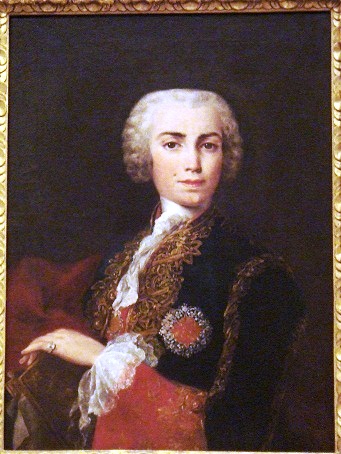
Farinelli, the famous 18th century castrato

My old blogger friend Arturo has produced a very interesting posting On the castrati, concerning an old practice of castrating pre-pubescent boys so that their voices do not break. They continued to be able to sing with a high soprano voice. The last castrato, Alessandro Moreschi, made a recording in 1904. Even with allowances made for the recording of its time, the musical effect is disappointing. He seemed incapable of singing a melisma with a nice legato, one of the first things a singing teacher will teach you, along with proper breathing. Our attention is brought to a programme of scientific research using computer technology into the reconstructed sound of the castrato voice, completely different from female sopranos and pre-pubescent boy trebles.

Officially, the Church excommunicated castrated men but made use of their musical talents in choirs and as soloists. We arrive at a problem of moral theology, that of physical mutilation and rendering a human being incapable of reproduction. Has the Church always been constant and coherent in its application of moral teachings and canonical discipline? I will not attempt to answer that question.

We can be thankful that this practice has disappeared along with that barbaric operation performed by surgeons of the past. Many boys died from infections following the operation.

Sometimes, normal men with (presumably) their “equipment” intact, have voice abnormalities and such differences can be put to great effect. A singing teacher I know here in France, Renald Laban, is a male soprano and has had quite a distinguished career as a soloist. Smoking too many cigarettes and age have taken their toll, and he now continues to teach and sing counter tenor at concerts and other musical productions in our area. With training and practice, it is amazing what we can do with our voices – without any physical “modifications”!

The article is worth reading.

Posted in Uncategorized | Tagged | 4 Comments