Celtic Christianity

Celtic Christianity falls into two clear categories: historical and modern revival attempts.The Celts are the peoples of Ireland, Scotland, Wales, parts of England and Brittany. The Celtic Church was unique to these peoples, and is reputed to be one of the oldest in the Christian world.  Tradition relates that it was founded by Saint Joseph of Arimathea in 37 AD, in Britain, in a place which is now called Glastonbury.

Another disciple, Saint Aristobulos, arrived in the British Isles in 63 AD. By all accounts, the Celtic Church remained free of all temporal power and poor. Monasticism played a capital role and gave us Saints Patrick, Brigit, Columba, Brendan, Samson, Amand, Fare, Columban and many others. Many important fragments remain of the Celtic liturgy, and the Use of Sarum, despite being a Norman variant of the Roman Rite, was to some extent influenced by the Celtic tradition.

This article seems to give an interesting account of the history, doctrines and traditions of Celtic Christianity. I have done no independent study of Celtic Christianity. We learn that the Gregorian Reforms (1150–80) were largely responsible for absorbing the Celtic Christians into the Roman mainstream.

It seems an attractive aspect of “Northern Catholicism”.

In modern times, a number of communities have sprung up inspired by a more or less authentic understanding of what Celtic Christianity was like according to available sources. The one that springs to my mind is the “non-canonical”Celtic Orthodox Church.

For others, I suggest going to Google and typing in “Celtic Christianity”, “Celtic Catholic Church”, “Celtic Orthodox Church” and Celtic-just-about-anything-else. You will certainly discover a number of New Age and “inclusive” communities, which I am not recommending in any way. There are even some real kooks out there, so discern and use your brains!

Posted in Uncategorized | Tagged | 25 Comments

Northern Catholicism is not without its critics

I have just been to my letterbox and found two big brown envelopes from Dr William Tighe, that indefatigable scholar from Pennsylvania. He keeps sending me books and articles, and he is obviously someone with whom I would spend a highly stimulating evening. He has sent me two criticisms of the Northern Catholicism book I mentioned a few days ago.

No piece of writing is above criticism, and this helps us to reflect and hone our critical faculties. Dr Tighe sent me a couple of articles from the 1930’s by a Father Gr, one on Northern Catholicism and Nordic Spirituality. So for now, I will comment a little on Fr Gr’s arguments whilst keeping this article reasonably brief – and do my best to represent the good Father accurately. Northern Catholicism is essentially a book produced to commemorate the centenary of the Oxford Movement – the Catholic revival in the Church of England, part of which would lead men like Newman to Rome, and bring others like Pusey and Keble to justify the Church of England’s Catholic integrity despite its role in the Reformation. Could Anglo-Catholicism model itself on the various “keep Rome at arm’s length” tendencies of France, Germany, Austria and other countries?

Fr Gr does evoke the fact this book included articles to compare the Anglican movement with other spiritual and doctrinal movements, especially in Lutheranism.

It saddens me to see the difference between Catholicism and Protestantism reduced to a question of infallible authority. If something does not unconditionally accept that authority, it is Protestant and appeals to “private judgement”. Tertium non datur, and Northern Catholicism is no more than an artificial intellectual construction. Wow! The Lutherans and Calvinists are both Protestant, but much more in the way of church culture and liturgy were preserved in the former, at least until the eighteenth-century era of dry rationalism. Let us not forget that there were some big problems in the Church in the sixteenth century.

Contrasting magisterium and private judgement so absolutely is a travesty, and something we have constantly to be on the watch for. As in many matters, I ask the question What’s in a word? Roman Catholics don’t like non-Roman Catholics calling themselves Catholics, just as the present hierarchy of the American Episcopal Church will not allow their redundant churches be used by anyone calling themselves Anglican. There can only be one kind of Catholicism – no private judgement and 100% infallible magisterium. And that kind of Catholicism has to be increasingly narrow to ensure conformity and control. If that’s so, perhaps we could consider calling ourselves Liturgical / Sacramental Protestants, though it’s not something that appeals to me – and denominationalism leads to the sectarian temptation. But it might take off the pressure. I find Northern Catholicism so much kinder than the negative overtones of the name given to those who protested against superstition, the exploitation of the simple for money and extreme corruption in the clergy. Have we not the right to be positive about something without being bullied?

Fr Gr spares no pains in defending the infallibility of his Church’s magisterium by distinguishing de fide and the kind of stuff where the Pope can screw up and keep his general credibility. Why go on about this, since the subject matter of Northern Catholicism is Catholic revival movements in Protestantism and one or two remnants of Catholicism that both remained Catholic and kept the Pope at arm’s length? We are supposed to be defining ourselves in relation to negative opposition to Roman Catholicism – and unfortunately, the Union of Utrecht fell right into that trap. We are Old Catholics because we reject… The purpose of this blog is to work out something better and more prophetic than that – and more spiritual.

The same dichotomy exists between the SSPX and Rome, the former appealing to Counter-Reformation Catholicism, which makes the whole thing more complex and its coherence difficult to discern. Archbishop Lefebvre appealed to Tradition, and Pope Paul VI appealed to his authority as an infallible Pope. I lived for many years tormented by this dichotomy and eventually arrived at the conclusion that this dichotomy has to be discarded in favour of a non-human form of doctrinal authority on pain of rejecting Christianity altogether. Souffrir passe, avoir souffert ne passe jamais as I have quoted umpteen times from Léon Bloy.

Simply, Roman Catholicism has painted itself into a corner with its We can’t be wrong therefore we are right. It cannot reverse anything without losing credibility, and it cannot keep going the same way without imploding. Christianity cannot be allowed to depend on such a paradigm of agonising contradiction. I don’t believe Christianity needs infallible authority. It needs to recover its spiritual content and understanding of the Scriptures, the New Testament, the Gospels, the writings of the Father, and not least the words and actions of Christ. Until it does, the haemorrhage will continue in our time of reason and criticism.

Was the Oxford Movement an attempt to recover the magisterium of the Church? Certainly in the case of Newman and others who went over to Rome. The French Romantics reacted the same way against eighteenth-century rationalism and came to distrust human reason. They reacted to some extent towards fideism and authoritarianism. The first to appeal to an infallible Pope in the nineteenth century were Liberals of the ilk of Montalembert, Lamennais, Lacordaire and Guéranger. Pius IX himself was something of a liberal until his stint at Gaëta in 1848 and the upheavals in the Papal States and the various surrounding states in what is now Italy.

I am less adverse to the influence of Protestantism in various expressions of Northern Catholicism. Catholic apologists have tended to demonise Protestants for “private interpretation” instead of following an infallible teaching authority operating through the agency of humans. Reformers like Luther and Calvin had their background and formation in the old religion, something lost in their spiritual descendents. As I have commented elsewhere, the essence of Reformation aspiration was the free response to God’s grace in reaction to the excessive heavy-handedness of the institutional Church and its “police”, the Inquisition. Of course, the iconoclasm and destruction of the priesthood and the Church’s liturgical life was something that was understandable but inexcusable.

There are big problems with liberal and conservative Protestantism as with the parallel movements in Catholicism, Anglicanism and elsewhere. Northern Catholicism is accused of inventing a Nordic Catholic Church (not the recent foundation in Norway under Bishop Roald Flemestad and in full communion with the PNCC) to rival the prestige and authority of Rome. Only a Roman Catholic priest would come up with such an idea. He could mock and laugh all he wanted (I presume Fr Gr is no longer of this world), but even Rome recognises (if only in theory) the legitimate differences of ethnical cultures.

Truly, if this kind of thing is still seriously disputed, the aspirations of the non-Curial elements of Vatican II (most of the Conciliar Fathers) are over and ecumenism and religious liberty are idle dreams. Not in the name of Tradition but of infallible authority. This would be the supreme irony of the traditionalists. It chills my blood to think of it.

Is the 2012 version of Northern Catholicism, as opposed to the vision expressed in that book of 1933, viable? Will it survive and endure? I have no idea. Probably not. I believe in Christ and the Gospel through their weakness and vulnerability, as with the witness of the Martyrs and the Confessors. We are not strong or infallible. Infallibility does not inspire me to faith, but fragility lived with courage, humility and fortitude does. The Redemption brought into the world strength from weakness, life from death, freedom from bondage.

Catholics and reformers alike are human and have sinned. People in every Christian “camp” have killed in the name of their God, as others in the same factions have been martyred for conscience and truth.

Christianity is either to be rejected, as the atheists do, or understood in another light. We must go beyond liberalism and conservatism – and find something that is forever fresh, new and full of vitality. I won’t live to see the day, but if I can contribute a little, that will bring consolation and hope.

Posted in Uncategorized | Tagged | 4 Comments

How might it be possible to construct a Christian micro-society?

I have always been fascinated by smallness and intimacy, and by the idea of what I might term a Christian micro-society. I am far from being the first to think of it. We have reams about a socio-political theory called distributism as a kind of modernised version of some forms of medieval social and economic life. Probably the nearest successful embodiment of this kind of theory is the Cooperative Movement. The workers collectively own the means of production and live from their real earnings, at least in theory.

I am not a specialist of politics or economics, and I would make a fool of myself trying to expound on these subjects, but I am profoundly concerned by the inhumanity of modern capitalism and globalism, even, without the conspiracy theories. Modern life is radically incompatible with Christianity. How does a Christian city-dweller, part of the “machine”, manage more than Sunday Mass and a little spiritual reading on the train taking him to work?

In my experience of life, I have rejected city life, but am still dependent on modern technology and means of communication, such as I am using this very instant. At the same time, I have never found a “micro-society” I would ever consider joining, usually because they tend to be totalitarian cults or assimilable to such by their characteristics of absolute obedience to a guru, brainwashing, exorbitant financial demands, etc. The only kind of micro-society I have seen to show any kind of stability and success is the Benedictine monastery. But, monks are men born outside and who freely embrace the monastic life by going through the traditional stages of initiation and probation.

Is such a life possible for lay people? I have read about the work of Eric Gill and Ditchling in southern England, but all that came to nothing. It transpired that Gill was of questionable morals, to put it mildly. There have been various attempts by right-wing people, typically traditionalist Catholics. There was one in Spain run by International Third Position in the 1990’s, but I doubt it has survived a number of scandals in that somewhat unsavoury political movement (founded by a man apparently involved in terrorist acts).

To this day, I have confused political ideas, as no existing ideology or manifesto satisfies me intellectually or in terms of humanism. I have sympathy with any manifesto that promotes the human person and his right to freedom, life and happiness. I am made to think that such utopian ideas are impossible and that human life is all about the dominators and the underdogs, 5% owning everything and squandering it and 95% struggling to earn a living and get by. Do human beings have a right to make slaves of others? These are big questions. I am unable to relate to national and international politics and economics, but I am tempted by the idea of the micro-society. It all depends who is in charge, the method of government, problem-solving, finance and everything else. It all seems a utopian dream, but dreams are the stuff of life.

Here is an article by an author whose name is withheld at his request, with a minimum of edition by me. Though this article hardly concerns “northern” Catholicism, there are traits in common, and the idea is impressive. We should keep these good people in our prayers.

* * *

Our island, erstwhile Isle de France was Catholic ever since the French settled in 1710-1715. The Catholicism which the French brought and a succession of Lazarist Fathers nurtured and maintained was definitely Gallican. The Four Articles were thus part of the Law of this island-of the Mascarene islands in general. The Lazarist Fathers were good pastors, well-loved and respected, who, faced with an acute scarcity of means, succeeded in inculcating the Catholic faith to several generations of islanders, especially, those born on the island. The revered memory of the Supérieur Ecclesiastique, officially, Apostolic Prefect, Father Gabriel Igou endured well into the latter parts of the 19th century. His tomb was recently discovered in the oldest graveyard of the capital, where a tall skycraper now stands. A Latin inscription, also recently discovered, in the cathedral mentions the then Governor and Father Igou. However, the scarcity of priests and the general decline in faith and morals that characterised the last decades of the 18th century led to the spiritual abandonment of the Catholic flock. Even though the cycles of Divine Services and the ministration of sacraments were ensured by a handful of priests, the pastoral requirements of the ever enlarging flock soon meant that many of the plantations and towns were left without proper pastoral care.

Continue reading

Posted in Uncategorized | Tagged | Leave a comment

The Spirit of Reviving Liturgical Rites

The biggest temptation, when proceeding with a practical revival of something like the Use of Sarum, is purism. It is the same aesthetic purism as a recent rebuilding of the famous Cliquot organ in Poitiers Cathedral. Instead of being content with restoring the sound of the pipes, the fine classical case and so forth, they had to restore the console exactly as it was in the eighteenth century. With the French pedalboard, which is very different from the standard modern pedalboard, it is possible to play only one kind of music on that organ – French seventeenth and eighteenth century music. Bach and the other German composers are impossible to play due to the design of the pedalboard. The keyboards are too far forward, and it is difficult to keep a sense of balance – I have never played a less comfortable instrument! That is purism gone too far. The analogy can extend to the liturgy.

It can happen also when Oxbridge undergraduates get together for some “fun” and have a “medieval day”. My impression of what things could be like would have been something like Normandy in the early twentieth century, largely standard European Roman Catholicism, but with some striking differences.

One question to ask ourselves is whether we go back to the Middle-Ages in everything. Such an idea would be absurd. In the rare situations where “local” Catholicism has been left relatively unmolested and “unreformed”, it is possible to detect a kind of “organic” growth or development over the centuries – for example an ornate baroque choir screen that continued the medieval tradition. Other question is pastoral practice – infrequent Communion was just as much a feature of country parish life as in the fourteenth century. It was the twentieth century and the liturgical movement that brought in frequent communion.

I sometimes have the impression that history is at an end, and all we can do to avoid discarding our culture is to put it all into museums. Great pieces of church music are now only sung at concerts – with raucous applause after each piece and bowing performers. But there is a problem – one of sufficient relevance to relate to people of our times. That is also the problem of any religious expression, however culturally relevant it thinks it is.

In the way I have come to think, liturgy is relevant only when the rest of life is organised around it. This was the case of nineteenth-century Norman villages and monasteries. For people whose religion and spirituality is just an hour a week, liturgy has very little to offer – not even entertainment.

Why Sarum? The medieval English Church has fascinated me since my adolescent years. I visited country churches in England and looked at squints, choir screens, piscinas and all the other things that didn’t seem to have any purpose with our Prayer Book services. My own approach to the Use of Sarum is more practical than academic. An old and esteemed member on my e-mail list, Fr Aidan Keller who is an Orthodox priest, has done a lot more systematic study than I have.

Those of us who aspire to “nordic” or “northern” forms of Catholicism should not be discouraged by lack of growth. There are many things that can be done to draw crowds, charismatic preachers and the celebrity style. In other places, people are drawn to attend Mass and Office in monasteries. That is less talked about, but where the real conversions happen. All we can do is to carry on as we are, to wait and pray.

Posted in Uncategorized | Tagged , , | 12 Comments

Odo Casel and Liturgical Theology

Here is another resend of an old Anglo-Catholic posting, which I think is of particular interest to a Platonic way of thinking.

* * *

What I am going to discuss is the theology of the European Liturgical Movement and one of its greatest pioneers, a German Benedictine monk by the name of Dom Odo Casel. The present Pope always found great inspiration in Casel’s ideas, calling them “perhaps the most fruitful theological idea of our century“. This was one of the greatest steps in the development of sacramental theology since the Council of Trent, and this is one of the reasons we only find irrelevance in the typical criticisms “pure Anglicans” level at us.

Johannes Casel lived from 1886 until his death in 1948. He was born in Koblenz in the Rhineland, and read classics at Bonn University. He and a fellow student, Ildefons Herwegen, entered the Benedictine Abbey of Maria Laach, a community that had been suppressed in 1802 and restored by the Beuronese Congregation in 1892.

maria laach 225x300 Odo Casel and Liturgical TheologyIldefons Herwegen became Abbot of Maria Laach and made of this monastery one of the greatest liturgical and intellectual centres of German Catholicism. Casel entered the community in 1905 and was ordained a priest in 1911. Before his ordination, he obtained a doctorate on the eucharistic theology of Justin Martyr from Sant’ Anselmo in Rome. On his return to Bonn University, he got a second doctorate, this time in classical antiquities and the Mystery Religions.

During his life as a monk, Dom Casel produced a phenomenal output of 309 major and minor works. In 1921, Abbot Herwegen asked Casel to edit the Jahrbuch für Liturgiewissenschaft (Yearbook for Liturgical Science), which is a monument for the intellectual revival in the German Church between the wars. It is amazing to think of this at a time when the Nazi barbarians were raping their country and throwing its cultural treasures on the fire at the auto da fes of Berlin! One thing that favoured Casel’s work, given the demanding routine of the traditional monastic timetable, was his being sent to be a chaplain to a small community of nuns.

He died from a stroke as he had just finished singing the Lumen Christi on Holy Saturday 1948. “Having just greeted the light of Christ in a clear voice and while preparing to celebrate the paschal praeconium, our beloved Father in Christ, liturgist of the sacred mystery and mystagogue, Odo Casel, monk of Maria Laach, having accomplished his holocaust and passing over with the Lord during the holy night, entered upon the beatific vision, being himself consummated in perfection by the mysteries of Easter which he had given to initiates. Thanks be to God“.

It was certainly Casel’s spirituality that kept him going through the horrors of the Hitler regime and the utter defeat of Germany in 1945. He was far away and concerned with things other than politics. As a theologian, he evolved exactly the same way as men like Joseph Ratzinger, Karl Barth and so many others. He saw the deficiencies of neo-scholasticism and a narrow legalistic view of the liturgy and the Church. He must have been exasperated by the rotting remains of nineteenth century individual piety.

Would we Anglicans want to embrace that caricature of Catholicism? I have always felt a great affinity to this robust liturgical and theological German piety so well lived and taught by the present Pope. I spent time with German priests and students in Fribourg, and was considerably influenced by my liturgy professor, Fr Jakob Baumgartner and one of his pupils, Fr. Martin Reinecke, who had also studied with Monsignor Klaus Gamber. It is another vision altogether. It is my regret not to have made much progress in the German language, as most Germans speak English!

Casel’s most well-known book is Das Christliche Kultmysterium (The Mystery of Christian Worship) in which his deep knowledge of antiquity and the old mystery religions comes forth from its pages. His style (as I read it translated into English) is forceful and manly. Man is called to turn to the Mystery. As a Benedictine monk, he was totally immersed in the liturgy and lived it body and soul. The liturgical celebration is the concrete reality in which Christ’s saving action in death and resurrection becomes present to us. Think about that idea for a couple of minutes! The liturgical vision is a view of the whole.

What is Christianity almost two thousand years since the death and disappearance from earth of Jesus Christ? Casel has the most convincing answer I know of. He brought us the word mystery, etymologically derived from both Greek and Latin. That is the heart of our faith, not a mere system of doctrinal facts and a code of moral conduct. It is much more than simply a spirituality that appealed to the Romantics and us post-moderns. This word Mystery is evident in the Epistles of Saint Paul – a deed by God, the working of the divine plan in eternity and its realisation in time, and which returns to God in eternity.

The Mystery is the person of the Saviour and the Mystical Body which is the Church. The term Mystical Body was particularly present in Pius XII’s encyclical Mystici corporis Christi of 1943, mostly written by the German theologian Fr. Sebastian Tromp. This identification of the Church with the Mystery brings a new dimension after centuries of Bellarmine’s “perfect society” analogy. This Mystery is Christ’s person, his incarnation, passion, death, resurrection, ascension and future coming. It is a whole and complete vision that does not reduce the liturgy to a sacrifice, but opens it to the wholeness of Christ. It is the very opposite from the narrow Nominalist mind of Protestantism and neo-scholasticism.

This kind of theology is not peculiar to Casel, as we see from reading Orthodox theologians like Schmemann, Bobrinskoy and Boulgakov among many others. The heart of faith is not simply doctrine and teachings but the acts by which we are sanctified and saved. Our salvation, liberation from sin and union with God are brought about by participation in the saving acts of Christ. This is not a system of morals or a doctrinal system, but the Mystery – God’s revelation to mankind through life-giving and salvific acts.

The Mystery has theological, Christological and sacramental-liturgical dimensions. God is transcendent and unknowable to man’s intellect and reasoning powers, but reveals himself to the humble. Man has always longed for union with the divine, and we see this through any number of temples and pyramids of the ancient world. God revealed himself more fully to the Jewish people, but Israel was no less a preparation for the fullness than any mystery religion of Greece of Egypt.

The deeds of his self-abasement, and above all his sacrificial death on the cross, are mysteries, because in them God reveals himself in a way that goes beyond all human standards of measurement. Above all, though, his resurrection and exaltation are mysteries, because in them divine glory was revealed in the man Jesus, and this in a form that is hidden from the world and only open to believers.

Mystery is necessarily hidden as well as revealed. We have so much difficulty in “getting it” because the Mystery can only be seen by faith and gnosis (yes, there is an orthodox gnosis, not only the heresies of Valentinus and New Age). This is knowledge that is above human learning and the simple use of acquiring information and reasoning.

It is a higher and deeper understanding of the notion of Tradition. The Mystery is not only a word, but also holy actions and deeds. Christ truly and really acts and works through the mysteries of worship and through the Sacraments. The Mystery, in Casel’s words is “a sacred ritual action, in which a past redemptive deed is made present in the form of a specific rite; the worshipping community, by accomplishing this sacred rite, participates in the redemptive act and thus obtains salvation“.

In Casel and some of the forward-looking Russians I mentioned above, and others, we find a whole high view of the liturgy. Saint Leo the Great said in his sermon for the Ascension: “what was visible in our Redeemer has passed over into the mysteries“. Thus, the liturgy is a Mystery, the Kultmysterium as Casel called it in German.

This is what distinguishes liturgy from ritualism, pageantry, folklore or theatre. It is not simply a collection of rubrics, formulae to say – something divorced from personal prayer and the Church’s humanitarian vocation. It is not the self-worshipping community or about “feeling good”. This is the presence and power of Christ doing his job. It is “the carrying out and realization of the new covenant’s mystery of Christ in the whole Church through all the centuries, for her sanctification and glorification“.

We are not talking of individualistic religion, but the whole Church. Christ and the Church live a true nuptial sacrament of the bridal chamber. Here we see reflections of Fr. Tromp’s theology and Pius XII’s encyclical. Without this mystery of Christ’s liturgical presence, Christianity would be no more than a myth to be grown out of and spat upon by our new atheists! The Church cannot be reduced to liturgy, but the liturgy is “the central and essentially necessary activity of the Christian religion“. Indeed, the great Saint Benedict laid down in the holy Rule that nothing was to be preferred to God’s Work.

The liturgy is the place of Christ’s real presence, which is the common teaching of the Church, especially since the Council of Trent. However, Casel arrives at the idea, not only of the presence of Christ’s body and blood in the sacred Elements, but also the whole saving deed of Christ. This is the basis of the expression Paschal Mystery that found its way into the teaching of Vatican II and Sacrosanctum Concilium. We are used to this kind of teaching, but Casel in the 1930’s and 40’s came up against considerable opposition for his ontologism, especially from the Jesuits of the time. There is a real ontological presence in the liturgy of both the person of Christ and his saving acts. In a way, the liturgy is like a “window” from time into eternity. Casel’s thought is eseentially founded on Plato’s theory of reality, as we will find with Eastern Orthodoxy and its theological tradition. Here is a realism that goes far beyond Saint Thomas Aquinas and the later scholastic tradition.

For Casel, this whole way of understanding the liturgy is summed up in the Secret Prayer of the 9th Sunday after Pentecost in the Roman missal:

Grant us, we beg thee, O Lord, that we may frequent these mysteries in a worthy way, for every time we celebrate the commemoration of this sacrifice, the work of our redemption is accomplished.

The words in Latin convey the meaning even more strongly: opus nostrae redemptionis exercetur.

This real representation of the saving deed cannot not be, because the saving acts of Christ are so necessary to the Christian that he cannot be a true Christian if he doesn’t live them after Him and with Him. It is not the teaching of Christ which makes the Christian. It is not even the simple application of his grace. It is total identification with the person of Christ obtained by re-living His life.

This total identification is made possible by the liturgy.

Casel, as a Platonist, saw everything as a whole. All the sacramental rites and the Office are as much a place of the presence of the Mystery as the Eucharist. Casel’s notion of participation was the direct source of the participatio actuosa of Vatican II, the real participation of the faithful in the liturgy. But this was not a superficial idea of playing priests, handing out hosts, drawing attention to oneself and taking over the church. Participation is living the liturgy in such a way as each one of us can participate in Christ – it goes much deeper. It is being more than doing.

Casel’s work underpinned Pius XII’s liturgical encyclical Mediator Dei of 1947 and Sacrosanctum Concilium of 1962. However, in spite of his Platonic metaphysics, Casel was not a systematic philosopher. His appeal to the antique mystery religions sounds dangerously close to the ideas expressed by contemporary atheists that Christ was just a copycat myth of ancient Egyptian and Greek myths of dying and rising gods and heros. This whole notion needs to be clarified and researched.

Father Louis Bouyer was a fan of Dom Casel and wrote that “the heart of the teaching on the liturgy in the conciliar Constitution is also the heart of Dom Casel’s teaching“. In particular, we read in article 10 that the “liturgy is simultaneously the summit towards which the activity of the Church is directed and the source from which all her power flows“.

I do believe that much of our Anglican liturgical piety is often founded in a similar “high” vision as we had in medieval northern Catholicism. From Casel’s vision also came a thirst for liturgical reform, the use of the vernacular and participation by the laity. These were good and noble aims, but often implemented without understanding the foundation ideas profoundly enough. There is next to no mystagogy (liturgical catechesis) in the parishes or Casel’s ontological realism. Many contemporary Catholics are profoundly Nominalist in their metaphysics, and this is a major source of secularisation and desacralisation. Casel wanted the very opposite!

Are we up to this vision ourselves as Catholic Anglicans?

* * *

Note: For comparison, I would like to introduce my readers to Radical Orthodoxy, a theological movement within Anglicanism that had been hyped up in the 1990’s as the Cambridge Movement. Radical Orthodoxy as a movement seems to have largely run out of steam, elitist club-class English and stuffy as it was. However, for the critically minded and those capable of sifting and weighing what they read, I can recommend some of the works written in this movement, particularly by John Milbank. Catherine Pickstock is (or has been) a partisan for women’s ordination, but has written beautiful books on the liturgy and sacramental theology, very similar to Casel. With those reserves, I recommend a discovery of Radical Orthodoxy.

Posted in Uncategorized | Tagged , , | Leave a comment

Jansenism

This is a reposting of an article I wrote quite a long time ago on the Anglo-Catholic. I have little sympathy with any kind of puritanism or “ultra-serious” religion, but I really do understand this  reaction from Counter-Reformation theology and spirituality.

Jansenism

jansen JansenismI have had occasion in previous postings to make comparisons between Jansenism and a certain kind of conservative Anglicanism. The comparison is very imperfect, and this time, I am writing without pointing any fingers whatsoever at anyone. This article is intended to be of historical interest in support of my previous article on the Counter Reformation, and a key to discovering some trace-tendencies in contemporary Catholicism.

In a nutshell, Jansenism was a religious and political movement, which developed in the seventeenth and eighteenth centuries, mainly in France. It was a reaction against certain developments in the Catholic Church, Jesuit-inspired theology in particular and against Royal absolutism, of Lous XIV and Louis XV in particular.

This tendency within Catholicism was named after the Bishop of Ypres Cornelius Jansen, author of its founding text Augustinus, published in 1640. To begin with, Jansenism was a theological reflection centred on the problem of divine grace. It later became a political force, manifesting itself in different ways, touching moral theology, the relationship between faith and Christian life, the role of the clergy in society and various political issues.

Jansenism began by being a defence of Augustinian theology in the debates provoked by the Protestant Reformation and the Council of Trent. Fighting against Roman authority gave Jansenism a Gallican tendency (note, the two issues are to be distinguished). As Jansenism developed in the eighteenth century, we find lay movements surprisingly similar to Montanism in the early Church or the Charismatic / Pentecostalist movement we sometimes come across in our own times. There were the Convulsionaries of Saint Médard in particular. It became influenced by the ideas of the Enlightenment and there was an increasing collusion with the types of thought that would eventually develop in to Liberalism. Then in the nineteenth century, Jansenism became a force for Tradition against modernisation.

The main characteristic of Jansenism was a stringent and strict Christian life. It was essentially a traditionalist movement, stemming from French Ancien Régime society. Jansenism was more “liquid” than traditionalist Catholicism in our own time.

Some of Jansenism’s theological and spiritual roots are to be found in Calvin and Puritanism in general. The essential issue is the relationship between divine grace and human freedom in the process of salvation. The Jansenists found the precedent of St Augustine against the Pelagians a great inspiration for their polemics against the Jesuits. Pelagius supported the idea according to which man had the strength to want good and practice virtue, a position that would relativise the role of grace. St Augustine maintained that God alone chose to whom he would grant grace. Man’s freedom is destroyed and made perverse by Original Sin. By an act of God’s sovereign will, God acts on man by efficiacious grace, but human freedom is not destroyed.

Medieval theology was dominated by Augustinian thought, and little place was left to human freedom. St Thomas Aquinas worked hard to conciliate grace and human freedom. Man cooperates in the work of his salvation, which is the work of God. Luther and especially Calvin worked in the same direction, annihilating any idea of human freedom, and going much further than St Augustine would have remotely imagined. It is from this exaggeration of some streams of medieval theology that the famous solas would orginate (Bible alone, faith alone, etc.). The Reformers emphasised predestination. Man is saved by grace, but man cannot resist this grace that God freely chooses to confer, and the divine will is above all things. To combat the Reformers, the Council of Trent (6th Session, 1547) emphasised human freedom and left its relationship with grace open.

The Jesuit theologians reacted strongly, fearful that excessive Augustinianism would weaken the role of the Church in the salvation of Christians. Under Renaissance and humanist influence, they sought to convey a more optimistic vision of man, and based their work of St Thomas Aquinas. This is how this Dominican theologian was declared a Doctor of the Church in 1567.

Theological conflicts grew from about that year. Baïus was condemned by St Pius V for denying the reality of free will. The work of the Jesuit Molina was a response to Baïus and claimed the existence of “sufficient” grace, which brings man the means of salvation, but requires a free act from the subject. In the seventeenth century, the controversy finds its centre in Louvain, Flanders (what is now Belgium). The Bishop of Ypres, Cornelius Jansen, also known as Jansenius, was a student and then a professor at Louvain. He began writing his magnum opusAugustinus in 1628, and it was left unfinished when he died in 1638. For Jansen, since Original Sin, man’s will without divine help is capable only of evil. Only efficacious grace can enable man to prefer the things of heaven to the things of this world. This grace is irresistible and is not granted to all. Parallel with Calvin’s theory of predestination, most people are born to be damned, and God does not will their salvation.

It was Jean Duvergier de Hauranne, Abbot of Saint-Cyran (called Saint-Cyran) who brought Augustinus to France in the early seventeenth century. France had been torn apart by the wars of religion, and the Jesuits were banned from France from 1595 to 1603, and Counter-Reformation ideas thus had no way of competing against exaggerated Augustinianism.

The Ecole Française of spirituality was, from the beginning, heavily Augustinian. It was mostly initiated by Cardinal Pierre de Bérulle, close to the ideas of Saint-Cyran. The dominant theme is the adoration of Christ the Saviour, bringing souls to a state of humility before God. There would seem to be nothing wrong with that! Saint-Cyran emphasised the need for a true interior conversion, without which the reception of Penance and the Eucharist would be both pointless and sacrilegious. Perhaps this Jansenism seems just the ticket! But let’s look at it completely!

Saint-Cyran’s spirituality is strongly monastic, and calls the elect to the contemplative and monastic life. From this came the relations between Saint-Cyran and the Arnauld family in Paris. He became spiritual director of the Abbey of Port Royal, a Cistercian nunnery to the south of Paris. The rule of Port Royal was strict, as would be expected. Saint-Cyran got into deep trouble for criticising the foreign policy of Cardinal de Richelieu, and was thrown into the Bastille in 1638.

Augustinus was printed in France in 1641 and reprinted in 1643. The Oratorians and Dominicans welcomed it. The Jesuits, predictably, opposed it. In 1640, the Jesuits condemned the renewal spirituality of Saint-Cyran that discouraged frequent Communion, on pretext of returning to the primitive Church. Like the Tridentine apologists and theologians, the Jesuits resumed Jansenist ideas into five propositions, but which were not formally attributed to Jansenius. These propositions were condemned by Innocent X in 1653 by the bull Cum occasione. The first four are declared heretical, and the fifth false.

Then came the fierce polemics between the Jesuits and the Molinists. The Molinists represented the “semi-pelagian” Jesuit position. Henri Arnauld, Bishop of Angers, a Jansenist, entered the fray in 1649. Arnauld attempted to defend the condemned propositions, claiming that they had been misunderstood. Arnauld finished up by being condemned, and he retired to Port Royal. He and the theologian Pierre Nicole were joined by the great French author Blaise Pascal, who wrote the famous Provincial Letters.

Pascal fought hard to support the Jansenists throughout the 1650’s. He based his arguments on Saint Thomas Aquinas. That enabled his book to be published with being condemned as heretical. He set out to demonstrate that the Jesuits had misrepresented Jansenism, and only the caricature was truly heretical. In the Provinciales, Pascal defended Augustinianism and Port Royal. The Provinciales ended up on the Index.

Jansenism also has its political dimension, but I will not go into that here. Those who are interested will find material on the Internet or in libraries.

From 1661 came the first aggressive gesture from King Louis XIV against Port Royal. This monastery was ordered to dismiss it novices and lay people the nuns cared for. The nuns were deprived of the Sacraments in 1664. The King had to seek ways to keep his Kingdom peaceful. A short-lived agreement was made between the Jansenists and Pope Clement IX, which lasted only until 1679.

During that time, the Jansenists were careful what they said, and distinguished themselves by the quality of their scholarly work. Louis-Isaac Lemaistre de Sacy published a beautiful translation into French of the New Testament. He finished his translation of the Vulgate in 1695, and is a monument of French literature.

The old quarrels resumed in 1679 on the death of the Duchess of Longueville. Louis XIV resumed the old oppression of the Jansenists. He obtained a final condemnation of Pasquier Quesnel’s Réflexions morales by Clement XI in 1708 against the Jansenists. Finally, Clement XI published the well-known bull Unigenitus Dei Filius in 1713.

The Jansenists continued writing against Unigenitus, especially between 1713 and 1731. It was in the 1720’s that the Prince Regent became more muscular. In 1730, Unigenitus became a law of the State, and the Jansenists found themselves persecuted.

The Convulsionaries of Saint Médard are an interesting chapter in the history of Jansenism. They were the equivalent of the Charismatics of our own times, and parallels are to be found between the Convulsionaries and Holy Trinity, Brompton – an evangelical Anglican parish located just behind the London Oratory in South Kensington. Ronald Knox described the Convulsionaries at length in his book, Enthusiasm.

The Jansenists of the mid eighteenth century were apocalyptic in their vision and pessimism. They were, as John XXIII said more than two hundred years later, prophets of doom. There is a remarkable collusion between the Jansenists and the more extreme Catholic traditionalists of the 1970’s and 1980’s. The second half of the eighteenth century was marked by the expulsion of the Jesuits in 1764 who had tried to reconcile the Jansenists and the Royal power.

Jansenism had its effect in the French Revolution. Many Jansenist priests went along with the Civil Constitution of the Clergy. They saw an opportunity to resist the power of Rome and the Pope. When the Concordat of 1801 was signed between Napoleon Bonaparte and Pius VII, the last Jansenists went along with the national Church. Only the Convulsionary groups kept a radical position. The collaboration of Jansenists with the Revolution earned them the opposition of the Ultramontanists of the nineteenth century. In particular, they were accused of being Protestants and Freemasons.

Some of the Jansenists fled to Holland, firstly to Amsterdam and increasingly to Utrecht. The history of the Episcopal Church of the Old Roman Clergy is well known, and is today the headquarters of the Old Catholic Church, Union of Utrecht. Their official break with Rome took place in 1724 with the illegal consecration of a schismatic Archbishop of Utrecht by Bishop Dominique Varlet, coadjutor Bishop of the diocese in partibus of Babylon.

Jansenism had its influence in Italy, manifested notably by the pseudo Synod of Pistoia. This assembly in 1786 promoted the doctrinal ideas of the Jansenists. Scipione di Ricci, Bishop of Pistoia and Prato was heavily influenced by Jansenism. Among the ideas of the Jansenists was a radical programme of liturgical reform based of the idea of restoring the liturgy to the “pristine” norms of a golden age of the primitive Church. The positions of that synod were condemned by Rome in the Bull Auctorem fidei of 1794. Many of the modern reforms in the Catholic Church were to some extent influenced by historical Jansenism, rather than Protestantism which is usually blamed by traditionalists.

Jansenism persisted into the nineteenth century with the partisans of Gallicanism. The theological quarrel about the role of the Pope came to an end with the definition of Papal infallibility at Vatican II in 1870. By that time, few were still interested in the endless quibblings about grace, nature and freedom.

However, there remained a strongly austere spirit in France, Ireland and many other countries. One colourful figure in nineteenth century France was a convinced Jansenist priest by the name of Guettée, who converted to Orthodoxy in 1861 and took the name Vladimir.

Jansenism has come to be associated with moral rigorism and an austere spirit. Some have blamed the leftovers of Jansenism for an unhealthy spirituality and sexual repression that might cause some priests to “flip” and commit acts of paedophilia. I have read that idea applied to the Irish Church. Such an idea is debatable and probably wrong. I have definitely seen Jansenist characteristics in some of the Catholic traditionalists of the Society of Saint Pius X or adhering to sedevacantist ideas.

There are some precious resources on a website, the link of which I hesitate to give here. I therefore give only the links to the subject matter discussed here. I will not give the link to the home page, because it contains seriously anti-Semitic material. I will not endorse such evil and illegal ideology and I whole-heartedly oppose anti-Semitism and all forms of racism. I advise not consulting the rest of that site.

Posted in Uncategorized | Tagged , , | 15 Comments

The Union of Scranton

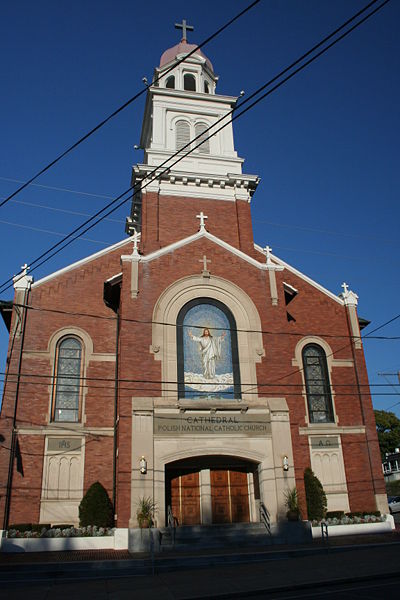
Cathedral of the PNCC in Scranton PA

This text is taken from the website of the Nordic Catholic Church. As some of you might know, the Polish National Catholic Church, based in Scranton PA in the United States is no longer in communion with the Union of Utrecht or the Episcopal Church over the “same old issues” – the ordination of women and same-sex so-called marriages.

For some time, the PNCC seemed to be static like some Orthodox communities and largely closed to contacts outside the Polish-American community. The PNCC, which split away from Rome in the 1900’s, originated amongst Polish miners and that their early history was driven by circumstances and not by calculated strategy or theological reflection. They had to find their identity as the process went on leading them first to Utrecht and then embracing The Road to Unity mentioned in the text below.

The PNCC, in spite of some theological eccentricities along the way, has moved towards a position that is much more similar in some respects to western rite Orthodoxy. Its isolation has given some protection against the aggiornamento in the Roman Catholic Church in the 1960’s and 70’s. They had bad experience with the Episcopalians and now with the Union of Utrecht. With the number of questionable independent bishops in America looking for respectability, it is understandable that the PNCC has not been inclined to take risks. They took some time accepting the Norwegian Lutheran community that became the Nordic Catholic Church and consecrating Fr Roald Flemestad to the Episcopate. Thus the PNCC shows a prophetic sense of generosity and a spirit of solidarity with other Christians who suffered from their Churches as they suffered from the pastoral inflexibility of the Roman Catholic Church in the USA in the 1900’s.

With this acceptance of the Norwegian community, the PNCC instituted a Union of Scranton, effectively in emulation of the old Union of Utrecht, but by rejecting the offending agendas (women’s ordination and same-sex marriages).

Bishop Flemestad will be spending time in Germany (Munich) at the end of this month, establishing a pioneer parish for the Nordic Catholic Church. Some of the German Old Catholic parishes have left the Union of Utrecht for the “usual” reasons and seek a more orthodox expression of Old Catholicism.

* * *

The Nordic Catholic Church was established in Norway in 2000 under the auspices of the Polish National Catholic Church (PNCC). Today the Nordic Catholic Church is led by Bishop Roald Nikolai Flemestad as a member Church of the Union of Scranton.

The following is taken from the preamble of the Statutes of the Union of Scranton:

The Union of Scranton is a union of Churches – and their bishops governing them – that is determined to maintain and pass on the Catholic faith, worship, and essential structure of the Undivided Church of the first millennium. The Union of Scranton finds its origins in the development of the Union of Utrecht established on September 24, 1889, in Utrecht, Holland (…) The full communion of the Churches found its expression and was evident in the bishops uniting to form a Bishops’ Conference, which other bishops later joined. Since the Polish National Catholic Church (PNCC) continues to hold the Declaration of Utrecht as a normative document of faith, the development of the Union of Scranton follows a similar design.

The Union of Scranton emerged because certain member Churches of the Union of Utrecht unilaterally began to ordain women to the Priesthood and to bless same-sex unions in opposition to Holy Scripture and the Sacred Tradition of the Undivided Church. Since November 20, 2003 the PNCC is neither in communion, nor affiliated with the Churches of the Union of Utrecht.”

Within the context of the Union of Scranton the Nordic Catholic Church has its orders and has received apostolic succession from the PNCC. Additionally, the theology reflects the doctrinal dialogue between the Chalcedonian Orthodox patriarchates and the Old Catholic churches as agreed in the consensus document Road to Unity from 1989. Thus, like the PNCC, the Nordic Catholic Church adheres to the teachings and praxis of the Undivided Church.

Furthermore, the Nordic Catholic Church emphasises in its Statement of Faith that it adheres to its Scandinavian Lutheran heritage to the extent that it has embraced and transmitted the orthodox and catholic faith of the Undivided Church.

The Nordic Catholic Church has presently five parishes in Norway and a developing community in Stockholm, Sweden. The activities outside Scandinavia take place in cooperation with the PNCC within the framework of the Union of Scranton.

Posted in Uncategorized | Tagged , , , | 2 Comments

The Catholic Movement in German Lutheranism

This essay by the German Lutheran scholar Friedrich Heiler is from a collection I have in my library – Northern Catholicism, centenary studies in the Oxford and parallel movements, edited by N.P. Williams and Charles Harris, London SPCK 1933. This is a particularly fascinating book which I picked up many years ago at Thornton’s in London for a mere £4.

This whole book, with its collection of essays over 550 pages, seeks to compare and contrast the native Northern Catholic tradition in its various forms and Counter-Reformation Roman Catholicism. I like the geographical “Nordic” designations given to the British Isles, Scandinavia, Holland and North Germany. I would also include the north of France, Normandy in particular. This book was collated at a time when the Nazis were ranting and raving about German racial superiority, burning books and killing people – but the author of the Foreword dismisses such an idea. We northerners are not better than Latins or Slavs – but different.

What really determines the “northern” type of Catholicism seems to be its attitude towards authority and relative freedom from the survivals of pagan folk religion. We cannot afford to be too schematic in this, but we have a certain guide.

I will be dipping into Northern Catholicism quite a lot to set the spirit of this new blog.

Lutheranism, as with many branches of European Protestantism in the early twentieth century, lived through a movement not dissimilar to Anglicanism a few decades before. The Lutheran Catholic movement promotes liturgical practices and doctrines that bear some similarity to those found in both Roman Catholicism and Anglo-Catholicism. Lutheranism in the Nordic countries like Sweden, Finland and Estonia were much less influenced by the Reformation than in some other countries.

Lutheranism does not have the “high church” and “low church” of Anglicanism or the way of “comprehensiveness”, because they were always united by the doctrine expressed in the Book of Concord. However there were Calvinistic and Pietist tendencies in Lutheran history. Rationalism led to the neglect of liturgy, ceremonies, vestments or even the regular celebration of the Eucharist. Unlike the English Reformation, Lutherans were much less iconoclastic and most pre-Reformation churches have been remarkably preserved.

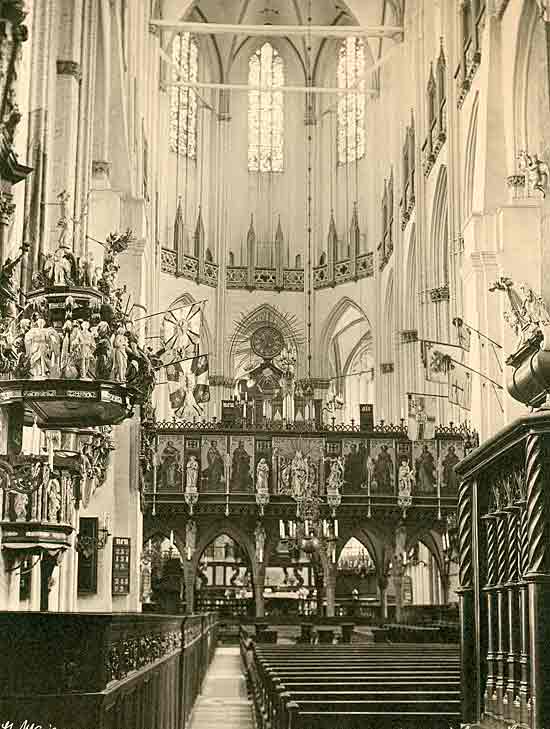
Marienkirche in Lübeck before the war

* * *

THE   CATHOLIC   MOVEMENT   IN GERMAN   LUTHERANISM1

By Friedrich Heiler

In the eyes of many, the Anglican Church is the only one of the Reformed Churches which has retained Catholicity in essential points, and, after passing through a period of decadence, has triumphantly restored it through the great Oxford Movement. The peculiar line of development taken in the course of the centuries by German Protestantism deprives many observers of any glimpse of the vigorous catholicity which was a mark of Lutheranism in its original form. It was not Luther’s idea to set over against the ancient Catholic Church a new Protestant creation; he desired nothing more than that the old Church should experience an evangelical awakening and renewal, and that the gospel of the sovereign Grace of God should take its place as the centre of Christian preaching and piety. Luther and his friends wished, as they were never tired of emphasising, to be and to remain Catholic. For this very reason, the champions of the religion of the Gospel at the Diet of Augsburg in 1530 were constrained to make an attempt to restore the broken union with the Roman Catholic Church. The credal statement drawn up by Melanchthon, which was submitted at Augsburg to the Holy Roman Emperor, and is known as the Confession of Augsburg (Augustana), is an eirenicon intended to serve as an instrument of reunion. The Protestant princes and cities therein set out a statement that the Protestant doctrine of Justification “stands in no single point in contradiction, either to Holy Scripture, or to the Catholic Church and the Roman Church, so far as can be ascertained from [official] theological teaching.” “Our Churches,” they say, “depart in no single Article of Faith from the Church Catholic: they lay aside only a few abuses which are innovations, and have been introduced at a later period of aberration in contravention of the Church’s Canons.” “Nothing with us in matters of doctrine and ceremony has been brought in which offends against Holy Scripture or the Church Catholic.” In a letter handed in by Melanchthon to the Papal Legate, Cardinal Campeggio, after the submission of the Confession, he goes even further and writes as follows: “We have no dogmatic teaching which differs from that of the Roman Church: … we are prepared to obey the Roman Church if only, with that kindness which she has consistently shown to each and every people, she will withdraw a few points or lighten their burden. . . . Furthermore, we acknowledge with the deepest respect the authority of the Pope of Rome and of the whole ecclesiastical constitution, provided that the Pope does not reject us. This loyalty to Christ and the Church of Rome we will maintain unto our last breath.” The wish and desire of the Confessors of Augsburg “that the schism may come to an end, and a true and united Religion be restored,” were not destined to be fulfilled. The projects of Reunion came to nothing, chiefly because the Roman Church doubted the sincerity of the wishes in that direction expressed by the Lutheran theologians and princes. The separation between Lutheranism and Rome became fixed and final. But the remarkable fact is, that in spite of the finality of the schism, the very project of union which contained the great confession of Catholicity became the credal groundwork of Lutheranism, defining its normative dogmatic position. It was to the Confession of Augsburg, which Melanchthon in his Apologia calls “pia et catholica confessio,” that the Lutheran pastors and theologians were required to pledge their faith; and even to-day this Confession finds a place in the ordination vows of many German Churches.2

In accordance with the principles of the Augustana, Lutheranism retained in dogma, in constitution, and in worship, its connection with the old Church. The “ecumenical Creeds,” that is the Apostles’ Creed, the Creed of Nicsea, and the Athanasian Creed, retained their place as normative. Episcopacy was preserved in all the northern Churches, in Sweden, Norway, Denmark, Iceland, and Finland. In Sweden and in Finland the apostolic succession through bishops was continued. It was lost in Finland only a few decades ago. In the matter of liturgy, the old forms were purged of only a few “unevangelical” elements. The normal Lutheran Communion Service is nothing but a reformed Roman Mass. Matins and Vespers of the Roman Daily Office continued in use in like manner. Private confession and absolution remained in use in the Lutheran Church until well into the eighteenth century. Vestments, such as the alb and the chasuble, the use of incense, the sign of the cross, the singing of Latin anthems and hymns were to be found in the German Lutheran Churches up to within that same century also. In contrast to what happened in Calvinist and Zwinglian lands, mediaeval churches were not despoiled of their pictures by the Lutherans, but were preserved in all their richness and beauty. Even tabernacles were retained, though no longer put to any use. The schools of Lutheran theology took care to emphasise the Catholic character of Lutheran teaching. Johann Gerhard expressly entitled his Defence of Lutheranism a “Confessio Catholica.” Molanus and the philosopher Leibniz vigorously championed the principle of Tradition, and laboured for restoration of union with the Church of Rome. Thus the Lutheranism of the seventeenth century was marked by a strong impulse towards Catholicism.

It was in the eighteenth century that the great change in Lutheranism took place, especially in Germany, the land of its birth. Consciousness of any connection with the Church Catholic faded : the rationalism of the Enlightenment (Aufklärung) became supreme in theology, in worship, and in the spiritual life. In the Churches of Germany many a pre-Reformation usage in divine worship died out, or else, as in Prussia, was forcibly suppressed. The fusion of Lutheranism with the system of the “Reformed” Church in the so-called “Union” in Prussia accelerated the process of de-catholicisation. In the nineteenth century, however, a powerful reaction against the Protestant Christianity of the Enlightenment took place. About the same time when in England the Oxford Movement began to breathe new life into the Anglican Church, there began in Germany a re-birth of Lutheranism. The jurist F. J. Stahl, who led the protest against the Prussian “Union”; the Hessian theologian A. F. C. Vilmar; W. Lohe, the great pastor and liturgiologist; Wackernagel, the hymn-writer; the liturgiologists Kliefoth and Schoberlein; and lastly Rocholl, the champion of the Lutheran Free Church of Prussia—these were the Lutheran personalities who endeavoured to restore to currency and esteem in the life and thought of German Lutheranism the Catholic fundamentals of the Confession of Augsburg. Their efforts did not indeed win results equal to those achieved by the Anglo-Catholic leaders, such as Keble and Hurrell Froude, Pusey and Newman. The ever-growing “Liberalism” in theology, the individualistic and pietistic form taken by the spiritual life of simple bible-loving Christians, together with the ever-increasing bitterness of the conflict between Protestantism and the Roman Church—these were the principal causes which prevented the leavening of the whole of German Protestantism through this “neo-Lutheran” Movement.

The end of the Great War was followed by a fresh movement towards the Catholicity proclaimed in the Confession of Augsburg. In the year 1917, the Jubilee year of the Reformation, Pastor Lowentraut of Lausitz published a new eirenicon under the title ” One Holy Catholic (allgemeine) Church,”in which he showed that between the teaching of Lutheranism in its classical form, and official Roman Catholic dogma, no essential difference was to be discerned. This work was ordered to be suppressed by the ecclesiastical authorities of Berlin— a modern Protestant auto-da-fe! In the same year Pastor Hansen of Schleswig set forth 95 theses, modelled on the 95 theses of Luther, wherein in outspoken terms he criticised with the utmost severity the declension of faith and life in German Protestantism, and preached a penitential return to the Church Catholic; but, in contrast to Lowentraut, he drew a clear distinction between “Catholic” and “Roman.”3 These theses provided the occasion for the foundation of the “High Church Union” (Hochkirchliche Vereinigung) which became the vehicle of the Evangelical-catholic Movement in Germany, and found its organ of publicity in the periodical Die Hochkirche, begun in 1919.4 This Union demanded the restoration of episcopacy on the basis of the apostolical succession; the celebration of the Holy Supper as the central act of Divine Worship; the revival of private confession; richer and more beautiful liturgical forms; and lastly, the foundation of religious brotherhoods. In 1924 the Movement divided into a denominational Church group which championed a more sectarian type of Lutheranism, and an oecumenical group which set itself to establish relations with Catholic Christians (Orthodox, Anglican, and Roman) and had its organ in the periodical Una Sancta. After this journal had been banned by the Roman Church, it took a new form and a new name, Religious Thought (Religiose Besinnung) 5 In this form it remains to-day an organ for mutual discussion between Protestant and Roman Catholic Christians in Germany.

After the reunion of the two groups in 1927, the High Church Movement exhibited new forms of activity. Until this date its programme had dealt almost entirely with matters of theoretical interest only, but now, with greater boldness, it began to undertake practical schemes as well. The Eucharist began to be celebrated in the rich forms of the Catholic rite; retreats were held; the practice of private confession grew; a breviary for the Daily “Hours” (Stundengebet) was published.6 Out of the bosom of the High Church Union arose an Order on Franciscan lines, the Brotherhood of the Evangelical Franciscan Tertiaries. This Order set forth the Franciscan ideal in the spirit of Evangelical Christianity.7 The most important creation of the High Church Movement is the Evangelical Catholic Eucharistic Society, founded in 1930 as a religious fraternity or brotherhood for Germany and Switzerland. Although its operations are confined to German Protestant local Churches, and its members are priests, theologians, and pastors of those local Churches, nevertheless, it accepts Catholic dogrn^. practises Catholic worship, and possesses the Catholic system of ecclesiastical order. The seven Catholic Sacraments are dispensed, the Eucharist in the Catholic sense and with Catholic belief in its nature is regularly celebrated with an elaborate eucharistic liturgy.8 Reservation of the Sacred Species is practised, and venerable Catholic rites, such as those of Holy Week, are in use. Entry into this brotherhood is accomplished by the reception of Confirmation at the hands of a Bishop. This Sacrament is administered by laying on of hands accompanied by anointing with Holy Chrism. The brotherhood dispenses all the old traditional Orders of the Ministry (the minor orders, the sub-diaconate, the diaconate, the priesthood, and the episcopate). Apostolical succession was received from the Galilean Church of the south of France, a Church which, though strictly Catholic, is independent of Rome, and whose Episcopate goes back to the Syrian Jacobite Church of Antioch, and is therefore reckoned valid even by Roman theologians.9

With these High Church practices, the Movement combines a deep devotion towards Lutheranism. It uses in divine worship Luther’s translation of the Bible, and the German Protestant hymns. Luther and the works of Lutheran theologians are eagerly read and used. All the prayers which are taken from the Roman or other ancient Western Liturgies are subjected, so far as is necessary, to adjustment in order to bring them into harmony with the Evangelical doctrine of Grace. For what the High Church Movement seeks is no mere outward and capricious blending of Catholic and Protestant usages and traditions, but an inner synthesis between Catholic dogma and worship and the Protestant faith in Justification and Grace, as these were preached by the Reformers, and above all by Martin Luther. For an “Evangelical Catholic” the terms “Catholic” and “Evangelical” are not contradictions, but blend harmoniously together. The “comprehensiveness” which is the very essence of Catholicity, the effort to achieve completeness, and the fullness and variety which are characteristic of catholic devotion, must be combined with concentration upon the one thing needful, viz. the will for purity and sincerity which it is the aim of Evangelical preaching to evoke.

What the High Church Movement in its new form seeks to bring about is nothing else than what the Confessors of Augsburg in 1530 had in mind when they were vis-d-vis the Church of Rome.10 Of course the Movement seeks union not only with Rome, but also with the entire Catholic Church, above all with Rome’s elder Eastern sister, and with the Catholic Churches of the West separated from Rome. The Movement works for close relationship with the Orthodox Church of the East, with which it knows that on all dogmatic points it is at one. It works also for relations with Anglo-Catholic circles, and with High Church and oecumenical groups in the Protestant Churches of Europe ; for the High Church Movement in no way limits itself to German Lutheranism, but embraces Lutheranism all over Europe and, indeed, European Calvinism likewise. It is most interesting to observe how similar Movements are to be found in the Lutheran Churches of Scandinavian and Baltic lands, in Iceland, and in Finland. They are found also in German-speaking and French-speaking Switzerland among adherents of the Reformed (Calvinistic) Church ; among French Huguenots ; in Calvinistic Holland ; and in the Italian Waldensian Church to which the influence of Calvinism extends. In all these countries there are eminent and zealous champions of the Catholic Movement. Thus, in Latvia there is Bishop Irbe, who was consecrated by Archbishop Soderblom, and has now retired. In Sweden there are the Pastors Lysander and Erlandson, also Pastor Berggren who is the leader of a Brotherhood called the “Societas S. Brigittae.” In Denmark there is Pastor Waldemar Brenk;   in Norway the late Pastor Hertzberg; in France Professor Wilfred Monod, the founder of the Franciscan Brotherhood of the ” Veilleurs”; in Holland Pastor Oberman and Professor van der Leeuw; in Italy Pastor Ugo Janni, editor of the periodical Fede e Vita; in the west of Switzerland Pastor Paquier; in the east Pastor G. A. Glinz. Then again there is the “Berneuchen” Movement in Protestant Germany—so called from the place where its first meeting was held. This, in spite of the radical Protestantism of its starting-point, has grown steadily nearer to the High Church Movement.11 The opinion expressed years ago by Friedrich von Hiigel, namely, that in the most refined minds of Protestantism a renaissance of the Catholic principle was imminent, is truer than ever to-day. A new spirit, Catholic and (Ecumenical, is spreading through the world—a spirit essentially one, however varied in the different countries may be the forms in which it manifests itself.

Of course in every country militant Protestantism stands with sword drawn against any Catholic awakening. This war is waged most fiercely in Germany against the High Church Movement. We have here to speak of systematic attacks, less from the side of the Protestant Church authorities —which are in no position to take penal action against High Church clergymen, since they also acquiesce in the continued ministrations of pastors who deny the Godhead of Christ—than from the side of the “Evangelische Bund” as it is called, a militant Protestant organisation which is always at war with the Roman Church, and which now includes in its objects strong antagonism to the High Church Movement. More dangerous and more widely spread than this open warfare is quiet but systematic opposition. Generally speaking, a champion of High Church or Catholic ideas to-day is proscribed in German Protestantism: in the most favourable circumstances he will be regarded as a foolish enthusiast; not seldom, however, as a cunning emissary of Rome and as a dangerous enemy of Evangelical Christianity. Even the majority of the German adherents of the (Ecumenical “Life and Work” and “Faith and Order” Movements take up a negative attitude towards the High Church Movement. A very high degree of love of truth and of the spirit of sacrifice is therefore demanded from anyone who in Germany would openly profess High Church and Evangelical Catholic opinions. What gives us constant comfort and hope amid all opposition is the example of the Catholic Movement in England, which likewise decade after decade has had to go through the fire of opposition and affliction.

However, all the opposition which arises from narrowness of mind, ignorance, and often quite irreligious motives in addition, will not be able to stay the Catholic Movement. And it is just this very German Protestantism, in which to-day the enmity against all that is Catholic is so strong, which must be the future theatre of the Movement for Christian Reunion. More than seventy years ago the High Church Lutheran jurist Stahl wrote as follows: “Among the German people the schism in the Churches started, in that people and there alone lie the seeds of Reunion, if only they remain true to the spirit of their own, their German Reformation.” And no less a person than Archbishop Soderblom expressed his agreement with this utterance when he wrote to the Jesuit Pribilla: “More than once I have expressed my conviction that if in fact a union (with the Church of Rome) ever takes place, it will come about in G&rmany.” It is that hope to which the great High Church German theologian of the nineteenth century, A. F. C. Vilmar, gave expression in solemn words when he said : “The time is coming when it will no longer be as a pious but distant hope, but as a present blessed fact, that we can say ‘there is One Shepherd and one flock,’ bound close and fast together in one mind and one faith and one hymn of praise in an outward as well as an inward communion on this earth and in this present life.”

___________

1. Translated by W. R. V. Brade.

2. See, further, Confessio Augustana, special number of the Die Hochkirche, published on the occasion of the 400th anniversary of the Confession of Augsburg.    Ernst Reinhardt, Munich, 1930.

3. New edition, Munich, 1930. Ernst Reinhardt. “Stimuli et Clavi, i.e. Theses adversus huius temporis errores et abusus, quas publice sive disputando sive scribendo defendet H. Hansenius.” From these theses the following may be quoted:
2.  Protestantismus qui dicitur non habet causam jubilandi, sed poenitentiam agendi in cilicio et cinere.
3.  Motus ille reformatorius, qui initium coepit anno 1517, multa quidem bona, sed plura mala commovit, vel, ut ita dicam, unum expulit diabolum, septem nequiores admisit.
4.  Reformatio quae dicitur iure meritoque deformatio est dicenda, quia, quae enixe et bona fide expetebat, parum assecuta est.
5.  Ecclesia tunc reformanda prave vel non sine vitiis reformata est.
10. Coetus protestantium catholicitatis obliti a fide verae ecclesiae abducti sunt.
13.  Protestantism! nunc haec est indoles: massa perditionis et singuli fideles vel singuli coetus fidelium; infidelitas percrebescens et parvus grex credentium; mors communis omnium et scintillulae vitae in paucis.
14.  Protestantismus ut denuo valeat auctoritate aliqua in re publica, pristinae suae meminerit catholicitatis.

4. Since 1930 edited by the present writer; published by Ernst Reinhardt, Munich.

5.  Now edited by Professor K. Thieme; published by Frommann, Stuttgart.

6.  O. J. Mehl’s work Continue instant in Prayer (Haltet an am Gebet), an Evangelical Breviary. Two vols. Grimmen in Vorpommern, 1930. This work appeared as a private issue by the author. The authorised Breviary of the High Church Union bears the title Evangelical-Catholic Breviary (Evangelisch-katholisches Brevier). The First Part appeared in 1932 as a special issue of Die Hochkirche (Ernst Reinhardt, Munich).

7.  See further Heiler, Im Ringen um die Kirche (E. Reinhardt, Munich, 1931, p. 517 et seq.

8. See further in Hochkirche, 1931, pp. log et seq., 1932, pp. 162 et seq. The Evangelical Catholic Celebration of the Holy Eucharist appeared in Munich 1931, published by Ernest Reinhardt.

9. See further Hochkirche, 1931, pp. 285 et seq.

10. For statement and programme of the theological groundwork see Heiler, Im Ringen urn die Kirche, published by E. Reinhardt, Munich, 1931.

11. See further Hochkirche, 1930, pp. 116 et seq., 1932, pp. 77 et seq.

Posted in Uncategorized | Tagged | 6 Comments

Erasmus and the Bible

In response to the call of this  new blog to articles on “northern Catholicism” as opposed to scholasticism or later denominational tendencies, I received this paper on Erasmus and the Bible from its author, Luke DeWeese. I have stored the pdf file on my website server, and it can be accessed here:

Knowledge of the Scriptures is largely due to the Renaissance and Humanism. In this article, we will discover the medieval tradition of reading the Scriptures and the enormous contribution brought by Erasmus. The vital dimension of biblical exegesis is being able to read the languages of the Bible – Hebrew and Greek. Any translator knows that translating is betraying – traductore traditore. No translation is ever perfect.

Erasmus was aware that knowledge of the Bible would bring far-reaching changes to the Church by a renewal of biblical theology, based on philological study of the New Testament text, and supported by a knowledge of patristics, itself renewed by the same methods. He believed that European society could be transformed by making the texts of Scripture available to every literate person. But that requires vernacular Bibles – and the quality of the translation depends on very profound knowledge of the exegetical tradition, the languages themselves and the whole theological dimension.

Read the paper and please encourage Mr DeWeese with your comments.

Posted in Uncategorized | Tagged , | 2 Comments

Invitation

My first post on this new blog is an invitation to readers, and members of the Use of Sarum group in particular, to contribute articles on the Use of Sarum and “northern Catholicism” in general (as distinct from post-Tridentine Roman Catholicism, scholasticism and anti-Protestant polemics).

I also invite my senior list members to consider becoming contributors with posting rights. Keep it highbrow, but not too inaccessible!

Articles on the liturgy, theology, Christian culture and much more would be most welcome, and it is my hope that this new approach will stimulate fruitful discussions in the comboxes and as little as possible of interest to so-called “trolls”.

Articles may be sent to me at anthony DOT chadwick AT wanadoo DOT fr.

Whatever, I extend to you all a warm welcome.

Posted in Uncategorized | Tagged | 4 Comments