The Philosopher King

I am so disenchanted with modern left / right political disputes and even the idea that English and European culture can be saved by reversing the policies of mass immigration, especially of Muslims. I am not going to discuss the question, but I am aware that some are accusing King Charles III of having converted to Islam and promoted a conspiracy to destroy western culture and civilisation in favour of the richest oligarchs of this planet.

I have been shaken by the lack of culture and religion of many of our contemporaries that I wonder if it might not teach them a lesson to find themselves under a regime like Iraq with the Ayatollah or Afghanistan under the Taliban ! No, I would not seriously entertain such an idea, but divine truth and love are found beyond the exoteric religion of institutional churches, synagogues, mosques, temples or whatever. Exoteric religion is vital because we are incarnate, but we need to search for our inner and immanent divinity which is at the same time transcendent. This is not syncretism or “New Age” but a concern that political religion alone will not solve the problems in the modern world.

King Charles III is often been accused of supporting “woke” and left-wing agendas like the environment and being involved in the World Economic Forum’s Great Reset. In 1994, he suggested that when he became King, he would use the title of Defender of Faiths rather than Defender of the Faith. He was open to other faiths, especially Islam, and this caused many to accuse him of promoting secularism or syncretism, renouncing the claim of Christianity to be the one true faith. The truth is not so simple.

Charles may well be our modern-day philosopher king in the Platonic meaning of this idea. He has supported the school of thought called Perennialism holding a universal truth which is more or less present in all traditional religions. His Majesty is the patron of the Temenos Academy, dedicated to studying Perennialism. How about the idea that he not trying to secularise and destroy spiritual tradition, but to give it new life ?

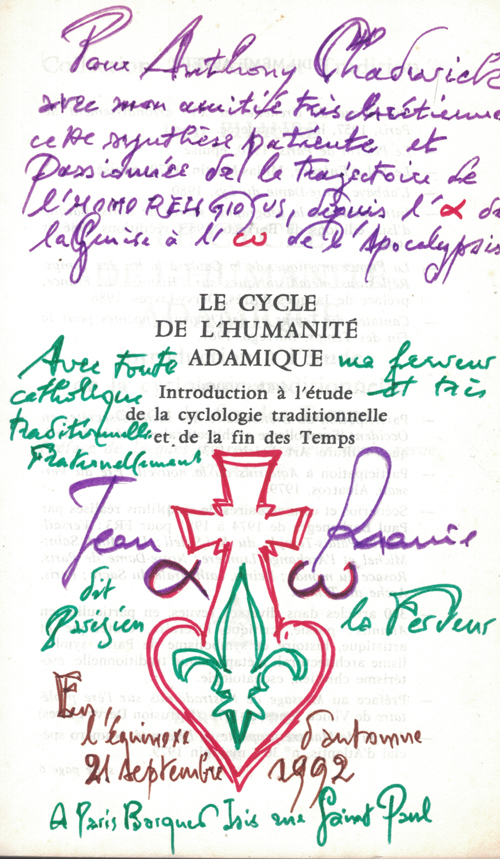
I am sensitive to this subject, because I discovered a different dimension of Christianity when I was at university in Switzerland. I participated in a church history seminar on Liberalism in which the name of Félicité de Lamennais was emphasised, a view of religion and the secular state that was condemned by Gregory XVI in his encyclical Mirari Vos of 1832. Like Modernism in the 1890’s and 1900’s, the word came to describe a very wide and imprecise worldview, notably promoting ideas like the separation of Church and State and a more open theological view than Thomism. My acquiring and reading Bernard Reardon’s Religion in the Age of Romanticism (Cambridge 1985) opened a completely new view of what Catholicism meant to me. I discovered German Idealism as an alternative view of epistemology and truth as a transcendent to which the soul yearns rather than pretends to possess. Many years later, I discovered Novalis, the young man who died of TB in 1801 having lived in the Saxony part of what is now Germany. In the early 1990’s when I was still a seminarian at Gricigliano, I was introduced to an amazing man living in Paris. His name was Jean Phaure. He had been born in French Vietnam. He wrote the book Le Cycle de l’Humanité Adamique, introduction à l’étude de la cyclologie traditionnelle et de la fin du temps. He wrote many other books too. It was a great privilege to meet him and to be invited to eat Vietnamese meals as he revealed to me a whole new world. When I discovered Novalis, this pen name rang with me – we walk new paths in fidelity to the great Tradition. My love of Romanticism suddenly converged with my discovery of Perennial Traditionalism, something much deeper than simple conservatism of nineteenth and early twentieth century authoritarian Catholicism. Another author who entered my world was René Guénon.
He with Frithjof Schuon and Ananda Coomaraswamy introduced a whole new volume to the history of Romanticism reacting against materialism and the extreme rationalism of the eighteenth century. To this day, I have Guénon’s La Crise du Monde Moderne, Le Règne de la Quantité et les signes des temps (just cast your mind to Berdyaev’s The End of our Time). There is also Orient et Occident, a theme described by Vladimir Soloviev that touched the young Fribourg student to the core. I have been wary of Guénon because of his conversion to Islam, even though it was the spiritual and mystical “branch”. However, I believe that our being able to relate to Christianity can be enhanced by exposure to Sufism and Hinduism in their most subtle expressions.

Charles has expressed particular sympathy with Perennial Traditionalism. He has himself mentioned the concept of the Reign of Quantity, lamenting a world that no longer years for God. I too have been brought to a love of the sea and a concern about the amount of plastic trash finding its way there. Like Berdyaev, Guénon spoke of art and creativity as a vehicle of transcendence. Everything is converging. The Romantics loved nature and it was a part of our human inspiration. As Wordsworth wrote during his days in the Lake District, where I spent my childhood climbing the fells with my family and our inexhaustible dogs :

I wandered lonely as a cloud
That floats on high o’er vales and hills,
When all at once I saw a crowd,
A host, of golden daffodils;
Beside the lake, beneath the trees,
Fluttering and dancing in the breeze.

Continuous as the stars that shine
And twinkle on the milky way,
They stretched in never-ending line
Along the margin of a bay:
Ten thousand saw I at a glance,
Tossing their heads in sprightly dance.

The waves beside them danced; but they
Out-did the sparkling waves in glee:
A poet could not but be gay,
In such a jocund company:
I gazed—and gazed—but little thought
What wealth the show to me had brought:

For oft, when on my couch I lie
In vacant or in pensive mood,
They flash upon that inward eye
Which is the bliss of solitude;
And then my heart with pleasure fills,
And dances with the daffodils.

Guénon brought King Charles closer to mystical Islam, where I still feel fear and recoiling. There are aspects of Islam that are forgotten in Christianity. The Quran was heavily influenced by Syrian Christianity and the polemics over Arian, Nestorian, and Monophysite Christology that tormented Christianity in these centuries. Charles believes it possible and desirable to find light in the traditions of other religions, because the same universal truth resides in them all. Would Charles like to see all religions merge together as in the view of syncretism ? His conservative critics would see a desire for a one world religion in the hands of a real-life Blofeld and SPECTRE ! This theme has emerged in the writings of dystopian novelists.

However, Perennialists, like the Romantics and Idealists before them, were highly critical of syncretism. Guénon was just as sharply critical of New Age, Theosophy and the other various groups from the late nineteenth century. I think that we can be assured that our King has no idea of rejecting Christianity and replacing it with Islam. He manifestly desires to enrich Christianity and bring life back to it after centuries of moralism, institutional hypocrisy and authoritarian overreach.

Perennialism has the ability to recognise truth, beauty and goodness in the various faiths present in Britain – at the same time as maintaining absolute truth. Others might go down the “woke” rabbit hole of inclusivity, he avoids relativism and any temptation to abandon the sacred. He might well save pre-modernity and tradition. Reading various articles and ideas about King Charles in this light of Perennialism, I am left with optimism for the future and faith in the spiritual nature of the Monarchy.

Posted in Uncategorized | Tagged , , , , , | 2 Comments

Returning to Writing

It is a long time since I last wrote on my blog. Perhaps it is a case of writer’s block or any one of those spiritual / psychological conditions that cause us to lose interest in things as our world becomes increasingly uncertain. We are subjected to a barrage of propaganda, essentially dualist in the extreme. I am not the only one to have noticed the same degree of popular discontent and politicians seemingly not caring or even in league with some kind of political and financial elite. I approach the whole situation as a sceptic. Aristotle’s Law of Non-Contradiction can indicate one contrary proposition as being true and the other false, or both being false.

I write this from the cabin of my little boat Novalis, still on her trailer and waiting for high tide to be launched here at La Rochelle. The weather is still unpleasant, but should improve this weekend before a new Atlantic depression next week. Our little flotilla of the Dinghy Cruising Association will certainly shelter in a port on the Ile de Ré when it strikes with heavy wind and rain.

Reading books when we have become used to electronic screens takes self-discipline. I have adopted the way of reading a light novel and a serious book, presently Aldous Huxley’s The Perennial Philosophy. This work seems to stick with Christianity and avoid some of the excesses of René Guénon and others of the early twentieth century. I am reminded of the calm prayerful and academic approach of Louis-Claude de Saint-Martin contrasted with the noisy initiatic rituals of some groups named after him. I come up with nothing new given what I have written in the past, and which you can find on this blog.

It takes a lot of effort to avoid getting caught up in the “fear porn” of the media. If someone wants to control us, the most effective way to do it is through fear. A Christian does not fear his own death.

Man that is born of a woman, hath but a short time to live, and is full of misery. He cometh up, and is cut down, like a flower; he fleeth as it were a shadow.

I retired this year from my translating business. I would have preferred to continue for another year, but I was getting no more work from my client agents. I have noticed the increasing quality of AI translation and that I was making fewer and fewer corrections to produce a “human quality” translation. So, I am now a pensioner. That word rings in association with the idea of having become a “useless” human being, worthy only of death to conserve resources for the young and healthy. Fortunately, most people judge humanity from its respect for its senior citizens and the dead.

I need to write, since it is the only way I can exercise a priestly ministry. The institutional Church I belong to is completely irrelevant in the country in which I live. France, the UK, many other countries are consumed with boredom and nihilism. I wrote about Georges Bernanos some time ago in Georges Bernanos and Boredom. People who get bored are usually of the personality profile that seeks to nourish its ego from the energy of others, rather than seek the Transcendent and Immanent God within. It is what I see with many of the “patriots” who target an alien culture seeking to replace them. What is being replaced ? This is one of the most important questions we have to ask ourselves. If we fail to get to what is most interior and rich in meaning, the rest, the exterior, will become more and more irrelevant. This is the drama of modern Christianity. If we try to “make it relevant”, it’s irrelevance will become more and more boring.

Our western culture seems to succumb to thuggery and organised crime, both from abroad and our own countries. Evil comes from within, as we are manipulated by demons, archons and narcissistic humans. It also comes from within ourselves in the form of aggression, fear – – and boredom.

I hope and pray that each of my readers will work out his own way back to God, truth, beauty, goodness, music, nobility of spirit.

Posted in Uncategorized | Tagged , , , | 10 Comments

Habemus Papam – 2005

I republish some blog postings I wrote about the election of Benedict XVI in 2005, now twenty years ago. I had not yet joined the Traditional Anglican Communion and I was quite disenchanted by the various options around me. I had spent a few days with an independent priest by the name of Bernard Duvert and the idea of joining an oriental church was studied. With me without any experience of the oriental rites! I was in a state of suspense, and I tried to see signs of hope and optimism. One such was Pope Benedict XVI.

Twenty years of history have unrolled between my reflections and these early days of Pope Leo XIV. We hope and try to see the bright side. Hope is a virtue with faith and charity.

5th April 2005 – Sede Vacante Continue reading

Posted in Uncategorized | Tagged , | Leave a comment

Other Christianities, far away

Having entertained a friend of mine for a few days, this person has left many things in my mind to reflect. He is a priest under Bishop Alistair Bate who extends his ministry over many different kinds of liberal and independent Catholicism. I consider my own situation of being in the Anglican Catholic Church (Original Province) which can seem almost “mainstream” in the English-speaking countries. I live in France, where the word Anglicanism is understood as Protestantism without any consideration of the high-church and Oxford movements in history in the Church of England. I am also friends with a priest who served many years ago in the ACC, who returned to the Church of England and is about to retire having reached the canonical age. His view of the future of Christianity seems, frankly, quite nihilist. What can I say?

Continue reading

Posted in Uncategorized | Tagged , | Leave a comment

The Nietzschean Christian Übermensch

I stumbled across a video and an article about a French diocesan bishop expressing his views of traditionalist Catholics and a need to keep a close watch over those who celebrate and follow the old Latin liturgy.

Mgr Jordy: l’ignorance et le mépris in Renaissance Catholique, and this video: Un Evêque contre les Tradis.

Continue reading

Posted in Uncategorized | Tagged , , , , | 2 Comments

Mature Christianity

I have had to reflect about the relevance of churches, not only the big institutions like the Roman Catholic Church, the Church of England and the Anglican Communion, and the various national Orthodox churches – but also the various traditionalist churches born of frustration with the “official” institutions.

Continue reading

Posted in Uncategorized | Tagged , , | 4 Comments

Another Christianity, Another Humanity

I have read articles and watched YouTube videos (I do not have a television) about the issues and the floods of executive orders coming from the President’s desk. We have notably the burning issues of illegal immigration, insecurity, “woke” ideology combining elements of cultural Marxism and anti-racism, green ideologies involving “Net Zero”, etc. I can understand this euphoria, but quite quickly took a step back to consider the possibility that if something is too “good” to be true, it is not true. The “woke” left will not give us utopia, but something like an Orwellian dystopia if allowed to go to its logical conclusion. Would the opposite extreme be any better? I have my doubts.

Continue reading

Posted in Uncategorized | Tagged , , , , , | 7 Comments

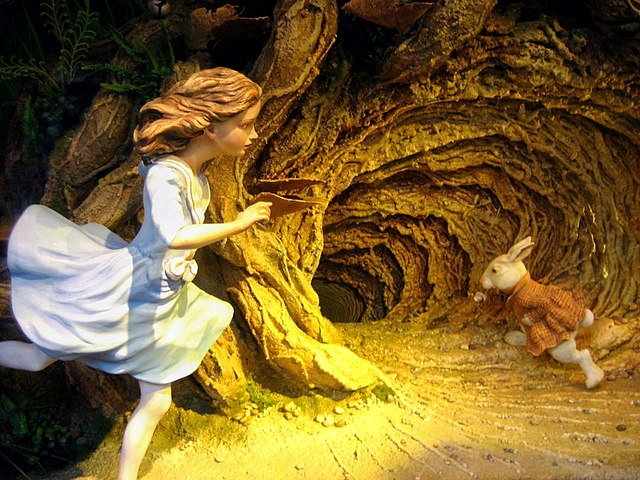
Rabbit Holes

rabbit hole - Wiktionary, the free dictionary

I have been very quiet as of late in the current controversies surrounding the inauguration of Donald Trump, Europe, the UK, Net Zero, electric cars, China and Russia, Islam, terrorists and grooming gangs, the Church and Pope Francis, American “woke” bishops and the list never ends. I spend far too much time on YouTube, even though I can generally spot “click bait” or a video intending to provoke emotions and anger. There are psychological studies about conspiracy theories, and a little self-criticism will reveal that I have allowed myself to be influenced more than I would like to admit.

Continue reading

Posted in Uncategorized | Tagged , , , | 1 Comment

The First Signs of Freedom: William Morris’s Romantic medievalism and the Oxford Movement.

Dr Timothy Graham is a medical doctor specialising in Gastroenterology at St George’s Hospital in London. He obtained an MPhil in Philosophy in 2011 with a dissertation on the thought of Austin Farrer from Queen’s University Belfast where he had previously completed his medical training. He is a deacon in the Ordinariate of Our Lady of Walsingham, lives in Surrey with his charming Italian wife and a young family of eight children, and keeps up his interests in Scripture, Romantic philosophy and books generally when he has the time.

He is a personal friend of mine, and he originally wrote this article in 2018 for a *.pdf review that I did not continue beyond its first edition. He has authorised me to publish it in this blog. He and I are convinced that without Romanticism, from its roots in Germany to France and Britain, Christianity would have faded away in the nineteenth century, superseded by scientific materialism.

* * *

The First Signs of Freedom: William Morris’s Romantic medievalism and the Oxford Movement.

Dr Timothy Graham

In his socialist essay Art and Labour (1884) William Morris argues that given the right conditions – a pleasant place to live, education according to capacity, and “unanxious leisure” – men who were masters of their work, who owned their materials, tools and time would produce things of beauty. Instead of producing products or mere parts of products as machine-operating wage-earners for an employer who pockets the profit, a task alienating themselves from their own productions, they would produce useful things rather, for their own enjoyment. Artistry and therefore beauty would penetrate even their simplest productions of everyday things. Morris’s News from Nowhere (1890), a utopia where such a society is realised, is at first disconcerting for the narrator who has wandered into it: “you are not yet used to our life of repose amidst energy”, says the character Ellen, “of work which is pleasure and pleasure which is work.”

Continue reading

Posted in Uncategorized | Tagged , | Leave a comment

The Art of Selfishness

I have just finished reading Andrea Wulf’s book on the Jena Idealists and one of the strongest points of origin of the Romantic worldview.

As she closed the book after a chapter about the wider influence of the Jena Set after the devastating defeat of the Prussians by Bonaparte in 1806, she wrote a final reflection on the art of being selfish. It is a striking use of a word we generally associate with children and adults with some kind of personality problem or are generally devoid of empathy for others. I head this posting with a cartoon of two small brats arguing over the possession of a toy. If an adult, like the boys’ father (assuming they are brothers) or a teacher finds them, one or both will be punished for selfishness and be told that “others come before you”.

I have just found this review of the book Jena Romanticism and the Art of Being Selfish: On Andrea Wulf’s “Magnificent Rebels”. Anthony Curtis Adler finishes his criticism with these two paragraphs:

In the epilogue, Wulf speaks of an “art of being selfish.” It is hard to know what this means if not the art of civil society, the art of being oneself with others — of realizing oneself through concrete relations with others. The Jena Set, to be sure, can teach us something about this, but so can many others who came before — and after. And few of their lessons are simple or easy. Certainly not Novalis’s declaration that “without perfect self-understanding we will never learn truly to understand others.” Wulf, citing this quotation approvingly, addresses her readers in a parabasis: “Let Novalis’s sentence roll in your mind for a moment.” Then she adds, without so much as paragraph break to give it time to roll: “What he meant was that we are morally obliged to turn inwards in order to be good members of society.”

Novalis’s sentence is strange and austere. By making any understanding of the other dependent on a degree of self-understanding that could never be achieved, it shatters the very project of self-understanding. But Novalis also writes, in a passage cited by Heidegger: “The peculiar property of language, namely that language is concerned exclusively with itself — precisely that is known to no one.” If there is one thing we learn first and best from the Jena Romantics, it is that the element of freedom, and hence of political life, is not just bodies and souls and “Ichs,” but language. It is not the art of “being selfish,” but of reading and criticism, of encountering fragments in their potential and becoming. This is the last thing that Magnificent Rebels, with its glib moralizing, emotional ventriloquizing, and cinematic immediacy, could teach.

I did get vague impressions that Wulf was being quite moralising about her perception (if historical) of the behaviour of the Jena Set, particularly their “interior decor, comings and goings, squabbles, and affairs“. My impression was that the gossipy tone was to take us the readers into that far off world of the late eighteenth century in order to get a better appreciation of the philosophical content. I think she wanted to make a point about the originality of what we would call today self-consciousness. This critic, Anthony Curtis Adler, seems quite dismissive of Novalis having anything original to offer, whether in concepts or in language.

The fundamental question, as Europe emerged from centuries of feudalism, was whether human beings were property and chattel, or conscious beings with freedom and rights that came in proportion to moral duties in respect to others. Is not the aristocracy or nobility of spirit the choice of acting and behaving and something that lifts us above greed, hunger and fear of punishment? We have to negotiate within ourselves this freedom and our responsibilities as a member of a community. Do we claim freedom at the expense of the other person’s? These are questions of the social contract and our moral conscience.

As I mentioned above, selfishness is a word now associated with uneducated children or adults with a personality problem. I remember my church history professor at Fribourg teaching us a fundamental principle – that we should not judge the past by the present, that we should not commit anachronisms. The Jena philosophers used the word Ich, German for I or ego in Latin. I have not studied the works of these men personally or searched for a word like Selbstsüchtigkeit. In any case, relatively few of those documents were translated into English, and my German is far from being good enough (New Year resolution?).

In the context of later thought (sorry for the anachronism), I would see a more noble and innocent meaning. In Idealism, we find nature in ourselves, in our own personal experience, and we find ourselves in nature. I have experienced this whilst climbing up mountains in Switzerland or my native Lake District, walking a dog through a forest in springtime or sailing along the cliffs of Brittany. Ralph Waldo Emerson, the author of Self-Reliance, described this time as an age of introversion.

At the end of the same century, Oscar Wilde wrote to Lord Alfred Douglas from prison:

It is tragic how few people ever ‘possess their souls’ before they die. ‘Nothing is more rare in any man,’ says Emerson, ‘than an act of his own.’ It is quite true. Most people are other people. Their thoughts are some one else’s opinions, their lives a mimicry, their passions a quotation. Christ was not merely the supreme individualist, but he was the first individualist in history. People have tried to make him out an ordinary philanthropist, or ranked him as an altruist with the scientific and sentimental. But he was really neither one nor the other. Pity he has, of course, for the poor, for those who are shut up in prisons, for the lowly, for the wretched; but he has far more pity for the rich, for the hard hedonists, for those who waste their freedom in becoming slaves to things, for those who wear soft raiment and live in kings’ houses. Riches and pleasure seemed to him to be really greater tragedies than poverty or sorrow. And as for altruism, who knew better than he that it is vocation not volition that determines us, and that one cannot gather grapes of thorns or figs from thistles?

Indeed what about altruism in a world where others do not care about us. We do good for others because love is better than hate. However, Wilde said:

But while Christ did not say to men, ‘Live for others,’ he pointed out that there was no difference at all between the lives of others and one’s own life. By this means he gave to man an extended, a Titan personality. Since his coming the history of each separate individual is, or can be made, the history of the world. Of course, culture has intensified the personality of man. Art has made us myriad-minded. Those who have the artistic temperament go into exile with Dante and learn how salt is the bread of others, and how steep their stairs; they catch for a moment the serenity and calm of Goethe, and yet know but too well that Baudelaire cried to God — “O Seigneur, donnez moi le force et le courage De contempler mon corps et mon cœur sans dégoût”.

Wilde clearly refers to Emerson and Goethe. Walking the treadmill and eating slops in Reading Gaol was certainly a bitter test against the temptation of resentment and hatred. On his release, Wilde came to France and died in a hotel room in Paris from the illness he had contracted in prison.

From a Christian perspective, it would now be relevant to go into the notion of personalism as distinct from individualism. There is an excellent book by John D. Zizioulas, a Greek Orthodox theologian, who wrote Being as Communion, Studies in Personhood and the Church. By being a member of the communion of the Church, a human being becomes an image of God. The Ich comes by grace and not by nature, which introduces a notion of dualism the Idealists sought to reconcile. Zizioulas opposes the notion of individual from person who has acquired personhood through baptism and membership of the Church. The book is cleverly written, but I react against this prod by the apologist and the inquisitor.

Another work I have is Andrew N. Woznicki’s Karol Wojtyla’s Existential Personalism. The late Pope John Paul II insists more on enchantment and the sense of wonder, something he may have inherited from Idealism and Romanticism (though he was fundamentally a Thomist) and his bitter experience with both Nazism and Communism. Many traditionalist fanatics have accused Wojtyla of wanting to replace the supremacy of God with a “cult of man”, but such an understanding is in my mind unjust and inaccurate.

I recommend Alan Watts, Behold the Spirit, written in 1947. There are some excellent blogs on the internet. Dr Michael Martin – The Center for Sophiological Studies and The Druid Stares Back (not paywalled) and his YouTube channel. There is also Rod Dreher’s Diary, which is paywalled. I am brought to think of medieval cathedral libraries with chained books! Rod Dreher has written Living in Wonder: Finding Mystery and Meaning in a Secular Age. This book is available as a paperback or for Kindle. These works and internet resources help us see the Ich or self in a modern light. Dr Martin has a keen interest in the Jena Idealists and Novalis in particular. These are ways, in my opinion, to becoming a mature Christian.

Posted in Uncategorized | Tagged , , , , | 1 Comment