Modern attempts to revive the Use of Sarum

For the sake of completeness, I published the following article on my old and long-defunct blog on 17th July 2006. Indeed it is a long time that I have been banging the drum, but my philosophical basis has evolved. The article has been on freerepublic.com for all this time, so I copy it here.

In a comment I wrote at the time, I said:

When attempts to restore Sarum (pre-Reformation English rite) were made, it was generally the 19th century and the general mood was Romanticism and nostalgia for the medieval era.

I frankly see little point today of restoring Sarum, because first of all you need a minimum of “culture” around it, and it just won’t wash with modernity or post-modernity, even among “fogeys”. A good question to ask is whether our nostalgics of today would be prepared to go back to medieval penitential discipline and general conditions of life in the 15th century (fanatical inquisitors and all).

You also need the liturgical books and clergy who know the ceremonies. Everything is well documented, and “reconstructions” have been performed in various churches in England and Scotland. It has historical and aesthetic value.

What about the liturgy of the future in an Anglican context, or that of a part of Anglicanism in communion with Rome. I think the Anglican Use is on the right track, but it needs revision to remove the influence of the Novus Ordo – for example the Offertory prayers. The Sarum or Dominican prayers could go in the place of the Novus Ordo formulas. The three-year lectionary is a positive development and is widely used in the TAC to which I belong.

I have always felt that the Tridentine Rite is not really the thing for an Anglican context, and in the Roman Church it did need reform. The problem is that it didn’t get the right kind of reform. The subject is too vast to expound upon here.

The real issue is that Christianity is in a critical situation. There are Christians who need to continue to sustain their faith with traditional liturgies. The Church also has the job of evangelising, and liturgies have little role to play there – not with the kind of people who haven’t discounted belief in Christ, but who would never set foot in a church.

We have this vocation if all Catholic and Orthodox Christianity is not to go the way of Sarum.

My thought about Romanticism was entirely undeveloped and quite typical of what many people think of this subject. I made no distinction between the Christenheit oder Europa of Novalis or the New Middle Age of Berdyaev, and the historical knowledge we have of the period as portrayed by Umberto Eco and others. However, I recognised the need for a cultural context, which is not found in any Church at this time. I was at the time more on the same kind of wavelength as Msgr Andrew Burnham – the use of some Sarum elements in a newly formulated liturgical rite. This was also the opinion of Archbishop Hepworth. Shortly after this time, I resumed the Tridentine rite to which I was accustomed as a Roman Catholic. I took up Sarum in about 2008 once I found the books and learned the ceremonies.

Minds change and evolve over the years. My intuitions were not very different then from the way I think now. In my recent book A Twitch on the Sarum Thread, I recognise that Sarum could not be revived in an ordinary Roman Catholic or Anglican parish. I am unsure about which context would be right. Perhaps we need to be working on the context by gathering intellectually and aesthetically sensitive souls, the remnants of Romanticism and a common mind to rediscover the roots of everything.

* * *

Most of my readers may be familiar with the fact that pre-reformation England had a number of diocesan uses and variations in the liturgy. It was the same in most European countries. The Use of Sarum became increasingly standardised in the early sixteenth century, and the Convocation of Canterbury imposed its use to replace the other uses in 1544. It was replaced by Cranmer’s first Prayer Book in 1549. The Use of Sarum had a great deal in common with the Norman rites, such as those of Rouen and Bayeux, though Sarum kept some of the old Gallican and Celtic prayers not found in northern France.

The Use of Sarum persisted among some of the English recusants as late as the seventeenth century, and it had been printed in Rouen as late as then. The Bull Quo Primum of Pius V, issued in 1570 with the Tridentine Missal, provided for its survival, as for any other rite of more than two hundred years standing. It has been occasionally celebrated in Roman Catholic places of worship, notably in March 2000 by the then-Bishop of Aberdeen, the Rt Rev Mario Conti, as celebrant. It was held at King’s College Chapel, the oldest building of the University of Aberdeen, in celebration of its 500th anniversary. As the Una Voce report on the event put it, Bp. Conti “wore borrowed vestments appropriate to the period and used authentic chants which he said had taken a fair bit of practice at home”. In 1984 a proper funeral service according to the Use of Sarum was given to the bodies of the crew of several hundred sailors from the English Tudor warship Mary Rose, which had sunk in the Solent, the channel that separates the Isle of Wight from the English mainland, back in 1545, after the point when King Henry VIII had broken with the Pope but before the appearance of new burial rites in the first English Prayer Book of 1549. There was much discussion of what to do after the sailors were raised from the deep in 1982, and they were finally given solemn burial in 1984 with both Anglican and Roman Catholic clergy participating in the service at Portsmouth Cathedral according to the old Sarum rites of Requiem that they would have expected in 1545. The ordinary of the Mass was in Latin with the lessons, bidding prayer, Lord’s Prayer, and committal in English, and the music was of that era, by John Taverner, Christopher Tye, and Thomas Tallis. When the English Roman Catholic hierarchy was re-established in 1850, Pius IX offered the possibility of reverting to the Use of Sarum, but the English bishops preferred the Tridentine rite. There was a possibility that Sarum would be instituted in the newly built Westminster Cathedral, but in 1903, the pro-Tridentine party gained the upper hand and the Tridentine rite was adopted for London’s new Roman Catholic cathedral.

Some Sarum customs and ceremonies survived in the Anglican Church, and attempts to restore the full Sarum Use happened in the late nineteenth and early twentieth centuries. However, for the most part, Anglo-Catholics introduced Sarum usages into the celebration of the Eucharist following the official 1662 Prayer Book rite with the Prayer of Oblation following the words of institution. See this link for the Alcuin Club’s pictures of a Dearmer-ite liturgy. The pro-Sarum movement had a considerable amount of influence and led to the use of the Sarum liturgy in some Anglican monastic communities, such as the Sisters of St. Mary at Wantage (now a prestigious girls’ boarding school), and the publication of many Sarum texts and chants in the English language. Percy Dearmer’s The Parson’s Handbook is a monument of this movement. There are many churches in England fitted out in the Sarum style, with the famous riddel and dossal curtains and posts at each corner of the altar. St. Cyprian’s Clarence Gate in London is a beautiful example of this style.

There is something I once read in an e-mail list, but I am unable to find the exact details. Apparently, some traditional Roman Catholic students at Oxford University had the bright idea of reviving it in one of the college chapels as a way to “get round” the Indult, but its use was condemned by the Congregation of Divine Worship as an “abuse”. The Roman Catholic Archbishop of Birmingham, initially not opposed to these celebrations, was obliged to put a stop to the Sarum Masses in Oxford. I would be grateful for any detailed information about this point.

An English musicologist, Nick Sandon, published material from the Sarum Missal and Gradual. These books may be ordered from Antico Edition. The texts are in the original Latin. The existence of these books shows the continuing interest in the Use of Sarum and a survival of the Oxford Dream.

The Use of Sarum has found favour in some Orthodox communities wishing to restore a western rite, particularly in the Russian Church outside Russia and the Milan Synod. Finally, a somewhat byzantinised version of the Sarum Missal in English was published by Fr. Aidan Keller in 1998. An English priest of the Russian Church outside Russia, living in Tasmania, has published a “Sarum” tendency liturgy in his St. Colman’s Prayer Book.

There was an interesting phenomenon in London a few years ago, an Old Catholic priest (ordained by the American bishop Walter Xavier Brown) celebrating the Sarum liturgy in his home. I once met him, in the company of a friend, and found that the chapel was assembled from bits and pieces recovered from what we English cynics would call “tat shops”. He was something of a curiosity among the fogies of the London Oratory and some of the Anglican ritualist hang-outs. I later learned that this priest had been murdered in his home in some sordid affair, the details of which are unknown to me.

Contemporary use of the Sarum liturgy can seem somewhat as an eccentricity for liturgical fogeys and can easily distract from a more “mainstream” sense of the Church. Restorations are often done in a precious spirit, born of Romanticism and an unreal vision of the unattainable past golden era, something that led to the decline of the Anglican ritualist movement. Furthermore, Sarum books are extremely hard to find, even in reprints, whether in the original Latin or the various done into English versions from the late nineteenth century. I would personally be favourable to a revival of the Sarum movement, if the result would be more than an antiquarian curiosity or something to which ordinary Christians cannot possibly relate. Celebrated in full, Sarum was a highly exuberant rite, and would require no less than a very large church for its full deployment. It was a part of a whole culture that was destroyed by the Reformation and the Ultramontanist influence of the Roman Catholic Counter Reformation. The French rites of Normandy survived into living memory, and with them, something like a Spirit of Sarum. I have myself seen choir rulers in copes and little boy servers in miniature blue dalmatics at Father Montgomery’s parish of Le Chamblac (Diocese of Evreux), and the “prayers at the foot of the altar” said in procession. A convert from Anglicanism in the early 1940’s, Fr. Quintin Montgomery-Wright went to a Norman diocese (Bayeux) to find the Spirit of Sarum! I attended a Mass in a parish church near Fécamp in the 1980’s, said by a priest who was so old he had to be helped up the altar steps. An old lady played a harmonium placed right in the middle of the choir, and there were a few old men in copes. The old priest has since died, and the parish closed. Very, very little remains.

Could Sarum ever be restored as a living liturgy in our present-day circumstances? The survival of the Tridentine rite is still very widespread, and officially recognised by Rome, but the Use of Sarum has almost died, as have the other great Uses, even the Ambrosian Rite of Milan. As in the past, most Tridentine priests (SSPX and Indult) despise local uses and adhere strictly to the 1962 Roman books. However, it is an element to consider in discussions concerning the Anglican Catholic identity, a notion of liturgical tradition and an alternative to adapting rites of Protestant origin for Catholic use.

Sarum liturgy links :

* New Advent Encyclopaedia article * Article by Canon J. Robert Wright * Order of Mass in Latin * Order of Mass in English * Russian Orthodox version * A link with some pictures of Dearmer style / Sarum altars

A brief add-on after some reflection:

Having read some of Eamon Duffy’s The Stripping of the Altars (or at least dipped into it), the typical parish scene in the late 15th and early 16th centuries would not have been some nice romanticised 19th century building by Pugin with Pusey or Keble as the parish priest. It would have been a part of a rural culture that was something akin to la France profonde – little villages and small towns where people were, as now, concerned for their work, family lives and – above all, what happened to them when they or their loved ones died. I think most of us are realistic enough not to see the period as the Oxford and London ritualists saw it, but as something more rustic and real than any modern city dwellers could imagine it.

Pre-reformation parish life had nothing to do with the city-dwelling fogies of London, Oxford or Philadelphia. There was certainly nothing precious about the priests who were distinguished from lay men only by their tonsures, their feelings hardened by seeing public hangings and animals slaughtered in the Shambles, people pouring their excrement out of their windows into the streets. Whether English parish life was steeped in superstition and immorality, or in genuine piety, would depend on the place and quality of formation of the priest and parish clerks. I have heard 14th century English parish life compared to that of some of the Greek islands of today or even Islam in Morocco, where the church was simply a part of life. One lived and died in it. It was all taken for granted – until the day it was all taken away…

Is it possible to revive the liturgical tradition of this general culture that was totally destroyed by both Protestantism and Roman Catholic Ultramontanism? I consider the RC Tridentine scene, which is less interested in the liturgy than politically conservative agendas and a vision of life that resembles 20th century totalitarianism. Roman Catholic traditionalism, like Anglo-Catholicism, is so self conscious – unlike some of the old priests in France I have spoken with who remember the old days and the different attitude they had. They just had Mass and Office in the parishes and didn’t think anything of it. I ask myself if the liturgy in itself is of any interest to anyone other than enthusiastic fogies and monks.

Where would I go with such reflections? Is it possible to integrate the liturgical tradition into modern life, whether it is Sarum, Tridentine, Prayer Book, Byzantine – or anything? The 19th century ritualists were able to introduce the liturgy into the poorest parts of London and other English cities. Now, the people of the “working classes” are alienated from institutional Christianity, but readily resort to superstitious practices – witnessing to their belief in the supernatural and non-material phenomena. They want cures from their illnesses and a way out of their poverty and hardship. This certainly happened because institutional Christianity – Roman Catholic and Anglican – became too precious, elite and intellectual, too “reformed”. Orthodoxy too adopts a “reformed” mentality as it comes into contact with the western world.

Most of us who are interested in Sarum like the nice clean Anglican churches in England and elsewhere, not too many statues, horribly ugly sets of Stations of the Cross or other things of questionable taste like in some of the Roman Catholic churches geared to popular devotion. My stomach turns when I go to Lourdes and see all those stores selling such crap to the credulous. Times don’t change very much!!! But, does our good taste remove our liturgical life from its cultural context? Is a balance possible between popular religion and good liturgical taste? Do we try to inculturate into modern secular enlightenment values like the revisionists and Novus Ordo people do – or do we go with the ghetto mentality? It’s a very difficult one to answer.

On a positive note, what is needed in Continuing Anglicanism is an expression of the Catholic faith in the English idiom. We English-speakers are worthy of a customary and it would not be fitting for us to be moulded in the uniformity of the Novus Ordo or even the glories of the Byzantine Liturgy. Unfortantely, Anglo-Catholicism has tended to force English Christianity into a Tridentine/Counter-Reformation mould. The core of the Tractarian movement was not in favour of adopting the Council of Trent and the Counter Reformation, but for restoring the English tradition. The Traditional Anglican Communion desires communion with Rome, and this is altogether laudable, but the Roman Catholic Church herself has left the Counter Reformation behind. We are sometimes called Anglo Papists because of this desire for unity with Rome, but we do well not to imitate the style of the traditionalists.

Liturgically, it would be wrong to seek to ape all the details of the Dearmer movement – the riddel posts, gothic vestments, apparelled amices and albs and all the trappings of the nineteenth century Sarum revival. However, traditional Anglicanism needs a wealth of rites and customs. There is no reason why the Use of Sarum may not provide the basis of an enhanced Anglican Catholic identity, and undergo a judicious reform and simplification in the line of Vatican II’s Sacrosanctum Concilium and the Liturgical Movement. For instance, the rites can be celebrated in traditional English, in any becoming architectural or cultural setting – whether gothic, baroque or modern – and in such a way as the people may actively participate in the celebration. In many respects, the Prayer Book of 1549 went in the right direction, but it did away with the venerable Roman Canon and many ritual aspects that would have done better to be retained. An Anglican liturgy based on Sarum would do a great deal to reunite the Prayer Book tradition and English spirituality with mainstream Catholicism without going the Tridentine Counter Reformation way – or the way of the present modern rites.

Posted in Uncategorized | Tagged , , | Leave a comment

Liturgical Ressourcement

I have made yet another discovery, of a blog on the liturgy with a difference – Canticum Salomonis, a blog for liturgical ressourcement. I was brought to this blog by my stats page which tells me which sites link to my blog when someone clicks on that link.

I am particularly impressed by the article Claude de Vert’s Simple, Literal, and Historical Explanation of the Ceremonies of the Mass: A Watershed of the Catholic Enlightenment.

In his Institutions Liturgiques, Dom Guéranger objected that what lacked in many of the Enlightenment attempts to produce a simplified and rational liturgy was unction, a sense of the sacred. However, Guéranger’s remedy was not a return to medieval standards of liturgy but adopting the Tridentine rite and the Ultramontanist papal ideology.

I see in this blog a serious attempt to recapture the spirit of medieval liturgy rather than the “1950’s” approach of many political traditionalists.

One published book that shows a similar attitude is Geoffrey Hull, The Banished Heart, Richmond (Australia) 1995. I have already published an article by Hull in this blog at The Proto-History of the Roman Liturgical Reform. Dom Alcuin Reid also shows this viewpoint of “liturgical ressourcement” in his book The Organic Development of the Liturgy and his edition of the T&T Clark Companion to Liturgy, an anthology to which I have myself contributed.

The more we study the liturgy, the more we are dissatisfied with the angry disputes between “traditionalists” and “liberals”. The malaise goes back much further, and this is the major reason for seeking the spirit of the medieval liturgy.

Posted in Uncategorized | Tagged , | 1 Comment

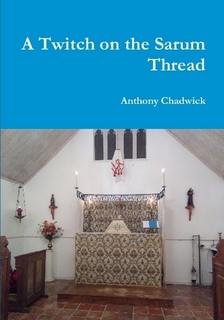
A Twitch on the Sarum Thread

I have just published this new book after quite a lot of feverish writing and recycling of some of my blog work. I have also included Canon Warren’s translation of the Order of Mass with the rubrics (in italics).

See my Lulu Bookshop and the book description. I still have to evaluate the printed book before making any revisions (very minor) and giving final approval. Here is my preface:

* * *

Following the fragmentary and personal style of my previous book Romantic Christianity, much of this volume is inspired by material previously written on my blog The Blue Flower. However, they are for the most part rewritten. This book is a set of reflections and does not pretend to be an academic work. Thus, I am not treading on the feet of those who, after considerable research into the sources, have begun to produce usable books for the Mass and the Office. In the bibliography, the reader will find everything I have been able to find on the history and celebration of this Use.

In Romantic Christianity, I emphasised the notion of beauty, together with truth and goodness, as the greatest apologia for the Christian faith. In my early twenties, I embarked on a course of instruction to become a Roman Catholic. During this time, I became fascinated with the pre-Reformation liturgy and the way it influenced late medieval English churches. Ironically, I probably learned more about the Church of England as I was leaving it than over the years when I played the organ and sung in choirs at school and in various parishes. The quote from Cranmer in his introduction to the Prayer Book is particularly haunting:

And whereas heretofore there hath been great diversity in saying and singing in Churches within this Realm; some following Salisbury Use, some Hereford Use, and some the Use of Bangor, some of York, some of Lincoln; now from henceforth all the whole Realm shall have but one Use.

Later on, I would discover that France too, up to a certain time, also had a diversity of rites and uses according to the multiplicity of dioceses and religious orders. Why did this diversity disappear? They were not formally abolished by Pius V in 1570, since he wrote:

(…)  and notwithstanding the practice and custom of the aforesaid churches, established by long and immemorial prescription – except, however, if more than two hundred years’ standing.

Roman Catholic canon law places jurisprudence and custom over codified law, and thus the authority of the so-called Tridentine liturgy was not to be absolute. In this way, most religious orders continued to use their old liturgical books as did many dioceses like Milan, Paris and Lyon to name the best-known.

Diversity in the liturgy was largely a victim of two phenomena of the Renaissance: the Reformation and the Counter-Reformation. A whole ethos of the Church was not abolished but allowed to die as priests and bishops adopted the new ways in the latter half of the sixteenth century.

My romantic imagination pursued the lost and the marginal, seeking out the last remnants. It motivated my journey to France in July 1982 and my stay with Fr Montgomery-Wright in his country parishes in the Eure department of Normandy. Fr Quintin, as many knew him, preserved many of the old Norman ceremonial usages as he used the standard Roman rite of 1965. He had been an Anglo-Catholic priest in London during World War II, became a Roman Catholic and went to France in the late 1940’s and was ordained by the Bishop of Bayeux. He had a considerable influence on my own developing thought. During my time as a Roman Catholic, I chased dreams and the truth and beauty of my own imagination, oblivious of the bleak reality of the French Church of the 1980’s and the severe ideology of the traditionalists.

Since those days, I became more of a realist, studied theology at the University of Fribourg after having parted company from the traditionalists. I spent several years in the seminary of the Institute of Christ the King in Italy, to an extent inspired by the Oratory of St Philip Neri, but something else made me continue to yearn and dream. It is my hope that I will bring others to understand my motivation and attraction for this lost world of which the average English parish church stands as a silent witness.

More recently, I was brought to a brighter epiphany as I discovered the Romantics and their love for a romanticised Middle-Age as opposed to what was in all likelihood the historical period. My Romantic initiation came, less through Coleridge, Shelley, Keats and Byron, but rather through reading Nikolai Berdyaev, the Russian philosopher who had emigrated to France, and Friedrich von Hardenberg, the German poet, philosopher and mystic who died very young from tuberculosis. The Romantic Middle-Age is a Platonic idea that is strongly present in our minds as a human culture that is open to the message of Christ and the plenitude of divine revelation. Friedrich von Hardenberg wrote his dream: Die Christenheit oder Europa in 1799 which is capable of a highly cynical interpretation if the Romantic notion of reality is disregarded.

Unashamedly, I identify with this particularly German brand of Romanticism and its notion of beauty, truth and goodness. It is a world apart, where disappointment and unhappiness are unknown. It is heaven on earth.

Posted in Uncategorized | Tagged , , , | 1 Comment

The Sarum Effect

The recent Sarum Vespers in America has made quite an impression, as The Legitimacy of the Sarum Use attests. Our Rad Trad (I wish he wouldn’t use that name!) has often come up with extraordinarily sensitive reflections. I have always found him sympathetic with me. He wrote in this article:

More famously, Fr. Anthony Chadwick celebrates the Sarum Use in his chapel in France. Much like the Oratorian celebrations in Oxford, Fr. Anthony does not make his Masses an act of historical play acting, replete with period style vestments and vessels. He uses what he has from his days observing the Tridentine books and does his best. He has even put out videos of his low Masses, one of a straight through low Mass and the other an instructional. Both are the only videos of their kind available now.

I have been banging a drum about this subject for more than a decade, but my perspective has evolved from a precise rite to the religious culture that surrounded it. This is something that was brought home to me as I came to France and saw some last remnants of popular parish culture involving a spirit that was totally different from the traditionalists. The priests I met in the 1980’s and 90’s are now dead.

I am presently planning a new book on the subject, and I find that Rad Trad’s methodology and mine concur: the question of reviving Sarum in Roman Catholicism, Anglicanism and Western-Rite Orthodoxy. Then I am thinking about the question of whether it can be revived and in what kind of cultural context. Naturally, I bring in that “universal panacea” of Romanticism, which, in the nineteenth century, revived France’s devastated Church and developed Wesley’s inspiration of bringing God back into the Church of England, restoring the country’s medieval churches and making the Prayer Book Communion Service look a little more like the medieval liturgy through the use of vestments and an eastward-facing altar.

I seem to be almost the only priest using Sarum as my ordinary spiritual fare, but I am alone and getting on in years. Come the inevitable, my Sarum life will also pass into history as did the remnants of the Norman uses in the 1980’s and 90’s. Perhaps the way the traditionalists (SSPX and with Rome) are evolving would surprise me, but I no longer live in their world and I am out of touch. Their priests are getting older and more mature and may end up like old parish priests. We have not to forget that the Tridentine liturgy is also a medieval rite in its essentials (with all the elements going back to the early Church) and can be celebrated without everyone getting anxious about the Mass being invalid if Father forgets to put on his maniple!

Sarum is more symbolic than anything else. It is the last medieval rite (use) to be used in England before the iconoclasm of the Reformation and the changes in the Roman Catholic Church to restore its credibility represented by the Council of Trent and the Counter-Reformation. It represents an idealised and Romantic view of a longer history of the Church than only the last four hundred years of constant bickering between Protestants and Catholics. We now live in a time when society shows no interest in any churchy things and humanity seems to be on a “race to the bottom” like the 1930’s.

I am in no illusion about (neo) Romanticism, because its being popularised would destroy it as happened in the late nineteenth century. It needs to be an unpronounced word among thinkers, writers, musicians, artists and sensitive souls. The best we can hope for is to sow seeds for the future, all too aware that the future may bring Götterdämmerung and the continuation of mankind’s fall. Perhaps there may be another brief window like roughly 1790 to 1830 and 1890 to about the 1960’s. On my own, I feel very inadequate and quite overwhelmed by the Philistine. I will join a few friends next October in southern England, and hope to be able to sow seeds of ideas which those gifted in leadership can plant and grow in humanity’s garden.

Rad Trad does legitimately ask what would be the right setting for Sarum. The Dean and Chapter of Salisbury Cathedral are obviously not going to do it, at least beyond a few nice processions. Its being celebrated in America or Canada seems something of an anomaly, though it can be seen as a little more normal in Normandy. Perhaps I should use the Use of Rouen, if I can find books older than the Neo-Gallican overhauls of the early eighteenth century. But, I am not a priest of the Archdiocese of Rouen or even in communion with Rome. I suppose I am English and belong to the English diocese of a Church of Anglican tradition – but my Bishop uses the Anglican Missal and not Sarum. Perhaps a solution would be to say that Sarum belongs to the English and northern French world as a descendent from the rite of Rouen. Here in France, there have been some celebrations of the Parisian and Lyon rites by priests of the Fraternity of St Peter.

Perhaps what needs to be revived is not so much Sarum but the liturgy itself, turning away from both the Tridentine crackdown on abuses and the post-Vatican II ideas of archaeologism (restoring rites from the early centuries of the Church on the basis of scant documentation) and inculturation on the basis of modern mass culture. I think we should encourage bishops and priests of all Churches to go back a few hundred years and be flexible about the practical aspects like the use of the vernacular and Latin. We must also not forget that the liturgical life has been, and should be, a preserve of the initiated elite and not the mass of the (baptised) catechumens.

The Ordinariate(s) would have been a most appropriate context for reviving Sarum, which altogether justified its use in Philadelphia in a Roman Catholic parish church. The appropriateness comes not from the place, but the attempt to bring the positive and Catholic elements of Anglicanism into a Roman Catholic context.

Here is a quote from my unfinished book:

What I find so tragic is that never were the Anglicans and Roman Catholics so close spiritually and culturally than in that period shortly predating the paroxysm of Roman triumphalism and the authoritarianism of Pius IX. The Anglicans sought their medieval roots, and the Roman Catholics sought their Recusant heritage, both from exactly the same source.

Posted in Uncategorized | Tagged , , , | 7 Comments

An Excellent Initiative – Experience of Worship

My attention has just been drawn to this site of resources on medieval liturgy:

Since I had not known about this site, I must assume it is quite new and will evolve in time. My congratulations go to the person who runs the site.

Posted in Uncategorized | Tagged , , | 2 Comments

Scepticism and Freedom of Thought

We begin to breathe at the end of Storm Ciara, a particularly vast and nasty one that has caused a considerable amount of damage in the British Isles and northern Europe. My house just suffered a loose tile that I was able to put back without doing anything dangerous. High winds and rattling roof tiles cause anxiety, and the natural reaction, when possible, is to get into bed and somewhere warm. I remember such storms as a child in the 1960’s in the north of England, with the Victorian sash windows rattling away with each gust. The Atlantic storm coming in with the Gulf Stream is nothing new, but it is worrying when it happens, and a challenge to our illusions of human omnipotence. We can be thankful here in Europe that we don’t get tornadoes and hurricanes like in America, because they bring total destruction to homes, human property – and lives.

I will not mention any names, but I was surprised yesterday by the accusations of being a climate change denier by someone close to me. I was like a “heretic” facing an “inquisition” enforcing a new orthodoxy – one taught by Extinction Rebellion and the secretive political and business-motivated forces sponsoring Greta Thunberg. I spent a considerable amount of time last night learning about Green New Deal and the European variants that various far-left political parties try to propagate. I try to be open-minded.

I wrote an e-mail to the person expressing my shock in the face of such accusations coming from a radicalised mind. To be fair, we English-speakers talk of denial rather than scepticism as the French prefer in regard to us “enemies of the people”. The “dogma”I am expected to accept and profess is that the temperature of earth’s atmosphere will be so high by 2050 (sometimes 2030) that human life would become extinct, and therefore protest groups like Extinction Rebellion are justified in their demonstration to force the USA, the European Union and national governments to eliminate all carbon emissions within ten years. I know that such radical action would be impossible, and that such a radical position is by now largely discredited. The Right has won in England, and Trump has shaken off an attempt to impeach him. The Democrats must now be in tatters! I am of the mind to believe that if global warming is as they say, then there is nothing humanity can do about it.

I was yelled at yesterday for being “sceptical”, and I replied that I am indeed sceptical in that I suspend my judgement on the subject not being in possession of scientific data that I could trust is not influenced by political ideology. In postmodern French political culture, scepticism means denial, but I prefer to use words according to their etymology and conventional meanings. Sceptical philosophy, founded by Pyrrho of Elis (Πύρρων), is about suspending judgement whilst seeking for truth (or the nearest we can get to it). Scepticism calls us to act according to our limited state of knowledge of things.

When reason confronts fanatical certitude, the only answer is silence. However, I find myself with the duty of finding out what I can about solar activity (we seem to have a minimum presently), the movements of sea currents, content measured in ppm of carbon dioxide in the atmosphere and other factors. I am quite curious, since sailing caused me to take some interest in meteorology, learning to read the weather. It is extremely unpleasant to find myself confronted with the beast of totalitarianism, thought control and everything else Orwell wrote in his dystopian novel.

Where can we find information that is not influenced either by “green totalitarianism” or Trump’s triumphalist capitalism? I do find it reasonable to believe that humanity puts a lot of carbon dioxide and toxic gases into the atmosphere, then decimates the forests of South America and other parts of the world, disturbing the natural regulation of carbon dioxide by vegetation that needs it. Industry is still tipping vast quantities of plastic into the oceans. Indeed, there is a dramatic ecological crisis. I have a lot of respect for those who invent special ships for recovering as much of that plastic as possible, a lot more than for stupid people gluing themselves to roads and railings in central London to cause the maximum amount of disruption and bitterness. Our world is in trouble, and I am all for efforts to clean up industry, reduce pollution of the air and sea, reduce intensive farming and air travel. We all need to go from a consumer paradigm to being a responsible citizen of the world.

In some ways, I could be tempted to want to go back to an eighteenth-century lifestyle, but that would be the end of my blog, e-mail and my computer. It would be worse for me than someone like Novalis in the 1790’s, because he never had the experience of what we have now. The thought is actually terrifying. I would have to learn to handle horses and have grazing space for them (my garden is on the small side). Goodbye, antibiotics, and we would have to be ready to die of diseases like tuberculosis and other bacterial infections. Most people survive coronavirus, but I’m not sure I would, given the hard time I have recovering from common colds! Goodbye, electricity, but I would (like everybody else) still have to send smoke into the air by burning wood to keep warm and lighting candles indoors. So, I don’t think Miss Greta’s ideas are so practical. Maybe the idea she has in her mind is something along the lines of Logan’s Run, a 1970’s American re-run of Huxley’s Brave New World. She and her minders, of course, would have the pots of money and status to live in some nice country mansion away from the glass-domed cities of οἱ πολλοί. Please excuse my sarcasm. No, we need to look for a moderate way of thinking about this problem without getting emotional or hysterical.

After my experience of radical Catholic traditionalism and things like sedevacantism, I have come to apply the principles of scepticism to the notion of truth itself. Truth exists, indeed, but is for the most part beyond us. Pilate asked What is truth? He doubted whether truth existed apart from the pragmatism of the moment. Jesus responded that he was the truth, the transcendent to whom we all aspire and yearn. We have to seek it and be humble as it brings out of us the sense of wonder. Following the Idealists and Romantics, I now know that we cannot possess the truth or impose a caricature of truth on others. The freedom of thought and expression (within the limits imposed by other people’s rights) is inalienable. I apply the same scepticism to right-wing agendas as well as left-wing ones. Environmental hysteria is political and is concerned for controlling people and taking freedom away in the name of collectivism and the sacrifice of the human person to the state or whatever.

Whatever problems there are with the environment, I am not sure that man’s responsibility goes beyond a few percent, even with all the smoke belching out of factories mostly in China, Russia and America, and out of the exhaust pipes of millions of cars and freight vehicles. It seems to me that Extinction Rebellion has done a lot of harm through its totalitarian ambitions. I am just as careful about conspiracy theories like those saying that we would all be forced to live in glass-domed cities, given artificial food (we already eat enough junk food!) and forbidden from going into the re-wilded countryside. I have a nagging doubt, but I don’t believe anything earthly as absolute truth, especially when there is a hidden political agenda behind it.

As I live in this ugly time of history, I am taken back to the time of the early Industrial Revolution, William Blake, children working in factories with dangerous machines. My own reaction is as angry and revolutionary as that of Shelley as he wrote in Prometheus Unbound, championing free will, goodness, hope and idealism in the face of oppression.

To suffer woes which Hope thinks infinite;
To forgive wrongs darker than death or night;
To defy Power, which seems omnipotent;
To love, and bear; to hope till Hope creates
From its own wreck the thing it contemplates;
Neither to change, nor falter, nor repent;
This, like thy glory, Titan, is to be
Good, great and joyous, beautiful and free;
This is alone Life, Joy, Empire, and Victory.

Everything seems to be closing around us, with Brexit, other similar tendencies in Europe. It is quite dramatic here in France, with people not so concerned with half-baked solutions for the environment, but with their livelihood. There doesn’t seem to be much of an alternative to President Macron, who got where he wanted by exposing all the petty corruptions of all the mainstream candidates. Now, the only alternative is Le Pen. Perhaps that might not be a bad thing pour mettre les pendules à l’heure. After all the right-wing that has seduced the working classes got its victory in the UK. It seems to be the future.

The future seems to be authoritarianism, the end of thought, beauty, truth and goodness, the end of art and literature as man’s spirit gives way in obedience to the “new orthodoxy” and its “inquisition”. Some of us will resist and survive. Others will give their lives in seemingly futile gestures.

The souls of the righteous are in the hand of God, and there shall no torment touch them.
In the sight of the unwise they seemed to die: and their departure is taken for misery,
And their going from us to be utter destruction: but they are in peace.
For though they be punished in the sight of men, yet is their hope full of immortality.
And having been a little chastised, they shall be greatly rewarded: for God proved them, and found them worthy for himself.
As gold in the furnace hath he tried them, and received them as a burnt offering. – Wisdom 3, i-xix.

Posted in Uncategorized | Tagged , , , , , , | 5 Comments

Candlemas Mass and Office

At last, someone has made the full video available of the Sarum Mass celebrated in Merton College Chapel in Oxford. It was celebrated by the Roman Catholic priest Fr Sean Finnegan in 1997. These were the Masses allowed for Roman Catholics by the then Archbishop of Birmingham but forbidden by Rome. It gives some idea of the complexity of High Mass, and the care taken to recapture the beauty of the music and ceremonies. Until recently, it was split up into ten-minute segments as per the former YouTube rules.

This year on 1st February, I Vespers of Candlemas was sung in St Patrick’s Church, Philadelphia, also under Roman Catholic auspices (Ordinariate). This ceremony was organised by an extraordinary young man by the name of James Griffin. Here is the video:

See the congregational booklet. It can be downloaded.

It is heartening to see interest in the Use of Sarum and another liturgical tradition that transcends both the Reformation and the Counter-Reformation.

Posted in Uncategorized | Tagged , | 3 Comments

My Store on Lulu

My bookstore on Lulu is to be found on Anthony Chadwick’s Store. I intend to publish other books – as I write them!

Posted in Uncategorized | Tagged , | Leave a comment

Romantic Christianity

I have just published my book through Lulu and am waiting for six copies other than my author’s copy. I will send the six copies to my Bishop and some friends free of charge.

Others who may be interested can buy the book directly from Lulu at a very reasonable price. Note: some may experience difficulties on Lulu’s site with this link that works for me in France. Try https://www.lulu.com/ and search for “Romantic Christianity”. There may be variations in the linking system in different parts of the world.

Here is my preface:

This modest volume has grown from the experience of life and my encounter with the Christian faith. What drew me to Christianity from a sceptical childhood and rational upbringing? I have had to discover that different things attract our contemporaries to churches, pilgrimages, priests, solemn music, plain preaching and silent prayer alone or in a group.

A few episodes in my childhood stand out in my memory in relation to the themes of Romanticism, especially the Sturm und Drang of a very black storm coming in from the Atlantic during a family holiday in Portugal. I stood on the breakwater of the port facing a freshening wind and the increasing waves. My mother found me and was concerned, rightly, for my safety. The dream died. What dream was that? It was perhaps a moment of facing the anger of nature with my own dark anger.

Throughout my adolescence, I was drawn to literature from the nineteenth century, especially the poets like Shelley, Keats and Byron. The passionate symphonies of Beethoven brought me another dimension in life than I would have found in the kind of music that stimulated my contemporaries. A few months after my brief encounter with the storm, I discovered the 1812 Overture of Tchaikovsky and its scenes of war and anger after the melancholy Orthodox Church chant opening the piece. Jules Verne was a particular influence with his vision of the future in technology that was yet to be invented. Captain Nemo seemed to be fighting the same war as Byron as he gave his life for the Greeks. I saw Christianity in Romantic terms as I began to learn the organ and sang in choirs. I was attracted by the transcendentals of truth, beauty and goodness, though I had hardly heard of Plato.

In our times, we find that Christianity has become much more associated with political activism in the belief that faith without good works is dead faith. Christian worship has largely become assimilated with television entertainment and the social dimension. At the age of 22, I embraced Roman Catholicism through the traditionalists. I crossed the English Channel the following year to France where I constructed a whole reality in my imagination, something I would never find.

For many years I asked many questions about Christianity, the world, other people and myself. I sought a theological response, a psychological answer, but none seemed to be forthcoming until I gained better self-knowledge.

From the outside, most institutional churches seem to be rotting, dwindling away, the buildings neglected or put to secular use. For the first time in history, the world is no longer hostile – but indifferent. The average person could not care less and has something else to do. Religion like politics becomes polarised and increasingly radical. No place remains for reasoned dialogue. The answer seems to be found in the observation that Christianity is being put to a use for which it was never intended: secular politics and governance. That is hardly a new problem.

Being a Christian involves initiation into a mystery that is hidden from those who are not ready to understand either with their intellectual faculties or a living imagination. I discovered that the themes of Romanticism which I had experienced for myself or read in literature perfectly described the human soul that was ready to receive this Mystery of God’s truth, beauty and goodness, expressed through man-made icons of music, liturgy and human love.

This work, not intended to be an academic study, but rather a set of reflections based on reading and personal thought over the years, is both a personal testimony and a narrative of a discovery which may bring others to happiness and fulfilment of life, answers to the eternal questions and our anguish.

Posted in Uncategorized | Tagged , , | 4 Comments

Miserere mei, Deus

On this 75th anniversary of the liberation of the concentration camps.

Have mercy upon me, O God, after thy great goodness: according to the multitude of thy mercies do away mine offences.
Wash me throughly from my wickedness: and cleanse me from my sin.
For I acknowledge my faults: and my sin is ever before me.
Against thee only have I sinned, and done this evil in thy sight: that thou mightest be justified in thy saying, and clear when thou art judged.
Behold, I was shapen in wickedness: and in sin hath my mother conceived me.
But lo, thou requirest truth in the inward parts: and shalt make me to understand wisdom secretly.
Thou shalt purge me with hyssop, and I shall be clean: thou shalt wash me, and I shall be whiter than snow.
Thou shalt make me hear of joy and gladness: that the bones which thou hast broken may rejoice.
Turn thy face from my sins: and put out all my misdeeds.
Make me a clean heart, O God: and renew a right spirit within me.
Cast me not away from thy presence: and take not thy holy Spirit from me.
O give me the comfort of thy help again: and stablish me with thy free Spirit.
Then shall I teach thy ways unto the wicked: and sinners shall be converted unto thee.
Deliver me from blood-guiltiness, O God, thou that art the God of my health: and my tongue shall sing of thy righteousness.
Thou shalt open my lips, O Lord: and my mouth shall shew thy praise.
For thou desirest no sacrifice, else would I give it thee: but thou delightest not in burnt-offerings.
The sacrifice of God is a troubled spirit: a broken and contrite heart, O God, shalt thou not despise.
O be favourable and gracious unto Sion: build thou the walls of Jerusalem.
Then shalt thou be pleased with the sacrifice of righteousness, with the burnt-offerings and oblations: then shall they offer young bullocks upon thine altar.

Posted in Uncategorized | Tagged , , , | Leave a comment