
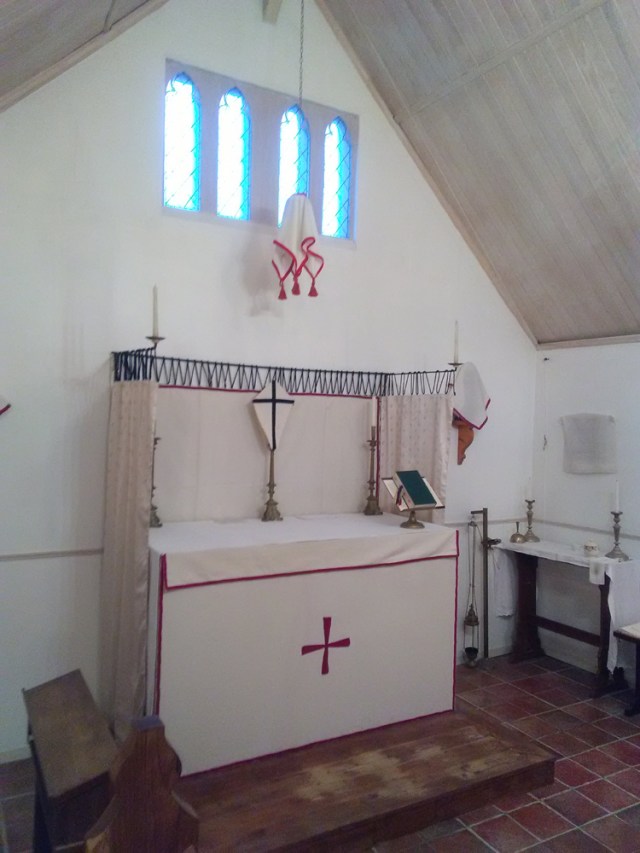
 Once again, we arrive at the gates of Lent after the short period of preparation called the Gesimas, after the Sundays of Septuagesima, Sexagesima and Quinguagesima. This is the time in many places when Carnival is celebrated – the word meaning “good bye to meat” and the embracing of a vegan diet except the Sundays. The full rigour of a diet without meat or other animal products is now only to be found in some monasteries and the stricter Eastern Orthodox Churches. For us in our times and living an active life, a good compromise is to abstain from meat on Mondays, Wednesdays, Fridays and Saturdays and to simplify our diet. The point is doing something that is healthy both for our souls and bodies to prepare us for the Paschal Mystery by revisiting the journey of the ancient catechumens in the early Church as they prepared for Baptism.
I have just returned from my chapel, having put up the Lenten Array according to our English tradition and burning old palms to make the ashes using a blowtorch and the metal lid of a jam jar. Once the burned bits have finished smouldering, I use a teaspoon to powder the ashes and put them into a little pot in which they will be blessed tomorrow. Being a cleric, I will be imposing ashes on the crown of my head where traditionally the Tonsure is shaved. The dirty crosses on the forehead are a later custom adopted for the laity.
What will Lent mean to me this year. For us all, it is a journey towards the renewal of our Transitus Domini, an expression full of meanings in the archetypes of the Old Testament and the Passion and Resurrection of Christ. Some of us will be wanting to work on something particular in our spiritual lives. I certainly intend to read more, especially the Humanist dimension of Christianity, which I believe is the only thing that will save the Church, not as an elite institution, but the communion of all in Christ. We will certainly reflect on the crisis of seeing what we have held dear for much of our lives being taken away, first our Churches, and then our countries and fatherlands.
Coming back to the old tired subject, I read How Brexit will save Britain today. It confirms my reflections on the new middle ages, the hymn to the night as we expiate our pride and embrace a new chapter of our history. My other thought was the story of Charles Dickens The Tale of Two Cities, and it being the turn of England and the UK to suffer a revolution it has not seen since the seventeenth century. What form that would take, I have no idea, and I can only pray there will be no violence or loss of life.
I do remember something from school history – that we escaped revolutions in critical times like the 1790’s, 1830, 1848, 1870 when there was so much instability in Europe, because our political establishment was able to enact the right reforms at the right time to lower the pent-up pressure slowly and safely. The status quo was maintained. In the twentieth century, the UK alone escaped occupation by the Nazis because of the natural barrier of the sea and the courage of the Royal Air Force. This certainly made many of us English feel apart and special in some way compared with France and most of Europe at one time or another occupied and oppressed by the Axis. We also have a highly archaic system of constitutional law and jurisprudence, which may be an advantage or a handicap (depending on which way you look at it) in comparison with the Napoleonic Code or France’s five Republics and the new Germany after 1945 and the reunification of that country in 1990. We have laboured with an archaic system for centuries, and the rest of Europe has a modern constitution and code of law for each country.
As for us all, Christians during Lent or our countries facing the future, we have to stare into our souls and take stock of our existential crisis. The UK, if no-deal goes ahead (or any kind of Brexit for that matter), is about to declare war on itself and become a defeated nation like Germany in 1945. No enemy was needed, and at no time has the European Union uttered the slightest threat in England’s regard.
I don’t know what is going to happen. There are plenty of rumours and sensational news articles, stories of chlorinated chicken and junk food, of shortages of medicines and toilet paper. These seem to be scare strategies for people used to thinking only about their daily lives (as I too have to). The main religion of England is no longer Christianity, but has for a long time been that of Mammon, the worship of money and power. Our country has more or less returned to the Victorian era when medicine and a home were luxuries and the poor cannot even appeal to the charity of religious communities. In the Victorian era, philanthropy was something that Oscar Wilde found wanting in sincerity or true compassion:
Most people are other people. Their thoughts are some one else’s opinions, their lives a mimicry, their passions a quotation. Christ was not merely the supreme individualist, but he was the first individualist in history. People have tried to make him out an ordinary philanthropist, or ranked him as an altruist with the scientific and sentimental. But he was really neither one nor the other. Pity he has, of course, for the poor, for those who are shut up in prisons, for the lowly, for the wretched; but he has far more pity for the rich, for the hard hedonists, for those who waste their freedom in becoming slaves to things, for those who wear soft raiment and live in kings’ houses. Riches and pleasure seemed to him to be really greater tragedies than poverty or sorrow. And as for altruism, who knew better than he that it is vocation not volition that determines us, and that one cannot gather grapes of thorns or figs from thistles?
O tempora, o mores! We are not very different now. Perhaps we are about to be taught a lesson. Our political system, both conservative and socialist, is rotten and unfit for purpose. It all needs to be swept away. The humiliation will be complete, and I can only hope that redemption and God’s forgiveness will come out of it. Read the article and ask yourself the question – Could it be true? Are we not a roaring mouse?
… perhaps we will get the revolution we actually need.
I don’t hope for a revolution, for violence or for death, but rather in the words of our Prayer Book:
Almighty God, the Father of our Lord Jesus Christ, who desireth not the death of a sinner, but rather that he may turn from his wickedness, and live; and hath given power, and commandment, to his Ministers, to declare and pronounce to his people, being penitent, the Absolution and Remission of their sins : He pardoneth and absolveth all them that truly repent, and unfeignedly believe his holy Gospel. Wherefore let us beseech him to grant us true repentance, and his Holy Spirit, that those things may please him, which we do at this present; and that the rest of our life hereafter may be pure, and holy; so that at the last we may come to his eternal joy; through Jesus Christ our Lord.


 The Blue Flower