
I have always been impressed by the Romanticism and idealism of Pope Benedict XVI, especially regarding the apology of Christian faith offered by beauty. The best-known quote is “I have often affirmed my conviction that the true apology of Christian faith, the most convincing demonstration of its truth…are the saints and the beauty that the faith has generated”. Conversely, the militant atheist Richard Dawkins bewailed the greatest challenge posed by the way art, music and literature can convey the reality of a spiritual and divine consciousness.
We are familiar with the old saying beauty lies in the eye of the beholder. People have their favourite composers and artists. I can like the music that others detest and find ugly. This seems to make the concept of beauty quite subjective and ephemeral. There are people who will say that 1970’s brutalism and atonal music are beautiful. I have always gone by the principle that beauty is objective and is based on eternal principles like, for example, harmony and melody in music. What is beauty. Someone like St Thomas Aquinas would recognise beauty by integrity, proportion and its ability to enlighten. Another way to recognise beauty is our experience of it, the effect it has on us. Beauty can lift us out of our selfish self-pity and nihilism and gives us “wings” to transcendence. It can shock us and cause suffering. For the Romantics, beauty brings us to long for the Universal Idea of beauty of which the beauty we experience is only an icon.
I remember my first impressions of entering York Minster, that great cathedral of the north of England, and hearing the choir and organ. Medieval cathedrals were built to draw souls to the infinite, away from the commonplace routine of our lives. The dominant dimension of a cathedral is the vertical, expressing the Sehnsucht of the human spirit for God in his truth, goodness and light. The human arts and nature convey the message of the Gospel through allegory and parable. As I recently mentioned during an interview with Dr Michael Martin, I have never been impressed by biblical literalism and “dogmatic” apologetics. I have been to the trouble of studying theology, because all the dimensions of God’s communication with man are important. Like many, I relate to art, music and nature.
As a musician, I was never keen on the “pop” music of the 1960’s and 70’s, but I would prefer to listen to what is generically named “classical” music. I began piano lessons at the age of 8 in response to having heard the organ in my parish church during the Christmas service. Unlike most people I knew, I actually noticed details of architecture and likened them to churches. Our family was respectful in regard to religion but never particularly devout. As popular music developed into things like “heavy rock”, I saw people who were stimulated by it. It repulsed and frightened me. The oof-oof-oof drumbeat and vocal screams of this a-musical monstrosity made me think of those old films about cannibal tribes with the missionary in the crock-pot being cooked alive. I had the same experience with musical modernism in the total chromatic atonal system devised by Schönberg in 1912. He had pushed romantic chromaticism to the limit and began to deconstruct the principles of harmony and melody, like Derrida in philosophy. These are the archetypes of the cancel culture of the woke ideology. As the twentieth century wore on, music and art would be utterly destroyed in displays of random splashes of paint and the effect of a dog striking notes on the piano with his paws and howling.
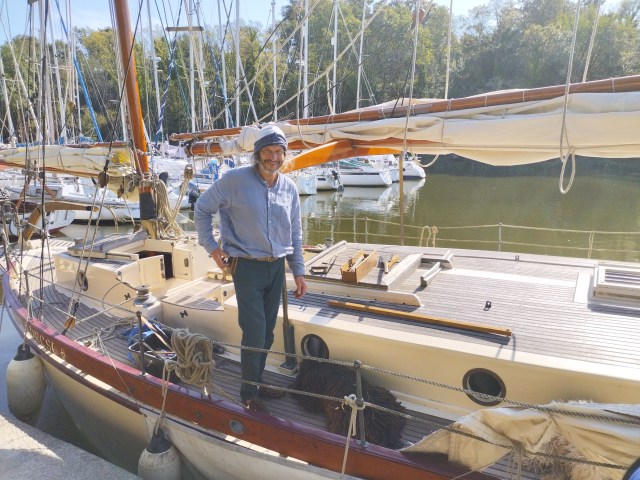
Another place of beauty is the natural world, especially the coasts of the land seen from the sea, mountains and forests. These are icons of God in Creation. Nothing has given me a new impetus of faith more than putting to sea in my little boat and exploring the cliffs, caves and islands of Brittany. We have to understand the role of the icon. It is not simply a picture, but conveys the presence of the person or spiritual truth portrayed. We are given windows to the transcendent.
Beauty is also to be found in persons who are close to God, especially through the innocence of children and the wisdom of many elderly folk. Benedict XVI once said “The beauty of Christian life is even more effective than art and imagery in the communication of the Gospel message. In the end, love alone is worthy of faith, and proves credible. The lives of the saints and martyrs demonstrate a singular beauty which fascinates and attracts, because a Christian life lived in fullness speaks without words. We need men and women whose lives are eloquent, and who know how to proclaim the Gospel with clarity and courage, with transparency of action, and with the joyful passion of charity”.
Beauty is also to be found in friendship, which is why I became endeared to St Aelred of Rievaulx and his famous book inspired by Cicero on friendship. Some claim St Aelred as patron of the alphabet soup of homosexual identities, which is a travesty. St Aelred was a Cistercian monk and Abbot of his community, and would have been very strict about sexual contacts between monks. However, he encouraged friendship, not something always found in monastic communities. Friendship with other human beings and God is a capital mark of spirituality. I would not bless a gay couple, but I would bless a friendship, even if I knew nothing about the private life of the persons concerned.
In my first contacts with the Church and awakening of a desire to know God and Jesus, I discovered church buildings and music. I sensed the sacred in all these expressions of beauty. Another landmark in my life was Anglo-Catholicism, already a big part of the services in York Minster thanks to the legacy of Dean Eric Milner-White. I went to London in 1978 and began to discover Anglo-Catholic parishes with the full liturgy. The combination of an eastward-facing altar, vestments, incense, music and ceremonies spoke another language. Does the liturgy lift us up, or drive us down to a parody of secular life? Anglo-Catholic worship can be quite affected and can itself become a caricature, making Evelyn Waugh write in his novel Brideshead Revisted about Charles’s cousin Jasper advising him to “Beware of the Anglo-Catholics—they’re all sodomites with unpleasant accents. In fact, steer clear of all the religious groups; they do nothing but harm”. The implication here is the aestheticism of a certain breed of late Victorian men who were attracted to a superficial level of beauty and were active homosexuals on the “gay scene”. It is tempting to dismiss the beauty of the liturgy for this simple reason. Abusus non tollit usum.
One who wrote a lot about aesthetics and beauty was Oscar Wilde. I recommend an attentive reading of De Profundis, the letter he wrote to Lord Alfred Douglas in January to March 1897, close to the end of his imprisonment in Reading Gaol. I have mixing feelings about this cri de coeur. Wilde’s sufferings were caused by his decision to prosecute the Marquis of Queensberry for libel. The legal establishment fell on him like a ton of bricks. The tone often reeks of self-pity and narcissism. At least that is the impression one can get. Many of the ideas are profound, and the condemnation of Victorian self-righteousness, philistinism and hypocrisy arouses sympathy in the reader, even to us born more than a hundred years after Wilde. We also take comfort in what a nasty character the Marquis of Queensberry was. Wilde identified with Christ in his suffering, and I see something sincere and noble in this. It gave his own suffering meaning. Wilde portrayed Christ as a Romantic artist and his Passion as a Greek tragedy. Christ was utterly original as a person, not a product of social conformity. Wilde emphasised the ideas of love and beauty, attributing them to Christ. Perhaps we can read these ideas as allegory and analogy rather than literally. Wilde was received into the Roman Catholic Church by a priest in Paris shortly before his death in November 1900. Wilde was certainly fascinated by Catholic liturgical aesthetics and the role of suffering and sacrifice in ritualistic symbolism. This is an example of beauty to which Wilde could relate rather than apologetics and moralising homiletics, a religion of text and word.
We now come to a notion of true and false beauty. These would surely be distinguished by the effect they have on us. There are expressions of beauty displayed on TV, advertising and popular culture. Are these expressions a delusion, dazzling and superficial, inspiring a desire for power, pleasure and possession – instead of bringing us out of ourselves and opening us up to the true freedom above? Beauty alone does not necessarily make us good, for many of the Nazi leaders were musicians and Hitler himself was a talented artist (even if he was rejected by the art academy of Vienna). Perhaps the difference is in our response to this beauty, being “surprised” (as C.S. Lewis would have put it) into love, truth and virtue.
I have not been into the philosophy of beauty for this little posting, something that would require a tremendous amount of study and work. There are works on aesthetics by Plato, Aristotle, Philo of Alexandria, Cicero, Plotinus, Augustine, Dionysius the Areopagite, and others. From medieval times, we have Bonaventure, Albert the Great and Thomas Aquinas in particular. The whole idea is expressed by the Romantics and analogical tendencies to this day. Dostoevsky came out with this famous slogan Beauty will save the world in his book The Idiot. He could not separate beauty from goodness and truth. The three Platonic transcendentals are a “trinity” of forms of a single absolute Idea.
The subject of beauty is far from concluded, but I am sure that without it, I would never have related to Christianity and my life would have taken a different course.


















 The Blue Flower