
This morning, I was musing about what it must be like to single-hand a thirty-foot yacht, to sail the boat on the open sea with no crew other than oneself and modern mechanical aids like the auto pilot.
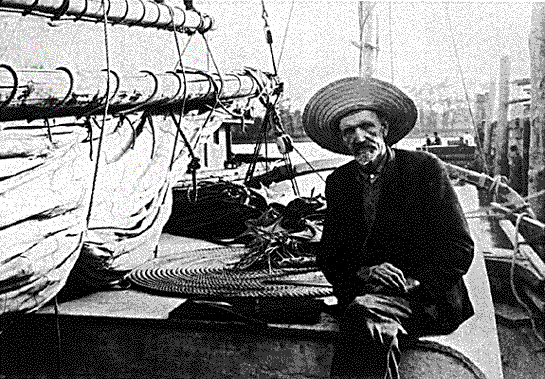
Many people have done it, like the very first to circumnavigate the globe alone – Joshua Slocum. His methods of navigation were little more than medieval. He got by without charts because his goat has eaten them! That man was a master mariner who could have sailed an old bathtub round the world with the feet still attached! Nothing stimulated my imagination more, when I was a lad, than tales of the sea, beginning with my own great-grandfather, Captain Cook and the wonderful stories of Jules Verne.
Single-handing a dinghy is not difficult in moderate conditions. I have even sailed the modern equivalent of the 420 with reefable mainsail, furling jib and an asymmetrical spinnaker (you can look up the technical jargon on Google). The main problem with single-handing a dinghy is capsize recovery, which is easy on a small boat like mine. Or, you can go for a self-righting boat – any ballasted keel boat. Those craft only turn turtle with the mast at 45° under water, a scenario which is hardly likely in the worst broach or knockdown.
Now, away from the technical aspects of sailing, I found a number of reflections from those who had single-handed yachts of thirty to forty feet on very long voyages, across the Atlantic for example. The spiritual side is touching coming from very down-to-earth men (and not a few women too).
Throughout history, individuals have endured privation and hardship in search of it. And singlehanded sailors have found it. Well, that too. But I’m talking about solitude; a momentary respite from the distractions and demands that occur when other people are around. It’s a time of peace and quiet, a chance to think and reflect, which refreshes the body, revitalizes the mind, and restores the spirit.
Whether you call it “communing with nature” or “feeling at one with the world,” there are times singlehanding can only be described as a spiritual experience — days when you marvel at the sea and sky and are awed and humbled by the majesty of nature, days when you savour the interaction of the boat with wind and waves and say to yourself. “It just doesn’t get any better than this.” According to an unpublished study by Dewey, Kahn, Yu, and Howe, these moments are covered by the inverse square rule — the intensity of the experience decreases by the square of the number of people aboard.
Singlehanding is unlikely to kill you. But it offers plenty of challenges that can make you stronger and better. Not just a better sailor, but a better person. Having to do everything yourself necessitates learning which increases self-sufficiency. Self-interest will motivate you to anticipate what could happen and plan for contingencies. When (not if) the unexpected occurs, necessity will stimulate the resourcefulness and creativity needed to deal with the situation (and, occasionally, prompt a few prayers and promises to change). Your ability to both endure discomfort and appreciate the little things in life will increase. Facing your fears and pushing your limits will boost your self-confidence; while the reality you experience will keep you humble. And, ironically, what you learn about yourself while singlehanding will make you a better companion.
Another irony is that singlehanders meet a lot of people. I think part of it is that, after being alone for a while, they are more inclined to reach out to others for companionship and conversation. But it also seems that others are more inclined to reach out to singlehanders. Maybe one person is perceived as less of a threat or burden than a group. Maybe it’s curiosity, the mothering instinct at work, empathy, or pity. Whatever the reason, the willingness of others to extend an invitation and helping hand to a singlehander and the generous degree of hospitality provided is a commonplace, yet unique and priceless, gift.
There is something precious about people of the sea. This afternoon I sailed with “Guad” from our club. We weren’t in the same boat, but me in my boat, and he in a delightful little boat called the Moth – a single large mainsail and a beauty of a hull. One could sense a kind of human solidarity that never occurs on land. I knew he had capsized before I saw that it had happened, and I immediately turned downwind to go and see if he needed help. Excellent seaman as he is, he righted the boat and was back aboard long before I got there, but he appreciated the gesture all the same.
It’s a shame the Internet isn’t the sea, and our computers boats. How much nicer blogs would be and how kinder we Christians would become! It is rare to find a sailor who behaves like those rude motorists on the road who behave as if they had bought the entire highway when they bought their expensive car. I am also wary of motor boats (those not being driven by those doing their job), unless their engine is under 20 HP and they have a sailing rig!
I am nowhere near ready for a long voyage. I don’t have the boat for it, and I have everything to learn about handling boats in port, docking and many of the skills common to motor and sailing boats. I need to learn radio hamming and navigation and improve my rudimentary knowledge of meteorology. But – I have the essential, the ability to handle a dinghy in quite rough conditions. They say that if you can handle a dinghy, you can sail anything!
Perhaps in a few years time…


 The Blue Flower
Father Anthony, you may have heard already about Pastor in Valle (Fr. Sean Finnegan)’s health problems [http://valleadurni.blogspot.com/], but I am sure he would appreciate your prayers.
All the best.
Indeed, I have read his latest article. If he reads this, he will be assured of my prayers too. Perhaps he could take up sailing! I’m not joking – for me, the sea is a great healer, especially of the soul. It cleans out the old “cobwebs” every time!
Bravo! What a beautiful and inspiring post! And I hope someday that I might have an opportunity to learn how to sail. “It’s a shame the Internet isn’t the sea, and our computers boats.” Thank you for this, Fr. Anthony.