
This morning, my enquiring mind has been poring over various texts concerning post-modernism and what it is generally understood to be. I try to synthesise everything in my mind and express something coherent.
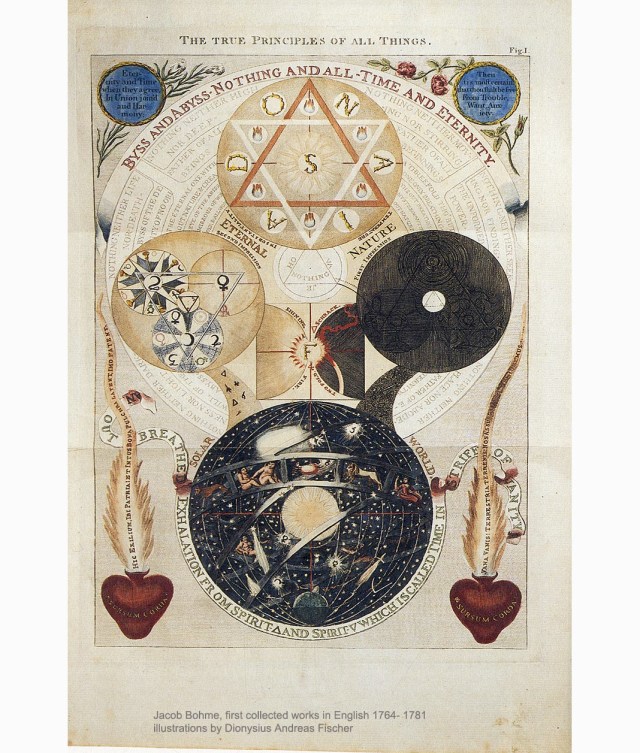
To get everything into a nutshell, the notion of truth as an objective universal idea or transcendental outside ourselves is discredited by things like the twentieth-century ideologies (as in World War II, the Holocaust, the Stalin purges and millions of dead in the Ukraine, etc.) and the mechanisms that created these errors in human thought and society have to be “deconstructed” and rebuilt ex-nihilo. After the deconstruction at the level of individual persons, as in Freudian psychoanalysis, or that of society, there would result a “productive nothingness” for which a new re-enchantment could emerge. Note, everything is potential, perhaps or perhaps not, nothing tangible – and a very dangerous state for humanity to be in. Who’s going to fill the vacuum first, God or a “new Hitler”?
I read a whole article on this subject, and finished it very frustrated, even though the author of the article on postmodern spirituality tried to reach at least a provisional conclusion. Either some kind of inspiration has to come out of the nothingness, or all that is left is a conflict between atheistic rationalism / materialism and conservative religion. I came away thinking that we are at a very dangerous watershed and at the gates of the worst and most murderous conflict mankind will ever have known, a war to end all wars that would make the Somme in 1916 look like a Christian ladies’ tea party!
Present-day atheism, as in Dawkins and Hitchins, is something anyone with a smattering of philosophy can see through in a moment. It is a “modern” concept that depends as much on infallibility and truth as any totalitarian regime or the Church of the Counter Reformation. This posting attempts to look at a more subtle kind of atheism, the kind professed by an Anglican vicar who has been more than forty years in his parish and has never hidden the fact that he believes neither in God nor in any kind of life after death. This school of thought is loosely grouped in the Sea of Faith movement.
SoF is most closely associated with the non-realist approach to religion. This refers to the belief that God has no ‘real’, objective or empirical existence, independent of human language and culture; God is ‘real’ in the sense that he is a potent symbol, metaphor or projection, but He has no objective existence outside and beyond the practice of religion. Non-realism therefore entails a rejection of all supernaturalism – miracles, afterlife and the agency of spirits.
‘God is the sum of our values, representing to us their ideal unity, their claims upon us and their creative power’. (Taking Leave of God, Don Cupitt, SCM, 1980)
Cupitt calls this ‘a voluntarist interpretation of faith’: ‘a fully demythologized version of Christianity’. It entails the claim that even after we have given up the idea that religious beliefs can be grounded in anything beyond the human realm, religion can still be believed and practiced in new ways.
Religion without faith? Frankly, I would find it easier to understand faith or some kind of spiritual aspiration without religion or belonging to a formal religious community. The former is sometimes known as belonging without believing, and the latter as believing without belonging. Anyway…
Sea of Faith was named after Matthew Arnold’s poem Dover Beach portraying the decline of organised religion to the ebbing tide of the “sea of faith”. Interestingly, the tides of the sea (I should know something about that!) are regular cycles, and what goes out comes back in – but I won’t pursue this little digression. The post-modern theme stands out clearly: de-constructing, rethinking, you name it. The stumbling block is the notion of truth, and with it, all metaphysical reality. The abuse of “truth” leads to all reality being discredited.
So its proponents and adepts remain in their churches and other places of worship, believing that their religious practices and teachings are just man-made, and still to some extent useful for a new use. So, without God or metaphysics, anything is possible. But, the maddening thing is that churches are crumbling whether they are conservative and metaphysical or liberal and sceptical. Man tries to seek integration, but with what is purely material or imaginary, conceptual and nominal.
I think critically about this tendency, not on account of being a fearful conservative, but through a complete rejection of realist ontology and metaphysics. Even scientists are discovering that reality exists outside Newtonian physics! Certainly revealed truths arrive through a human agency, a prophet who writes down his experience and what he believes God said to him in some way. The Bible had to be written by human authors, also interpreting their experiences in human terms. That is something we cannot escape. This school of thought is not without its intuitions, especially the humanist side and inclusivity. There is a pastoral concern for those the Church left behind.
An article has been written on the Australian website of Sea of Faith. It is a study on Postmodern spirituality by Robert Miller, which I have found particularly fascinating in my enquiry.
In this study, post-modern spirituality is about aesthetics and not about truth. Unlike the English deniers of all metaphysics, this essay has a strong Platonic note. Beauty is one of the transcendentals, along with truth and goodness. It is an erotic (eros – pleasure, not necessary sexual) way to well-being, liberation and empowerment. It is sometimes called re-enchantment, something capable of provoking, a sense of wonder leading to love.
This article above all comes into conflict with duality, beginning with the post-modern theme of deconstruction, or what the ancients called asceticism or κένωσις, emptying out of self. The technique is used in monastic mysticism as much as Zen and Buddhist meditation. We suspend judgement and thought and renounce all earthly attachment. Theories are de-constructed and we let go of knowledge and even belief. We thus transcend the duality of all dialectical opposites and become open to a higher reality. Many developments of this theme are not easy to follow, and there are risks.
If we can de-construct and then re-construct according to our preferences, what will result? A naughty thought comes into my mind: the Invisible Empire? Retro-futurism is indeed very post-modern! Then the mind boggles as we construct a whole new reality. I know zilch about quantum physics, but I am told that according to that theory, the human mind can create reality by projection. That might seem to be nonsense, but we live in only one universe in the same way as a radio (or wireless set if you prefer) can receive only one frequency at a time. My own mind still explores notions like gnosticism and pantheism, because they contain seeds of understanding things in a higher and broader way than in strict orthodoxy.
Unlike our English atheist friends, I find narratives of near-death experiences convincing like the more credible medium communications with the dead. There are too many unexplained things for them to be passed off as illusion or fraud. The idea of final annihilation is too depressing to contemplate, because in a materialistic conception, nothing comes out of it, nor is there any hope. Is belief in the afterlife a hard-wired illusion in all of us? Or is it an indicator that it is true, or at least with ontological reality?
I can sympathise with the emphasis on beauty, for beauty has not been abused as the notion of truth has! The article proposes the idea of the ability of beauty to “save” spirituality from religion, religion being defined as an oppressive and moralising system of authority. Post-modernism is the ultimate scepticism, characterised by nihilism that de-constructs itself. All thought is abolished – and my immediate thought is what a gift that would be to someone like Hitler! You just round up the sheep and “ethnically-cleanse” them as you want… What an epitaph for the Enlightenment and the age of reason!
If you want a vision of the future, imagine a boot stamping on a human face – forever.
George Orwell in Nineteen eighty-four. What an indictment!
Truth-centred belief systems are awkward in history. The Enlightenment defined itself as truth based on rational evidence and science (knowledge acquired by deduction). All truth has to begin with first premises, and therein lies the rub. Post-modernism has rejected truth, but here, one has to be careful.
If there is no knowledge then we cannot know there is no knowledge.
To say otherwise would be to affirm another truth. That’s the big problem with Dawkins saying there is no God. On the basis of what evidence?
Can anything be done with post-modernism other than by a very big meteorite hitting the earth and causing an extinction event? In a way, if there is no truth, at least there is beauty. So-and-so likes classical music, another person likes “boom-boom-boom” and someone else likes playing football. That sounds very superficial to someone accustomed to seeking truth and reason. Our “new atheists” are just as much into dogmatic truth as the most conservative Christians or Muslims. The idea of “political correctness” depends on yet another kind of truth.
I have often written about anarchism like in Christian Anarchism. It is the paradigm of extreme post-modernism. Will it bring out the basest and most insane animal instincts in us or the noblest? The Augustinian in us would think of hell and chaos, but I remain uncertain. We sometimes lose our structures and references involuntarily, and this brings out a new dimension. Like an outlaw in the days of Robin Hood or the Wild West, we find a need for a new existence and a positive way ahead than what would be offered by the Augustinian Weltanschauung. We can lament our loss forever or find in it a new source of creativity and freedom. If our truth has died, our capacity to wonder and enjoy beauty lives on…
Where there is love and spirit, there is no law, a notion I encounter in Nicholas Berdyaev. Those who are children of the law cannot stand someone else’s freedom, and we find that notion in St Paul (Galatians iv. 23):
But the son by the bondwoman was born according to the flesh, and the son by the free woman through the promise.
The kind of ἀγάπη of which the same Paul writes is something a million miles away from ethics. It brings compassion and empathy, quite unlike the “philanthropy” or “charity” of which Oscar Wilde wrote in his In Carcere et Vinculis. Perhaps good things lie beyond the Ungrund, darkness and emptiness of post-modernism!
The most profound criticism of “modern” religion and dualism is that of Augustinian dualism, the opposition of divine and human, the creator and the created. I don’t know to what extent we should discard outward forms of worship, the very liturgies I have always loved and found I could relate to through beauty. To what extent the Jewish Law was done away with by Christ is open to debate, but the Gospel vision presents something very radical. Drop the letter and keep the spirit? It is the question of centuries to which conservative Christians have always given their answer.
The most obvious consequence of the universe being divided into the “good guys” and the bad guys” is the perpetual conflicts within ourselves, between the so-called righteous and sinners, those who are “in” and those who are “out”. Thus the idea of eternal and everlasting hell came in. Going further, the excluded ones are simply those who are not in the caste, gang, ethnic group, club, clique or however you want to name it. The “prosperity gospel” likewise gets rid of the poor and unfortunate, for a man is worth his money! The “fewness of the saved” ideology is the ultimate genocide, and without spilling a drop of blood. Indeed, the brave man kills with a sword and the coward with a kiss!
I finally begin to see a great challenge and beauty in our times. Either we are near the end, or the night is at its darkest just before the dawn. In line with this same theme, I include a link to The Minimal Religion, or the Way in the Desert by Mikhail Epstein. Can we compare our own post-modern condition to the way things were under Soviet Communism? That idea would certainly be open to debate.
Nox praecessit, dies autem appropinquabit; abiciamus ergo opera tenebrarum et induamur arma lucis, sicut in die honeste ambulemus.


 The Blue Flower
Yes, Father, I think you are touching on an important question: what is truth? [PIlate asked this. It suddenly occurred to me that one might read some significance into the silence of Jesus when asked that question by Pilate, over and above the conventional one, that Pilate’s question was cynical rhetoric demanding no answer or that at that particular moment Jesus had far more important considerations than delivering a complicated lecture to a ruthless Roman.]
I read Dr Miller’s article. The deconstructive radicalism of post-modernism is all too obvious once we step outside of ourselves, so to speak, and try to look back on ourselves. We see the old self apparently confined within a perspective, but we see it with a new perspective still – though perhaps differently – confined, and can never quite escape our egocentrism. The post-modern key is the realisation that at any moment we are always a “centre” to “Other” or opposed to it and that the notion of a fixed objectively discerned truth or reality is fragile. As they say, nothing is ever quite the same again.
I don’t think I find the idea of your vicar’s “religion without belief” as so incomprehensible as you do, but perhaps that may be because I have gone further down the path of post-modernism (mmm! never thought of it that way before!). But I can’t help feeling that, since I think our species appears to be, along with the rest of the cosmos, an evolving one, we are all children of the post-modern age or affected by it some way, and that it’s just that many people do not realise that. I believe I detect in both conservative and liberal discourse a significant difference in the way they handle what they think is :truth” and “reality” from their forebears that they may think they are in tune with; but the “world” today is in some ways very different and this must make a difference. We are all operating within a paradigm of preference, one might say.
For this reason, I think there is a lot to be said for the proposition that today we can, or perhaps even ought, to approach or realise God through beauty, the emotional plane and not through what we imagine to be logical truth. If God, and mystery like incarnation, are beyond words, then words are a serious impediment in many contexts. Once, when in earlier philosophical studies, I thought that the argument for God based on religious experience was worthless or able to be dismissed. But now, I think it may be the strongest “argument” of all: God cannot be understood, only experienced, perhaps.
I think there is more commonality between what we like to think is “pagan” or “false” spirituality or religion and our own native Christian schema than we are supposed to allow, on the emotional and experiential and aesthetic planes. Perhaps we readers can have a solid exploratory conversation on this subject and see where it takes us.
Pingback: Post-Modernism in a nutshell « Real Rest is the Best
Pingback: Post-modernism keeps the mystery alive « Real Rest is the Best