
Another search term came in – mainsheet length, mirror dinghy centre main.
There are two ways of setting up a main sheet in a dinghy. Most modern boats have a central mainsheet:
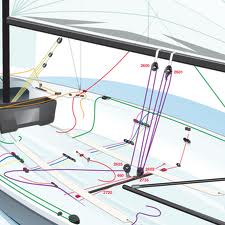
This arrangement requires four pulleys because one loses the leverage of a boom-end mainsheet. The Mirror mainsheet is very simple. It is tied to one side of the boat’s transom, runs through a single pulley at the end of the boom and through a pulley on the other side of the transom. It is simple and sensitive, and I much prefer boom-end mainsheets. I developed this preference sailing the Laser dinghy and compared the leverage and control I had with the rope-burn and heaving you have with centre sheeting.
In my boat, after the pulley on the transom, I then run the sheet through a centre pulley just aft of the centreboard. This avoids the mainsheet interfering with the tiller when tacking and gybing. The other advantage of pulling the mainsheet upwards is that when I am hiking for close hauling, I have both the tiller stick and the mainsheet to hold on to, so as not to put all the effort into my tummy muscles. The disadvantage is that the rope running from the transom to the centre block can cause rope burn to the feet and shins, and they take a long time to heal. I have to get my legs over the rope so as not to touch it as it runs.
The length of my mainsheet is 7 metres or 23 feet.
Here are two boom-end mainsheet rigs. Both are sensitive and comfortable. The first is the traditional Mirror rig.
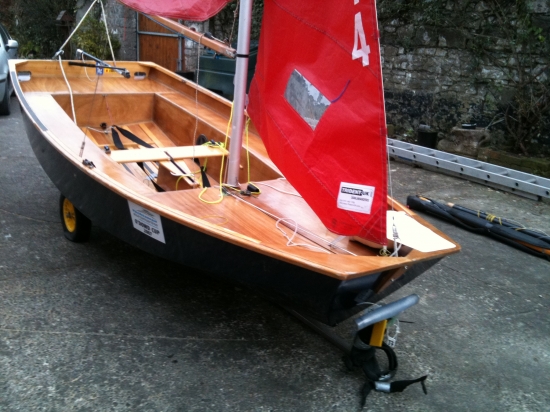
This one is inspired by that of the Laser. It has an independent traveller rope. Using the traveller enables you to get the mainsail into interesting shapes for better efficiency. On bigger boats, the traveller pulley can be locked in any position. In this photo, the Laser influence goes much further, in the possibility of tightening the traveller rope with a pulley system and a cleat. It is a neat setup.
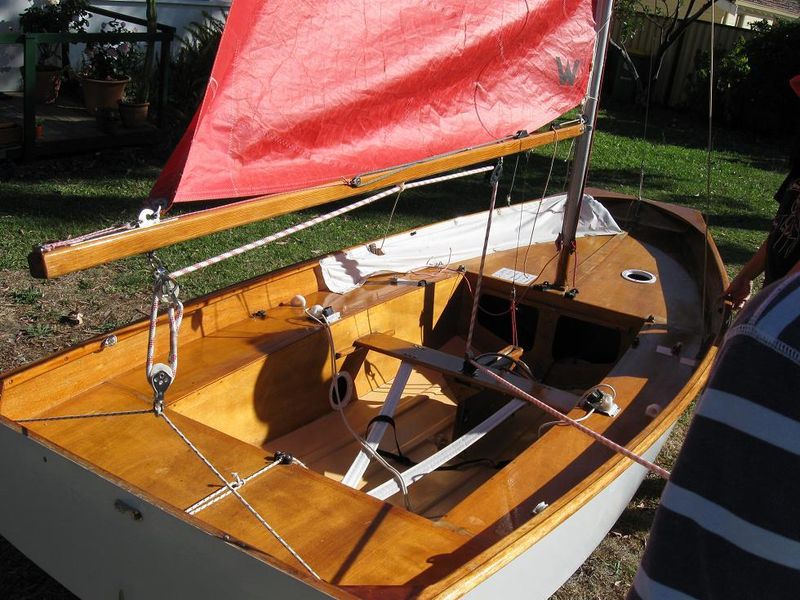


 The Blue Flower
would love to see a photo of the transom of the Mirror from inside the boat to see more clearly how you have rigged the bridle/traveller and block and how it leads to the jamcleat on rear deck. Best Mark
This is the standard way of rigging a Mirror.
My rig 2/3 along the mast. Start from the mast, go through a pulley fixed to the hull under that point (centreboard casing or bottom of cockpit), through a pulley on the boom a little astern, then through a second pulley on the hull. Then find a practical point to cleat it so as not to have to hold the sheet in your hand all the time.
Thank you. Yes; very familiar with the standard way of rigging the Mirror. I have owned it a very long time! Its the centre sheeted version I am trying to better understand. I have created an a small extension rear of the thwart to mount a 40mm ratchet block with a cam cleat. From here, the sheet goes to a block directly above on the boom, then along the boom to a sim block at the aft. From here it goes down onto another block mounted on a bridle made of 4mm rope and this is fixed to the transom. The sheet then terminates back on the end boom lock. Its the fixings on the transom I am interested in. The old mirror had a hole drilled for the sheet to terminate. I think the traveler/bridle uses some Stainless Steel eyelets max 500m apart, and is tied to these with 275mm clearance over the tiller. I can see that on some peoples boats they make this 4mm rope adjustable using a jam cleat. This is the bit I am trying to understand better. Thank you!
Sorry to take time to answer this one. Basically, I switched to centre (2/3) sheeting because I use an engine – sheet to the boom, down and through a pulley, up again to a pulley on the boom, down to a second pulley and to a cleat on my centreboard casing. Your system reminds me of the Laser rig. If you are not using an engine, you can adopt the Laser setup with a traveller. https://www.youtube.com/watch?v=vnjIz1KdJ0g On the Laser, the tension is adjustable. These are extremely subtle adjustments for regatta sailing. I have never had a Mirror, only the Mirror rig on a Tabur 320 or a Zef hull. I have never used a traveller system. You can also consider a rigid traveller. https://s30384.pcdn.co/wp-content/uploads/2019/09/marshall_22_3.jpg.