
No, I have not applied to join the Ordinariate! As last time, His Eminence Lord Cardinal de Paluel is not a Prince of the Church, but a buoy half way between Veulettes sur Mer and Saint Valéry en Caux. It is a north cardinal buoy marking the distance from the nuclear power station of Paluel within which boats are not allowed to sail. We have to sail to the north of this buoy.
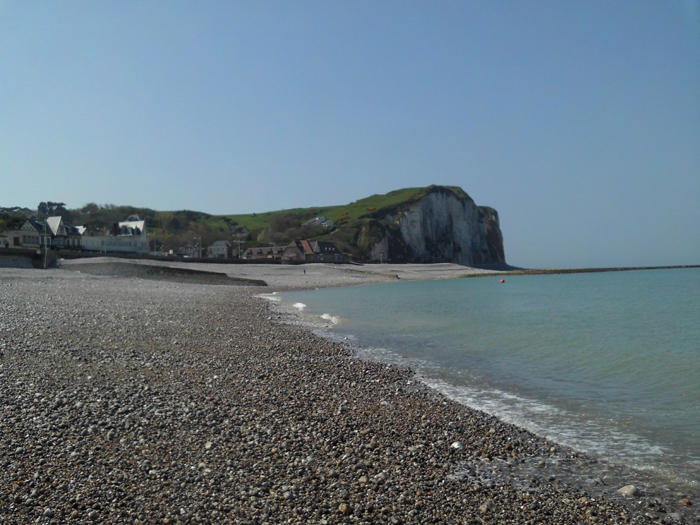 This is the shingle beach of Veulettes sur Mer facing the west cliff and the casino. It is here at Veulettes that I took my first sailing lessons with the school here and the legendary Christophe Falon (who would sail his Laser dinghy in a force 8 gale). Today, the conditions were a beautiful fresh sunny day with a light north-east wind of 7 to 8 knots. The sea was almost flat.
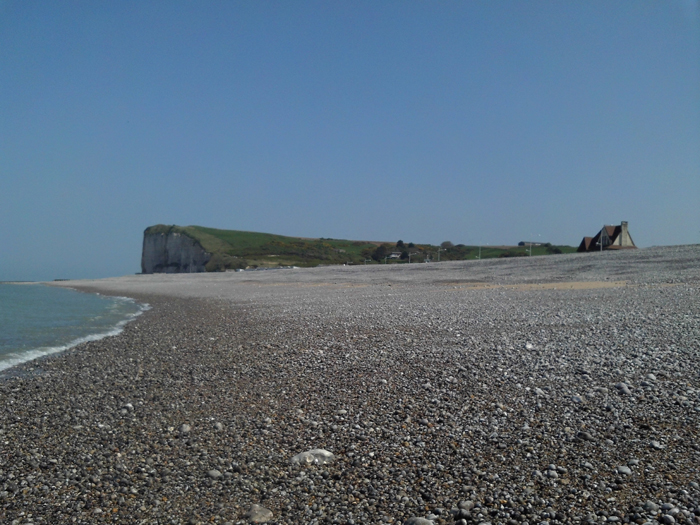 This is the east cliff, looking in the direction of Saint Valéry en Caux and Paluel. I went in this direction against the ebbing tide and upwind.
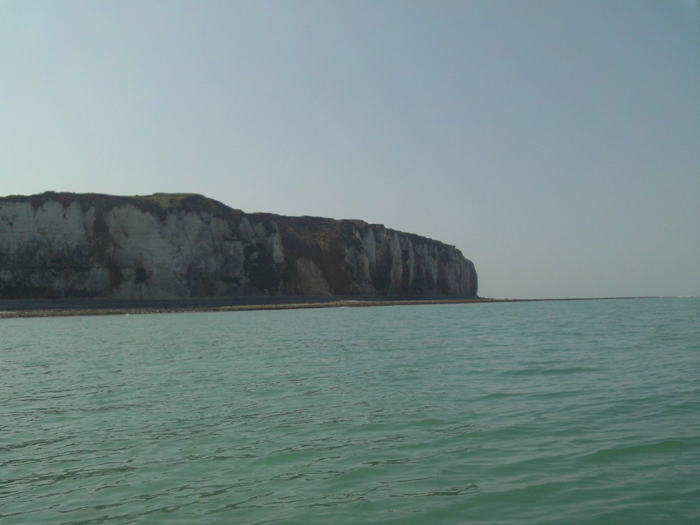 Once I had launched the boat and I was at sea, more of the west cliff became visible.
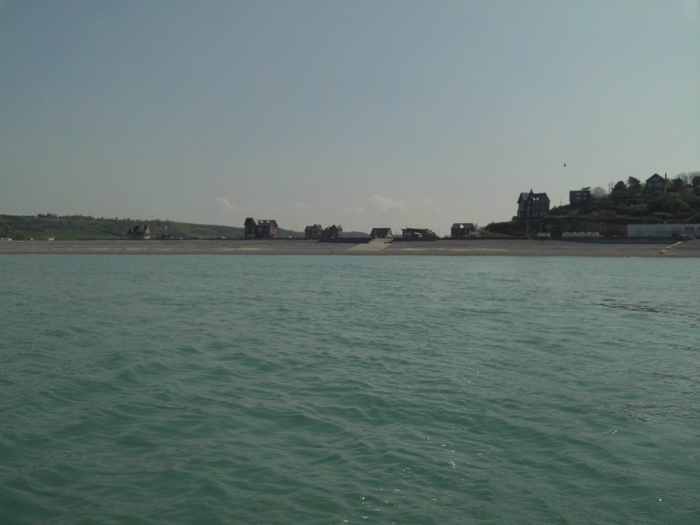 Here I am west of the slipway and downstream, having left the beach on a broad reach. I now needed to get upwind and up-current.
 After having tacked, I was now to the east of the slipway, close-hauled and making good headway.
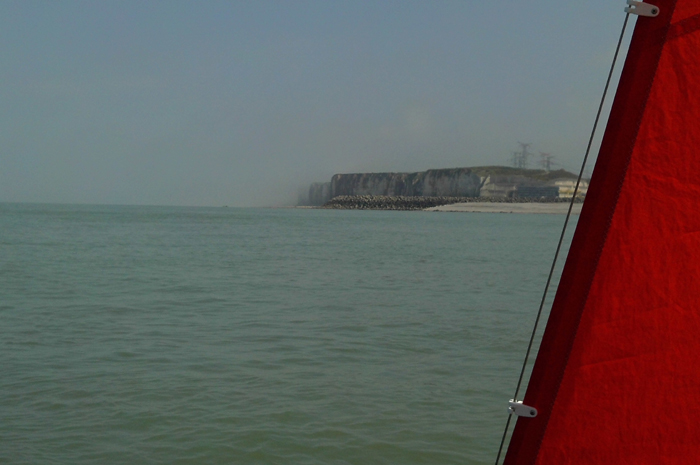 The photo had badly reproduced a sea mist that engulfed Saint Valéry en Caux and remained extremely localised. Behind my jib, the Paluel nuclear power station is becoming visible.
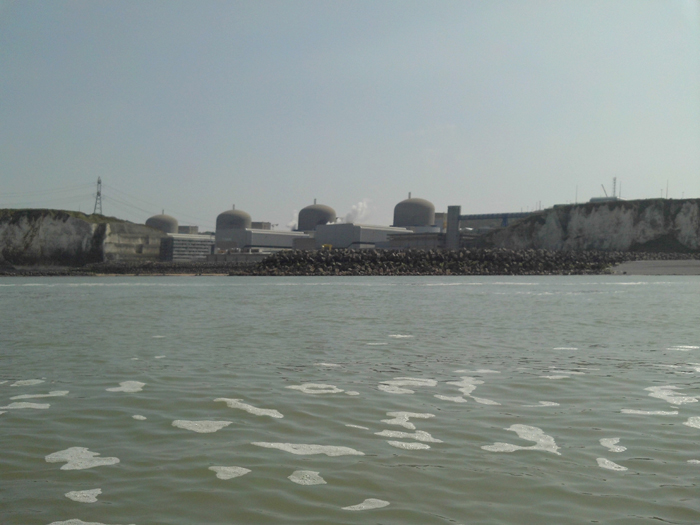 I passed in front of the power station. It turned out that was too close, but I was increasing my distance as I sailed towards the cardinal buoy. The four reactors are clearly visible in their concrete casings. I trusted that the bubbly stuff you see in the water was not radioactive!
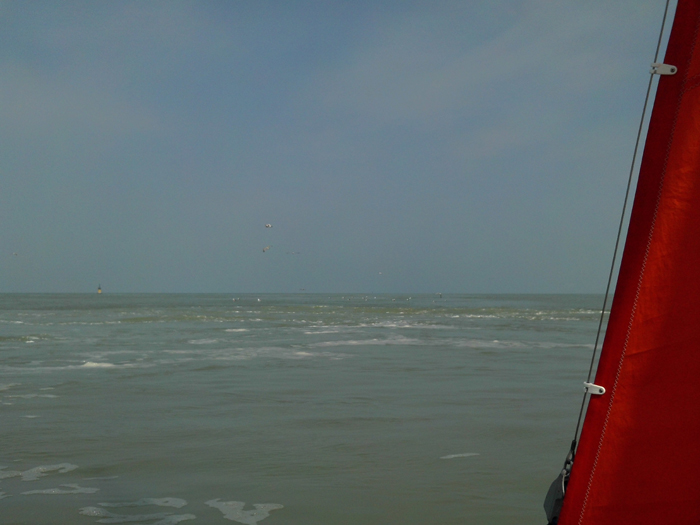 At nearly low tide, here is some very shallow water with strong currents and eddies, quite a little maelstrom to avoid in such a tiny boat as mine.
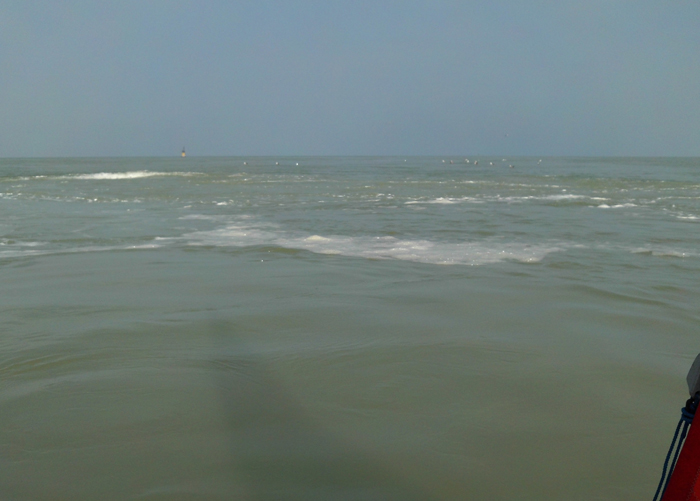 Here I was closer to the disturbed water, and His Eminence is visible on the horizon about one quarter from left to right of this photo.
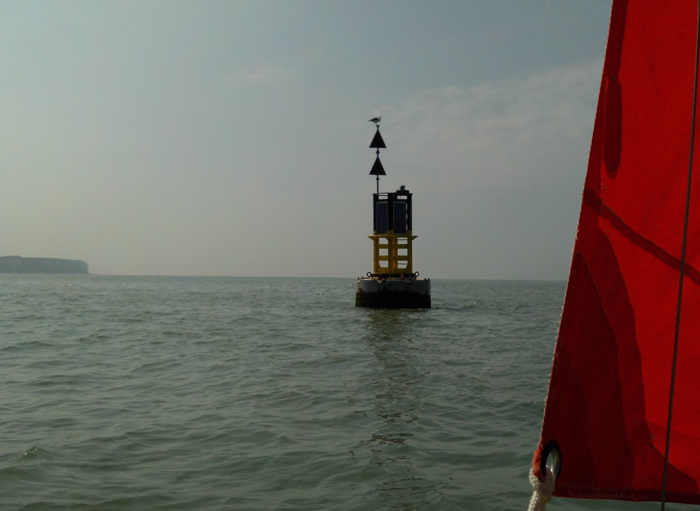 Having passed the cardinal buoy to port, I tacked and went into a broad reach to return to Veulettes by the north of the buoy.
 Here I am in the Sacred Presence of His Eminence. The two arrows pointed upwards indicate that this is a north cardinal buoy.
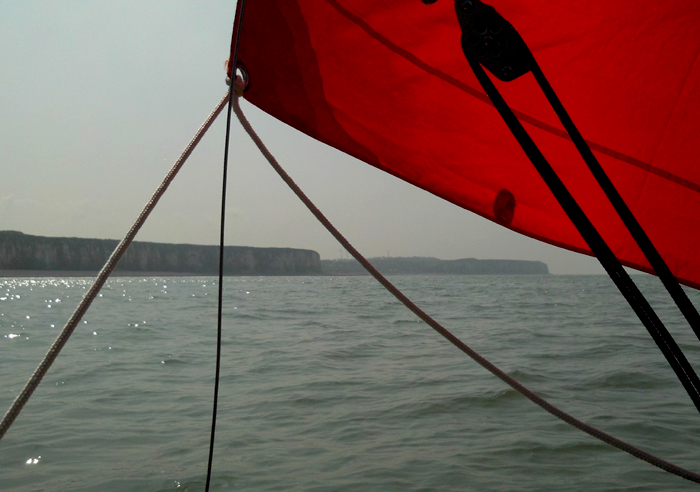 Having taken leave of His Eminence, I returned towards Veulettes.
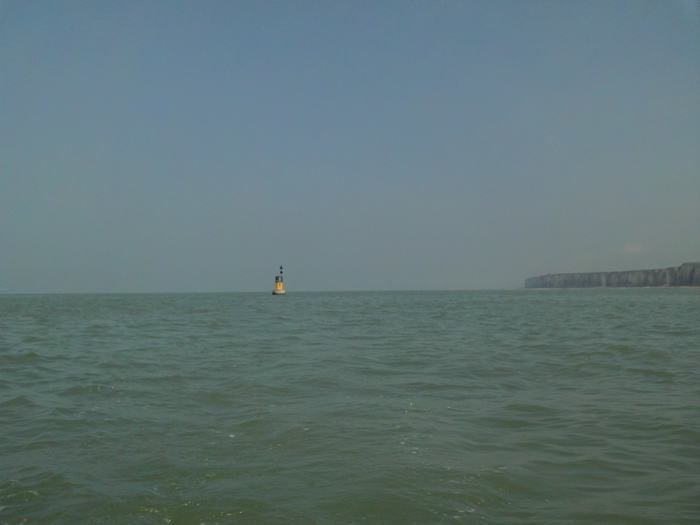 The Cardinal waves goodbye.
Soon after this photo, I was followed by a pneumatic motor boat with a French flag on it – Gendarmerie Nationale. I was sailing too close to the nuclear power station and set off an alarm somewhere. The two young Gendarmes told me that I has been seen in the forbidden zone, and that I should have been north of the cardinal buoy much sooner. I apologised and promised to take greater care in the future. I think I would really have been in trouble had I attempted to land there, because nuclear power stations, understandably, take their security very seriously! So, on I went back to Veulettes in a full reach, and beached just over two hours after launching.
It was a calm and peaceful little cruise in absolutely beautiful weather, though there could have been a little more wind for my sails.
* * *
Addendum: When I related this problem of the zone interdite on an e-mail list of cruising sailors, a kind member mentioned to me that I would have known about the triangular area had I been equipped with my chart. Here is the relevant part.
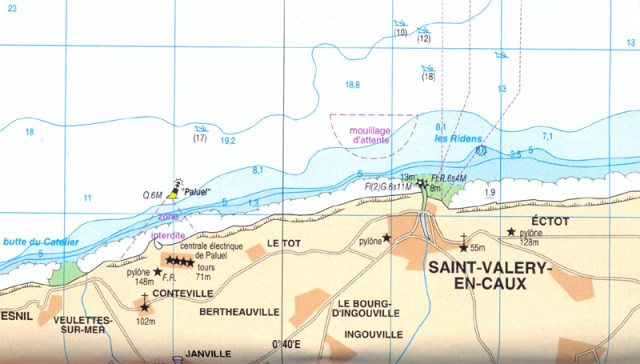
I don’t always use my GPS or maps in my car, for example when I go on known roads and routes. One thing I was unsure about was what defined the boundary other than the buoy, which is a point. Was it a radius equal to the distance of the buoy from the shore? No, the chart is clear. I would have “nicked” off the apex of the triangle whilst on a port tack, and only cleared the buoy after tacking and being on a starboard tack to the north of the buoy (correct position).
Moral of the story: always have a chart on-board even if I don’t need it 99% of the time. My coastal charts are in a handy book which goes nicely into my waterproof plastic drum. One doesn’t need extremely accurate navigation for this kind of coastal sailing, but there are limits.


 The Blue Flower
Ballad of the Goodly Fere
Ha’ we lost the goodliest fere o’ all
For the priests and the gallows tree?
Aye lover he was of brawny men,
O’ ships and the open sea.
When they came wi’ a host to take Our Man
His smile was good to see,
“First let these go!” quo’ our Goodly Fere,
“Or I’ll see ye damned,” says he.
Aye he sent us out through the crossed high spears
And the scorn of his laugh rang free,
“Why took ye not me when I walked about
Alone in the town?” says he.
Oh we drank his “Hale” in the good red wine
When we last made company,
No capon priest was the Goodly Fere
But a man o’ men was he.
I ha’ seen him drive a hundred men
Wi’ a bundle o’ cords swung free,
That they took the high and holy house
For their pawn and treasury.
They’ll no’ get him a’ in a book I think
Though they write it cunningly;
No mouse of the scrolls was the Goodly Fere
But aye loved the open sea.
If they think they ha’ snared our Goodly Fere
They are fools to the last degree.
“I’ll go to the feast,” quo’ our Goodly Fere,
“Though I go to the gallows tree.”
“Ye ha’ seen me heal the lame and blind,
And wake the dead,” says he,
“Ye shall see one thing to master all:
‘Tis how a brave man dies on the tree.”
A son of God was the Goodly Fere
That bade us his brothers be.
I ha’ seen him cow a thousand men.
I have seen him upon the tree.
He cried no cry when they drave the nails
And the blood gushed hot and free,
The hounds of the crimson sky gave tongue
But never a cry cried he.
I ha’ seen him cow a thousand men
On the hills o’ Galilee,
They whined as he walked out calm between,
Wi’ his eyes like the grey o’ the sea,
Like the sea that brooks no voyaging
With the winds unleashed and free,
Like the sea that he cowed at Genseret
Wi’ twey words spoke’ suddently.
A master of men was the Goodly Fere,
A mate of the wind and sea,
If they think they ha’ slain our Goodly Fere
They are fools eternally.
I ha’ seen him eat o’ the honey-comb
Sin’ they nailed him to the tree.
-Ezra Pound
Wonderful photos. A limerick for you:
There was a cardinal in the sea
I saw as he waved at me:
Reactors too near,
I sadly did fear,
As I heard from the gendarmerie
At the risk of fomenting another controversy here, ed, I prefer Pound.
So do I. You were posting the Pound while I was constructing my cute little limerick. It wasn’t meant to be great poetry.
Thank you, Ed, for the thought. Also, Stephen K has written me a lovely little piece. I have often wished I could write poetry, but it seems not to be among my talents. I write prose and I am venturing into a little musical composition, motets and part-songs.
Ezra Pound looks like an interesting character, but I fail to understand how an artist could become ensnared by the ideologies of Mussolini and Hitler, even if he like many of us was disillusioned with capitalism and usury.
Some writings stand up better to critics than others, but the rule in the end would be De gustibus non est dispudandum. I appreciate spontaneous strokes of the pen without any ambition of pleasing the purists. I am flattered to know that my little trip out in my boat inspired – – – poetry!
Bernard and ed have inspired me to pen a little something here:
The sea is a near-smooth pool
Through which my dinghy glides;
Its bow is slicing sharply
Wavelets in the tides.
I see ahead the buoy that bobs
Upon the current in the bay;
That warns the sailors where to pass
And from the station keep away.
There, upon the southern head
Lay brooding, silent Paluel;
Promethean, black and dark
And a gateway into Hell.
My vessel steered too close,
I am ashamed to tell,
I tacked against the wind
To reach that red robed sentinel
Before the station’s vassals
In their cutter caught my flight;
Alas! My fugitive attempt
Arrested t’was, in sight
Full plain, clear, of the Cardinal
Himself, the marker of the drome,
And only after courtesies could
I sail onwards back to home.
Your Eminence, your memory
I humbly ask and pray,
That next time should I sail close by
And passing by your way,
You wink and blink your warning lights
When my dinghy is to lee,
For I am an honest voyager,
And a child of the sea.
I wish not harm to anyone
I seek the open space;
That in the wind and in the waves,
I might upon God’s Face.
dedicated to Father Chadwick
Thank you, Stephen, for such a lovely piece. You reveal indeed your knowledge of the sea and sailing – as well as the Romantic fascination with the Modern Prometheus as it stands as a “gateway to hell” in the cleft cliffs of Paluel. My reflection on passing it – should it explode, I wouldn’t feel a thing as me, my boat and millions of tons of sea would be instantly vaporised. However, nuclear power stations don’t explode like nuke bombs. They go wrong and slowly pollute the earth for thousands of years of the half-life of the plutonium or whatever they use.
My big problem yesterday was getting upwind, which was made easier by keeping close to the shore and tacking out to sea at the last moment before going before the Monster. At low tide, there was quite a current! I think the Gendarmes were decent seamen, because they would have understood that it was a problem of navigation.
Anyway, you captured it all beautifully in this poem.
* * *
Percy Bysshe Shelley (1792 – 1822)