
Today is the feast of the Holy Innocents. Following a message from heaven in a dream, Joseph took Mary and the Infant to Egypt to take refuge, in an image of the First Exile of the Israelites to the same country. Herod ordered his soldiers, like a troop of the Waffen SS, to go into Bethlehem to kill all the little babies in the hope that Jesus the Messiah would be eliminated. At one point in my Mass today, I broke down in tears at the thought of such an evil act, and that such evil continues to our own days. I dried my eyes and continued the Mass.
Most of us think about the scourge of abortion, which quickly becomes a kitsch ideology of people demonstrating outside abortion clinics. Killing the innocent unborn is evil but rarely out of hatred for God and Christ, more for the convenience of the women who make such a decision. It is often more complicated than that and we are then in a harder position to judge the sins of others.
I thought more about the Holocaust, acted to perfection in the film Schindler’s List. Those people were killed out of hatred for God and their belonging to the Chosen People of Israel. What a paradox that Hitler who commanded all that through his henchmen was a talented artist!

He failed to get into the Vienna art school and art critics would have something to say about this and other works. Strangely, after Germany’s defeat in 1945, many things about the Nazis became taboo, but not Hitler’s art. What happened? It certainly brings a new element to the mystery of evil.
Something else occupies my mind, the Jena philosophers, the nest of German Idealism and Romanticism. I recently acquired Andrea Wulf’s Magnificent Rebels: The First Romantics and the Invention of the Self.

It appears to be a well-researched work and sources (mostly from private letters) are cited. The reader (at least me) gets the impression of going back in a time machine to the 1790’s in a small medieval town in eastern Germany. The period covered is very brief, up to the 1800’s (Novalis died in 1801) and the dispersion of these personalities to other cities like Leipzig and Berlin. How many other towns of 800 houses and fewer than 5,000 inhabitants attracted minds like Johann Wolfgang von Goethe, Johann Gottlieb Fichte, August Wilhelm Schlegel, Friedrich Schelling and Friedrich von Hardenberg (Novalis)? These and a few others constituted what Wulf calls the Jena set.
As I began to read (I am presently only half-way through the book), I was deeply impressed, especially by the more mature Goethe. Schlegel and his wife Caroline were translating Shakespeare’s plays into German verse. Fichte and Schiller worked on a theory of the Ich, a highly complex explanation of the relationship between the human subject and the natural world and other people. Schelling and Novalis sought to improve this theory whilst reducing the dualism between “myself” and the “other”. This dualism would be overcome by the union of the subject with nature by beauty, art and poetry. This would form the essence of the Romantic mind in its rational study of nature, yet in the light of the creative imagination.
Unfortunately, much was spoiled by the arrogance of young minds thinking they were the “chosen ones”. They were inspired by the French Revolution, at least its pre-Terror phase. So was Wordsworth with his Bliss it was in that dawn to be alive But to be young was very heaven. They began to argue against each other. This idea of the Ich seems to have gone to their head as happens today with our young people staring at their mobile phones and resisting authority. Despite this, Goethe, Schiller and Schelling remained friends. They exchanged ideas together. Schiller’s letters On the Aesthetic Education of Man would form a basis for this generation of thinkers, who called themselves Romantics. The simplest explanation of the term Romanticism would be the French word for the novel, a fictional work – un roman. A novel is entirely the idealistic creation of its author projecting ideas onto objective reality.
Of all these early Romantics, Goethe was passionate about science. He was particularly fascinated by Galvani’s discovery of electricity and its effect on living and dead animals. It is no coincidence that Mary Shelley applied these theories and experiments to her romantic creation, Frankenstein’s monster, made from pieces of dead human corpses and brought to life by electricity.
The Jena set broke up in 1803, and Napoleon’s army arrived in Jena in 1806, plundering the town and setting fire to buildings.
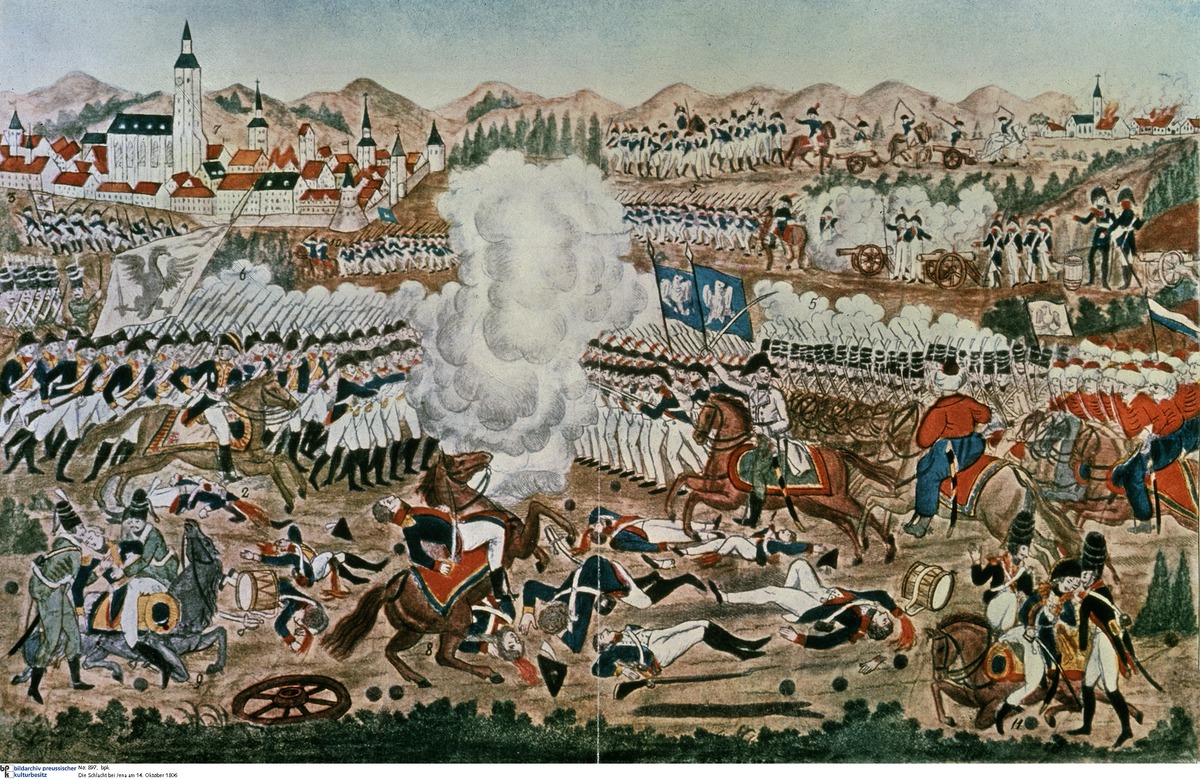
The French defeated the Prussian army and the victorious emperor slept that night in Goethe’s bed! Fichte admired the French Emperor and began to think about an Ich of a nation. Certainly this Ich filtered down through the decades to Nietzsche and his Ubermensch. The book ends with this devastating battle, which is something of a spoiler for me, as I have not yet got to the end of the book. I read in reviews of this book that Wulf traces the influence of the Jena set on the English Romantics, Coleridge in particular – and then the American transcendentalists (Emerson and Whitman) and the psychoanalytic theories of Sigmund Freud and C.J. Jung. Indeed, there is much discussion about the downside of individualism of the young and in society to the detriment of social and collective life. I hope to work a little on that development to “save” something of the individuated person in the face of a world that reacts to the side of collectivism away from liberal democracy.
Like Novalis’ life cut short by TB, the Jena movement was so short-lived. We leave Wulf’s pages realising that we are looking back 220 years into history. Death has covered everything of that era except the monuments, works of art, pieces of music and written documents and works from those men. Did the human imperfections, which were not the evil of men who slaughtered the Innocents of Bethlehem or millions of innocent human beings in the early 1940’s, merit the obliteration of their works and beauty through which they sought redemption? Wulf postulates that we are all Romantics in 2024. Let us not confuse the vitality of the idea with its kitsch. To quote from Rob Riemen talking specifically about politics:
In a kitsch society, politics is no longer a public arena for serious debate on what a good society is and how it can be achieved. It has become primarily a circus where people try to gain and hold on to political power and a public image.
If everything is to be judged by its reductio ad absurdam, we would have done better to stay in the Stone Age! Better still, we all become Woke and be done with it. Cancel everything! In regard to Wulf, I withhold my judgement until I finish the book and think for a few days. Perhaps we might see a parallel between Andrea Wulf as a young single mother and Caroline Schlegel who divorced and remarried with Schelling.
I began with the theme of evil and beauty, and close with an idea of sinful human weakness and beauty. We are all called to die one day and we all face God’s judgement. Hopefully, we will have produced something lasting that can be left to humanity, something beautiful, true and good.
To suffer woes which Hope thinks infinite;
To forgive wrongs darker than death or night;
To defy Power, which seems omnipotent;
To love, and bear; to hope till Hope creates
From its own wreck the thing it contemplates;
Neither to change, nor falter, nor repent;
This, like thy glory, Titan, is to be
Good, great and joyous, beautiful and free;
This is alone Life, Joy, Empire, and Victory.
Percy Bysshe Shelley, Prometheus Unbound


 The Blue Flower
Thanks for this! I know too little about them all, and seem so far only to keep meaning to read more of them (mostly in translation, dodgy as my German is)…. I wonder if Wulf has much to say about the creepy Hegel – one of whose letters in translation his English Wikipedia article quotes about seeing Napoleon enter Jena on 13 October 1806, the day before the Battle of Jena: “I saw the Emperor – this world-soul – riding out of the city on reconnaissance. It is indeed a wonderful sensation to see such an individual, who, concentrated here at a single point, astride a horse, reaches out over the world and masters it.”
I grow ever more fascinated by the ‘Anglican’ attention to the Holy Innocents – having by good hap just first listened to the LibriVox audiobook of Arthur Machen’s “The Happy Children” on the Feast – and seeing a connection with his other Great War story “The Monstrance”, about which I have commented in a new online edition at the Darkly Bright Press website. And there is Elizabeth Goudge’s “By the Waters of Babylon”. And in how far behind them both William Holman Hunt’s ‘Triumph of the Innocents’? And then there are Charles Williams’s remarks, including those in chapter five of The Forgiveness of Sins: “In the old Rites the blood of the offering and the consequent forgiveness had been separate things; their connection had been, or rather had seemed, almost arbitrary. It may be, because of it, that the whole animal creation has indeed a greater place than we know; the feast of the Holy Innocents ought perhaps to be thought to include those calves and goats and bulls who died, unknowingly, too soon, and, unknowingly, for vicarious satisfaction. They were symbolical? alas, they were living! they were of less value? we owe them still their own; they were sacrificed by command of the Will? it may be that the Will recollects them, and it was not perhaps without reason that it was forbidden to the faithful of the Old Dispensation to eat the blood; it was not safe until their Maker had also given us his. If that great Feast of the children who also did not will to die, and did not know for whom they died, and yet have been canonized because of that ignorant death—if that feast cannot be extended to include the sacrificed beasts, then it might not be altogether a useless act of devotion to God if the Church recollected before him one day in the year the irrational innocents who also died. He certainly whose sacred blood was not without relationship to theirs may have recollected them when he concluded their blood with his own, when the veil of the temple, behind which the mystery was wrought, was at last rent; and all was exposed—sin and repentance and sacrifice and pardon.”
I was grateful back in the day to be connected with British ‘Anglicans for Life’ in their opposition to the hyperindividualized technically-sophisticated mass slaughter of unborn embryonic as well as fetal human beings, but have gotten out of touch – a quick check suggests they have been largely succeeded by the international U.S.-based organization of that name.
Thank you for these notes. I am a little further advanced with Wulf’s book and have now “lived” through the tragedy of the end of Jena and Napoleon’s victory. He “met his Waterloo” in 1815 after having been defeated in Russia in 1812 (cf. Tchaikovsky). Hegel seemed to have rejected the Ich ideal and returned to 18th century classical rationalism, combining it with the godless ideas of the French Revolution. I live in France and have a French passport, but I have never been a fan of Napoleon.
Thank you also for your reflections on the Holy Innocents, a whole chapter that needs study.
I have never been involved in anti-abortion activism. Abortion is always sinful but there are often mitigating circumstances: extreme deformities in the embryo, illness of the mother, rape, circumstances in life causing an intolerable degree of poverty for the woman, lack of child care making it possible to get a born child adopted and saving his/her life. I hate the spirit of political activism, its fanaticism and intolerance.
Just caught up with Gregory DiPippo’s interesting “St. Thomas of Canterbury 2024” post largely about “the earliest known musical composition that refers to St Thomas” – not yet martyred, but with King Henry referred to in these terms “Herodis namque genitus / dat ipsam ignominie” with Gregory DiPippo commenting “King Henry is described as ‘a son of Herod’, because he drove Thomas into exile, as Herod did the Holy Family. But perhaps the unknown author intuited what would eventually come of Henry’s importunity against the Church, since, just as the words of Jeremiah were later revealed to be a prophecy of the Massacre of the Innocents, so also ‘the son of Herod’ would wind up having Thomas killed on the day after their feast.” When it came out, I loved Denis Stevens’s LP Music in Honor of St. Thomas of Canterbury – which I now find uploaded on YouTube with a very different performance of “In Rama sonat gemitus” than that linked at New Liturgical Movement – but if it had text and translation, I do not remember being struck by this memorable characterization of Henry.