

I stumbled across a video and an article about a French diocesan bishop expressing his views of traditionalist Catholics and a need to keep a close watch over those who celebrate and follow the old Latin liturgy.
Mgr Jordy: l’ignorance et le mépris in Renaissance Catholique, and this video: Un Evêque contre les Tradis.
Mgr Jordy is the Bishop of Tours, that lovely city sitting astride the great Loire river with a splendid medieval cathedral. Like many politicians of the Left, the ideal is a managed deconstruction that is imposed from above onto οἱ πολλοί or the unwashed masses. I can fully understand the criticism of this attitude by the traditionalists, sick as they are of decades of cognitive dissonance between the Papal and episcopal authority in the Church on one hand and the spiritual and human vocation of the Church as a religion in the meaning of re-ligare on the other. The Bishop of Tours singles out the late Jean-Marie Le Pen as the figurehead of wrongthink rather than taking a more critical position in regard to the progressive islamisation of Europe and street violence.
He with Archbishop Lebrun of Rouen are charged with the responsibility of liaising with traditionalist communities, especially the Fraternity of St Peter – and the Society of St Pius X at a greater “sanitary” distance. The traditionalists denounce a despising attitude rather than a more becoming pastoral view, enclosing them into predefined stereotypes and categories. I have been in France for a long time, and I was a Roman Catholic between the years 1981 to about 1998 when I ceased to have any canonical relationship with Rome and my former superiors. My first contact with French traditionalist Roman Catholicism was the famous Fr Montgomery-Wright in his little country parish in Normandy and the Society of St Pius X. From 1984 until 1985, I was a pre-seminarian in the Archdiocese of Paris, in a relatively conservative environment under the direction of Fr Eric Aumônier who later became Bishop of Versailles. I had come a long way from York Minster and the Anglo-Catholic parishes of London! What was this opposition between the official Roman Catholic bishops and this equally cold and mechanical traditionalism?
A part of these issues could be explained – very partially – by the bitter experience of France under Nazi occupation from 1940 until the liberation in 1944. There was also the role of General De Gaulle and the Algerian War, the weakening of France as a colonial power. There was also the collective memory of the French Revolution, Robespierre’s Terror, a highly unstable nineteenth century, the clash of Liberalism and Integralism, anti-clericalism and the separation of Church and State, so many tremors and quakes in a relative short period of history. In our own times, the mind-virus “woke” is less explicit in France and other European countries than in the English-speaking world, but it underpins left-wing politics in both the secular world and the Church. The philosophical roots are broadly cultural Marxism and the deconstructionism of Derrida and others. There are conspiracy theories, maybe conspiracy realities, which I will not attempt to discuss here. It is above all a pseudo-religion that takes inspiration from the most decadent aspects of Christianity like compassion in opposition to masculine power.
As a young man swimming in this ocean of ideas and attitudes in the 1980’s and 90’s, I understood little until I went to Fribourg University and was encouraged to read many works for my studies and my mental health. I have already mentioned Nikolai Berdyaev who aroused my interest in German Idealism and Romanticism. I was drifting away from Thomist scholasticism. I still had my two years of seminary at Gricigliano before me, but I was protected by having done my curriculum of theological studies. My superior noticed certain books in my room, Baron Von Hügel and Tyrrell for example, but passed over them in silence. I do believe that my epistemological scepticism and idealism gave me something that enabled me to survive aspects of French traditionalist Catholicism that I had not been able to identify. For many shallow-minded people, being anywhere other than the hard-left made one a reincarnation of Hitler. I have studied Nazism and Fascism from a historical point of view, and can attest that those ideologies are dead. Analogies and attempted revivals exist, but they are very marginal and are not a part of traditional Catholicism. I was protected against the hardness of the Petrusbrüderschaft (Fraternity of St Peter) and Ecône by being in the Italian baroque surroundings of the Villa Martelli. There was something missing in my understanding of traditionalist Catholicism – Nietzsche.
Friedrich Wilhelm Nietzsche (1
This article exposes this view quite clearly – Between Christ and Anti-Christ
Nietzsche rejected Christianity in The Anti-Christ:
Christianity is called the religion of pity.—Pity stands in opposition to all the tonic passions that augment the energy of the feeling of aliveness: it is a depressant. A man loses power when he pities. Through pity that drain upon strength which suffering works is multiplied a thousandfold. Suffering is made contagious by pity; under certain circumstances it may lead to a total sacrifice of life and living energy—a loss out of all proportion to the magnitude of the cause (—the case of the death of the Nazarene)… Mankind has ventured to call pity a virtue (—in every superior moral system it appears as a weakness—); going still further, it has been called the virtue, the source and foundation of all other virtues—but let us always bear in mind that this was from the standpoint of a philosophy that was nihilistic, and upon whose shield the denial of life was inscribed.
To quote the author of this article, “Nietzsche saw Christianity as a fundamentally nihilistic credo that exalted a slavish and life-dampening morality, eventually turning its values into a world-historical force“. He saw the continuation of the discredited and dead Christianity in “political liberalism, democracy, and socialism”. He aspired to an aristocratic (rule by the best) superiority over the “herd morality of the masses”. I am intrigued to find mentions of Jordan Peterson in this context. The resurgence of nationalism and populism are taking a developed form in this beginning of the twenty-first century, but I recognised these tendencies in French traditionalist Catholicism in the 1980’s. Nietzsche seems to have become the instrument by which the Knight would save Christendom from Communism and this so-called “woke” ideology. I too have been impressed by notions of the aristocracy of the spirit in Berdyaev and modern thinkers like Rob Riemen, but it is something other than Nietzsche.
We are not called to adopt Nietzsche’s ideas, but rather to take them as a criticism of the aspects of Christianity that cause it to lose its inner vitality and credibility. He saw in Christianity a slave morality, a foundation of weakness and passivity, compassion, humility and pity. He admired the Old Testament for its narratives of strength, power and nobility, but saw in the New Testament a Christ of failure, weakness and slavery. Christianity would infantilise us and make us dependent, and would oppose hierarchies of merit, rank and distinction. Humans could only grow and thrive under challenge and hardship, a kind of stoicism and British stiff upper lip idea. The will to power is a drive to overcome obstacles and to achieve greatness. All that is appealing and something I encountered during my English public school education – competition and the culture of sport. The best is the winner and first past the post – and to hell with the losers and others! As a schoolboy, I found the notion appalling. I would never make a good recruit for the Army or become a footballer. Is bestial competitivity the mark of humanity, like wild animals in the jungle? Do we have to come to terms with the idea that mankind has to have wars from time to time on pain of nihilism or loss of meaning to life? However, I would agree that we have to get out of the comfort zone and push ourselves towards an ideal. There is not only sport and physical excellence. There is also art and music which requires work and self-sacrifice to achieve the desired result. There is also the vocation of the physician whose mission is to care for the sick and injured through scientific research and its application.
Certainly, what is truly slave morality in Christianity and modern social justice movements shows itself in resentment and a desire to tear down the powerful and successful. The oppressed (or those who imagine themselves to be oppressed) claim moral superiority over the strong white heterosexual male. At the opposite pole we have the figure of the master, the one who whips the slaves to make them work harder – or simply the one who has achieved. I am old enough to remember the recreation we had at my junior school in Ambleside. We went each day to Millan Park where there were (are) large rocky outcrops. We would climb up onto them and we would dare each other to jump off them, a height of about twelve feet or three metres, high enough to get badly hurt. I doubt whether modern health and safety standards in education would allow a school to tolerate such games. I took this photo in about 1969 or 1970. I am thankful to have more than mere memories.
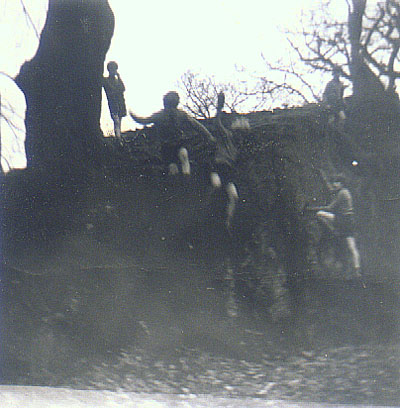
I took up the challenge and did the jumps. The trick was to keep the legs flexible and bent, falling and rolling over like paratroopers on hitting the ground. I don’t remember any boy breaking a leg or an arm. It was better than fighting or bullying! We also had our football game each Wednesday in the same park. My schoolmaster’s report about my participation was “He has a go“, a diplomatic way of saying useless at football but with a positive will. Dr Arnold who was headmaster of Rugby in the early nineteenth century (cf. Tom Brown’s Schooldays) put emphasis on sport precisely to combat bullying. Excellence doesn’t have to be at the expense of the weaker people!
We need some exposure to hardship and danger to become strong, independent, and creative. Modern obsessions with safety and comfort stifle our potential and cultural life. There is a via media involving responsibility of parents and teachers. I have always had a great admiration for Scouting and Sea Scouting. Have your children go to a sailing school and have them learn to challenge the sea and nature. Mountaineering is not competitive except against one’s own fear and weakness. That is the way to go.
Nietzsche’s biggest problem was Christ’s Passion and crucifixion, but this was a superficial understanding of this central mystery of our faith. Christ’s Passion is not a triumph of weakness over strength, but strength expressed through service to others in the place of domination and competition. Is not each one of us weaker than another? Finally, the Paschal Mystery surpasses these considerations in the metaphysical transformation of death into life.
Mors et vita duello
conflixere mirando;
dux vitae mortuus
regnat vivus.
There is a point at which Nietzsche comprehended the Christian message. We have to embrace suffering to transcend it and find personal growth. This dimension is present in Buddhism and most of the world religions. We must go beyond our limits of comfort and safety to find enlightenment. What we can learn from Nietzsche is that his criticism of Christianity, though badly founded, would enable us to see clearly in regard to modern political movements that grew as kitsch pastiches and caricatures of Christianity and insipid pietism. Such movements would hide their resentment and lust for power in a language of claiming justice and equality.
Central in Nietzsche’s philosophy was the notion of the will, the will to power. It is a frightening concept when you are faced with it. The will brings us resilience, courage, and creativity, the best of ourselves. Voluntarism is a part of philosophy. In medieval philosophy, it is associated with Duns Scotus and William of Ockham. It emphasises the divine and the human will over the intellect (voluntas superior intellectu). It took particular importance in the Jesuit order.
We have a text by St Ignatius of Loyola from 1553, the Letter on Obedience. That text said in Latin: “Et sibi quisque persuadeat, quod qui sub Obedientia vivunt, se ferri ac regi a divina Providentia per Superiores suos sinere debent perinde, ac si cadaver essent” which can be translated as “We should be aware that each of those who live in obedience must allow himself to be led and guided by Divine Providence through the Superior, as if he were a dead body”, – perinde ac cadaver. The idea is terrifying, but an open mind would interpret it as largely rhetorical to emphasise the need for obedience to a superior in a religious community. No one would reasonably think that a Jesuit would execute an order to kill a hundred people and believe it not to be sinful! The idea is nevertheless as radical as the authentic monastic vocation. Such a notion descended to the level of the Führerprinzip of Hitler and murderous SS officers in concentration camps claiming at their war crimes trials that they were only obeying orders. It is dangerous even if the foundational idea is radical in Christian spirituality.
I will now come to the real subject of this posting, the possible influence of Nietzsche in the positioning of traditionalist Roman Catholicism in relation to the “woke” and deconstructionist Left. I watched the video of the French layman denying that there was any ideology defining traditional Catholicism to argue against a left-wing bishop charged with keeping a watch over the “far-right”. The subject of virility came up as the presenter showed his baby child, a symbol of the Catholic family and his role as husband and father – and he is right. For me, it is just a question of proportion. I have been a hanger-on with the Society of St Pius X, a pre-seminarian in the Archdiocese of Paris in the days of Cardinal Lustiger, a seminarian in Rome in a conservative American community, a student at Fribourg, a seminarian surrounded by the fineries of Gricigliano. I was often confronted by this notion of la Volonté, the power to get things done. A notion that went with will was stability. Once you are fixed by the exercise of will, you never change again. Immobilism is more important to becoming aware that a mistake has been made and something needs to be done to preserve my integrity as a person. To break that stability is its opposite – instability. It would only be in 2018 that I sought a psychiatric examination to investigate the possibility that I had Aspergers autism, a condition that takes incoherence and bullshit with great difficulty, even more the acceptance of a notion of will over intellect. Any variation from Communist dogma in the Soviet Union was also called instability.
Priests and seminary superiors can be more or less moderate with any and all of these notions. Without will, a person will not get anything done, especially if it is a notion of duty which brings no pleasure as a reward. Similarly with sticking with something constantly over time, unless the alarm bells go off to warn us that we are doing the wrong thing. These aspects of humanity can be exploited and turned into weapons of manipulation. Some people are genuinely devoid of will and are unstable to the point of not being trustworthy. In some cases, this can be caused by mental illness, or simply by a need for a kick up the backside!
Perhaps I am looking in the mirror. Perhaps. I see scenes of large groups of youngsters at pilgrimages and scout camps, seminarians singing the Office in their community chapel. Personally, I have been hurt by collectivism united by will and stability. I am through with it all, but I don’t have the authority to judge. I just have to see it all with a sceptical mind of a person who has changed over the years. I have no sympathy for the system, the Blob, the Machine, call it what you want. Nietzschean masculinity also leaves me cold and sceptical, knowing that the best are not motivated by power or competition, by money even less. No devout Catholic would admit to being influenced by Nietzsche the atheist and apostate! But the ideas are borrowed and exchanged.
This is something I noticed in the Church of England of my childhood and the existing Continuing Churches. This emphasis on masculinity and will to power is not a part of our world. The bishops of my Church (Anglican Catholic Church) have been accused of weakness in dealing with a priest who was highly motivated by Nietzschean ideas behind his political opinions and activism. I am very happy to be in a Church where we are conservative about morals, the sanctity of human life and Christian doctrine, but we are open-minded about purely political matters. As priests, we are called to be quiet parish pastors, teachers and contemplatives. I have nothing to prove to anyone. Only to God. I know where I am weak and where we are strong.
When I left my marriage, my sister who is a person of absolute integrity, kindly wrote this in April 2021:
You have finally arrived and how amazing you have been: your forbearance, tolerance, honesty, strength of mind and resilience. You might feel exhausted and broken right now but the future is full of hope.
I come out of it all as a broken fool for Christ, but with hope of rebuilding my life as a priest of the catacomb church here in Europe. Where is true strength and power found? I simply look at last Sunday’s Epistle of St Paul (2 Corinthians 12):
He said unto me, My grace is sufficient for thee: for my strength is made perfect in weakness. Most gladly therefore will I rather glory in my infirmities, that the power of Christ may rest upon me. Therefore I take pleasure in infirmities, in reproaches, in necessities, in persecutions, in distresses for Christ’s sake: for when I am weak, then am I strong.


 The Blue Flower
I attended St Stephen’s House where Fr Robinson trained for the priesthood. I, on the other hand, was training to be a teacher and the place was obsessed with all the various hierarchies that crossed there – ecclesiastical, academic and professional – the Principal flew his heraldic banner on certain feast days!
I thoroughly disliked the place and even Oxford itself. It was a pressure cooker of a time for myself and even the academic aspect was shallow and disappointing.
Fr Robinson did not attend when I did (and I was only there for one year in 2015/16) but he has the Staggers’ stamp – love of hierarchy tinged with coldness and a last-resort-pragmatism. I’m not surprised he did not last that long in the ACC. I think he may well have a priestly vocation (he’s been quite determined at getting ordained and having some sort of official ministry) but it seems irreconcilable with his political ambitions. Perhaps he will one day decide which means more to him.
One forgotten detail about Oxford is my friendship with the late Dr Ray Winch (https://sarumuse.org/?s=winch) who had taught for many years in a school, converted from Roman Catholicism to Orthodoxy and worked for the cause of Western Rite Orthodoxy. The end of his life was one of disillusionment, attending Latin masses in Roman Catholic churches and finally asking for a funeral without any religious ceremonies. His personality was not an easy one to understand but I sympathised. I went to university in Fribourg, Switzerland, at a time (1986-90) when things were reasonably sensible other than a few hysterically progressive students and professors agitating.
I have never met CR, so I have no way of discerning his “temperature” or lack thereof. Having watched a few videos and read some bits and pieces he wrote in X, I have the impression of an arrogant narcissist who wants to be the boss. Archbishop Haverland did make the point that he expects priests to be quiet and solid workers. Read CR on X. Is it about Christian doctrine and morals? No, it’s politics and shouting at the adverse opinion. I would advise him to go and find a boring and badly-paid job in an English city where housing is unaffordable!