
The voice of God is music – harmony, counterpoint, rhythm, form, inspiration – a whole language that words alone cannot convey. Music can be an instrument of revelation, or one of control and evil. I write this little piece with J.S. Bach’s Kunst die Fugue played by Lionel Rogg on the modern baroque organ of Geneva Cathedral. This work was left unfinished at the point where three fugue subjects converged into a climax, and then fizzled out. Lionel Rogg plays the fugue a second time, but with his own composition in a conjecture of what the Master might have written. There is a story going round that two pieces of Bach have just been found in Leipzig. If they are authentic, I hope and pray they will be published so that I can buy a copy.
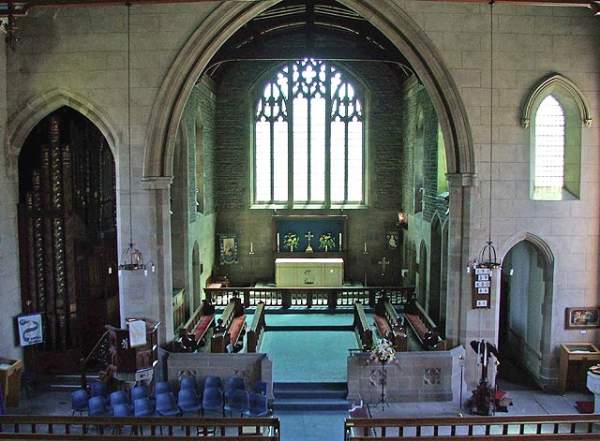
I had the electrifying experience at some eight years of age on going with my family to the Christmas service at St George’s in Kendal, our parish church. There is a large organ in a chamber to the north of the choir. This three-manual organ was built in 1883 by Wilkinson and Sons of Kendal. In 1911 the same firm moved the instrument from its original home in the south gallery to the newly constructed organ chamber. In 1983 it was restored by Rushworth and Dreaper of Liverpool, the successor firm to Wilkinson. The pedal stops vibrated through the floor as this mighty organ accompanied the old favourite carols. The hearty singing by the choir and congregation lifted this little boy to heights from which he would never descend.
I told my mother that the best Christmas present I could ever get would be to learn the organ. The usual thing is for a child to learn the piano, and then move on to the organ from about Grade 4 and when the legs were long enough to reach the pedalboard. We are talking about 1967 when I changed schools and began to commute to Ambleside on the 555 bus from Kendal. We had singing lessons at school given by the organist and choirmaster of St Mary’s Ambleside, that beautiful Victorian church in the middle of Millan Park. We learned songs from the New National Song Book edited by C.V. Stanford, all the old favourites like Early in the Morning just as the Sun was Rising and many others from the English folk repertoire. The lessons were each Friday as Mr Lewis played the piano. My piano lessons were on Saturdays, and my progress was shared with cycling round the garden at home, climbing trees and making things. I still have the adjustable height piano stool I sat on to practice at home.
My mother’s housekeeper Molly gave me her old gramophone with some 78 rpm records, some of light songs and others of classical favourites. The most striking was Tchaikovsky’s 1812 Overture which scratched and cracked under the old steel needle. Unfortunately, the life of the gramophone came to an end when my curiosity for machines and how they worked came to the fore. I dismantled it and was unable to put it back together again. After a couple of years, I got given a cheap transistor radio and a cassette player from about 1971. That was the year when I was 12 and my mind was erupting with Captain Nemo playing the organ in his submarine and declaring war against the world ! I have visited Jules Verne’s house in Amiens – and I would have loved to have met him, had we been contemporaries. Unfortunately for me, he has his place in history but I could read English translations of his books and see films made of that inspired imagination. I can now read them in the original French.
At the age of 12, my own mind was erupting with the anger of the Romantics like Shelley and Byron, the fictitious Nemo invented by Jules Verne. I have already written two articles on this theme – The Nemo Syndrome and The Byronic Hero of the Seas. I could have become a very bad boy, except that my father did everything he could to help, have me go on adventure weeks with other boys and attend Wennington School in the hope that being freed from the conformity mould might help me form my own personality and seek good. The following year, in 1972, I went to St Peter’s School in York. There was a real pipe organ in the chapel, and a repeat of that moment at St George’s. No sooner than I had asked the music master, Keith Pemberton, I was having organ lessons with David Cooper (who himself ended up as organist of Lincoln Cathedral before passing away from cancer). His method was certainly the most traditional : scales and arpeggios, simple pieces – but he would also dazzle me by playing flashy pieces by Marcel Dupré and Vierne, and I would watch and turn the pages of his score. The idea was to motivate me, because he knew that this is how I work, not by slavishly following rules and conventions.
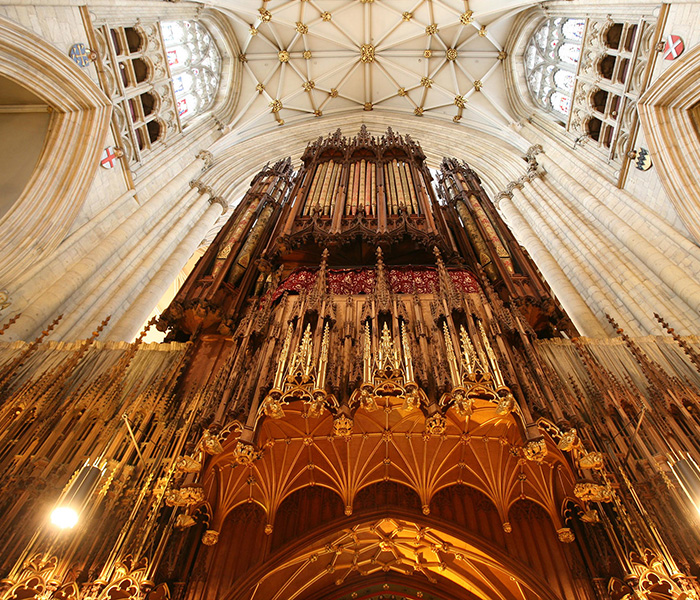
 By January 1973, I had sung in the school choir for the Epiphany Procession in York Minster. These were the days of Dr Francis Jackson and the precious-voiced Dean and canons reading the Scriptures and taking daily Choral Evensong. As with David Cooper at School, the next stage was being in the organ loft with Dr Jackson and hearing his virtuoso playing. My own motivation for learning Mendelssohn’s Third Sonata came from there, and several years later, I had the rare opportunity of playing it on the Minster organ – and used the Tuba Mirabilis, “the big bugger“. Through singing in the choir, learning the organ and going to the Minster as much as possible, within three years, I asked our Chaplain, Rev’d Noel Kemp-Welch for Confirmation. I had begun to relate to prophetic texts from the Bible, to be moved by the Gospel message and to be attracted to spending moments in prayer. Music was my evangelist !
Christianity is a yearning for the transcendent.
O Thou transcendant,
Nameless, the fibre and the breath,
Light of the light, shedding forth universes, thou centre of them,
Thou mightier centre of the true, the good, the loving,
Thou moral, spiritual fountain— affection’s source— thou reservoir,
(O pensive soul of me— O thirst unsatisfied— waitest not there?
Waitest not haply for us somewhere there the Comrade perfect?)
Thou pulse— thou motive of the stars, suns, systems,
That, circling, move in order, safe, harmonious,
Athwart the shapeless vastnesses of space,
How should I think, how breathe a single breath, how speak, if, out of myself,
I could not launch, to those, superior universes?Swiftly I shrivel at the thought of God,
At Nature and its wonders, Time and Space and Death,
But that I, turning, call to thee O soul, thou actual Me,
And lo, thou gently masterest the orbs,
Thou matest Time, smilest content at Death,
And fillest, swellest full the vastnesses of Space.Greater than stars or suns,
Bounding O soul thou journeyest forth;
What love than thine and ours could wider amplify?
What aspirations, wishes, outvie thine and ours, O soul?
What dreams of the ideal? what plans of purity, perfection, strength?
What cheerful willingness for others’ sake, to give up all?
For others’ sake to suffer all?Reckoning ahead O soul, when thou, the time achiev’d,
The seas all cross’d, weather’d the capes, the voyage done,
Surrounded, copest, frontest God, yieldest, the aim attain’d,
As fill’d with friendship, love complete, the Elder Brother found,
The Younger melts in fondness in his arms. Walt Whitman
Two things in my life spoke to me of God, the most sublime of musical composition – and the sea. I would not build a steam-punk submarine with an organ in its saloon, but many years later, I would learn to sail. Don’t talk to me about relevance and the secular / political meaning of Christ. Christ also reacted with anger and feeling against the money-changers in the Temple, the hypocrites among the Scribes and Pharisees, and not least the demons he drove out of a possessed man into a herd of pigs. He was also that kind of tender image of the Sacred Heart, but above all he was a man and God Incarnate. I see him in the poetry of the Romantics.
To suffer woes which Hope thinks infinite;
To forgive wrongs darker than death or night;
To defy Power, which seems omnipotent;
To love, and bear; to hope till Hope creates
From its own wreck the thing it contemplates;
Neither to change, nor falter, nor repent;
This, like thy glory, Titan, is to be
Good, great and joyous, beautiful and free;
This is alone Life, Joy, Empire and Victory. Percy Byssh Shelley
I now understand the way I was as a 12-year old boy struggling against the bounds, the anarchist between temptation and being lifted by beauty and the idea of freedom. It gave me a tumultuous life, but I don’t seem to have come out of it too badly.
Now, back to music, another thing about my younger years, I hated what we called pop music, rock or whatever new labels came about. In the 1960’s, we had the Beatles which was tolerable. The orchestration would be typically a set of drums, a bass guitar, a lead guitar and one or two singers. Sometimes other instruments would be added. The sound of the strings would be amplified and distorted by electronic means. By the 1970’s, this style became ever more brutal and loud. The lyrics of the songs were often without taste or offensive. As the years went by, we had rock, punk, techno and so many other notions to which I remained alien. People listen to this stuff in shops, pubs, other public places, night clubs. It went with the sexual “revolution” and promiscuity. Some priest-exorcists have been so far as to call this noise Satanic. It brings out what is most base and vulgar in humanity, often illustrated by tattoos people have etched on their arms and other parts of their bodies. An attempt to analyse this stuff would reveal the most banal of poetic expression or melody, just boom, boom, boom !
I have refused modern culture all my life. Even here in my little village, people drive past in their cars with this stuff turned up loud. It is a relief when the car has gone away, especially when they have their windows open. I know nothing about the psychological reasoning behind this drug for the ears and every other sense that experiences vibrations.
There is always the spiritual side of this as well. One is always reminded of Plato’s famous quote from Book 3 of the Republic:
And therefore, I said, Glaucon, musical training is a more potent instrument than any other, because rhythm and harmony find their way into the inward places of the soul, on which they mightily fasten…
This is something that is vital for the education of children. Have them appreciate classical works, learn an instrument – orchestral and / or keyboard. Learn about musical theory and history. Most importantly, churches must return to the classical repertoire of church music with choir and organ. The great Monsignor Lorenzo Perosi did so much to make church music sacred again with his Cecelian Movement. So much has been done in the Anglican world since Purcell, William Boyce, S.S. Wesley, Stanford, Elgar, Parry and men like Francis Jackson. The Roman Catholic Church lacks the tradition of Choral Evensong. Of course it has Vespers in places like the London Oratory, but it is rare. The faithful must be exposed to the finest music we can sing, play and compose.
Offer the best, and we can only hope that people will turn away from the noise of modernity.
Soul
But hark! upon my sense
Comes a fierce hubbub, which would make me fear,
Could I be frighted.Demons
Low-born clods
Of brute earth,
They aspire
To become gods,
By a new birth,
And an extra grace,
And a score of merits.
As if aught
Could stand in place
Of the high thought,
And the glance of fire
Of the great spirits,
The powers blest,
The lords by right,
The primal owners,
Of the proud dwelling
And realm of light,—
Dispossessed,
Aside thrust,
Chucked down,
By the sheer might
Of a despot’s will,
Of a tyrant’s frown.
Who after expelling
Their hosts, gave,
Triumphant still,
And still unjust,
Each forfeit crown
To psalm-droners,
And canting groaners,
To every slave,
And pious cheat,
And crawling knave,
Who licked the dust
Under his feet. J.H. Newman, Dream of Gerontius
Music brings brings peace and harmony, in contrast to the incessant noise and hubbub of the modern world. Pop music must be eschewed in the same way as drugs and tattoos. Indeed, Plato warned us 2,400 years ago. The Greeks knew about harmony and natural harmonics of the vibrating string or column of air. Their music was certainly much more developed than we could imagine.
Real music is ordered silence, since harmony follows eternal rules and mathematical principles. I don’t know know what can be done about several generations of pop and rock from my own Baby Boom until now. It is a part of the world taken over by the Archons of noise, stress and anxiety, those same demons who were tempting the dying soul described by Newman.
Perhaps I can end this reflection with Gabriel’s Oboe, the instrument chosen to bring Christ to the Guaraní in those tumultuous years of the eighteenth century and that most virtuous of Popes, Benedict XIV.


 The Blue Flower
Dear Fr. Anthony (and all readers of this site),
I wrote a little note on my Substack site about your Sarum book and your ministry in general. Forgive me, I have the book on my shelves but I didn’t have it with me at the time I write the post and I got the content of the essay muddled up with your Romantic Christianity book. That aside, I hope these few paragraphs do a measure of justice to your life of service thus far.
In Domino,
John Fitzgerald.
This is a lovely book – a long essay on Romantic Christianity followed by the full text of the Sarum Rite of Mass. Please do visit Fr. Anthony’s blog – sarumuse.org – a wonderful repository of reflections and explorations in the things that matter.
Fr. Anthony is based in Normandy and is a priest in the Continuing Anglican communion. By his own admission he’s found it hard to find a place in either the Roman Catholic or Anglican churches. Too many egos, power games, and shinning up the greasy pole. Fr. Anthony’s too awake, too honest, and too clear-minded for such games-playing.
He says that hardly anyone – usually no-one – attends his Masses. That’s a shame, but I don’t think that’s what really matters. His online ministry and his humane, wise, and generous presence – just that alone – is simply invaluable in this darkening age.
Many thanks for your kind comments. The book about the Use of Sarum “A Twitch on the Sarum Thread” is a play on one of the chapters in Evelyn Waugh’s “Brideshead Revisited”. I have sent you both books in pdf format.
I live in the Mayenne, no longer in Normandy, and I am a priest in the Anglican Catholic Church, Patrimony of the Metropolitan under Archbishop Mark Haverland. Yes, life is too short for playing games with narcissists and psychopaths !