Pope’s ID going Viral

Sometimes, I wonder whether people are looking for something to talk about. Pope Francis has obtained a new passport from his native country – BERGOGLIO, Jorge Mario. Well, one might protest, he is the Pope and is supposed to have Vatican identity papers and nationality.

I suppose I’m not the Pope, but here’s mine:

passportI live in France, yet I still renew my passport with the British Consulate in Paris. Yes, I have remained British and I am allowed to live and work in France by virtue of being a national of a member State of Europe. I doubt whether my passport will go viral!

Well, there we are. Pope Francis is Argentinian. What a surprise!

Posted in Uncategorized | 4 Comments

Obituary for Brother Charles Vockler

I simply give the link to the article in the ACC web site and reproduce the text by Archbishop Haverland. I will also celebrate a Requiem Mass tomorrow for him on the day of his funeral.

* * *

While Anglicans across the world reacted with sadness to the news last week of the death of Brother John Charles Vockler, there was also an outpouring of gratitude for a man whose ministry was marked by piety, humility, and a wonderful sense of humor.  His successor, Archbishop Mark Haverland, captured the sentiments of many in the ACC with the following statement:

My esteemed predecessor, Brother John-Charles, the Fifth Metropolitan of the Original Province and Fifth Acting Primate of the Anglican Catholic Church has now entered life eternal.  If he were still a bishop of the Anglican Communion, I believe he would be its senior bishop by date of consecration.

He had a most remarkable life, knowing the late Queen Mother, Mae West, Archbishop Michael Ramsay, Prince Charles, Queen Salote of Tonga, and a host of other folk, great and small.  He was loved by many, and he helped many of us learn to pray better and to love God more.  Given his age and the peaceful circumstances of his death, comforted with priest and sacrament, we cannot be sorry for him.  I had hoped to visit him in May, but that was not to be.  I know you will all remember him in your prayers and Mass intentions. 

May he rest in peace.

Born in Sydney, Australia, on July 22nd, 1924, John Charles Vockler was educated at the University of Adelaide.  In 1948 he was ordained an Anglican priest, and after spending several years in academic posts, was called to serve as Archdeacon of the Eyre Peninsula.  In 1959 he was consecrated assistant bishop in the Diocese of Adelaide.  After four years he was translated to the Diocese of Polynesia, where, as bishop ordinary, he remained until 1969. He later served in an episcopal capacity in both England and the United States.

In 1994 Brother John Charles was received into the Anglican Catholic Church where he served as lecturer at Holyrood Seminary and founded the Franciscan Order of the Divine Compassion (FODC). From 2001 to 2005 he served as Archbishop and Metropolitan of the ACC’s Original Province.  After his retirement as Archbishop, he returned to his native Australia, where he remained until his death.

A requiem mass for Archbishop John Charles will be celebrated in the Chapel of All Saints College, St Mary’s Campus (Grant Street, Maitland, NSW) on Wednesday, February 19th at 11:00 am, Canon Matthew Kirby presiding.  All who wish to attend are welcome.

Learn More »

Posted in Uncategorized | Tagged | 1 Comment

Music & Monarchy

george-firstHere is a magnificent set of documentaries about our British Monarchy and the music our Kings and Queens patronised.

Posted in Uncategorized | Tagged , , | 2 Comments

For at his word the stormy wind ariseth…

I wish to share with you this link to some photos of the sea in Brittany just a few days ago. The Arctic vortex has caused a single storm system that is causing very cold weather in North America and hurricane force storms over western France and the British Isles. We in Normandy haven’t had it too bad – a tree down here and there and the odd tile blown off a roof, but little more.

Last Friday to Saturday night, they called it the Saint Valentine Massacre in England. Here, the roof tiles rattled and the draughts could be felt throughout the house. The wind whistled like a banshee, but we were safe.

My boat has remained high and dry in my back yard under its tarpaulin!

The text on this page is in French, but no commentary is needed to explain the photos, especially the ones of a fishing boat getting back into port, an extremely dangerous manoeuvre in those conditions.

I ask your prayers for all those who have been lost at sea, made homeless by flooding and for others who are still in danger even as the weather calms.

* * *

They that go down to the sea in ships, and occupy their business in great waters;
These men see the works of the Lord, and his wonders in the deep.
For at his word the stormy wind ariseth, which lifteth up the waves thereof.
They are carried up to the heaven, and down again to the deep; their soul melteth away because of the trouble.
They reel to and fro, and stagger like a drunken man, and are at their wits end.
So when they cry unto the Lord in their trouble, he delivereth them out of their distress.
For he maketh the storm to cease, so that the waves thereof are still.
Then are they glad, because they are at rest; and so he bringeth them unto the haven where they would be.

Posted in Uncategorized | Tagged , | 2 Comments

Patricius on Tolkien

My good friend Patricius has written an article about Ronald Tolkien in his blog – Is Tolkien dangerous? Part I…. He has sent me the second part to ask my advice, but I have already had to tell him that I know very little about Tolkien and haven’t yet had the pleasure of reading his books. What I do know is that Patricius has studied this author, read his works and gone into the symbolism.

I would like to encourage my readers to read the article on Patricius’ blog. He wrote me an e-mail some days ago to draw my attention to the article on the traditionalist Roman Catholic blog Rorate CaeliThe fantasy writing of Tolkien was Catholic! Well, not so fast … Tolkien stands accused of just about every heresy including Gnosticism. I could comment on the way that some conservative Catholics imagine to be their duty to protect the world from anything that does not come under their narrow orthodoxy. I think I will leave that to someone who knows a lot more about Tolkien than I.

Gnosticism is often targeted by conservative Catholics and Protestants alike, and I suspect often for the wrong reasons. I have written before on the theme of the “two old testaments”, one being the first part of our Bible, the foundational texts of Judaism and the people of Israel, and the other being the other religions in the ancient world which also prefigured the coming of Christ and the fulness of Revelation and Redemption. There is an “orthodox” Gnosticism in the Alexandrian School, represented in particular by Clement of Alexandria (uncanonised by the Roman Catholic Church in 1586, but still venerated by Orthodox and Anglicans)  and Origen. In this school, we find an allegorical and symbolic way of reading the Scriptures and understanding the “hermeneutic of continuity” between the “pagan old testament” and the Mystery of Christ.

I have often written in the past on Dom Odo Casel, the Benedictine monk from Maria Laach in Germany, who laid new foundations of liturgical and sacramental theology in the twentieth century. His work is greatly admired as a part of the ressourcement movement that includes great names like Ratzinger, Louis Bouyer and Henri de Lubac. Casel was bitterly opposed in the 1920’s and 1930’s by Jesuit theologians pushing the old narrow scholasticism of Suarez and others. Here are three articles of mine in this vein:

After considering this dimension of liturgical Christianity as a mystery religion, or rather the mystery religion par excellence, there was in history another kind of Gnosticism. This word comes from the Greek γνώσις meaning knowledge, not the kind of knowledge we obtain through information, but an inner knowledge of God. It was for the most part persecuted out of existence in the early centuries of church history, and until recently was only known to us through the great adversary of the Gnostics, St Irenaeus of Lyons. Since then, texts have been uncovered, particularly in Egypt, at Nag Hammadi in the 1940’s. Among these texts, whose authenticity as historical documents seems reasonable to accept, we find a number of Gospels that were not included in the canonical New Testament and other writings dating from very early.

We owe our knowledge of Gnosticism to the psychoanalyst Carl Gustav Jung and recent authors like Stephen Hoeller and Elaine Pagels. Bishop Hoeller, of Hungarian origin and now living in Los Angeles, has produced an amazing website. There is a kind of Gnosticism which can be reconciled with classical Christianity only with difficulty. I think it was Nicholas Berdyaev who mentioned that had Gnosticism won out in the early centuries of Christianity, the Church would not have survived. Christianity would only have lasted for a few short centuries before passing into the same oblivion as many other elitist sects of those times. Nevertheless, there are some intuitions in Gnosticism that would bring an extremely beneficial influence to Christianity and its mystical dimension.

Gnosis is the knowledge of transcendence gained by intuitive and interior means, by personal experience. Such experience cannot be described literally, and therefore can be expressed only by means of analogy and myth. Myth is not fiction, something untrue or a figment of imagination, but exactly a means of expressing mystery and experience. The most classical notion of Gnosticism was expressed by Valentinus whose writings give what we know about their cosmology, theology of creation and sin and redemption. It is totally different from what we have learned as Christians.

It begins with the idea that earthly life is filled with suffering and the world is flawed. The big difference is that humans were not at fault for this. The problem came from the creator. In monotheism, the creator is God, and therefore the Gnostic position seems blasphemous. The creator and God are two distinct entities. God is a God above God, ultimate, transcendent and unknowable. This God did not create anything, but emanated everything from himself. Everything is God, a notion we find among pantheists. However, some parts of the divine essence went so far from their source that they suffered changes. These parts became alienated.

Between God and ourselves, there are intermediate deific beings called Aeonss. Together with God, they make up the Pleroma, the world of fulness. One of the Aeons is called Σοφíα (Wisdom).  Sophia emanated a flawed being who became the creator, the Demiurge or half-maker. In his flawed nature, the Demiurge claimed to be the true God. Even with his good side, the Demiurge was responsible for the Archons or rulers, those classical Christianity would refer to as demons.

Humanity was made by the creator, but contains a spark of the true God above Gods. This vision of a dual world and human nature is called dualism. Humans are generally ignorant of the divine spark within each person, and this ignorance is maintained by the Demiurge and the Archons. We thus remain slaves to these lower powers. On death, the divine spark is released from its prison, but unless it has gained Gnosis, the soul will be reincarnated on earth and thrown back into the same slavery. Humans are divided into three categories: the spirituals who are ready for Gnosis and liberation, the earthbound and materialistic called hyletics, and the psychics who are more intellectual but less spiritual. The third category mistakes the Demiurge for the true God and has a literalistic view of everything. Such a notion would satisfactorily explain the violence and vengeance of Yahweh in the Old Testament.

There is a notion of salvation in Valentinian Gnosticism. Ignorance has to be dispelled by Gnosis. Man is helped by the great salvific figures like Seth (the third Son of Adam), Jesus, and the Prophet Mani. Most Gnostics looked to Jesus Christ as their Saviour. However, this salvation is not from sin but from ignorance, the cause of sin. Christ did not save through his suffering and death but by his teaching and by establishing mysteries. These mysteries are also known as sacraments. Christ gave the Apostles powers to administer the sacraments, and these powers were conferred on successors of the Apostles.

This notion of the Demiurge and God is represented by St Paul’s idea of the letter of the Law and its spirit. This has consequences on the evaluation of systems of morality and ethics based on laws. Morality based on inner integrity enlightened by the divine spark is of God. Rules are held to be useful, but have no salvific value.

A Gnostic world view is Cynical and encourages non-conformity to the values of the world. Gnostic eschatology is remarkably similar to that of Buddhism. Souls are reincarnated until they have obtained the Gnosis to be able to be freed from bondage to the Demiurge. That is nearly everything in a nutshell, grossly simplified. Better and more detailed introductions are available of Bishop Hoeller’s site linked to above.

Gnosticism as a religion or Christian sect disappeared many centuries ago. There are some modern revivals, including that of Bishop Hoeller in Los Angeles, but they remain very small and marginal. However, in the twentieth century, it took a different form from that of a religion – depth psychology. The work of C. G. Jung, together with his teacher Sigmund Freud, still form the basis of modern psychiatry and psychoanalysis. Jung was instrumental in making the Nag Hammadi library of Gnostic writings known in the 1950’s.

The old myths bear a remarkable resemblance to the modern psychiatrist’s knowledge of the human soul, the alienated human ego that loses contact with the Self. The myth of Sophia illustrates our disconnection from the collective unconscious. It is by means of such work on ourselves that we become integrated and at peace in ourselves. I would recommend the reading of Psychic Wholeness and Healing: Using All the Powers of the Human Psyche by Conrad W., M.D. Baars and Anna A. Terruwe. This book concentrates on problems like obsessive-compulsive disorders. I have been most impressed on reading this book in the 1980’s. I still have it in my library.

It would be wrong for me to write an apologia for Gnosticism, for the reasons given by Berdyaev. It is an elitist vision, which if carried to the extreme, would propose monstrous ideas of humans unworthy of life as taught by the most evil regimes of the twentieth century. It seems to solve many of the problems we have with the creator God of the Old Testament, but new problems appear. We have to be extremely prudent. That being said, Christianity has been influenced by any number of “heresies” and “pagan religions”, and this influence has been beneficial and enriching. Gnosticism paradoxically, has a universalist element that serves as an antidote to sectarianism.

The school of Alexandria represents the best of orthodox Christian gnosticism and the mystical dimension of our faith.

To end this article, which initially concerned the question of whether Tolkien was a Christian or a Catholic, we will probably learn a great deal from this 74-minute lecture by Dr Stephen Hoeller on Tolkien and The Lord of the Rings (use the right button of your mouse and download the mp3 file to your hard disk if you have anything other than a very fast broadband connection). Tolkien was a wise man, profoundly personal and individual. He would certainly not have allowed himself to become the “property” of anyone’s agenda.

Like Patricius, I can end with the question of whether Tolkien was concerned to be conformed to conservative Catholicism.

Posted in Uncategorized | Tagged , , , | Leave a comment

Meltdown?

Dr William Tighe draws our attention to Anglican Church in Meltdown. The article is inevitably written by the ever-smug Fr Dwight Longenecker. I could say say all kinds of unkind things like wondering what he’s doing in America and so forth, but I see no point in it. He invites people to join his Tiber-Swimming Team as the fishmonger at his market stall would cry Cockles and mussels, alive-o, alive-o! or the slick door-to-door salesmen of old would ply their vacuum cleaners and floor polishers.

Before bringing the reader to the “inevitable” conclusion, he has an interesting build-up. The “preparation” work for having the reader “make his step forward” is classical. I have no more sympathy for or interest in the goings-on between the Church of England and the American Episcopalians, their various movements and indabas. The one thing I noticed about Church of England clerics and “committed” laity is that they love meetings and lots of verbose claptrap. They just seem to revel in boring people to tears. The way of bureaucracy is to wear down the opposition by boring it to death – the war of attrition. Bravo, it’s the best argument for atheism I have known until now. They beat Dawkins & Co. hands down!

We know the story by heart, all about the ordination of women, same-sex marriage and women bishops. Those people just don’t seem to realise that 90% of the population just don’t care, either that of they just go along with the secular idea that the Church should simply follow the general trends in society. What an admission that the only person in a parish who was opposed to the innovations was the priest! That to me is extremely significant.

He next builds up his selling tactic by pointing out that conservative opposition to the innovations would meet with persecution. This is the constant self-justification technique – say how persecuted one is. It justifies any amount of provocation and nastiness, blowing up cinemas showing smutty or blasphemous films, torching abortion clinics without a second thought. Not being able to have the support of a “Christian” totalitarian state, the persecution line is their only justification.

Either side is just as theatrical as the other – Tweedledum and Tweedledee. Both sides claim to be persecuted, one by medieval obscurantists and the other by secular humanists. Perhaps we should give them American Civil War uniforms and weapons – with live ammunition!

Indeed, the Church of England and the Episcopalians are in a mess, and so are the Roman Catholics. I would like to see Fr Longenecker come over to France and take over a thirty-parish “pastoral sector” in the Archdiocese of Sens-Auxerre or perhaps in the Massif Central. Diocesan bishops were predicting thirty years ago that their dioceses would be dead within ten years. That’s the reality outside the American parishes with pots of money.

It would be easy to suggest that Continuing Anglican Churches were the only way. We are still marginal not far from forty years since the famous St Louis meeting that established our Affirmation of Saint Louis and set up an independent Anglican jurisdiction that scandalously split up. This argument has been used ever since to say that we were no good. It behoves us not to be triumphalistic. To the contrary, I see Continuing Anglicanism streamlining itself, cleaning up its act and learning from its experience. The more cantankerous bishops and rival jurisdictions have withered away and are gone. The more solid and stable have withstood the test of time. As a priest in the Anglican Catholic Church, I am optimistic for our future as a manifestation of the Catholic Church. We may not be the only way, but we do have something to offer. Roman Catholicism and Orthodoxy are not the only way. They are an option among several others.

Fr Longenecker is right in saying that no reconciliation is possible between the ecclesial world of Madame Jefferts Schori and that of the conservatives. The kind of Church both represent is over. It belongs to history. The conservatives don’t have enough military juntas to go round to enforce orthodoxy and compliance to the biggest wigs in town. The so-called “liberals” also represent a sinking ship. It’s over.

The most condescending thing about Fr Longenecker’s piece is the sanctimonious cant about authority. We’re no longer in the 1870’s with the word infallibility on everyone’s lips! The Church of Benedict XVI no longer functioned in terms of authority and obedience any more than that of Pope Francis. The more I consider this question, the better I understand the abdication of Benedict XVI and the present run-down by Pope Francis of conservatives and traditionalists. Fr Longenecker might have a conservative bishop. Otherwise, he is just as much an island as when he was an Anglican vicar in England.

Digital StillCameraAs for the Tiber Swim Team, I don’t see many men in the shallow water of that river in the above photo. I have always seen this analogy to be a stupid one. Looking at this photo, we see the opposite bank of the Tiber and the Castel San’ Angelo, which is the side leading to the Via della Conciliazione and the Vatican. The wall is rather high, especially for men wearing no more than their swimming trunks and the only way up is via a narrow stairway. Most of us have more serious things to do in life!

People do become Roman Catholics, and I welcome their freedom to do so. Something attracts them to that Church and they make their pilgrimage in life. It isn’t for everyone. So much for “trashing” everyone to leave them with this possibility alone, just as with Orthodox zealots who claim the same thing for their Church. The more this goes on, the more it becomes clear that there is no “true church” – and the writing on the wall is that Christ’s silence is that same silence he kept face to face with the High Priest Ciaphas and Pontius Pilate.

We won’t find a true church anywhere, and there is nothing to tell us “where” we should go as we flee institutions that insult our intelligence and our very humanity. We might find that we can render service in a Church community that welcomes us and in which we can find something in common with its clergy and other members. That church will be as “true” as we make it through our transformation in Christ. We have to work it out for ourselves.

The moral is simple. Don’t be taken in by the sales patter. Work it all out for yourselves, and simply do what God calls you to do in life.

Posted in Uncategorized | Tagged , , , , | 8 Comments

A Gold Mine of a Blog

Here is a blog I have been introduced to recently – Tony Equale’s Blog. There are many themes in it that ring very true with me. His latest article (I am waiting impatiently for part 2) is Universalist Christianity — part 1.

Far from being the source of exuberant joy, in sectarian Christianity the relationship to “God” has been made elusive and anxiety-ridden, and “God” an ominous task-master whose glaring invasive presence motivates a self-preoccupied obedience through fear of eternal punishment — hardly “good news” for us “existentially challenged” humans.

The article develops this (provisional) conclusion through St Paul’s universalism and mission to the Gentiles.

It seems refreshing. Churches that no longer have control over societies and human beings have to rethink their justification for existence. They then either cease to exist, “go funny” or bring something new out of it. If the Church is no longer a condition for salvation (stopping people going to hell), then it is necessary to preach good news and something to attract.

I’m doing little more than banging an old drum, but I find this blog refreshing – also to be read critically since no one is 100% right all the time.

Posted in Uncategorized | Tagged , , , | 3 Comments

The Cat among the Pigeons of St Peter’s Square?

I was doing my usual rounds this morning and was pointed to an article in Italian – Forse non è canonicamente valida la “rinuncia” di Papa Benedetto. The way things move in the Vatican, this one might have the canonists chomping on it for centuries.

This journalist (I haven’t the foggiest idea about his credentials to comment on Roman Catholic affairs) comes up with the thesis that others have suggested – that the abdication of Benedict XVI would have been forced on him. If this is so, no canonical act is valid if it is done under constraint or fear. It is the same principle as in marriage. No marriage is valid unless it is bilaterally free and without force or fear.

The argument is based on the timing of the abdication and who knew what when. It seems that the question of a Papal abdication was in the air from 2011, though Cardinal Bertone only discussed it from mid 2012. Benedict XVI made it clear in his speech of 10th February 2013 that:

For this reason, and well aware of the seriousness of this act, with full freedom I declare that I renounce the ministry of Bishop of Rome, Successor of Saint Peter, entrusted to me by the Cardinals on 19 April 2005, …

Perhaps the decision to abdicate was indirectly forced. Are there degrees of coercion, given that he was opposed by a number of Cardinals in the Vatican? There are some external signs Benedict XVI kept like the white cassock, the title and his arms. Are they of any significance.

On the other side, Benedict XVI appears to have accepted the Papacy of Francis without any reserve. It was the same in 1958 when it was alleged that Cardinal Guiseppe Siri was elected in 1958 to replace Pius XII and was forced to refuse the election, clearing the way for Angelo Guiseppe Roncalli who became John XXIII. The idea is the basis of the ideas of some sedevacantists, called the “Siri Thesis”. See Fr Paul Kramer’s position here.

Whilst I am far from convinced by these conspiracy theories, we may be inclined to stay tuned and keep our ears open. The ambiance in the Roman Catholic Church over the past year has been quite strange, as it has been in the blogs. Time will tell…

Posted in Uncategorized | Tagged | 7 Comments

More Conservative Delerium

I often get news bulletins from French and English-speaking conservative sources like Civitas in France. Sometimes things go a little far like this article in French – Des petits garçons en robe à l’école maternelle au nom de la théorie du genre

pink-boys-1-MPI

I have the impression that this article is based more on conjecture rather than fact. To me it is plain that the costumes in the above image are for the purpose of a game or having fun rather than having the boys identify as girls. Note the garland on the boy on the right. This is fancy dress.

These were points I made in an article the other day about the possibility of men with long hair who are neither homosexuals nor effeminate. I think it is healthy for children to cross-dress for the purpose of play. When I was that age, my sisters and I had a big chest full of dresses and girl’s things, and I put them on for fun as they did, and we “played girls”. I also had my boy’s things like cars, train sets, climbing trees and making things. I am not a transvestite or a trans-sexual for it.

This is one aspect of conservatism that discredits issues that are generally necessary, like contesting many of the left-wing “political correct” agendas. We need to learn to think, to reason, to examine things critically lest we trash our own credibility. I am not a conservative, or a traditional-ist, but a liturgical Christian – a Catholic. We do have moral principles, but we’re not going to stop children have fun as they grow up and discover their world.

Some things I read make me very angry.

Posted in Uncategorized | Tagged | 2 Comments

Chadwick – What does this name mean?

I don’t know if there are many Chadwick-s in the USA. The French are very amused, especially my wife who is French but took my surname on marrying me. She merely explains to friends that the name is about as common in England as Lefebvre or Dubois in France. I once speculated that, the last syllable being “wick”, it had something to do with candles or lamps. After all, many English surnames reflect occupations back in the mists of time. A butcher in my native town Kendal has to be called a meat purveyor because his proper name is W. Butcher. He must have come from a long line of men in the same trade from way back, from the days they pole-axed cattle in the Shambles.

The Chadwick surname has its roots in two English towns of this name. One is in the parish of Rochdale, Lancashire, and the the other is in the parish of Broms, Worcester. Most of us originally hail from the northern town in the county of black puddings and the Lanky twang. For the etymology, the two syllables are split up. The first, Chad, is the name of a seventh-century Irish archbishop called Ceadda in Old English or Cedda, Ceddae in Latin. He was a pupil of St Aidan in Lindisfarne. Chad was Archbishop of York and then Bishop of Mercia. He established the Diocese of Lichfield. The feast of St Chad is celebrated on 2nd March. There was the holy bishop Chad, but there must have been many other Chads up and down the country in the middle ages. On this page about Chad as a Christian name, we find a long list of known men. It was an extremely popular name in the USA in the early 1970’s, and is still often given to boys.

The wick part actually has nothing to do with candles. It comes from the Middle English wicke or weke, the Old English wice or wēoc(e), the Middle Dutch wiecke and the Old High German wîch. The Latin word for village or estate is vicus. The Latin and Anglo-Saxon traditions both point to the notion of home, the place where a person belongs, either the village or the person’s house.

It is fascinating to see the number of Latin words also deriving from vicus. The most striking is vicarius with its notion of replacing (in a place) – vicarious atonement or the vicar as a priest in a diocese taking the place of a bishop in a particular parish. Villa also contains the same idea, that of a particular type of house, but it is a little further away as a word. The word Wick also designates a town in Scotland, and forms a part of the towns of Wickham (Hampshire), Norwich (“north wick”), Greenwich (perhaps a farm at one time). Before becoming an international airport serving London, Gatwick was a goat farm, and Chiswick was a place that made cheese.

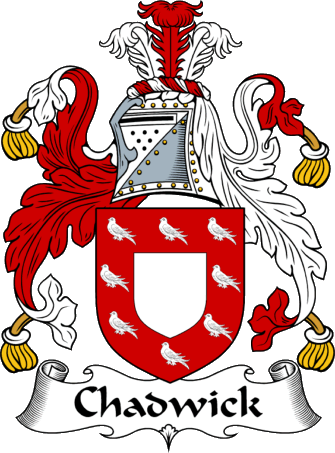
chadwick-armsSo, the name Chadwick would mean Chad’s home. The traditional motto of the Chadwick name In candore decus, meaning honour in sincerity, is indeed a high ideal to live up to. There is a coat of arms, but I’m not sure I would have the right to use it according to English rules of heraldry. The shield is red with a small white shield in the centre, and a varying number (mostly eight) of white doves against the red part. This is an example of a generic coat of arms corresponding with the surname, taken from a website. I do not claim these arms to be the proper ones of my family.

My sister occasionally finds time to research into our family history on my father’s side (which bears the name). Restricting myself to just the direct lineage of my father, born in Scarborough (Yorkshire) in 1928. Frederick William Chadwick (1901-1980), born in Scarborough. Frederick William Chadwick (1859-1939), born in York. Isaac Samuel Chadwick who seems to have been a Methodist minister in the Bradford – Shipley area of the West Riding of Yorkshire. Perhaps she will get beyond the nineteenth century, but on the whole, we seem to have been hard-working folk in business and shipping. We might have made the transition from Lancashire to Yorkshire at the beginning of the nineteenth century, perhaps a little earlier.

There are dozens of Chadwick families looking for their roots, and it is all quite bewildering. We must all be related in some way, but the genealogist would have to go back a very long way to find common ancestors. I prefer to think of myself as coming from solid Yorkshire roots, even though I was born in Westmorland (exactly one hundred years after my great grandfather). I am definitely a northerner, even though my mother’s roots were in London.

Posted in Uncategorized | Tagged | 6 Comments