Orwellian Religion

I am astounded by this article Still Lost in Blunderland (PART ONE): Refuting Peter Kwasniewski’s Latest Attack on Ultramontanism and Still Lost in Blunderland (PART TWO): Refuting Peter Kwasniewski’s Latest Attack on Ultramontanism from the sedevacantist site Novus Ordo Watch. They have castigated an author who participates in the New Liturgical Movement and Rorate Coeli by the name of Dr. Peter Kwasniewski. I have read a number of his articles and I find them impressive by their critical and “out of the box” thinking.

I advise readers to go straight to these two parts of the article and then come back to my terse reflections. (…) That was quite a dense reading and an eye-opener into the drama of sedevacantism, essentially that a Pope is not Pope when he is not infallible. Otherwise said, how do we maintain the infallibilist notion of the Papacy when it is evident that it has made Catholicism complete nonsense? Sedevacantism “saves” infallibility by demonstrating that the fallible Pope is in fact a false pope. Of course, there is a notion, largely thanks to Cardinal Newman who was an “inopportunist” at Vatican I, according to which the Pope is only infallible when he “engages” his infallibility by solemnly defining a dogma of faith or moral teaching. However, the implication is to present the precedent of the notorious ideological slogans of the twentieth century – Der Führer hat immer Recht and Il Duce ha sempre raggione. Likewise, the main characteristic of Big Brother in Orwell’s Nineteen Eighty-Four is always right and it is a thought crime to deny it. The anachronistic extension of the idea is to postulate an Orwellian Church, a hypocritical dystopia.

Dr Kwasniewski needs to be read attentively, and I haven’t yet had the time to go through all his work on this subject. I am likely to find his ideas more credible than those of the sedevacantists.

As far as I see it, with my own experience of right-wing conservatives and sedevacantist totalitarians, taking a retroactive position with the Old Catholics and Bishop Strossmayer of 1870 is an attempt to “save” the Church against the papalist ideology. Strossmayer was alleged to have made a highly polemical speech to the first Vatican Council, but one that is considered by serious historians to be spurious. It was promoted for a long time by anti-Catholic Protestant polemicists.  Hans August Hasler wrote How the pope became infallible in 1981 and mentions this text. It is a text of which we must be wary. Who really did write it? Ian Paisley’s grandfather? The Catholic Encyclopedia mentions the speech, said to have been forged by a former Augustinian Mexican, Dr José Agustin Escudero. At the same time, some had highly cogent reasons for such nonsense to be defined as Church dogma. Strossmeyer was indeed an opponent of Papal infallibility and did make a speech to that effect at the Vatican Council. The text should be available in the Acta of the Council should someone have the heart to find it in a library. Strossmayer and Newman played the card of diplomacy whilst the German opponent of infallibility Ignaz Döllinger got himself excommunicated bell, book and candle.

In a certain way, the sedes are more coherent than many of the “mainstream” traditionalists and conservatives. The result is exactly the same as the Old Catholics: they set up separate organisations and run them with the same authority as the Vatican and diocesan bishops in the grand old Piuspäpst days. In their minds, they are the Church, unless the Church can exist as a Platonic Universal Idea. However, that would seem to deny the Orwellian ideology they uphold. War is peace, black is white, something like Covid politics!

I have the impression that we Anglicans come out of all this smelling of roses!

Posted in Uncategorized | Tagged , , , , | 4 Comments

Academy of Ideas

I have been enjoying many videos from the Academy of Ideas. In the description, we find:

We create videos explaining the ideas of history’s great thinkers. We do this to help supply the world with more knowledge, to empower the individual, and to promote freedom.

I have found many videos on solitude and the question of relationships. Solitude is a double-edged sword: it builds us or kills us. We find our vocation in life or we succumb to addictions and self-harm. If we seek a relationship with another without first tending our own soul, the dissolution of the relationship begins there.

I was also impressed by this video on conformity.

The person who runs this site has obviously spent a lot of time thinking and reading about me and you (or you and I), the otherness of other people and what makes a relationship. He leans heavily on the psychoanalysis of C.G. Jung. My own reclusive life is bringing me to understand many more things about vocation, meaning of life found in one’s own work, thought and values.

We have been conditioned in our lives to give first priority to relationships, marriage and social life – on pain of being labelled as selfish. Man is a social animal as said by all philosophers of history. However, relationships are only a part of our existence and vocation in life. The greatest books, works of art and technological achievements are the fruit of the individual person.

If we live alone, we should see this positive dimension of solitude as opposed to loneliness and dependency on others for our “addictive fix”. I wish for you all a fascinating time watching these videos and developing your own critical minds.

The summer has given time to work through many of these things, because the coming autumn and winter will bring another way of living – less time outdoors and more intimate work reading and writing.

Posted in Uncategorized | Tagged , , , , | 1 Comment

Straf! Straf! Straf alles!

A comment from Patrick Sheridan (who is open about his identity) brought me to look at his blog where he writes only rarely. I quoted the Naval officer on the subject of excessive punishment of sailors and its negative effect on morale onboard His Majesty’s ships. I also thought of the caricature of Hitler from 1940 by Charlie Chaplin ranting in gibberish that superficially sounds a little like German. Indeed, I have mentioned this film when describing what looks like a purge in the Roman Catholic Church of traditionalist milieux and diocesan bishops who have accepted them into the mainstream.

Patrick became Orthodox and has often expressed his frustration with some of the less coherent aspects of the traditionalist scene. I too left it to return to my native Anglicanism via the Continuum. As a priest, I do not use the Roman rite but rather the Use of Sarum from a version based on several sources from the 1520’s. My position in regard to the RC traditionalist scene is less severe even though I suffered from it. I have tried to see things a little more positively and in terms that transcend human vengeance and Schadenfreude.

I am still quite perplexed to see traditionalists attempt once again to reconcile the discredited doctrine of Papal infallibility with the way Pope Francis is conducting his ministry. Some traditionalists are criticising the motu proprio from a canonical point of view or one of auctorias. I studied the Roman missal of 1570 at university, and a pared-down version is published in Dom Alcuin Reid’s Companion to Liturgy.

I understand what has happened to Patrick: information overload. Many years ago, I met a student at Durham University by the name of Stephen Bicknell. He was just as passionate about the organ as I, working as I was at the time as an apprentice with Harrison & Harrison. He went on to the organ building world but down south, in London and with Manders. Rather than the usual way of doing a lot of woodwork and passing tools to the organ tuner on his round, he went in for organ design. His career was remarkable and his many creations include St John’s College Cambridge. He expressed a very positive opinion about the London Oratory organ designed by Ralph Downes and built by Walkers. After a time, something went very wrong with him, in his soul, and he left the organ world. I understand, because professional musicians and instrument makers can be a bloody-minded lot! He worked in some other line of technical work. I will not comment on his personal life. It sufficed to say that he contracted HIV and suffered from it for the rest of his short life. He was found dead at home at the age of 49 years.

The Church Fathers speak of the spiritual sickness of acedia, and the mental health profession speaks of depression. Perhaps. I have lived through seminary at Gricigliano where I didn’t do too badly, and then on pastoral experience in a parish in la France profonde, I became very discouraged. I could easily empathise with the story in the Journal d’un Curé de Campagne by Georges Bernanos – My parish is devoured by boredom... After the failure of my marriage which also had its effect on my priestly vocation, I have had to learn to keep the right distance in order to avoid acedia on one hand and bitterness on the other. These are things we have to sort out ourselves and have the will to overcome them.

For Patrick’s fixation on the question of the 1962 version incorporating the Pius XII Holy Week among other things, I observed even in my own time at seminary that there was a tendency to resuming some of the older rites of before Pius XII. Our protagonist for this question was the late Fr Frank Quoëx who was a seminarian at Ecône, went through a sedevacantist phase and ended up at Gricigliano before transferring to the Archdiocese of Vaduz in Leichtenstein. Perhaps had he lived longer than his 38 years, he might also have become saturated and molten down. Someone like Evelyn Waugh was particularly sensitive to these very human issues as is evident in Brideshead Revisited. I really do wonder what is traditional. Does everything in Christian life have to be traditional? I ask this question whilst I use a rite that is extremely archaic. At least Sarum gets me out of all these fixations centred on the Roman rite and its various versions since 1570.

What I have seen of the French traditionalist scene, after the various cranks and nutcases at St Joseph & St Padarn in Holloway Road, was mainly characterised by hard-line right-wing politics. Either Dieu et le Roi! C’est tout! – or a second best being some modernised half-baked form of Fascism. At Gricigliano, it was less political and less influenced by extremely twisted forms of popular religion. Was it narcissism or a Roman Catholic version of the Biretta Circle in southern English Anglo-Catholicism, the sodomites with unpleasant accents, quoting Evelyn Waugh again? There was still a heavy dose of caudillo-style politics, such as organising a meeting of the Front National in a village where the Gestapo had tortured and shot a number of young men fighting in the Résistance. There are some things you just don’t do! Please, a bit of tact…

If anyone had a reason for being bitter about the tradis, I would. The years have gone by and I have let go. L’amore fa passare il tempo, et il tempo fa passare l’amore, as the Italians put it. It is an illusion to think that Francis’ reason for getting his own back on the tradis was a question of the 1962 version, the Pius XII Holy Week or the 1911 Breviary of Pius X. It was ideology that had nothing to do with the liturgy. There are plenty of Novus Ordo communities that are just as caudillo as the tradis!

I see Benedict XVI’s Summorum Pontificum as an attempt to settle differences that were not really liturgical. Thus we have ordinary use and extraordinary use, which have no analogy with the uses of Sarum, York, Paris or Rouen. C’est du bricolage! It was a pragmatic step by someone who is an intellectual and would know better in terms of church history. This was an attempt to defuse and soften the polemics, and it was successful to a great extent. Traditiones custodi reignited the old polemics from the 1970’s and 1980’s.

Patrick goes into an argument of Pope Francis making a distinction between the “unreformed” Roman rite and the 1962 version which would have been abrogated on the basis of it not being the traditional Roman rite. Maybe there is merit to this argument, but it is certainly not the reasoning of Pope Francis.

I too think that Roman Catholic traditionalism is untenable. Is Orthodoxy or Continuing Anglicanism any more tenable and viable in time? I know that each one of us is mortal and no one will care a toss when we are gone. With what is going on in the world, I really wonder. We still have the Covid epidemic. The Taliban has taken over Afghanistan and we can be expecting more export-a-terrorist to kill people where they feel like it. There is also climate change, which is up for discussion in the scientific world. People all around us are soaking up the Woke ideology and are speaking and thinking in terms that were unthinkable in the 1960’s and 70’s. Some speak of the collapse of western civilisation. Surely, the living would envy the dead! As an Idealist and a Romantic, I go along with the idea that reality comes from our consciousness, and that the quality of our spiritual life can change everything. If the tradis would take more notice of the ideas of Rod Dreher in the Benedict Option, there might be more to hope for. Everything has to be based on a high quality of Christian living and worship, and not on politics, ideologies or aggressive slogans.

As a convert to Orthodoxy, Patrick emphasises the need to abandon Papalism. I as an Anglican would agree. Our consciousness can only associate Papal infallibility with Orwell’s Insoc and Big Brother in his prophetic novel 1984. The Vatican is now at a level of corruption unrivalled since the time of Alexander VI and Lucretia Borgia. The credibility is gone. That much I agree. Perhaps Patrick would say “You now know that your Church has no credibility. Therefore, convert to Orthodoxy“, perhaps not. I have expressed my own forebodings many times. If I didn’t actually believe in the truth of Christianity, I too would have given up, as many have done so. Yet, atheism goes nowhere and satisfies no one.

If anyone can give an example of a future for Christianity, it is the monasteries. This is one reason why Dom Alcuin Reid has a powerful voice, not as a polemicist or a politician, but as a contemplative monk. Rod Dreher wrote his Benedict Option, but in an American cultural perspective. I myself wrestle with my own life and vocation and circumstances leading me to the hermit’s life. If being a hermit is being a recluse shut in somewhere, I see no point in it. Covid and separation have made me too much of a recluse, and I need to make the effort to have outside activities and some social life – for my mental health! Some do live such a life between their intense life of prayer, yet a contact with the world without imposing any kind of ideology. I think of Fr Charles de Foucauld who was a “traditional” hermit, but yet the “little brothers” inspired by him who were heavily involved in the Worker Priest movement in the 1950’s. We have to be a leaven in the desert. I see no other future for Catholic and Orthodox Christianity.

I don’t like the Society of St Pius X any more than Patrick does. I found them very sectarian and invasive, rather like the notorious archetypical narcissistic personality manipulating and gaslighting their adepts. I have also observed even more extreme caricatures like Palmar de Troya, Opus Dei and the Legionaries of Christ – the latter two being in the mainstream Church and using the new rite. Palmar de Troya is still going and has not been forcibly dispersed by the Spanish police as would happen in Jacobin France. Laïcisme or its American counterpart Secularism are not such bad inventions, even when there are laws that violate or contradict Natural Law and Christian moral teachings. Even with the risk of dérives sectaires, I would not take repressive action against the Society of St Pius X whether as a high political figure or the Pope. Perhaps by calming the polemics, it would be possible to recognise the good in other Christians mutually.

Ironically, Jorge Bergoglio is open to question about collaboration or involvement with the Junta in Argentina until 1982. Pope Francis: questions remain over his role during Argentina’s dictatorship – article from 2013. It is something quite easy to understand: Cuius regno ejus religio. The Jesuits were always good at this kind of thing. The book Mission by Robert Bolt or the excellent film provide us with a parable of this kind of duplicity with anti-Christian powers. Bergoglio’s motives are not pure, any more than those of any other political leader. If that is all the Church is, then it is no longer a question of rites and liturgies!

Perhaps we could invite the newly-victorious Taliban in Afghanistan to come and sort it all out for us! I think we would regret it….

Posted in Uncategorized | Tagged , , , , , , , , | 10 Comments

Assumption 2021

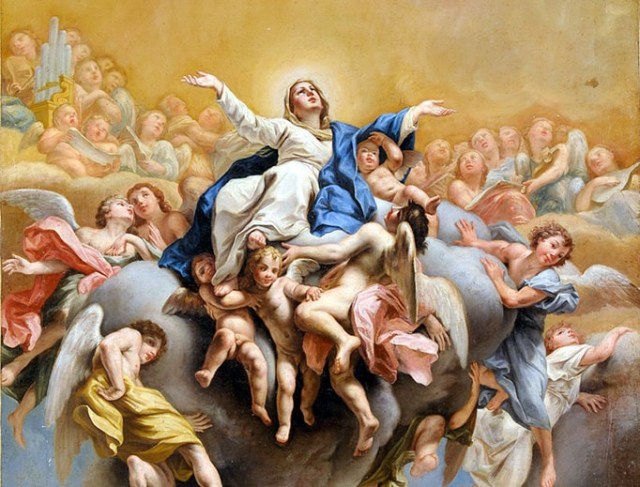
I wish you all a joyful feast of the Assumption this day. Many of us are praying in union with Roman Catholics who are challenged by the recent motu proprio from their Pope. We pray that serenity may reign together with the will to survive and continue in our many diverse liturgical traditions.

I prayed today for a new Enlightenment and Age of Reason, not like in the 18th century but one sanctified by grace and the gifts of the Holy Spirit.

I entrusted our suffering world to the holy Mother of God, whether through human wickedness, fanaticism, obscurantism, sickness, extreme weather, earthquakes and all other adversities. All we can do is muster the will to survive and come through this adversity and consecrate ourselves and our loved ones to Mary.

Posted in Uncategorized | Tagged , , | Leave a comment

Weltschmerz

I have just watched this video from the psychologist Richard Grannon

I warn you that there is a lot of swearing and not too many kind words about God or religion. I look behind the front and try to understand what he is about. He is not easy. I first discovered him while researching what mental health professionals usually call narcissistic personality disorder.

Just before watching this video, I wrote a long response to a friend who wrote about some of his intimate experiences with a person he suspected of having such a disorder. I went into aspects of my own experience, ways of dealing with it in my present life and what I can learn. For quite some time, I have read and thought about Romanticism, the Sturm und Drang of my life and the sturdy self-reliance of the American Transcendentalists. My friend is also someone who is resilient and a strong personality. He also has his weaknesses. Don’t we all?

I gave Rob Riemen some more free publicity for his books on what can be nobility in the human spirit and ways of fighting against mindless ideologies and opinions. To what extent are we prepared to be ourselves? Oscar Wilde and Quentin Crisp asked the same question.

Returning to Richard Grannon with his northern English grit and gutty narrative, perhaps only our Weltschmerz can bring us out of our idiocy to make the difference by our nobility of spirit. Institutions, including nations and churches, are dead and dying. What is left could be forced into a diabolical and Orwellian dystopia. Is all that awaits us the long journey to the Gulag or the gas chamber? It depends on each one of us.

Why does God not help us? I think it is because we are taking God for granted, waiting for hope outside ourselves. Such a notion of God is simply not there. The God to whom we pray is elsewhere – within ourselves. If anything, we can try to follow and understand his reasoning like someone living in France under the Occupation or a prisoner in a concentration camp.

Will to Live is a key to understanding what Richard Grannon is trying to convey through his experience of sleepless nights and semi-consciousness. I see in this reflection a Hymn to the Night, the Ungrund of Böhme, the New Middle Age of Berdyaev. It is a brief moment of revelation when we are at our lowest through sleeplessness, sickness, adversity or being near death. One aspect of this will to live is Why?To what purpose? This is something we call vocation, not should I enter the nunnery or go to seminary, but what are the highest values in us. Whatever it is with each of us, it is the thing we have to define in this idiocracy of a world. Will is an important aspect of Nietzsche’s philosophy in relation to nihilism and stupidity.

I have no conclusion. We have just to learn what we can. We should be critical with rational arguments and courtesy in our debates. Perhaps we can build hope out of despair, darkness and chaos.

Posted in Uncategorized | Tagged , , , , , , , , , , | Leave a comment

Freedom?

This article presented by Sandro Magister and written by Professor Pietro De Marco is fascinating. Many traditionalists are joining the fight against vaccines, but in reality it is this rebellion that would bring them into subjection under a “new world” dystopia. Agree or not agree, the article is worth reading.

The current protests in France and elsewhere are not Christian, but nihilist.

I have been impressed by listening to this video by the psychologist Richard Grannon, who has specialised in toxic and cruel personalities conventionally called narcissists and psychopaths. He talks in particular about the chaos and civil unrest caused by the Woke ideology, but there is a parallel between the Grannon video I saw only yesterday and Prof. De Marco’s posting about people of a right-wing ideology who are mistaken in the target of their war. One or the other, these ideologies are nihilist and can only lead to those who would profit from the confusion of people with ideals but inexperienced in life.

Listen to the Grannon video and then the article about what is freedom. It would seem to me that freedom is getting rid of the virus by whatever means available to us, being concerned for others and working to rebuild society, rational debate and a social contract.

Posted in Uncategorized | Tagged , , , , | 2 Comments

Dom Alcuin Reid on Traditionis Custodes

On my daily rounds of my bookmarked websites, I often find interesting things in The New Liturgical Movement. We are indeed far from the heady days of 2005, the year when Benedict XVI was elected and I joined the TAC. I am presently working on the Romantic roots of the liturgical movement and indeed the entire revival of Catholicism in the early nineteenth century. The article in question is Dom Alcuin Reid in CWR: Does Traditionis Custodes pass Liturgical History 101? by Gregory DiPippo. No sooner does he begin his article does he refer to Dom Alcuin Reid’s new article Does Traditionis Custodes pass Liturgical History 101 ?

Apart from the comments at the end of the NLM article suggesting that “rad-trads” are part and parcel of the liturgical tradition and that we can’t have anything without them, or that “rad-trads” don’t exist, the tone is pastoral and serene. Indeed, for my project of an extended essay for a Fellowship of the National College of Music and Drama, I intend to pick out the pastoral dimension of old liturgical rites such as we use in some of the continuing Anglican Churches like the ACC.

Why did this tragedy happen according to Dom Alcuin? He brings up the subject of “rad-trads”. The “rad-trad” phenomenon seems to form the basis of this step towards the repression of the old liturgy. Dom Alcuin’s argument is eminently pastoral: invite all Catholics into centres of liturgical life with kindness and charity.

Many diocesan bishops are taking a pastoral stance, because Papa Francis’ provisions are unworkable. It could be that the Roman Catholic Episcopate is no longer unanimous as it was in the 1970’s, and the Führerprinzip in regard to the Pope is a thing of the past. The idea of liturgical wars seems surreal in our time, but people will be frustrated and lose their desire to continue in that Church. A few Roman Catholics have come to join us in the ACC, and they have been made most welcome. A person’s faith and sense of vocation are precious, and often too fragile.

I too say that I am not a Roman Catholic, and I am not directly concerned. However I am concerned that Pope Francis has caused anxiety and alienation among many other calamities. It is a pastoral scandal. Dom Alcuin is a liturgical historian and a Benedictine monk. I have participated in an infinitesimal way in his work, notably my chapter in the T&T Clark Companion to Liturgy. What a difference between the cultured and erudite Benedict XVI and this bourrin (as we express it in French, meaning a course and unrefined man, an oaf)!

As Dom Alcuin quoted, Benedict XVI began his pontificate with an act of humility:

The Pope is not an absolute monarch whose thoughts and desires are law. On the contrary: the Pope’s ministry is a guarantee of obedience to Christ and to his Word. He must not proclaim his own ideas, but rather constantly bind himself and the Church to obedience to God’s Word, in the face of every attempt to adapt it or water it down, and every form of opportunism.

He is a true father in Christ, one of the greatest theologians and historians of the twentieth century. Like Benedict XIV in the 1750’s, he was a ray of light in the gathering clouds of obscurantism. He was pastoral and generous, unlike this philistine caudillo who took his place.

I would end by quoting Oscar Wilde. These words referring to art and culture, but which could also refer to piety and spirituality, would devastatingly describe this nincumpope:

The Philistine element in life is not the failure to understand art. Charming people, such as fishermen, shepherds, ploughboys, peasants and the like, know nothing about art, and are the very salt of the earth. He is the Philistine who upholds and aids the heavy, cumbrous, blind, mechanical forces of society, and who does not recognise dynamic force when he meets it either in a man or a movement.

Posted in Uncategorized | Tagged , , , , | 6 Comments

For a New Enlightenment

I write from the point of view of living in France, and refrain from criticising policies in the UK or anywhere else. I get sick and tired of hearing demagogues like Florian Philippot complaining about the erosion of individual freedoms in France through the imposition of a health pass (obtained by full vaccination, a test or proof of having contracted Covid within the last six months), when he would impose an authoritarian regime were he to be elected to the Presidency.

I have tried to give them a fair hearing, as those who speak for the thousands of people militantly demonstrating in cities like Paris, Lyons and Marseilles. The slogans are all about individual freedom. One thing that is missing is a viable alternative to combat the pandemic and relieve the pressure on hospitals. The minority of conspiracy theorists would deny the existence of the virus and claim that people are dying of other illnesses like flu, and that the pandemic is a fiction intended to bring about a New World Order or a New Reset, a universal world regime something like Communist China. I am afraid that such an idea, like most other conspiracy theories like shape-shifting reptiles disguised as the Queen of England, has no credibility.

What is the alternative to something that admittedly would be extremely difficult to implement and enforce? President Macron recently said:

Si nous n’avions pas le pass sanitaire aujourd’hui, on serait obligé de refermer, c’est-à-dire de faire porter la contrainte sur tout le monde. Avec le pass sanitaire, on la fait porter uniquement sur celles et ceux qui ne se sont pas encore fait vacciner.

If we had no health pass now, we would have to close down again, make everyone suffer from the constraint. With the health pass, we impose it only on those who have not yet been vaccinated.

It seems rather clear. The alternative is to go back to the lockdowns of last year. He did attract our attention to the limit of our individual freedoms, the responsibility we assume for other people is the classical social contract. We have to take our reasoning to its logical conclusion to be a part of an adult democracy. It is quite alarming to see the extent of the “anti” demonstrations, and the moral condition of this world. Oddly, the extreme-right populists are at one with the insoumis of the extreme-left. The emerging fanaticism is really quite worrying. I have the impression that it is merely a part of a new nihilist revolution leading to something very, very, ugly – just a hundred years after the Europe of the Dictators.

The freedom to refuse medical treatment is an old established ethic in Europe. A person suffering from cancer has the right to ask for palliative treatment against pain and let the inevitable happen rather than go on with chemotherapy. There is a limit to what medicine can do in relation to the quality of life. What about the health of a society? This is the worst pandemic we have has since the Spanish Flu of a hundred years ago which claimed twenty to fifty million lives. What we decide for ourselves is one thing. What about our families, work colleagues, friends and the people next to us on a train going to work?

The real issue is the capacity of hospitals to treat the victims of Covid compared with their patients suffering from other conditions, including those that are life-threatening. Where is our altruism? Many of our society just have no care for others. They are nihilists and live only for their own pleasure.

I am not a medical expert, but I have read points of view of epidemiologists and doctors, trying to compare them lest any points of view be politically-motivated. What seems most objective is that we are faced with the Delta variant (which seems to be slowing down and even diminishing like in the UK) and other vaccine-resistant variants and new viruses in the near future. There are two strategies: vaccinate all vulnerable persons and / or vaccinate as many of the general population as possible to obtain herd immunity. Either would relieve the pressure on hospitals.

If some people think that they can demolish this vaccinial strategy and return immediately to normal life, they are deluded. They mention no alternatives, but there are several:

  • return to general lockdown when the hospitals are overloaded, just like in March 2020 and November of the same year. Would we who are vaccinated accept this constraint placed upon us by those who refuse to be vaccinated? Natural justice would seem to call for a “targeted” lockdown. If the spoilt brat won’t eat his vegetables, he won’t get his ice cream!
  • a programme of general compulsory vaccination. Just how would that be implemented? Troops of Waffen-SS rounding up people from their homes and carrying them away in vans and trains? The simplest answer would be to consult social security files (what happens to the medical secret?). Just think of the bureaucracy needed for that in a system that works like the engine of a very old car.
  • “let rip”. Simply remove all restrictions and leave the hospitals to assume the overload. Sick people would have to be “sorted” between those who are younger, more “viable” and have more chance of recovery. This presents a serious moral / ethical problem for doctors. Could we stand by and accept such a situation as has been seen in countries like India where so many died because of shortages of oxygen?
  • refuse to reimburse the medical expenses of those who refuse vaccination, contract Covid and fall seriously sick. An alternative would be to hike their social security contributions.

Consequences of any decision have to be assumed to the logical limit.

Just today, anti-vaxxers are appealing to the Constitutional Council to have constitutional law oppose the Government. This introduces an element of incertitude. If this blockage of the Government is successful, then it is confinement or “let rip” as I mentioned above.

The Health Pass seems to amount to a “targeted” lockdown that allows vaccinated people to live normally. It is intended to nudge less decided people to go and get vaccinated. This strategy worked because when M. Macron announced the Health Pass, large numbers of people went and got vaccinated. There are ethical principles of individual freedom (as we are not in Communist China or in North Korea), and how such a system could be prevented from being abused by a future dictator or unscrupulous demagogue.

How do we become adults? This is both a challenge to and an epitaph of our society. I have personally been vaccinated, not only to escape possible death from pneumonia but also to protect others with whom I come into contact. I have very little social life and I follow the masking rules in shops and other public buildings. Most of us here in France do so without constraint.

I am brought to think of Psalm 32 in the Book of Common Prayer:

Be ye not like to horse and mule, which have no understanding: whose mouths must be held with bit and bridle, lest they fall upon thee.

Great plagues remain for the ungodly: but whoso putteth his trust in the Lord, mercy embraceth him on every side.

Be glad, O ye righteous, and rejoice in the Lord: and be joyful, all ye that are true of heart.

A noisy minority is trying to cancel what can be done to help the situation without admitting the alternative (because they would not accept a new lockdown either). Are the bit and bridle the only way? If so, our world is a very sad place that can “work” only with a Hitler or Stalin in charge!

We of the majority who have taken this threat seriously from the beginning need to make our voices heard. That is why I am writing this little piece. We need to become mature and responsible adults. The vaccinations are far from perfect, and the decision of Pfizer and Moderna to hike their prices is revolting, crisis capitalism at its very worst. I hope the European Union will have the gut to appropriate the vaccines and strip away the proprietary patents.

Maybe the virus will just fizzle away. It seems to be doing so in the UK and it has flattened in France. Can we be sure that another variant even worse (with seven other demons) will not come and take its place? This is not the first time that I have compared viruses with evil spirits! We have vaccines, and we also have fasting and prayer. May the holy Mother of God deliver us from this plague, that we may return to holiness and virtue!

Being opposed to something is just no enough. We have to assume the consequences of the alternative (assuming that the pandemic is far from being over). Other than spiritual and theological considerations, I am just an “ordinary guy” who reads different sources and hears the sound of different bells in order to form a politically-free idea of what is going on. That wearing a mask or not takes on a political meaning is both pathetic and indicative that our contemporaries are spoilt brats in need of punishment and / or education.

Increasing numbers of thinking people are taking refuge in the countryside. I did so many years ago, because I know what can happen in France with their radicalised and mindless reactions. It can happen in any country as it happened in Germany, Italy and Spain in the 1930’s. If we abdicate our own intelligence, responsibility and spiritual life, then someone will take over and decide on whether or not we are worthy of life! The true Romantic upholds Reason as much as he extols Imagination and Idealism. May this leaven bring forth fruit in our sick world!

* * *

I have just received a private e-mail, which I will reproduce in such a way as to hide the identity of its author. The tone is moderate and represents attitudes in many sincere people.

This is just a quick email to say I think Covid has done more to divide people and destroy the social trust fabric etc than anything that springs to mind in my own experience. But I blame Covid only as a kind of material cause, because the efficient cause is squarely on leaders and their policies and the sustained alarmist character of much media reporting.

There is unfortunately a new orthodoxy, and we know what happens with orthodoxies: “heretics” get burnt. Whilst I don’t dispute about the whole phenomenon, I would disagree with the accusation that those who do not wish to receive injections are selfish. The compulsion over injections is ostensibly to combat the virus but is more immediately or directly aimed at helping political leaders and invested bureaucrats get out and beyond their own various policy approaches and initial assessments as they must know – although not admitting it – that on statistical fatality grounds the virus has not been able to land a glove on pandemics of the past. A more globally self-imposed disintegration I can’t think of.

A question people have to ask themselves, I suppose, is what type and degree of divisions and classes of people and movement does one think good for a tolerant free society, and whether public policies should be constructed from the more generous idea than the narrower idea. Here is where John Rawls’ theory of justice might inform our approach; i.e. whereby we choose the minimum criteria consistent with what we would want if we assumed we would be incarnated into the lowest rung or situation.

I responded:

It is hard to come up with a hard and fast solution. I have had the two jabs and I have little social life. That gives no absolute guarantee against catching it while shopping even though we are all wearing masks!

The problem with the French situation (…) is that Macron is playing a very delicate game to prevent an all-out revolution by a kind of “coalition” between extreme-right and extreme-left. Many of the protesters are “gilets jaunes” led by Florian Philippot who is much further to the Right than Marine Le Pen. Elect that lot and it would be like the regimes of Franco and Pinochet!

Perhaps the pandemic is a hoax and a conspiracy. I have not seen evidence that would convince me. Prudence forces me to assume the threat is real. The alternative to it being a hoax (with the justification for a revolution) is vaccination, “targeted” lockdown or lockdown decided by the usual indicators. The hype by the media is criminal. I chose the title For a New Enlightenment because of the need for information, evidence and knowledge. I am far from sure of the rational basis of the revolutionaries, and they would be more tyrannical than the present regime.

I fear that society is going to disintegrate, and the way is the catacombs in the practical form of remote country places and a form of work that makes such a life possible. Those who live in cities will relive 1789 to 1799, guillotine or no guillotine. There are lots of ways to kill people!!! I don’t think a tolerant and free society is possible any more, which breaks my heart. If people will not seek to think critically, then they have to be ruled by people like Hitler or Robespierre. Macron is no superman, but he seems to have the most balanced and pragmatic attitude in a political scene that has collapsed. If the only alternatives are Fascism and dinosaur Communism, then I would consider voting for him next year.

Perhaps it is time to “let rip” as they have done in the UK. Vaccinate the vulnerable and let the young catch the virus. Those young people who would suffer serious symptoms would be “collateral damage” and it takes about 90% to get herd immunity. Perhaps that is the way, but it doesn’t seem to be very ethical in terms of human life.

The mass of people unfortunately doesn’t have the intelligence to take the normal precautions we take as individuals. Perhaps the future is Chinese-style Communism and totalitarianism. We could hold out for a time, and then there is only death to look forward to. Perhaps it is check-mate. Orwell or Huxley?

Will the Mother of God help us? It isn’t automatic, but there are miracles in history.

Posted in Uncategorized | Tagged , , , , | 9 Comments

Modernism and Integralism

In these ideological conflicts, the “other” is often grouped together into a homogenous block in order to condemn it more easily. One thing I have noticed about many traditionalists (I listened to a sermon by Bishop Donald Sanborn today in which he took on Pope Francis and Traditiones Custodes) is the use of the word Modernism as coined by the condemnation by Pope Pius X. When Modernists and Modernism are actually studied, one will find little more than a euphemism to describe an opposition to strict Scholasticism. There was a stream of so-called Liberalism that sought to demythologise the Scriptures and deny the possibility of miracles, as one would find in the works of Rudolph Bultmann (who was a Protestant) and Alfred Loisy among others. In fact, Modernism sought to come up with an apologia against Protestant Liberalism that would secularise and discredit Christianity as a spiritual religion.

Here are some old articles I have written about the subject:

If Modernism is simply not wanting to restrict theology to scholastic calculation, then I am a Modernist. However, the word seems to have little meaning, because we all live in “modern times” and have always done so throughout history.

Here is a fine article about Modernism: Christian Modernism by Bernard M. G. Reardon who also wrote Religion in the Age of Romanticism, Cambridge 1985. I quote an important section of this article:

The use of the word Modernism in restricted reference (hence the capitalization of its initial letter) to a movement of a theologically “modernizing” or liberalizing character in the Roman Catholic Church at the turn of the twentieth century has already been alluded to. But it should at once be said that to describe Roman Catholic Modernism as a movement at all is somewhat misleading, as it had little cohesion, and those to whom the designation “Modernist” has usually been applied do not in any sense constitute a school. As the most famous of them, Alfred Loisy (1857–1940), expressly stated, they were only “a quite limited number of persons” who individually shared “the desire to adapt the Catholic religion to the intellectual, moral and social needs of the present time.” But the exact determination of their overall aim differed from one writer to another, according to his particular interest. Thus the only satisfactory way of studying Modernism is not to attempt to impose upon it a schematization like that of Pius X, by whose encyclical Pascendi dominici gregis it was condemned in 1907, but to examine and assess each author’s contribution to the cause as a whole. The countries where Modernist tendencies were most in evidence were France, Italy, and England. Germany, rather surprisingly, was less affected, and in the United States it had no real following at all.

The task that, in one way or another, the Modernists undertook was that of presenting the world of their day with a defense of Catholicism, in both its doctrinal and institutional aspects, which could be accepted as intellectually plausible. In other words, what Protestant liberals had done for the Reformation tradition they would attempt for the post-Tridentine, and their procedure was often no less radical. Thus Loisy, in The Gospel and the Church (1902), approached the whole problem of historical Catholicism—its dogmas, its hierarchy, its cult—along evolutionary lines as a natural growth responsive to spiritual and social needs and determined by the continuously changing cultural environment. A direct reply to Harnack’s What Is Christianity?, Loisy’s book denied that the essence of Christianity could be located at any one stage or identified with any single element within its historical life. The entire historical life of Christianity, he maintained, alone provided the data for a true—because empirically grounded—estimate of what the Christian religion is. In this context, Catholicism will be seen to be justified—so Loisy argued—by the sheer fullness and diversity of its content. Similar arguments were used by the Anglo-Irish Jesuit George Tyrrell (1861–1909), notably in his posthumous work Christianity at the Cross Roads (1910).

The peculiar difficulty facing the Modernists lay in seeking to validate a form of Christianity that appeared fatally vulnerable to historical criticism. Indeed, they felt that the main pressure upon faith came from precisely this quarter, and the familiar type of Catholic apologetic, tied as it was to biblical fundamentalism, was incapable of meeting it. Moreover, the question of dogma also raised other issues, of a philosophical order. Catholic philosophy, by official direction, meant Thomism, although more often than not Thomism conceived in a narrow, unhistorical, and scholastic form. A more dynamic religious philosophy was wanted, according to Modernists like the French Oratorian Lucien Laberthonnière (1860–1932), a disciple of Maurice Blondel (1861–1949), as well as to the Bergsonian Édouard Le Roy (1870–1954) and to Ernesto Buonaiuti (1881–1946), protagonist of the Italians and author of The Program of Modernism (1907). For a more dynamic philosophy they looked not to Kant, as Pius’s Pascendi had alleged, but rather to the voluntarist tradition of much nineteenth-century French thought and even to American pragmatism. Tyrrell and Laberthonnière both stressed the role of the will in belief and were disposed to understand doctrine in terms of an ethical symbolism. Le Roy’s account of dogma (Dogme et critique, 1907), in particular, represented it primarily as une règle de conduite pratique (“a rule for practical conduct”), without intrinsic speculative content. Thus the doctrine of the divine personality means in effect “Conduct yourself in your relations with God as you would in your relations with a human person.” The vindication of dogma, therefore, will rest on its capacity to induce the experience in which it is itself grounded.

However, the Modernist apologetic, whether historical or philosophical, won no approval at Rome, and the movement was summarily suppressed. In 1910 a specifically anti-Modernist oath was imposed on the clergy, or at least those engaged in teaching. The result of the Vatican’s action was to retard Catholic biblical scholarship, as well as practically all non-Thomist theological thinking, for many years to come.

Bishop Sanborn also kept a straight face as he affirmed that Luther invented Mass facing the people. This would not explain why Lutheran churches have eastward-facing altars, and any altars facing the people would have come from 1970’s Roman Catholic influence. Getting one’s facts right does help for being credible.

I don’t think I can now say much more that is not already in my old posting Modernity and Christianity. As a former student of Fribourg University, I wrote Reflections on Ressourcement Theology.

When I was ordained a deacon at Gricigliano, I was asked to pronounce the Anti-Modernist Oath of Pius X. I did so sincerely, because I believed that Modernism was identical to the kind of theological liberalism in the nineteenth century that sought to secularise the Church and abolish the supernatural. Since then, I have discovered many things, among which was the intellectual sloppiness and ideology of Pius X and Cardinal Mery del Val (the author of Apostolicae Curae of 1896 – oh yes!).

One of my memories of Dr Ray Winch was his sympathy for what he termed as “true Modernism”, the attempt to defend the intellectual credibility of Catholicism by expanding the philosophical and historical basis of our studies. On this basis, he left the Roman Catholic Church and became Orthodox.

* * *

I touch upon the subject of l’Intégrisme or what Pope Francis calls the rigidity of the traditionalists. Oversimplifying, I would perceive it to be a very deeply rooted ideology in reaction to the French Revolution in an attempt to replace existing political systems in Europe and other parts of the world by the Church having authority over leaders of countries. This ideology would finally be called by the euphemism Social Kingship of Christ mentioned in Quas Primas (1925) of Pius XI. To be fair to Pius XI, he was more than concerned with the rise of Fascism and Nazism and sought to deflect people’s misplaced loyalty to their political leaders by embracing Christ as their King. However, words are all too often understood as euphemisms, in some cases meaning the opposite of what they say.

The tightening occurred when Pius IX had to flee Rome for Gaëta in 1848 because of the increasing hatred of the Church in a revolutionary movement to some extent influenced by that of France and various masonic groups like the Alta Venti dei carbonari. Towards the 1860’s, the paranoia and conspiracy theories became palpable and the “converted” (liberalism to intransigence) Pius IX led to the infallibilist movement largely led by the Jesuits. I have the book by August B. Hasler, How the Pope became infallible, 1979, and found that extremely fascinating.

After a relatively “cool” pontificate of Leo XIII (1878-1903), Pius X (Guiseppe Sarto) resumed the tightening programme against theologians who were not strict Thomists, because they would be perceived to be a part of the “conspiracy”. The condemnation of Anglican Orders, though under Leo XIII, was a part of this ever-tightening atmosphere.

Here are some old articles, especially about the Sodalitium Pianum of Msgr Benigni (not Bugnini!).

This “tight” Catholicism movement faded from the death of Pius X in 1914 and the two world wars. Pius XI, the Pope of between the wars, turned his attention to the survival of the Church in the face of Fascism. Pius XII was a diplomat and did his best to keep the Church out of the same trouble as the Jewish communities of Europe. Integralism (far-right politics under the control of the Church) was waning long before the election of John XXIII who had been in trouble as a young priest with accusations of Modernism.

Unfortunately many traditionalists have tried to continue and revive this inquisitorial movement. Bishop Sanborn, somewhere between sedevacantism and sedeprivationism, distinguished three main groups of traditionalists: the ones recognised by Rome, the Society of St Pius X and the sedevacantists. All hung on this bishop’s notion of Modernism with which pre-Vatican II Catholicism, as he termed it, had no basis of dialogue or compromise. Unfortunately, this version of traditionalism promotes a message that has no credibility with thinking people. We are back to the real theme of Modernism that was faced by Pius X as a great conspiracy bent on destroying the Church, when the reality was quite the opposite.

Personally, I have been alienated from traditionalist Roman Catholicism, even though I was in one of the more moderate communities of the Ecclesia Dei scene. I have spoken with clergy and lay people of all tendencies. This is not the way to ensure a future for Catholicism.

In a way, Pope Francis is not wrong, but his response to “rigid” traditionalists has no credibility. Attacking from the point of view of the liturgical rite is exactly the wrong response. The problem is one of political ideology and an excessively narrow methodology in terms of theological study. Also, Pope Francis, and probably the quasi-totality of his Jesuit order, are working from a perspective against which the Modernists sought to defend the Church, her orthodoxy and her spiritual life. Not all traditionalists are “rigid”, and this aggression against the situation of the old liturgy in the Roman Catholic Church seeks to punish all for the excesses of a minority, albeit a powerful clerical minority.

I have followed the history from the Enlightenment to the Revolution, the tendencies of French Romanticism to seek a hypertrophy of the Pope’s spiritual and temporal power. From then we have the excesses of Rome from about the 1860’s to the 1900’s, a period of masonic-inspired aggressive anti-clericalism in France and Italy, the attempts to defend intransigent Catholicism, the Ressourcement movement from the 1950’s perceived as the “fruits of Modernism” (where there was no connection between the two). Finally there was Vatican II, the excesses of the late 1960’s to the death of Paul VI and the three main traditionalist reactions. It is tragic that Benedict XVI abdicated, because he was bringing so much hope for a new current of Catholicism that was neither of the Left nor the Right, but spiritual and mystical.

Finally I returned to Anglicanism, but in its Continuing form. I am no longer trapped in these contradictions of incoherence. I serve the Catholic Church in a very limited way as a priest, contributing as much as I can to Catholic education and study.

Posted in Uncategorized | Tagged , , , | 5 Comments

A Nihilist Revolution?

Incendie de Notre-Dame de Paris — Wikipédia

I was tempted to give this post the title A New Russian Revolution? – but it is not a question of Russia, either under Soviet Communism or the Putin regime. It is about my own country. The vandalism of a church is relatively but a small symptom, but an indicator of what seems to be behind an epidemic of arson and wanton destruction. The article has a number of links underneath it to such more serious incidents.

One commenter seemed to understand things rather well according to his world view that is not mine:

I think it’s much more likely to be people who consider organized religion, (or perhaps specifically Catholicism?) to be a scourge. I personally feel sad to see art desecrated, but I can somewhat sympathize with the impulse to repudiate what it stands for. As lovely as this structure is, it’s maintenance testifies to social value that no longer exists, if it ever did.

The desecration of this lovely old building is akin to the desire to pull down statues, I think. As stupid and pointless as that is, and as disrespectful of art, it speaks to a powerful impulse that lives in many people now, and manifests as a need to actively deny any form of membership that is based in the history of a group. The churches and the statues announce, “This is who we are, collectively.” The desecrators reply, “Collectivity is a pack of lies.”

“Tear it down!” is the unspoken, subconscious cry manifesting everywhere: Acceptance of the Covid lies tears down the economy, degradation of music and art tears down human feeling, materialism tears down human thought, political corruption tears down collective values. It’s as if the world we have known is a set of bowling pins and something has set the ball on a trajectory to strike them all down. Once the tear-down process is complete, will the psychopaths really be in charge of the rebuilding, as is their desire? I don’t think so – I think their plans are pipe dreams.

But how will people make sense of their existence? What a time to be alive!

In itself, it seems to be the cry of a nihilist. Perhaps this person would welcome a planet-killer asteroid or an all-out nuclear war. At the same time, the person recognises the existence of human feeling, thought, collective values, life itself. What is in the mind of a young man emptying fire extinguishers and breaking windows in a medieval church? Is it fun? Is it an expression of anger? Mental illness?

Vandalism is an old problem and is found in all periods of history. With some research, we would probably find that legal and police authorities have profiled those who have been charged and convicted of vandalism. It is commonly associated with gang culture in inner city deprived neighbourhoods. Buildings and vehicles are often victims of riots as presently done by the more extreme elements of the Gilets Jaunes and those who oppose the Passe Sanitaire here in France.

Vandalism to churches, if it is not for self-entertainment, would seem to be motivated by hatred of religion, or hatred of Christianity by fanatical forms of Islam. Legal authorities in different countries vary on the ways they deal with vandalism. In Singapore, one might get three years imprisonment and a caning. Most western countries will not send a vandal to prison for more than six months, which is complicated in the case of most offenders who are still minors.

In history, one particular form of vandalism is iconoclasm, theologically motivated by the condemnation of images from the early Church to the Reformation and, more recently, the liturgical reforms in the Roman Catholic Church from the 1970’s.

Vandalism was a characteristic of the 1871 Paris Commune. In that year, the Tuileries Palace was burned down, and Nietzsche himself saw in this act a fight against culture. What would justify something so senseless? Why turn on beauty and works of scientific achievement? Why the wish to destroy man’s knowledge of history and what we can learn?

When the Nazis were defeated, the Allies systematically destroyed the symbols of the totalitarian regime.

The destruction of Nazi symbolism was something that was necessary in 1945 as part of the exorcism of something so evil and dreaded, which had taken so much human life over its twelve years of tyranny. This time, it is a reaction against evil that caused this wave of vandalism, often by spectacular means such as explosives. At the same time, is there something in common between someone who attacks a church and Allied soldiers who destroyed Nazi symbols? The question seems blasphemous, but perhaps the vandals of today believe they are doing some good by ridding the world of symbols of what they perceive to be repressive religion.

Coming back to the comment I quoted, there is a feeling that human society and its institutions have become so corrupted that complete destruction is needed before the construction of something completely new. The UK has suffered the double-whammy of Brexit and Covid. We no longer have any confidence in politicians. Art without form and music without harmony and beauty are so destructive. Materialism and consumerism take away our taste for thought and reading. In the Church, secularisation and liturgical deconstructionism have destroyed spirituality and mysticism. Why not do a “hard reboot”, press the computer’s “off” button and cease all activity before restarting ex nihilo? It is a tempting thought. Perhaps press the “off” button and throw the computer off the cliff into the sea – suicide!

We are faced with the mystery of evil. Few theologians and mystics have got anywhere near this terrifying reality other than Jacob Böhme. His thought was very much at the root of German Idealism and Russian philosophy. Böhme saw a struggle of opposing principles, of light and darkness. The struggle of God between his love, anger and wrath are visible throughout the Old Testament, and coincided with the Reformation themes in Luther and Calvin. The opposition is within the divine essence as it is within us all who are created in his image. God himself is tormented. The church vandal is tormented. However, German Idealism at the root of Romanticism gives the key to discerning one thing through another. Light is discerned against darkness, good against evil, the spirit against matter. Creation and Redemption are continuing, and this is the most fundamental meaning of the Church and the Sacraments of Christ.

This may to some extent explain the torment of nihilism, the immaturity of the person who has not yet discerned goodness, truth and beauty against his own nothingness. If we stop at the torment of our spiritual vacuum, we can only seek to destroy, self-harm and ultimately commit suicide. This is something we will understand in the ultimate perversion of the German spirit as it was twisted by Hitler’s ideology. They committed suicide rather than face an alternative and a more human world view.

Ultimately, though we may feel like taking vandals and flogging them and laying their backbone bare as Captain Bligh would have put it, we need to bring the power of the Idea and the Imagination back to the world. Only light can fill our darkness.

Posted in Uncategorized | Tagged , | 3 Comments