Going by a few search box questions, here are a few ideas for rigging the Mirror dinghy, or indeed most light sailing boats.
The outhaul and the downhaul are terms we often come across. There is no ambiguity about the term outhaul, which can only mean one thing, but the term downhaul can be taken to mean what most of us sailors call the cunningham which tightens the luff of the mainsail or the boom vang. These three devices are used to trim the sail to get it into the most efficient aerodynamic shape for the point of sail.
For convenience, I will call the boom vang the downhaul, the pulley tackle used to prevent the boom rising as the sail fills with wind as the boat sails downwind. The device for tightening the luff of the sail is the cunningham.
Generally, the outhaul is loosened for light weather conditions, and tightened to de-power the sail as the wind rises. The foot of the sail should never be further from the centre of the boom than the span of one hand, about seven inches.
The downhaul is loosened for light weather conditions or for sailing downwind. It is tightened for beating and close reaching. It tightens the leech of the sail to enhance the sail’s aerodynamic properties.
The cunningham, when tightened, moves the centre of effort of the sail from the luff to the centre. Instead of pushing the boat, the wind creates a Bernoulli effect and the boat is drawn forwards, making upwind sailing (outside the windward angle of 80-90°) possible.
Using these three devices, the sailor trims or adjusts his sails to get the best out his boat. This is what they teach us at sailing school. On a dinghy, you feel whether everything is right, with a glance at the sails to check.
Many older boats do not allow for adjustment of the outhaul. The clew of the sail is simply tied to the end of the boom. Similarly, the cunningham is fixed, and the sail will not set properly for upwind or downwind sailing. Looking at some classified ads for the Zef dinghy, I noticed that the early ones had no downhaul either, relying only on the mainsheet to control the rising of the boom, even when running downwind.
Not being able to trim the sails seems to me like driving a car with no gears, just one ratio for getting the vehicle to move from a standstill up to running at top speed! A boat is trimmed not only by setting the mainsail, but also by using the jib for increased weather helm or lee helm. A dinghy’s ballast is the body of the sailor who sits on the gunwale and moves fore and aft depending on his point of sail. A bigger boat has a fixed ballast, as low as possible on the bottom edge of a generously-sized long keel. We constantly trim the boat by the rudder, the trim of the sails and where we sit.
So, I would say that all boats need to have these devices for trimming the mainsail. It suffices to learn how to use them. There are many inventions of easy-to-sail boats, but they don’t appeal to me. I like everything the old-fashioned way, and especially the traditional gaff rig. My kind of boat doesn’t win regattas, though I have to say that my little yellow gaffer with the red sails was not that far behind the Lasers and Europe Moths a couple of Saturdays ago. I prefer cruising and exploring to racing around the three buoys!
Another precise question was the form the outhaul would take. The simplest is a pulley at the end of the boom and a piece of rope cleated somewhere along the boom. My own system is the pulley at the end of the boom, a pulley about two-thirds along the outhaul rope, and the longest part running through a pulley attached to the mast, back to the pulley on the rope, back to a second pulley on the mast, and then to a cleat on the foredeck at the base of the mast. The three pulleys reduce the effort needed to haul out the sail’s clew. I can thus control the outhaul even when the boom is far out for running before the wind.
All my ropes are within easy reach – the downhaul, the cunningham and the outhaul – just afore of the centreboard. It is the Laser system I was taught with at the Glénans. This arrangement is so convenient, like leading all ropes back to the cockpit in a yacht, so that the skipper can reef (shorten) his sails when the sea gets big and the wind really starts to blow. It is a question both of convenience and safety.
See this useful presentation to get you to understand the principle of setting your sail, especially from the point of view of the outhaul (and backstay on a yacht).
I would just like to get a couple of reflections in during a brief blog session. I remember as a kid in the 1960’s being brought up in a very straightforward kind of family, not very religious but highly respectful of all authorities and institutions. As a choirboy, I remember being suspicious of the Methodists until I met some some of those people and saw how straight and honest they were – at least the ones I met. My sister-in-law has often remarked how Establishment my family was (and is). If we belonged to a Church, it was the Church of England, just as we obeyed the laws of the land, considered the police to be an instrument of the authority of the law and the State. Our schools also represented institutions and authorities. That was my own experience in the 1960’s in the north of England, a bit like the 1950’s elsewhere!
Stick with the mainstream – was always the good advice of my parents. In regard to the Church, one would either be Church of England or non-religious. However, I came from a very tolerant and open family background, and never would I hear a bad word said against Roman Catholics, Methodists or Jewish people. We were Establishment, yet with feeling and tolerance towards the minorities. It was a balance we felt and expressed with the high ideal of the common good and stability of society in our eyes.
I have experienced this basis as an English Anglican, which is something different from America, where minorities and marginal faiths are the majority. There is no Establishment. In Continental Europe, there are still expressions of cujus rex ejus religio – you followed a religious expression as was that of the governing authority of your country.
The real crux of this article is the question of institutionalisation and free faith. Are we Christians because it’s the way we are brought up in our families and cultures, or is it a way of life that is freely adopted through having become convinced by its message? Reality would answer – both. The latter notion leads to the former as Christianity as a “philosophy of life” begins to influence society and its institutions, and also proves conducive to the psychological well-being of individual persons. Christianity in history built cultures and moral traditions of law.
One problem in today’s society is that the influence of Christianity is challenged by other systems of faith and morality. We live in multi-cultural societies, where Christianity is actively rejected, and this would inevitably bring us to the conclusion that there is no longer any such thing as mainstream Christianity. All Christianity is marginal as no Church has much influence on society in most countries.
After all, Christianity began as a “sect”, a counter-cultural movement. It was a persecuted minority, and historical evidence points to it being divided and fragmented from the beginning. It only survived because it was adopted by the “mainstream” – ie. the Roman Empire. The relevance of Christianity to most of us is less political, cultural and social – but what it does for me, how well it answers my existential questions. What answer does it bring to suffering and death? Then, how does it bring us to experience transcendence and lift us out of our drab existence and the mechanistic determinism of our world?
Institutionalism happens to every inspiration and insight of founders. In came the theological speculation and the urge to find the right explanation for everything. A religious society had to be organised and be given set forms of worship through liturgies and rites. Institutionalisation becomes a living symbol of the experience of the founder, and the sacred becomes embodied in profane structures. We go from experience to a balance between experience or the prophetic dimension and the institution and culture, and finally to the pure institution and a smothering of the prophetic instinct. Finally, the institution is questioned and replaced by something new and different, and a new cycle begins. Institutionalisation brings a dilemma that can never be resolved.
The institution remains alive for as long as it tolerates creativity and heroism, the cult of the saints, but the institution is there to create stability. We observe this happening when “eccentric” people begin to stretch the institutional limits between orthodoxy and heresy, and how the institution deals with it by punitive measures, a long drawn-out investigation embroiled in bureaucracy or a fundamentally open attitude. This happened in the Reformation era as in the 1960’s as “enthusiasm” came about and produced the Charismatic movement as well as the secularising currents.
Dilemma is our lot in life. Religion both needs the “mainstream” institution and suffers from it. The prophetic dimension has to find expression in “ordinary” and empirical expressions to which most of us can relate. One of these dilemmas is our motivation for adhering to our particular religious movement. We can be a disciple of a charismatic leader and be very single-minded – the words monk and monastery came from the Greek word μόνος, singleness of mind. With the arising of the stable institution, there comes another kind of motivation: power over others, prestige, aesthetic and cultural needs, security. These motivations can be quite benign in a small institution, quite iniquitous in a larger one!
What happens when self-interest prevails? The original institutions are gradually transformed and corrupted. When the corruption is complete, it is then challenged and threatened, and then forced to bring about reforming measures. We see these characteristics in the large Church bodies, particularly bureaucracy sacrificing the very goals of the institution to vested interests, official timidity and inertia. From a religion of converts, we have a Church of cultural “cradle” members.
The prayer of converts who had the “experience” becomes liturgy. We all relate to liturgy in different ways. Most of us are persons of routine. Our domestic and professional lives are generally ruled by routine and a fixed way of doing things. Rigging my boat has become almost a rite, because doing everything out of habit and routine eliminates errors and things getting out of order. Monastic life is 99% routine, and 1% quiet and unannounced experience of beauty or transcendence. Go to a high point of a city and look down, and see it functioning like a machine. That is the end result of routine, something that began by being good but which removed the heart and soul from what routine was meant to preserve.
This is liturgy. I celebrate Mass as I rig my boat, with attention and care. Naturally, ropes and sails don’t have the transcendent meaning of the Sacraments of Christ, but the approach is similar. We combine automatic habits with thinking about what we are doing. Driving a car or riding a bicycle are also conditioned habits, but we still have to keep an eye on the road to ensure our safety and that of our passengers. The sacred action of the liturgy has both to be a movement of the soul and something we do right – for the reason it is not our property but a part of the community to which we belong. The rites of Mass, the other Sacraments and the Office are autonomous and work like a machine, but they provoke a spiritual response. There is the dilemma of the Deus ex machina and spiritual anarchy. There must be an interplay between the objectiveness of the liturgy and the subjective experience of those who participate. If that link is completely broken, then the liturgy is dead. If subjectivity prevails, then there is nothing stable or objective. As rites become more routinised, the obscurity and mystery keep an element of sacredness, but also allow magical attitudes to develop.
We need to recover symbolism through knowledge and spiritual experience, so that we do not become alienated from the liturgy. To what extent has the transcendent to be symbolised? Do we not run the risk of secularising? If the balance is lost, the relationship between external and internal is lost, and then it is attacked and rejected. Much of the English Reformation was concerned about doing away with the “abomination of the popish mass“, even more so than the Papacy itself! Symbolism is rejected because it had been lost.
Spirit and letter is another dilemma, already known to Saint Paul. The letter kills and the spirit gives life. There is the old order of the law, and the new order of grace. In time, Christianity would become as legalistic as Old Testament Judaism in the Temple clergy, the Scribes and the Pharisees. This transformation happens to every religious movement that survives the death of its founder. Conversion and coercion are another difficult point. It was the whole drama of medieval Catholicism with the Inquisition and the Crusades, the forced baptism of Jews and Muslims and their persecution for relapsing into their former religious habits. One of the most difficult things a convert will find about his Church is that most of his co-religionists never experienced conversion, but are just part of the furniture. The institutional Church continues to preserve the values of spiritual conversion, enshrining belief in liturgy and canonical structures like parishes and dioceses.
Religion depends on interior dispositions of its members, but tolerates the presence of those who are nominally religious. Religious leaders are constantly tempted to use the relationship between faith and culture to enforce religion. In a totalitarian society, church leaders can find themselves in a position of using a godless dictatorship to reinforce their power. The relationship between Church and State, religious experience and political loyalties, can make religion very “mainstream” but can at the same time weaken it. Such a relationship alienates Church members opposed to that particular political ideology.
There always has been and always will be tension between the rejection of compromise with the world and evil, but yet the need to maintain a relationship with the world in order to influence it with Christian spiritual and moral values. I write from the point of view of a Continuing Anglican priest, a member of a Church that is comparatively marginal and relatively unaffected by institutionalisation. Nevertheless, any body that survives the death of its founder will go the way of institutionalisation. The first stages will be beneficial and the later stages will see its corruption and death or reform. This just seems to be a fact of our human existence.
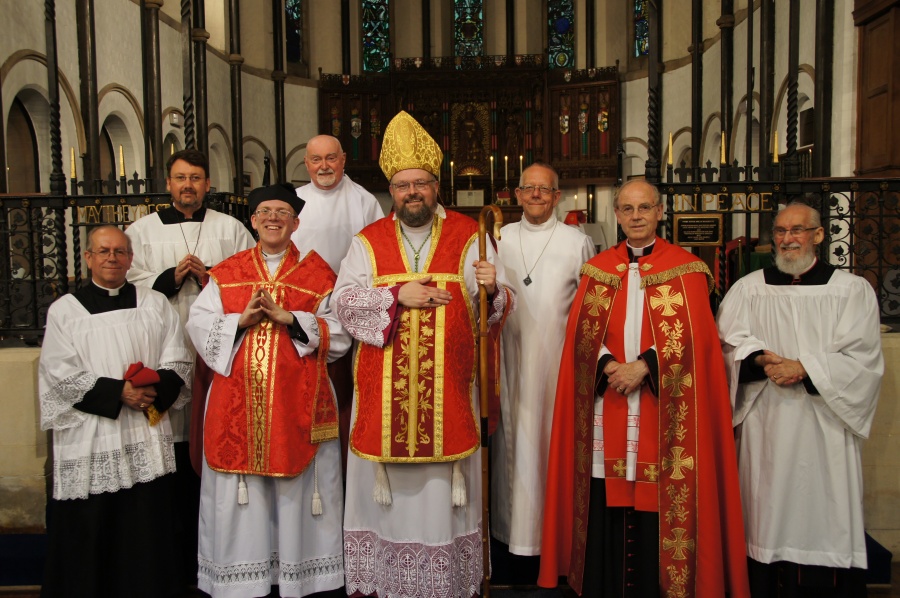
I draw your attention to the ordination of Fr Jonathan Munn of our Diocese (ACC in the UK) by Bishop Damian Mead.
Please see the page on our diocesan website – Ordination of Fr Jonathan Munn & First Mass. It is my regret to have been unable to be present, but I ask your prayers for him in his ministry (where he was already serving as a deacon). I renew my warmest congratulations.
I have just today returned from north Brittany where I have spent five whole days in the footsteps and wake of a fine French TV series on the terre-neuvas in the 1920’s, Entre Terre et Mer. The terre-neuvas were fishermen who sailed from the coasts of Europe to the Grand Banks off the Canadian coast from the sixteenth century to the early twentieth to bring back tons of salt cod. As the Grand Banks became overfished by modern factory ships, the time of the terre-neuvas came to an end with a ban imposed by the Canadian authorities. Saint-Malo and Fécamp were important ports for this kind of fishing. They went out there on a three-mast ship and the fish were caught on hooks tied to weighted traces from the ship’s dory boats. Sometimes, a boat would venture out too far from the ship in the fog and get lost. Many good men were tragically lost in this way. This type of boat is still used to this day for fishing and pleasure, and they can be sailed downwind or rowed upwind by two strong men. The terre-neuvas brought about the colonisation of Saint-Pierre and Miquelon and the port of Saint-Pierre became a place where sailors would find entertainment and their ships could be resupplied.
The French TV series is extremely moving and brings a deeply human element into the drama of a highly dangerous occupation. Seeing it re-awoke my childhood dreams of going to sea in the footsteps of my great-grandfather who sailed round the Cape Horn several times as he brought wool from Australia back to England. They were tough men, and their womenfolk anxiously prayed for their safe return. Never was the prayer for those in peril on the sea more apposite. The sea is a dangerous place, fickle and ready to catch the unwary. Even close to the coast, a sailor takes very careful precautions, to ensure his safety – particularly taking the proper equipment on board his boat and checking the tides, the currents and the weather. It is too late for me to do anything more than amateur sailing, and I hope one day to get something bigger than my dinghy, perhaps a Hurley 22 which is ballasted at about 40% of its total weight – a true ocean boat. If the sea is associated with Leviathan in the Old Testament, God is present there very perceptibly as in any remote place in nature.
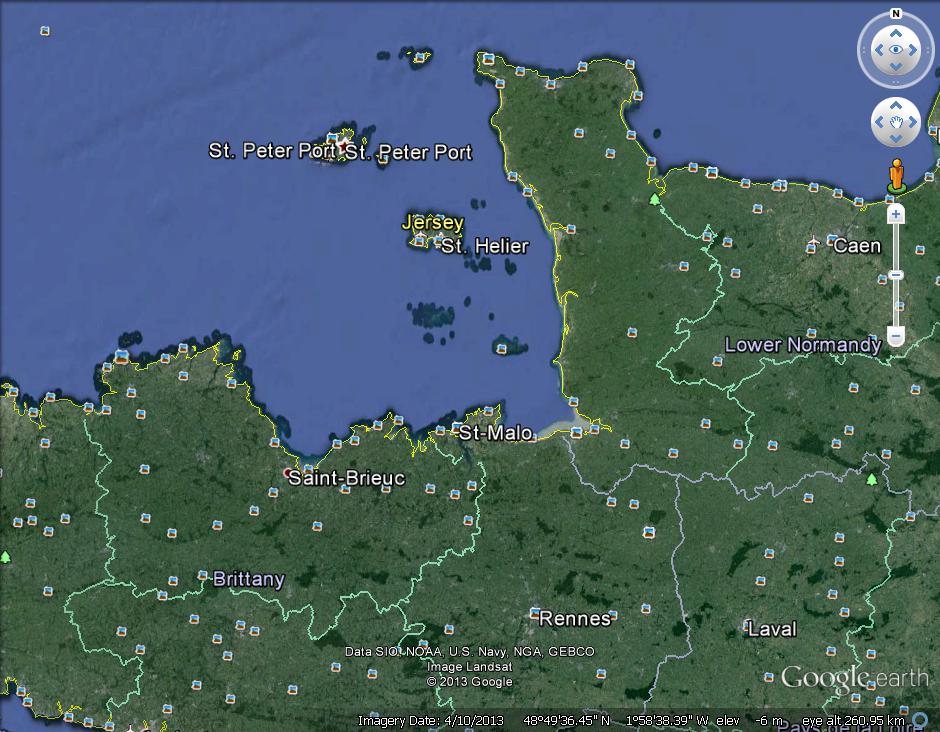
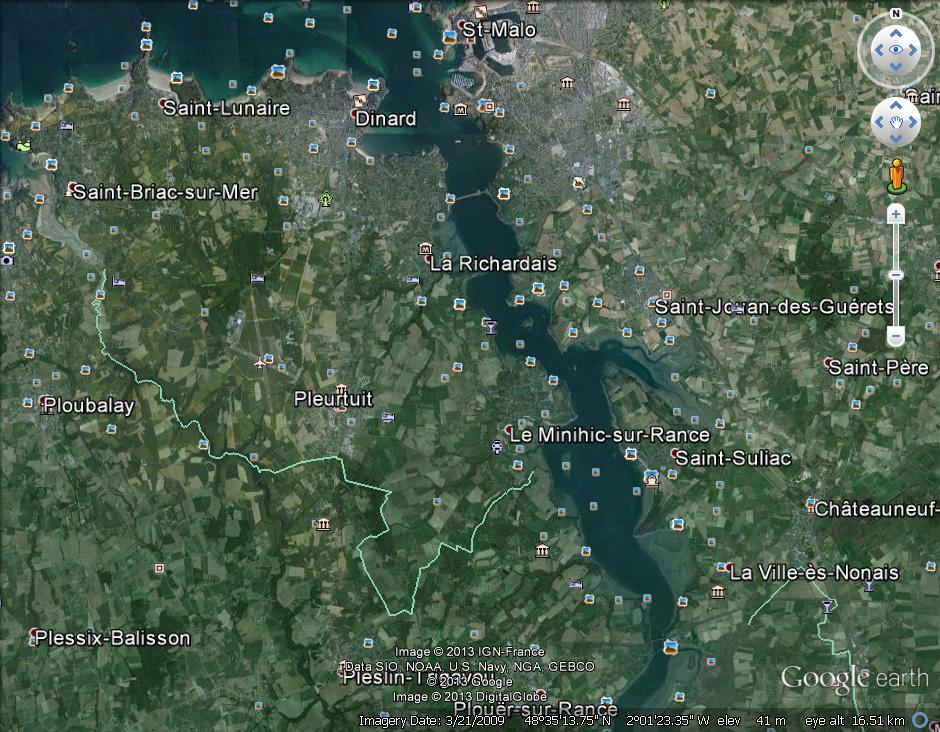
The idea for my little holiday in the area of Saint-Malo came from the TV series on the terre-neuvas, where they lived when not at sea and where they sold their catch, and also from knowing that the Rance was a great place for sailing. There are two ways of having a sailing holiday – in a boat you can sleep on, a yacht for coastal or offshore sailing, or trailer-sailing. With the latter way of doing things, as my dinghy is so small, you make the long distances on land by road, and then launch the boat in the small areas in which you have decided to sail. Therefore, it was camping and trailer-sailing for me.
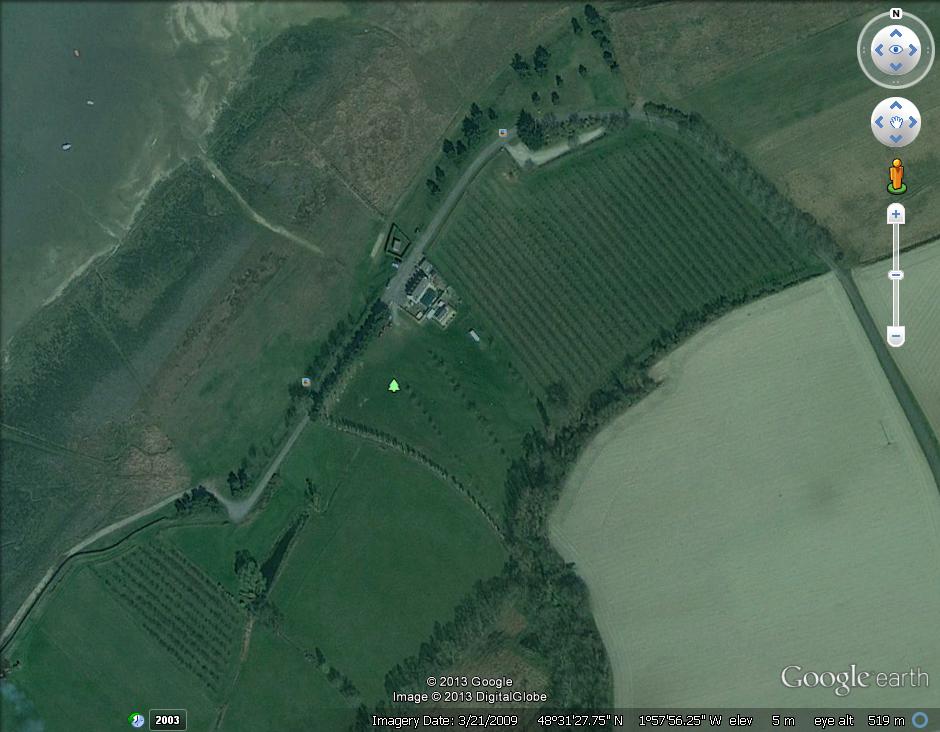
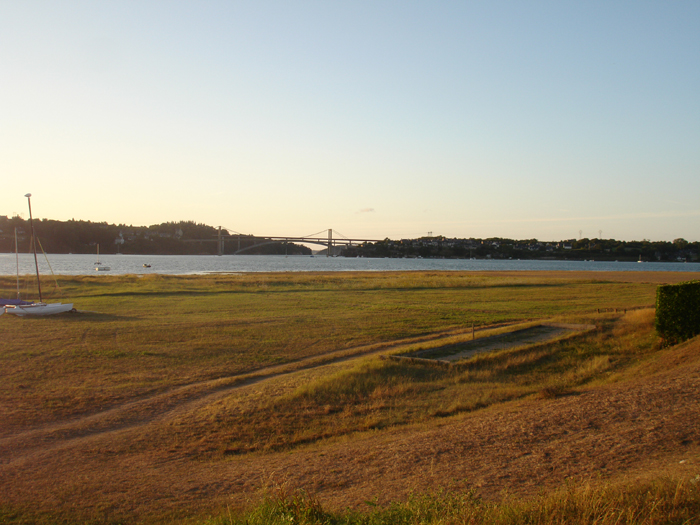
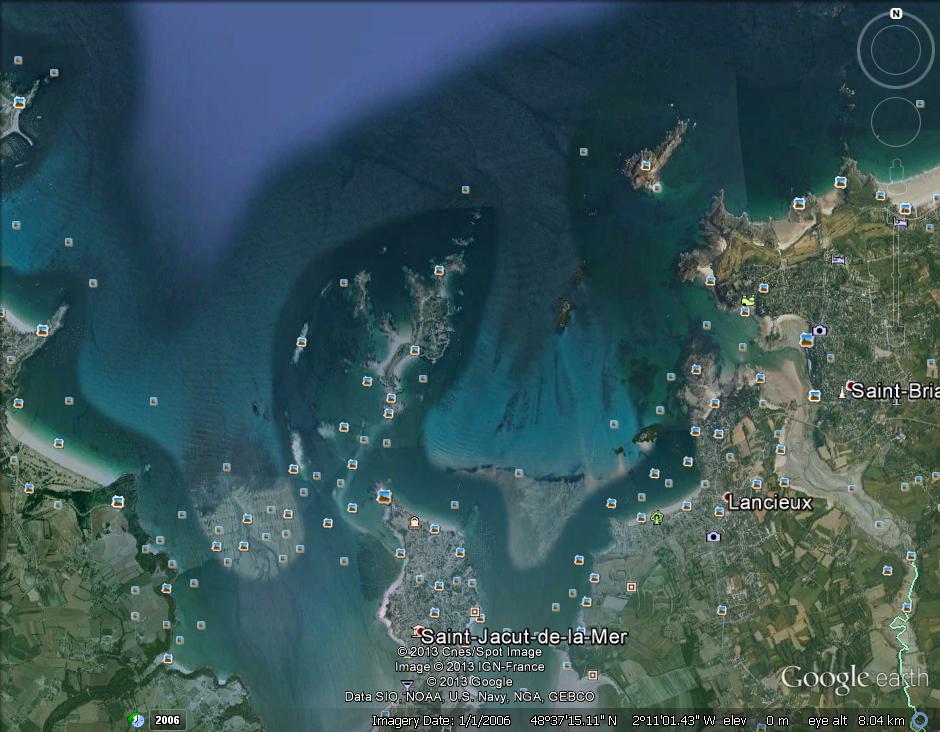
The second satellite photo is of the camp-site where I pitched my tent, at the “bottom” of the Rance, a lovely quiet place without the gimmicks and “entertainment”.
Sunday 18th August
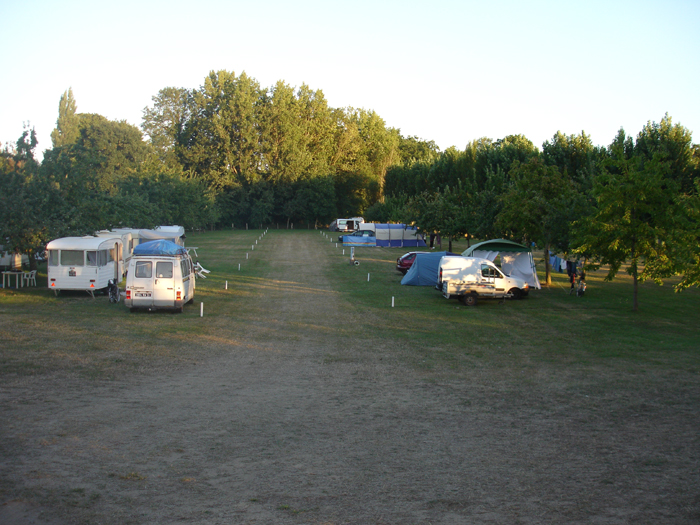
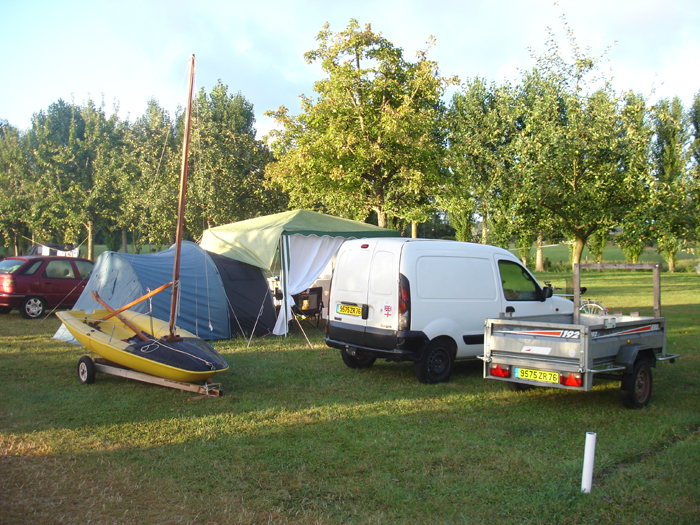
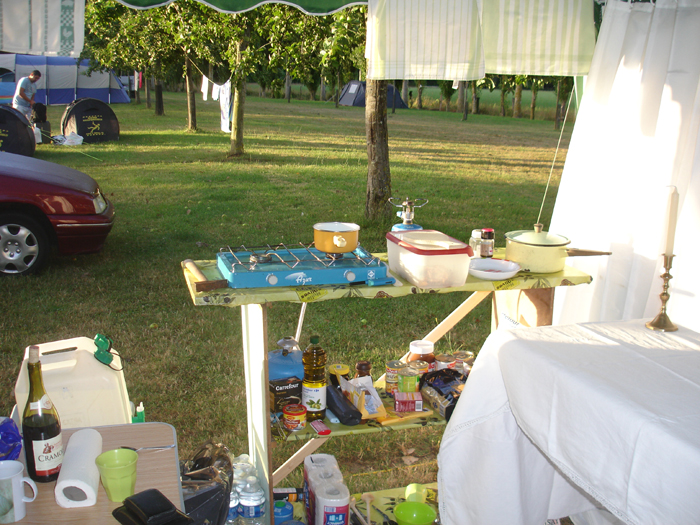
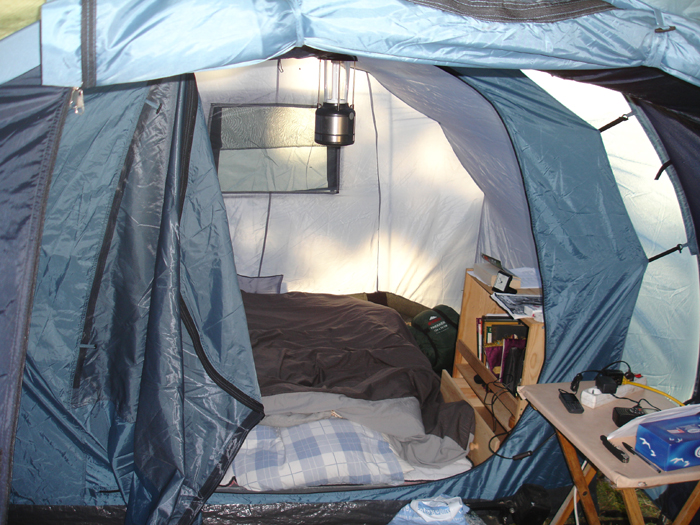
The following photos are of my base camp:
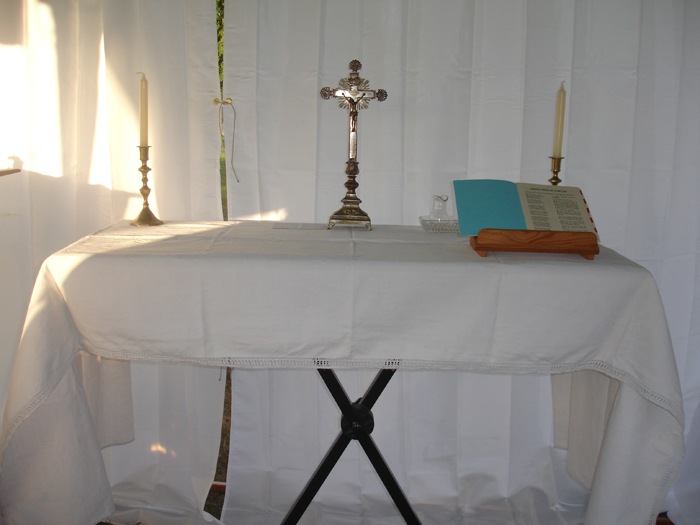
Yes, indeed, I took my chapel kit with me, and have a proper altar-sized table of the right height to say Mass each day. That was my occupation for the Sunday evening as I arrived at the Ville Ger.
Monday 19th August
See this fine video of a sailing on the Rance, and you will see many of the things I saw from my own boat.
At 7 minutes, 8 seconds, you see a white building on the opposite bank, which marks the spot of my camp-site. The owner also runs a bar and sells the most amazing Brittany beers including one that uncannily resembles Irish Guinness.
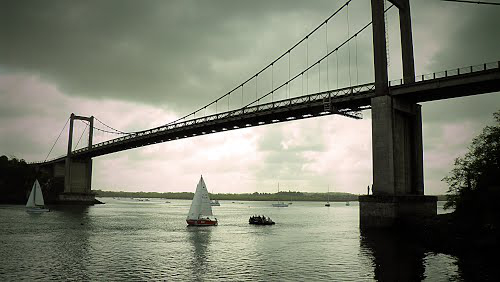
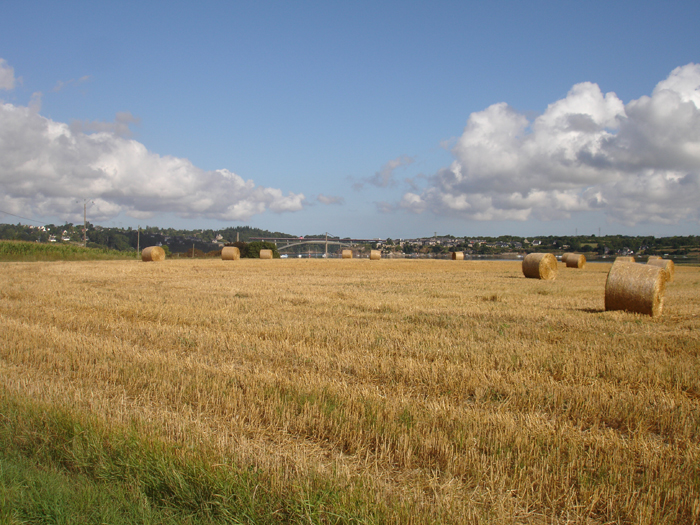
At last I was opposite Plouër sur Rance on the west bank of the Rance. I had simply to rig the boat and go. There was a fresh north-west wind, which would mean tacking and close-hauling all the way up. The Rance is smaller than I imagined, and it only took me a few hours to sail all the way to the hydroelectric dam between Saint-Malo and Saint-Suliac. This mouth of the Rance is divided into several anses or bays between the narrow parts. The first narrow part I had to negotiate was where two high bridges cross the Rance.
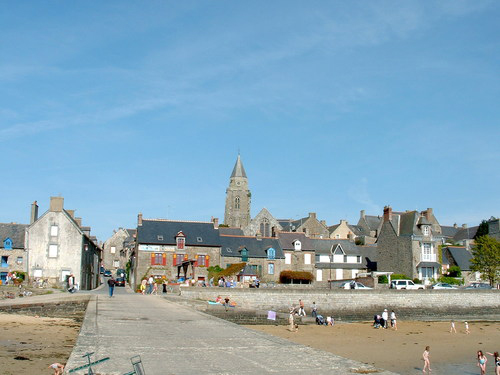
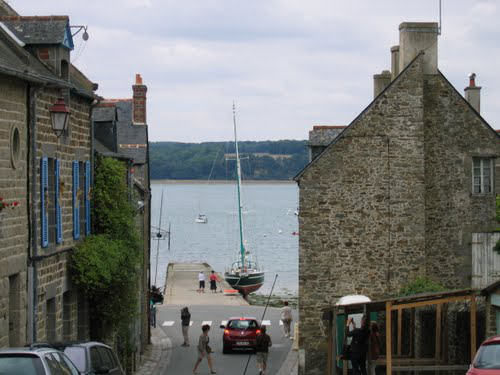
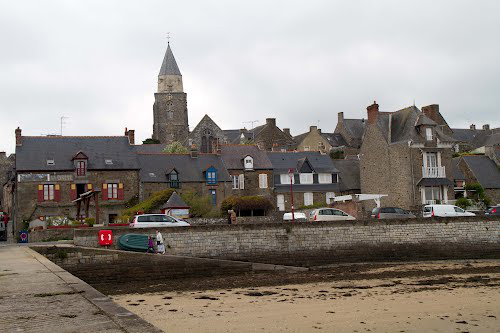
I tacked under the bridges being careful to keep as much wind as possible and avoid being blown into the lee bank, and at last arrived in an immense plane of water. The discovery was beginning for me. After another narrow-ish strait, I saw the village of Saint-Suliac on the east bank, off my starboard beam. I landed there to have something to eat from my picnic box and to visit this village so associated with the film and the real terre-neuvas of old.
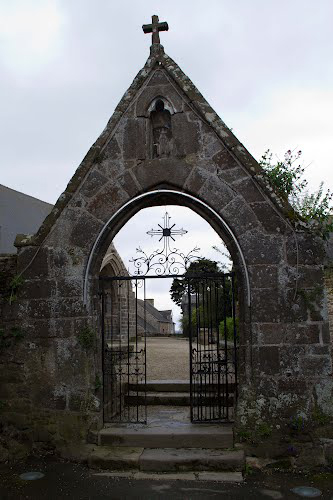
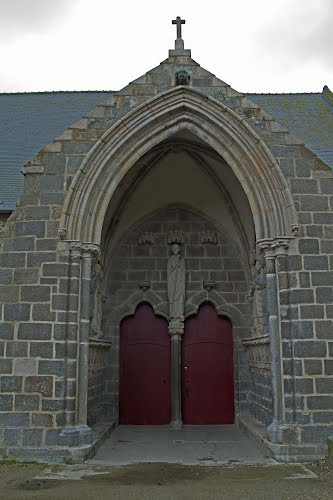
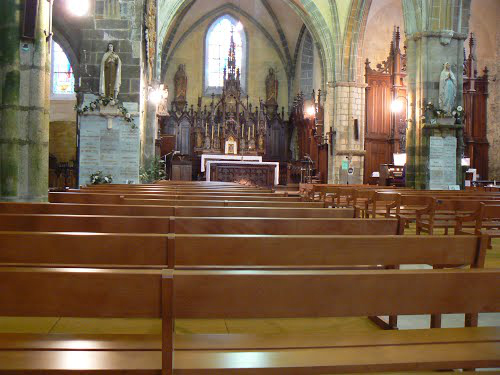
The church is essentially thirteenth-century but with furnishings from the nineteenth century mostly of appalling taste.
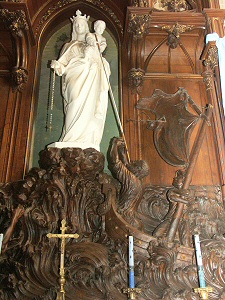
One thing is obvious, is that those wives and children of seamen had the faith. It is all they had in their anxiety as they waited for the safe return of the ship with all its crew. To the right of the high altar, there is an altar of Our Lady, with a carved representation of men perishing in a stormy sea, and being pulled out of the waves by the Mother of God by a kind of silver staff. The image is most moving.
I returned to my boat and continued tacking to the north, passing two small rocky islands and put into a small port with a sailing club and some boat repair workshops. The mud at low tide was knee deep! Yuck! The sail back was most enjoyable, running before the wind and nothing to do apart from look at the world around me and the occasional classic rig boat. I arrived at the campsite almost at high tide.
I should add a note about tides in the Rance. They are artificial because of the hydroelectric dam built in the early 1960’s. Their system makes the tide of the Rance follow the sea tide by about two hours to get maximum power into the generator turbines. On the Rance, the tide remains high for a long time, and low for a long time, with the intermediates remaining very short. It seems very strange, like sailing under bridges!
Tuesday 20th August
High tide on the Rance was in the morning, but there was almost no wind. A bicycle only needs leg power!
I cycled into the local village to get some food and visit the church, a large nineteenth-century building, quite nicely restored. By about 11 am, I saw some fluttering leaves in the trees. There was very little wind, but some. It would get me over to Plouër-sur-Rance.
There’s not too much to it, a marina and a place to get your boat repaired. As the tide ebbed, I saw a forty-foot ketch up against the dock, already aground and the owner using every means possible to stop his vessel falling away from the dock wall. I suggested securing the mizzen mast to a mooring ring using the block tackle of his mainsheet. Great idea! This was a kindly young man in his thirties with his wife and two small children. He was in the Merchant Navy, an engineer and mechanic, and has taken a sabbatical year to sail his yacht as far as Brazil. Boats bring people together! I left him and his family to get their lunch, and I tucked into mine, some cold meat and vegetables I had cooked the evening before. I went to visit Plouër, but there was very little to it, mostly modern houses of well-to-do people, an eighteenth-century church and a few nice cottages. Better get back to the boat before the tide really gets low! The Merchant Navy fellow with the big yacht showed me around, and he proudly showed me the engine, a vintage Renault four-cylinder diesel engine of amazing reliability. His navigation and radar equipment were also his pride and joy.
I launched the boat and set off for deeper water, and the wind began to pick up. I returned to Saint-Suliac, especially to attend to some little point about my rigging that was annoying me. I then visited the other ports all the way back, and still the low tide was reducing the navigable channel. It was beginning to rise again. At the end of the day, I put in at the camp-site and ended the day a happy man.
Wednesday 21st August
I still had three days, and there was now the open sea to discover. This is where the terre-neuvas saw the last of their land for the several months of their perilous voyage to Canada. The great fortified city of Saint-Malo would remain in their minds.
For my tiny dinghy, I could not use the port or the yacht marina. I needed to go to the beach just south of the port at Saint-Servan. I was lucky to find a parking slot big enough for my van and the trailer.
Here’s the boat rigged and ready to go.
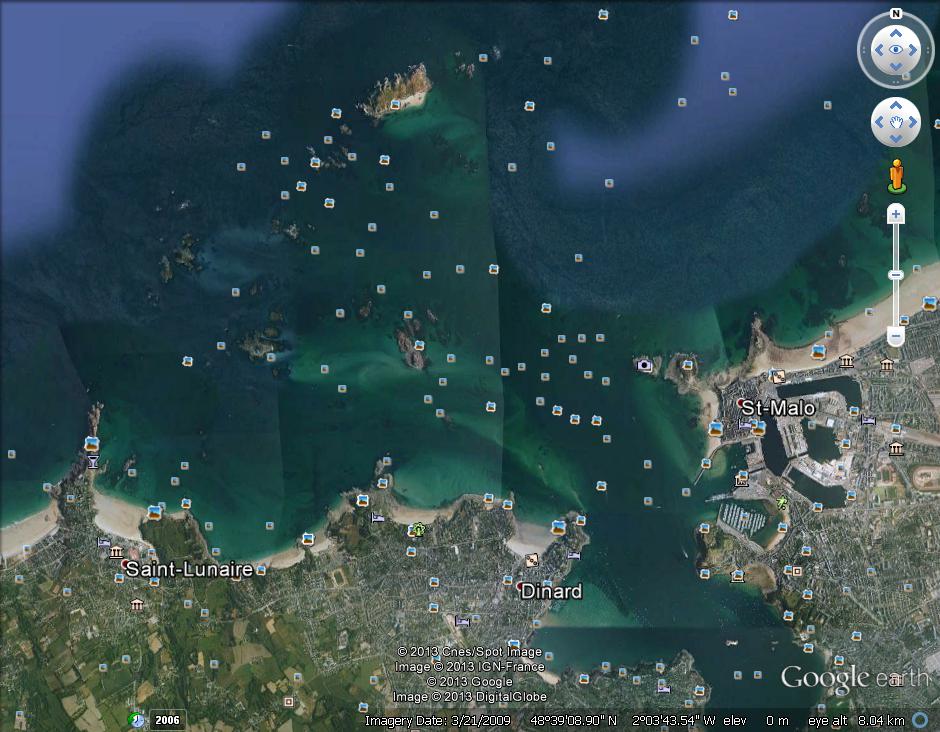
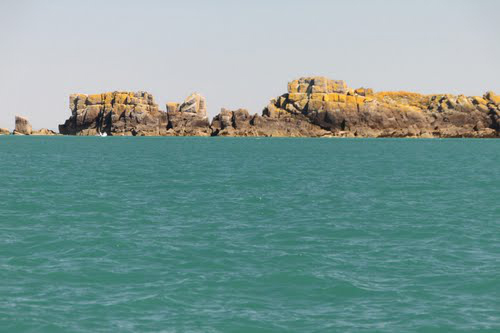
This was certainly the most enjoyable outing, which would involve a crossing to the island of Cézembre. To get there, I had to cross the shipping channel, which is technically illegal in a dinghy, but I kept my VHF open on channel 9 to keep an ear open. The Harbour Master’s office only seemed to be interested in a yacht that needed to buy diesel fuel and find a berth. How stimulating! I crossed the channel quickly and then took advantage of the ebb tide to make a quick passage to Cézembre. It’s a strange place, associated with Saint Brendan, the patron saint of sailors, and a last bastion for the Germans in 1944. The Allies bombed the hell out of it, including the use of napalm, and obliterated every trace of life. To this day, the vegetation is very barren, and we are not allowed access to most of the island because of large numbers of unexploded bombs and shells.
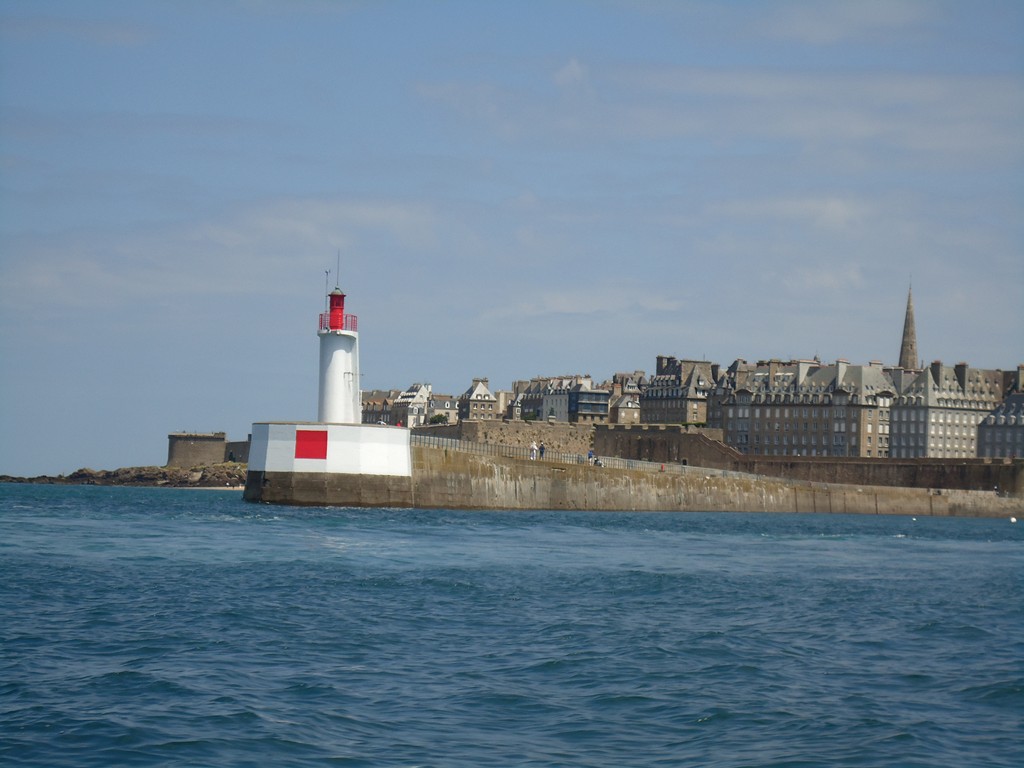
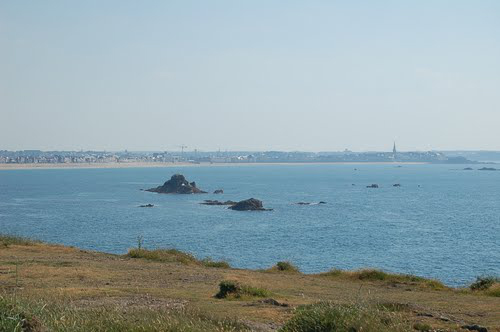
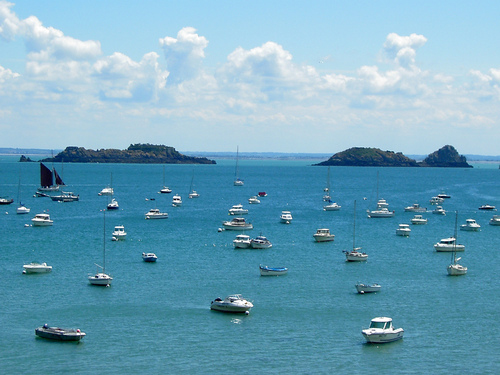
This second photo is a view of Saint-Malo from Cézembre. I ought at this point to say that some of these photos are not mine. I could not take my non-waterproof camera on board the boat for fear of ruining it. So these smaller shots were “pinched” from Google Earth. Whilst I waited for the tide to turn for the return to Saint-Malo, I sailed around some of the other islands off the shore of Dinard, the town just across the mouth of the Rance from Saint-Malo. The return was just as enjoyable as the outward trip, in a broad reach off the north-east wind.
Going on local advice, I thought about the next day, and a sail to the island of Agot, more of a natural place untouched by man’s warlike follies. But, the tidal current is dangerous. I followed the wise man’s advice, and decided on a trip from Lancieux, further to the west. I would go by road and avoid the dangerous bit.
Thursday 22nd August
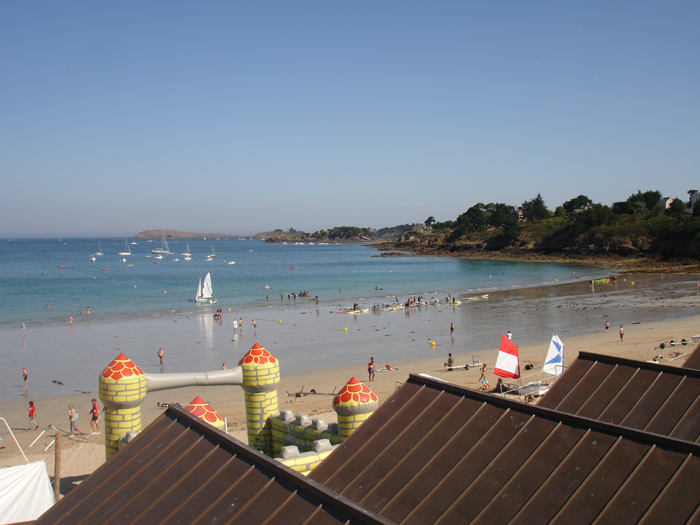
After saying Mass of the Octave of the Assumption, I set off for Lancieux, a lovely double bay to the west of Saint-Malo.The beach is a favourite with sunbathers.
I went through the invariable “ritual” of rigging the boat, and at last it and I were ready for sea.
I sailed for Agot, an uninhabited island with some prehistoric remains. Those with our own boats can land on the beach, but there are no “mass tourist” boat services. I was able to rifle a couple of pounds of mussels and some clams, which gave me a delicious supper, cooked in a sauce made from shallots, onions and white wine. The shellfish went into my anchor bag. I then sailed across into the west bay with a careful eye on the time from the tide point of view. This was specially important over these days with the strong spring tides.
The seafood proved delicious as I brought my catch back to the camp-site and cooked it.
Friday 23rd August
The lovely beach to the north of Cancale was a difficult spot to find a parking slot for the van. I detached the trailer and found a little place for it, too small for a car, near the launching ramp. After doing the round a couple of times, I found a parking slot half way along the promenade. Most people were having their lunch in restaurants or picnicking, and that left me a little peace and quiet to rig the boat. Milling crowds of people on holiday are something quite unpleasant!
Once I left the beach with the beach trolley in a safe place, this would promise to be a fine outing. The wind was coming from the north-west and gave me a nice close reach. The tide was in my favour as I sailed to the point and tacked to the west. The cliffs were quite high, with a semaphore station and a good few people on the cliff edge to admire the view. The thought that came into my head was that if they noticed my boat, they would find it quite insignificant compared with the immensity of the sea.
This is one point with sailing. We are like the folk of old in the great cathedrals, dwarfed by the immensity of God and humbled to our true insignificant selves. I remember my regatta skipper of two years ago – The sea teaches us modesty. That or you get killed in very short order! Just stand on a cliff and look at the boats, and even the big yachts look very small.
I looked at my watch and considered my predicament should I be against the tide on the northern part of the point! I would be swept to the west and would be unable to get back to Cancale. I took the boat about and returned the way I came, passed the beach and headed to the two islands south of the beach. The sea was in one of those mysterious moods as I could see the great Mont Saint-Michel off my port beam many miles away. The Cotentin coast was also visible as was the island of Chausey, south-east from our “imperial” Channel Islands Jersey and Guernsey. The Channel Islands themselves were way over the horizon. I was about half a mile from the north Brittany coast.
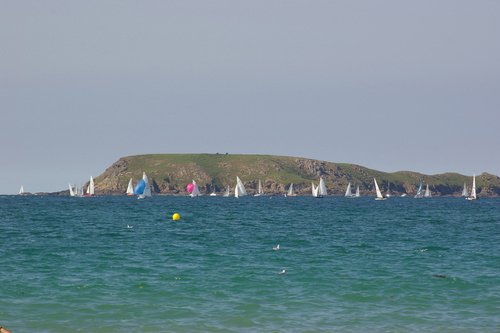
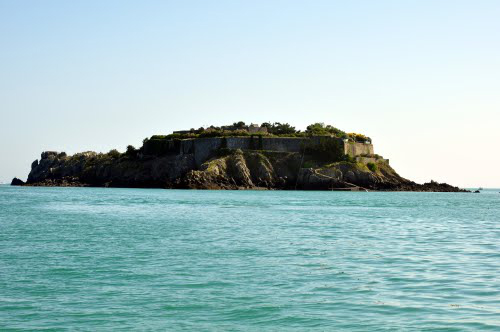
I then approached the two isles in the above photos, the Isle of Rimains and another rock without any possibility of landing with a boat. The Isle of Rimains has a fort built on it, constructed in the seventeenth century on plans by Vauban to defend the pass of Cancale and the Bay of the Mont Saint-Michel against – always the same enemy! Yes, we the Brits! The castle is now privately owned.
This was the last sailing of the week, and I put in onto the beach at about the same time as a school of catamarans. I landed, went to get the launching trolley, and a couple of kind people helped me haul the boat up to my road trailer (still there!). By the time I got back to the camp-site, the wind was getting up and the signs of bad weather were there. Sure enough, it rained in the night.
Saturday 24th August
I began the day with Mass of St Bartholemew in union with Fr Jonathan Munn’s ordination being celebrated in Chatham, Kent. I deeply regretted being in the wrong place, but the Kingdom of God knows no geographical limits. I celebrated under the arbour attached to my tent, and the four shower curtains gave some protection from the rising wind. No question of lighting candles! I had to cover the host with the front part of the corporal lest it should get blown away in a gust.
It was the day to pack up and go. The very helpful man in the caravan just opposite my pitch turned out to be homeless with his wife stricken with multiple sclerosis and totally handicapped. They were waiting for council housing, and a friend of theirs lent them a caravan. One comes across misery everywhere in this fallen and sick world. From the beauty of nature to our sickness, decay and death! The two are part of the same world created by God and messed up by – call it what you will, original sin or the mysterious side of the Old Testament Yahweh in his moods of love and anger. I think these people were not believers, since they asked me nothing about religion, yet would have seen me celebrate Mass. I didn’t hide away! All I could do was to encourage this stricken humanity to keep love and hope, and never give up in the face of human hardness of heart.
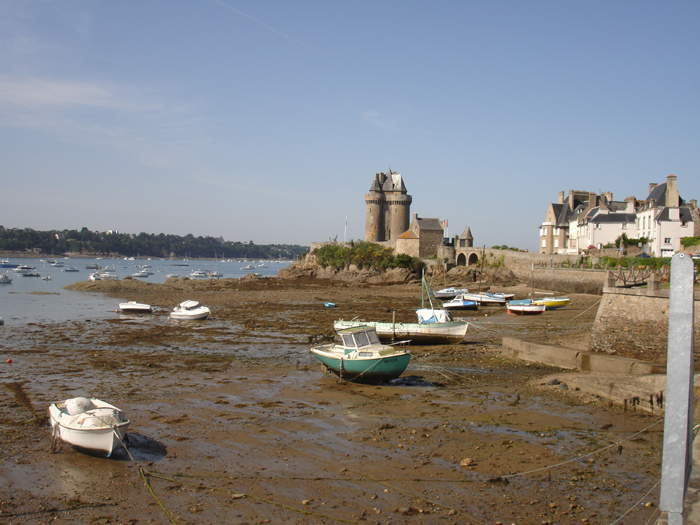
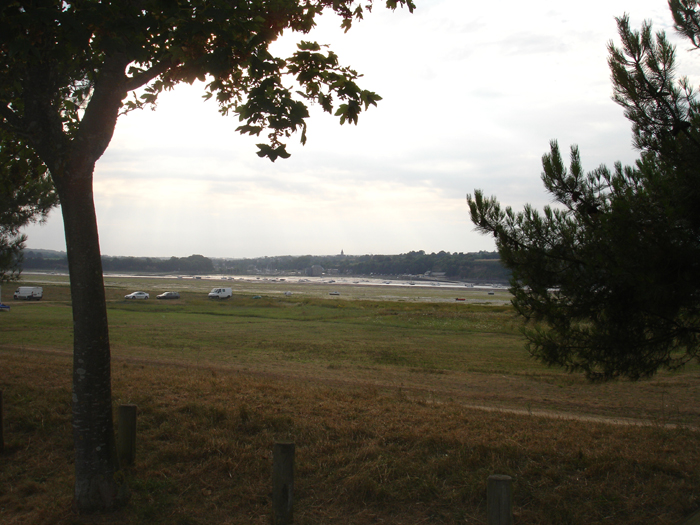
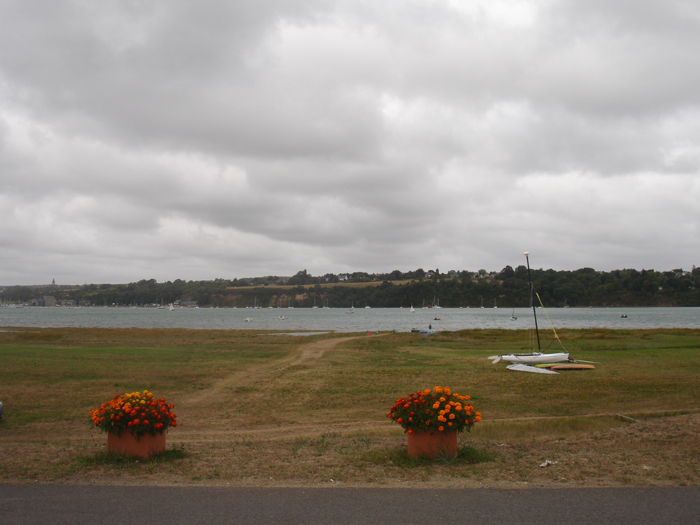
Here are a couple of shots of the extreme low and high tides in the Rance. The second was taken on the Friday morning as the depression came in from the north-west.
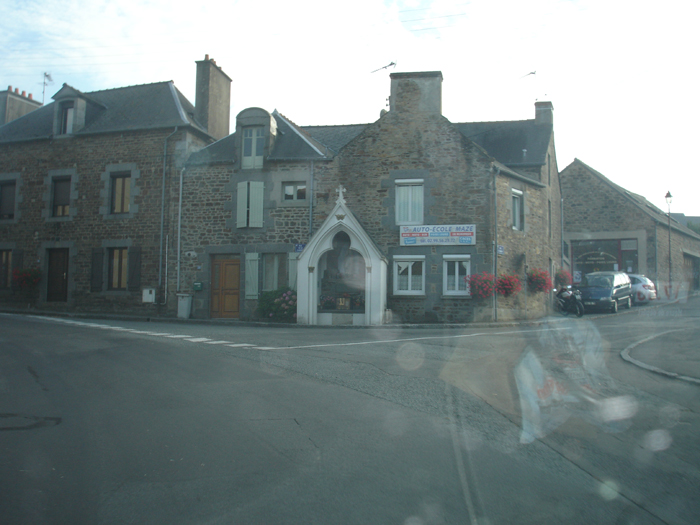
As I left Brittany, I found this interesting street shrine –
I took the photo from inside my van as I drove past. The reflections of the windscreen mar the scene. The shrine is evidence of a great amount of piety and strong popular religion in Brittany, like in England before the Reformation. This is the Celtic spirit as its highest! They were, and still are tough people of the land and sea – entre terre et mer, or whatever they would say in their own Breton language.
I above all needed closeness to nature, and a little taste of this robust life with the elements. I was far from entertainment, advertising, selling, human business and dishonesty, noise, mass tourism and the many things that cause sickness in our souls and inner being. Far away from churches and religious folk, without the internet, blogs and trolls, it was a true spiritual retreat!
My sailing club had a superb regatta yesterday afternoon. We were nine dinghies and eight catamarans. The wind was a westerly and moderate one, but very unstable with buffeting gusts, so we had to be very dynamic with the mainsheet. The regatta was held in three rounds. The first was quite easy in a 10-knot breeze. For the second, the wind freshened to about 15 knots and there was a heavy swell. The close haul to the first buoy was a “bitch”.
By the time we had the third round, the wind was rising to about 18 knots and gusting at about 20. I had not fitted my reefing line. Boats were capsizing all over the place – mine didn’t, but I was bailing all the time. By that time I decided to leave the race and return to the beach, after signalling to the safety boat to help a capsized dinghy with the mast stuck in the bottom and filling with water. Even coming in to the beach, I broached in the waves and had to make a second attempt at beaching. It was hairy! But no one was hurt and only two boats suffered minor damage, other than a Laser with a broken mast.
The sea is fickle, and not to be fooled with! We must never forget that.
* * *
I am going away today for a whole week in Brittany, as mentioned in an earlier posting. My wife needs the laptop computer, and we agreed that a week without blogs or internet would be good for me. The only electronic devices I will have will be my mobile phone, VHF for the boat and and an MP3 player to play music for whilst I read real books in the evenings.
I’ll be back next Sunday (25th August), and my prayers and thoughts go out to Deacon Jonathan Munn of our Diocese who will be ordained a priest next Saturday. See our diocesan website and the announcement.
If you are not moderated (if you have already posted and see your comments appearing immediately), you can send comments freely. Others will have to wait until I get back before seeing their comments appear. Thank you for your understanding.
I did a little survey of interesting blogs a few days ago. Here’s a couple of the forgotten ones, which are generally very good. The first has some very interesting reflections about why people go to continuing churches. The second has recently published a timeline of the English Reformation to help us brush up on our history.
Less than a month after I had my Rex put to sleep, my other dog Sally got her paw badly bitten by a dog. The paw is nearly healed. On the other hand she became lethargic, very weak and off her food. She is 12 years old, a cocker spaniel cross-breed.
I took her to the vet (not our own who is on holiday but another one) this morning, and he ran a blood test to arrive at something like a diagnosis. She has become severely anaemic and is low on red blood cells and haemoglobin. The vet suggested having a echograph done to examine the spleen and liver, then mentioned doing a biopsy to see if it is possible to remove the tumour surgically.
Hold your horses! This seemed like a ploy to get me to spend a hell of a lot of money for a dead dog! Some vets are just money machines. My father is a retired vet – I know a true vet when I see one…
My wife and I think it could well be exhaustion and shock after the biting and the process of a very nasty wound healing. Psychological traumas have their effect on the body in both humans and other species. She has something to give her a better appetite, and she will be getting rich food for the next couple of weeks: oily fish, black puddings, pig’s liver and kidneys, cat food, chicken bones, cheap cheese and all sorts of nice things to give her strength. Then we’ll see if she has cancer with our own vet, just two weeks until she gets back from her holidays.
If it is cancer, it will be sad to see another dog go so soon after Rex. We can pray for dogs, since the Ritual gives a rite for the blessing of sick animals. They are our companions and it is wrenching when they have to go.
If it is just exhaustion and depletion, then she just needs nursing for another year or two of life. She is a good dog, loyal as most dogs are. Truly, 2013 is an annus horribilis for me, beginning with the loss of my mother, and now my dogs. I too ask your prayers.
Habitually, my wife and I are usually together at some campsite on this date, and the Mass of the Assumption is celebrated using my travelling Mass kit. This year, we are taking our week-long breaks separately for various reasons. So, I celebrated this Mass in my chapel, as always from the Sarum Missal. The proper resembles the pre-1950 Roman version, except that we have a beautiful sequence (and also different sequences for the Masses within the Octave). Here is the Latin text from our missal:
Die 15 Augusti in Die Assumptionis B.M.V.
Officium
Gaudeamus omnes in Domino diem festum celebrantes sub honore Mariae Virginis de cujus assumptione gaudent angeli et collaudant flium Dei. Ps. Eructavit cor meum verbum bonum: dico opera mea regi. Gaudeamus omnes. Gloria Patri. Gaudeamus omnes.
Oratio
Veneranda nobis, Domine, huius diei festivitas opem conferat sempiternam, in qua sancta Dei genitrix mortem subiit temporalem; nee tamen mortis nexibus deprimi potuit, quae filium tuum Dominum nostrum de se genuit incarnatum. Qui tecum vivit et regnat in unitate Spiritus Sancti Deus, per omnia saecula saeculorum. Amen.
Lectio libri Sapientiae. Ecclus. 24:1120
In omnibus requiem quaesivi et in hereditate eius morabor; tunc praecepit et
dixit mihi creator omnium, et qui creavit me requievit in tabernaculo meo. Et dixit mihi in Iacob inhabita et in Israhel hereditare et in electis meis mitte radices. Ab initio ante saeculum creata sum et usque ad futurum saeculum non desinam et in habitatione sancta coram ipso ministravi. Et sic in Sion frmata sum et in civitate sanctifcata similiter requievi et in Hierusalem potestas mea. Et radicavi in populo honorifcato, et in parte Dei mei hereditas illius, et in plenitudine sanctorum detentio mea. Quasi cedrus exaltata sum in Libano, et quasi cypressus in monte Sion, et quasi palma exaltata sum in Cades, et quasi plantatio rosae in Hiericho, quasi oliva speciosa in campis, et quasi platanus exaltata sum iuxta aquam. In plateis sicut cinnamomum et aspaltum aromatizans odorem dedi; quasi mirra electa dedi suavitatem odoris
Gradale
Propter veritatem et mansuetudinem et iusticiam, et deducet te mirabiliter dextera tua. V. Audi flia, et vide, et inclina aurem tuam, quia concupivit rex speciem tuam.
Alleluya. V. Hodie Maria Virgo caelos ascendit. Gaudete quia cum Christo regnat in aeternum
Sequentia
Area virga primae matris Evae florens rosa processit Maria.
Oritur ut lucifer inter astra etherea
perpulchra ut luna.
Flagrascit ultra omnia balsama,
pigmenta et thimiamata.
Purpurea ut viola,
rocida ut rosa,
candens ut lilia.
Patris summi quam elegit proles deica.
Et assumeret carnem sacrosanctam
ex Virginis carne incorrupta.
Celsus nunciat Gabriel nova gaudia æterni regis exortum in terra,
matremque eius ita salutat:
Ave Maria, domini mei Mater alma,
cælica plena gratia!
Tu benedicta regem in sæcula paries
efecta orbis regina.
Fecunda ergo, inquit,
quomodo esse queam, cum virum non agnoscam ex quo sum nata et semper permanens virgo pudica?
Ne timeas, respondit Angelus,
sanctum pneuma descendet in te, casta,
quo fecundata paries deum et hominem una.
O vere sancta atque amanda,
ex qua est orta redemptio nostra salus,
quoque mundi veraque vita.
O dei nostri genitrix,
pia suscipe nostra hac die precata
in qua es assumpta ad cæli claustra.
Tu es enim Patri cara,
tu es Jesu Mater bona,
tu Sancti Spiritus es templum facta.
Tu es pulchra dei sponsa,
tu regem Christum enixa domina es
in cælo et in terra.
Hodie namque curiæ cælestis
tibi obviam agmina te assumpserunt
ad palatia stellata.
Jesus et ipse festivus
tibi matri cum angelis occurrens
sede paterna secum locavit in sæcula.
iam cum deo regnas nostra excusa clemens mala poscens cuncta bona,
O benigna!
Mediatrix nostra,
quæ es post deum spes prima,
tuo Filio nos representa,
Ut in poli aula læti jubilemus, alleluya!
Evangelium
Sequentia sancti Evangelii secundum Lucam. 10:38-42
In illo tempore: intravit Jesus in quoddam castellum, et mulier quædam Martha nomine excepit illum in domum suam. Et huic erat soror nomine Maria quae etiam sedens secus pedes domini audiebat verbum illius. Martha autem satagebat circa frequens ministerium; quæ stetit et ait: domine non est tibi curæ quod soror mea reliquit me solam ministrare? Dic ergo illi ut me adiuvet. Et respondens dixit illi dominus: Martha, Martha, sollicita es et turbaris erga plurima. Porro unum est necessarium: Maria optimam partem elegit quæ non auferetur ab ea.
Offertorium
Diffusa est gratia in labiis tuis, propterea benedixit te deus in æternum.
Secretum
Grata tibi, quæsumus, domine, munera nostra efciat dei Genitricis oratio, quam et si pro conditione carnis migrasse cognoscimus, in cælesti gloria pro nobis apud te jugiter orare sentiamus. Per Dominum.
Præfatio Et te in assumptione.
Communio
Beata viscera Mariæ Virginis, quæ portaverunt æterni Patris Filium.
Postcommunio.
Mense cælestis participes efecti, imploramus clementiam tuam, domine deus noster; ut qui festa dei Genitricis colimus, a cunctis malis imminentibus, ejus intercessionibus, liberemur. Per Dominum.
* * *
There are some lovely reflections by soon-to-be Father Jonathan Munn on his blog Assumption of Our Lady 2013: Dixit Dominus on the first psalm of festal Vespers Dixit Dominus.
France still marks the Assumption as a public holiday, even if so few people go to Mass. The village where I usually keep my boat, Veules les Roses, has a solemn procession of boats and those who sail in them for their work or pleasure and a blessing of the sea. It is good to see that not everything is gone.
These are warm sunny days, and the canicule has left us. The mornings are fresh, sweet and dew-filled. The days here in Normandy are like in southern England, warm without being hot.
For the rest of the Octave, the various Saints coming up are commemorated as mere memorials as the Octave takes precedence, even over the 12th Sunday after Trinity. I will certainly take the liberty of celebrating the Sunday and commemorating the Octave.
May you all have a good and holy Assumptiontide before things like getting children back to school, getting back to our jobs in earnest and the daily grind. Enjoy the Dog Days while they are still with us!
I have been reading quite a bit about evidence for what we Christians believe, namely the immortality of the soul. When we see death, it looks so final, so hopeless, so irreversible. The absence of a departed loved one seems so absolute that even a believer can have doubts and echo the ideas put about by materialist atheists.
One such idea, hiding behind science, is the “near death experience” being the product of chemical and electrical reactions in the dying brain, but that once dead, that person will no longer exist. However devoutly we believe, we can all have doubts. I certainly often do coming from a highly rational and scientific background.
Here is a video of a woman who had a very special kind of operation on her brain. To do this, the surgeons needed to “flatline” her, a degree of anaesthesia far more profound than usually used for surgical operations. The patient had truly to be clinically dead whilst maintained in a state from which she could be revived. Modern medicine has made incredible advances in this field, and new ethical problems arrive when people formerly assumed to be dead are still revivable.
This lady had an operation to remove an aneurysm.The surgeons had to lower her body temperature extremely low, stop her heart, drain the blood out of her brain, a hairsbreadth short of killing her.
After the operation and her return into her body, the patient was able to describe the surgical instruments used (which she did not see before the operation) and relate things the surgeons said during the operation, including technical terms she did not understand. People under a normal anaesthetic, let alone this degree of clinical death, do not have any consciousness. Naturally, all the vital parameters were monitored during the operation.
The only explanation for this was that the patient’s soul did not depend in any way on brain activity, which was measured as totally absent. I find this reassuring, and really helpful in bolstering up our faith, trust in God and hope – both for our departed loved ones and when facing our own inevitable death.
There’s a lovely article on Fr Ray Blake’s blog Poorer Church, a non-Pelagian Church, a re-Orientated Church. He naturally bases his ideas on what he has been hearing from Pope Francis. Poor Church? Few things make me more angry than learning that some monstrosity has been installed in a church or a cathedral for use as an altar facing the people and cost a fantastic sum of money, perhaps thousands of euros (dollars, pounds, whatever) for an ugly piece of concrete, metal or plastic done by a questionable artist. In the 1970’s, they were burning vestments on bonfires (some of mine were rescued from such a fate) and commissioning expensive new vestments that “looked poor”.
What is even more obscene is the impoverishment of the liturgy whilst some clergy drive flashy cars and have equally flashy careers. There I agree with the idea that many of us do well to drive around in more modest vehicles, and live in a more modest lifestyle. Some of us have little choice when we are limited by a low income. Frankly it suits me to eschew bourgeois life and fashion. I like the simple life!
Fr Blake makes good points about the bishops hob-nobbing with the powerful, but we have to be realistic. There is a difference between simplicity and impoverishment. An impoverished Church ceases to be or do any good for anyone. Without priests, liturgy, beauty, inspiration and more, what is the point of the Church?
Pope Francis seems to have been calling traditionalists Pelagians, those who in St Augustine’s time believed that salvation was through human strength and not divine grace, a man-centred religion. Supposedly it is a matter of saying so many rosaries to get this or that favour from God. Fr Blake seems to understand things deeply – the man-centred religion is not the traditionalist resistance but rather the way things have been done in the Church over the past fifty years. The quintessential Pelagian liturgy is the priest taking the place of God looking at his flock over the altar, as Benedict XVI put it, the closed circle. The antidote to Pelagianism, or its modern equivalent, is re-orientation, turning to the east, the Eastward Position for the liturgy. In the eastward-facing Mass, the priest is hidden and God takes his rightful place. Re-orientation is not only doing the liturgy the old way, but also turning back to God ourselves – conversion, turning around and going the right way. There is the conversion of each of us, but also the conversion of our institutional Churches.
Good reflections, Father Blake, and we all have progress to make regardless of whether we are Roman Catholics or are in some other ecclesial communion.
This is my personal blog concerning my philosophy of life as a Christian following the Romantic world view. I am a priest in the Anglican Catholic Church – Original Province and live in France.

 The outhaul and the downhaul are terms we often come across. There is no ambiguity about the term outhaul, which can only mean one thing, but the term downhaul can be taken to mean what most of us sailors call the cunningham which tightens the luff of the mainsail or the boom vang. These three devices are used to trim the sail to get it into the most efficient aerodynamic shape for the point of sail.