
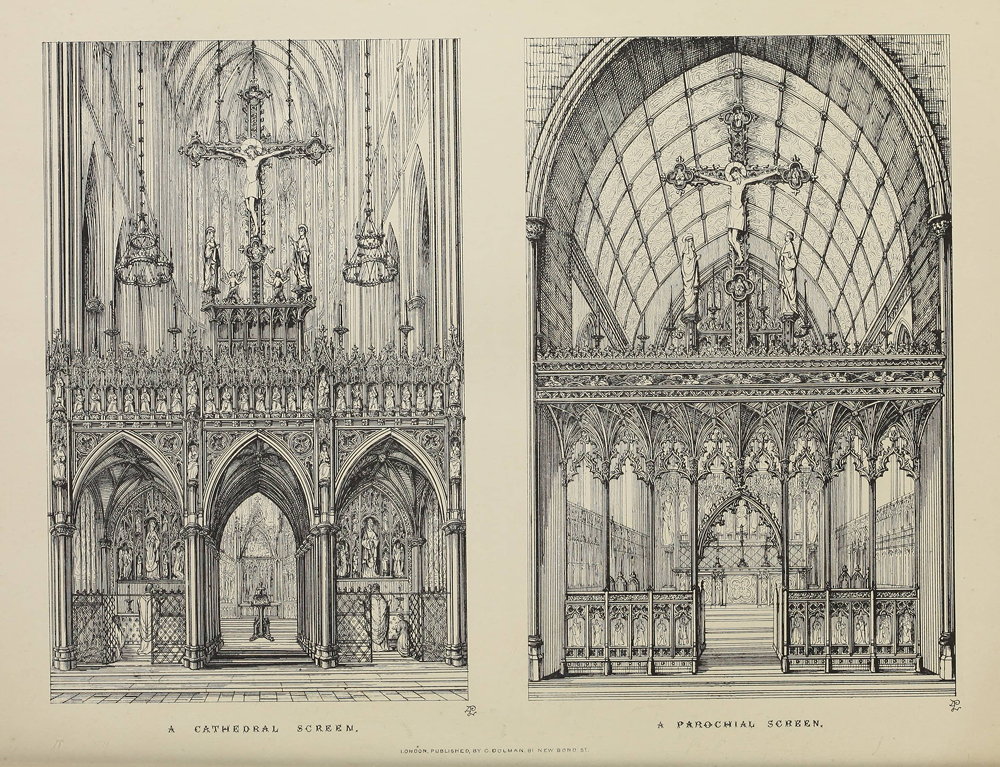
Just today, I watched a video about the disparition of the Jubé or rood screen in cathedrals and other churches, especially during the eighteenth century, some two hundred years after the Council of Trent. Jubés : la vraie raison de leur disparition. The Council of Trent is usually blamed for this massive change, on the pretext that it would allow better participation by the laity in the liturgical action. But, the chronology does not agree. Many more rood screens remained in Anglican churches, and only the Enlightenment pushed for their suppression, at the same time as in most European countries.
This article is not about rood screens as such, but the old left brain versus the right brain, the interaction between human reason and intuition, creative imagination. worship as a mystery. This was the drama of Romanticism as it began to emerge in the final decade of the eighteenth century. The rood screens came down for the same reason as Mass facing the people was introduced in the mid twentieth century.
My mind returned to an essay I wrote at Fribourg about Dom Guéranger, largely based on Dom Louis Soltner’s Solesmes & Dom Guéranger, published at Solesmes Abbey in 1974. I also had access to the three volumes of the Institutions Liturgiques in my University library. Dom Guéranger represented a milestone in the history of the French Church in the nineteenth century. He realised that much of the Church in Europe had fallen under the influence of Jansenism and forms of puritanism, and that the worship of the Church had to be reformed according to rational principles rather than tradition being trusted. He expressed the idea of an Anti-Liturgical Heresy.
Unfortunately, Dom Guéranger’s mind took him to an extreme Ultramontanist view: defer to the Pope instead of a local questionable diocesan bishop. A group of Romantic-minded clerics formed in the early nineteenth century and ironically formed the Liberalism that was condemned in Gregory XVI’s Mirari vos of 1832. Its main exponent was Félicité Robert de La Mennais (1782 – 1854) who upheld Ultramontanism – that is until the Pope struck him down.
The eighteenth century was not a time when liturgical tradition could thrive rather than be rationalised. It was the spirit of classicism. Oscar Wilde wrote:
To me one of the things in history the most to be regretted is that the Christ’s own renaissance, which has produced the Cathedral at Chartres, the Arthurian cycle of legends, the life of St. Francis of Assisi, the art of Giotto, and Dante’s Divine Comedy, was not allowed to develop on its own lines, but was interrupted and spoiled by the dreary classical Renaissance that gave us Petrarch, and Raphael’s frescoes, and Palladian architecture, and formal French tragedy, and St. Paul’s Cathedral, and Pope’s poetry, and everything that is made from without and by dead rules, and does not spring from within through some spirit informing it.
He described Christ as a Romantic, and I cannot say I disagree with him. I believe that Dom Guéranger saw the Church’s liturgy through the eyes of a Romantic. His greatest work was the Institutions Liturgiques, the first volume of which appeared in 1840, the second in 1841 and the third in 1851. Guéranger was attacked by several French bishops for the opinions expressed in his Institutions Liturgiques, and he responded to these charges by writing his Défense des Institutions Liturgiques in 1854, in the form of a letter to the Bishop of Toulouse.
It is not easy to resume his monumental work in so few words, especially the Institutions Liturgiques. Perhaps the most characteristic notion expressed in this work, other than his hostility to local uses (especially when they were modified by the Jansenists), was the so-called anti-liturgical heresy.
Guéranger produced an analysis that he named anti-liturgical heresy. He perceived it as a system of unorthodox principles used to undermine the Church’s liturgical faith and practice. He was criticised for the use of this term. This analysis lists twelve characteristics, which I interpret rather than simply quote from Dom Guéranger:
- The rejection of tradition and changing the liturgy to make it conform to doctrinal or theological principles or teaching.
- Replacing texts composed by the Church by texts from the Scriptures. For example, the Introit Salve Sancta Parens in the Masses of Our Lady was abolished for this reason.
- Composing new texts to replace biblical texts when it suited the purpose of making liturgy follow theology.
- The illogical character of these changes: The desire to return to a primitive simplicity in the liturgy would become impossible when respect for the Tradition had been lost.
- The desire to find a rational explanation for every liturgical action. This is just what has been called pastoral pragmatism by Pope Benedict XVI, an excessive desire to simplify the liturgy, leading to a loss of the sense of mystery.
- The “extinction of the quality of unction“. Here he means what we call the sense of the sacred. He found that the Jansenists were hostile to notions of “giddy piety” or “the blessed mutter of the Mass”.
- The diminution of veneration of Our Lady and the Saints. The Sanctoral was severely pruned back in favour of the temporal cycle in some of the eighteenth century neo-Gallican missals.
- The use of the vernacular language. Most of the Jansenist-reformed rites continued to be celebrated in Latin, like, for example, the Vintimille missal of the Archdiocese of Paris. The parish priest of Asnières, Jubé, favoured the vernacular as well as many other proposed reforms that inspired Bugnini in the twentieth century.
- The desire to shorten the prayer of the Church: In the desire for simplicity and practical functionalism, the tendency was to shorten the lengthy and onerous parts of the liturgy.
- The rejection of the authority of Rome: manifested in the elimination or alteration of prayers for the Pope or showing the primacy of Saint Peter.
- A diminution of the dignity and role of the priesthood. As in the Pauline reforms after Vatican II, some Jansenists had very forward views about reducing the distance between the laity and the clergy. Many a fine rood screen thus disappeared!
- The increase of secular control in ecclesiastical matters. I find it hard to see a form of ‘Erastianism’ manifested in the liturgy.
In point 11, he commented on the disappearance of rood screens, and we could describe altars facing the people in the same terms. The subject of Jansenism is vast and related to Calvinism and certain interpretations of St Augustine as in the Protestant Reformation. I have written about this connection between Jansenism and desires for liturgical reform by referring to Geoffrey Hull’s The Proto-History of the Roman Liturgical Reform.
Clearly, the target of Dom Guéranger’s criticisms was not the old medieval liturgical rites like Paris, Rouen or Sarum, but the fabricated rites of the eighteenth century. They were still in Latin and remained very close to the old Roman rite, but introits and prayers were mercilessly rewritten. No introit was allowed unless it came from the Scriptures. Such volumes of eighteenth century missals can still be found in libraries, bookshops and churches.
The parallel between the secularism of the eighteenth century and our own time is glaring in terms of the underlying spirit. Art and architecture were still classical and followed rules of proportion and symmetry. Our time is soulless and one of ugliness and anti-aestheticism, a form of nihilism. Living as I do in a remote village in the Mayenne, I find it difficult to interpret what I read and hear online without the experience of the hard reality in the cities. On the other hand, my mind is largely kept clear from ideology and groupthink. This is why I have been attracted to Romanticism rather than political ideologies of left and right. A few of us long for things that are real as opposed to corporate rationalism and the insulting “art” and “culture” we are offered by the Machine. Aldous Huxley named these longings in Brave New World, in response to being offered a life of perfect artificial happiness and pleasure: “but I don’t want comfort. I want God, I want poetry, I want real danger, I want freedom, I want goodness. I want sin”. Obviously, what Huxley meant by sin was not offending or forsaking God, but the desire to escape the mould of conformity and shallow moralism.
The Romantic cri de coeur continues to abide in our private lives, in conflict with rationalism, obsession with profit and spiritual emptiness. There was something of a Romantic movement in the 1960’s, but particularly with the group of intellectuals called The Inklings both before and after World War II. Men like W.H. Auden and C.S. Lewis did not the defend the Church’s role in power politics as it lost its soul by neglecting its Christian witness. Even the notion of Christian civilisation is unsure until priority is given to our life with Christ. One one hand, there is a reaction against something that is artificial and mind-numbing, and on the other, a yearning of our souls.
My eyes for beauty pine
My soul for Goddes grace:
No other care nor hope is mine
To heaven I turn my faceOne splendour thence is shed
From all the stars above:
‘Tis named when God’s name is said
‘Tis Love, ’tis heavenly LoveAnd every gentle heart
That burns with true desire
Is lit from eyes that mirror part
Of that celestial fire
Like the old Romantic movements, there are no political parties, at most a few men sitting round a table with a pint of beer. Most of us spend our lives alone playing music, sailing a boat, writing ideas as they come… David Bentley Hart describes Romanticism as a culture that “loves life, the life of the natural world and of human community, more than property or power or capital or nation or blood or race. An unrelenting love of all the beautiful fragilities and delicate personal bonds that our epoch is systematically eradicating“.
Our leaven of Romanticism will not make the world a paradise. The Parable of the Sower in Matthew 13 explains its inner meaning:
And the disciples came, and said unto him, Why speakest thou unto them in parables? He answered and said unto them, Because it is given unto you to know the mysteries of the kingdom of heaven, but to them it is not given. For whosoever hath, to him shall be given, and he shall have more abundance: but whosoever hath not, from him shall be taken away even that he hath. Therefore speak I to them in parables: because they seeing see not; and hearing they hear not, neither do they understand.
I am brought to think of the Hylics and Pneumatics in an article I wrote some time ago, Caste, Class and Determinism. True nobility is of the spirit. The Romanticism we need is imagination and intuition, humility and realism perceived through idealism. Will we build up intentional communities on this basis? I for one have no aptitude for such social engineering. I admire Diggers and Dreamers, when it doesn’t become an exercise in collectivism and groupthink, some watered-down Marxist ideology. We cannot generalise, because the idea is wonderful. I remain an outsider in my little village house. I can contribute by my occasional writings, at least I hope so.


Thank you for this!
“Even the notion of Christian civilisation is unsure until priority is given to our life with Christ.” I am finding something much like this perception in the literary work of the architect Ralph Adams Cram.
The Bridges poem – with its ‘mediaeval touch’ in “Goddes” – is new to me, as is the Howells setting (which I have now enjoyed – more than Bax’s ‘art-song’ setting, which I also found and tried).