The Blogging Ministry

I begin with a hat tip to Fr Smuts for bringing the article to my attention. He makes no commentary himself, but gives the link to Seven Reasons Every Pastor Should Have a Blog.

It obviously depends on what kind of ministry we have, whether in my kind of situation or where the minister or priest is in charge of a parish and is occupied with normal pastoral work. Blogging is a ministry of the word – of preaching, teaching and education. It is sometimes not easy to avoid polemics and unkindness, but we should remember first of all that we are writing for real people. This is not a computer game where we can simulate killing people and suffer no legal consequences. We have pastoral responsibilities, and I have sinned as much as any other in this respect.

The first requisite for doing a blog is knowing how to express ourselves in writing. Many people have given up reading, let alone writing. Someone trained for the ministry of a church is generally literate and cultivated. Some of us have been to university where we are expected to write essays, more extended researched works and prepare seminars. I am lucky to have enjoyed writing as a schoolboy and to have had a good schoolmaster (yes, he used the slipper!) who didn’t allow the least error of grammar or spelling to escape. If I got bad reports in many things, writing English wasn’t one of them. The use of language is a gift. Like music, we can learn technique, but underneath we have it or we don’t. Simply, not everyone is called to be a writer. I wasn’t called to be an engineer or many other occupations. Each to his own job! This is why I wouldn’t recommend blogging for all ministers and priests, just those who express themselves well and enjoy writing.

I too recommend that articles should generally be brief. Any kind of written work needs planning. Generally one chooses a subject, a “state of the question”, a historical or systematic approach, and finally a section where the writer wishes to add his contribution and speculations. That is when we want to write more formally. Pieces of music have form, especially from the classical era (Mozart for example). Styles of writing also follow the same cultural roots as schools of music. Form in writing is a result of clear thought and planning. With some of us, the “planning” is intuitive, in the same way as the spatial perception needed for navigation at sea without modern electronic instruments.

Another thing we should decide is whether our blog is personal. It doesn’t engage the ecclesial body to which we are affiliated as priests or ministers. As I have found by experience, we should be careful about representing our Church. These are things to discuss at length with our Diocesan Bishop and the Metropolitan Archbishop, and to try to get the thing going with their official recommendation and some intellectual heavyweights on the job.

Communication is essential, but is a double-edged sword. People can answer back! We become accountable, even to those who are not always very kind.

The blog as a pastoral tool has its limits, because the relationship between the priest and a Christian soul is highly confidential. We can use e-mail and Skype when physical presence is impossible because of distance. It can’t be a “confessional”, but the blog can be an excellent “pulpit” and “professor’s chair”. Outreach ministry? Well, the blog certainly lets people know you are there. In America, it can bring seekers to get in their cars and come to services. Not so much in Europe. But, my objective is not to “fill empty pews” or look for “customers” as I do with my translating business, but to be of service. Some priests publish sermons on their blogs. Personally, I don’t. I occasionally give a little liturgical catechesis but that is all. Frankly, I usually find online sermons quite boring, and I don’t feel it to be my role to “preach” on the blog. That’s just the way I am with no reflection on anyone else.

I can’t overemphasise the importance of having one or several central themes that keep the blog coherent. This blog is somewhat diverse, as I can afford to be as this is a personal blog. My central theme is classical northern European Catholicism and the pre-Reformation English traditions. From there, I expand into my various more or less related sub-themes and my non-religious hobbies like sailing. However diverse subjects are, keep a golden line that underlies the entire blog and keeps it cohesive and a product of your unique personality.

I became fairly well-known through my brief participation in The Anglo-Catholic blog in its heyday from late 2009 to the summer of 2010. This was a very widely read blog, which after the Ordinariate movement was completely resolved and instituted, went into a long hiatus. It may yet pick up again and find new blood. It was a good blog, and gave me precious experience. I wasn’t the captain of that particular ship. It was enough to be one of the officers.

Another thing to watch out for is burn-out because of being over-sensitive to  comments from mean and nasty people. Any of us with a democratic instinct is tempted to allow freedom of speech to all. Try it and those nasty, provocative or mean-spirited people will ruin your blog, just as surely as if you let in all the spam that tries to mimic legitimate comments. In medio stat virtus. We have to learn to manage comments, moderating as little as possible, yet keeping up the quality of the blog. WordPress has administrator options for moderating e-mail addresses so that we have a choice with those commenters who are getting on our nerves. In the end, remember that your blog is your blog. It is like your home – you let in those who are respectful guests and who keep control over what they write.

Also, posts can be written in too much haste. For me, a post going wrong should never be published. It “runs out of steam”. I have sometimes published a bad post and have needed to take it down (my own conscience or a quiet e-mail from someone), and that is embarrassing. If in doubt, don’t publish. Keep it in your draft section on the blog or on your hard disk. The night brings counsel, and we can save ourselves regrets by not publishing. What’s a bit of writing gone sour? Get rid of it and wait for a better time to write. We all get episodes of Writer’s Block. Mine can last for up to a week or so. Just don’t worry about it. Do other things and your hobbies when you’re not working – and it will come back. We don’t write for the sake of writing, but to say something.

I don’t recommend blogging for all, but it can be immensely rewarding if we love writing. Comments and private e-mails are most welcome.

Posted in Uncategorized | Tagged | 1 Comment

War and Peace

No, this is not a rewrite of Tolstoy’s monumental book. I simply draw your attention to a new tendency in the thread of comments on The Roaring Mouse. The subject has turned to the painful issue of warfare. Is there such a thing as a just war? How justified is pacifism? In a war, the real enemy is war itself.

I believe that no war in history has ever done any good, even if things seemed clear that the Allies fought against Hitler for life and freedom. The Normandy coast to this day is festooned by indestructible Nazi concrete bunkers, and they will still be there in 2044 and 2144. Our coastal towns are all built of ugly buildings from the 1950’s, built in haste to house the homeless and reconstruct something like a normal life again.

I am old enough to have had nightmares about the nuclear holocaust we all feared in the 1960’s, the war to end all wars. May no child ever have to fear as we feared!

I am become Death, the destroyer of worlds (Bhagavad Gita).

Posted in Uncategorized | Tagged | 4 Comments

My Usuals in the Blogosphere

Here are some of the blogs I keep my eye on to keep informed. It is not an exhaustive list and there are many other fine blogs around. There is no “order” in this list.

Posted in Uncategorized | Tagged | Leave a comment

Fifteen Nautical Miles

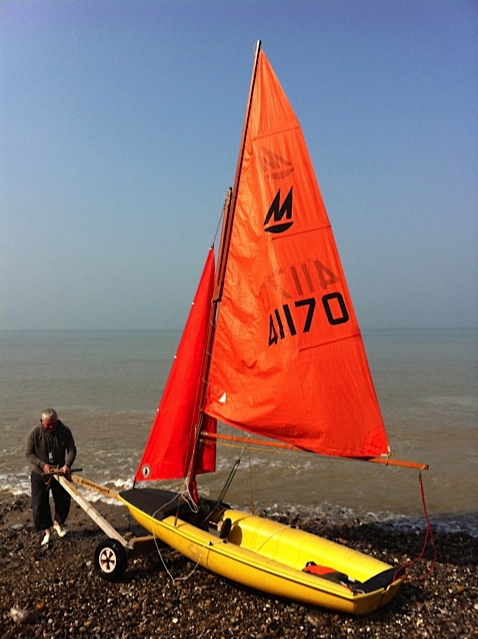
I made a day of it yesterday and sailed from Veules les Roses to just short short of Varangeville sur Mer, slightly to the west of Dieppe. Google Earth gave me a distance measurement of 7 and a half nautical miles each way. The return trip would have been a little more due to the fact I was tacking upwind. I set sail just before midday and beached a little after 4.30 pm, which gives me an average speed of about 3 and a half knots.

veules-st-margueriteHigh tide was at 14.41 and the coefficient was 86, and I turned back at about 13.45 to allow a reasonable amount of time for getting back up wind. For about an hour either side of the high and low tides, there’s hardly any current, but there is still some turbulence in the water to watch out for. The outward trip was pleasant apart from some nasty chop in the rip tide currents, but I was running before the wind. The return was mostly on a starboard tack with some short port tacks to get away from the turbulence caused by the wind hitting the high cliffs.

The wind averaged about 8 to 10 knots with a few 12-knot gusts. As the tide turned, the chop was very nasty, looking like a ploughed field, on the way back – due to the opposition between the wind and the tidal current. The starboard tack was not too bad, as I was well off the waves, but I had to take the port tack in a broad reach to be off the waves and keep good steerage. The tidal current was in my favour, so I had no worries. I would get back home even if my mast came down!

On that subject, I was slightly inshore from most of the yachts sailing along the coast from Le Havre, Fécamp and Saint Valéry en Caux to Dieppe and beyond. Some sported huge colourful spinnakers. One in particular drew my attention: he was jury rigged with a temporary mast (perhaps his boom) on the forepeak with his storm jib. The man sailing this vessel seemed to have been able to recover the mast which was lashed to the top of his cabin, and I imagine the boom, mainsail and genoa were stowed away below. He was almost certainly also using his engine. When your car breaks down on the road, you just phone the number you get from your insurer, and you’ll get a tow to the nearest garage within an hour or so. At sea in a boat, you can call Mayday on the radio and get rescued – and pay a fortune to have your boat salvaged. Alternatively you just have to cope with what you have. I have done it myself – using the jib to get back to the shore, on condition that the land is to lee. In this case, I unrigged everything and stowed it in the bottom of the boat. You then tie the peak of your jib to its halyard, run it through the mast pulley and hold up the mast with your left hand, also holding the jib sheet. You then have a mini spinnaker. Steer with the other hand. You won’t win any races, but it saves others the bother of coming to get you without dire necessity. Like the boy scouts, we learn to work out a solution for every problem. But, yesterday, my rig performed perfectly and there were no problems.

That is also my approach to my life as a priest.

The weather was beautiful and fresh, and the sunlight was slightly veiled, just as I like it. I love August!

Posted in Uncategorized | Tagged , | Leave a comment

The Roaring Mouse

I heard something in private correspondence about one of our ACC bishops in South Africa anathematising the person occupying the post of Presiding Bishop of the Episcopal Church. This event has been described in an article by David Virtue (reproduced below). I claim no originality to the title of this posting. Indeed the Principality of Little Fenwick defeats the United States of America in this fanciful tale from the 1950’s.

Frankly, I find this more than a little absurd, and it throws discredit on our Church. We can show our disapproval of “liberal” Christianity, but beginning to behave like Counter-Reformation popes is a little over the top! I would have preferred to see a erudite book by this bishop refuting all the errors of “liberal” Anglicanism – that would certainly have given him more credibility.

I don’t know the full facts and why Bishop Kenyon-Hoare went ahead with this particular stunt. Did he think he would garner massive support and following, or did he overestimate his own importance? I would be most embarrassed if my own Diocesan did such a thing! I thank my own Bishop for his practical sense and realism.

* * *

African Bishop Anathematizes Episcopal Presiding Bishop

By David W. Virtue
www.virtueonline.org
August 8, 2013

An Anglican Catholic Church (ACC) bishop from Southern Africa has anathematized the Presiding Bishop of the Episcopal Church Katharine Jefferts Schori, saying that she has committed the one unforgiveable sin: that of blasphemy against the Holy Spirit.

Writing in The Trinitarian the official organ of the ACC, the Rt. Rev. Alan Kenyon-Hoare, Bishop Ordinary of the Missionary Diocese of Southern African, said Jefferts Schori’s statements made from the pulpit on Whitsunday whilst on a visit to Curacao in the Episcopal Diocese of Venezuela were heretical and that his pronouncement of anathema is irreversible.

He accused the Episcopal Presiding Bishop of saying that “all the writings of St. Paul are satanically inspired. I pronounce publicly that she is anathema.

“I did so on the grounds that she committed the one unforgiveable sin: that of blasphemy against the Holy Spirit. That of course, is not my judgment, but of the Lord himself. Her statement was designed to lead her followers into heresy of the grossest kind.

“I therefore call upon all her followers to immediately quit ECUSA or be subjected to the same judgment.”

The bishop said it is not possible for Dr. Jefferts Schori to repent of such a sin, since she can no longer tell the difference between good and evil, having said in effect that Satan and the Holy Spirit are one and the same person.

He said she made the statement to bolster her silly feminist beliefs. Whilst it may be possible to debate the ordination of women, there can be no excuse for blasphemy when doing so.

“I call upon all orthodox Christian leaders to support me in my public stand against all heresy, and this one in particular. It should be noted that a pronouncement of anathema is irreversible, and this ancient ecclesiastical curse was sanctioned by the early fathers.”

Posted in Uncategorized | Tagged , | 71 Comments

Tuppence a Peek

The old Anglo-Catholic blog has shown a fluttering of life (the first since a posting in January 2013 about traditionalist RC matters) with an article about possibilities for a new and definitive Mass liturgy for the Ordinariates. I have read rumblings here and there, but this seems to give the strongest indication that it would have more in common with the old Tridentine / English Missal rite than with the American Prayer Book and the Novus Ordo. However, it is surprising that secrets haven’t been better kept until the books are published.

Would Pope Francis approve of such a thing? We are no longer in the heady days of Benedict XVI!

Times have passed since I was kicked off that blog just under three years ago. My old articles are still there, and remind us of another era of the ordinariate movement. I moved on long ago – and I can only wish the Ordinariates well and that The Anglo-Catholic will find a new and useful role.

Update: Keep your secret secret!

A comment on this blog article seems to be from someone who is privy to the Prefect’s secrets. It reminds me a little of the Finis Africae in the secret library of The Name of the Rose. To whet our appetites, ordinariate folk are promised “elements of the Sarum Use“. I wonder which ones, because many things are called Sarum. I suppose they will find out soon enough.

We are in the process of developing a “catholic” Mass, meaning universal, and all will have to make certain compromises. – sounds like the Frankenliturgy maker Bugnini. All the same it’s secret, not even the Squadron Leader’s dog Nigger can go in there! Top security and all that… I remember the insulated double door of my old superior’s office. Loose lips sink ships.

Anyway, it’s not my problem. I have a Sarum Use that was republished in the nineteenth century. No liturgy is perfect. At least it doesn’t have to be concocted and it isn’t secret. It can be found in any good theological faculty library in England or on the Internet – and there isn’t even a copyright on it. Most of our clergy use the Anglican Missal, also a complete rite that needs no further work.

It seems that not all preferences will be included. I suppose that depends on who wants what – probably the whole reason for this thing being classified top secret, for eyes only and all the rest.

Again, I wish them the best of British luck, and a stiff upper lip as they put their best foot forward.

Posted in Uncategorized | Tagged , , | 2 Comments

I’m a lumberjack, and I’m okay

It’s an old song from Monty Python that you can find by searching on Google or Youtube. Over the past week, I have cut down at least thirty thuja (cedar) trees that were invading my garden. The point is that these trees have to be trimmed and tended from the day they are planted (I didn’t plant them). If not, they grow out of all control and smother everything else in the garden – grass, flowers and deciduous trees. I took on some paid help in a man who had worked as a builder and now does gardening and landscaping, reasonably priced and a workman like in the “old days”. We got to work with chainsaws, billhooks and tough leather gloves.

At last, the last tree came down yesterday afternoon (it was a nice cool rainy day, just right for hard physical work), and I hired a flat-bed vehicle today to transport as much green waste and branches as possible to the local municipal dump. We are keeping the trunks and big branches for firewood – two to three years drying out. There’s still some trunks to cut close to the ground with our chainsaws, and then a load of tidying up. We were burning during the first week, and the wind veered to the south-west and choked the entire village. Our Mayor has been very understanding, but I do have to be more careful about the wind direction!

So the experience of being a “lumberjack” for a week is rather tiring, considering that the real lumberjacks in Canada have enormous machines for handling the trunks and stripping the “eye whip” branches away. I am reminded about the old Irish joke about a man from County Kerry getting a job in Canada as a lumberjack. The foreman told him that he had to cut down a hundred trees a day. The result on the first day was ninety-eight. Paddy got a chance, and the tally on the second day was only ninety-nine. The foreman said “Sorry, I can’t keep you, but let’s have a look at your chainsaw to see if it’s working properly“. He pulled the rope and started the engine. Paddy exclaimed – “Bejeepers and begorrah! What’s that noise?

A reader expressed a little concern that the blogs had “run out of steam”. I would venture a simple explanation – it’s August, hot in the Northern Hemisphere and quite a few of us are on holiday. Next week, I’m taking my boat, travelling chapel and breviary – among other things – to north Brittany (see previous article), and I count on a quiet week’s sailing. I don’t think I’ll be taking a computer. I think my only contact with the world with be my mobile phone and meeting other “yachties”.

So I don’t think there will be much blog traffic for the next couple of weeks, as for those going to the mountains, jungles of Asia or wherever. For those going away from home and work, I wish you all a great holiday yourself, and I imagine we’ll all start picking up after the Assumption.

Keep me in your prayers during this time of “retreat” and relaxation.

Posted in Uncategorized | Tagged , , | 2 Comments

Waxing Lyrical

Here is a lovely posting from Deacon Jonathan Munn who wrote St Benedict’s Priory Salisbury 2013: Incarnation about his retreat reflections at a moment when he is preparing to receive the gift of the priesthood. It is a beautiful meditation on the smallest and humblest things mattering to God.

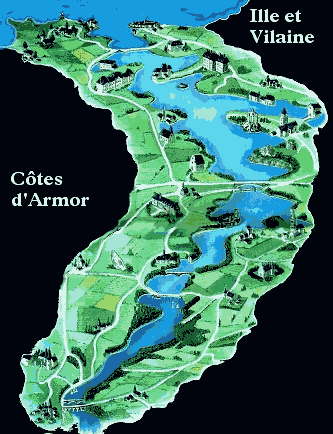
My own summer holiday plans have had to change by necessity, and my needs this year revolve around a time of solitude and exploration of nature. In a few days, after the Assumption, I will be going to spend some time on the banks of the Rance on the North Brittany coast. The Rance is a long estuary that extends inland from the Port of Saint-Malo all the way in to Dinan.

rance-mapIt is navigable practically all the way, even with deep-drawing long keel yachts. Also, though it is tidal, the Rance is very safe and one can avoid heavy sea swells and currents. Though I love the sea and it moods, sometimes inland sailing can do much good.

rance There are villages where I will be able to beach my boat, take dry clothes out of my waterproof plastic drum – and visit the church where in the old days anguished wives prayed for their husbands in peril on the sea during their long voyages to the Grand Banks to bring back tons of salt cod.

rance-drawingIt is one of those magic places that attracts sailors in all kinds of sailing boats who want to explore, spend quiet days on islands and away from the world. Others compete in regattas, pitting their sailing skills together with a boat built for speed and efficiency. All the bridges are high enough to sail under without taking down the mast. This will be my monastic cloister this year between my van, my tent and my little ten-foot dinghy – my little life of Swallows and Amazons, innocence and childhood regained.

launching-boat2Smallness indeed!

I greatly appreciate Deacon Jonathan’s quote from William Blake:

To see a world in a grain of sand
And a heaven in a wild flower,
Hold infinity in the palm of your hand,
And eternity in an hour.

(William Blake 1757-1827, from Auguries of Innocence)

Naturally, I will be taking my breviary and travelling Mass kit. Indeed my life will be as little as future Father Jonathan’s – ora et labora. I would add the verb navigare, to navigate or sail.

I would also add Kenneth Grahame’s famous quote for The Wind in the Willows:

There is nothing – absolutely nothing – half so much worth doing as simply messing about in boats.

There are two more postings from Deacon Jonathan, which are profound and searching. Are all priests corrupt? – Secularisation, sentiment and small things and the earlier All priests are corrupt – The damaging implications of sweeping statements. Powerful stuff to read in these Dog Days, Dies Canicularis or La Canicule! These are truly dog days for me as I had to have my Rex “put to sleep” and my other dog Sally got a paw badly bitten by another dog (she’s on the mend)! The cats are fine. Back to the subject: –

I live in a country where secularism (laïcité) proved necessary after the self-righteous bourgeois Catholicism of the nineteenth century. The fact that religion has a spiritual rather than a political role can only be positive. Naturally, he, like myself, is liable to get shot down for “unorthodox” ideas. We need to agree on our use of words and get to concepts and reasons, and not just superficial feelings caused by a “buzz”.

Another thing about Catholic France is that you’re either a traditionalist and practically “Fascist” in your political ideology or tolerant and going along with the Novus Ordo “mush”. And then there is the “left” ideology, as intolerant as the “right”. We have to learn to be individual persons and think outside the box – that is how genius and inspiration come about.

Our urban and rural societies are post-Christian. Perhaps if I lived in town and rented a former workshop, I might attract people who are not satisfied with what is in the religious supermarket. Here in the country, no one is interested, and very few go to the parish church. Perhaps the country folk are even more alienated than the cosmopolitan city folk in Rouen and Paris.

Like Deacon Jonathan, I feel the need to participate in society, even if it means being discreet about being a priest. I am highly privileged to belong to a diocesan clergy with men of the calibre and inspired vision of Bishop Damien Mead and soon to be Father Jonathan Munn. We are only ordinary men, not saints, but we have learned to be individuals, persons and with free minds.

Indeed, respect for laïcité and the separation of churches and secular politics is not a betrayal of our faith or spiritual commitment, or our belief in objective truth. I too have been inspired by the monastic way, but I am a secular priest, called to be a part of society in the real world, in which increasing numbers of people are atheists or aspire to a non-Christian spiritual world view.

He would probably not admit it, but I find Deacon Jonathan very close to my own anarchist views – in that every human system can become corrupt and has no absolute value. Authority is a necessary expedient, for the bene esse of society, as with law, but the ideal is for the human soul to transcend both authority and law. This ideal is easier to approach to some extent for individual persons and small groups than whole societies like nations.

Many of us regret that our lives “do not make any difference”, that we are crushed by the determinism of the “machine”. I certainly get that impression as a blogger. But in Christian terms, the smallest movement of atoms or energy moves the whole world. Everything is connected and nothing is isolated. This is one of the discoveries of quantum physics. Everything is an all, and that all is God.

Let’s see how dinghy sailing and saying the Office mix…

Posted in Uncategorized | Tagged , | Leave a comment

Pope Francis on Progressivism and Traditionalism

I found this fascinating quote in the article From Rio de Janeiro to Rome, from Poetry to Prose by Sandro Magister. In it, Magister quotes the Pope’s take on two opposite tendencies, progressive and traditionalist, present in the Church:

The Gnostic proposal. This is usually seen in groups of elites with the proposal of superior spirituality, rather disembodied, that ends up in pastoral attitudes of ‘quaestiones disputatae.’ This was the first deviation of the primitive community and has reappeared, in the course of the Church’s history, in revised and corrected editions. In common terms they are called ‘ enlightened Catholics’ (to be presently the heirs of Enlightenment culture).

The Pelagian proposal. This appears fundamentally under the form of restoration. Before the evils of the Church, what is sought is a solely disciplinary solution, in the restoration of outdated conduct and forms that even culturally have no capacity to be significant. In Latin America this is seen in small groups, in some new religious congregations, in exaggerated tendencies toward doctrinal or disciplinary ‘certitude.’ Fundamentally it is static, although it can  claim a dynamic ‘ad intra,’ of involution. It seeks to ‘recover’ the lost past.

What may be analysed in the Roman Catholic Church will certainly be present in all Churches and ecclesial communities.

This ought to challenge our own motivations, whether we must consciously return to the past to “restore”, or go forward with the flow of history. We should not forget that in time, the cultural and liturgical styles of the 1960’s and 70’s will also be dinosaurs – and are already objects of conservatism. Is that period just as lost a past as the 1930’s or the nineteenth century or the fifteenth? Must history be marked by ruptures through which the past no longer exists?

What is the role of the liturgy? We admire it in Orthodoxy but shun it when our own tradition is in question. Where is Christianity best expressed? In the mass rallies and outdoor Masses attracting thousands of people? In the prayer, toil and slog of everyday life in a small community?

I tend to agree that if we carry on out of a motive of conservatism of the past, we become sterile and irrelevant. Can we carry on with traditional liturgical forms and follow the trajectory of history? Is Continuing Anglicanism an adequate vehicle for old wine in new skins and a resolution of this dichotomy between “right” and “left”?

Posted in Uncategorized | Tagged , , , , , | 5 Comments

‘Tis the gift to be simple

Damian Thompson has just published The Amish, Jews, Muslims and the future of religion. He writes about the Amish, who with certain groups of Jews and Muslims would represent the future of religion. It’s an interesting idea.

I visited Pennsylvania in a hired car back in January 1998 and followed the traces of Harrison Ford’s Witness and another film starring Gregory Peck as a mad Nazi trying to recreate his Führer by breeding little cloned Hitlers. The farmland sprawls wide and is punctuated by white clapboard houses, gambrel barns and wheat silos. One would see cattle and horses in the fields. Occasionally, I would see an Amish man travelling along the road with his horse and carriage. The countryside is rather lovely, not very different from some parts of the south of England.

Authors and researchers have written on this subject of people who take their religion very seriously in their whole lives, in their families and the wider community. They try to find reasons why some religions thrive despite modern times, and why others wither away.

As far as I can see it, the Amish is almost a kind of “monasticism for lay people” and families. They refuse modernity, but the line is often difficult to draw. Damian Thompson notes the parallels with orthodox Jews and Muslims: strict dress codes and isolation from the modern world. The accent is placed not on theological speculation but an eminently practical approach to Christianity – live it in our lives. Monasteries work because they are micro societies, fed not by procreation but by vocations, and they follow a rule under the direction of the abbot, just like a well-run ship with its officers and crew.

mission-1986This notion seems to characterise the Jesuit approach of Pope Francis: develop Guarani-like societies where the seed of the Gospel has been planted. Above all, put the Gospel into practice. Might this be the future? Look out for such communities coming into existence. I have already commented on communities like L’Emmanuel, the Chemin Neuf and others in the charismatic way. Such communities can easily fall victim of cult gurus and dictator-like leaders of narcissistic tendencies! That is the downside of isolating from the “real” world. There must be some relationship with the world, as Blessed Charles de Foucault in his hermitage maintained relations with his Muslim neighbours in the Algerian desert.

Most of us will never live in such a community or minister to such, but I have always shied away from modern urban life, preferring the country and the sea. Even though I am a priest, there is little one can do outwardly. The Christian Gospel then becomes something interior and an invisible leaven in our ordinary life. I would be interested in comments from readers who have decided on a simple life for the sake of Christian living.

Posted in Uncategorized | Tagged , , , | 1 Comment