A Knock at the Jesuits?

I have just discovered Fr Ray Blake’s article Loyola’s non-liturgical legacy about the effect of the Jesuits and the Counter-Reformation on the liturgical nature of the Church. Before going into this subject, it would be good to reassure readers that I will not make sweeping statements about Jesuit priests. Many of the most enlightened theologians of the twentieth century were Jesuits: Henri de Lubac, Jean Daniélou and Hans Urs von Balthasar. The two former men established the Sources Chrétiennes with Fr Claude Mondésert. They were heavily involved in the ressourcement movement. I haven’t forgotten Fr George Tyrrell, the so-called “modernist”, who wrote his mind knowing that he would get into deep trouble. Fr Joseph Jungmann of that Order also gave us the monument of liturgical scholarship Missarum Sollemnia – The Mass of the Roman Rite. Also, one cannot disdain or underestimate the heroic efforts of the priests who brought Christ to the Guarani in what is now Brazil, immortalised by the film The Mission that was released in 1986. They were no less heroic in the far East.

Is this movement still in vogue in the Society of Jesus? Or rather, was it replaced in the years following Vatican II by a kind of decadent neo-scholasticism as happened with some of the Protestant Reformers, a particular way of dis-incarnating theology to turn it into a political or social idea and away from its liturgical, monastic and contemplative roots? I found a considerable amount of insight in Tracy Rowland’s book Ratzinger’s Faith (OUP 2008).

Fr Blake makes some points that strike a distinctive note. Unlike the monastic orders and the prebendary canons of old, the Jesuits did not have the Office in choir. This was also a hallmark of the Oratorians and some other lesser known communities founded in the late sixteenth century in Italy. The other main point, a consequence of the Office being said only in private, was a major change in church architecture, the disappearance of the choir. The jubé or rood screen disappeared and the short and stubby chancel is separated from the nave only by the communion rail. The free-standing altar for Mass facing the people, introduced in France and Germany as early as the 1920’s, was only a logical development in a perfect hermeneutic of continuity!

Another Jesuit innovation was mental prayer – unknown in ancient monastic Rules – but even among the friars, especially the Carmelites it tended towards the via negativa, whilst the Jesuits, following the example of Ignatius’ Spiritual Exercises gave full scope to the imagination, ‘picturing a scene’ moved very quickly from the minds of Jesuits to the walls, ceilings and altar pieces of their churches.

chiesa-del-gesuThe use of the imagination in prayer is often discouraged in the Benedictine tradition. The Jesuit method of meditation or mental prayer is to use the imagination in the place where one could nowadays play a video of the life of Christ or other related themes. From there would come the use of inculturated popular entertainment to try to get the message over. We see where all this goes…

* * *
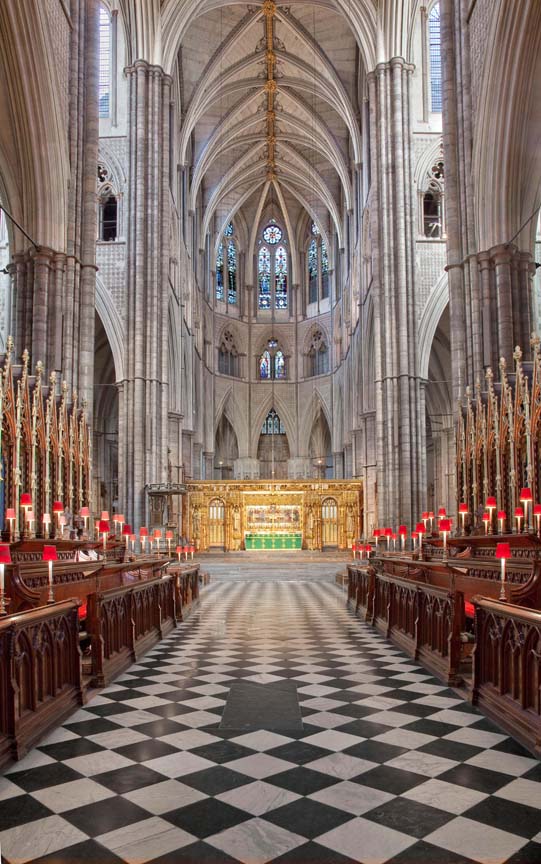
Westminster Abbey. Choir and apse looking eastOne aspect of Anglicanism that preserved a considerable amount of the medieval Catholic tradition was the Cathedral Office. The Reformation stripped parish worship down to very little, dividing the church into a preaching hall and using the old chancel as a place for the Lord’s Supper. Music and any sensual stimulation were things of the past. In the cathedrals and collegiate churches, Anglicanism was something else. The medieval Church remained almost intact and the Offices were sung by a professional choir to a high standard. In the wake of the Oxford Movement, the prevailing idea was to introduce cathedral worship into the parishes. Thus from about the 1840’s came the rehabilitation of what remained of the medieval quires and places where they sing, surpliced choirs and large pipe organs in the vicinity of the choir stalls. The aesthetic effects of oversized organs stuffed into side chapels and specially built chambers was not always satisfactory. All the same, the effort was there in an optic of restoring parish worship to a pre-Reformation standard.

amiens_massThe next question is one that concerns Pope Francis (a Jesuit and apparently insensitive to aesthetics) and the possibility that he might to some extent cancel out the work begun by Benedict XVI in the fields of theology and the liturgy. I only belonged to the Roman Catholic Church for a brief period (within the time of the John Paul II pontificate) of my life, and I feel unqualified to make any kind of negative judgement. All the same, I try to keep an open eye on things as they happen. I think he is a deeply spiritual man with something highly positive to offer, but I have my reserves about the more cultural and liturgical dimensions.

What we need to do in the ACC, with our modest means and marginal position in society, is to seek to continue this work of liturgical restoration and the inspiration of the English cathedral tradition. This involves careful design of buildings within the limits imposed by lack of resources and getting clergy and laity informed about the role of the liturgy in the Church. Much can be done even without the grandiose buildings. We may never be able to do very much, but every little helps.

Posted in Uncategorized | Tagged , | 1 Comment

Are the Atheists our Enemies?

I received a very kind message from my Bishop this morning who found that it was wise to put The Anglican Catholic to bed for a little while until it gets focused on positive themes and transcends the kind of themes for which I devised the three Blow-Out departments on this blog. Even there, I expect a degree of courtesy so that matters can be discussed between adults. This blog does not engage my Church or Diocese in any disputes – see the disclaimer at the head of the right-hand sidebar.

I often say it myself, and my Bishop has put it beautifully:

The fights that regularly break out in the holy places in the holy land between groups of monks charged with custody of these shrines does more damage to the cause of the Gospel than a million authors writing books like the ‘God Delusion’.

calotteAh, the Holy Mountain! Some of those monks will have only themselves to blame if the whole place is turned over to developers to turn Mount Athos into a complex of luxury hotels and rest centres with saunas and jacuzzis for rich businessmen and politicians. In the 1900’s in France, the French government became virulently anti-clerical and turned the monks out of their monasteries, took possession of the cathedrals and parish churches, took away state support for the Church as under the old Napoleon / Pius VII Concordat. Priests and pious lay Catholics were mocked in the same way as Jewish people under the Nazis. In short, what was the cause of all that?

Clericalism.

The western world faces a secular future. Even the Muslim immigrants are enjoying life in our countries and put their faith on the back burner. Three things contribute to this process, religion discrediting itself through intolerance and obscurantism, the easy modern life (on condition of being able to afford it) and pressure from atheist intellectuals.

I am in two minds about discussing things on blogs. We clergy tend to say that we should keep quiet about all the “negative” stuff and present a rosy image of Christianity to the world, one that will appeal to the innocent and credulous. Another part of me says that we all have to be lucid about the reality so that our faith and Christian commitment will be that much more robust and be able to resist scandal and anti-religious rhetoric. Perhaps this is something we could discuss.

Certainly, the spectre of Christians fighting over sets of doctrinal articles, dogmas from Ecumenical Councils, liturgical rites, political ideologies and the “true church” alienates most people of good will. I am certainly affected by all this poison, and I am expected to be thick-skinned, being a priest and veteran at blogging! One great intuition of Pope Francis is the idea of being simple again and thus getting the real message of Christ over to people.

Some may read this and say to me – Speak for yourself! Indeed, we are all guilty of being the most effective persecutors of Christianity, far more than Robespierre, Jules Ferry, Jean Jaurès and Richard Dawkins to mention only a few ideological atheists. This is persecution from within, and we all have our examination of conscience to make when we consider our empty pews and increasing church upkeep bills with nobody to pay them.

The atheists may be our enemies, but we are our own worst enemies!

Posted in Uncategorized | Tagged , , , | 9 Comments

Dives et Pauper

Photo: Pastor Jeremiah Steepek (pictured below) transformed himself into a homeless person and went to the 10,000 member church that he was to be introduced as the head pastor at that morning. He walked around his soon to be church for 30 minutes while it was filling with people for service....only 3 people out of the 7-10,000 people said hello to him. He asked people for change to buy food....NO ONE in the church gave him change. He went into the sanctuary to sit down in the front of the church and was asked by the ushers if he would please sit n the back. He greeted people to be greeted back with stares and dirty looks, with people looking down on him and judging him.  As he sat in the back of the church, he listened to the church announcements and such. When all that was done, the elders went up and were excited to introduce the new pastor of the church to the congregation........"We would like to introduce to you Pastor Jeremiah Steepek"....The congregation looked around clapping with joy and anticipation.....The homeless man sitting in the back stood up.....and started walking down the aisle.....the clapping stopped with ALL eyes on him....he walked up the altar and took the microphone from the elders (who were in on this) and paused for a moment....then he recited“Then the King will say to those on his right, ‘Come, you who are blessed by my Father; take your inheritance, the kingdom prepared for you since the creation of the world. For I was hungry and you gave me something to eat, I was thirsty and you gave me something to drink, I was a stranger and you invited me in, I needed clothes and you clothed me, I was sick and you looked after me, I was in prison and you came to visit me.’ “Then the righteous will answer him, ‘Lord, when did we see you hungry and feed you, or thirsty and give you something to drink? When did we see you a stranger and invite you in, or needing clothes and clothe you? When did we see you sick or in prison and go to visit you?’ “The King will reply, ‘Truly I tell you, whatever you did for one of the least of these brothers and sisters of mine, you did for me.’After he recited this, he looked towards the congregation and told them all what he had experienced that morning...many began to cry and many heads were bowed in shame.... he then said....Today I see a gathering of people......not a church of Jesus Christ. The world has enough people, but not enough disciples...when will YOU decide to become disciples? He then dismissed service until next week.......Being a Christian is more than something you claim. It's something you live by and share with others.

Update: This story has turned out to be an urban legend, and therefore is not true. It is doing the rounds on the blogs and Facebook, and my Bishop reproduced it in good faith. This photo is one of a homeless man in London. All the same, I leave my article of yesterday in place for its value as a “modern parable”.

* * *

The story is always the same. We all do it as we see down-and-outs in front of a railway station begging. Most are alcoholics and drug addicts, in most cases almost at the end of their lives. I have lived in London’s East End and seen methos (methylated spirit drinkers) found dead in winter and ignominiously taken away by the police in plastic bags. Our consciences work overtime, knowing that any money we give them will either not be enough or would be used to finance the “habit” rather than buy food and other essentials. What can we do?

Looking at something my Bishop put on Facebook, there is an incredible story of a new pastor of an Evangelical church:

Pastor Jeremiah Steepek (pictured [opposite]) transformed himself into a homeless person and went to the 10,000 member church that he was to be introduced as the head pastor at that morning. He walked around his soon to be church for 30 minutes while it was filling with people for service….only 3 people out of the 7-10,000 people said hello to him. He asked people for change to buy food….NO ONE in the church gave him change. He went into the sanctuary to sit down in the front of the church and was asked by the ushers if he would please sit n the back. He greeted people to be greeted back with stares and dirty looks, with people looking down on him and judging him.

As he sat in the back of the church, he listened to the church announcements and such. When all that was done, the elders went up and were excited to introduce the new pastor of the church to the congregation……..”We would like to introduce to you Pastor Jeremiah Steepek”….The congregation looked around clapping with joy and anticipation…..The homeless man sitting in the back stood up…..and started walking down the aisle…..the clapping stopped with ALL eyes on him….he walked up the altar and took the microphone from the elders (who were in on this) and paused for a moment….then he recited

“Then the King will say to those on his right, ‘Come, you who are blessed by my Father; take your inheritance, the kingdom prepared for you since the creation of the world. For I was hungry and you gave me something to eat, I was thirsty and you gave me something to drink, I was a stranger and you invited me in, I needed clothes and you clothed me, I was sick and you looked after me, I was in prison and you came to visit me.’ “Then the righteous will answer him, ‘Lord, when did we see you hungry and feed you, or thirsty and give you something to drink? When did we see you a stranger and invite you in, or needing clothes and clothe you? When did we see you sick or in prison and go to visit you?’

“The King will reply, ‘Truly I tell you, whatever you did for one of the least of these brothers and sisters of mine, you did for me.’

After he recited this, he looked towards the congregation and told them all what he had experienced that morning…many began to cry and many heads were bowed in shame…. he then said….Today I see a gathering of people……not a church of Jesus Christ. The world has enough people, but not enough disciples…when will YOU decide to become disciples? He then dismissed service until next week…….Being a Christian is more than something you claim. It’s something you live by and share with others.

In my own experience, most of us who have spent any time in cities will have become cynical by the sheer number of con-men, thieves and mafia-type organisations preying on the credulity and sense of pity of ordinary people. When I was in Rome, there were criminal organisations running prostitutes and professional beggars, using children they had bought from corrupt orphanage agencies in countries like Albania. I have often offered to buy food for someone appearing to be hungry – but they clearly wanted money for something else…

Obviously, the best thing is for a parish to run a soup kitchen, somewhere where truly homeless people can find a meal, a bed for the night and some second-hand clothes – but not money. It is best to have people give to such an organisation rather than directly to the people concerned. The example shows the indifference of many of us, compounded by our cynicism in the face of thieves and crooks. Perhaps it is a case of preferring to be deceived twenty times than unjust just once! There are also possibilities for us to do voluntary work for the homeless and donate money to organisations and agencies established to help them – and they are very good at distinguishing the those who have genuinely fallen upon hard times from those who are looking for “easy money”.

Posted in Uncategorized | Tagged , , | 6 Comments

Nice Little Article on Anglican Identity

Articulating Identity by Deacon Jonathan Munn of our Diocese.

I always appreciate Deacon Jonathan’s writings, which are always very articulate. The issue of Anglican “identity” or the “patrimony” much discussed in the contexts of the Ordinariates is a difficult one. There has been enough to-and-fro between my postings and some exponents of so-called “classical” Anglicanism. Like many words and concepts, Anglicanism means different things to different people. Things are made worse when we think the way we understand it should be imposed on all in a complete lack of tolerance. It also has to be said that this fundamental incompatibility is intrinsic to the Reformation / Counter-Reformation polemical world view. There is no common ground, and one position can justify itself only by negation of the other.

This is why I have always expressed the idea that any kind of Catholicism has to transcend that period and that way of thinking (based on decadent scholasticism and questionable metaphysics). We in the ACC talk of the Undivided Church as a standard of faith and orthodoxy. In the absolute, there never has been an “undivided” Church, as Christians were in conflict right from the beginning, but what we call “undivided Church” is the general consensus of western and eastern Christianity prior to the mid eleventh century that followed the christology of the Council of Chalcedon. It is what western Catholicism and eastern Orthodoxy have in common over and above the liturgical and cultural differences. We refer to a kind of ecclesiology that situates the authority of the Church in the body of the Episcopate rather than on a single Patriarch or incumbent of one of the ancient Apostolic Sees.

Dr William Tighe wrote a very interesting essay on the question of the Thirty Nine Articles – Can the Thirty-Nine Articles Function As a Confessional Standard for Anglicans Today? Dr Tighe is a Roman Catholic who attends the Eastern Rite, but he has written this article beautifully. Fundamentally, the Thirty-Nine Articles are too tied to their historical period and a particular style of philosophical language and scholarship for them to be of anything other than of academic relevance to us today.

We in the ACC are often criticised for identifying with the mainstream Catholic tradition rather than the tenets of the Protestant Reformation whose purpose it was to combat superstition and anything like a resurgence of Paganism in a Christian context or corruption in the clergy. So be it. There will always be Christians with their convictions, traditional ideologies and inherited principles. We can hardly blame them, but rather engage a “dialogue of love” and show that we are not so wicked or superstitious after all.

We should certainly spend less time justifying ourselves than seeking to live fully the tradition with which we identify. A most edifying example I see are the many monasteries which write little or nothing on the internet, yet each day live the liturgy of the Mass and the Hours of prayer. Surely, the internet can be our scriptorium and the classroom where we can both teach and learn. I like to see it used constructively, with the priority given to our real liturgical and spiritual life. Would that not be more healthy?

I don’t mind people “blowing out”, as we all have a need to do it from time to time, but it is not the real expression of our Christian life. Perhaps our real “patrimony” or “identity” is that of being Christians with the sacramental “interface” we have between earth and heaven. It certainly bears thinking about!

Posted in Uncategorized | Tagged , , | 7 Comments

Royal Birth

I join my Diocese and the people of my native country in congratulating Their Royal Highnesses the Duke and Duchess of Cambridge today on the birth of their son, His Royal Highness Prince George Alexander Louis of Cambridge. I likewise include them in my Mass intentions and other prayers.

Posted in Uncategorized | Tagged | 3 Comments

Anglican Papalism Revisited

Another article is worth reading – Anglican Papalism on the Episcopal Church Socialist League blog. The blog author is Ryan Chegwin of the (presumably) Episcopalian parish of St Paul, Minnesota. He announces the colours thus:

Anglican Papalism is for men and women in the Anglican Communion who believe that true ecclesial reconciliation comes about through corporate reunion with the barque of Peter.

The Anglican Papalist cannot abide individual submission to Rome, but instead seeks only total ecclesial reunion between the Church of England (including her daughter provinces) and the Church of Rome. The Anglican Papalist is abundantly aware, as Fr. Brooke Lunn asserts, that “the true home of the Church of England [and her daughter provinces] is in full union with the Holy See”.

The Anglican Papalist is an orthodox Catholic in every sense save for professing the validity of Anglican orders, an adherence to uncorrupted Anglican liturgical traditions, and confessing the continuing undivided Catholicity of the Church of England (including her daughter provinces).

As the great Anglican Papalist Fr. Fynes-Clinton stated “our schism from Rome was Corporate: the remedy must be Corporate”, and furthermore as Fr. Frederick Oakeley said “we trust, of course, that active and visible union with the See of Rome is not of the essence of a Church; at the same time we are deeply conscious that, in lacking it, far from asserting it, we forego a great privilege.”

The hoped for unity of the Cathedra Augustini and the Cathedra Petri does not mean uniformity, but rather a unity in an acceptable ecclesiastical diversity (cf. Fr. Brooke Lunn). For Anglican Papalists the Roman Pontiff’s Personal Ordinariate of Our Lady of Walshingham and the Personal Ordinariate of the Chair of St. Peter is not an acceptable institutional model of ecclesial reunification. Thus, the Anglican Papalist yet remains in the Church of England (or a daughter province) to serve as a living witness to both the Anglican Communion and the Roman Church of our shared origin in the apostolic community, and working toward that for which our respected canonical bodies are striving: unity.

Some Catholics outside our fold, both Roman and Anglican, excoriate the position of contemporary Anglican Papalists as appearing naïve, romantic, outdated, or improbable; however such accusations only serve to strengthen the Anglican Papalist faith in our Lord’s desire “that they all may be one, as thou, Father, in me, and I in thee; that they also may be one in us“ (John  17:21, Douay-Rheims). Again, let it never be forgotten that the principal impetus of Anglican Papalism is always and ultimately unity.

I am indeed intrigued to find my blog listed as sympathetic to Anglican Papalism! Well yes and no. When Archbishop Hepworth was Primate of the TAC and led that inspiring bishops’ meeting in Portsmouth in October 2007, the ideas of corporate reunion with Rome, an old dream, was exciting and stimulating. However, most of us had different notions about the nature of this union and to what degree we went along with papal ecclesiology. Normally, that is the description of the Anglican Papalist. The keyword is ecclesial reunion.

On one side, the Papacy in Rome is the historical “patriarchate” of the Latin Church, and was accepted as such by all Chalcedonian Churches until the symbolic date of 1054. I celebrate Mass una cum famulo tuo papa nostra N. not because I see myself in any way under the canonical jurisdiction of a bishop under the same kind of arrangement with whatever comes between him and the Pope. I do so as a prayer for unity with all Catholics of the Latin Rite (including local uses like Lyons, Rouen/Sarum, Milan and Anglican uses developed over the past hundred years or so). But, that unity is understood in different ways.

It is illuminating to observe the idea of the validity of Anglican orders (and other Sacraments) being the only difference between the Catholicism of Pius IX and Paul VI and Anglican Papalists. We members of the Anglican Catholic Church and other similar communions of Anglican tradition, whilst professing what is often called an Anglo or Anglican Catholic position have many other points of discussion such as neo-scholastic theology, Papal infallibility and Ultramontanist ecclesiology as opposed to Conciliarism. Nevertyheless, this “position statement” holds union with Rome as not of the essence (esse) of the Church, but for her good (bene esse). The distinction is fine, and quite wobbly!

Uncorrupted Anglican liturgical traditions? We should see that with an objective and critical mind after a good reading of Adrian Fortescue and Fr Jungmann, Battifol among others who wrote on the Divine Office. What is an uncorrupted Anglican liturgical tradition after Cranmer did away with the Use of Sarum? The English Missal and Anglican Missal are translations of the Roman rite with a few bits and pieces of Prayer Book tweaked in – done by those with no authority in the Church of England.

Why not the Ordinariate? The Anglican Papalist stays in the Church of England or at least in the Anglican Communion. There is the problem of female priests and bishops. That hardly goers with any kind of Anglo-Catholicism. What about the Continuing Churches which are not “recognised” by Canterbury or the Lambeth Conference? This definition is also wobbly like the old vestry stool used to reach up to high cupboards where the Christmas stuff is kept!

We need very definitely to study the pre-Reformation period in the light of modern historical scholarship and take a fresh view of the Church prior to both the Reformation and the Counter Reformation. This is why I do not identify as an Anglican Papalist but simply as an Anglican Catholic.

Posted in Uncategorized | Tagged , , , , , , , | 8 Comments

Just a Little Note on Blowing-Out

The Orthodox Blow-Out Department has really taken off as its “classical” Anglican and Roman Catholic counterparts have not. Most of the incoming comments linked to from the right-hand sidebar of this page are going that direction.

Firstly, I would like to say that this is a sideshow and not the primary subject of this blog, so the blowing-out is both visible everywhere and isolated in its own “compartment”. All the same, I continue to ask readers to write rationally and not emotionally – and never to resort to ad hominem attacks. Some people feel very strongly about things, especially when they have been personally thwarted, airbrushed out or disappointed by church authorities. Such blows are certainly not the fault of other blog readers here.

If we are Christians, we should be forgiving, not just 7 times but 77 times – and more. Life is difficult. We just have to take it. Sometimes we are pushed out of the church community we trusted, and all we can do is rebuild differently with humility in our hearts.

Just remember that birds fly, pigs wallow in the mud and cows eat grass. Humans also do what we in our different situations of life are designed to do.

There is no provision for comments here, but you can comment on the blow-out page. Just please keep it civil.

Posted in Uncategorized | Tagged , | Comments Off on Just a Little Note on Blowing-Out

Missing the Essential

I have just come across the article Tragic Worship by Carl R. Trueman in First Things. This is something I have noticed in popular culture, notably the enthusiasm we have for celebrities like the ancients for heroes and demi-gods. I do believe that human history is cyclic and shows a certain number of constants. The “good old days” were not so good, neither the 1930’s for my parents’ generation, nor the 60’s and 70’s for me. Like most people, I am afraid of technological and scientific progress, which all too often exceeds man’s morality. Why is it that the greatest inventions are immediately made into weapons of war? We live in fear and we live in hope.

I have been quite fascinated by a translation I recently did of the website of a well-known French fashion menswear company and the way they seduce their market. The emphasis is definitely on the look and appearance, and clothes are our social signals like our body language, gestures and our use of spoken language. It is true that we feed good in our favourite clothes and the image with which we identify. I am acutely aware of this from the experience of wearing the priest’s cassock or suit in a world that no longer relates to what it symbolises. Popular culture is very definitely an affair of fashion, entertainment, fun and celebrity. At the same time as being incredibly superficial, there are characteristics of modern urban culture that need to be studied to know whether Christianity has anything to say. I have been learning about street artists and urban young people in general – they are not all bad or anti-social. There is something there, impalpable but transcendent in its own way.

I am quite amazed to see some of the things coming back in like the preppy style and the dandy look, which has evolved over the last few centuries. We are reminded that these things are not just from our own days, but that extravagance is less something of our time than the seventeenth and eighteenth centuries! It was a fascinating job to do – and get paid for!

The bottom line is how we deal with death, not only physical death but the changes and chances of this fleeting life. Within our lives on this earth, events come and go – they are born, they live and they die. Post-modernism definitely caters for the young, who no more want to be fettered by those of us who are getting old than we wanted when we were young. Age doesn’t always bring wisdom, but often brings bitterness.

The Middle Ages accepted death as an image, something that would stimulate us to seek wisdom and live our life now the way we would want to die. This is the mystery we live in the liturgy and which is beyond entertainment and the superficial. This is certainly a reason why revivals of faith happen in times of war and any event that reminds us of our mortality.

Read the article. It is worth it.

Posted in Uncategorized | Tagged , | Leave a comment

Sisters of Perpetual Indulgence!

Grab yours before it’s too late! So commercial advertising blares out to the world.

The British mainstream left-wing press has published Vatican offers ‘time off purgatory’ to followers of Pope Francis tweets. The article seems pretty sick, and I can only imagine that a newspaper largely run by atheists would make hay out of something like this to discredit all religion.

At the same time, we are touching upon a constant phenomenon in the history of the Church: a conviction according to which, firstly, the high clergy of the Church have take the place of God in questions of what happens to souls after death, and secondly, that those same clergy are hopelessly out of touch with reality and that attempts at being self-consciously “modern” are utterly pathetic.

In the early Church, the indulgence had nothing to do with getting people “off the hook” in the afterlife. Indulgences made sense when reconciled sinners had to accomplish severe penances – like spending years in a monastic “prison” or walking to Jerusalem. The Church from about the third century allowed the practice of recognised holy Christians to pray for sinners and ask for the canonical penances to be shortened. From the sixth century, some of the heavy penances could be commuted for reconciled sinners by having them recite prayers, give alms or going on pilgrimages less difficult than Jerusalem from western Europe. By the eleventh and twelfth centuries, the indulgence was removed from its association with canonical penances and attached to a more “supernatural” notion of remitting temporal punishment due to sin, even the “other side” of death.

Indulgences go with a particularly Roman Catholic notion of purgatory considered entirely in commercial and juridical terms. The Orthodox and many Anglicans also pray for the dead, but are less clear-cut about the nature of the intermediate state between heaven and hell. I tend to give credence to the notion that there is no need for such a notion, and that souls can obtain the help they need to leave the dark realms to find God’s light. We humans in this world know just about nothing about what awaits us, but certain pieces of “revelation” and different religious traditions allow us to conceive of a number of (or a continuum of) degrees of beatitude as well as degrees of suffering – all outside time, or at least our time.

I tend towards the notion of universalism – that all souls (even the demons) will/might find their way after however long in their present cursed existence – but that sin and wickedness will not go unpunished. I have written about this before, but the bottom line is that we know nothing about what lies outside this life – unless we are blessed with special experiences.

Until now, apart from the time when the RC Church was looking for money to rebuild St Peter’s Basilica, the Church has been reasonably sober and serious about this matter based on its traditional theological stances of having a “treasury of merits” for its children. Now, the idea is being associated with the use of internet social networking and having people follow the Papal visit to Brazil. It is to be seen whether this is true or just the ravings of atheists!

If this is true, then the whole thing is sinking into banality as would not have been imagined in the 1970’s. Salvation a few mouse clicks away! What about those who don’t have enough to eat, let alone enough money to buy a computer and internet connection? It has all become a sick joke!

I have done my best to see in this new Pope a profoundly spiritual man, in spite of his total insensitivity to beauty or music. Still, I won’t judge or denigrate his faithful and clergy – but I am left with many others in confusion and an empty feeling in the pit of the stomach.

Posted in Uncategorized | Tagged | 17 Comments

Anglican Catholic Unity

Here is a heads-up on another article by Deacon Jonathan Munn – Anglican Catholic Unity.

If comments have to be from a low church or “classical Anglican” point of view, please use the Classical Anglican Blow-Out Department. Deacon Munn obvious sets out to propose unity between Churches of similar Anglo-Catholic churchmanship in terms of doctrine and liturgical usage. Please keep it at this level to make discussion possible on equal terms.

Posted in Uncategorized | Tagged , , | 1 Comment