On our Return

We only really had two days outside travelling and doing practical things at the camp site. The wind must have reached about force 7, perhaps gusting force 8, when we arrived on Thursday afternoon.

The next day, the wind had dropped to about force 4 in the morning and so I ventured out to sea in my little dinghy. I shortened the mainsail and tried to shorten the jib by wrapping around the forestay. On my Friday outing, it was very short and I went out twice, the second time having removed my jib entirely. The wind whipped up, very unstable and in gusts from the south-west and I had to close-haul back to the beach.

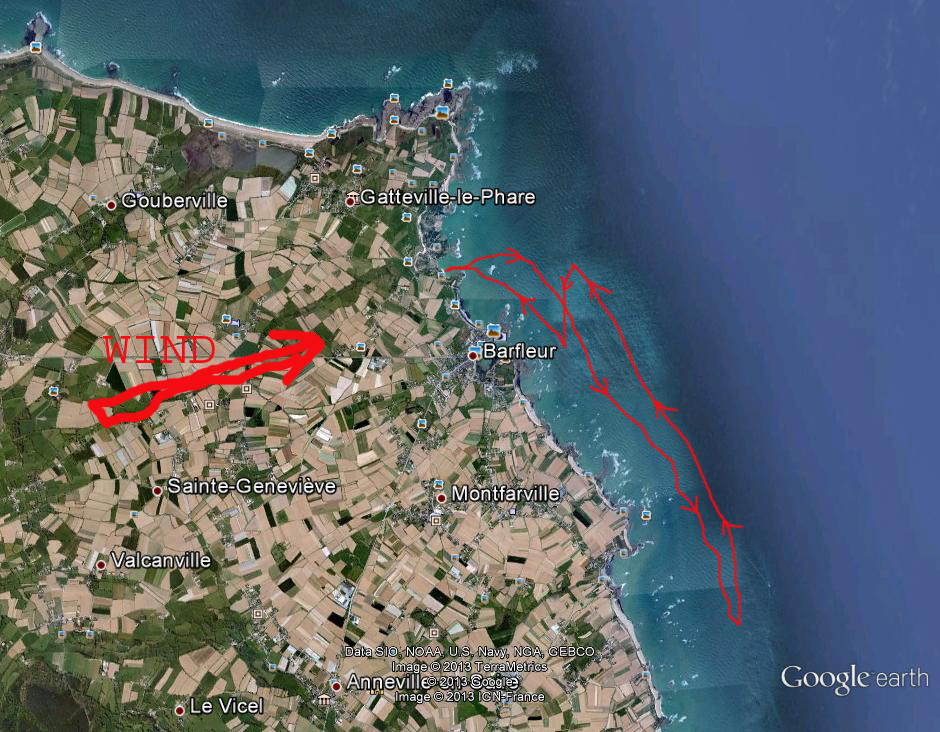
gatteville-area

The following day, Saturday, the wind seemed to have calmed. Even with a slightly calmer wind, I took the boat out with reefed mainsail and no jib. I went along the coast in a broad reach, and it felt like being in a speedboat. The wind was, as ever, quite unstable and very gusty. I had planned to go to St Vaast la Hougue, but it would have been imprudent. The wind started to whip up again, and I was concerned. I turned back and realised that my drift was taking me too far out to sea. By the time I reached Barfleur, I headed up and began to tack towards the shore, and this reduced the chop of the north-east swell colliding with the tidal current and the small wind waves. I was frozen stiff by the time I beached the boat, and took her back to the caravan, and then had a long hot shower and a vigorous rub-down with a towel.

On the Saturday afternoon as life returned to my stiff limbs, Sophie and I went to visit Valognes, a town that made its fortune in the middle ages through its excellent tradition of making salted butter. There were some lovely big eighteenth-century houses and a fine church, nearly destroyed in 1944 but with the medieval choir restored and the rest redone in modern (1950’s) style. We then went to visit the Cap de la Hague and the Nez de Jobourg with their magnificent views of the sea and the Channel Islands from the highest cliffs in France. Facing the strong south-west wind, the same wind I challenged in my boat (but on the lee side of the Cotentin), the sea showed its mysterious mood with the slight haze over the horizon and the heavy swell. It was magnificent!

This was certainly the way to spend our Ascension weekend, in the midst of nature and wild beauty. Other things fade into insignificance. God is found a different way, in the howling of the wind and the ageless rocks…

Posted in Uncategorized | Tagged , , | 5 Comments

A Break in the Cotentin

My wife and I are off tomorrow morning (after an early Mass of the Ascension) for an extended weekend until Sunday night. I’m taking the boat but the weather forecast looks dicey. Friday looks OK for the moment (16 to 18 knots) and I might have to shorten sail, especially the jib which is on the generous side for this boat. The sea will be to lee of the land, so there will be little swell, but I’ll have to get back to the beach close-hauled.

Here’s where it is:

gatteville-map

This area is full is maritime and World War II history. Sainte-Mère Eglise was capital for D-Day on 6th June 1944, when so many men perished under the German machine guns. Cherbourg was the first I saw of France in August 1966 as a small boy, coming off a ship from Southampton and disappointed that France was not like the African Savannah with lions and elephants. It is a fine coastline full of fishing ports and oyster growing. There are also many Vauban and Napoleonic fortifications against – guess who – always the same enemy!!!

Here is a nice summer view of the camp site and coastline:

gatteville The famous lighthouse of Gatteville (top of this photo) marks a very dangerous part of the sea, where tidal currents can be stronger than 9 to 10 knots. In bad weather, the combination of wind and waves creates a true ship-eating maelstrom. I will stay south of our beach and near the shore. With a ten-foot dinghy and no engine, to venture near the Raz de Barfleur would be madness! That is unless I want a very quick trip to Cherbourg on the outgoing tide, or an even faster journey to Davie Jones’ Locker!

I hope to have a couple of nice anecdotes and photos when we get back home.

Posted in Uncategorized | Tagged , | Leave a comment

One that Pisseth against a Wall

One thing I love about the King James Bible is the quaint language that can seem at times raw for modern ears.

I Kings xvi.11:

And it came to pass, when he began to reign, as soon as he sat on his throne, that he slew all the house of Baasha: he left him not one that pisseth against a wall, neither of his kinsfolks, nor of his friends.

There are dozens of passages of psalms that cause sniggering in the choir stalls of many an English parish church, but I won’t go into those double meanings now. Some hymns have references to being firm to the end.

Now! Now! That’s enough superfluity of naughtiness! (cf. James i.21)

Why find amusement in this quaint expression that simply characterises human beings of the male sex? I was reading something (no need to link to the source) about Fr Yves Congar, the French Dominican theologian at Vatican II who was far too friendly with Anglicans for the taste of the Holy Office of his time.

The anecdote goes:

…[O]ne night after dinner, Congar and some friends were walking past Ottaviani’s Palazzo di Sant’ Ufficio. He proceeded to excuse himself for a minute, walked over to the building, peed on the wall and returned to the group with a satisfied smile on his face. A good story, but one I was reluctant to report, until now.

This old gentleman can’t have been the first to do such a thing!

There was once an organist of Dursley Parish Church in Gloucestershire, a veterinary surgeon, who took his choir to sing at a college chapel in Oxford. One bathroom was being repaired and was out of order, and some boys were going to the wrong places. He announced to his choirboys:

I am well acquainted with horse shit, pig shit and cow shit, but I cannot stand the human variety. So there are facilities at the other side of the quadrangle where you can all go and do it together.

Now, this is Anglican Patrimony, perhaps something Fr Congar understood well.

Posted in Uncategorized | Tagged | 12 Comments

Religious Fanaticism

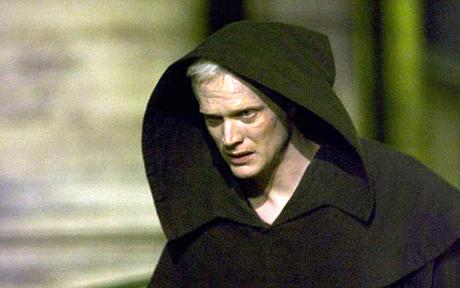
opus-dei-monkI have already written on this subject, especially when commenting on the Grand Inquisitor theme.

My task here is simply to offer a few summary ideas to help us all to understand how the “mechanism” works.

Fanaticism is not the result of faith but a lack of faith. It comes from fear that one’s commitment does not go far enough. Believing in God, praying and living a moral life are, for that person, not enough. There is the element of proving something to himself and others, showing his faith through extreme commitment.

All religious people feel they have to do something. Most go to church and try to avoid doing evil, being good decent folk. A next stage is serving the poor, getting involved with humanitarian works, giving money, becoming a priest, a monk or a nun. These are fully committed Christians. Then we have people who commit atrocities “in God’s name” like seventeenth-century Christians – both Protestant and Catholic – or today’s Muslims in the Taliban or Al Qaeda. This is fanaticism.

Fanaticism need not always involve murder. It can take many forms, superimposed on the predatory instincts of ruthless people seeking to establish their fields of power and dominion. The Grand Inquisitor (see above) is a perfect example of this kind of person and his motivations. Trolling on the Internet is also an aspect of this kind of personality when motivated by extreme religious “commitment”.

The borderline seems to be between the person who practices his faith and religion, but respects other people in their beliefs – tolerance and recognition of good and grace in the other. Proselytism is the beginning of predatory fanaticism when it involves trying to trash and destroy the other person’s basis, to create a need for the fanatic’s way. This is the usual approach implicit in commercial advertising, and is a common characteristic of unredeemed humanity.

If God has any interest in what human beings do, it is preferable that God should be seen as love (as said by St John and others in the Old and New Testaments) than as some kind of Lord High Führer who feeds on suffering, blood and death – the Demiurge or “bad creator god” of the Gnostics. Most of us are sure that a loving God would prefer us to be good decent folk than going to church and being evil in our lives!

Does that make us have to be liberals? That depends what liberalism means. If it means tolerating other people and recognising good and truth in them, then we should be liberal. If it is some kind of intolerant ideology to be imposed on others, then we should not be. It is as simple as that.

We should be aware that fanatics, as sociopaths / psychopaths in the world around us, are only a tiny minority. Most of our churches, mainstream and marginal, are made up of good, positive, decent and tolerant people. That goes for the Roman Catholic Church to the little group of Evangelicals in their improvised place of worship. Most of us want to serve God and be good to other people, helping those less fortunate than ourselves and being just. This is one thing we should remember. When there are problems, it isn’t the fault of the Church or most of us faithful and clergy – but of the tiny minority who have no empathy or care for other people, or any recognition of truth and goodness outside themselves.

That is fanaticism. When we recognise it for what it is, then we have nothing to fear.

Posted in Uncategorized | Tagged , , , | 1 Comment

“Embryo Parson” Prepares to Write a New Article

In reference to my earlier article Facing Criticism, an update by someone calling himself Embryo Parson promises that he will “address his comments when I have a big enough block of time to do so in depth“.

I remember from the 1980’s a sketch on a comedy TV show about two English gentlemen in the very early nineteenth century. One accuses the other of insulting his wife and slaps him across the face with a pair of gloves, indicating that the accuser and husband of the insulted wife was challenging the other gentleman to a duel. Whereupon, the challenged party learns to shoot with a duelling pistol. Finally, on the morning appointed for the duel, the challenger produces a pair of swords to the dismay of the one who had so diligently learned to shoot a pistol.

Embryo Parson describes himself in The Life and Times of The Embryo Parson. He seems to be an interesting and sympathetic fellow who has been through a lot of personal hardship and lack of pastoral sense on the part of clergy in various Churches. His conversion was a radical one, and this can bring the kind of radical commitment Christ asks of his disciples, and it can also bring fanaticism. As Umberto Eco wrote in his famous book The Name of the Rose:

Fear prophets, Adso, and those prepared to die for the truth, for as a rule they make many others die with them, often before them, at times instead of them.

I haven’t had time to peruse the whole site, but I discovered that he is a Calvin apologist. I need to see his expressed opinions through that optic. That seems to be the bee in his bonnet when “modern Anglo-Catholics” say that Calvin has no place in Anglicanism. According to this Embryo Parson, Calvin is intrinsic to Anglicanism (for example The Rev. Roger Salter on the True Nature of Anglicanism).

Calvinism is intrinsic to the fabric of Anglicanism and any vendetta against Calvin himself cannot erase this historical and theological fact. Anglicanism is drenched with Augustinianism.

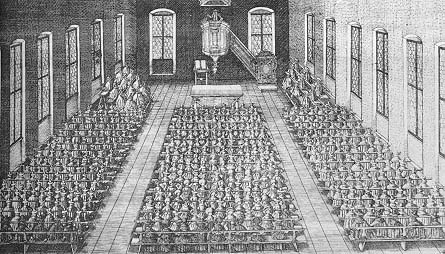
I am a cradle Anglican and have seen a few churches in my time. I have also lived in France and Switzerland, the former country with a Reformed Church minority. Last summer I visited a Reformed church in La Rochelle quite similar to the one in this old engraving.

calvinist_church

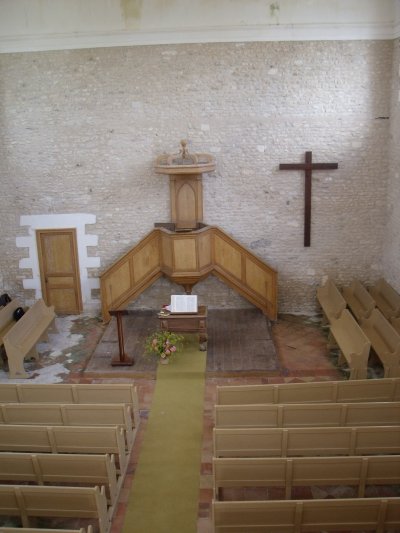
Here is another one of a French Reformed church. It must be very “high-church” because there is a cross on the wall!

calvinist_church2

The Reformed Christians of France and much of French-speaking Switerland (outside Fribourg and Valais) were brave people, and resisted the persecution by Louis XIV and the Revocation of the Edict of Nantes. There was a bloodbath. Decidedly, the sixteenth and seventeenth centuries were not a time of tolerance and dialogue!

This being said, I do know the difference between the Church of England that baptised me and the Eglise Réformée.

I haven’t studied Calvin very much, still less read the Institution de la religion chrétienne, his flagship work comparable in the Reformed world to the Summa Theologicae of Thomas Aquinas. Without wishing to insult anyone, I have always had the impression that Calvin was the sixteenth-century Christian equivalent of the late Ayatollah Khomeini of Iran. Calvin, like many historical ideologues, needs a good deal of study. Some sources (for example) whose impartiality I cannot guarantee suggest that Calvin was something of a little dictator who gladly put people to torture and death in anticipation of their inevitable damnation as reprobate souls predestined to the fiery pit. The sixteenth century was a nasty time, and Christians – Catholic and Protestant – were behaving not very differently from the Taliban and Al Qaeda in our own times. If a human being was predestined for damnation, then there was no duty of any respect of that person. You can kill them, take their property, rape their wives – and no sin is committed!

Puritans in England and America had an inquisition against women accused of witchcraft that rivalled the Roman Catholic Church’s inquisition in Spain and other parts of the world. The Salem Witch Trials in New England are an example of persecution by Puritans. See Salem Witchcraft: The Events and Causes of the Salem Witch Trials. Can all this be blamed on Calvin? The article makes no such insinuation, but seventeenth-century Puritanism was just as fanatical and murderous as fanatical Catholicism in the same period. What was sure about Calvin is that he set Geneva up as a theocracy and he made the rules!

I’m not going to waste my time reading Calvin’s theology any more than Suarez, Bellarmine, Molina and others. Catholicism in the seventeenth century had Jansenism that also had very pessimistic tendencies derived from Saint Augustine. Lots of damned and very few saved. Do we see where the logic goes? Yes, the Untermensch of the guys in jackboots in the 1940’s, lining up their “unworthy of life” victims for the gas chambers. I am often criticised for reasoning according to the principle of the reductio ad absurdam or taking things to their ultimate consequences. It isn’t always a valid way of thinking, but it can be. I hardly have the taste for wading through Calvin’s theology, since the man had nothing to do with Christianity or the Gospel other than nominally and hypocritically.

Putting aside the accusations of murder, persecution and oppression, because everybody with few saintly exceptions was doing it in those days, there is another consideration. The properly theological considerations are based on late medieval scholasticism based on philosophical systems that forbade the participation of any being in another or any notion of the Universal. God was being put in prison!

I refuse to argue according to the categories of this kind of theological method. No theology is perfect, since it is faith seeking understanding (and not always finding it). Still, it can be said that some approaches to theology are more open to the mystical and spiritual notion of God, to God’s generosity and even to a carefully understood notion of universal salvation or deification (Θέωσις) by grace, or even the orthodox version of Gnosticism of the Alexandrian School. I have written on neo-patristics and the Ressourcement school of twentieth-century Europe.

Our embryo parson friend and I seem to live on different planets, and we seem unlikely to have any common ground on which to base a dialogue. I find this tendency with a few others who run blogs and call themselves “classical Anglicans”. I don’t think they really represent most Continuing Anglican jurisdictions seeking to bring churches together in unity and Christian love. If they did, then we are necessarily faced with the exclusion of Catholic or even “high-church” elements.

If he is thinking of challenging me to a long and drawn-out theological debate, as with Roman Catholic and Orthodox convert apologists, he will be disappointed. But I will maintain that Continuing Anglicanism is home to many Christian folk who are all on their pilgrimages. I am a fairly thick-skinned person, having been blogging for years and facing criticism and occasional insults – but I do take exception to being trashed, as seemed to be implicit when we “modern Anglo-Catholics” are seen as “playing at religion”. It’s always the same dagger – we’re the “true church” and you are the insincere and perhaps deceitful impostors, traps for the unwary and spiritual frauds.

I will not argue with a man who thinks this way. If he wants to initiate a theological argument with a long article, I fear he may be wasting his time. Actually, it might be more apposite to see if he picks his nose in public, forgets to zip up his fly or if he has dirty fingernails! Someone familiar with his writings has told me – I don’t know his real identity, but indications are that he has moved around quite a bit and earned for himself a reputation for being loudly dissatisfied and combative. We’ll see, or perhaps we won’t. Either way…

Posted in Uncategorized | Tagged , , , | 63 Comments

A Comment by Young Fogey

Following my earlier article Facing Criticism, our friend in Pennsylvania showed an amazing level of understanding as he reacted to the matters I expressed.

Fr C on not fitting into the churchmanships around you, even if they’re conservative. I was too Anglican to be a good Roman Catholic and too influenced by the Tridentine forms I sought out to be a good Anglican. I sought out a third way in the light of my experience in France in parishes like that of Fr Montgomery-Wright. Despite our doctrinal difference — finding a place in the Catholic Church vs. finding one in Continuing Anglicanism — we’ve always had a lot in common. His lasting point: the molds familiar to trads — Counter-Reformation religious order, militant laity — are neither the fullness of pre-conciliar Catholicism (the ’50s moderate/liberal French priests he knew, who didn’t go Novus but weren’t reactionary either: ‘they are not what we were’) nor for everyone; they’re not perfect. We’re both just old enough to have grown up naturally learning high-church forms, if not necessarily high-church theology, from the Anglicans before they became more obviously liberal, sort of parallelling Catholics who grew up right before the council. There are parallels and lessons for trads from the old Gallicanism, etc., a traditional church that largely runs itself and is locally based. But I’d say our religious culture isn’t necessarily Anglican. (Leaving the Pope on principle and accepting the English ‘Reformation’ even filtered through high churchmanship are not options.) But there’s a third way for me too. Peter Robinson, a Continuing cleric like Fr C, has described my answer when I couldn’t. Mass-and-office is pre-conciliar’s version of high-and-dry in a good way. Super-high and baroque liturgically like Gricigliano and Bourne Street, but Christ- and Eucharist-centered (why the Mass is so emphasized), very theological; devotionally moderate. The pre-/non-conciliar church is a big tent; different versions of the ‘mix’ I describe are of course welcome. (I don’t mind seeing the charismatics at the new Mass when I’m there on holy days or flea-market Sundays.)

I still remember Fr Jacques Pecha in his parish at Bouloire where he had been from 1955 until his death in 2002. He commented on the “reactionary” priests by saying “they’re not what we used to be” (ie. priests ordained long before Vatican II in provincial dioceses).

The lost paradise was no paradise – but it seems to be just about gone. Gricigliano comes fairly close to having recreated something of baroque Catholicism, but the reactionary fault lines are there too. I have been away from it for nearly twenty years.

The biggest problem is the relationship between local religion and culture. Culture no longer has anything to do with religion, and the churches are “uprooted” and living “in exile”. Cultural relevance is something that either favours the Church or secular values – and no one has been able to solve that problem.

Posted in Uncategorized | Tagged | Leave a comment

Rigging your Boats

Quite a few are still looking for my articles about rigging sailing dinghies. It’s the new season, and some of us have already taken to the sea seven or eight times this year. It has been a late spring, and my heart goes out to those who are still having snow. The spring here is still cool, but the weather is pleasant except in the more inland parts of Europe.

To those of you who are sailors, I wish you luck (and skill) in rigging your boats and sailing them. If you have questions that I could help you with, please let me know via the combox. Most of it is either right or wrong for each type of boat, but there are ways of getting around problems or jury-rigging when things really do go wrong.

Remember to observe safety at sea, and don’t take risks! It’s not worth it. Always wear your life jacket and take a mobile phone or a portable VHF with you – or both. Take an anchor especially if the wind is coming from the coast and blowing out to sea. It will save your life if your mast comes down! Check the weather and tides beforehand and let your nearest and dearest know you’re going sailing, fishing or whatever. Remember the sea is always stronger than we are!

Good luck…

Posted in Uncategorized | Tagged , | 3 Comments

Facing Criticism

This is something I should address as unofficially as possible, therefore in my personal blog. I stumbled across a blog with which I was not previously familiar, and which published The Conciliar Anglican (Fr. Jonathan) on The Rise of Parties.

It really is the “old problem”, which we are not going to solve here. So, I will just offer a couple of reflections in the knowledge that I will be shot down. I have no personal experience of American Anglicanism, either in TEC or the Continuum. There are big differences between our “English” way and the “classical Anglican” ethos in America.

My experience of Anglicanism was for the most part outside the “spikey” parishes of London and the South Coast. I developed something of an interest in Christianity from my time at school. It was public school (English “public” school that is, not American) religion – broad, liberal, doctrineless and passe partout. We in the choir had blue cassocks and surplices. The musical repertoire was everything that was most ordinary in Anglicanism, and sometimes we got some “smells and bells” at York Minister in the days of Dean Alan Richardson who had followed in the footsteps of Dean Milner-White. What is Anglicanism to a cradle Anglican? Probably something like Roman Catholicism to a cradle Roman Catholic. It’s something you go along with until you have enough awareness to seek an identity or reject it altogether as irrelevant to the rest of our existence.

I was not conscious of belonging to any kind of “reform” movement. I was just in the Church of England and developed an interest in church music. As I found “bells and smells” at York Minster, I came across Evangelical parishes in our city and some boys at my school who wanted to spice up chapel services with their guitars and catchy songs. By 1973, our chaplain introduced Series III and the first modern-language services that needed special compositions and not the classical repertoire we had been doing. This was my first notion that different “tendencies” wanted to do different things with the Church.

As time went on, I read something about Methodism, since we occasionally had ecumenical services with them. Their churches were so different, usually with a big central pulpit and the organ behind, with a little wooden table in front and the communion rail with little holes for the individual communion glasses. We Anglicans had a central altar (eastward facing or facing the people), the pulpit off to one side and we were given communion from a common chalice. This was so of the most Evangelical parishes.

One impression we English Anglican boys got was that it was a matter of taste and what felt best with. We chose our church because the music was good, because there was a fine organ, because we liked the Vicar, the services, whatever. No one I knew liked to be pressed into any one mould of conformity. With very little doctrinal basis, as with Roman Catholic youngsters, most of us would just “grow out” of religion.

Did we have an idea about Anglicanism having to be distinctive? I preferred Anglican churches to the non-conformist style, and I didn’t find myself attracted to the kind of piety I found in Roman Catholic churches where I occasionally played the organ, surrounding Saturday afternoon confessions and evening Rosary. As for doctrinal formularies, I hardly knew what the Thirty-Nine Articles were – and we still had the Prayer Book for Evensong. Actually in the choir, we didn’t use prayer books, but pointed psalters, a hymn book (Ancient and Modern Revised) and printed sheet music for the versicles and responses, the Magnificat and Nunc dimittis and the Anthem. We had the services as we were used to them, but without self-consciousness.

In my Anglican life in the late 1970’s, I wandered into some very “spikey” churches in London on my many “organ crawls”. I was reminded of the York Minster choir and our school choir processing up opposite sides of the Minster, led by acolytes in dalmatics swinging thuribles for the Epiphany 1973? We sang the lovely old carol O’er the hill and o’er the dale. The “spikey” churches reminded me of all that. It was in 1979 when I discovered an Anglican parish using the Novus Ordo Roman rite. That was at St Alban’s Holborn, up at the high altar and using sung settings with the Prayer Book texts, or even Latin as when using compositions by Mozart, Haydn, Byrd or others. I drew the line when I heard an East-End vicar talking about putting in an altar facing the people to conform to Roman Catholic norms!

I preferred the Prayer Book texts from the point of view of musical settings and an eastward-facing Eucharist rite. On the other hand, I witnessed a north-end 1662 service in one of London’s City churches and found it bizarre. I only went into the place on account of the fine eighteenth-century organ in a church that was not bombed during the Blitz in 1940. I began to hear about comprehensiveness, but that seemed to go with ecumenism, and I remember deeply offending a clergyman because I confused the two terms. The poor man understood that I sinned through ignorance, and I was just a lad of my time.

In time, I assimilated notions about the Tractarians and the Oxford Movement, and even about the London slum priests going to prison in the 1860’s for Ritualism. I didn’t have the impression of men “playing at religion” even if there were some very “camp” homosexual men around. That was and is London and places on the South Coast like Brighton.

I don’t think I ever heard of Hooker until I had become a Roman Catholic and was nostalgic about Anglicanism, and therefore read about it. Newman was supposed to be the great hero of converts, and it seemed strange he took so long to work everything out! Coming to the point, some of the identitaire articles floating about have no bearing on the Anglicanism I knew badly but of which I was a part.

My Roman Catholic experience marked me deeply, perhaps to the extent that I was too Anglican to be a good Roman Catholic and too influenced by the Tridentine forms I sought out to be a good Anglican. I sought out a third way in the light of my experience in France in parishes like that of Fr Montgomery-Wright. That way would be the pre-Reformation, medieval and conciliar tradition of Catholicism. I was struck by the quip by Oscar Wilde in his famous letter to his boyfriend about the meaninglessness of reformations. There is something so tedious about being reformed – it’s all about having to put on one’s Sunday best rather than enjoying life! I was always interested in seeing Catholicism as it “naturally occurred” in countries like Italy, a phenomenon of increasingly rarity.

So, comprehensiveness based on “reformed Catholicism” was never much of a priority for me.

This article to which I make reference assimilates me to “modern” Anglo-Catholicism, perhaps something like St Alban’s Holborn, St Mary’s Cable Street or Bourne Street. Lots of lace and big six? I have nothing against, since I was a seminarian at Gricigliano and unashamed baroque Catholicism seemed a good contrast with the more dour and humourless traditionalists. Since then I dropped the lace and took the plunge with the Sarum liturgy, whether others are interested or not – it makes no difference here in France.

Blog articles and comments of modern Anglo-Catholic clerics such as Chadwick and Haverland…

I am indeed flattered to be compared with my Metropolitan Archbishop who is an excellent theologian and an erudite man.

Was comprehensiveness really an ideal with the Tractarians? Perhaps it was, but this is the first I hear of such a notion. I would not dare to speak for Archbishop Haverland, but I have not jettisoned anything that was never a part of my religious baggage. Am I playing church? Am I wanting the church I want and forgetting the Church which God wanted. So, my Archbishop, I and others are not only “modern” Anglo-Catholics but also sectarians! I have a feeling or surreality, as if someone were calling me a pink elephant and I were looking over my shoulder to see whether the description fitted me or someone standing behind me.

Strangely, I am not really interested in a “church I want”, but more in finding the Church at all. Where’s the comprehensiveness in indicting our intentions and interior motives? What is not sectarian is seeking to base comprehensiveness on a narrow and intellectually unsatisfying ideology? It is a bit like trying to examine current social issues in the light of Marx and Lenin rather than the research of those with the benefit of more relevant data?

What makes them so sure that God wants something based on Reformation-era ideas and reactions against the Roman Catholicism of the time? Has God ever expressed any preference for any “type” of Church? The binary thinking (which is not merely for pedagogical purposes) is quite astounding. Only if you’re “modern Anglo-Catholic” are you seeking a “pure” Church consisting on bits and pieces chosen from the “cafeteria”. Now where have I heard that one before? Oh! Of course! From the conservative Roman Catholic apologists.

So, we “modern Anglo-Catholics” are bound to die out eventually. Isn’t that rather obvious? We’re all going to die one day! But, the idea of Anglicanism as “conciliar Catholicism” rather than Protestantism with the hard edges filed off seems still to be going more or less well. People have been going to Rome and Orthodoxy since the days of the Oxford Movement – and they were hardly “modern Anglo-Catholics”. Some Evangelicals have also gone to Rome and Orthodoxy, as they still do. It is not because of “modern Anglo-Catholicism”, but because a particular person or group believes that this is the right thing to do.

It is manifestly silly to blame “modern Anglo-Catholicism” for people being “bled off”. Perhaps “they” should blame Tractarianism and not only “modern Anglo-Catholicism”. Well, before Tractarianism, Anglican pottage was latitudinarian and an affair of country squires and the Establishment gentlemen sporting their facial hair in their Clubs.

So we “modern Anglo-Catholics” have “no real understanding of the Gospel of Jesus Christ” and are merely “camp” aesthetes! It’s a point of view… It’s time to question this term “modern Anglo-Catholicism”. If this were an accurate way to describe us, then why are we using old liturgical forms rather than the Novus Ordo? Perhaps “modern” means anything since the sixteenth, seventeenth or eighteenth centuries. It’s all rather slippery.

It comes to another consideration which is no less than a “true church” claim and the correlative intolerance. It strikes me that such intolerance and branding of ones “adversaries” will do more to discredit the Church and alienate seekers than either the importing of “foreign” traditions or reviving “obsolete” customs.

I wish all the best to all groups of Christians in their endeavours to bring about unity between themselves. I sincerely hope for their success in making their message more credible to tired, cynical and alienated people of our time. Perhaps only in America can any kind of Christianity make any claim to worldly success. That being said, I am hardly naïve about the fact that the greatest oppositions between Continuing Anglican factions are in America.

For my part, I am not jealous about the label Anglican. When I was a boy, it meant being in the Church of England. I quoted Bishop Mercer’s piece about extra-mural Anglicans a while ago. We all have difficulties in defining our identity or our particularity, and we squirm about using the title Catholic for fear of offending the Roman Catholics. Orthodox is even further away from our horizon as a word. Do we define ourselves by the institutional body we belong to or by our belief and praxis? It is a tendency among many independent Catholics to use special adjectives so that they don’t fall foul of accusations according to which they are misrepresenting themselves as other kinds of Catholics. This is a big problem.

What do we do? Go away and let the strongest stake their claims to the exclusion of all others? If that the Church God wants?

It strikes me that the goal should not be one of gathering all the little Anglican communities and making a big and politically powerful institutional body, but rather tolerance and recognising Christ in other people and the groups they belong to. Anyway, I could go on about this forever, and those who are convinced need no convincing, and those who are not convinced will never become so. I leave off this little article with the famous quote:

For those who believe, no proof is necessary. For those who don’t believe, no proof is possible.

Posted in Uncategorized | Tagged | 17 Comments

Double Standards

It is quite astounding. Young Fogey for some time has been pushing for Roman Catholicism. I thought he was quite ultramontanist in his ideas, constantly going on about the necessity of an “infallible authority”. Well, he seems a pleasant person with lots of interests and eccentricities like his love for classical automobiles and other artefacts of the “old days” from hats to razors to what gentlemen used to put in their hair to make it shine. They say – whatever floats your boat, and I have my own interests and eccentricities, including boats that float!

We can’t always be totally coherent in our thinking, balancing our beliefs with pragmatic considerations. It’s no use believing in something that has absolutely no practical application. One is brought to think of Tantalus and the water that is so near yet so far, giving rise to the English word tantalize.

My attention was brought to the following opinion by the fact it links to one of my articles.

Fr C on low-church Pope Francis. Again, if he just leaves us alone I’ll be fine. If not, if Francis turns out to be Paul VII, laymen have several options: go back to hunkering down at the lowest Sunday Novus, as for the past 40 years; Greek Catholic; or the SSPX or other irregular trads, as long as they’re not a separate church in principle. We will have the Mass. I know: what about sacraments that depend on jurisdiction? State of emergency in the church: if the local putative Catholics are really liberal Protestants, you do what you have to. Archbishop Lefebvre’s eternal Rome, not local usurpers.

Though this person speaks of the absolute necessity of being a Roman Catholic, the approach is the fairly classical theory of the traditionalists, almost a form of dissimulated conciliar Catholicism. The authority is no longer the Pope but the notion of Tradition and the consent of the body of the Church, even if an Ecumenical Council is not involved. This was precisely the disputed point between Paul VI and Archbishop Lefebvre. For Paul VI, the Pope is the living Magisterium. For Archbishop Lefebvre, the Tradition limits the use of Papal authority. This second position would certainly make sense to me, but many conservatives place the authority of the Pope as an absolute.

I simply go through a few phrases of this quote.

Again, if he just leaves us alone I’ll be fine.

This is exactly the spirit of Gallicanism or Germanic conciliarism. The Pope is a symbol of the Church’s unity, but of the bene esse of the Church, not the esse. It is also the attitude of Germanic progressives today – one can’t have one’s cake and eat it!

If not, if Francis turns out to be Paul VII, laymen have several options: go back to hunkering down at the lowest Sunday Novus, as for the past 40 years; Greek Catholic; or the SSPX or other irregular trads, as long as they’re not a separate church in principle.

I admire the courage of those who have persevered over the years. We do have to remember that far more have abandoned any practice of Catholicism. It is a frequent assumption that the numbers plummeted because of the liturgical changes. This is unlikely because even officially approved Tridentine masses remain very marginal. I won’t speculate about the causes, but the traditionalist theories are too simplistic. So, the distinction between Catholic and schismatic is not being a “separate church in principle”. This gives justification to more serious ecclesial aberrations like priests operating without episcopal oversight or becoming episcopi vagantes under some pretext of “epikeia” or “emergency” canonical situation. Quite frankly, the constitution of Continuing Anglican Churches is more healthy in ecclesiological terms than this kind of brain-twisting.

Indeed, there is the problem of Sacraments depending on Ordinary Jurisdiction – marriage and penance-absolution. Who is to be the judge of a genuine canonical “emergency” or a priest flouting Church discipline and following his own fancy? That is unless they are going to be a Church with only five Sacraments, and less than that if they have no bishops.

Perhaps our friend could come to the conclusion that it was sunny weather yesterday but raining today. Continuing Anglicanism is far from perfect, and human error makes life difficult – but we are a Church of all weathers!

Indeed, conciliar ecclesiology makes more sense…

Update – YF answers me on his blog:

Tuesday, continued: answering Fr C’s questions

Fr C writes here on this. When I met him online years ago he was a trad but not in a usual militant trad mold; simpático with me in some ways. We have less in common now he’s joined Continuing Anglicanism but his criticisms of things and people in the Catholic Church, including the trad movement, sometimes are right.

  • Infallible authority doesn’t necessarily mean ultramontanist. Roman Catholic doesn’t either. The last Pope, for example, wasn’t ultamontanist and never was. In a way his abdicating teaches a lesson he’s taught all his life as a professor and priest about the limits of the papacy (the man’s fallible; the office ex cathedra not). I understand Vatican I actually put the brakes on ultramontanist opinion by clarifying what papal infallibility is not. All more or less Catholic groups believe in a kind of church infallibility: the Eastern churches for example, and I think the Union of Scranton believes something like high Anglicans about the consensus of pre-‘Reformation’ churches’ belief, expressed as the Vincentian canon, being the source of doctrine. Catholicism believes the Pope’s a subset of church infallibility; an essential part of the church, but only part of the church. Tradition’s guardian, who can’t change doctrine.

  • Trads do have a lot in common with old Western conciliarists such as the Gallicans and old Germans, and with the East in this regard: papal minimalism, or the traditional Catholic religion largely runs itself.

  • Today’s German progressives, like mainline Protestants, want to change doctrine to fit secularist culture; we don’t, and can’t anyway. Even the Pope can’t.

  • No to going to priests operating without episcopal oversight, unless there really is no other option (exactly what the church teaches). Being under a bishop is Catholicism 101 right out of patristics.

  • Continuing Anglicanism’s not an option, because while ’50s-high-Episcopal-style churchmen like Fr J. Gordon Anderson are great, very close to us, I’m afraid they’re wrong about classical Anglicanism; it’s not Catholic.

Just a couple of words from me. He is right to make the vital distinction between those motivated by fidelity to Tradition and progressives who fit in with modern culture and political correctness. As for Continuing Anglicanism not being an option, I have myself discussed the problems of basing everything on a Reformation “default”, something that does create a big difficulty between, for example, the Anglican Catholic Church and, for example, the school of men like Rev. Peter Toon.

If Anglicanism is “English Gallicanism” or “English Conciliarism” that would solve many contradictions, but I can only speak for myself, not for others. Some problems between those claiming to be Roman Catholics, traditionalist or otherwise, are as serious as if not more serious than between “old high-church” Anglicans and Anglo-Catholics.

Perhaps I was a little “binary” in my criticism of YF, but he can also be very binary in his writings. We both need to be subtle and nuanced.

Posted in Uncategorized | Tagged | 29 Comments

Work

Sometimes, we can get awfully sanctimonious about work, especially when someone else is doing it. We are indeed fortunate if our daily work involves helping people, as a doctor or a nurse does, or if we find fulfilment in something like a craft by which we create something new with our skill and hands. In such conditions, we are motivated to take pride in doing a first rate job.

Not everyone is so fortunate – that is when they are able to find a job or set up a business. Work can be degrading. Certainly, one of the greatest satires on the condition of workers in the industrial age is Charlie Chaplin’s Modern Times. Here, he is seen as an assembly line worker.

This film was made in the 1930’s during the Depression. Economic life in those days was still based on manufacturing and production. If you were unemployed, whether it was your fault or not, there was no unemployment benefit or indeed any kind of welfare state. I won’t go into all these arguments for or against state-controlled or private health and welfare, because the issues in each country are complex and there are several legitimate points of view.

Christians often fall into divers political opinions about the means of production and the men and women who have to work. There has to be a balance between the just remuneration of the workers and the investments from the company’s turnover needed for maintaining and developing production tools and its progress in its particular market. Beyond this just balance, there are the excesses of capitalism and socialism. These were the things at stake during Mrs Thatcher’s administration as Prime Minister in England. For me the ideal is something like the Cooperative Movement or Distributism. The Arts & Crafts Movement was something wonderful in its ideas, but it is not economically viable in the society we live in.

Work for most people is a hard slog with very little reward other than the salary they earn to maintain their lives and consumption. The more we earn, the more we need more and have to work to earn it. These are problems we all face in keeping the wolf away from the door and providing for our families. There is nothing romantic about most people’s jobs or anything remotely resembling job satisfaction or indeed anything in common with a self-employed carpenter two thousand years ago.

We generally aspire to be just and honest people and put our bit in for society and our own needs. For some, it is very difficult to be totally honest in an exploitive system, and it is easy to understand the person who decides to live in such a way as to need as little money as possible. There is an idea from some of the anarchists as to a legal way of avoiding tax – earn too little money to be taxable. But, this means a way of life that is incompatible with owning a house, a car, electronic gadgets and the like. There are also “alternative economies” for those interested in that kind of thing.

Thus I see the value of work as relative. There are different kinds of work. Doing your own garden is work, but you don’t get paid for it. Same with a woman (or a man) doing housework or renovation work. With the latter, you are earning money by saving it and not having to pay someone else to do the job. Some people like to be as self-sufficient as possible, though complete self-sufficiency or “survivalism” is an illusion. The more fortunate people fulfil their lives through a vocation, that sometimes is their paid work – for example doctors and social workers. Increasingly, we priests are non-stipendiary and have to have a job to earn our living. I do technical translations and teach technical and business English. I don’t really see that as a vocation, but it is much nicer work than having to work as a civil servant (the job is as boring as watching paint dry, but you get job security, a decent salary and a good retirement pension). Most people just have to settle for what they can get according to their marketable skills.

So, talk of a “spirituality” of work is very relative. Some people have jobs that enable them to take pride in a good job well done, and others are so degraded and exploited that such sentiments become very difficult.

Knowing something of real life makes me gag at some of the sanctimonious cant about thrift and work. I admire Pope John XXIII, for when he was a young priest, he defended workers’ rights in a time when such sympathies would earn a priest the suspicion of being a Modernist! I can understand the sentiment and intention behind instituting a Christian feast of work to “baptise” the secular one set up by socialists, but it will mean too many different things to different people.

I am lucky in that my work is pleasant, though irregular and not extremely profitable. I have the freedom of working at home and having only deadlines and quantity imperatives to meet, so I can go sailing when there is a gap, but it can be difficult to make ends meet. We all do more or less well in the current conditions of scarcity of work and financial crisis.

On this Feast of Saints Philip and James, my heart goes out to those in difficult and dangerous work, the exploited, the unemployed and those who work hard but earn their living with great difficulty. We have a duty to respect people’s work and treat employees with kindness, empathy and justice.

Churches have always engaged in society through social teaching, which is more or less relevant or based on reality. I would certainly say to some priests that they wouldn’t last five minutes on the assembly line!

Posted in Uncategorized | Tagged , | 2 Comments