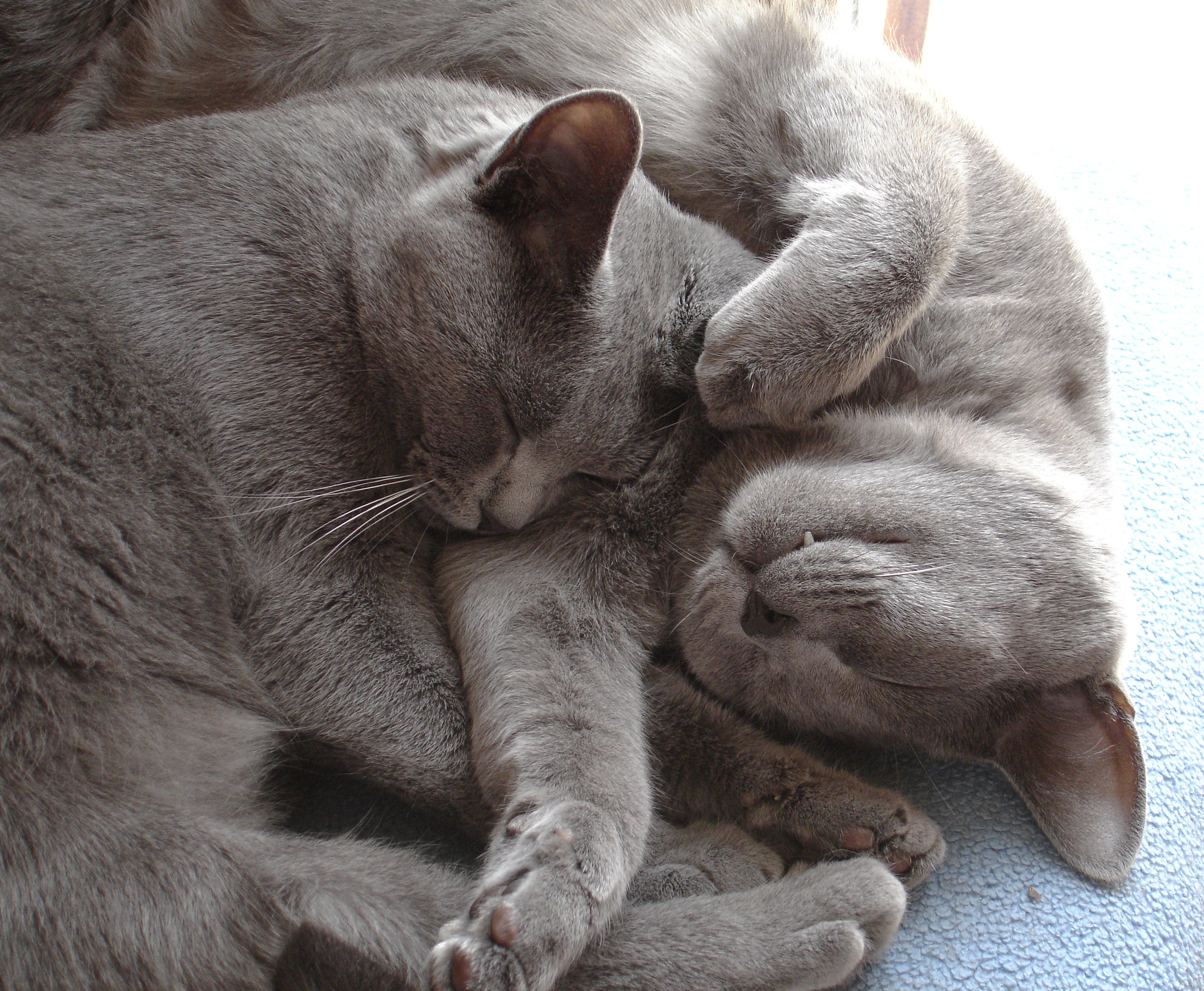
My wife and I have two adorable Chartreux cats who luxuriate in their thick and soft grey fur, named Celestine and her biological offspring is called Doucelin. We are woken each morning by incessant head-rubbing and purring as these two half-starved creatures crave their morning food! We bought Celestine from a breeder, and found the kitten was not well socialised, as the breeder had several nursing cats and litters of kittens in the house, each confined to a bedroom suitably stinking of cat piss!
Cats are brought round to our way of life by giving them their needs and our affection. We also have to take away their natural sexual instinct by having them neutered by the vet, after Celestine had had her litter of three kittens (we kept one and sold the other two, which paid our veterinary and other expenses). Otherwise, they would revert to the wild state. That is how cats are, more so than dogs. Then the denatured cat adapts to life with humans, and the relationship is reinforced by means of maintaining them in a state of kittenhood by stroking them – imitating the mother cat licking them – and giving them more than what they need in terms of food. It’s a two-way contract, the human gets affection from the cat in exchange for a soft and care-free life.
So, I am really dubious when humans, religious or not, are likened to cats being herded and brought together in some form of unity. I need also to say that the advertising sketch I reproduced on Continuing Anglican Ministry – Herding Cats is very funny. Simply, cats are not cattle or sheep, or even dogs – they are not social animals.
Getting onto the point of this article, I have been looking at the latest posts on the Anglican Diaspora, which is a fine forum with some good people on it and a good friend running it. In particular, we have the continuation of the “old problem” of establishing the basis of a “comprehensive” Anglicanism that everybody could accept. It is a concept that seems to approach that of inventing and designing a time machine or a perpetual motion machine that needs no continuing energy input to keep working.
I won’t quote the postings, but they can be found in this thread (you can look at the previous pages to trace it all from the beginning). I find this thread stimulating and thought-provoking, and it has inspired a few posts on this blog. At the same time, it is frustrating because the stated goal to be attained in as impossible as time travel or perpetual motion – that is: time travel and perpetual motion are possible in a universe other than ours.
I have already said it: we either have to discard Protestantism and base ourselves on a form of pre-Reformation Catholicism, or on post-Tridentine or post-Vatican II Roman Catholicism. We can do this by knocking on Rome’s door to join the Ordinariates, go to our local Roman Catholic parishes, or by becoming something assimilable to Old Catholicism. Alternatively, we can base ourselves on the Reformation formularies and allow ourselves a little indulgence in our taste for “bells and smells” and reject both pre-Reformation and post-Tridentine Roman Catholicism as erroneous, and reject Old Catholicism as alien to the Reformed Anglican position. A third way would be to get together on the basis on rejecting any doctrinal foundation and just getting on together for the sake of improving humanity in some kind of Enlightenment perspective.
The obvious solution would seem to be an agreement to separate two groups: one loosely based on a kind of “pre-Reformation Old (Conciliar) Catholic ideal” and the other bound to the English and Continental Reformation and the old high-church movement from the late sixteenth to the late eighteenth century. I note that in the Continuing Anglican world, the latter prevails in the USA and the former in the somewhat marginal TAC and ACC communities in England. There is little need to state that my own sympathies lie with the former position, and that the Reformation is irrelevant to my own Christian life and intellectual convictions.
To insist all the same on pushing the two fundamental perspectives into one body necessarily implies that one have to give way to the other – and under an authority that can enforce compliance. This authority can be something like the Pope and the Vatican or a secular authority in somewhere like England where the Church is still established, but where anything goes. Without the authority of the Pope (RC apologists will be delighting in my “seeing the light”) or that of the confessional State, church unity can only depend on voluntary agreement.
We English have been used to clerical obfuscation and ambiguous language – saying something that can be interpreted in two or more different ways and according to different meanings attached to common words. This creates an illusion of unity, where none in fact exists, and it breeds hypocrisy and the idea that all churchman do is spend other people’s money on playing games. I would not say such an idea is wrong, and I have no time for the Church of England as it is now or since I left it more than thirty years ago.
So, we have several types of Anglicans:
- post-modern “liberals” who have taken the Enlightenment to the ultimate extreme,
- those who think of themselves as Protestants,
- those who think of themselves as Catholic (non Papal, non Roman) and reject Protestantism
- those who think of themselves as Catholic and have become Roman Catholics or Eastern Orthodox with or without concessions to their cultural attachments.
One cogent point of view on this forum defends the idea of having two Continuing Anglican Churches to avoid Anglo-Catholics being forced out or put in the defensive.
Is it such a bad thing to have more than one Anglican church?
The other school of thought, represented by a good friend who comments here on this blog, would refuse any possibility of such a settlement based on separation along the theological fault lines. To admit such a possibility would be admitting the illegitimacy of Anglicanism as a whole. Here it could be replied that this imperative should extend to negotiating with the Roman Catholic, Eastern Orthodox, Old Catholic, Lutheran and other Confessions, with the liberals as well as the conservatives. It could be argued also that failure to produce results should result in forfeiture of the credibility of Christians to the atheists and secularists. How far do we go? If this imperative of organic unity is absolute, it looks as though we have to choose between being Protestants or Roman Catholics – or abandoning Christianity as something intrinsically founded on error and illusion.
Realistically we have to admit that, yes, there are divisions, not only within Anglicanism, but between Christians of various persuasions. Differences exist and, as a result, divisions exist. Is this acceptable? Are we brethren or are we not?
The argumentation is attractive. We either bury our differences or admit that we are not sincere Christians. Perhaps this is what has really caused the demise of Christianity in the modern world. It is founded on illusion and fallacy to such an extent that it has to be put aside and scrapped like a car that has become too unreliable and expensive to maintain. On the other end of the spectrum, the RC and Orthodox apologists are right, and we should be converting to those “true churches” – which themselves are revealing their irrelevance to the modern western world.
As far as I see it, organic unity is only possible under constraint and compulsion, on pain of excommunication which in the Middle Ages involved total social shunning. Only two ways lie open to such a pariah of society, repentance and reconciliation or death. Perhaps our friend should be campaigning for election to the Presidency of his country with the possibility of abolishing the Constitution and bringing about some kind of theocratic dictatorship to punish all kinds on non-conformity. I’m not saying that this is what he would like to do. It’s not in his nature, but it is the only way, with a Secret Police Inquisition to root out dissidence.
The big problem with this is that Christ willed that his disciples should be free, and that Redemption involved freeing the children of the new Israel from the chains of the Law – by fulfilling it. St Paul is full of this theme, as are the Gospels. We will again find this theme of freedom in twentieth century Russian philosophy and in European currents of thought as humanity groaned under the weight of the Ideologies.
Perhaps we can belong to a single body, but in which doctrinal formularies are mere formalities or which simply don’t matter. This is post-modern religion in which anything goes, at choice at the cafeteria of ideas. A little of this and a little of that would be so nice! OK, fair enough, and it would seem that liberalism and relativism are the only way to deal with the violence and conflict – either physical or intellectual or both – that pushes our tired-out world to the brink. Then women clergy and gay families should be a part of our daily life, together with coffee-table eucharists and smug chattiness. We are then wrong with being conservatives or holding onto stuff that should have been carried away by the dustbin men a long time ago! A word of warning. One won’t find much tolerance with the liberals and politically-correct crowd. So, we are back to square one.
I think we are all opposed to Christianity being discredited and made into a foolish illusion by division and intestine intolerance. We all find denominationalism to be poisonous. Come and live in a country like France where the only respectable Christians are Roman Catholics and Reformed, and a few ethnic Churches for ethnic people – and anything else is a dangerous cult to be repressed by any possible financial and legal means! This is why my wife has always encouraged me to keep an ethnic character to my ministry – be English and make the most of it – and not be something like a “French Old Catholic” – which is disreputable in the eyes of most people. Over here, the Gallicans are usually associated with uneducated errant clergy who live from the credulity of simple people through doing exorcisms and parallel “medicine” for money. It is a question of image and local sensitivity. In the USA and a lesser extent in England, we have had non-conformity and religious pluralism for centuries, and this is considered as normal. There is a middle ground between Anglo-Saxon denominationalism and the Church-State alliance which is still implicit in Europe. But that is just about impossible to define, let alone bring about in reality!
Could there be some new form of Anglican settlement in the conservative Continuing Churches? Perhaps coherence would demand that the Continuing Churches should dissolve their organisations and tell their people to go back to their owners – the parishes that have their names inscribed in the Baptismal Registers. How dare Continuing Anglicans want to be free not only of Protestantism but also of all the modern liberal developments which are surely the will of God, since they have been adopted by the bishops of the Church and synodal organs of government? Not happy with that? Tough! Become Roman Catholics or Orthodox or stew in your juices. This is what we are up against.
Something realistic has to be possible. What has happened? We get different types of Anglicanism as you have different types of Catholicism, Orthodoxy and Protestantism. It’s just a fact, whether we like it or not.
Our friend tells us that we “have” to incorporate Protestantism into our existence as Christians and Churches. After all, Rome itself has taken certain Reformed things into account – the Bible and the liturgy in the language of the people. Emphasis on the community rather than individual piety, monotheism to regulate the more questionable aspects of devotion to Our Lady and the Saints. It is true that things needed to be tidied up in the 1950’s as in the 1530’s, but often things went from one extreme to the other, the Puritans in the sixteenth and seventeenth centuries as the Novus Ordo iconoclasts of the 1970’s. If this is carried too far, what right have Continuing Anglican and traditionalist groups to exist and dare affirm their independence from the “official institution”? Does not schism breed schism? This is our agony.
Who is going to distinguish between “moderate” Protestantism and full-blown Puritanism (or other phenomena along similar lines) and opposition to any form of Sacramental Mystery or Hellenic philosophy? Are we going to reach agreement? I would be all for trying, but no significant progress has yet been made. It seems for the time being more realistic to consolidate the stability of Anglo-Catholic churches on one side and Evangelical churches on the other, either that or giving up. We are often presented with dilemmas, the most usual of which is that we have to identify and define our Anglican identity in something like a coherent and agreed way – or admit to Rome’s classical position according to which Anglicans are bogus Catholics playing games and deceiving the faithful!
We all have our history, and we do not have the right to discard it. Can we form a new Anglican identity based on the historical models and inspirations? This seems to be the the approach of the Anglican Church in North America, which still seems to be attached to ordaining women even though it refuses the homosexual agenda. Some of the more “comprehensive” continuing Churches are pushing for a relationship with the ACNA, if only they can ditch women priests! There seems to lie the rub. The devil is always in the details. That’s what the Anglican Diaspora thread was all about to begin with.
We need to talk to each other, listen to each other, and respect each other. We need to recognize that, within broad limits, there will be differences of opinion, and even to be thankful for that. Openly discussing our differences in a respectful and gentlemanly manner, with the recognition that none of us are 100% right all the time will go a long way toward bringing unity. Infighting, rigidity and combativeness will only produce division and weaken our common witness.
In the absolute, I can’t agree more. However, it only works when we remain at an unofficial level. On this blog, I have readers from all sorts of places, religious convictions and affiliations to this or that Church. When abstraction is made of those three aspects, we can indeed pray together and find harmony between ourselves. It is when efforts are made towards disturbing that harmony and forcing people to choose when organisations “horse-trade” and negotiate one thing against another, that everything falls down. I read something about this in Soloviev. The Antichrist is born not when Christians pray together but when their Churches attempt to abolish their differences and conform to some alien mould of conformity.
He says it himself. The goal should not be producing a “pure” and monochromatic organization. This would only be possible by means of inquisitions and police states.
The reality seems to be just about the present status quo. I joined the Anglican Catholic Church, not because I believe it to be any “truer” than any other community identifying with Anglicanism, but because I find it to have attained a credible level of stability after all the shenanigans of the 1990’s involving men like Bishop Leslie Hamlett and a long period of recovery. I myself needed an ecclesial mission and continuity in my vocation as a priest. Perhaps had I been living in the north-east United States, I would have remained in my parish throughout the period of turmoil in the TAC, and would have made no change. I live in Europe and I “lost” my Archbishop and the recovery of the TAC in England seems less obvious or generally known – so I had to make a decision. The ACC may seem “sectarian” to some, but I am highly impressed about how Archbishop Haverland has made sense of the mess that prevailed fifteen years ago and how Bishop Damien Mead has taken the reins in England. We are small and marginal, but we are also stable and credible through our integrity. That is a remarkable achievement!
When there is more stability and integrity in all our little communities, I do believe that we will be able to begin cooperating in things like sharing material resources – seminaries, libraries, information – and then churches and services rendered by Bishops without clerical pretensions and ambitions to power. We can begin by getting rid of the negative stuff, the bad memories of the 1980’s and 90’s, the so-called “Phalanx” and having services together – Mattins and Evensong to avoid differences over the rite used for the Eucharist.
I fail to see how it could all become like the Church of England in the 1950’s, because the genie is out of the bottle and the cat has experienced the joy of catching a mouse for the first time. The ideal should be there, but also there should be the ideal of letting Churches get their acts together and reflect on their own identity and common convictions. There seems no crime in that!
* * *

Lest I be seen to be “reinventing the wheel”, I draw your attention to the posting and thread of comments on ACC Makeover. There is no solution to this dispute, and I won’t even try.