Reflections on Ressourcement Theology

I’m reposting something from my defunct English Catholic blog, which I see as particularly useful. Like the medieval Church when the fragmentation was as yet latent with the Lollards and the early Reformers, much of the problem was being caught up in excessively narrow scholastic categories. This is certainly true of many of those who defend Anglicanism from the point of view of the sixteenth-century formularies. This article was originally published on June 5th 2011. I include the comments of the time.

* * *

The term ressourcement is both a neologism and a French word. As mentioned in an earlier article, the word has been derived from Sources Chrétiennes (Christian Sources) an immense collection of bi-lingual critical editions of patristic writings. If you read French, you can refer to Sources Chrétiennes online. You will see how impressive this library is. The word also refers to the notion of returning to sources, which some might interpret as Protestant archaism and the illusion of the primitive Church. We find the idea beautifully expressed by Léon Bloy:

Retour à la case départ, là où les pierres me reconnaissent, les arbres me prennent pour l’un des leurs, là où je fais partie du paysage au point de disparaître. La vie comme un cercle, la vie comme une complétude, un retour aux sources, aux racines.

A somewhat prosaic translation into English would run – A return to the beginning, where the stones recognise me, the trees adopt me as one of their own, where I merge into the landscape to the point of disappearing. Life like a circle, life like completeness, a return to sources, to roots.  Péguy, in 1912, was highly optimistic about a Catholic “renaissance” in France. It is a mystical vision we find also with the Baron von Hügel and Fr Tyrrell. Tradition needs to be given space to grow and bring about renaissance. Men of those days had had enough of the petrified and dry bones of neo-scholasticism. This was the kind of “Modernism” that had nothing to do with the secularising efforts and refusal of mystery and miracle of Loisy, Harnack, Bultmann and others who eventually influenced Hans Küng and Karl Rahner. Conservatives and proponents of neo-scholasticism conveniently plaster over the differences and lump everyone into the same basket.

In a more strictly theological context, a return to sources refers to the Fathers of the Church – all of them from Clement of Alexandria to Bernard of Clairvaux, Athanasius to John Damescene. The field of vision is as vast as the sea seen from a small boat or the universe from our planet.

The idea is that referring to the Fathers rather than narrowly focusing on the philosophy of Aristotle and the Scholastics following the methods of St Thomas Aquinas and St Albert the Great would help to restore a key of interpretation following the notion of continuity and development. Researched and worked on with intellectual rigour, the neo-patristic method and vision would help to renew the Catholic’s sense of Tradition and bring a breath of fresh air.

Anglicans are generally unfamiliar with the scholastic so-called Manual tradition entrenched in Catholic universities and seminaries since about the eighteenth century. Perhaps this “little book” way inspired Chinese Communism with the Red Book everyone had to read and meditate. Scholasticism is highly attractive to the newcomer with its mathematical precision and logical clarity. The risk is one of reducing God to rational categories in a logic of clericalism. Using reduction ad absurdam, here is a piece of work using the neo-Thomist method to demonstrate that the Papal See is “formally vacant but materially occupied”. This might seem to be complete gobbledegook to most of us unfamiliar with this system, but is very coherent. This so-called Cassiaciacum Thesis was formulated by a Dominican priest, Fr Michel Guérard des Lauriers who was a disciple of Fr Garrigou Lagrange and a professor at the Angelicum in Rome and Le Saulchoir in Paris. He was no fool! Where this kind of thing falls down is that theology is largely concerned with theological truths that transcend human reason. The reasoning is so clever that it no longer corresponds with reality, the very basis of Aristotelian epistemology!

We cannot discredit all scholastic theology through this absurd extreme, but it does serve to show us that other theological visions exist and are perfectly orthodox in terms of the creeds and the definitions of the Ecumenical Councils.

Ressourcement theology largely grew in France from the end of the nineteenth century and had a tremendous amount of influence at Vatican II. These theologians felt they had to respond to the challenges of the twentieth century manifest in secularism. This movement drew some inspiration from men like Newman, Möhler and Blondel. Men of culture like Paul Claudel and Charles Péguy (mentioned above) also left their mark. This was also a time of the liturgical movement inspired by a desire to re-sacralise the Church’s worship and bring the faithful to a higher spiritual and intellectual level.

This movement was not purely French, but Germans like Romano Guardini, Karl Adam and Dom Odo Casel were present. The French movement was led mainly by the Dominicans of Le Saulchoir and the Jesuits of the Lyons Province. The most eminent names are Jean Daniélou, Louis Bouyer, Yves Congar, Henri de Lubac, Marie-Dominique Chenu and Hans Urs von Balthasar. The opponents of this movement called this tendency la nouvelle théologie, with the idea of casting suspicion of heresy on these men. However, this grouping was not actually a group or some kind of Modernist conspiracy, but simply a common tendency among many different theologians of different religious orders, universities and groupings. They were united by a common conviction that theology had to talk to men of our times and that we are called to rediscover the whole Christian tradition.

One essential aspect of this movement is the importance of Church history. The idea is to look for answers in the Fathers for contemporary questions. The other important thing is to understand doctrinal definitions in their historical context. One important thing my old church history professor, Guy Bedouelle OP, taught us was that you understand history by the values of the time. You don’t commit anachronisms like judging the Inquisition in the light of our understanding of human rights and religious freedom. For example, it is sobering to know that the Inquisition had a fairer and more disciplined legal procedure than secular tribunals of the same period. I have criticised “non-historical orthodoxy” in some of my articles on liturgical reform.

The problem is not new – the Church is playing an endgame. Humanly, the game is over and the Church is called to disappear, presumably to give place to secularism or other religions. The Church is not without fault. Here in France, the working class was lost to the Church from about the time of World War I. Ever since then, no one seems to have come up with a solution in spite of the bold initiatives like the worker priests and the Mission de France. I have for a long time been haunted by these words from an article about Julius Evola (1898-1974), the Italian philosopher who was suspected of being close to the Fascist ideology, though he never belonged to Mussolini’s party.

Evola tells us that “the decline of the modern Church is undeniable because she gives to social and moral concerns a greater weight that what pertains to the supernatural life, to asceticism, and to contemplation, which are essential reference points of religiosity.” It is certainly not fulfilling any kind of meaningful role, either: “For all practical purposes, the main concerns of Catholicism today seem to turn it into a petty bourgeois moralism that shuns sexuality and upholds virtue, or an inadequate paternalistic welfare system. In these times of crisis and emerging brutal forces, the Christian faith should devote itself to very different tasks.” (…) Evola suggests that because the Church is so inadequate, it should be abandoned and left to its ultimate doom.

This intriguing Italian thinker might not have had all the answers, but he certainly asked the right questions. The accusations may be excessive but not fundamentally wrong. Should we let go of the Church and Christianity or only the caricature that generations and whole peoples have rejected? If we are not to reject Christianity, perhaps we need to give it new value and spiritual meaning. For Jean Daniélou, a Lyons Jesuit who taught at the Institut Catholique of Paris, theology had become absent from the thought of the twentieth century and the post-war world. For this theologian neo-Scholasticism has virtually no historical sense. With its essentialist and objectivist character, Neo-Thomism is unable to relate to our existentialism and human subjectivity. It was eminently a pastoral consideration. God’s transcendent mystery was hidden by rationalistic theology against which the existentialist Kierkegaard reacted. God had no longer to be an object, but a personal God accessible through love. We can see where Karol Wojtyla (Pope John Paul II) was trying to get at by combining Thomism emphasising being with the existentialist notion of experience, producing a highly interesting system called Existential Personalism.

The ressourcement movement sought to break out of neo-scholasticism as out of a prison. The instinct of these theologians was paradoxical – go forwards by going backwards. A return to the sources was what was needed. The motivation was more pastoral than academic or “intellectual masturbation”. These sources are the Scriptures, the liturgy, the dogmatic definitions of the Ecumenical Councils, the Fathers of the Church. They are channels of grace from that one Mystery of Christ. Christ had once again to live in his Church through the Paschal Mystery. These theologians wanted to be in intellectual and spiritual communion with a kind of Christianity that would be capable of fulfilling man’s deepest spiritual aspirations. In this pastoral vision, what was the interest of the Fathers as opposed to more recent and scholastic theologians? Perhaps some of the Fathers were quite close to our own experience in our own time.

What is amazing about this movement is the Sources Chrétiennes collection. Each volume contains a classical patristic text in its original language (usually Latin or Greek) and a French translation. I constantly used these books at university. It was thanks to these men that we know something of the Greek and Cappadocian Fathers. The ressourcement theologians also worked on St Thomas Aquinas, and some of them, the Dominicans in particular, were Thomists – but they were convinced that the dry and stuffy manuals were not Aquinas.

It is important to distinguish between those who sought to open windows and doors to let in fresh air, and those who wanted to proceed like the Protestant Reformers, refusing tradition and development to resort to some idealised “primitive church”. We can return to the sources but not to the past!

Putting it as schematically as possible, we thus find a marked contrast between two theological “cultures”: classical and romantic. The “classical” theological culture gave the idea that mystery could not be admitted and that God himself was in a way under man’s control. It was a secularising movement. On the other hand, we see Newman, the “mystical Modernists” and the Ressourcement definitely in a romantic optic. The real dialectic is not between conservatism and progress, but between religion as a rational ethical code and religion as an experience of the heart and the intellect, love and beauty as much as truth.

What is Romanticism? You can click on the link for the wider cultural meaning of this concept, but what interests us is not yukky banalised sentimentalism about boys falling in love with girls and getting married. What is of interest is its dimension as a reaction against the Industrial Revolution and its equivalent of our own time, against ideologies and de-humanisation, against the tendency to make society into a kind of self-policing ethical machine that counted only on reason and science to give meaning to life. The Romantic revolt, which had something of a re-run from the end of the nineteenth century up to World War I, expressed itself mostly in art, music and in education (if we look at the example of Matthew Arnold, the famous headmaster of Rugby). The Oxford Movement in the 1830’s was very much situated in the earlier Romantic movement, and this has definitely formed Anglican culture over the past hundred and fifty years. I suspect that Romanticism is again being revived in subcultures like the “Goths”, and in the Church. I personally identify with the aspects of Romanticism that seek to give new life to love and beauty in the Church and her liturgy.

I might be shot down for identifying with some aspects of Romanticism and relativising others like the dark “gothic” and less than healthy tendencies. Have I the right to choose from the cafeteria? If some parts are bad, does the whole have to be rejected. Did not our grandmothers take a partly bad apple, cut out the bad bit and give us the good part to eat? Is it a question of temperament? Perhaps. Some people are naturally rationalists – I grew up in a scientific family. Others are artists, writers, musicians and thinkers. Some are natural optimists and others dwell on the more melancholic aspects of life. Much as I love the joy of the baroque, I tend to prefer the Romantic to the classical “ethical” and moralising spirit. Simply, I don’t like to be policed, but prefer to be good out of love and attraction to beauty!

Romanticism was particularly pronounced in the northern countries, England and Germany in particular. It is through the duality of Classicism and Romanticism that I perceive the present difficulties of Christianity in the west, between an excessively ethical emphasis over the aspect of experience of the sacred and the mystical. Romanticism appeals to the Middle-Ages, and tends to idealise the period naïvely. The classicist would tend to emphasise the hardness of mediaeval life: violence, intolerance, obscurantism, superstition, sickness, disregard for human life, chaos. Yet, despite this “darkness”, cathedrals were built, music was composed, ordinary people were deeply religious from motives of conviction and love and not merely through threats of punishment.

Without claiming that mediaeval is good and baroque is bad (because much beauty came out of the seventeenth and eighteenth centuries), when confronted with the dry aridity of the Manuals, the choice was between going back to older sources or inventing something new. Probably the Romantics did a little of both. They were brought up in classicism and rationalism and aspired to the best of mediaevalism. They saw the Middle-Ages as no one from the mediaeval era did – as we do not see ourselves like people from the twenty-third century will (if nothing happens to destroy all life on earth between now and then).

From the evidence of twelfth and thirteen century writings of St Thomas Aquinas, St Bonaventure and so many others, we see a very fine philosophical culture largely based on Plato and Aristotle. The overriding concern was to keep the flower of Tradition alive. Theirs was an organic conception of the unity of theology and life. Thomism and Neo-Thomism seem to be two vastly different categories, and not a homogeneous development of the latter from the former.

In 1947, Cardinal Suhard (Archbishop of Paris) asked Catholic intellectuals to innovate and lead. However, ressourcement theology does not invent without first learning from tradition. Newness must be rooted in the origins and the life of the Church. After Vatican II, Louis Bouyer wrote very acidly about the excess of innovating without referring to tradition. Indeed, in his Décomposition du Catholicisme, Bouyer identified the euphoric progressivists and demolishers with the old neo-scholastic men who had simply lost the faith! The ressourcement theologians of post-war France were not motivated by the idea of adapting theology to the tenets of modern atheism and rationalism, but to establish points of dialogue and common ground between theology and the contemporary world.

Ressourcement is not so much a kind of via media between neo-scholasticism and its developments in attempts to adapt to atheism and agnosticism, but a genuine “third way” that transcends both kinds of rationalism – conservative and progressivist. It is more of a kind of radical traditionalism. Indeed Radical Orthodoxy is a constituent part of this movement. We do not need a new theology or a new Church, nor one that is no older than Vatican II or the Council of Trent.

We must learn to distinguish between Thomism and neo-scholasticism. Ressourcement represents a hermeneutic of tradition. One extremely important point is that no one period of church history is perceived as the one and only reference point. There is no “golden age”. There is good and bad in all periods of history. Much of the best of this theological movement happened exactly during the period when Hitler and his gang of psychopaths were murdering and raping Europe. That alone is a sobering thought. We need to search in the entire tradition for the writings and liturgical rites that can serve as sources of life. It should also be noted that Ressourcement theologians never applied the polemical epithet “new theology” to themselves.

Theology cannot remain sterile intellectual speculation. It has to be concerned for the present and the Church’s pastoral mission. Compartmentalising has to give way to a global and all-encompassing vision of dogmatic theology, history, spirituality and life in general.

The ressourcement vision probably comes more naturally to Anglicans for two reasons: our romantic and northern roots and coming from Protestantism, which was an earlier reaction against distorted scholasticism (based on Nominalist metaphysics). We might conveniently talk of this as Anglican patrimony, but we should have the humility to recognise that we do not a monopoly! The French and Germans, Roman Catholics and Christians from the Reformation tradition also have their fingers in the pie. We do not suffer from any dualism or dichotomy between fidelity to tradition and creative freedom. Freedom and creation are fruits of obedience to the wider tradition of the Church from its beginnings to the present day. Newman, Péguy and Blondel, among others, presented Christian tradition as something dynamic and vital that looks ahead, not something retrograde that weighs down and imprisons.

There is one final thought to express here. Beauty and creativity are often reactions against evil. We will always have evil with us, in our various national governments, business and the Church hierarchy. Men, will always want to pull us down and keep us under control. Life has always been like that. It is for us to rise to the challenge and “think outside the box”. That is the condition of progress. Some periods are more propitious for these aspirations than others, but there is no reason why we too cannot make our mark – even if it brings us great suffering.

4 Responses to Reflections on Ressourcement Theology
  1. Michael LaRue, K.M. says:

    I do believe, Father, that this is the best piece of yours I have ever read. I was quite happily taught in seminary from many of the authors you mention as part of the Ressourcement, and I very much found in then Cardinal Ratzinger a kindred spirit. Unfortunately he is such a rare bird. I presume you have read the Regensburg address. How do you think his approach therein to the question of truth and reason concerning God and theology relates to your thesis?

    Thank you very much for this piece!

    Very respectfully in Christ,
    Cav. Michael

    •   Fr Anthony Chadwick says:

      Thank you. Here is a link for the Regensburg address – http://www.ewtn.com/library/papaldoc/b16bavaria11.htm

      This Pope really has a knack of making us understand the real issues, notably the consequences of Kantian metaphysics on one hand and Greek realism on the other. I just wish I could read him in German without needing translations!

  2.   Gael says:

    Thank you, Father, for these interesting articles.
    Return to the sources…hmmm. The sources are here. You surely mean that we should re-appropriate them and internalise them again. The big problem, as i see it, with the Ressourcement movement was that it was unaccompanied with a radical turn to the monasticism. In this, I concur with Evola’s point. One cannot pretend to return to the Fathers if one does not intend to live as the Fathers did. (And what about the antecedents of the Ressourcement: Migne and Gueranger, especially in the latter’s Annee Liturgique?)

    Any movement that sets out to re-vitalise the Church should, in my humble estimation, be monastic, radical in its adherence to the Rules of the Fathers, and at the same time, missionary. Of course, the bourgeois shun the notion of a Church Militant, preferring the comforts of committee rooms, etc, and therefore content themselves with the mediocre. The notion for them is to do what they can, and not what they must. On the other those animated by the spirit of Basil, Benedict, Bruno, Dominic, Francis, etc-which is indeed, the spirit of Christ’s Gospel, christians ought not to do what they can, but what they must.

    Anyway, I really like the Sources Chretiennes Books- the critical apparatus sometimes leave doubtful about the author’s orthodoxy…

  3.   Dale says:

    Once again father, a truly excellent article.

    I would posit, perhaps incorrectly, that Ressourcement might very well match the historical theology that was very much part of early Anglo-Catholicism. This return to Patristic writing and theology was very evident in the more non-Roman oriented Catholicism of certain sections of the Tractarian Movement. Unfortunately, this group was less and less an active player with the growth of Papal-Anglicanism and its psychological need to limit itself to the most recent innovations within modern Roman Catholicism.

    I have in mind especially the works of J.N.D. Kelly’s “Early Christian Doctrine,” and his studies on early creeds as well. Going along with your most recent article, I would venture to also mention Dearmer’s search for theology of beauty, within the Anglican context, found in his liturgical studies and the musical tradition explored by G.H. Palmer; this for me is in some ways the epitome of Anglo-Catholicism.

    I would also add that I do agree with you on an acceptance, albeit mitigated, of the actual texts of Vatican II; my problem has never been so much with Vatican II as with Vatican I, which I believe changed the whole direction of Roman theology away from the Patristic movement towards that of Papalism and autocracy (long after such issues ceased to be political movements); in this respect I believe that von Doelinger was the real hero of Patristic Catholicism over that of the papal party. Eventually, I feel, that the exterior life of the new Romanism founded by Vatican I would, and needed, a liturgical expression; hence, the new liturgy, reflective of new theology and the victory of the cult of ugliness that seems universal in most modern Roman parishes.

Posted in Uncategorized | Tagged | 8 Comments

Anglican Comprehensiveness

This is a really difficult subject that has caused so much conflict between Anglicans and which causes people of other Churches to doubt our sincerity and attachment to the notion of objective truth. Comprehensiveness is essentially a political solution to conflict and internal instability of a nation such as happened in the Renaissance era in England. It therefore becomes a perceived solution to present-day sectarian conflict within ecclesiastical structures.

Many have argued for some kind of comprehensiveness within the Roman Catholic Church since the years following Vatican II, especially in the domain of the liturgy. Some clergy and laity remained attached to the old Latin liturgy, and others accepted the modern “happy clappy” styles and something they felt more conducive to participation rather than being an affair of clerics. In spite of liturgical differences, doctrine in the Roman Catholic Church is standard except with convinced liberals.

The different “churchmanships” in Anglicanism were more or less defined by the mid nineteenth century between the Evangelicals, the High-Church / Anglo-Catholics and the Broad Church / Liberals. Certain aspects of all of these tendencies are good for all, for example love of the Bible and personal conversion, the liturgical Mystery and the freedom to use one’s grey matter.

As time went on, these “churchmanships” divided into their conservative and liberal forms. Thus we have “affirming Catholicism” using the same kind of liturgy as run-of-the-mill Roman Catholics or liberals, the Evangelicals are mostly pentecostal or charismatic with only a minority using the old Reformation era styles of services, and differences between “central” Anglicans being quite subtle but no less real. So, instead of three “churchmanships”, we have in theory six, divided between conservatives and liberals. In reality, there are probably many more, perhaps in a continuum rather than a discrete scale.

In the old days, the unity of Anglicanism was imposed by the British Crown and the Prayer Book with the doctrinal formularies it contains. Would we want to go back to the days when priests were imprisoned for ritualism? Only Church of England people living in England are subject to uniformity laws, and even there the Prayer Book has been supplanted by a whole series of alternative rites since the late 1960’s up to the Book of Common Worship. We continuers and Anglican Communion folk in other countries are no more bound by English law than any Anglicans are bound by laws governing the Roman rite. That has an advantage and a disadvantage. The disadvantage is that there is nothing to regulate comprehensiveness.

In an ideal world, people would be free to do as they want provided that those who avail of this liberty respect the freedom of other people. This is the fine balance of tolerance which is very fragile in a regime of human sin. It is like the idea of “voluntary communism” where no one is greedy, and puts his money into the kitty so that the poor and the sick can be looked after, and resources are shared by all.

If revealed dogma is true, then it is non-negotiable, and the old adage of Saint Augustine (Hippo) comes in – In necessariis unitas, in dubiis libertas, in omnibus caritas. Roughly translated, it means unity in essentials, freedom in what can be discussed and charity in all things.

Fr David Marriott wrote a comment to this blog yesterday, and it was fascinating to read. I never knew the Reverend Dr Peter Toon, but I have read some of his writings. He was a fine man, but it is difficult to get behind his thought. Should our Church be comprehensive, or should we be all low-church with the option of using high-church trappings in some places? That seems to be how it is resumed. Is there a doctrinal and spiritual reason for the high-church way, or is it just a matter of optional non-essential extras?

Is there legitimacy in some Anglicans being truly Protestants (Calvinists, Evangelicals, call them what you will) and others being attracted to the idea of rolling back the Reformation in all but abolishing superstition and simony in popular religion or following the ideals of the Roman Catholic Counter-Reformation. We have the same thing in Roman Catholicism: some want Vatican II with the “hermeneutic of continuity”, others want Vatican II with church history starting in 1965 – and others who want to go back to the 1950’s. Can all these groups tolerate each other? Perhaps we can say that truth is above any of us, and we are all trying to get there in the ways we think are best and most appealing to us. Perhaps this idea would most reflect the Anglican way.

We thus have the idea of central Anglicanism, the Broad Church. It is an elusive concept as we all become increasingly polarised and radical in our “positions”. Latitudinarianism was another nineteenth-century concept that reacted to affirmative notions of objective truth from either the Catholic or Evangelical sides. Could this be compared with the apophatic approach of Eastern Orthodox philosophy and theology? In terms of liturgical expression, central parishes might use a “Dearmer” style English altar and vestments, but no incense or complex ceremonies. Rites are often eclectic, mixing authorised material with prayers and ceremonies from other sources. It seems to be a way of “smoothing” differences through compromise and ambiguity. We also hear the expression middle-of-the-road. Some Roman Catholics occasionally use that expression to describe themselves. Some critics will often say that what stays in the middle of the road is liable to get run over by a car! Are compromise and ambiguity the right way? Even if we do not try to “own” truth, do we still acknowledge that there is something objective outside our political and ecclesiastical agendas?

Try to please everyone, and you will please no one, as we read in Aesop’s fables. It can be a sign of weakness to bend to peer pressure, changing our intimate convictions to suit the prevailing political climate like the Vicar of Bray, pleasing everyone by saying things that each can interpret to his taste. On the other side, we are indeed called to be “all things to all men (menschen)”. The balance is on a razor edge! The broad church way can itself become narrow in its concern to show intolerance to what it perceives as the extremes of camp ritualism and pulpit-thumping bigotry.

The limits of comprehensiveness seem to be be the limits it imposes on the so-called “extreme” churchmanships. It might be more desirable to have separate ecclesial groupings tolerating each other at a non-religious level than trying to force everyone into a same mould and causing more fragmentation along unexpected lines of fracture.

When my mother died, as I mentioned here in this blog, I attended a Baptist service with my sister. It included a Lord’s Supper. My sister made a sign to me saying that I could receive communion if I wanted. I didn’t, because doing so would negate everything I believe about the Catholic priesthood. I recognised those good Baptists as sincere Christians, and I was happy to pray with them and hear God’s Word with them, but unless Baptism confers the ordained Priesthood, I couldn’t recognise their sacrament. This is the pain of separation and having to be true to one’s own beliefs.

Perhaps comprehensiveness could involve communities doing what they believe they should do, being true to themselves, but there being a basis on which all could unite – the concept of mere Christianity, without everything else becoming optional and unnecessary theatricals or trappings, or icing on the cake. Prayer and sharing the Gospel are the basis of all Christians, and few would have any major issues with that. The idea of being both a Catholic priest in one place, and Evangelical minister in another, and a broad church parson in a third place seems to tear us apart. Can I celebrate according to Sarum or the Anglican Missal and see myself as celebrating a Catholic Mass with the 1662 Communion Service (which is not one of the authorised liturgies of the ACC)? Could I do a Novus Ordo with clowns and balloons and then do something different in the next church? A priest has his intimate spirituality and is not merely a “sacrament machine” for different groups of laity with different tastes! There are limits. Maybe the ACC is “narrow” but a priest can live his way and life in stable and healthy conditions.

Another thing to consider is that things don’t mean the same thing in different historical periods. Comprehensive Anglicanism was once based on a solid notion of “mere Christianity” with belief in a revealed and true God. Now it is the liberalism that is eschewed by conservative elements in the Establishment and the Continuing Churches. What is the limit of what we include in our own communities? Women priests and bishops? The LGBT agenda? Doubts about the incarnation and the Resurrection or “reinterpretations”?How far do we have to go? Conversely, how narrow can we get before we fly up our own rear end?

We live in a very pluralistic society, and we cross paths with people who believe, don’t believe or who are seeking. Among those who believe, we have people who identify with different ideas, sensitivities and symbols. We can’t hope to mix that together. Unlike the 16th century with the conformity and anti-recusant laws, people are free to go where they want on a Sunday. We don’t have to be self-conscious and worry whether we are “open” enough to please everyone. If we are believers, we don’t have to accommodate non-believers, even if we respect them and treat them kindly. We do what we believe is the right thing, and people can choose to come to us if they feel they would be happy with us. Otherwise they’ll go somewhere else.

Some churches feel that they have to compete and adjust to the market of the moment. I would prefer to say The Lord be with you to empty pews than adjust matters of faith and conviction to a fleeting market! It is a matter of fact that most believers like popular entertainment as a form of prayer and the “charismatic” style. The charismatic churches are probably doing the best business and raking in the most money. Is that what it’s all about? I respect the charismatics and think they are sincere Christians, but I feel no obligation to become charismatic and minister to them. Like the Baptists of my sister’s community in Leeds, they deserve our kindness and we do have things to learn from them – but we don’t have to be them.

Perhaps when we become much less self-conscious and tormented, God may be allowed to do his work of healing and the ut onmes unum sint may come about at a level we least expect.

As an afterthought, I have already expressed my esteem for Archbishop Peter Robinson. I would not see eye-to-eye with him in everything, but he is a fine theologian and a man of integrity. I link to two relevant articles of his – Old High Church Tenets and Broad and Central. The real issue is the extent to which we see the Reformation as a bedrock and model of Anglicanism – or the pre-Reformation English Church  – or for that matter Counter Reformation Roman Catholicism. He and Dr Toon need to be read and studied, so that we can better understand our own aspirations.

Posted in Uncategorized | Tagged , | 30 Comments

Anglican Catholic Clarity

I greatly appreciate what Archbishop Mark Haverland wrote a couple of years ago in The Trinitarian about the position of the ACC in relation to Anglicanorum coetibus. I bring up the subject, not as an attack against the Roman Catholic Church, but in view to a comment or two that have come this way recently. Some members of the ACC were at the time more vocal than others about the movement set in motion by Pope Benedict XVI, but the Archbishop’s statement is measured and temperate.

He was lucid right away in that going to the Ordinariate was no different from any classical way of converting to Roman Catholicism. True, there would be a certain corporate aspect, but that was to be all. Anglican orders are valid only when the RC Church deals with the Canterbury Communion in the ecumenical dialogue. They “become” invalid in the case of converting clergy. In the end, the provision was only of interest to a number of clergy and laity leaving the TAC and the Anglican Communion.

One of the important issues was that of Anglican orders and their condemnation as “absolutely null and utterly void” by Leo XIII’s Apostolicae Curae of 1896. The English Archbishops responded with Saepius Officio and affirmed that the theological principles contained in the Papal bull would cast doubt on the validity of Roman Orders too. The current sedevacantists claiming the Roman Catholic tradition indeed use Apostolicae Curae as an argument against the validity of the rites reformed by Paul VI in the 1960’s. Rore Sanctifica is a prime example of this argumentation. It could be inferred that if the current Roman Catholic rite is valid, so are Anglican orders, because validity survives the radical change of the rite, and even that of the “essential form”. There has also been theological scholarship since 1896 that is more favourable to the validity of Anglican orders from a Roman Catholic point of view.

The big obstacle is the ordination of women, but that is not our problem, nor is it anything to do with the rite.

Archbishop Haverland made the point that the Ordinariate can only attract Anglicans who are desperate to get out of Anglicanism“. I’m not sure if that was entirely fair to all, but perhaps to a good number. There is the question of numbers, which can be made to mean anything, since Continuing Anglicanism is itself quite marginal. At the same time, relatively few joined the Ordinariates of the USA, the UK and Australia. It remains to see how they will fare under the pontificate of Pope Francis who allegedly said before his election to the Papacy that the Ordinariates were unnecessary and that any useful dialogue was with Anglicans who remain Anglicans.

Our Archbishop made the point that those who formed the backbone of the English Ordinariate were not using Anglican liturgies, but the modern Roman rite. There is provision for the Book of Divine Worship and any new Anglican-inspired liturgical books for the Mass seem to be elusive for the time being.

First, there are those, particularly in England, who have either never worshipped using classical Anglican forms or who long ago abandoned such forms. Many English Anglo-Catholics use the Roman Catholic Church’s liturgies. If one is already dieting on the mess of pottage which is the Novus Ordo, conversion is liturgically easy. But such people will not reconstitute Prayer Book or Anglican Anglican missal (even if “corrected”) worship in the Roman Church. They will just improve the quality of the music a bit and perhaps for the sake of of an occasional nostalgic kick might sing Evensong and Benediction in an Anglican fashion. In a generation this group will probably assimilate fully into existing Roman diocesan and parochial structures. The converts in question do not really value their liturgical patrimony, because they willingly abandoned that patrimony years ago. For such people conversion is a matter of finding a safe berth after their comfortable jobs and guaranteed incomes in the Church of England become too costly for conscience to permit them to continue to enjoy.

He sees the Americans in other terms:

Those who do, however, will tend to be more traditional liturgically than the English converts. They also will tend to be unhappy with their current Church homes. They will tend to belong to ‘Continuing’ Churches that are unstable or poorly led or they will come from the Episcopal Church or other bodies of the old Canterbury Communion.

It just seems to be statement of fact. Some had a solid conviction that it was unnecessary to leave Anglicanism to be Catholic. Others of us have come to this realisation through experience, and perhaps in certain cases already having read the book, seen the film or even been there. I have come to the ACC confident in its stability, maturity and self-confidence – gained from having learned lessons, notably about the qualities of those called to the Episcopate.

In the wake of everything, our Archbishop says:

We are not refugees looking for a perch on which to settle. We are adherents to one of the great traditions of Christendom, whose treasures we value and will preserve. Some day Rome may care to talk to us as happy traditional Anglicans, not as wannabe Roman Catholics.

Some may scoff at this, and certainly it will take many years of strengthening the stability, maturity, and contentment of our Church, but perhaps one day it will become possible to dialogue with Rome as grown men, recognising each other as Catholic and being concerned for the well being of the faithful and the world.

The experience of the past few years has been educational and salutary for myself and some others. It is a temptation to seek security in big mainstream churches, but safety and security are but illusions we have to live without. We are mortal beings and fragility and danger are part of our existence as fallen beings and a consequence of Original Sin.

It is equally wrong for us to show disrespect to the Roman Catholic Church. The Papacy, properly understood, is a symbol of the Church’s unity. Many of us mention the name of the Pope and that of the Ecumenical Patriarch at Mass before naming our own Bishop and the Queen of England. Under Pope Francis, certain obstacles to dialogue may well be crumbling, and we may indeed hope that dialogue may be initiated on the basis of mutual recognition. That may well be something for beyond our lifetimes, as we do well to be realistic and free from illusions.

The intention should be there, but it is finally in the order of the bene esse of the Church, since the Church subsists in each community – like the Body of Christ subsists whole and entire in any fragment of a consecrated host broken into a hundred or a thousand pieces.

Let us be confident and go forward in faith, hope and charity.

Posted in Uncategorized | Tagged , , , , | 7 Comments

Sailing in 2013

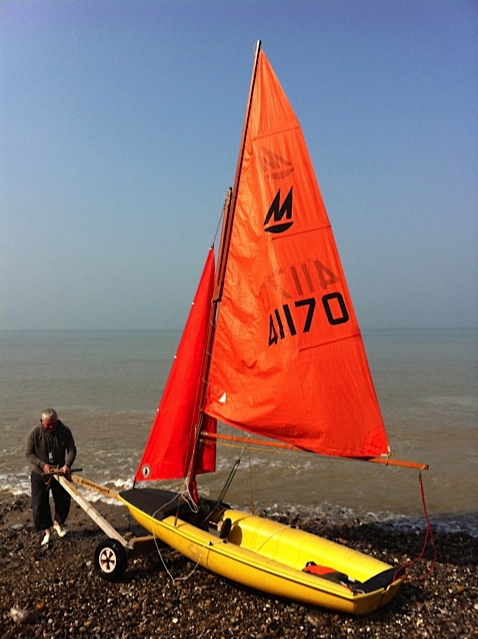
launching-boat2

I have written very little about sailing this season. I took the boat out for the sixth time this year last Friday, and I hope to have a nice little outing tomorrow in spite of being promised 100 % cloud cover. The late spring has made for quite bitter conditions and care taken not to capsize or stay out for too long. I was frustrated to see the winter conditions persevering as they were until mid-April.

Up in the north of England, just before I went to the ACC Synod in London and my reception in Canterbury, I found the grass was still straw coloured from the relentless north-east wind that had been blowing since mid-March and the time when we were getting blizzards of snow. It was probably whilst walking up the Helm (one of my favourite childhood walks) with my brother that I badly bruised my left foot.

My foot is still aching a little bit now and then, but it survived hauling the boat up the pebbled beach just below the slipway! I’m an impatient so-and-so, and my father always used to say I liked “sailing close to the wind“. Now, the metaphor has become literal! I still limp a bit when going downstairs, but it’s getting better. No sense in feeling sorry for oneself!

The last couple of times sailing on the English Channel off the French coast, the breeze was quite fresh at some 12 to 15 knots and the sea was lively. Dinghy sailing teaches you to cope with waves and take them on a little off the wave direction. Too far off and the wave will roll you over, too little and the wave can lift your bow so far up that the boat falls astern and broaches. Both accidents can cause a broken mast and injury – so we have to be careful. As I would face a wave, my whole face would be splashed with bitterly cold water. It calls for the British stiff upper lip and our courage as navigators!

On my first time out this year, during the last Conclave in Rome, I took the boat to the port of Saint Valéry en Caux, as I described in Towards the Unknown. The port is too narrow, and if you are facing the wind and have no engine, you’re stumped unless a man in a boat has the kindness of heart to give a tow. Launching from a beach and landing on a beach are more easily controlled, but you have to watch it when surfing in on a wave – keep your weight well astern and make sure the centreboard and rudder are up. If you dig your bow in, the boat will broach and you can end up with a roll-over and broken mast. It also helps not to beach at high tide unless the waves are not too big!

Spring has finally arrived, and after a cold but sunny weekend, we are going to get some warmer days as we approach May. A “shortie” is much more comfortable than a full wetsuit, and I love sailing with bare feet (which has been impossible until now) – just as I play the organ barefooted rather than wear shoes. There’s a certain sense of freedom that goes with sailing entirely on the wind and sea.

Since last season, I bought a new mainsail, which can be reefed and made the necessary modifications to the rig (notably to keep the gaff close to the mast to enable the sail to set properly). I bought new stainless steel standing rigging, and the mast is much more rigid when I close-haul to the wind. I am much less likely to de-mast at sea. My gaff is joined down the middle with glue, and this came undone last Friday as I beached the boat. I took the gaff home and re-glued it, adding stainless steel screws – so that is again as good as new.

I have also attached a piece of elastic from one side to the other of the stern, allowing me to lash the helm when I heave-to. This enables the sailor to have two hands free for reefing and setting the sails and for bailing out the gallons of water that get into the boat. I really ought to buy self bailers! Another goal this year is a portable waterproof VHF, essential for safety for which a cell phone is no reliable substitute. Another is to get some fishing tackle so that I can catch a few mackerel this summer.

So it gets better every year.

Posted in Uncategorized | Tagged , | Leave a comment

The Nightmare of a Post-Human World

Dr William Tighe sent out an e-mail with the text of Leon Kass: The Meaning of the Gosnell Trial. Gosnell, according to the evidence given by the media, is a quack specialised in abortions “on the cheap”. The story is grisly, and had this man been charged and convicted of such crimes in England just a few years ago, he would have surely been sentenced to hang! The story is indeed revolting to any of us, whether we are fully committed to the Pro-Life movement or are simply human beings.

Abortion is not the only evil in our society, by which humanity sloughs off the Christian Gospel to slide into barbarianism. There is an entire culture of death that pervades our society as Pope John Paul II warned us so long ago. I have been operated on by a surgeon who showed absolutely no concern for my well-being. I was just a subject of research, or perhaps just a “job”! When we are faced with evil, we can only be filled with horror – or die spiritually. This is undoubtedly how it was when the Allied discovered the Nazi concentration camps in 1944 and saw the extent of the horror and barbarity. As commentators of the Second World War have said, “This was a world that came close to dying”. Only heroism and self-sacrifice of the Allied forces, and of the various Resistance movements in occupied countries and in Germany itself, redeemed our world for the future in which we now live.

We are faced with ever greater evils against humanity in the form of “Frankenstein” science, every time man attempts to put himself in the place of God the Creator. We are faced with euthanasia and cloning too. Could euthanasia one day become compulsory for the elderly at a fixed age? Cloning has been found to be impractical and incredibly wasteful of life, but some are still bent on it.

The true dignity of humanity is our spiritual nature, what makes us independent from material wealth and the desire to live forever in our bodies. We are faced with systems promoting the destruction of innocent human life, and contradictorily, for the indefinite maintenance in life of those who can afford it. It is monstrous.

Just at the moment, perfect babies, ageless bodies and the stuff taken out of Huxley’s Brave New World are true threats to humanity. We also face the incorporation of mechanics and electronics into human bodies. It is difficult to see where the line is drawn between prosthetics like hip joints, prosthetic legs, false teeth and mesh devices for operating on hernias – on one part – and something like the bionic men of science fiction movies. Even conventional medicine has its limits.

The idea of the post-human man is chilling and a product of materialism. We have already seen the relegation of art to museums, the perversion of science and a society that has less and less compassion for the elderly, the poor and the sick.

It would be salutary for us all to read Aldous Huxley’s Brave New World and Orwell’s Nineteen Eighty-Four and take a critical look at what is happening now. Morality and spirituality do not always progress with science and technology, and this is where the danger is.

I am all for science and discovery, man trying to understand the natural world and the universe as best as possible. I am of a curious nature myself, and I like to learn and discover. But what I discover, I respect and refrain from manipulating or interfering with it. This I learned in childhood discovering little animals and insects. My father would tell me that they have as much right to live as we do, and that they should be observed without frightening them. The problem is not science and the use of man’s intellectual faculties in his discovery of our world, but “scientism” foisted on everyone as a kind of “religion”.

It is natural to fear death, but it is also natural to accept it to save someone else’s life or simply when our moment has come as God wills. Wisdom begins with the fear of God, as the Holy Scriptures teach us. There are certain branches of science that have gone way beyond morality, such as being able to tamper with genetics and human neurology. They fail to take man’s spiritual nature into account.

This reserve about science run amok has been with us since the days of Mary Shelley and the tale of Frankenstein. The idea of resurrecting a corpse (or bits of different corpses sewn together) by purely human means seems to be – and is – blasphemous. The idea, nearly two hundred years later, horrifies us. We know that such a deed is physically impossible, but many things these days are far from impossible!

Christians have a completely different attitude to suffering and illness and mortality. It all comes back to the same word, which is far stronger than compassion:

EMPATHY.

Posted in Uncategorized | Tagged , | 5 Comments

For a Continuing Anglican Ecumenical Movement

I jot down these few ideas in response to Ed Pacht who observed the remarks of Archbishop Haverland in regard to Archbishop Falk and the TAC, affirming that there is an ongoing debate. I can easily see that there are two sides to any difficulty, just as my father said to my sister and I when we had childhood disputes: Six of one and half a dozen of the other.

Since I joined the English Diocese of the ACC, I resolved to keep out of American Continuing Anglican politics and I believe I should continue to keep this resolution. At the same time, I am concerned that there should be peace and cooperation between the Continuing Anglican jurisdictions in America as in the other parts of the world. There have been meetings, notably at Brockton, considered as an important milestone in restoring peace and unity between jurisdictions that have until recently been in conflict. The ideas are out there, and the work is already begun.

All I can do here is offer a few reflections which may meet with “That is already on the agenda” or “That idea is totally inappropriate or impractical“. I am just taking pot shots in the spirit of positive “brain storming” for our own little blogosphere discussions.

It would strike me that many of the problems date from the 1980’s and 1990’s and concern many bishops who are now retired or deceased. Someone is going to have to write a good an unprejudiced history to improve on Douglas Bess and others who would trash the “Alphabet Soup” en bloc and encourage conversion to Roman Catholicism or Orthodoxy. Having myself lived though the Ordinariate events from the point of view of the TAC, I have seen how things can become so destructive, and so I resolved to do what I could to help and collaborate in the regrouping movement. Eventually, I found myself in a part of the world where the ACC was quite unharmed and the TAC may yet take many years to get anywhere beyond pious wishes (they are doing well in parts of the USA, but I’m not in the USA). I left the TAC with my prayers for their good, and sought to offer my priesthood to a Church with more youthful hope and life to do its work in my native land and this Continent of Europe.

There may be two possibilities: forget the conflicts of the past and wait for time itself to efface memories and bitterness, or engage dialogue to face causes and look for ways to remedy the difficulties. Since the 1990’s, I notice that in the ACC there is a much higher standard of theological education among the clergy, and this together with other factors has brought an atmosphere of seriousness and maturity that attracts trust and confidence. This spirit also seems to be getting into the other main American jurisdictions. In England, I find a different spirit from the parochialism and petty-mindedness of the 1990’s. The basis is there for something new and refreshing.

An obvious model for sorting out remaining problems would be the early ecumenical movement in Europe involving the Roman Catholic Church, Lutherans and Anglicans. With roots in the end of the nineteenth century, it was largely a reaction to the suffering and hopelessness caused by two world wars and man’s need for hope. Christianity would be that much more credible if the separated Churches and denominations were seen to be uniting in accordance with the mandate of Christ – ut omnes unum sint – that they all might be one.

Ontologically, the Church is already one through belief in the Gospel and the Sacrament of Baptism. Unity is found in degrees between this base and the fulness of sacramental life and Catholic faith found in all the episcopal and patriarchal Churches. However, there is the human dimension of the Church which is broken through sin. The Church, visible through its sacramental signs and humanity, needs to be a bringer of hope and peace in a world torn by warfare, greed and oppression.

There are different approaches to unity, some of which can be counter-productive without a spirit of wholeness and generosity. The Continuing Anglican world has fewer theological differences to resolve than, for example, the Swiss reformed churches and Rome. All ecumenical dialogue involves avoiding “getting stuck” and being prepared to discuss everything. The Orthodox and Rome are much more reticent about intercommunion, whilst the Continuing Anglican Churches, including the ACC, are prepared to give Communion to Christians of other Churches if they are baptised and believe in the Eucharist in the Catholic way. We are thus looser on questions of intercommunion and degrees of unity.

Between the Catholic (not only Roman but also Old and English) and Orthodox Churches, there are two approaches – a dialogue of love and a dialogue of truth. In our Continuing Anglican Churches, this can take the form of forgiving and forgetting the sins of the past, bishops and archbishops meeting together and visiting each others’ churches and congregations. Between high-church and Catholic jurisdictions, there should be no problem about dogmatic agreement based on a common commitment to the Affirmation of Saint Louis. The problem is to what extent we can dialogue with low-church Anglicans whose theology is heavily influenced by Calvinism.

I have already touched upon the square pegs and round holes of comprehensiveness and its limits. This would have to be the subject of dialogue, and is way beyond my “pay grade”!

There are things that can be done. There has already been the meeting at Brockton, just as long as it is followed up and maintained. There can surely be a sharing of resources like seminary faculties, libraries, internet resources, churches and schools and humanitarian efforts. We all need to be motivated by the prayer of Christ more than our grievances and gripes. We could do well to take inspiration from the Vatican II decree on ecumenism Unitatis Redintegratio, and Pope John Paul II’s encyclical Ut Unum Sint. I won’t quote them here, but the ideas are plain enough and inspiring.

The prerequisite for any dialogue is a change of heart and a disposition to forgiving and seeking forgiveness, self-denial and humility, gentleness and generosity. The collective memory and consciousness of humanity are extremely powerful, and we “remember” events of long before we were born. This anamnesis can be for good or for evil.

We have to overcome prejudice and misunderstandings through ignorance, indifference and complacency. Divine grace obtained through prayer, asceticism and the Sacraments will help us purify the bad memories of the past. When we have order in our own houses, we can set about going the way of dialogue and reassuring the other of our own integrity and trustworthiness.

When discussing issues of theology, there is a certain “hierarchy of truths” – but within limits. Not everything is negotiable, but discussion will enable us to deepen our own perception of truth and revealed dogma. We are not to ask each other to compromise or be unfaithful to our own convictions, because revealed truth is objectively true. But, it is not for us mortals to possess the truth. We are all learning it and approaching the Mystery with fear and trepidation.

Perhaps the goal should be more that of a common celebration of the Eucharist rather than institutional problems of abolishing differences between presently separated Churches. There needs to be a living consciousness that the Catholic Church subsists in all episcopal communities where the Sacraments are true, the Faith is taught and believed, and the Eucharist is celebrated. Christ is mutually recognised in the Breaking of Bread.

Just one final note: I have avoided discussing the “liberal” churches that have adopted sceptical systems of thought in their theology, have modernised their liturgies and follow modern feminist and homosexual agenda trends. This article has been about unity within Continuing Anglicanism. Relations between Continuing Anglicanism and Rome and Orthodoxy would have to be the subject of another article, which I may never feel inclined to write.

Whatever the obstacles, we must persevere.

Posted in Uncategorized | Tagged , , , | 5 Comments

Conciliarism

constance

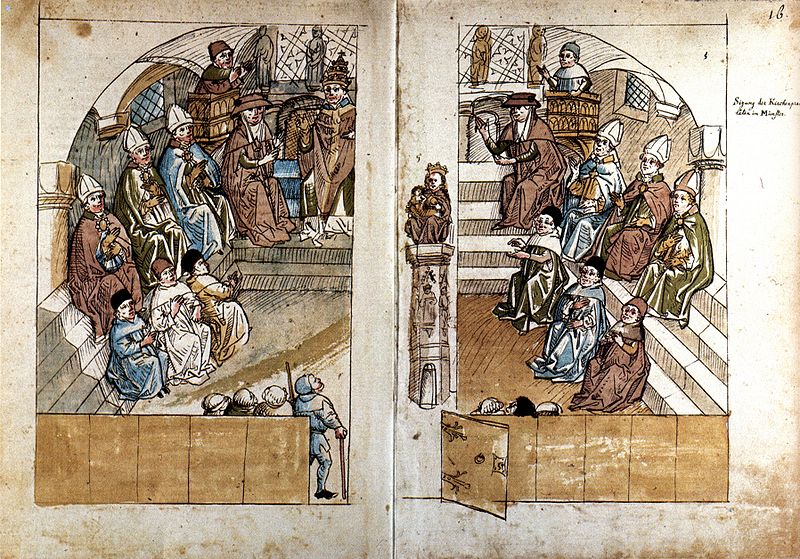
I have already brought up the subject of Conciliarism in Old Catholic Ecclesiology and Northern Catholicism. Conciliarism was a reforming movement in the European Church from about the fourteenth century. It promoted the view that the highest authority in the Church is the Ecumenical Council and not the Pope acting outside or above the communion of the Church. This movement was a reaction against the corrupt Papacy, the schism between Avignon and Rome in particular, which caused the convening of the Council of Pisa (1409), the Council of Constance (1414–1418) and the Council of Basel (1431–1449). Thus, Conciliarism prevailed and gave rise to a whole reforming movement in the Church, especially in the Northern countries. The Papacy got its own back through the Fifth Lateran Council (1512–1517), and Ultramontanism reached its paroxysm in 1870 with the definition of Papal infallibility.

Why an article on a subject that would seem to concern the Roman Catholic Church? The answer is simple: the Church of England at the time was still in communion with Rome as was the Church of France under Louis XIV. Anglicanism, like Gallicanism and Old Catholicism, finds its legitimacy by identifying with Conciliar ecclesiology.

The Papacy, as historians know, was extremely corrupt in the Middle Ages, and the great issue at the time was the constant dispute between the popes and the kings of Europe, especially Boniface VIII (1235-1303) and Philip the Fair of France. This dispute resulted in the bull  Unam Sanctam, which asserted papal power over both the spiritual and secular “swords” and that salvation was impossible outside the Roman Catholic Church and the authority of the Pope.

The history of the Avignon Papacy is complex, and can be studied in standard church history books or from web articles, so I won’t go into it here. Eventually, the only way to solve the conflict was to have an authority higher than the popes, so that a judgement would be possible to decide which pope should abdicate. This was Conciliarism, whose first Council (Pisa 1409) was a fiasco and only succeeded in adding a third pope! The Council of Constance (1414–1418) was more successful and brought an end to the Schism by deposing John XXIII and Benedict XIII. The third pretender to the papacy abdicated. Constance decreed that the Ecumenical Council should enjoy a higher authority to that of the Pope. As mentioned, the Papacy struck back and Conciliarism became marginalised.

Now, for the theory of Conciliarism. It comes largely from the ideas of William of Occam, and promotes a greater degree of democracy and consultation in the Church. Authority not only comes from God, but also from the people. The Church is the congregation of all the faithful, and this is the infallible Church, not the Pope, who is as fallible as anyone else. William was amazingly advanced, and advocated that Councils should include the participation of lay men and women! It was also a movement against the excesses of clericalism.

Naturally, the greatest opposition came from clericalists and the dreaded Inquisition representing the oppressive aspect of Papal power. The neo-scholastics like Thomas Cajetan worked for a reassertion of the supremacy of the Pope, whose authority as successor of St Peter came from God. The Pope received his authority from Christ, and delegated it to the bishops (power of order distinguished from the power of jurisdiction). This is the essence of Ultramontanist ecclesiology.

Despite the Counter Reformation and the Council of Trent, Conciliarism survived and formed the basis of Febronianism, Gallicanism and Josephinism. The schism of Henry VIII fell into the same pattern as the French Church in the seventeenth and eighteenth centuries, the only difference being that France did not break as totally as did England. France simply kept Rome at arm’s length, but the theory was the same: the King was the boss in his own country, and the Bishop in his diocese.

Some RC apologists affirm that Conciliarism is dead since the Ultramontanists got their own back and Old Catholics are too few to matter. It’s a point of view, but there were serious concilarist elements at Vatican II. Lumen Gentium removes emphasis from the Papacy to an extent in favour of the College of Bishops. The Eastern Orthodox are completely concilarist in their ecclesiology and attach much less importance to a “living magisterium” than to Tradition. However, they had no historical connection with the above-mentioned events of western church history. Conciliarism and anti-Ultramontanism are characteristic of Old Catholics and Anglicanism.

It is ironical that Roman Catholic traditionalists use the word “conciliar” in a derogatory way to judge Vatican II and its wake as opposed to Tradition. Anglican Catholics and Old Catholics share Conciliarism as an essential characteristic of our ecclesiology and fidelity to Catholic Tradition through the living communion of the Bishops and all the faithful, both clerical and lay. This vision of ecclesiology has all kinds of consequences, some of which have been happily adopted in the Roman Catholic Church since Vatican II, notably the participation of the laity in church governance and de-emphasis of clericalism.

The Anglican Catholic Church, as most other Churches of Anglican tradition, attach great importance to the Synod as the governing body of the Diocese and the Province. This Synod is made up of a house of bishops (at provincial level, or the Bishop at diocesan level), clergy and lay delegates elected by their parishes.

Over and above considerations of liturgies and cultural aspects, Conciliarism is the most distinctive part of our Anglican heritage and tradition.

Posted in Uncategorized | Tagged , , , , , , , | 17 Comments

Sarum Revival

sarum2002

It’s an incredible “sticky” subject, and it seems to be best to teach by example rather than arguing it out. Back in 2010 and earlier, I speculated about such an idea being possible, not as something to be universally imposed but available as an alternative. I am a priest in the Anglican Catholic Church, and my Bishop has no objection to my continuing to observe the Use of Sarum in my own chapel, but he is clear in that I should conform to the Anglican Missal elsewhere in our Diocese. That is fair enough, and a priest has the duty of obeying his Bishop. However, I am thankful for this indulgence, and for this reason, it would be improper of me to disparage the liturgical use of other parishes and missions in our Diocese.

Some years ago, I was quite prolific on the subject, and many of my earlier articles are found in Google with the words “sarum revival”. Some quite waspish articles were written about that time about my ideas, and that Sarum was truly dead. Others were sympathetic and reflected the same aspiration. Some Sarum liturgies have been celebrated in Canada and the United States in Anglican settings, both Canterbury Communion and Continuing.

There are many obsolete liturgies from the history of the Church, and most are no longer discussed, at least at anything like a “popular” level. Sarum continues to fascinate, and the work of Percy Dearmer, alongside the Arts & Crafts movement in general and men like Sir Ninian Comper, has had more influence in the furnishing of English churches than many would like to admit. However, Dearmer, as a parish incumbent in the Church of England, believed it to be his duty to use the authorised English Prayer Book.

Much as it is pointless to argue about rites or ecclesiastical “fashions” (since de gustibus non est disputandum), I would very much like to participate in work in Continuing Anglican circles to promote the “English” style as exemplified in the early twentieth century, regardless of which exact liturgical rite is used by episcopal authority in a given place.

Above all, I wrote this little posting to try to keep discussion alive.

Posted in Uncategorized | Tagged , , , | 3 Comments

Divided we Stand

I would like to draw your attention to the article Divided we Stand. Some of the comments to this blog post reflect some of the feelings I have had on reading this book by Douglas Bess, which I finished last night before dropping off to sleep.

The tendency is critical, something I can understand having known one or two of the episcopal players in the 1990’s. The agonising problem is situating the Anglican idea between comprehensiveness and a fairly “Tridentine” Catholic vision. I have joined the ACC in agreement with our Church’s adherence to the Affirmation of Saint Louis rather than to the Thirty-Nine Articles (though some of our clergy favour the latter). We in England have followed much of the English tradition of Anglo-Catholicism by using the English Missal and the Anglican Missal. In England, the ACC suffered in the late 1990’s from the somewhat excessive demands for liturgical uniformity by Bishop Leslie Hamlett.

Douglas Bess’ book goes into detail, and sometimes his use of terms like the Southern Phalanx, until you discover an appendix containing an explanation, is confusing. This term would denote the low-church tendency that objected to bishops and churches wanting to be exclusively Anglo-Catholic. The issue of comprehensiveness was a dividing issue in the 1990’s, because some bishops wanted more of it, others less. Eventually, men like Bishop Hamlett would leave the ACC because it was too “comprehensive” and inclusive of more Reformation ideas than he could tolerate. However, it wasn’t only a problem of theology and praxis, but also of small-minded and parochial men lusting after power and influence.

Nowadays, the Continuing Anglican Churches are finding their alliances and making their peace with each other, though dividing lines are fortunately not excessive. For example, the Church led by Archbishop Peter Robinson, of more central churchmanship, is in communion with the Anglican Catholic Church and the Anglican Province of Christ the King. Bonds of unity and friendship are strengthening between this alliance and Churches like the Anglican Church in America (TAC) and the Anglican Province in America (APA). The latter two are Catholic, but more comprehensive in their outlook.

Bess’ writing is subtle, and he made the effort to avoid dualistic or binary thinking. Many ACC and APCK parishes, like that of Fr Robert Hart in South Carolina, avoid the Missals and prefer the 1928 American Prayer Book and seek a distinctly “classical Anglican” expression. Continuing Anglican is thus not divided along a high-church and low-church line, since many of the “classical” Anglicans distinguish the notions of old high-church and Anglo-Catholic, identifying the latter with more Tridentine practices. It is a form of English Use, but without actually using the pre-Reformation rites such as Sarum.

The idea of actually reverting to the Use of Sarum as used prior to the first Prayer Book of 1549 has never really taken off. I find this unfortunate. There are published books containing the authentic Sarum texts published in the nineteenth century (Latin and English) and in 1911 (Canon Warren in English), and much of the ecclesiological movement in those days of early Ritualism restored the pre-Reformation English style of church furnishing. Percy Dearmer went as far as dressing up the Prayer Book Communion Service to look like a Sarum Mass, and the effort was most laudable at a time when priests could get into very serious trouble for taking liberties with the lawful rites of the Church of England. Developing this tendency would be a good subject of discussion in the light of the Roman Catholic Church allowing more diversity of western liturgical forms.

To what extent does difference justify schism and aloofness? This will always be a problem in Continuing Anglicanism without a secular authority imposing acts of conformity, comprehensiveness and tolerating diversity of emphasis, liturgical usage, theology and piety. The real rift has always between between Catholic only and comprehensive.

The writer of this article, himself in the more Prayer Book and Thirty-Nine Articles perspective, identifies Calvinism as the point of division. That is an interesting point, and perhaps that tendency is more widespread in American Continuing Anglicanism than in England. It would seem to be more wise to base comprehensiveness on different forms of Catholic expression but without the thorn in the side of Calvinism.

There is still a long way to go, perhaps along the lines of full communion between Catholic jurisdictions of different tendencies (old high-church and Tridentine) and an ongoing dialogue with the low-church (Calvinist) jurisdictions – a two-tiered approach to make progress possible. Doubtlessly, this has already been thought of and presently in progress.

The idea that there would be an irreducible number of two Continuing jurisdictions is cogent. There may be charitable and friendly relations between Catholics and Calvinists, but they are mutually exclusive if either tendency is true to itself. I myself would find it difficult to swear by the Thirty-Nine Articles – which we don’t in the ACC in England (we swear to uphold the Holy Scriptures and the Affirmation of Saint Louis – containing profession of the seven Ecumenical Councils).

The unity movements are happening right now, and progress is being made. It seems likely that however far we get, there would always be two Anglicanisms and two foundational visions – one of Calvinism and the other of reformed (in relation to the excesses of the medieval situation) Catholicism.

Interesting. Comments are welcome, but please be courteous and positive in discussing how we can move together and be true to what we believe in our hearts.

Posted in Uncategorized | Tagged , | 6 Comments

Continuing Anglican Ministry – Herding Cats

Oh yes, here’s how it’s done.

Posted in Uncategorized | Tagged , | Leave a comment