Pearls of Wisdom

Lest I should be seen to be the old square liturgy buff I am, I would like to share some quotes from Pope Francis in Few Surprises. Francis Is Just That Way.

I confess that in general, through the fault of my temperament, the first solution that comes to my mind is the wrong one. Because of this I have learned to distrust my first reaction. Once I am more tranquil, after I have passed through the crucible of solitude, I draw near to that which I must do. But no one can save me from the solitude of decisions. One can ask for advice but, in the end, one must decide alone.

This is a man who knows about the discernment of spirits in the Exercises. On the other hand, our decisions are entirely ours, and no spiritual director can be of any help in this – other than by proffering principles on which to base any sound decision. I don’t have Pope Francis’ responsibility, whether as Pope, Archbishop of Buenos Aires or Jesuit Provincial. But I have had to, and still have to, face decisions in utter solitude and no help from God is forthcoming. We must decide alone.

I am sincerely convinced that, at the present time, the fundamental choice that the Church must make is not that of diminishing or taking away precepts, of making this or that easier, but of going into the street in search of the people, of knowing persons by name. And not only because going to proclaim the Gospel is its mission, but because if it does not do so it harms itself. It is obvious that if one goes into the street it can also happen that one has an accident, but I prefer a thousand times over an accident-ridden Church to a sick Church.

This is the mind of a parish priest or perhaps even a provincial diocesan bishop of a hundred years ago. We have to expose ourselves, go and get our hands dirty on the job, be seen to be priests as we do something for the poor. This is what my old parish priests used to do in their battered and worn cassocks, just keeping people company without ramming the Faith down their throats. An accident-ridden Church to a sick Church? My old superior used to tell us about Cardinal Siri saying that he preferred to be considered as stupid twenty times than unjust one single time!

By all means, we can and must hold onto our liturgy and all that makes Christ incarnate. But we also have to be pastors and wise men, men with hearts, humanity and humility – the kind of humility that knows it sins by pride. And I believe that Pope Francis will teach us, Roman Catholics and men and women of other Catholic Churches, this way of wisdom and humanity, the way of the heart.

He has only one lung and cannot sing. He only speaks Italian and Spanish and a smattering of one or two other languages. But, I, with my little tenor voice and love of music, have only half (or much less of) the father’s heart he has. In this I am entirely with him!

Posted in Uncategorized | Tagged | 4 Comments

Holy Week Rites

Parisianrite1705

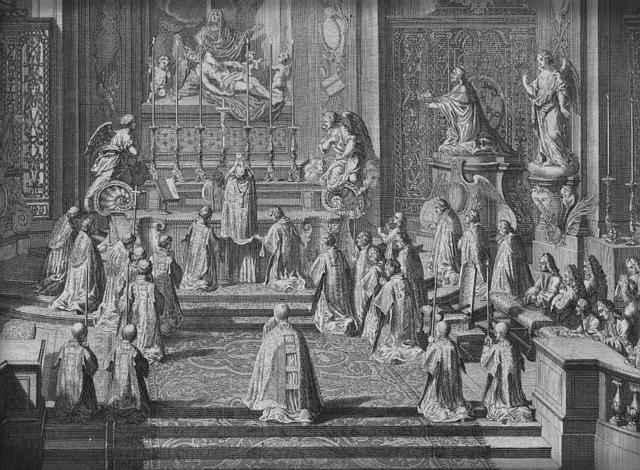
Pontifical Mass at Notre-Dame de Paris in 1705

Preference for the pre-1955 Holy Week rites in the Roman Catholic Church is still a relatively marginal question. I have two friends in England who are particularly interested in the question and who are regular readers of my blog. At least one of them, using the handle Rubricarius, has known John Tyson, a layman who devoted himself for many years to producing the famous Ordo in Latin according to customs of the middle of the last century before the unpleasant and unfortunate changes of the 1950’s and early 1960’s. This Ordo is now produced by Rubricarius, who runs The Saint Lawrence Blog.

I was also trained in the Roman Rite at seminary by a remarkable young priest by the name of Fr Frank Quoëx who was the MC and taught liturgy to the seminarians. He possessed the art of paying lip service to the 1962 liturgy and did as much as he dared of the pre-Pius XII rites during Holy Week, and also the use of folded chasubles in Lent.

Many have remarked that if the Pope should ever decide to do the ancient Papal Mass again, Fr. Quoëx would have been one of the few people who could have arranged it properly.

One piece of work he gave us to read was The “Restored” Holy Week by Msgr Léon Gromier, Papal Master of Ceremonies during the Pontificate of Pius XII – a conference given in 1960. I did this translation, though others may also have done translations (better than mine certainly) since I did this one around about the beginning of this century. I have already written on this subject in Monsignor Léon Gromier and Liturgical Reform.

Rorate Caeli has just published two parts of a FIUV Position Paper on the 1955 Reform of the Holy Week services. The texts are available through Rorate Caeli or in pdf format:

This author also recommends Philip Goddard’s Festa Paschalia. These papers are intended for non-specialist consumption.

I get a nagging feeling that questions of liturgy in the Church of Pope Francis are going to look like individual persons crossing the Atlantic in small boats or even swimming across! Also under Benedict XVI, there was no sign of anything substantial being done to the rites themselves, to either the “extraordinary” or “ordinary” forms of the Roman rite, using the terms used by the Pope emeritus in Summorum Pontificium. Perhaps such studies would give courage to individual priests and communities to take their own initiatives and break with the post-Tridentine instinct of not going to the toilet or sneezing without permission of the Congregation of Rites or the post-Vatican II equivalent.

In France, priests have taken initiatives for decades. One might exclaim – And look what a mess the liturgy in France is in! One might also notice a more liturgically-motivated reaction to the 1960’s reforms and the “heresy of formlessness“. There are two sides to priests taking liberties. Anglicans have always been masters at tweaking the liturgy to conform to rules and at the same time restore pre-Reformation norms as much as possible, stretching everything to the utmost limit. Percy Dearmer – and never mind about allegations of his favouring theological modernism!

But, indeed, there are no easy answers. Surprisingly enough, and I’m sure Patricius will pick me up – most Latin rite traditionalists seem to be satisfied with the 1950’s reforms of Monsignor Annabile Bugnini – because Pius XII was the Pope at the time! Was Bugnini a case of falsus in uno falsus in omnibus, or was it all part of a big plan as evidence suggests?

Comment as you will, but try to be positive and constructive. I use Sarum, not because I consider it a perfect rite, but because it has been undisturbed (because of its disuse) since 1549. Some things seem to be more “logical” because they haven’t been “disturbed” by the insertion of aspects of popular religion. That being said, that can be said for aspects of any rite. It is perhaps for the reason that liturgical rites are so imperfect, being the products of human minds and hands, that they should be left as undisturbed as possible – without “pruning them back” to “restore pristine simplicity” – – – or – – – introducing the parish’s favourite Blessed Sacrament and Rosary devotions to guild the lily!

The Eastern Orthodox seem to have kept liturgical stability and a liturgical sense. Why can’t we? Oh, please, Orthodox readers – be kind!

Posted in Uncategorized | Tagged | 41 Comments

April Fools Jokes

I haven’t told any and they don’t really correspond with my sense of fun. The April Fools Joke has to have some measure of credibility to it, to have people going for a while. Here in France, they call an April Fools joke a poisson d’avril, because a joke or hoax is called a fish. We say in English that someone is weaving a fishy yarn, it sounds fishy, meaning that is is to some extent false, either as a joke or with intent to deceive.

the-one-that-got-away

It without doubt comes from the tales of anglers and their stories about the one that got away, and the size indicated by the distance between their hands increases with every second!

I remember the English TV show Look North (it’s still going!) and our being shown a way to catch fish by running an electric cable alongside the fishing line and baiting the hook with a miniature watertight loudspeaker playing music! Other years, we had spaghetti trees and a transistor wireless set that ran on gas! They show all sorts of curiosities, educational items and local news. I watched it faithfully each day after the Six O’clock News on BBC1, and I loved it, even as a little boy.

I have read on some blogs about Society of St Pius X bishops concelebrating the Novus Ordo and similar stories. Frankly, they stretch my patience. So, this is why I am not cracking any on this blog.

Posted in Uncategorized | Tagged | 2 Comments

One is better off with who in charge?

Not that it matters to me personally, but I am observing comments of both traditionalists and progressives about the latest news from Rome. Surely many will shun off such concerns as those of mentally unstable people or at least having missed the point of Christianity in their attachment to externals like the Pharisees of Old Testament times. The point is something said not by Pope Francis himself but by Fr Raniero Cantalamessa for his Good Friday homily.

It seems to be a programme of renewed iconoclasm – text in an unofficial translation. When I was up at Fribourg, we studied Cantalamessa’s book on Easter in the early Church, a magnificent piece of work. He can say beautiful things like I used to hear from Metropolitan Anthony Bloom in London, but why this desire to reinvent the wheel? It looks like a programme that is very definitely a hermeneutic of rupture, very similar to that of the Lollards, the Protestants, the Jansenists and Archbishop Annabile Bugnini who was charged with compiling the new Roman Catholic rites in the 1950’s and 60’s. It is a theme with which we are familiar, one of bathwater and babies. It seems encouraging to want to be rid of “true church” ideologies, division between Christians, bureaucracy, legalism and so forth. But what does getting rid of the residue of past ceremonials mean? It seems dangerously to mean the liturgy itself and the entire notion of Tradition. Cantalamessa uses the analogy of old buildings ad their fittings, restoring primitive / pristine simplicity to use language that we read in the documents of Counter-Reformation and Vatican II popes, in the writings of the Reformers and the Jansenists. We have heard all this before – and within our lifetimes.

I have read observations saying that Fr Cantalamessa preached in quite a “traditional” way under Benedict XVI. Yes, I remember as a small boy learning the traditional English folk song – In good King Charles’ golden days, When loyalty no harm meant… I knew little about Christian doctrine, but I understood that the song described a man with no convictions, an opportunist. All the same, we still hear echoes of the guffaws of men like Kasper and Mahoney, perched atop the gallows like as many carrion crows!

Traditionalists who were considered as quite “mainstream” until two months ago are now crazy or fanatical in the minds of some, which probably doesn’t exclude the possibility of some being so in reality. A friend of mine in France says very sensibly (my translation):

I see no confusion but blinding clarity.

We we really again in a period of destruction. Active destruction.

I also think that auto-destruction, progressivism is going to shoot its last cartridges into its foot whilst it believes itself to be surviving.

What he [Pope Francis] says is not entirely wrong, but the patrimony that he will leave us , if he disowns us, will be heavy to cope with.

We weren’t at the bottom, we are going down yet further.

Benedict XVI was going very slowly, obviously having to get each jot and tittle past the heavy Vatican bureaucracy on pain of something extra being added to his soup, no doubt. It was easier to bring back items of dress than do anything more profound about a reform of the reform. I think that was the point about Benedict XVI. He went to war out-gunned and out-horse-powered.

It remains to be seen whether Pope Francis wishes to pursue a deep reform of the reform whilst making abstraction of the tat. The Benedictines in France don’t use lace and their vestments are rather more modern and sober – but their liturgy is beautiful and uplifting. I go more for simplicity myself. Pope Francis is a Jesuit, and very few Jesuits have ever been interested in the liturgy. We are until now led to believe that, as for Paul VI, the liturgy is some kind of optional accessory that can be discarded at will according to “missionary” imperatives. In this way of thinking, form has no importance, only the rationally apprehended “truth”. That’s what it seems to look like until now with Pope Francis. I know the discourse by heart – Fribourg University in the 1980’s made me immune!

As mentioned before, it would seem doubtful that Pope Francis would abolish the English so-called Agatha Christi indult of Paul VI, the 1984 indult and legislation of 1988 by John Paul II and finally Summorum Pontificium of Benedict XVI. The problem would be the possibility for priests and priestly institutes availing of these faculties to minister in an “ordinary” diocese. It is much easier to treat all that as Anglicanorum coetibus was dealt with, made dead letter except in a fairly skeletal form. This is a very cogent concern. Perhaps, under Benedict XVI, some bishops accorded permissions unwillingly but out of a feeling of obedience to the Pope. With that incentive gone – Chassez le naturel, il revient au galop. For those who don’t read French, we English say that The leopard cannot change its spots. Many traditionalists will return to the Society of St Pius X, which is now saying that they are relieved not to have accepted a deal with Benedict XVI! Right or wrong – posterity will judge.

As men like Dr Luc Perrin say, it is too early to judge with certitude. There are indications that seem to fit into a pattern, and those who go along with the reformer (as in Lollards, Protestants, Jansenists, etc.) mindsets like Kasper and Mahoney still seem to be delighted. Naturally, those who want abortion, gay marriage and women priests may be disappointed – but yet so might those wanting traditional liturgies.

I was a Roman Catholic for only a relatively short period of my life, but I still have my contacts and influences. I really do wonder whether we are better off under triumphalist conservatives who were at their most vocal during the Benedictine Pontificate, and who talk in whispers now – or under the way things were in the Paul VI era, when you had to be extremely conservative to react against the heresy of formlessness.

None of us has any reassurance of being in a Church or particular jurisdiction with a future, something to which we can leave our earthy goods and entrust our children and grandchildren. We Continuing Anglicans are fragile and are ourselves regaining stability brick by brick. Many Roman Catholics two months ago thought they could lord it over everyone else and boast their solidity – they are now walking on eggs as they wait for things to “pan out”.

I feel sad and worried about others who wait for Godet like many of us Anglicans did as we laboured with our illusions two to three years ago. I yet have confidence that Pope Francis’ pastoral sense would prevail as he considers the need for cultural diversity in the Church, between his own people and the Africans and Asians – and the Europeans of both post-modern and classical cultures. Perhaps this view might come across as a way to restoring the pre-Tridentine kaleidoscope of local rites and uses together with the customs of the historical religious orders. This would be my hope and my prayer for our Roman Catholic brothers and sisters.

Posted in Uncategorized | Tagged , , | 12 Comments

Resurrexi

Resurrexi, et adhuc tecum sum, alleluia :
posuisti super me manum tuam, alleluia :
mirabilis facta est scientia tua, alleluia, alleluia.

* * *

Happy Easter, everyone!

Posted in Uncategorized | Tagged | 3 Comments

Evangelical Catholicism Revisited

A few days ago, I had my rant (Evangelical Catholicism and New Evangelism) about the kind of Christian evangelism that resembles modern business and marketing methods. Everywhere we turn, we find advertising (Wikipedia article that equates advertising as a kind of psychological totalitarianism, to be resisted by political means or taxed out of existence). It invades our homes and privacy, and we find it in all public places. The prospective customer exists for business, for someone else’s money. We don’t need to buy, but they need to sell. This is the world some call The Pit! Not only we are told that the product exists and our lives would be better with it, we are “worked on” by means of psychological manipulation. Business is ruled by offer and demand, so the businessman has to increase the demand to suit his offer.

However, there is another angle, and I have appreciated Bishop Chandler Holder Jones’ article Authentic Anglicanism: Catholic and Evangelical. He puts this message over in ten points. I take them up and paraphrase them into my own words:

  • Is our faith a personal relationship with a living Christ or some kind of ideology? This is significant when the “Christian commitment” of some is really only a political ideology.
  • Is this relationship having any effect on our lives, bringing us to holiness? We all have efforts to make. Has this Lent made any difference?
  • Do we love the Bible and the written Word of God? Do we feed on our lectio divina as the source of our living faith and participation in the Church?

If we do not read, mark, learn and inwardly digest the Holy Scriptures with the most careful dedication, we shall never grow or mature in our faith, nor shall we become the Christians and Saints God wants us to be. The Bible, in its theological, spiritual and moral application, should serve as the unique, indispensable and inexhaustible resource for the faithful Anglican Catholic. Let’s go to Bible Study!

  • The Sacraments and our devotion to them, their role in our holiness.
  • Orthodox liturgical worship. The liturgy is vital, and we have to get beyond the externals – but without abolishing them. We should study liturgical theology in the works of authors like Dom Odo Casel and other lights of the twentieth-century liturgical movement. We need to learn about the traditional rites and learn to celebrate what corresponds with our own local and cultural traditions. The  ars celebrandi is vital, for it conveys the sense of wonder and mystery through which God’s presence is conveyed to the faithful. Indeed, the Mass does matter.
  • The liturgy has to be accompanied by good preaching and catechesis, and what St Cyril of Alexandria called the mystagogical catecheses. Such teaching enables the faithful to participate in the liturgy in the deepest meaning of participatio actuosa. Devotion to the Sacraments needs to transcend the mechanical and superstitious level and reach a spiritual level. This is not done by abolishing the Sacraments and liturgy, taking away the child’s sweets, but by education in the true meaning.
  • Objective standards of faith. Roman Catholicism has, especially since the Council of Trent, insisted on the Magisterium, the teaching coming from the Pope and Vatican dicasteries. These days, this notion is most defended by conservative zealots rather than the Roman authorities themselves. Outside of Roman Catholicism, not all is private judgement. For this, we need a profound understanding of Tradition and the loci theologici, for example the Bible and the liturgy, the Fathers of the Church and the seven truly Ecumenical Councils (Nicea to Nicea II). The Church in which we live is governed by bishops and the priests they delegate for the ministry, and this magisterium too is a part of Christian Tradition. We need to forsake the sola principle, that of affirming one good thing at the expense of another. We can have, and should have, both faith and good works – for example. We need to approach the Church with a spirit of humility and obedience rather than affirming our own opinions as absolutes.
  • We are disciples, called to deepening our relationship with our Master and being perfected by grace. We have to collaborate by being open and putting ourselves in a situation where this happens – in the communion of the Church.
  • We are called to evangelise, not selling vacuum cleaners and clockwork toys, but all participating in the mission of the Church – spreading the Gospel and baptising the newly-converted. There is the problem of clericalism and anti-clericalism. We need to deepen our understanding of the Catholic priesthood and the non-ordained priesthood of all the baptised, the people of God. A deeper understanding of this truth would help to balance the clergy and the laity into a single communion instead of two opposing forces. We need to make our churches welcoming places, not by invading people’s privacy with yet more ‘advertising’, but showing them genuine kindness and friendship.
  • Fidelity and commitment to our own tradition. There has always been a certain amount of diversity and flexibility in the Anglican tradition, and also a certain amount of hypocrisy. For example, Anglicans sometimes say that the Book of Common Prayer is the bedrock of their identity – but yet flinch from it when it is a question of using the rite of Holy Communion instead of a traditional Eucharistic rite for the Mass. It might be more accurate to say that the Prayer Book is a valued monument of our tradition since the Reformation, but has been added to and supplemented by traditional and pre-Reformation sources. We have a lot of work to do to define Anglican Patrimony and expand it beyond the parsimonious and “either / or” mentality that prevails in such quarters. There needs also to be a new path forward for understanding between those with “low church” sensitivities and those favouring the “high church” approach. Many of the dangers of “Anglo-Papalism” could be offset by a deeper knowledge of the pre-Reformation English Church and its traditions together with comparative local traditions elsewhere in France and northern Europe. Likewise, the Thirty-Nine Articles are a historical monument rather than a universal standard for all periods ever since the sixteenth century. For this reason, as in the liturgy, there is a need for further definition of Anglican Patrimony.

I don’t think I have “outdone” the good Bishop in these ten points, but we need to stretch the limits in order to escape the influence of late medieval Nominalism which would seem to be the greatest contributor to the “either / or” mentality instead of the universal and all-encompassing.

The “new evangelical” approach needs more clarity of thinking. The cores are there such as the authenticity of commitment rather than pretending to be Christian to avoid punishment or social shunning, and the primacy of lectio divina over traditional medieval and Counter-Reformation devotions. At the same time, there is room for both. It is the same in the liturgy – it is not iconoclasm and “taking the sweets away” that does the trick, but increasing understanding at a spiritual level beyond the intellect.

I suspect the good Bishop is still struggling with a kind of “Thirty-Nine Articles versus Affirmation of Saint Louis”, and this dogs the Continuing Anglican Churches. We all struggle to one extent or another. For me personally, my having been a traditionalist Roman Catholic for some fourteen years (swimming the Tiber there and back if you like the analogy) put things into perspective, as emphasis is then placed on being Catholic in a particular cultural context.

Before propagating something, we first have to identify and understand it. I hope my few thoughts on this Holy Saturday will be of help.

Posted in Uncategorized | Tagged , | Leave a comment

Sepulto Domino

sepulto-domino

The Easter Sepulcre

* * *

Estimatus sum  cum descendentibus in lacum. Factus sum sicut homo sine adjutorio, inter mortuos liber. ℣. Posuerunt me in lacu inferiori, in tenebrosis et in umbra mortis. ℟. Factus sum sicut homo sine adjutorio, inter mortuos liber.

Sepulto Domino signatum est monumentum, volventes lapidem ad ostium monumenti. Ponentes milites qui custodirent illud. ℣. Ne forte veniant discipuli ejus et furentur eum, et dicant plebi: Surrexit a mortuis. ℟. Ponentes milites qui custodirent illud.

℣. In pace in idipsum. ℟. Dormiam et requiescam.
℣. In pace factus est. ℟. Locus ejus, et in Syon habitatio ejus
℣. Caro mea. ℟. Requiescet in spe.

Posted in Uncategorized | Tagged , | Leave a comment

Maundy Thursday Mass

Secular life is often parsimonious with the liturgy during the week. Here in France, school holidays no longer correspond with Easter but fixed dates in the spring time according to the region. Necessity brought me to celebrate the Maundy Thursday Missa in Coena Domini in the morning rather than in the evening as Pius XII directed for the Roman rite.

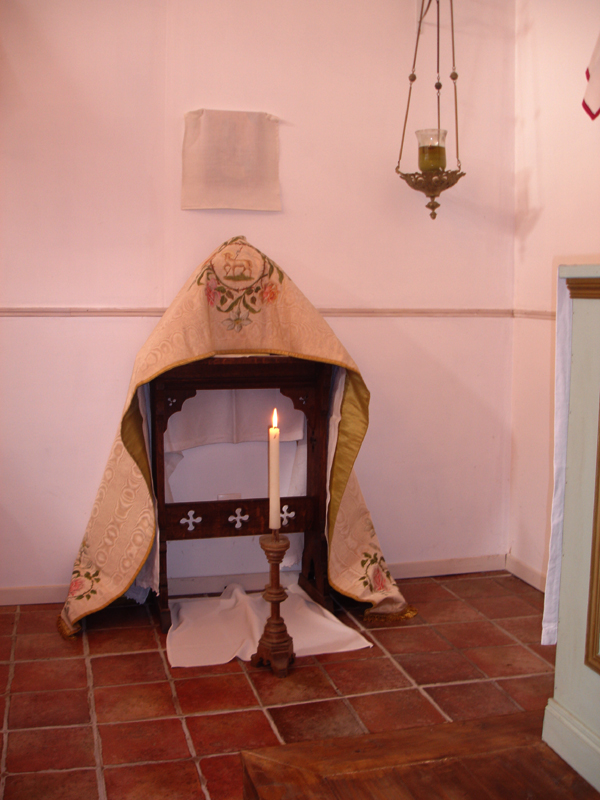
Maundy Thursday in the Use of Sarum is much more sober than in the Roman rite [I include within this category the English Missal and Anglican Missal, even though they contain elements from the Prayer Book and thus remnants of Sarum]. We don’t sing the Gloria, we don’t play around with bells, and we wear the dull red vestments of Passiontide. I compromised and wore festal red. I came to the conclusion, following the suggestions of Fathers Finegan and Keller, that it was fitting to put the second and third hosts in the hanging pyx immediately after Communion rather than a “simple Easter Sepulcre” with the influence of the Roman rite in mind. The symbolism isn’t the same. The Easter Sepulcre is for Good Friday until the early morning of Easter Sunday. The hosts are those consecrated on Maundy Thursday – so the liturgical symbolism of the Triduum remains intact.

We use one rite or the other. I use Sarum, though I allow certain liberties like using prefaces from the Rouen Missal. Rouen has a preface for Maundy Thursday. The liturgical family is the same.

We don’t have the Agnus Dei either, any more than the Kiss of Peace. The Agnus Dei is reserved to the Bishop when he celebrates the Chrismal Mass. This Mass keeps the character of Passiontide and Holy Week.

Nevertheless, in popular piety, Maundy Thursday has become a “feast of the priesthood”, and I greet all those who have sent me e-mails and messages on Facebook. It was during the Last Supper when Christ instituted both the Priesthood and the Eucharist. This is a part of our priestly spirituality and what keeps us going.

I also greet my lay readers on this day in the spirit in which a priest washes the feet of his faithful or the Bishop washes the feet of his priests, or the Pope of Rome renders the same homage to delinquent teenagers in Rome in prison, who doubtless will be touched by the grace of conversion and amendment of life.

We are called and ordained to serve and learn humility – real and profound humility, which is invisible to everyone else…

Posted in Uncategorized | Tagged , , | 4 Comments

Evangelical Catholicism and New Evangelism

salesmanI’m someone who likes to use words well, and being a translator, I have developed a sense for using language accurately and rationally. Words sometimes conventionally have emotional meanings that can seriously mislead – but are a part of our human condition.

One such word is the Anglicised version of the Greek word εὐαγγέλιον meaning good news as is news brought by a messenger ἄγγελος, an angel. The Greek word is rendered into St Jerome’s Latin as evangelium or bona annuntiatio. Old English gave us gōdspel and Middle English gave us gospel as we still use in our modern English. The good news of the mysteries of Jesus Christ were named gospels, but that word is only analogically applied to information of proven truth rather than simply good news. The word is already corrupted from meaning goodness to meaning absolute truth.

Evangelisation has come to signify the means of propagating the Gospel and the Christian religion among those who have no prior knowledge of it or who have become lapsed Christians or have for some other reason rejected their traditional faith. This is the mission of the Church, the great commission to announce the Gospel and administer the Sacrament of Baptism in the name of the Holy Trinity. We read a considerable amount about the importance of the mission in the Acts of the Apostles, the Gospels themselves and the writings of St Paul. Missiology is a discipline within the genus of theological studies. There is a theory of evangelisation as well as the actual “marketing” techniques used in the different eras of church history.

St Paul succeeded through his use of Hellenistic philosophy even though he hailed from the Jewish tradition. This combination was highly successful in the Mediterranean basin. This discipline therefore involves knowledge of cultures, anthropology, history and methods of communication. During other periods, men took the easy way – invading and colonising a country, giving a few notions of Christianity, baptising by force and persecuting relapsi as heretics! The latter method was favoured by those who lusted for political power, but it has nothing to do with the Gospel.

Nowadays, the primary requisite is to respect freedom, whilst offering a Gospel that is attractive and convincing by the merit of its intrinsic truth. To do this, like any marketing technique, the “market” has to be targeted and researched. It is the same in business – you either research a need for a product or service and you fill that need by being in the right time and place. The difference with Christian mission is you are not (or should not be) doing it for money, but altruistically for the good of those you are sent to evangelise.

Last week, I received at least three telephone calls from an insurance company peddling its wares. We get this all the time in France and doubtlessly in other countries too. I deeply object to marketing by telephone. They force a person to take notice of them by stopping us in our tracks and react favourably or unfavourably to their offer. The first time, I simply told them I was satisfied with my present insurance policies for my healthcare, home and car and that I was not interested in their offer. I thanked the person and then put the phone down. They called a second and third time. The second time, I suggested that the person could give me their personal phone number so that I could give it to the Jehovah’s Witnesses. The third time, I threatened (bluffed) doing a trace on their call and resorting to legal action (which would need more proof of harassing that I would be able to provide). With some telephone salesmen, I react like a bureaucracy and put them on hold, and play them nice music until they get bored and give up. Truly, telephone marketing is a dirty business. Now, if Christian evangelism is conducted in anything like this way, it is too horrible to contemplate.

I am opposed to aggressive marketing, just as with with the crude attempts of internet trolls. It is in its essence little different from the methods of the King or Queen of Spain in the fourteenth century and the dreaded Inquisition! It violates freedom and privacy, or even our own intimate relationship with God in all the ways He manifests his existence and love.

Evangelicalism is a “buzz” word with an emotional meaning, usually denoting the characteristic of Christian denominations competing for customers, and therefore bases of power and wealth – who puts the most cash into the collection plate! The word is often opposed to other characteristics such as contemplative or liturgical – dare I say it – Americanism on steroids! I get the impression the Roman Catholics in South America are aping the Protestants because they fear bankruptcy for not keeping pace with the market of people who like mass hysteria and “feel good” services.

I think the real point has been missed. Christianity is trying to appeal to the wrong cultural instincts rather than searching from aspirations to “spirituality” and the transcendent, through the sense of beauty and contemplation some people seek by climbing mountains or getting into a boat and going to sea. These aspects seem to be seriously neglected in the usual evangelical paradigm.

We need to understand our words accurately and rationally, and once and for all decide what Christianity is all about. What it is not about are politics and business!

Posted in Uncategorized | Tagged , , | 4 Comments

Sarum Triduum

I publish this old posting I put on The Anglo-Catholic three years ago, just in case anyone is doing Sarum this year and needs information.

* * *

missalesar 187x300 Sarum TriduumHere are some of Fr. Sean Finnegan’s posts from his blog, Valle Adurni, from last year [2009] on Holy Thursday, Good Friday and Holy Saturday in the Use of Salisbury, or Sarum.

These postings contain valuable ceremonial information. I have found them a great help.

* * *

Also see:

Posted in Uncategorized | Tagged , , | Leave a comment