
The question may seem to have lost its relevance and no one discusses it, but the people still exist. Division, multiplication and Alphabetti Spaghetti! by Deacon Jonathan Munn is well worth reading.
The question may seem to have lost its relevance and no one discusses it, but the people still exist. Division, multiplication and Alphabetti Spaghetti! by Deacon Jonathan Munn is well worth reading.
Naturally, click on the image to get full size. Have fun!
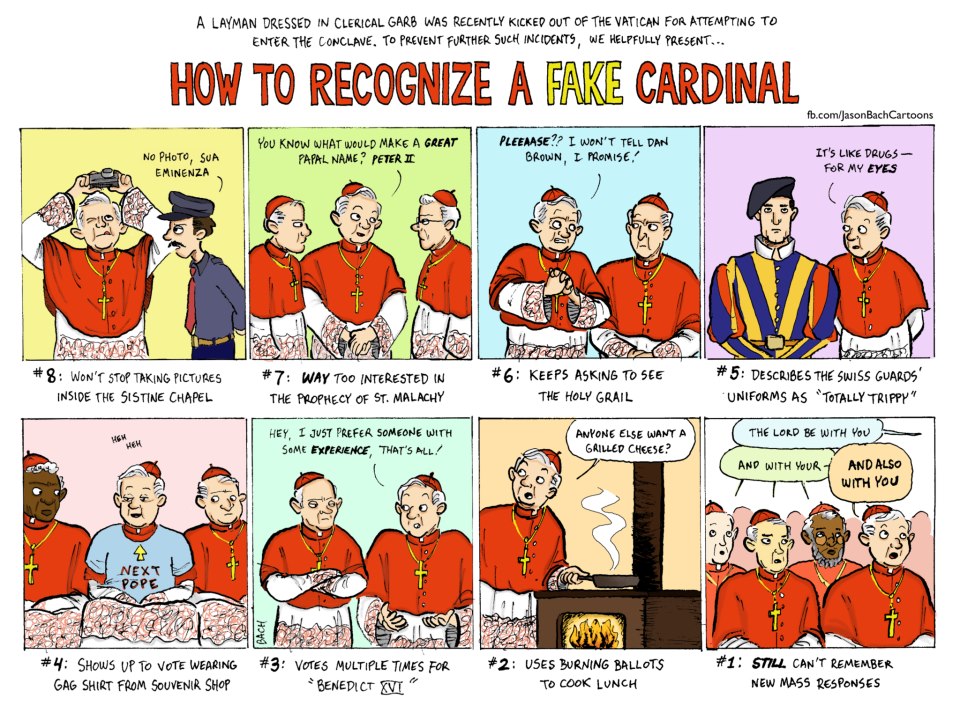
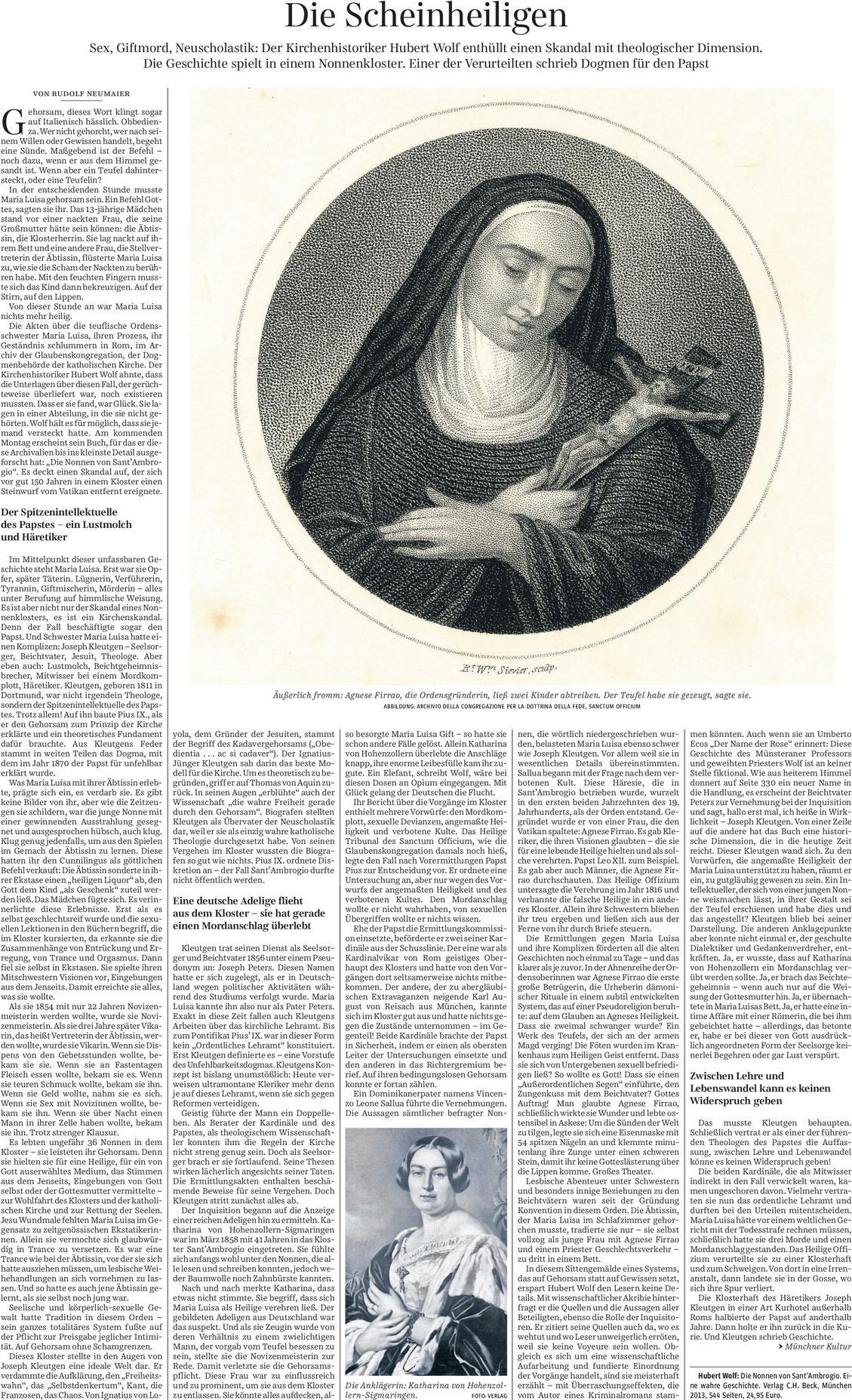
I have just been on the phone with someone who told me about Hubert Wolf’s Die Nonnen von Sant’Ambrogio: Eine wahre Geschichte. Apparently, this is about an extremely perverted Jesuit priest in nineteenth-century Rome who had the most influence on Pius IX for promoting the definition of papal infallibility. He would have been involved in sexual scandals with the nuns and the affair would have been known about and covered up by Pope Pius IX.
I have just been sent a German newspaper article – and Google translation does a very bad job on translating the text into English. I am told that German Catholics who know about this are absolutely scandalised, and it discredits Pius IX. Click on the image to get full size.
Süddeutsche Zeitung, Samstag, den 16. Februar 2013
How reliable is Hubert Wolf, a priest and professor at Münster? His specialising in Vatican scandals involving complicity with evil (including Nazism during World War II) seems to give us the impression of a man with an ideology. He needs to be carefully studied, preferably by one fluent in German, which I am not.
I quote from the Wikipedia article on Kleutgen:
Some years before the Vatican Council Kleutgen was confessor extraordinary to the Benedictine Convent of St. Ambrose in Rome. The nuns of this convent honoured as a saint one of their sisters who had died fifty years before. This was reported to the Holy Office and everyone concerned was severely punished; Kleutgen and the ordinary confessor (both men of exceptionally holy lives) were suspended, because of lack of prudence in directing the nuns, for awhile even from saying Mass.
Kleutgen consequently left Rome and went to the secluded shrine of Our Lady in Galoro, where he wrote the greater part of his Theologie der Vorzeit and Philosophie der Vorzeit. After the opening of the council, at the urgent request of several bishops, especially Archbishop Stein, Apostolic Vicar of Calcutta, his superior general recalled him to Rome to place his talents and learning at the disposal of the council, and Pope Pius IX removed all ecclesiastical censures as soon as he became acquainted with the work which Kleutgen had written. In 1879 some Old Catholics spread the report that Kleutgen had been condemned by the Roman Inquisition to an imprisonment of six years on account of complicity in the poisoning of a Princess von Hohenlohe; but, on 7 March, Juvenal Pelami, Notary of the Inquisition, testified that Kleutgen had never been summoned before the Inquisition upon such a charge, and consequently had not been punished by it.
I am not clear about Pius IX covering things up. Perhaps the problem was that Kleutgen would have been inconveniently guilty of the sordid happenings at Sant’ Ambrogio and too useful as an infallibilist theologian for the Pope’s agenda. Did the Pope cover up a heinous crime by a priest for the sake of his infallibility?
I am open to help in getting to the bottom of this question, which might turn out to have an amazing and shocking collusion with the present-day paedophile priest scandal and episcopal cover-ups.
If any of my readers is able to read German and has read Hubert Wolf’s Die Nonnen von Sant’Ambrogio: Eine wahre Geschichte, I would be very glad of a write-up and resume.
Papal contender: condom use a ‘duty’ in some circumstances – one would expect nothing less from The Tablet.
Two observations: Benedict XVI already broke the taboo by saying that condoms were justifiable to prevent the spread of AIDS. All moral acts are judged by the finis operis – the final intention and purpose. Of course, not all means are justified by a good end purpose.
It is something of a case of the stable door being closed after the horse has bolted.
I’m sure many French aristocrats went to the guillotine in the 1790’s without ever understanding what it was all about – if you get my meaning…
I found a search term – reefing mirror dinghy.
Shortening sail is the term for when there is too much wind. On a ship with many sails, this is done by reducing the number of sails offered to the wind. On a sloop or any small boat with only one or two sails (jib and main), the sails are reefed – only a part of their surface is offered to the wind, in order to de-power the boat and make handling easier.
There are two methods of reefing, roller and slab. The method described here is called slab reefing. The jib on a modern boat is furled around the forestay, and some boat designs allow the mainsail to be furled around a revolving boom.
Normally, it is not possible to reef a Mirror dinghy sail for two reasons. Most Mirror mainsails are not made for it and there is the problem of keeping the gaff close to the mast.
Here is a reminder of the Mirror rig:
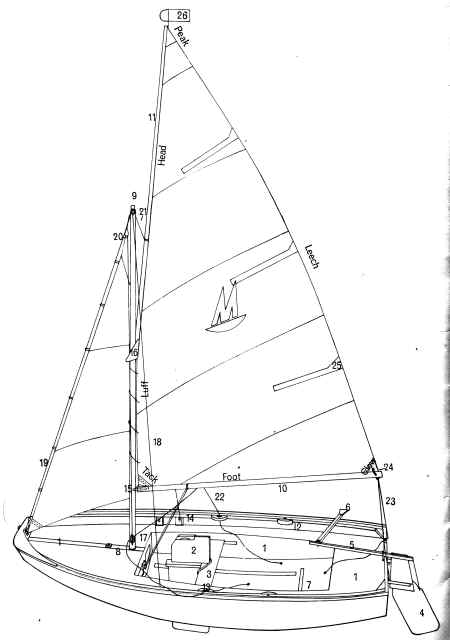 If the gaff pulls too far away from the mast, it leads to increasing difficulty in trimming the sail. The solution is some kind of lashing that is loose enough to allow the gaff to slide up and down as a sliding gunter.
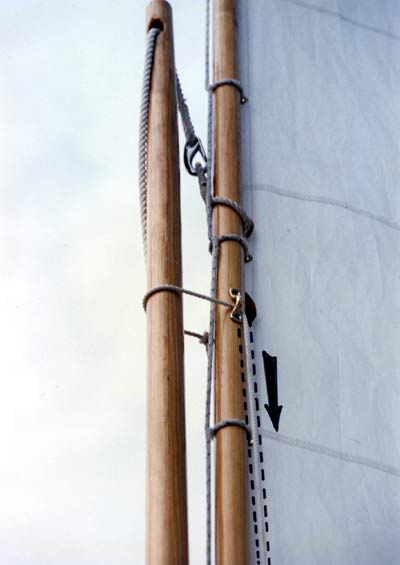
This is a nice design for the lashing as it can be controlled from lower down on the gaff and cleated. Once you have a reefable sail (they can be found, or a sailmaker can adapt your non-reefable sail), and the problem of the gaff is solved, then you can look into your method of reefing. The most convenient is single-line reefing. Here is a nice young Australian showing us how it is done, but it should be realised that our friend from down-under has a Bermuda rig with no gaff problem:
I have followed this method, and it seems to work well. Of course, to do this kind of manoeuvre at sea, you need to be able to lash the helm once you have hove-to – because you do need both hands to release the main halyard to the mark and then take in the reefing line. It’s delicate in a dinghy, but it can get you out of a tight spot when the wind gets up. It also gives the boat lee helm making it easier to tack without getting “clapped in irons” (facing the wind without steerage), even when you have to take the jib down.
Here’s another method making it possible to drop the mainsail at sea.
My wife just sent me this, asking me what I can do without infringing the Highway Code:
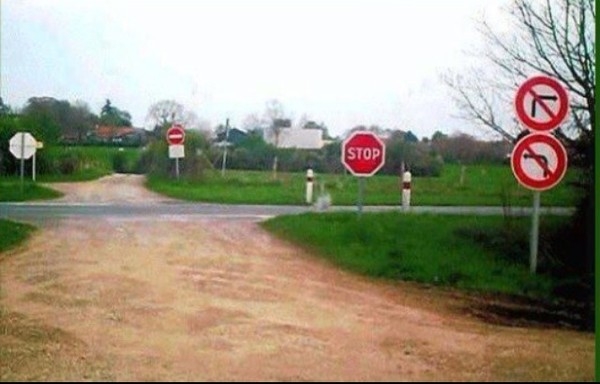 It almost seems to be an image of the Church these days!
Highway codes seem to be about the same in most countries. Perhaps you can turn round and go back the way by which you came, if that was not a one-way street. There seems to be one way out, but it looks like a country lane and perhaps not suitable for motor vehicles, and perhaps only goes to a farm.
I have another idea of a solution (legal), but I’ll wait for some of you to comment.
Ideas, anyone?
Much has been made of sayings and writings by Benedict XVI and men like Cardinal Christoph von Schönborn, Archbishop of Vienna in Austria. I had the latter as one of my professors at Fribourg. He normally taught dogmatic theology in German but gave a few special courses in French which I attended. He struck me as someone who was intensely interested in the dialogue with Orthodoxy rather than a purveyor of clown masses.
I approach this subject as a continuing Anglican, from the perspective of the “underground church” or the “micro-church”, call it what you will. It is another perspective from which to view the changes in the big mainstream Churches, especially the Roman Catholic Church.
Something I have already seen in France is that parish life is becoming decreasingly available to people who live outside the big cities. Parishes are closed down or merged, and people have to travel to services taken increasingly by lay people in the absence of ordained priests. The reality of the future is closed churches and the extinction of popular religion. If the institutional Church wants to hold onto something, the only tangible reality is elitist religion based on intellectual ability or simply money. That is what they are pointing at. Reality dictates that the rest of us are jettisoned with the abandoned and rotting church buildings.
Schönborn observes a simple statement of fact: Vatican II was intended to be the basis on which the Church would be inserted into a free society. There are no more kings or dictators to force people to go to church and pay their dues to the Church. Freedom is to be embraced joyfully. There, the Cardinal thinks like an Orthodox philosopher, not as a progressive. The Church will have to compete against other Christian communities, other religions and secularism.
“Parishes will be larger and “slimmer” in structure“. That has been a reality in France over the past forty years or so, and some priests in some dioceses have more than thirty or forty former parishes to look after.
The demise of popular Catholicism is due to a number of problems. I would name them as the credibility of the Church under the onslaught of the media, the idea of everything being optional and therefore there being no need to bother going to church, and even for those who want to go to church, the unavailability of priests and banality of services. There are other and more complex issues too.
Fr Joseph Ratzinger wrote his ideas of a smaller and “slimmer” Church in 1970 in his book Glaube und Zukunft, which I quoted in another article.
Fragmentation can have its positive aspects, especially the possibility of one community to survive even when the next goes down under the weight of a scandal or the lack of a priest. Independent sacramental communities of all kinds have very few faithful, but the faithful they have are motivated and informed about the issues. Perhaps that makes a popular Church into an elitist Church. The popular Church asked very little as a minimum and considered holiness as a lifetime process. Now everything is a prerequisite. That’s quite frightening!
I don’t think we will ever have a popular Church like in the nineteenth century or the 1930’s. I see the need for subsidiarity and distribution of authority, a way for a diocese or a parish to survive even when its neighbour loses credibility. That means decentralisation. Religion needs to be based on sincere belief and love, not on constraint and legalism. The unavailability of priests needs to be resolved by something like in Greek Orthodoxy, and there needs to be freedom to rediscover traditional liturgies.
I think this is what Pope Emeritus Benedict XVI and Cardinal Schönborn are really saying, even if the latter has to play balancing tricks with the iconoclasts in his backyard!
* * *
Please see More on the future of the Church by Fr Michael Gollop, a very good and insightful article commenting on this one. A little comment at the end of his article: It would seem, then, a strange time for the Latin Church to be encouraged by so many to jettison its rule of celibacy; perhaps the rest of us should consider embracing it. It is true that many who criticise the RC Church and offer it their “advice” would not shed a tear on seeing it disappear!
I can see things go the way of reinforced conservatism or liberalism with a vengeance. I’m not sure I like either to put it mildly. There have been times in the Church’s history where clergy became Goliards in one form or another, living out their days banished from the normal life of the Church and living their faith as best they could. So be it…
* * *
Please also see The only constant…
Naturally, local conditions differ, but Catholic parish life is concentrating into the areas and groups of people who tend to form elites through social standing, wealth or intellectual capacity. Naturally, such communities should be encouraged, but the Church also has a mission to weaker, the poorer and less well-educated.
Theology also takes place here on the Internet, but it is limited and still exclusive. I can go weeks without meeting a single person interested in discussing matters of faith or who goes anywhere near a church.
I don’t know which way things can go. I don’t have the ideas and intuitions I had in April 2005, even though I doubted Ratzinger would be elected. We seem to have the Italian “old guard”, the Americans and the Brazilians at their strategy tables – and Kasper flapping his arms around like a chicken with its head chopped off! Perhaps he is going to be running after trains leaving the station – poetic justice indeed! Perhaps they should all be locked in the Sistine Chapel right now on bread and water and told to get on their knees and pray, and only begin voting after Easter!
There needs to be a lot of rethinking. The Orthodox model of autocephalous local churches seems to be right, if we attach more importance to the quality of local religious life and we are less concerned for pan-Catholic uniformity. I don’t think the present Eastern Churches have the far-sightedness, other than individual metropolitans and philosophers, to bring influence to bear on western Christianity. Perhaps that might change, but liberalism is a real threat to the Orthodox Churches, and they do well to keep their “innocence”.
We definitely need to get beyond the Reformation and Counter-Reformation, and into the wealth of what I would call true Western Orthodoxy, not a pastoral concession attached to an Eastern Church, but the Western Church having recovered the old ecclesiology and the place of the Pope as understood in the first millennium. I distantly recall from my dogmatic theology classes the Tome to Flavian sent to the Council of Chalcedon, and the Chalcedon Fathers confessing “This is the faith of the fathers … Peter has spoken thus through Leo …” – the Pope did have authority and importance in 451, but not like in 1870!!! Eastern Orthodox western-rite vicariates are just as marginal and without hope of being real influences as the Continuing Anglicans and the RC Ordinariates that have taken the form they have taken – even more so in Europe than in the USA.The Orthodox idea is right, but everything is in the way it is extended to culturally western Christians.
The biggest problem is the destruction of Christian culture and its replacement by hard-line secularism and atheism. The leprechaun cannot be pushed back into the bottle!
In the absolute, the solution is a Church that can exist outside culture and against culture, like in the underground Churches that were persecuted by Soviet Communism or the ancient Roman Empire. The spirituality that arose from the underground Church formed the basis for monastic spirituality in the desert. We should look towards Russia and try to find out how the Orthodox Church has brought people back to God, whereas the Roman Catholic Church in countries like Czechoslovakia and Hungary has not succeeded.
There will be many ideas the Cardinals could discuss once they have turned away from the media’s cameras and microphones, and from the noise of the world. Knowledge of theology and history are essential, but the real secret will be their return to God and eschewing of worldly power and honours. That is why conclaves are secret – most wise.
Much food for thought…
Not being a Vatican watcher, I was more attentive to the first signs of spring here in France and took the boat out to sea for the first time this year. It was uneventful. As always at the beginning of a season, I wondered whether I had forgotten how to sail, but the reflexes kicked in like riding a bicycle.
I sailed out of the port of Saint Valéry en Caux, which has a very narrow harbour entrance. There was an east wind, so I had to use my paddle to get out of the port, and then my sails filled as I reached the sea. It was a different matter coming back in, because the wind had veered to the south-east and was blowing directly out of the port. I tried a number of solutions, but each cancelled each other out. I approached the port wall on a reach and hoped I would get past the pillar with a bit of paddling and then tack inside the harbour. Too narrow. I was facing the wind and I got nowhere paddling. As luck would have it, a man came along in a small motor boat setting out for a quiet afternoon’s fishing. He kindly towed me into the port, and then I was able to paddle the last few feet to the slipway I used to launch the boat. Lesson from experience: don’t use Saint Valéry en Caux with a south-east or north-west wind without an engine. Le Havre is a lot easier, as it is wider and tacking is possible to cross the port entrance at an angle – if there are no ships… I generally use a beach for launching and landing, but you have to watch the waves.
That’s for the sailing. I ignore the Roman horse fair going on at the moment, the latest scandals involving a Scottish cardinal (the problem being hypocrisy rather than homosexuality in itself) – see Who Knew? – and the media calling for gay marriage, women priests and more of the same. Sometimes you get a more or less intelligent but of analysis, and that I will discuss – because the fortunes of the Roman Catholic Church will effect the rest of us in terms of the credibility of Christianity. Human nature is wont to throw babies out with bathwater!
The progressive anti-conservatives tend to be quite reactive in digging out information and analysis. I point out the Catholica Forum as an example, but of course do not endorse the position of those people in their anti-intégrisme – Tweedledum and Tweedledee, Scylla and Charybdis, call it what you will. But, they are finding the articles:
The John Cornwell who called Pius XII Hitler’s Pope has written this piece of fishwrap. There is probably no smoke without fire, so exercise your critical faculties. The conservative Cardinal Pell hopes for a Pope who can govern. “I think we need somebody who is a strategist, a decision-maker, a planner, somebody who has got strong pastoral capacities already demonstrated so that he can take a grip of the situation and take the Church forward“. I don’t know. Why should new Pope modernise Church just to placate liberals? It’s not a bad article, but it centres more on the pro-life and abortion question rather than the moral condition of the clergy. There will be a lot of pressure from the media to make the RC Church go the way of the Anglican Communion into a new form of Erastianism (the Church as the “spiritual arm” of the secular state).
A badly disguised false bishop tried to get into the general congregation of Cardinals. This story is strange, since the man was not disguised as a cardinal but as a bishop. I have the impression that the intention was not to have the Cardinals believe he was a bishop, but to deliver a protest message. If you really want to masquerade as a cardinal, you need to spend a lot of money at Gammarelli’s and look the part! There are giveaways for any of us who have been to seminary. You don’t wear the fascia like a belt around the waist but much higher up. My old seminary rector, ordained for Cardinal Siri’s archdiocese, reckoned on the fourth button from the top – at least between the chest and the tummy. The rest of this Daily Mail article is entertaining, but I have better things to do.
With Benedict XVI having abdicated, a new Pope would be asked to stay on until he dies. Old news, really and nothing new. Was the Pope right to abdicate or not? We might know after the election of the new Pope (depending on who he will be) or in a few years time in retrospect. One will find in Catholica a lot of ideas of improving the management and organisation of the Vatican – make the buggers work. Yes, that depends on who you have got to run the bureaucracy. The Catholica progressives tend to be pessimistic about whether there ever could be a reform. And then, what kind of reform?
The French traditionalist Forum Catholique often has threads that quickly become tedious through “troll syndrome” which tends to be corrected in short order by XA, the forum moderator. On Rorate Caeli, there is an exhortation – A message to the Conclave by Pope Benedict XVI: Do not let yourselves be pushed around by the media – from the Pope Emeritus from when he was still Pope, asking the Cardinals not to give in to media pressure. Fr Zuhlsdorf is keeping a close eye on Rome. Any Cardinal with a cloud over him in relation to covering up child sex abusing priests who gets elected Pope would be blighted from the outset. The media is incredibly powerful, and modern secular states have no problem with that. www.chiesa (Sandro Magister) is a serious source of information and analysis. Whispers in the Loggia is another Vatican-watcher to keep an eye on. Damian Thompson really has it in for the British Magic Circle hierarchy. Who can blame him?
Benedict XVI is already being challenged for wanting to keep the Vatileaks report secret and only for the eyes of the next Pope – Brazilian Cardinals demand access to the Vatileaks dossier before the Conclave begins. I suppose they could get someone to blow the safe – and then it would not be the Italian Job but the Vatican Job!
The sedevacantist fringe tends to have little more than opinion. One of the more well-known sites in this category is a real dustbin (trash can for the Americans), showing, among other things, a photo (doctored I suspect) of Benedict XVI making him look like a vampire from a Hammer horror film! Novus Ordo Watch is no better, but it does contain links to media articles beyond the limitations of their own opinions.
Prognostics are impossible. Why should everything not simply continue as it is? It is human nature to seek a break and a change. Some people relish the idea of a civil or world war – just as long as they don’t get killed in it! Why should I care, as one of my critics challenged me? After all, I am one of the 1980’s “lost generation” of seminarians who “blew our chances”. Most had the wisdom to move on and have nothing more to do with the Church. On the other hand, if it is to be business as usual, how long can it continue against the onslaught of the media and secular political correctness, not to mention the power of blogs and forums which makes bureaucratic obfuscation that much more difficult?
The only possible answer is that we’ll see. In the meantime, we can only get on with our lives. Has anyone noticed the drop in the numbers of blog posts everywhere, the paucity of comments and the general atmosphere of uncertainty and expectation?
It is also Lent, and some are making efforts…
Another sailing search term came in – mirror dinghy boom vang options
I usually term the boom vang as the downhaul as opposed to the two other devices for trimming the shape of the mainsail, the outhaul and the cunningham. The outhaul pulls out on the clew towards the free end of the boom and flattens the foot of the sail to reduce power as the wind gets up. The cunningham tightens the luff for a fresh breeze, and it is loosened in very low winds. The important thing is to get the mainsail into a smooth and even shape with no folds.
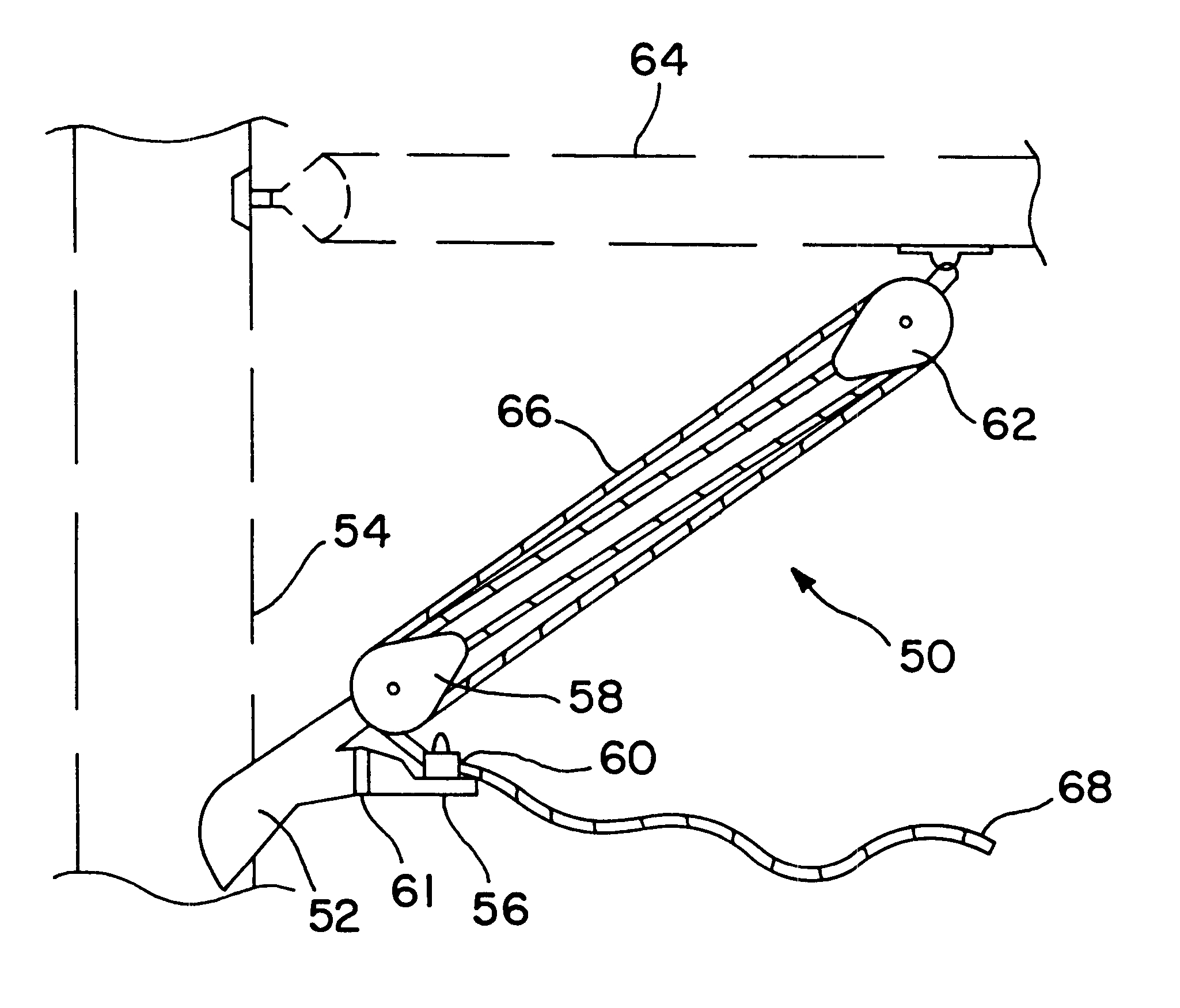
64 – boom, 58 and 62 – pulleys, 66 – rope, 54 – mast, 50 – air (!), 52 – rigid tang, 61 – hinge, 56 – cleat mounting, 60 – cleat, 68 – end of rope.
According to United States Patent 6520103,
A boom vang system for sailboats has a rear facing pivotal cam cleat arm hingedly connected to a rigid tang on the sailboat mast. When the boom vang rotates off the centerline of the boat, as for instance will occur when the boat is sailing downwind and the boom and sail are blow off the centerline of the boat, the pivotal connection of the cam cleat arm, to the tang allows for the cam cleat to be urged into alignment with the sailor regardless of his position on the boat. The cam cleat arm may rotate along an arc lying in a plane substantially parallel to the boat deck. Sheeves and pulleys may be rigidly connected to the rigid tang to prevent tangling of lines.
It’s quite long-winded, but the idea is to prevent the boom being pulled upwards as the mainsail fills with wind when the boat is running with the wind. It is drawn tight for close-hauling and let out a little for reaching and running. Experience gives the sailor the best trim for each point of sail in all weather conditions.
The Mirror downhaul is fixed to a shackle at a point near the boat’s keel in a line more or less downwards from the axis of the mast. This point is standard on all Mirror dinghies. The point on the boom is marked by a wedge-shaped wooden block on the topside, and the downhaul has a loop which engages on this wooden block and exerts force downwards and towards the mast.
The more vertical the force, the less there needs to be a complex pulley system. The Mirror downhaul is more vertical than the 45° on most boats. The angle can be shallower if the downhaul is attached to the mast above the boat’s deck, but a higher pulley tackle ratio will be needed (4 to 6 times). For example on a Laser set up for serious racing (we see the complex outhaul and cunningham systems included in the schema):
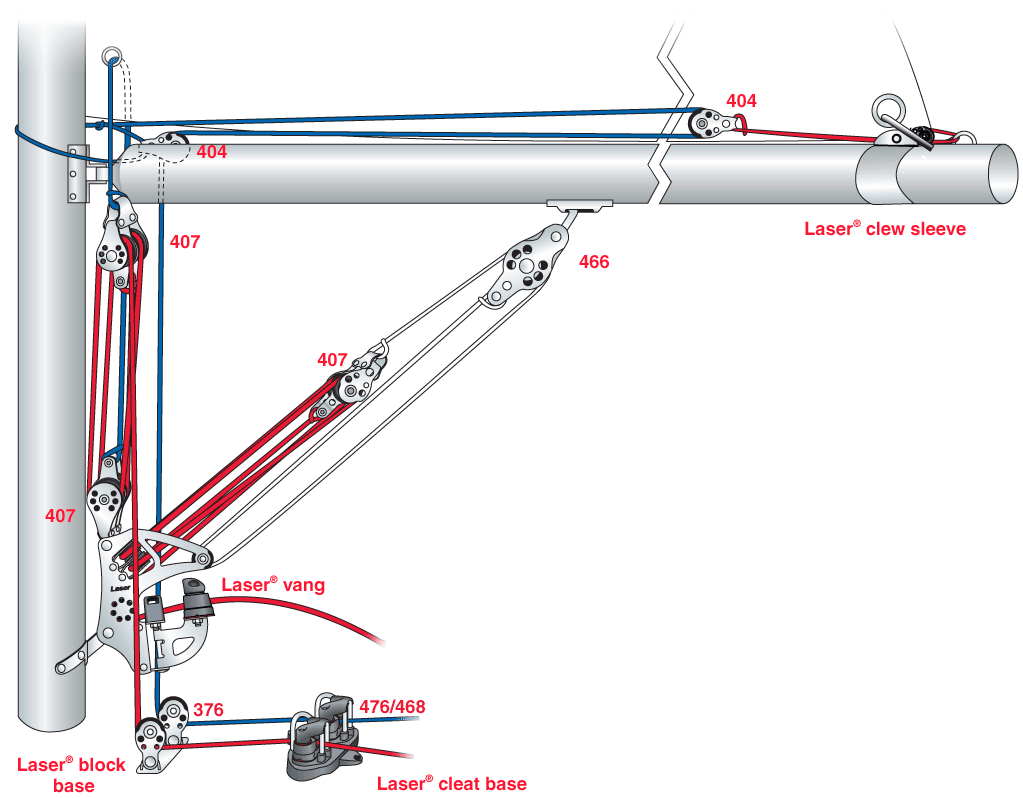
I see little need to talk of options as the two points of force are standard on the Mirror dinghy, and any convenient pulley and cleating system can be used.
I’m beginning to like this new blog I have discovered, at least for the time being and without having corresponded with this fellow. He wrote About that deadline… yesterday.
Having known the Society of St Pius X in France and elsewhere (in the early 1980’s), I can hardly imagine the future direction of the Roman Catholic Church being for anathematising Vatican II, electing Bishop Fellay to become Pope Pius XIII and getting the European Union to establish Catholicism as the official religion with a Gestapo-style secret police to ensure compliance.
African and other non-European candidates for the Papacy will certainly be touted over the next few weeks as the conclave progresses. I have no desire to speculate and I don’t want to know about the contending candidates or what the secular journalists think about them. It’s all so unhealthy!
But I can give credence to the idea that one way out of the conservative / progressive dialectics would be to re-centre the Church outside Europe. It’s no use speculating on the effect of that, except that such a direction of the Church would involve very strict morals and complete insensitivity to European culture and art. African liturgy is very exuberant, too much so for introverted or contemplative Europeans. I suppose the best way of getting an idea of all that would be to know something about churches in Africa. This one is from Zambia:
One thing is for sure, an African Church taking a minimal interest in what’s left in Europe would be better than either a two-bit SSPX dictatorship or a white-suited chief executive officer wearing Gucci sunglasses in partnership with Ms Jefferts Schori and ever-increasingly top-heavy bureaucracy.
Whatever… We’ll see. It’s no use being more than distantly concerned. I think we can take it that the days of the Pope being interested in the classical western liturgy are over.

 | David Llewellyn Dodd… on Archives from Static site |
 | Fr Anthony Chadwick on Priest and Sailor |
 | John Fitzgerald on Priest and Sailor |
| Fr Anthony Chadwick on Twenty Years of Diaconate |
 | Theo on Twenty Years of Diaconate |
| David Llewellyn Dodd… on Archives from Static site |
| Fr Anthony Chadwick on Dr Winch’s Gregorian… |
 | wmarthurs on Liturgical Beauty and Hom… |
 | Jeremy Marshall on Dr Winch’s Gregorian… |
| Fr Anthony Chadwick on Liturgical Beauty and Hom… |
| David Llewellyn Dodd… on Liturgical Beauty and Hom… |
| Fr Anthony Chadwick on In the midst of madness |
| Fr Anthony Chadwick on Liturgical Beauty and Hom… |
| David Llewellyn Dodd… on Liturgical Beauty and Hom… |
 | Hunchback on In the midst of madness |
 The Blue Flower