Much has been made of sayings and writings by Benedict XVI and men like Cardinal Christoph von Schönborn, Archbishop of Vienna in Austria. I had the latter as one of my professors at Fribourg. He normally taught dogmatic theology in German but gave a few special courses in French which I attended. He struck me as someone who was intensely interested in the dialogue with Orthodoxy rather than a purveyor of clown masses.
I approach this subject as a continuing Anglican, from the perspective of the “underground church” or the “micro-church”, call it what you will. It is another perspective from which to view the changes in the big mainstream Churches, especially the Roman Catholic Church.
Something I have already seen in France is that parish life is becoming decreasingly available to people who live outside the big cities. Parishes are closed down or merged, and people have to travel to services taken increasingly by lay people in the absence of ordained priests. The reality of the future is closed churches and the extinction of popular religion. If the institutional Church wants to hold onto something, the only tangible reality is elitist religion based on intellectual ability or simply money. That is what they are pointing at. Reality dictates that the rest of us are jettisoned with the abandoned and rotting church buildings.
Schönborn observes a simple statement of fact: Vatican II was intended to be the basis on which the Church would be inserted into a free society. There are no more kings or dictators to force people to go to church and pay their dues to the Church. Freedom is to be embraced joyfully. There, the Cardinal thinks like an Orthodox philosopher, not as a progressive. The Church will have to compete against other Christian communities, other religions and secularism.
“Parishes will be larger and “slimmer” in structure“. That has been a reality in France over the past forty years or so, and some priests in some dioceses have more than thirty or forty former parishes to look after.
The demise of popular Catholicism is due to a number of problems. I would name them as the credibility of the Church under the onslaught of the media, the idea of everything being optional and therefore there being no need to bother going to church, and even for those who want to go to church, the unavailability of priests and banality of services. There are other and more complex issues too.
Fr Joseph Ratzinger wrote his ideas of a smaller and “slimmer” Church in 1970 in his book Glaube und Zukunft, which I quoted in another article.
Fragmentation can have its positive aspects, especially the possibility of one community to survive even when the next goes down under the weight of a scandal or the lack of a priest. Independent sacramental communities of all kinds have very few faithful, but the faithful they have are motivated and informed about the issues. Perhaps that makes a popular Church into an elitist Church. The popular Church asked very little as a minimum and considered holiness as a lifetime process. Now everything is a prerequisite. That’s quite frightening!
I don’t think we will ever have a popular Church like in the nineteenth century or the 1930’s. I see the need for subsidiarity and distribution of authority, a way for a diocese or a parish to survive even when its neighbour loses credibility. That means decentralisation. Religion needs to be based on sincere belief and love, not on constraint and legalism. The unavailability of priests needs to be resolved by something like in Greek Orthodoxy, and there needs to be freedom to rediscover traditional liturgies.
I think this is what Pope Emeritus Benedict XVI and Cardinal Schönborn are really saying, even if the latter has to play balancing tricks with the iconoclasts in his backyard!
* * *
Please see More on the future of the Church by Fr Michael Gollop, a very good and insightful article commenting on this one. A little comment at the end of his article: It would seem, then, a strange time for the Latin Church to be encouraged by so many to jettison its rule of celibacy; perhaps the rest of us should consider embracing it. It is true that many who criticise the RC Church and offer it their “advice” would not shed a tear on seeing it disappear!
I can see things go the way of reinforced conservatism or liberalism with a vengeance. I’m not sure I like either to put it mildly. There have been times in the Church’s history where clergy became Goliards in one form or another, living out their days banished from the normal life of the Church and living their faith as best they could. So be it…
* * *
Please also see The only constant…
Naturally, local conditions differ, but Catholic parish life is concentrating into the areas and groups of people who tend to form elites through social standing, wealth or intellectual capacity. Naturally, such communities should be encouraged, but the Church also has a mission to weaker, the poorer and less well-educated.
Theology also takes place here on the Internet, but it is limited and still exclusive. I can go weeks without meeting a single person interested in discussing matters of faith or who goes anywhere near a church.
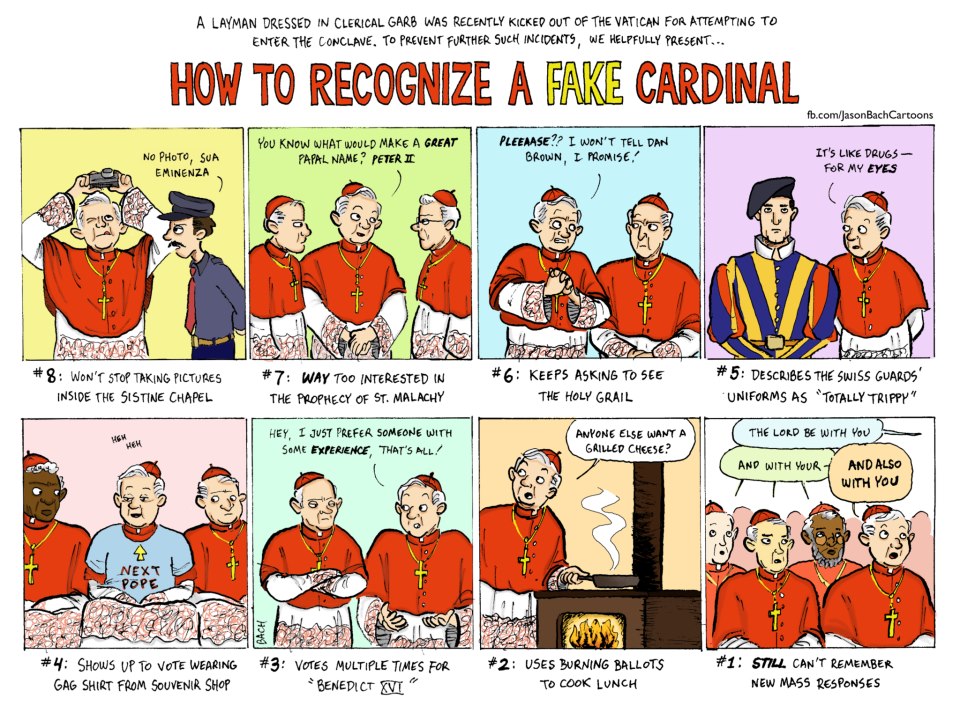
I don’t know which way things can go. I don’t have the ideas and intuitions I had in April 2005, even though I doubted Ratzinger would be elected. We seem to have the Italian “old guard”, the Americans and the Brazilians at their strategy tables – and Kasper flapping his arms around like a chicken with its head chopped off! Perhaps he is going to be running after trains leaving the station – poetic justice indeed! Perhaps they should all be locked in the Sistine Chapel right now on bread and water and told to get on their knees and pray, and only begin voting after Easter!
There needs to be a lot of rethinking. The Orthodox model of autocephalous local churches seems to be right, if we attach more importance to the quality of local religious life and we are less concerned for pan-Catholic uniformity. I don’t think the present Eastern Churches have the far-sightedness, other than individual metropolitans and philosophers, to bring influence to bear on western Christianity. Perhaps that might change, but liberalism is a real threat to the Orthodox Churches, and they do well to keep their “innocence”.
We definitely need to get beyond the Reformation and Counter-Reformation, and into the wealth of what I would call true Western Orthodoxy, not a pastoral concession attached to an Eastern Church, but the Western Church having recovered the old ecclesiology and the place of the Pope as understood in the first millennium. I distantly recall from my dogmatic theology classes the Tome to Flavian sent to the Council of Chalcedon, and the Chalcedon Fathers confessing “This is the faith of the fathers … Peter has spoken thus through Leo …” – the Pope did have authority and importance in 451, but not like in 1870!!! Eastern Orthodox western-rite vicariates are just as marginal and without hope of being real influences as the Continuing Anglicans and the RC Ordinariates that have taken the form they have taken – even more so in Europe than in the USA.The Orthodox idea is right, but everything is in the way it is extended to culturally western Christians.
The biggest problem is the destruction of Christian culture and its replacement by hard-line secularism and atheism. The leprechaun cannot be pushed back into the bottle!
In the absolute, the solution is a Church that can exist outside culture and against culture, like in the underground Churches that were persecuted by Soviet Communism or the ancient Roman Empire. The spirituality that arose from the underground Church formed the basis for monastic spirituality in the desert. We should look towards Russia and try to find out how the Orthodox Church has brought people back to God, whereas the Roman Catholic Church in countries like Czechoslovakia and Hungary has not succeeded.
There will be many ideas the Cardinals could discuss once they have turned away from the media’s cameras and microphones, and from the noise of the world. Knowledge of theology and history are essential, but the real secret will be their return to God and eschewing of worldly power and honours. That is why conclaves are secret – most wise.
Much food for thought…

 Possibly a reader or two has done what is necessary for me to be invited to connect with them on Facebook and LinkedIn. They may think me rude for not obliging.