Ideal Characteristics of Anglo-Catholicism

To follow up from my previous article, I give some ideas about what I would like to see in Anglo-Catholicism as expressed in the Continuing Churches and how things could be in the future.

Rather than a revival of the kind of Anglicanism that was founded on the English Reformation and fettered to the State down to matters of ritual and interpretation of the Prayer Book, we need to have a broader vision, one of Catholicism without any qualifying adjective. This kind of Catholicism would be as understood over the first millennium and by the more pastorally-minded of Eastern Orthodox priests and bishops. There needs to be a profound sense of not founding a new church, but of rediscovering the living Tradition.

Wanting to reject all ecclesial development since the first three centuries of Church history is not a good idea. There were many healthy developments in the middle ages in spite of the presence also of some corruptions and accretions. One capital task for us all is learning to understand the Orthodox and helping them to learn to understand us. We have got to get beyond the notion of “conversion” to the “true Church” to an attitude of whole-hearted hospitality and welcoming of diversity in matters of liturgical traditional and culture.

As in all Catholic and Orthodox Churches the integrity of the priesthood and episcopate needs to be carefully safeguarded without falling into excesses of Donatism. Ordination is not “defiled” by its being conferred by the “wrong” bishop. It is valid or it is not valid. There need to be clear guidelines for conditional ordinations when they are judged to be necessary or appropriate. There needs to be a programme of education to combat neo-Donatism.

The legitimacy of the Church does not depend on approval by Rome or a canonical Orthodox authority, but on the integrity of its creedal orthodoxy and the integrity of its Episcopate. There needs to be a considerable amount of thought about the role of the bishop in the Church. The Church consists of human beings who are sinful through weakness, but steps need to be taken when weakness becomes a permanent state of evil, arrogance, pride, ambition and delinquency. Bishops need to be accountable to their priests and lay faithful so that an evil or unfit man can be removed with the minimum of damage to the Church as a whole.

The Affirmation of Saint Louis is an excellent basis of doctrine. There are also the agreed statements of a couple of decades ago between the Union of Utrecht and representatives of Orthodoxy. There is also the Declaration of Utrecht from 1889 to state a clear position concerning the definition and exercise of “papal infallibility” in the Roman Catholic Church. Like Old Catholics, Anglo-Catholics need to be aware of the unacceptable developments in Roman Catholicism to be encouraged to rediscover the older ecclesiology and basis of the Church. The emphasis should be on the idea of belonging to the universal Church of the whole of its history.

Anglo-Catholicism needs to be dedicated to the following orientations:

–         Theological study based on the Scriptures and Fathers of the Church, and all the noted theologians ever since.

–         The reform of excessive clericalism, a synodal method of government and subsidiarity. There needs also to be a healthy detachment from secular politics or the temptation to worldly power. The mission of the Church also is essentially religious and spiritual.

–         Commitment to union with other Churches of like theological convictions and with the Catholic Priesthood. Union is more through human contact and bonds of friendship than negotiations between bishops. It needs to be a work of the whole Church.

I see no tendency in the Anglican-Catholic to compromise on the essentials of the Sacramental integrity of the Church or traditional doctrine, for example giving in to temptations of liberalism or unhealthy forms of esoteric religion. For this, the Anglican Continuum should be praised. This puts Continuing Anglicans into a unique position in relation to Rome and the Western Orthodox vicariates. Even if conversion and absorption are out of the question, the duty remains to resume the dialogue when the current polemics will have abated.

The marriage of the clergy should be maintained as presently. Divorce and remarriage in the clergy is a real problem. Institutional procedures for annulments should be carefully researched and conducted according to acceptable canonical norms.

It would be fitting in the Anglo-Catholic world that churches should be appointed and liturgies celebrated in an “English” manner, avoiding the excesses of baroque Roman Catholicism. I would encourage more use of the Sarum or northern French liturgical rites and traditions rather than counter-reformation Roman Catholic custom. The resources are available and a printing house could easily publish the necessary books. The language of the people would normally be used, archaic English for English-speakers, but without excluding the possibility of reviving the liturgy in Latin, especially when sung. Some parishes in the ACA offer Mass in Latin for former Roman Catholics who prefer it.

Liturgy needs to be given its importance like in the mind of the Eastern Orthodox and monastic traditions of the east and the west. Liturgy expresses what we believe as Christians and how we build our relationship with God and our fellow Christians in the Church. Through beauty and communication with all the five senses, the liturgy has the power to evangelise the whole person.

A vital dimension of Anglo-Catholicism and the Old Catholic idea is the primacy of the conscience, not merely obedience to an authority. The right conscience needs to be formed by empathy for other people and through education, especially in the family. A correct understanding of magisterium would be instructing, guiding and teaching, rather than imposing a spiritually totalitarian regime in which the screws are tightened always in the same direction – until something breaks.

Many of these ideas may seem to have little to do with Anglicanism but rather to a wide vision of Catholicism without any restricting or qualifying adjectives. The term Anglican Patrimony has been discussed a considerable amount over the past few years in the context of the Ordinariate. It is discussed in a different way in a continuing Anglican context, often in conflictual terms. As I mentioned in my previous article, separation of the “churchmanships” of comprehensive Anglicanism into a number of communions seems inevitable, given the separation from the Anglican Communion and the Establishment. Anglo-Catholicism should see no shame in putting the Thirty-Nine Articles, Black Rubrics and other historical accretions from the English Reformation into a museum and appealing to Catholicism.

Freed from the fetters, I am sure the restoration of bonds of mutual friendship and fellowship in prayer can be brought about even if communicatio in sacris is still a few years down the road. To a large extent, we are responsible for building up our own hope in the future.
Posted in Uncategorized | Tagged | 22 Comments

Suggestions for Anglo-Catholic Union

My perspective will certainly seem to some to be a little on the “innocent” side, as I have very little experience of Anglican institutional wrangling. I am isolated and have very little in the way of social connections with my fellow clergy. I have never been on a parochial church council, and I attended the TAC College of Bishops meeting in October 2007 from the point of view of an observer. We English love procedure at meetings and an appropriate length of time spent in ensuring that procedure is followed and the level of consultation is correct. I have spent more than half my life in France, in an environment of “ordered anarchy” for want of a better term. So, in these considerations, I am unqualified to enter into institutional considerations. I concentrate on properly theological and spiritual themes.

Following my last article on Post Brockton Continuing Anglicanism, I saw something glaring – the radical incompatibility between non-sacramental or minimal-sacramental Christianity and what is generally described as Anglo-Catholicism. Very often, we get hung up over meanings of words, so I’ll try to get this straight. Frequently, the term Anglo-Catholicism is taken to mean a tendency of the Church of England in the nineteenth century and onwards to our own time to aspire to union with Rome by imitating or “aping” post–Tridentine norms, and then adopting the post Vatican II changes when they were implemented. Alternatively named Anglo-Papalism, it is distinguished from the Old High Church, describing the theological movement of the Caroline Divines and the Oxford Movement and adopting a highly conservative attitude about classical Anglicanism being based on the Book of Common Prayer, the Thirty-Nine Articles and, in general terms, the ethos of the Reformation. Thirdly, we have a more Evangelical tendency in the ACNA. It would be interesting to know how Anglo-Catholics fare in that communion.

For the purpose of this article, I would like the term Anglo-Catholicism to describe a maturing vision of the Church in its liturgical and spiritual culture as well as its theology. With the experience of Roman Catholicism and much of Anglicanism with modern / experimental liturgies, I would like to see the promotion of traditional western forms of the liturgy and church culture, which is one of the most positive aspects of the Continuing Anglican Churches adhering to the Affirmation of Saint Louis – the Missals.

My suggestion would be to concentrate on getting the Affirmation of Saint Louis Churches to meet together and get sufficiently agreed on doctrine and liturgical usage (optional character of the Prayer Book for the Eucharist in favour of the missals) and give second priority to dialogue with the old high-church and Protestant communions. Essentially, I see a distinction to be made, as in Roman Catholicism, between conservatives and traditionalists. Labels are always dangerous, so it is always the same matter of defining words carefully. Over simplifying, conservatism is a matter of keeping things the same, with the thought that variation involves error. Whilst I have reserves about the theory of doctrinal development (what in the mind of Newman settled his cognitive dissonance on the subject of papal infallibility), what I would call traditionalism is a quest for a living and maturing tradition in the communion of the Church. It is a kind of via media between believing something because authority teaches it and has the political clout to enforce it, and refusing the Church any character of a living organism. Perhaps Orthodoxy is closer to this idea of living tradition than anything else, provided it can open up and emerge from its own conservatism. The western Orthodox idea, however well or badly it has been implemented by Eastern Orthodox authorities, would seem to be the inspiring model for the Affirmation of Saint Louis, the give-away being the affirmation of seven Ecumenical Councils and the notion of the Undivided Church.

One way forward, for some, is the Ordinariate or Western Rite Orthodoxy. Some Anglicans can find their way in either the Ordinariate or the Antiochian and ROCOR vicariates. It is a matter of individual conscience. One thing that has caused problems in the TAC is clergy and laity joining another Church and leaving their Anglican community in a weakened and fragile state. I am not going to go any further into this issue, and whilst refraining from negative criticism of the Roman Catholic and Orthodox Churches, my aim is to make positive suggestions for the future of some Anglican communities.

It seems to me that most of the Affirmation of Saint Louis Churches are Anglo-Catholic. A great point has been made – that the Anglo-Papalist dimension has been removed by the Ordinariate. What is left behind is defined by another ecclesiology and understanding of the idea of the Undivided Church. The study of Old Catholic theology (ecclesiology based on the Council of Constance) is a great help in finding a new theological synthesis.

In the USA, the Anglo-Catholic churches are mainly the Anglican Church in America (ACA), the Anglican Province of America (APA) and the Anglican Catholic Church – Original Province (ACC). The more “Protestant” churches are those that are linked to the Global South and the Anglican Communion, and of course the Reformed Episcopal Church (REC). The ACC and the TAC have a significant international presence, and there is a number of smaller continuing Anglican Churches following Anglo-Catholic principles.

The problems with a “pan-Anglican” union seem to be theological and the source of Orders, together with a fairly “Donatist” view in some communions. The ACC is strict on the point of maintaining an absolute non-communion with those who have at any time being involved in the ordination of women, or even those who are ordained outside their particular episcopal lineage. The TAC has bishops generally descended from the same lines of succession and have never been involved in ordinations of women, but there are relationships of communion with Forward in Faith which is composed of Canterbury Anglican clergy.

I would be inclined to support the ACC position to some extent whilst adopting an open attitude with the TAC member churches and the APA. There seem to be grounds for theological agreement on the basis of the “western Orthodox” position of the Affirmation. Similar liturgies are used in all three communions, usually involving the use of the pre Vatican II Roman missal translated into “Cranmerian” English incorporating material from the Prayer Book of each country in question. Use of the Sarum liturgy is rare but does not go unnoticed on the occasions when it is used.

I think there could be union at two levels: full union when there is mutual recognition of each others’ Orders and theological agreement, together with agreements at a canonical and administrative level. Then there could be some kind of ongoing dialogue between the Anglo-Catholic union (whatever it would be called) and the churches upholding a “lower” kind of ecclesiology and theological position based on the Thirty-Nine Articles. The problem for some of the low-church conservatives is that they blame Anglo-Catholicism for liberalism and what drove them out of the Anglican Communion. The barrier seems to be insurmountable.

Another important aspect is that any union of the Anglo-Catholic churches should be of an open and inclusive character, ie. not with an objective of discrediting smaller communities accused of “imitating” or being impostors or deceiving the faithful. Everyone is someone else’s bogeyman, and such a mentality is destructive.

The ideal of an Anglo-Catholic union is that it would be a single episcopal synod, where bishops get together, get their act together, and make mutual decisions about jurisdictional matters, and if necessary, a reduction of the number of bishops in proportion to the numbers of parishes in each diocese. That would be the most credible objective, but perhaps one that could be achieved in a number of stages. I don’t know how it could be made to work, but I don’t see any prospect of success when trying to resolve differences between Anglo-Catholics and central / low churchmen, at least outside the British Establishment and the old Empire.

If the TAC could get together with the ACC and the APA, that would give a large and credible communion, even better if other Anglo-Catholic communions like the Diocese of the Holy Cross can be in on it. Once stability is ensured, then perhaps there can be further stages at gaining the confidence of other Christians whether or not they identify with Anglicanism. The category of Anglicanism needs to incorporate the Old Catholic vision in terms of episcopal ecclesiology and the integrity of the local Church as in Orthodoxy.

Obviously, there have to be institutional aspects, which are way above my “pay grade”, a matter for professionals of meetings and corporate life. I would hope that such would take second place behind questions of theology and validity of Orders.

Anglo-Catholicism is now going to be more moderate with the transition of the Anglo-Papalists to the Ordinariate. I hope it will not have to be fettered to the Articles and the Prayer Book, a continuation of the old cognitive dissonance from which even moderate Anglo-Catholics have suffered in the past. I am sure that suggestions could be made of suitable formularies, like for example, the old agreements made between the Orthodox Churches and the Union of Utrecht. There are lots of possibilities.

Also, a peaceful parting of the ways between Anglo-Catholics and broad / low Anglicans would free the low churchmen from having to accept doctrines not contained in the old Anglican formularies. It would do them a favour too.

Just a few ideas…

Posted in Uncategorized | Tagged | 39 Comments

Post Brockton Continuing Anglicanism

Post-Brockton takes a bit of wading to get through it, but it is interesting in this barren post-ordinariate, post-everything, time. Outside State control like under the English Monarchy and Parliament, I don’t see how comprehensiveness can work.

Comments would be most welcome.

Posted in Uncategorized | Tagged | 16 Comments

A Few Links to the “Intégrisme” Theme

All these links are in French. If you can read this language, then you will see that the polemics go back a very long way.

As I mentioned in my earlier article, Sodalitium is the review of the Istituto Mater Boni Consilii, a group of priests in Italy who aspire to restoring the status quo of the Church under Pius X. They are much more “extreme” than the Society of St Pius X from which they are dissidents, and hold a position about the Pope (since 1958) close to sedevacantism. Les Amis du Christ-Roi, based at Nantes, are even more extreme.

And a couple of books by one of the greatest scholars in the subject, which give more balance in historical and intellectual terms:

  • Emile Poulat, Intégrisme et Catholicisme Intégral, Paris 1969.
  • Émile Poulat, Catholicisme, démocratie et socialisme. Le mouvement catholique et Mgr Benigni de la naissance du socialisme à la victoire du fascisme, Paris 1977.
Posted in Uncategorized | Tagged , , , , | Leave a comment

Charlie Chaplin Speaks in 1940

Posted in Uncategorized | Tagged , | Leave a comment

An Excellent Explanation of French “Intégrisme”

This comment on Fr Smuts’ blog about Bishop Fellay, superior of the Society of St Pius X, calling the Jews the “enemies of the Church” is worth reading. Friends used to joke with me in private, calling them the “Waffen SS – PX”! Those priests are not all neo-Nazis by any means, some are good devout men who got into it because of the liturgically and doctrinally traditionalist stance, but others of those men have some very nasty ideological opinions.

During the occupation of France by the Nazis from 1940 until 1944, some Catholic minds thought Nazism would be useful to get their own back against the Socialists and Freemasons who were responsible for the separation of Church and State in 1905 and for anti-clericalism.

Of course, anti-semitism goes back further and is one of the most profound sources of embarrassment for the Church since the days of the Spanish Inquisition and all the way back in history. It was an important part of the late nineteenth-century anti-liberal conspiracy theories that blamed everything on the Jews, the Socialists and the Freemasons.

I am quite taken back by the motto adopted by Maréchal Petain – Travail, Famillle, Patrie. This is also the motto of a right-wing organisation (supported by the superior of my old seminary) based in – – – Brazil. Brazil, Paraguay and other South American countries were refuges for some of the worst Nazi rats when Hitler was defeated – if they had enough gold (which was stolen from the victims of the Nazis in the concentration camps). I don’t know if there is any connection, but the connection seems pretty obvious! I have to give it to my old superior that he did rebuke a seminarian who declared himself to support the neo-Nazi ideology! I remember… And I was in a clerical institute recognised by Rome.

French bourgeois Catholicism has a lot to answer for. Practically the whole working class in this country is alienated from the Church, that in spite of the generations of Marxist priests and bishops from 1945 up to about the John Paul II era. It is a sign of shame that there were many Catholic justes who did what they could to resist the enemy and save as many Jewish people as possible, but this was not the official policy of the French Church! They sacrificed their lives and were often atrociously tortured by the Gestapo before the relief of death.

Mourad’s account seems to be accurate according to my information and reading of writings of historians like Dr Luc Perrin of Strasbourg University. However, he overlooks something that he might be intending to describe in a future comment, the phenomenon of Intégrisme as a Papally-supported (Pius X 1903-1914) movement reaction against theological Modernism. This accounts for the name of the Fraternitas Sacerdotalis Sancti Pii Decimi or Fraternité Sacredotale Saint-Pie X.

Here is a link to my article on anti-Modernism in the pontificate of Pius X and up to the suppression of the Sodalitium Pianum headed by Monsignor Umberto Benigni in 1921 by Benedict XV – see Sodalitium Pianum.

I was “received” by the SSPX in June 1981 and attended their masses in London until leaving for France the following year. There were some good and devout people, but the cranks left me with a lasting impression. I spent some time at one of the Society’s schools in France from October 1982 until the Easter of the following year, learning French and helping with teaching English. It was an eye-opener to say the least, a lens through which I would have a critical view of Roman Catholicism for many years.

One again, I am spiritually exhausted and ask for your prayers and will need to address these questions much less frequently. It’s greasy, very dirty and like something I once trod on in the gutter – very unpleasant! It is nothing other than pure evil!

This kind of thing can be dealt only by prayer and fasting…

Posted in Uncategorized | Tagged , , , | 14 Comments

Will Beauty Save the World?

As we have been talking about beauty and aesthetics recently, here is an old Anglo-Catholic posting of mine. I reproduce it in full since I am the author. The article dates from March 20th 2010. There are some sympathetic comments attached to the old article.

* * *

Dostoyevsky came out with an idea that few of us will ever understand – “Beauty will save the world”. I often wonder how this can be, as beautiful buildings, paintings, musical instruments and every form of human art are usually the first victims of war and man’s inhumanity to man. Has beauty ever saved us from anything?

There is something about art and beauty that cannot be disputed and softens the hardest people. Ideologies are always hollow, smooth talking and empty, whether they are philosophical ideas, plans for reorganising society or even the literalist understanding of the Gospel. Even here, my use of words only adds to the proliferation of clashing ideas, so my thought will only be of limited use. It would be better to produce a work of art!

However, the use of language can be in itself a form of art, when a writer has a talent for fine prose and poetry. The use of words is an important part of our liturgy, without which the actions, ceremonies and symbols would only at best have ambiguous meanings. I am a fervent believer in a world of ideas signposted by the triple transcendentals of goodness, truth and beauty. These are not my ideas, but those of Plato, Saint Augustine and many of the other Church Fathers and Saints.

Beauty, like Christ himself, suffers and dies to save the world – and even then, salvation or deification is situated at a level that escapes our materialistic understanding. Beauty has saved the world, and can do much to help us today.

The kind of Anglicanism we are bringing into communion with the Catholic Church [I was writing in March 2010 from a “Hepworthian” perspective] is a vision that was revived only in the nineteenth century. It is one of the central tenets of us Anglo Catholics that Catholicism survived in the English Church throughout the centuries, but it was comatose in the Age of Reason! The Catholic revival of the Romantic era was an aesthetic response to the doctrinal, canonical and spiritual work of the earlier post-Reformation divines. Like many movements, it was a reaction against the arid intellectualism and dry rationalism of the eighteenth century. It also broke free from the yoke and the bare sternness of Puritanism and the whited sepulchre that masqueraded as religion when Puritanism had decayed. The Oxford Movement was to a great extent inspired by Romanticism as was the French Catholic revival under Montalembert, Chateaubriand, Guéranger and Lacordaire at exactly the same time. It brought sensuality and sensitivity for beauty to the forefront. Man is not merely a rational and intellectual being, but is also emotional and capable of being moved by religion expressed as poetry and art.

The aesthetic movement sprang directly out of the Oxford (Tractarian) Movement. Though Newman sought to trace the continuity of doctrine from the Scriptures and Fathers, throughout the history of the Church, he was a man of his time and the emerging aspiration to transcend the collapsed classical world of the previous century that had been so abjectly ruined by the French Revolution. The former world had passed away, and the Romantics looked to a new world. Do we, in 2010, not recognise our own feelings as we left the twentieth century?

Romanticism sought to revive notions of the medieval era, without of course seeking to reproduce it in every aspect, the evil with the good. Men of the early nineteenth century were not interested in feudalism or corrupt bishops. Romantic mediaevalism was selective and took beauty, and pushed rationality to the background to give breathing space to the emotions and feelings. The Ritualists followed closely in the footsteps of the Oxford Movement, and sought to bring back aspects of the old pre-Reformation Church, especially through the Gothic revival in architecture and the arrangement of the sanctuary and the altar.

Many cringe at the idea of late nineteenth century aestheticism, and think of Oscar Wilde. We conservative Christians tend to react the way his judge and the establishment of that time reacted. We have enough problems in our own time with homosexuality and immorality against human life and the family. Yet, that extremely sensitive character was able to write In carcere et vinculis, the famous letter to Lord Alfred Douglas, which has moved many a reader to tears. That letter influenced many of may own ways of seeing the relationship between beauty and faith, and especially the purity of the heart and a visceral eschewing of bourgeois hypocrisy. Wilde, received into the Catholic Church in Paris shortly before his death in 1901, remains one of my favourite authors of that period.

Evelyn Waugh outlined the continuation of this eccentric aestheticism into the Roaring Twenties in his wartime novel Brideshead Revisited. I recommend the British television series of 1981 that can be seen on Youtube. This epic comes in 11 episodes. You have a choice of characters with which you can identify, for you will arrive at the end feeling that you know those characters intimately. Waugh himself was profoundly intrigued by the dying embers of aestheticism that were just about extinct by the Wall Street Crash of 1929, the Depression and World War II. Quomodo sedet sola civitas, vanity of vanities!

What I might term as aesthetic Catholicism was a desire to present and receive Catholicism as an attraction to difference and otherness. It had to be distinguished by its beauty and a morality that stood out from hypocritical Victorian moralism. That aspiration to difference continued over a whole century before resurfacing in some of the extreme and morally unacceptable tendencies of modern Anglicanism. Everything in moderation!

Aestheticism in the late nineteenth and early twentieth century English upper class was considered as wildly perverted by the Protestant gentry. Charles Kingsley found that Catholics and Tractarians in the Universities bore “an element of foppery even in dress and manner; a fastidious, maundering, die-away effeminacy, which is mistaken for purity and refinement“. Implicit in these accusations were thinly veiled charges of homosexuality, a serious crime in those days. One character in Waugh’s book warns an impressionable young Oxford undergraduate about the dangers of Anglo Catholics – They’re all sodomites with unpleasant accents. That is for the extreme decadence into which some elements of the Movement sank.

But, not all of it foundered. The aesthetic movement had its limits, but we should be careful about rejecting it because of the excesses committed by a few of the more flamboyant camp personalities. There was an objective foundation in goodness and beauty in a search for truth – this is what drives us today. I am sure most of the Ritualist priests were pious men, concerned for a vision of the Church involving beauty and a radical position in favour of the poor. And – they were ready to go to prison for their convictions!

This was another thing about English upper class aesthetes – their utter dismay over how the middle class was treating the little working people and poor souls living in the city slums. Priests of such a vision would never get preferment in the viscerally Protestant Establishment, and so they built the slum parishes in Holborn, Whitechapel, Hackney, London Docks and most of the seafaring towns of England’s south coast.

What of the future? There are many signs of hope in our days. One is having a Pope with aesthetic ideas, a musician and lover of beauty in the liturgy. Another is our arriving at the end of a modern era and young people looking for something different. A Romantic revival? History always repeats itself. An event occurs for the first time as a tragedy, the second time as a farce, as would be seen when comparing Julius Caesar with Mussolini or Frederick the Great with Hitler. A second gothic revival would be utter cynicism! However, there are certain aspects from which we can learn.

One hopeful sign I saw some years ago was Radical Orthodoxy, and there are many inspiring things in those books by Milbank, Pickstock and others. But, the Cambridge Movement (as some have called it) was too snottily snobbish and never caught on. I have a copy of Radical Orthodoxy (ISBN 0-415-19698-I) which I have found interesting to read in small doses. What has particularly excited me intellectually is what we find written about aesthetics, the problem of post-modern nihilism, friendship and generally a fairly neo-Platonic view of everything. But I have to warn you that it is difficult reading. Catherine Pickstock, a brilliant intellectual who writes so beautifully on the liturgy, is in favour of the ordination of women. The Oxford Movement had been brought to the pastoral level by the Ritualist slum priests in the cities of the 1860’s. Who will ‘apply’ Radical Orthodoxy?

The Goth subculture among some of the young post-modern people takes a certain amount of influence from nineteenth century aestheticism, but is far removed from Christianity, and is quite sinister in its undertones. Some priests have felt a calling to missionary work among Goths, but I have no idea about whether those efforts have met with significant success. I think those young people are misguided, but their reaction is as understandable as that of Shelley, Sir Walter Scott and Tennyson in their own time, that is without mentioning the taste for the macabre and the melancholy in Bram Stoker, the author of Dracula and Mary Shelley who wrote Frankenstein in that gloomy and cold summer of 1816.

In many ways, I see parallels between the end of the eighteenth century and the beginning of the nineteenth with our own time. Reason and rationality are denigrated by post-modernism, as are ideas and ideology. Greater priority is given to feeling and experience, but in a way we modern fogies find most disconcerting.

Coming to the common ground of most ordinary people, we certainly need to give priority to beauty in our places of worship and our liturgy, giving the best of what we have. I certainly hope we will be able to have the use of old churches as much as possible in England, America, Australia and other places. When it comes to furnishing them, we really need to study the works of artists like William Morris who sought objective beauty in the early twentieth century, and become influenced by that current of thought and feeling. Too many churches, even where traditional liturgies are celebrated, are appointed in a tawdry and vulgar way. I would love to see a revival of the Arts and Crafts Movement. [Here is another Arts and Crafts link.]

Beautiful churches, beautiful music and beauty in the liturgy will do much to bring people back to the Church. Beauty will breed beauty as artists and writers begin to feel loved and appreciated, rather than spurned and marginalised like in the nineteenth century. We need a new Christian aesthetic movement, a liturgical movement, a Catholic movement in general.

Posted in Uncategorized | Tagged , , | Leave a comment

Wisdom from John Locke

It is one thing to show a man that he is in an error, and another to put him in possession of the truth.

Posted in Uncategorized | Tagged | Leave a comment

Is free Catholicism cognitively dissonant and/or deeply dishonest?

I can sometimes understand why atheists like Richard Dawkins would have things in such a way as Christians would be no more acceptable in society than Holocaust deniers and flat-earth fanatics. Perhaps he would like to be a new Robespierre and have the guillotine permanently set up on a public square ready for use at any time! Perhaps his good lady wife is good at knitting… Unfortunately, he is not the only one. In the same way as some of the most virulent French revolutionaries were former rigorist Catholics, so it is in our own day.

The serpent eats its own tail as we find more souls who would correct Christ’s errors in the words of John Gielgud as the Grand Inquisitor.

I have to admit about being vague about “free Catholicism” as there is no institution upholding that notion, and all the free Catholic attempts I have known of came unstuck or did not survive their founders. In the mind of the “totalitarian” Catholic, religious freedom is cognitively dissonant and/or deeply dishonest. Catholicism is therefore all about submission to authority and being under the control of a single institution.

If the fundamentalists of that Church spoke Arabic, the word would be none other than Islam (س ل م). The association of ideas is chilling. In history, the Church has hardly distinguished itself for respecting human freedom in any way – the Inquisition, the Crusades and everything that discredits it with us and our contemporaries. Islam (or at least the strict tendencies thereof) is no different from Christianity in the fourteenth century.

Is rejection of such a vision the equivalent of Satan’s non serviam in the Genesis narrative, the root of all sin and the Fall? That is question conservative Catholics ask. The cognitive dissonance is, however, not in the minds of those seeking the freedom Christ gave his disciples, but rather in the minds of those upholding an ecclesial system that has had its Vatican II, preached ecumenism and religious freedom, and uphold the pre-conciliar ideology.

These questions are constantly raised in the blogs, and nothing we can say will change the minds of the conservative Catholics, since the empathy they have for other people is probably less than a dim flicker. One might just as well try converting the Ayatollah of Iran or the Taliban in Afghanistan. One of my objectives in this blog is to uphold an alternative vision, different from and above the warring factions of the conservatives and liberals – two forms of the same intolerance. That alternative vision is freedom, however much it lacks viability in human terms.

The same questions are asked, whether sacramental Christianity or “generic” Catholicism is based on a notion of voluntary love and service of God or fear of punishment for falling back into one’s “natural” evil state. Here, one can easily see the root of Hitler’s ideology according to which people are nothing more than cattle to be disposed of by the “master race”.

The conservatives then emphasise the futility of anything “pretending” to be Catholicism without being under the proper authority. Anything not part of the system is held to be a false imitation of Catholicism with the purpose of deceiving the credulous. The extreme Eastern Orthodox do the same thing, and some will even re-baptise people moving from one Orthodox Church to another Orthodox Church. This conception of the Church is the greatest obstacle to evangelism.

They continue by saying that any reason for describing oneself as “Catholic” other than being parts of God’s “Waffen SS” is shallow and unsustainable. They mention the example of fragmentation between national Orthodox Churches and between traditionalist groups. We bewail the same kind of fragmentation between independent Anglican and independent Catholic groupings.

In Catholicism, there may be wildly different opinions, but the Pope is the central authority that keeps us together. We can either be obedient and be in communion, or be disobedient and be excommunicated.

The simplism might seem to be appealing for the war-weary continuing Anglican or someone who has been involved in a “vagante” Church. Give up freedom for totalitarianism, and one finds the pill for happiness. Do we not read all about it in Huxley’s Brave New World?

Those conservatives have relinquished their freedom, and I wonder how happy they are in a system that theoretically upholds (but doesn’t practice) religious freedom and ecumenism (but reduces it to diplomatic chit-chat). They repeat the same mantras and cannot learn from any other point of view. I leave them to stew in their juice, but rather appeal to those who are not convinced they hold the final truth.

Attempts at free Catholicism have never been long-lasting. Conciliarism, which was the solution agreed upon by the Council of Constance (14 14-1418) to resolve the situation of up to three rival popes was finally snuffed out by Vatican I. Pius IX cut off the final branch of Rome’s credibility. Henceforth, any pile of bunkum coming out of Rome under the cover of (implied) papal infallibility was made acceptable. Hitler and Mussolini invented nothing! The old archdiocese of Utrecht was seduced by Kulturkampf liberalism in the 1880’s, and Old Catholicism became what it became – aligned with the sterile and de-sanitised mush of much of contemporary Christianity, the nemesis and mirror image of the infallible Pontiff.

I have come to the stage where I cease to believe in any “true church”, at least that notion being tied to any visible established institution. The setup I belong to was reduced to a pile of rubble by the ordinariate movement, and the survival is not as transparent as I would have hoped. They surely have their reasons “above my pay grade” or “clearance level”. Its looks like we have to accept a certain degree of obscurantism, at least until it turns out to be something manifestly unacceptable.

Saint Augustine maintained that a sacramental life was possible outside the official Church – valid but illicit – whilst Saint Cyprian upheld the total invalidity of any sacramental life from the instant of separation from the institutional Church. Rome now tends to hover between the two. Bishops and priests in independent contexts cannot refer to Rome for the ontological reality of the ministrations or legitimacy. They must appeal to a principle other than authority. They can’t have their cake and eat it!

The fact that Rome recognised Eastern Orthodox orders and those of the Old Catholics before they started ordaining women is an indicator of the fact that Rome is not actually Cyprianic in its theology. Conservative Roman Catholic lay people are often both Cyprianic and Donatist.

What is the characteristic of Catholicism? Is it the sacramental and liturgical character of its worship. If they exist in the Orthodox Churches, then can they not be an aspect of other forms of independent sacramental Christianity (based on a priesthood that would be valid in Augustinian terms)? Perhaps the Orthodox are more acceptable to westerners because they are practically unknown to us and “exotic”.

Putting it another way, what makes a Christian, a carrot or a big stick? Did not the British Navy just after the time of Captain Blighe admit that flogging with the cat o’ nine tails breaks a good man’s heart and makes a bad man even worse? Would we not be better Christians through love than through fear of punishment? Aesthetics often draw souls to the truth through sacred symbols and a sacramental experience. One of my loyal readers says that aesthetics is the wordless language of the soul. That is the difference between Catholicism and Protestantism, not Vatican totalitarianism and the canonical equivalent of Fascism.

Belonging to the Church, any Church, is a question of connection. The beauty of the liturgy, a thing of the past in most RC churches, is one thing that connects us to the essential Christ-Mystery. Aesthetics is a means by which we fall in love with the Mystery, and Christ draws us to himself.

I am not repelled by the fragile church such as the one I belong to as a priest, because the entire Gospel of Christ is all about fragility and weakness. The Grand Inquisitor’s religion is about power and strength. The strong send the weak to be burned at the stake, shot or gassed. The weak and fragile have compassion and empathy for the little ones of this earth, those to whom the Beatitudes apply.

Catholicism in its universality is a pilgrimage of the human spirit in the way of freedom and holiness, a journey towards the light…

Shut it all up in a box, and I, with nearly the totality of our contemporaries, would not be interested.

The message I try to convey here is one of hope, for those who are not locked up in one prison or the other. Freedom is lived in our weakness and precariousness, but such is our condition that we can transcend.

Posted in Uncategorized | Tagged , , , | 14 Comments

Hanging Pyx

I have just received an e-mail asking me about the hanging pyx.

The hanging pyx is an ancient method of reserving the Blessed Sacrament in a church until it was replaced in most places by a tabernacle on the altar or set into the wall behind the altar. It is rare, but can still be found used in a number of places, even outside England.

Typically, the pyx was made in the shape of a dove or a cylindrical container. I recommend this article The Hanging Pyx by Shawn Tribe.

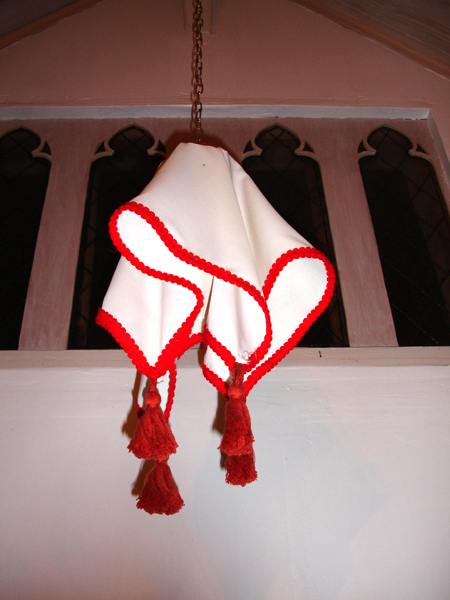
Not being a silversmith, I made my pyx out of wood. I did consider using some kind of lantern for a pyx, but I never found what I wanted. So I had to make a wooden one. Here is a close-up of it hanging above the altar.

It is lowered on a halyard running through two pulleys, and here it is just above the altar table.

Here, the pyx is unhooked from the chain and the veil removed.

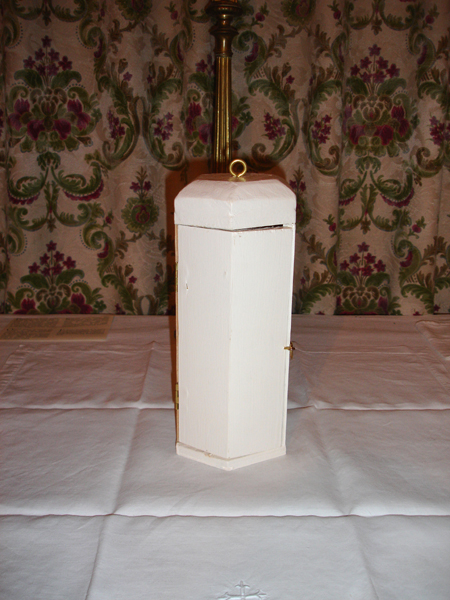
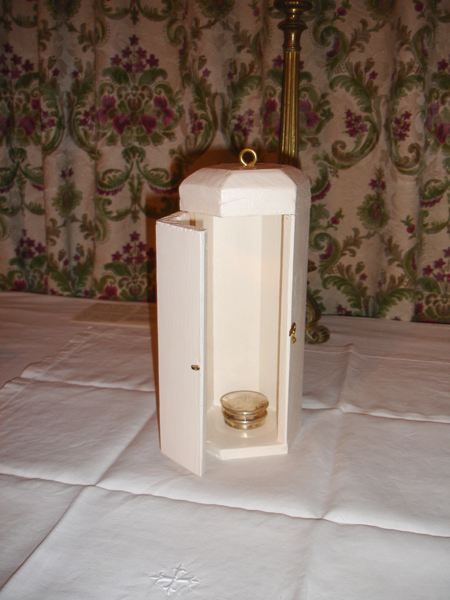
Finally, it is photographed with the door open.

This pyx is made from six strips of pine in a hexagonal shape. Here’s where your old school geometry comes in handy! The corners are planed at the required angle. Take two strips for the door. Glue and clamp. Take the other four strips and the base and top you have previously drawn out and made. Do a trial assembly. Once you have made sure the planed angles are right, glue up, assemble and clamp. It’s not easy to do a perfect job. Mine isn’t!

Finally, paint the pyx inside and outside. Leave it to dry for several days after having applied the second coat, a third if necessary. I chose off-white as a colour. Bull’s blood red is another possibility. Use matt or satin paint, not gloss. Screw a brass ring into the centre of the roof. Fit the door with hinges and a metal latch – which you buy from a model shop or an ironmongery shop. Brass fittings look nicer.

The veil is square, at least three feet by three feet, so that one foot and six inches hangs down at the sides. The corners hang down further. Use the floppiest and most flexible cloth you can find. Sew red binding around it and the hole in the middle. Add red tassles.

Work out the height of the pyx and install a pulley in the ceiling directly above where you want the pyx to hang (I suggest the rear part of the corporal on the altar, and naturally in the centre). You can do this with a plumb line to get it accurate. Use pulleys designed for sailing boats – they are smaller and more discreet. Attach the other pulley at the side of the chapel. Use good-quality white cord for the “halyard”. Use a length of brass chain. Tie the halyard to the top end of the chain with a bowline. Use a “S” hook between the chain and the ring of the pyx. This makes it possible to take the pyx off the chain and remove the veil.

Posted in Uncategorized | Tagged , , | 4 Comments