Counter Reformation Catholicism

I have already written on Counter Reformation Catholicism on the Anglo-Catholic blog. Though this blog has been in hiatus for some time, we can be grateful to its moderator for having kept the existing material in place. I woke this morning with the idea of adding a few reflections. Perhaps this desire was triggered by seeing the Brideshead Revisited series that appeared on British television in 1981. There has been a recent remake, which apparently makes a huge concession to the LGBT agenda, certainly not intended by Evelyn Waugh when he wrote his book. I prefer the innocence of the 1981 version with the extremely well-studied character portraits. Waugh was a satirist and the characters of his novels are caricatures, but amazing well-constructed ones. It is available on Youtube in ten-minute segments, which is tedious. I suggest either buying the DVD or getting a software package for downloading files from Youtube onto your hard disk, and another programme for joining the *.flv files. You can then watch the series at your leisure.

My seeing this series left a deep impression on me, as it was the time I was converting to Roman Catholicism in London, largely attributable to a friend who was himself under instruction with a Jesuit priest at Farm Street. My first port of call was St Etheldreda’s Ely Place, and then having been quite shocked at some of the things the assistant curate responsible for my instruction said, I went to the Society of St Pius X. The Fathers of the Oratory had been suggested, but I just felt out of place other than by going to their famous Sunday Vespers with full ceremonies and music.

In 1981, I was 22 years old and incredibly naïve about what aspired to be a continuation of the Counter Reformation Church known by countless English Catholics in the twentieth century. In the chapels and churches of the Society of St Pius X, I met many who had been converts as early as the 1930’s and into the 1950’s and heard their reflections about how the dream was shattered by Vatican II and the changes. I befriended a man by the name of Ken Cooper, born in 1912 and converted in 1932, who has served in World War II in the RAF and was a prisoner of the Japanese. He was very devout and did all he could to encourage the youngsters without the crankiness he found among many of his fellow churchgoers. I also befriended a priest of the same age by the name of Fr John Coulson who had been converted during the war (he was sent into Italy and was part of the Bari beachhead) and stayed in Italy and became a Camaldulese monk. Many servicemen did in those dark days of destruction and the close of World War II. It is said that the American who pulled the lever to release the atomic bomb on Hiroshima became a Trappist monk at Tre Fontane in Rome. Wars do strange things, they draw agnostics to the faith and make atheists of believers. It suffices to read The Waters of Siloe by Thomas Merton to understand the sheer numbers of former servicemen knocking on doors of monasteries in the late 1940’s.

So it was the kind of Catholicism I believed at the time I should seek out, offering a clear truth and certitude against all the errors and incertitudes of Protestantism, liberalism, agnosticism, atheism and the modern world in general. Through my friend who was going through instruction with the Jesuit priest, I came into contact with the various groups of conservative Catholics in London mostly concerned with apologetics and upholding Humanae Vitae. A little retro-futurism sufficed to project Pius IX’s aura of infallibility on the still relatively youthful John Paul II. I sensed it was another kind of Counter Reformation, less concerned about the liturgical rites than the Lefebvrists.

The triumphalism and certitude of the Tridentine Church can instil a sense of wonder in the innocent and those who have suffered in life. This kind of Catholicism welcomes a man with a long confession to make and God’s forgiveness to receive. It was a kind of Catholicism that repelled as many as it attracted. It oscillated between Jansenist rigorism and Jesuit voluntarism, and by the 1950’s it concealed deep corruption, perverted sexuality and excessive punishment in the schools and convents.

The Counter Reformation was an attempt to clean out the system and bring in freshness and clarity, concentrating on catechesis and pastoral work. The sixteenth century was the period that saw the first vernacular Bibles and more healthy devotions for the laity. If one is going to have a celibate clergy, then it is better to have religious communities. The two great innovations were the Jesuits and the Oratory of St Philip Neri. There were also the Theatines and the Barnabites. Many of those priests were from the Italian nobility and those communities patronised the arts. It was also a period of uniformity and centralisation.

In 1981, one could find Counter Reformation Catholicism in London in plentiful supply. There was the Indult in England for the old rite Mass from 1971 and the Latin Mass Society was a stable and assured institution. Many of us went both to the LMS and the Society of St Pius X, though the clergy of the latter did not like two-timing!

When I finally went to university five years later, we had an excellent church history professor who had obviously taken a great interest in the Counter Reformation and the anti-liberal polemics of the nineteenth century. He was of great help to me when I researched into the missal of Pius V of 1570. What were things like in the Church in those days? We have little to go on except documents and narratives. The impression I have is that life was a struggle for raw power, and the fires were fuelled by religious fanaticism. When they killed, they did so with a maximum of sadism and suffering: burning at the stake, drawing and quartering, breaking on the wheel and everything the perverse human mind could imagine. The following century was no better. It was also a time of sublime beauty with the art of the Renaissance. There were saints and holy fools of God, probably like in Russia under the Tsars. We can only speculate. In England, as the message seemed to come over in school history lessons, a nobleman had only to say a word wrong and he would be sent to the scaffold for high treason.

Much of the old fanaticism was flattened out in the eighteenth century by the Enlightenment and the acceptance of scientific discoveries of men like Newton, Galileo and Copernicus. The eighteenth century was a time when one could breathe a little more easily – if you were from the right noble family. It all ended in the bloodbath of the French Revolution with a wave of fanaticism against its fanatic opposite number. In the nineteenth century, it could not possibly have been the fault of the infallible Church and Catholic apologists saw a conspiracy everywhere – the secret societies and the Jews. By the end of that century, the country folk and urban working classes were alienated. Then there was World War I and the slaughter of millions of young European men and the “lost generation”. Popes Pius XI and Pius XII did and said what they could about the latest threats of Communism, Fascism and Nazism. By 1945 it was known that many bishops had collaborated with the occupying regime for favours and a power base, and the young priests revolted, attracted as they were by Communism. So it seemed, only the Communist had real guts to oppose the Nazis. Of course, that was not true, since many non-Communists also resisted and paid with their lives.

I see the Counter Reformation period (Council of Trent to 1945) as one of Hegelian dialectics, one of massive mood swings from thesis to anti-thesis and back to thesis, and so forth. The nineteenth century was one of monstrous conspiracy theories which fuelled the anti-Modernist polemics of the early twentieth. They still continue in traditionalist circles, and they have republished many of the books written in the nineteenth century against the Illuminati, the Alta_Vendita dei Carbonari and especially the Jewish organisations like the B’nai B’rith. The famous and successful American novelist Dan Brown did nothing more than to exploit conspiracy theories that lay just under the surface of the collective consciousness. Nowadays, most of the conservatives have either rejected these discredited theories or are more careful about what they say in public.

When I think of it, it is shocking to see every means exploited to defend and promote the Church except prayer and the gentle non-violent way of the Gospel. That alone says so much. No organisation that fights for political power and influence is immune from the temptation to justify evil by a finality perceived as good. This is something of which increasing numbers of ordinary people are becoming aware, and as a result are leaving the Church either to find the ideals of Christ in some other form or embrace secularism and the contemporary form of the Enlightenment.

I think that it is likely that the Church will continue on a downward spiral until it runs out of money and worldly power as conferred by political leaders openly or under the table. The Vatican should lose its status as a nation and come under Italian nationality and law, just like any cathedral or parish anywhere else in the world. Already, St Jerome in the fourth century had noticed that the Church had become weaker in virtue as it accepted favours from the Roman Empire under Constantine onwards. Cujus rex ejus religio – that was the slogan of the sixteenth century in the Catholic and Protestant worlds alike. It was about politics and power and not about Christ. How can one kill in the name of Christ?

As a final word, I had hopes that Benedict XVI was enough of a historian and theologian to see this problem. He certainly has, but he is overwhelmed and can do nothing about it. It would cost him his life – perhaps as may have happened with John Paul I. It can’t go on forever.
Posted in Uncategorized | Tagged , | 22 Comments

End of the World

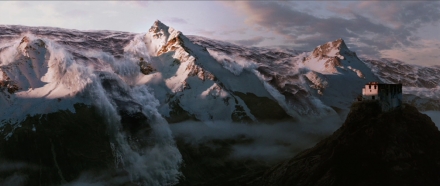
mega_tsunamiOne is inclined to be cynical about the credulous victims of the end-of-the-world hype that has been going around over the last few years. Yes, I have seen the film and I have the DVD in our collection. In it, terrible things were happening weeks and months before the three modern Noah’s Arks are launched in the mountains of China. The cinematographic effects are stunning! In our world, we have had some bad weather and unexplained phenomena, but nothing that would in itself cause the end of the world. However, for some, the recent hurricane Sandy on the east coast of the USA was the end of the world! People lost their lives, their loved ones, all their property…

What could “kill” our planet entirely? Plasma outbursts from the sun would annihilate our technology, sending us back a couple of centuries, but not us. That leaves us with being struck by a comet or a big meteorite. Experts in astronomy tell us that there is presently no such threat. We’re going to have a big comet to see next year, but it will remain a safe distance from the earth.

Planet X? I was brought up in the principles of the Enlightenment as are most people born in the mid twentieth century and before. If Planet X exists, someone must have seen it as such a big object – but they haven’t! Let’s be rational! There are no alien spacecraft hidden in our mountains. Was it not Chesterton who said “When people stop believing in God, they don’t believe in nothing — they believe in anything“?

So, life goes on, and the bills will still have to be paid on the 22nd December of this year. Some people will have tragically killed themselves – and brought on their own private ends of the world. Others will have spent all their money on what is offered by the most unscrupulous businessmen, as they will make money from anything. Others still will be driven into complacency by yet another failed prophecy.

Religious people often fit into the psychological profile of those who can only feel justified by persecution, such distorted eschatology or especially by the misery of others. Did not St Thomas Aquinas expressed that the joy of the blessed would be increased upon seeing the predicament of the eternally damned? It is probably the most damning characteristic of religion!

The end of the world we have to be concerned about is our own deaths, which will arrive faster than we think. We often allow ourselves to be distracted from wisdom by what is sensational, brash and loud, where reality is found within – in the waters of silence.

Yes, the end is nigh, but at the level of each one of us. It might be the painful lump in the body and the doctor shaking his head, plain old age or a banal car accident. The question is whether we will be terrified or serene…

Posted in Uncategorized | Tagged | 1 Comment

Ordinariate News

There is quite a lot of news on Foolishness to the world and Fr Smuts’ blog about the Ordinariates and the new Deanery in Canada. I have met Fr Wilkinson and corresponded with him a few times, and congratulate him on having been ordained to the priesthood by a Roman Catholic bishop.

The Ordinariate tends to be a “radioactive” subject on account of some persons on the Internet concerned for imposing their particular “truth” on others without any consideration of personal circumstances. At the same time, it brings me pleasure to learn of the fulfilment and joy of those who have made it though the system with their vocations intact.

I am glad it has worked out well for some, and the original vision has survived in microcosmic form. Reconstruction is happening.

Similarly, I expect the TAC to find a way to pull itself together and pick up the pieces, as expressed by the desires of Bishop Michael Gill in South Africa. Many terrible things have happened over this year, but yet we have to know what we want as individual priests with the bishops we have. The Armchair Inquisition might want to have them for breakfast, but life has to go on somehow. It isn’t all-or-nothing. Such is the mystery of life and our call to forgive others so that we ourselves may obtain forgiveness.

It is also interesting to discover that Peter Slipper has been cleared from the serious accusations against him. As many of you know, he was ordained a priest by Archbishop Hepworth. Some have seen opportunism in that act, but knowing Archbishop Hepworth as I have known him, I see more of a pastoral and fatherly concern, a capacity for cutting through the cancer of Donatism that has afflicted the Church since probably the beginning. Christ called it the leaven of the Pharisees. We may well be in for more surprises as time goes on.

Posted in Uncategorized | Tagged , , , | 2 Comments

Ebbing of Christianity

I have been reading a number of articles about the ebbing of Christianity, the default position of people born since 1980 as agnostic or atheist and the surge of Islam. The various analyses are interesting and more or less convincing. Official Anglicanism is characterised by an increasingly feminised clergy and theological liberalism. In Roman Catholicism, especially here in continental Europe, the real problem is the lack of priests and the declining availability of an incarnational and sacramental life. That is particularly felt in the country parishes.

So is the solution biblical or canonical fundamentalism? They may be for some people, but young people of today are not looking for authority and more control, but rather are running away from it.

It is curious to read about persecution of Christianity from atheists, and at the same time about persecution of atheists from Christians. How strange that it seems to be a point of view! I have said it before. There is no persecution in the western world. No one is being killed or put in prison for their faith or lack of it. People call themselves persecuted to legitimise and justify themselves. They take the gay marriage issue so personally, but it is not a religious issue but one concerning purely the civil law. Indeed, churches which are against gay marriage are not only not forced to carry out such ceremonies; they are not allowed to do so. It’s easier over here in France with the separation of Church and State. The State can do what it wants and the Church is not forced to celebrate any kind of marriage. I am not really convinced that persecution has arrived, but it might come if the bishops and priests provoke a reaction. Quite frankly, I don’t care what people do in civil life as long as they don’t pretend it’s a Sacrament!

Propaganda is put out according to which most people would be for women priests and the normalisation of homosexuality in the churches, and for married priests in the Roman Catholic Church. Is that true? At any rate, something is being missed in this hubbub of moralising. It is interesting to see how Roman Catholics fear persecution because of clerical sex abuse. It won’t be persecution but justice for centuries of clericalism! The disregard for human beings has gone on for long enough.

There is one thing that could regenerate churches: religious communities in the parishes, urban monasteries and the beauty of liturgy and prayer. That is something done in France for decades, even when they are using more “modern” forms of liturgy. France is one of the most godless countries on this earth, but where there is beauty, liturgy and prayer, people will go to those services. Even in traditional isolated monasteries, people will get in their cars and travel to a Mass in Latin with Gregorian chant.

Will our western world become Muslim? That is what many of us fear. If that happens and the ruling Muslims are of the fundamentalist and intolerant kind, we would be persecuted, as would people who are not religious. As with fundamentalist Christianity, that kind of religion would never attract me any more than most of our contemporaries, baby boomers or generation X’s.

I begin to take an attitude that consists of saying that if Christianity has outstayed its welcome, then it will fade away. Perhaps it faded away centuries ago to be replaced by grotesque caricatures, and what there is left deserves to pass out of history. Perhaps my attitude changes as I get older and find it increasingly difficult to relate to the younger generations. Were not the roles inverted when I was a little boy with my grandfather born in 1901? The world has been through many near-misses for Christianity. It wasn’t doing too well in France at the beginning of the nineteenth century in the wake of the Terror. There was also the anti-clericalism of Emile Combes and Jean Jaurès a hundred years later that also practically wiped out a Church that had already alienated the working class. It seems that the nineteenth-century Church had learned little from that of the eighteenth. I think that had I lived in those days, I would have become an anti-clerical or a Communist!

The lady doth protest too much, methinks. This is one of Shakespeare’s most hackneyed quotations from Hamlet, but how true in the case of the Church and Christians! Only today, I read that the Pope is telling people to go along with the magisterium and stop arguing for the usual stuff (women priests, gay marriage, etc.). On one side, I can sympathise, but authority is not the way. If this continues to be the way, the Papal Court of Benedict XVI could be in a similar position to the Court of Louis XVI in 1789. There is coiled up energy waiting to be released. I neither sympathise with an agenda that would bring about the American Episcopal Church on a world scale, nor with a resurgence of the Church of Pius IX and Ultramontanism. Outside the two binary poles, very little seems to remain. What an epitaph!

The future does seem bleak and incomprehensible. I think we will lose our culture, and much of it is already lost. There will be darkness, but a darkness that will herald the coming of new light.

Posted in Uncategorized | Tagged , | 7 Comments

A New Model of Church?

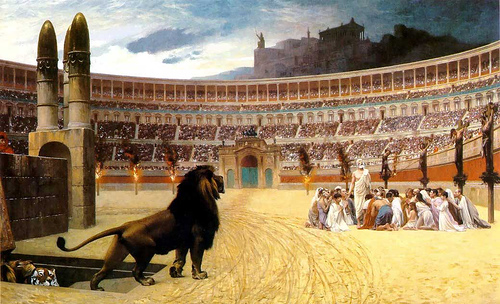
christian-persecution

This is an interesting article from the Catholic Herald: Catholics today could see the birth of a new model of Church. Mass media seems to have changed everything, especially the Internet, blogs and social networking. Freedom of the press indeed, not only of professional journalists but also of anyone able to write!

I have also noticed this explosion of new means of communication, and at the same time our increasing inability to dialogue rationally. Evidence of that is the current conflict in the Anglican world, not over the ordination of women, but the tolerance of diversity in the Church and society. Are our computers becoming Orwelliam telescreens? Some would say – Of course, what else? As a blogger with some experience, the freer we are in our writing, the more we will be shot down by the pensée unique in the comment box – or at least someone’s political correctness.

Dialogue with the world? That is my life as I often do not meet a priest or even a believer from one week to the next. I was discussing the same-sex marriage issue with my wife the other day, and her instinct was quite surprising. Who cares as long as they don’t try to make a “sacrament” out of it? It could be more complex in England for Churches to refuse “sacramental” same-sex marriages, but here in France, we have  civil marriage as in required by the law before going to be wedded in church. No priest or religion in France has the legal powers of a civil registrar as does a local Mayor or one of his or her deputies. Of course, in civil same-sex weddings, there is the question of children, which is a hard one. I don’t pretend to solve that one here.

The trouble is that there is no dialogue, simply the imposition of opinions and the dominant version of political correctness. All that is left now is violence or for the Church to relinquish its public profile. We now have “dogmatic” secular liberalism and religious fundamentalism, one against the other and very little else. I know just about zilch about modern educational methods, since my wife and I have not been able to have children and send them to school. But, one thing that is said and written is that children are not taught to reason, but rather to react emotionally to slogans and turn their back on the culture of the past. I’m not that old – we got Bible stories in school when I was little, and my schoolmaster was most insistent on the correct use of words and language. Now, it seems that the kids no longer get Bible stories, English grammar or very much else.

What’s going to happen to the Church? Well, there are historical precedents: the French Revolution and the Anti-clericalism of the late nineteenth century to World War I. Churches were expropriated and monks and nuns forcibly run out of their monasteries in the 1900’s. There seems little need of that, for the Church has been persecuted and run down by its own over the past forty years. With the influence of “brick-by-brick” Benedict XVI, we seem to be getting a resurgence of intégrisme, regardless of the rite of the liturgy. Catholicism with teeth and an identity, but with how many real faithful? That is what I observe with the traditionalists and conservatives, the zealots and the bigots, and quite frankly a model of Christianity that does not attract me.

A small and elite church? That seems to be a goal of both the secular humanists and the integral Catholics, but will that influence the world? I give the question a lot of thought. As a priest, I’m afraid I amount to very little. My own opinion matters very little, but I am concerned about the future being formed by the clash of relativist and fundamentalist ideologies. Such is not the kind of Church I would ever want to join. I would prefer to remain with the marginalised and unchurched of this world.

If the “official” Church decided to shed its “old skin”, it would not only be painful but also would remove any distinction between the “real” Church from its vagante competitors! Malachi Martin, in one of his books, prophetically suggested that if the Church lost its standing at the green-topped tables of power, the Pope would find himself relegated to a status similar to that of the Dalai Lama and lesser religious leaders. In a certain way, the new model of Church already exists, but perhaps not one envisaged in Rome in the early 1960’s. It will be a Church that will no longer be able to rely on truth, because “truth” would be the monopoly of “Big Brother”. Thank goodness for post-modernism!

All that will remain will be the ability to re-enchant and make outsiders say – “Look, how the Christians love each other!

Posted in Uncategorized | Tagged , , , , | Leave a comment

Sarum Sequence for the Second Sunday of Advent

Sequence for the Second Sunday of Advent (translated by Canon Warren).

Let the choir devoutly bring
Welcome to th’ eternal King,
And with one consent renew
The Creator’s homage due.
Him angelic legions praise,
On his face enraptured gaze.
On him wait all earthly things
Till his nod their trial brings.
Awful he in judgements deep
Yet in might doth mercy keep ;
By thine agony of woe
Pity, Lord, and save us now.
To the gleaming stars on high
Raise the world in purity :
Let thy saving health appear
Scattering perils far and near.
Bid the universe be clean,
Let us live in peace serene.
Till unto those realms we soar
Where thou reignest evermore.

Posted in Uncategorized | Tagged , | Leave a comment

The Conception of the Blessed Virgin Mary

Use of Sarum, translated by Canon Warren

The Conception of the Blessed Virgin Mary.

At Mass. Office.

Let us all rejoice in the Lord, celebrating this feast in honour of the virgin Mary ; over whose conception angels rejoice, and praise the Son of God.
Ps. My heart is inditing of a good matter : I speak of the things which I have made unto the king.

Glory be to the Father etc.
Gloria in Excelsis is not said.

Collect.

O merciful God, hear the supplication of thy servants ; that we who are assembled together on the conception of the virgin mother of God, may through her intercession be delivered by thee from the dangers which beset us. Through etc.

Epistle. Ecclus. xxiv. 17 — 22 (Vulg. 23 — 31).
As the vine . . . shall not do amiss.

Gradual.

Hearken, O daughter, and consider, incline thine ear. So shall the king have pleasure in thy beauty. V. According to thy worship and renown. Good luck have thou with thine honour. Ride on.

Alleluya. V. The conception of the glorious virgin Mary, of the seed of Abraham, of the tribe of Judah, of the bright root of David.

Sequence.

Let us celebrate this day
whereon piously we say
Mary was conceived.
Begotten is the mother maid,
conceived, created, channel made
of pardon to the world.

Adam’s primeval banishment
and Joachim’s own discontent
there find a remedy.

This the prophets have foreshown,
this was to the patriarchs known :
the virgin whence a flower should spring,
the star which forth the sun should bring,
on this day is conceived ;
the flower which from the rod should bloom,
the sun which of the star should come,
is Christ interpreted.

O how happy, O how fair ;
sweet to us, to God how dear,
hath this conception been !
Misery now is at an end,
mercy doth on earth descend,
for sorrow joy is seen.
A mother new new offspring bears,
from a new star new sun appears,

new grace doth all inspire ;
The mother bears the generator,
the creature brings forth the creator,
the daughter bears the sire.

O unexampled novelty !
O new, unheard of dignity !
the mother’s holy chastity
The Son’s conception shows.
Rejoice, O gracious virgin mild !
fair rod with blossoms undefiled,
mother ennobled by her child,
Such grace no other knows.

That which lay hid, in figure sealed,
by clouds mysterious concealed,
the future mother hath revealed.
For once a virgin pure and good
reversed the laws of motherhood :
nature, surprised, beheld a flood
of deity outpoured.

Whoe’er thou art, without delay
open thy lips, her praises pay ;
offer her homage, to her pray,
at every hour, on every day.
With swelling voice, with spirit sage,
by supplicating prayer engage
a portion in her patronage.

Thou of the sad art comfort sure,
true mother of the orphans poor,
of the opprest the help secure,
thou of the sick the healing cure,
all things to all thou givest.
With one consent we ask of thee,
whom praise awaits especially,
conduct us wanderers o’er this sea
unto salvation’s port, where we
by grace may be at rest. Amen.

Gospel. St. Matt. i. 1 — 16.

The book of the generation . . . called Christ.

Creed.

Offertory.

Full of grace are thy lips, because God hath blessed thee for ever.

Secret.

O Lord, let the human nature of thine Only-begotten one succour us ; that he who being born of a virgin diminished not, but sanctified the chastity of his mother, may free us from our offences on the festival of her conception, and may make our oblation to be acceptable to himself, Jesus Christ our Lord. Who liveth etc.

Preface.

And thee on the conception etc.

Communion.

True faith in thy Son hath purged the sins of the world ; and thy virginity abideth immaculate.

Postcommunion.

Grant, we beseech thee, O Lord, that through the intercession of the blessed ever-virgin Mary, the sacrament which we have received of our bounden duty on this annual celebration, may afford us relief in life both temporal and eternal. Through etc.

Depart, the mass is finished, is not said.

Posted in Uncategorized | Tagged , | 42 Comments

Sea of Faith

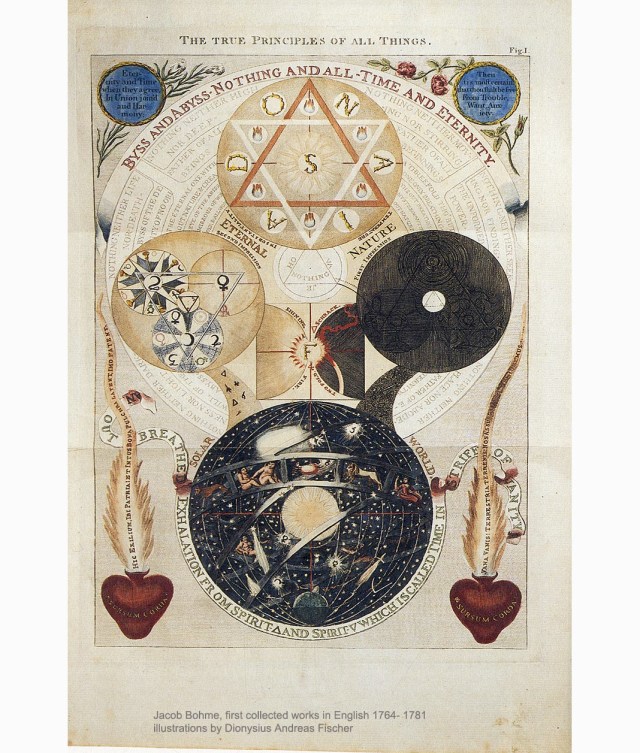
boehme_ungrund

This morning, my enquiring mind has been poring over various texts concerning post-modernism and what it is generally understood to be. I try to synthesise everything in my mind and express something coherent.

Continue reading

Posted in Uncategorized | Tagged , | 3 Comments

What Happened to St Aidan’s Des Moines?

The article By The Way, What Happened To St Aidan’s Des Moines? asks a question about the continuing existence of this parish of the ACA Diocese of the Missouri Valley. Archbishop Louis Falk was there, but is he still there? Is this parish still a part of ACA / TAC jurisdiction? It is not on the Diocese’s official list of parishes. Do any of my American readers know what has happened?

Posted in Uncategorized | Tagged , | 25 Comments

Fraternity of Saint Osmund

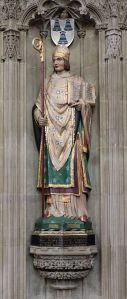
osmundI am launching an idea for a dispersed community of prayer for those who wish to live a life inspired by the Rule of St Benedict and the idea of the Secular Oblature. It is not a monastery, nor is it anything pretending to be an ecclesiastical jurisdiction, but in reality a name given to the concept of the New Goliards. The idea is fundamentally no different.

All I would like is to build up a spiritual community of lay people and priests committed to giving their name and commitment to the common ideal and a regular cycle of prayer and intercession. We might sometimes correspond about a spiritual question or a way to live according to the Holy Rule in our state of life. Otherwise, we would live in solitude and offer our lives in prayer following the liturgical cycle as expressed in the Office. Such a life would also give meaning to priests who find themselves living a solitary life through vocation or circumstances in life – and especially to their daily celebration of Mass even when no congregation is present.

This Fraternity would be open to lay folk (men and women) and priests whether or not they belong to a recognised institutional church body and whether they are married or single. All that is demanded is that all have been baptised and that those claiming to be priests have been ordained by one conventionally known to be a bishop. I would not be in a position to judge the objective validity of a priest’s orders, preferring to leave him to continue to celebrate Mass and his ministry of intercession. The Fraternity would not be in a position to give any canonical mission, or faculties to hear confessions outside situations of danger of death.

To belong to this Fraternity, I would appreciate knowing something about the person in question and the history of his life and sacramental Christian commitment. I also need to point out that there is no provision for the ordination of those aspiring to the priesthood. This Fraternity would be prepared to find its place in due time in an established ecclesial body. Each member would commit his or her self to the Fraternity’s intercession list and the daily recitation of the whole or a part of the Divine Office according to any breviary or prayer book and in any language. I would also want an e-mail from each member at least once a year.

There would be no habit or any obligation to travel anywhere for retreats. Instead, members would receive texts on the Rule and traditional monastic spirituality, and may send e-mails to a private e-mail list to be established using software like Outlook – no need to use any web-based forum. I am open to suggestions, but I don’t want to “codify” anything in the absence of a reality, if you get my meaning. If no one is interested, then it will just be an idea to be scrapped, and I would simply continue with my little life waiting for God’s will.

If anyone is interested in a serious commitment before God, the comment box is not the place to express such an interest. They should send me a private e-mail to anthony.chadwick AT wanadoo.fr.

Posted in Uncategorized | Tagged , , | 1 Comment