What Happened to St Aidan’s Des Moines?

The article By The Way, What Happened To St Aidan’s Des Moines? asks a question about the continuing existence of this parish of the ACA Diocese of the Missouri Valley. Archbishop Louis Falk was there, but is he still there? Is this parish still a part of ACA / TAC jurisdiction? It is not on the Diocese’s official list of parishes. Do any of my American readers know what has happened?
Posted in Uncategorized | Tagged , | 25 Comments

Fraternity of Saint Osmund

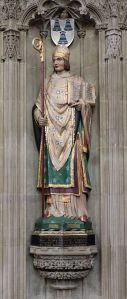
osmundI am launching an idea for a dispersed community of prayer for those who wish to live a life inspired by the Rule of St Benedict and the idea of the Secular Oblature. It is not a monastery, nor is it anything pretending to be an ecclesiastical jurisdiction, but in reality a name given to the concept of the New Goliards. The idea is fundamentally no different.

All I would like is to build up a spiritual community of lay people and priests committed to giving their name and commitment to the common ideal and a regular cycle of prayer and intercession. We might sometimes correspond about a spiritual question or a way to live according to the Holy Rule in our state of life. Otherwise, we would live in solitude and offer our lives in prayer following the liturgical cycle as expressed in the Office. Such a life would also give meaning to priests who find themselves living a solitary life through vocation or circumstances in life – and especially to their daily celebration of Mass even when no congregation is present.

This Fraternity would be open to lay folk (men and women) and priests whether or not they belong to a recognised institutional church body and whether they are married or single. All that is demanded is that all have been baptised and that those claiming to be priests have been ordained by one conventionally known to be a bishop. I would not be in a position to judge the objective validity of a priest’s orders, preferring to leave him to continue to celebrate Mass and his ministry of intercession. The Fraternity would not be in a position to give any canonical mission, or faculties to hear confessions outside situations of danger of death.

To belong to this Fraternity, I would appreciate knowing something about the person in question and the history of his life and sacramental Christian commitment. I also need to point out that there is no provision for the ordination of those aspiring to the priesthood. This Fraternity would be prepared to find its place in due time in an established ecclesial body. Each member would commit his or her self to the Fraternity’s intercession list and the daily recitation of the whole or a part of the Divine Office according to any breviary or prayer book and in any language. I would also want an e-mail from each member at least once a year.

There would be no habit or any obligation to travel anywhere for retreats. Instead, members would receive texts on the Rule and traditional monastic spirituality, and may send e-mails to a private e-mail list to be established using software like Outlook – no need to use any web-based forum. I am open to suggestions, but I don’t want to “codify” anything in the absence of a reality, if you get my meaning. If no one is interested, then it will just be an idea to be scrapped, and I would simply continue with my little life waiting for God’s will.

If anyone is interested in a serious commitment before God, the comment box is not the place to express such an interest. They should send me a private e-mail to anthony.chadwick AT wanadoo.fr.

Posted in Uncategorized | Tagged , , | 1 Comment

North End Celebration

It is quite surprising to encounter interesting things in old Anglo-Catholic literature like this chapter on the Eastward position from 1912. In it, we find many of the arguments used in the 1960’s (and before and afterwards) for reordering churches to make celebration facing the people possible. I have often defended the eastward position by referring to scholars like Monsignor Klaus Gamber, Louis Bouyer and the present Pope. Liturgical archaeology more strongly defends the eastern position than the idea of making the celebration more visible for pastoral reasons by facing the people.

Some conservative low-church Anglican clergy still use what is called north-end celebration. Here is a photo a reader sent me of one of the clergy of his ACA diocese somewhere in the USA.

north-end

Dressed in cassock, surplice, tippet and Canterbury cap, he is positioned at the side of what appears to be a solidly built wooden table (a through mortice and tenon joint is seen on the visible leg). The table is up against the wall of the room he is using for his church.

North-side celebration (sometimes called north-end celebration) is an application of the English legalist spirit to introduce the Eucharist facing the people, because the communicants (there were few of them in those days) had sat on the other side of the table, which was positioned in the middle of the choir in the lengthways axis of the church.

The Altar’s North Side and its comments are worth reading.

Since about the seventeenth century, the practice of moving the communion table from its place where the old altar stood and placing it in the choir of the church for a Communion Service fell into desuetude (as was even ordered by Archbishop Laud). The Prayer Book continued to direct the priest to stand at the north side (which had by now become the end). As the eastward position was an issue in the nineteenth century with the Ritualists, we can assume that the rule was north-end celebration until the eastward position became more or less accepted in the early twentieth century.

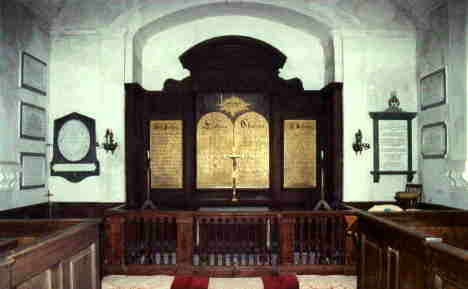
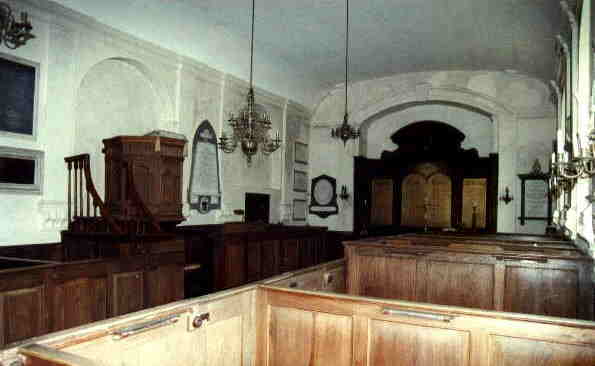
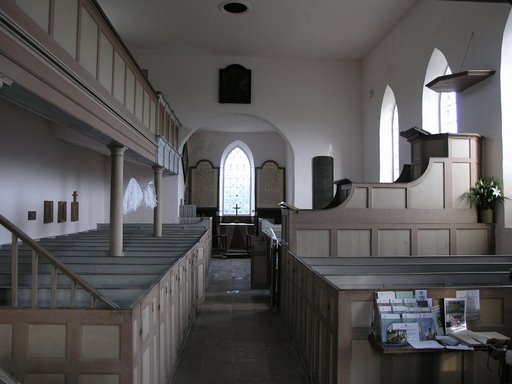
Here are some images of pre-Tractarian churches:

pre-tractarian1

pre-tractarian2

pre-tractarian3

There are many more fine examples in England, and probably also in America. These two churches have their communion tables where the altar stood (assuming they were re-ordered pre-Reformation buildings, though I suspect that both are Georgian).

I have seen north-end celebration as late as the mid 1970’s at the parish church of St Thomas, Kendal, where I was baptised in October 1959. It is a strongly Evangelical parish, and the last time I visited this church, it had an altar table facing the people. In the 1970’s, the altar (wooden with solid panels in the front and sides) was still up against the east wall and had a plain brass cross and no candlesticks. On each end was a little reading desk, like a missal stand. The vicar would be at the north end, and the assistant curate of the parish knelt at the south end, as there was a kneeler for this purpose.

There are few churches in England still in their pre-Tractarian arrangement, but some remain like Hailes in Gloucestershire. That church has been re-ordered in a more Catholic direction, but older photos and plans show the table in position between the choir stalls, indicating the true meaning of north-side celebration for the sake of facing the people.

Posted in Uncategorized | Tagged | 16 Comments

Use of Sarum in Toronto

I have just discovered this video, though it has been around for a while. The liturgy in question was celebrated in St Thomas Anglican Church in Toronto, Canada.

Some of the comments are quite waspish:

Good effort, but trying to do UoS in a modern church building is like trying to play golf on a tennis court.

On the other hand, you can play tennis on a golf course, and celebrate the Sarum liturgy in a cathedral or a village church, or even my chapel. I find that church in Canada most suitable.

Naturally, the use of female servers is criticised by some. That is perhaps the most significant anachronism. This is however something that makes me think that this was not a museum reconstruction but “extraordinary rite” worship in a real parish setting.

For all the faults in anything that is human and imperfect, this is a laudable effort at reviving the Sarum liturgy in practical terms.

Now, if anyone could point us to a full video of this ceremony…

Posted in Uncategorized | Tagged , , | 8 Comments

Spiritual Loneliness

It can happen to all of us when we are disconnected socially from other church people and far from our bishops, brother priests, etc. Like many others, I have lived through the events concerning the Traditional Anglican Communion. It is tempting to become bitter or to look to the general decline of Christianity for self-justification. I won’t say what has inspired me to write this little reflection, but it is important to get good and positive thoughts out. I would have an excuse to be sad in this Stygian gloom of Advent in the northern hemisphere, but there are many beautiful things about winter and late autumn too!

Like many others in the world, I have very little in the way of pastoral ministry. I have spent time trying to analyse the reasons why. It is largely a question of “market” and what people look for. Essentially, they want baptisms, marriages and burials with very little commitment. On the other hand, they cannot be expected to be committed to parishes that are all but in theory abandoned by the local diocese that doesn’t have enough priests to go round. Some people will go to the Protestants, Evangelical communities (imported from the USA, they are growing) or non-Christian religions. The others lapse into agnosticism. There is a category of more or less marginalised people, generally “lower middle class” who appreciate a more “superstitious” kind of Christianity with more “paganism” in it. France being a nation of hypochondriacs (Napoleon called us Brits a nation of shopkeepers!), there are plenty of people looking for exorcisms and faith healings that they won’t find in the average Novus Ordo parish. This latter category is usually the target market of independent sacramental clergy, who often find they reap a tidy profit from it. It is also possible to advertise oneself as a substitute for Rome to appeal to the divorced and remarried and other “tolerances”. I refuse to go that way, though I treat people as persons loved by God on an individual basis and away from prying eyes and bandwagon ideologies.

In this country, one does very badly with advertising, knocking on doors and all the gimmicks. However, in a certain way, the way ahead is within ourselves. This is why I believe that many of us are called to be contemplatives even though we cannot be monks on account of being married and not living in a proper monastic community. When I think of the average isolated layman several hours by car from the church where he goes whenever he can make it, I have daily Mass in my own chapel. I have only to celebrate it – with the chapel door open (or at least unlocked when it’s cold) and with the intention of being in communion with the whole of Christ’s Church, both visible and invisible.

Many holy men, the Curé d’Ars for example, wanted to go away and be hermits, to be alone with God. God wanted him to be a parish priest, and he died in his parish at his post. St Sergius of Radonezh wanted also to be alone, but monks followed him into the wilderness and pestered him to become their Abbot and spiritual father. It seems strange to be hankering after the opposite.

I think I have mentioned it before about the Chinese saying – When there is peace in the heart … family … town … county … country … continent … the whole world. How true. The contemplative life is the first step – keeping everything going on our own: the chapel, vestments, sacristy, keeping everything maintained and clean, daily Mass and Office, being kind and tolerant with people, praying for people, being kind to animals and respectful of the environment (yes, it is part of spirituality). Next, being good to our wives even if they are little interested in religion or “traditional” religion and all our non-believing and non-practicing friends. Perhaps, if we have peace, they might sense that and ask themselves why – but we haven’t to bank on it. Give without counting the cost, do good without seeking a reward. Isn’t that the message of Jesus, St Francis of Assisi and so many others?

Then we just do what we can where we are. I just ask your prayers for this poor sinner!

Posted in Uncategorized | Tagged , | 4 Comments

Conservatism and Progressivism

The whole modern world has divided itself into Conservatives and Progressives. The business of Progressives is to go on making mistakes. The business of the Conservatives is to prevent the mistakes from being corrected.

G.K.Chesterton

Posted in Uncategorized | Tagged | 1 Comment

Liturgy and Maturity

I reproduce this text with some reservation as it comes from the Australian Catholica forum, situated in the radical progressive perspective. Yes, they are for the ordination of women and LGBT people, yes, just like ECUSA. I’m not endorsing or approving this forum, so I don’t want criticisms from conservatives for having given links to it. As always, you are all adult readers and you have the responsibility for what you read and how you react to it. I refuse to assume the role of a nanny!

That being said, the man in charge of this blog, Brian Coyne, often has very interesting reflections, and not least about the liturgy. Is he into coffee-table eucharists, or is he moving beyond that stereotyped style of the 1970’s? I have no idea.

Here are Mr Coyne’s reflections about human maturing and the role of the liturgy. When you have read them, I suggest re-situating them in the context of the thread.

* * *

Three ideas come to my mind in response:

  • Liturgy as an emotional doorway into something more profound: A “Way” of approaching Life

    The maturation of the human person from the lizard brain we are born with to the self-individuated mature adult is a slow process. Our interaction with the world as new born babes is primarily emotional as opposed to intellectual. My sense is that spiritual maturity follows the same pathway that is seen in physical, emotional and intellectual maturation. It is a long and slow process. Spiritual maturity is possibly the most extended of all the maturation process in that it occurs over an entire lifetime. We are probably, if all has gone well, at our most spiritually mature shortly before we die. Physical maturation appears to occur most quickly with the child turning into a physically mature individual somewhere between the ages of 16 (possibly even 14) and 20.

    Researchers tell us today that the maturation of the brain takes about 25 years. I speculate that emotional maturation probably takes half a lifetime with, perhaps, the so-called mid-life crisis being some sort of marker to the end of the process of emotional maturation. Of course there are some individuals who break all the rules, or the normal indicators and either mature much earlier — and it would seem some never mature at all. That is to be expected from what we now understand of the Guassian distribution curves which tell us about most, if not all, behaviours and characteristics about life.

    It seems to me that spiritual maturation is not only the lengthiest process but it possibly even starts much later in the life journey. It is dependent in a sense on a certain level of emotional and intellectual maturity before it can really get underway. Hence we educate our children in the fairy tales both for their social development and also as a tool for their early spiritual development. The emotional commitment, later in the journey — through such things as liturgy — I would argue is an important precursor to the individual developing some more intellectual sense of what Jesus Christ, or their religion, might do for them in the betterment of their lives. Liturgy can be short-circuited though to provide an emotional fulfilment as the end objective in itself without having an eye to any further objective (such as pointing the individual to how the thinking or example of Jesus might improve their lives). The Liturgy becomes important for the “emotional high” that it gives the person participating in the liturgy and carries not much further into their lives other than they need to return to the “spiritual filling station” next Sunday to obtain another emotional high. In other words the liturgy has effectively no effect on their moral maturation except in a very kindergarten-level sense of “obeying the teacher” rather than being “guided by the Divine” and learning how to think and “follow one’s own conscience”.

  • Liturgy is not time bound to a particular cultural or emotional style

    There seems to be a belief in some, including in our present leader, Benedict, it seems, that liturgy is something of some “higher order” than the other “signage and symbolism” that we need and use in our lives. It has to be “solemn, serious and classical” to be “sacred” as though some it is the pomp, solemnity and high-brow nature of the ritual that makes it sacred or pleasing to God. God only likes the art produced by Mozart and that produced by the likes of Bob Dylan, Justin Bieber, or Missy Higgins, or the film makers who have put together (for example) “Redfern Now” is somehow profane and is incapable of leading a person to any divine insight.

    It’s a furphy of course. A total misunderstanding of the communication process and the role of liturgy in the entire endeavour of spiritual maturation and learning “to think, and behave, like God”. I doubt anyone on the entire planet is capable of communicating any of this to the likes of a Benedict-Ratzinger, a Raymond Burke, or the people who congregate at Latin Masses. They all know “what worked for them” as 12 year olds or 16 year olds … they all know what worked to make them enthusiastic enough to sign up for seminary … and they sincerely believe that if only they can implement “what worked for them” half a century or more ago in the whole church it will lead to the eventual re-evangelisation of the whole of humanity.

    Liturgy is not primarily an exercise in giving people “emotional highs”, whether they’re into the music of Mozart, Dylan or Missy Higgins. It is the entré point to spiritual maturation and growth.

  • The societal trend towards isolation and small groups but with a need to express ourselves as belonging to some universal family

    One of the interesting trends in society on the big canvas is the way we are becoming more and more socially isolated. Technology is partly driving the trend. We don’t go to dances anymore, or even the local picture shows that were once common in every little town across this nation. We can be fully entertained in our own homes, or our motor cars, without having to venture out — and in ways that were not able to be even dreamed about even a few decades ago in terms of audio-visual and creative quality. It is not just churches, but political parties and all manner of social organisations that are having a huge battle today drawing people away from their television screens, or even their mobile screen now, to engage in the endeavours that “build a sense of community”.

    Paradoxically, I pick up a sense that as this “social isolation” continues there is also a countervailing sense in the majority of individuals to express some sense of “belonging to something bigger”. There is this countervailing sense buried deep in the human spirit that is constantly “wanting to get out and express itself” that “I am part of the human family — I want to help build, or be part of, a better world”. This, I think, is what gives rise to the growth of what I call “secular liturgies” as the churches have retreated as the prime suppliers of liturgy in people’s lives. There is a desire in every person, it seems, to want to have membership of “something bigger”. There is still a desire to “congregate” and these various “secular liturgies” — from the entertainments put on in modern shopping places (what have been dubbed “the cathedrals of the 21st Century) to the global scale of the Opening and Closing ceremonies of the Olympics — have become some sort of replacement for what the churches once provided.

    (…) This leads me to trying to answer your end question, Tony. I sense the trend is moving away from Sunday liturgies and a sense of geographical (parish) communities to much smaller groupings (and possibly widely spread geographically BUT, at the same time, there is still a hunger for much larger physical-space liturgies albeit held less often — perhaps only once a year or even only once ever few years. Whatever emerges as the social answer to the spiritual needs of humanity in the future will, more than probably, follow that trend which seems to be emerging.

Posted in Uncategorized | Tagged , , | 2 Comments

John XXIII, the Old Catholic Pope?

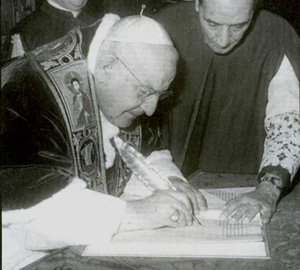
johnxxiiiMy attention was drawn to this article on an ultra-traditionalist website. Naturally, the ultra-traditionalists, sedevacantists or whatever, intend to express the idea that Vatican II was set up against the reactionary position of Pius IX and the definitions of Vatican I. Therefore Vatican II was set up to break with the “hermeneutic” of tradition and continuity.

I read this article differently. If the facts reported in the article are true, John XXIII aligned himself with the Vatican I minority who were either “inopportunists” or became Old Catholics. From thence comes the provocative title of this posting. My own definition of Old Catholicism would be something like Catholicism without any pretension to absolute authority of a single Bishop, doctrinal infallibility or claim to temporal authority over secular leaders – and with an ecclesiology of a kind that would be compatible with dialogue with Eastern Orthodoxy.

The central thesis of this article is that Vatican II was convened explicitly against Vatican I. Afterwards, Paul VI tried to moderate the “rupture” by appending notes (nota praevia) to the Constitution Sacrosanctum Concilium to save the Papal prerogatives in matters of dogmatic teaching and governance of the Church. It’s an interesting hypothesis.

The questions of particular interest to the author of the article are the temporal authority of the Pope, a remainder of the old medieval Papacy of characters like Boniface VIII and others, and upheld by Pius IX in the nineteenth century. John XXIII introduced an opposition to the old militant and triumphalist spirit to affirm the Church as mater et magister, mother and teacher.

One of the common policies of the Vatican after 1975 – when a strong reaction against the Council became public and accelerated – has been to try to link Vatican II to Vatican I in order to give legitimacy to the former. It was for this reason that John Paul II beatified John XXIII together with Pius IX. This is also why we sometimes see the Vatican adopting “conservative” measures. And it is for this same reason that Benedict XVI is now insisting on the “ hermeneutics of continuity.” The goal of all these initiatives is to pretend the Council was not what it really was: a planned revolution in the Catholic Church that intended to destroy her and replace her with another completely different Church.

Of course that is how the traditionalists see it, but they don’t seem to be factually wrong in the light of the evidence they produce. The difference is that I see it from another point of view, Old Catholic. In a way Paul VI and his successors up to John Paul II represented an attempt to recover the continuity with the Piuspäpst Church against the original intentions of Pope John. Benedict XVI, to an extent, seems to mirror John XXIII in this episode of history from 1963 to 2005. But, let us not speculate any further about whether Benedict XVI is more in line with John XXIII or Paul VI…

The article continues by discussing the issue of Ostpolitik, which with John XXIII only reflected the policy of Pius XII in relation to the Nazis – keep quiet so as not to provoke a worse persecution of the Church by condemning the power in place as Pius V had done with Elizabeth I in 1570. That is another question.

Read the article, and I would be interested if readers can dispute the factual basis of the traditionalist article or offer a basis for constructive progress in this reflection.

* * *

Here are a couple of earlier articles of mine on Old Catholicism:

Posted in Uncategorized | Tagged , , , | 32 Comments

Another Kind of Imperialism!

No, this is not the British Empire or even the Great Invisible Empire of Romantia. I’ll just give you the link and recommend reading this fascinating paper.

Posted in Uncategorized | Tagged , , | 1 Comment

Retro-futurism

Over the past few days, I have been studying various forms of utopianism in what could be termed-post modern culture. I have often wondered what post-modernism is because the future of Christianity depends on being able to connect with the ambient culture and influence it with Christian ideas and values.

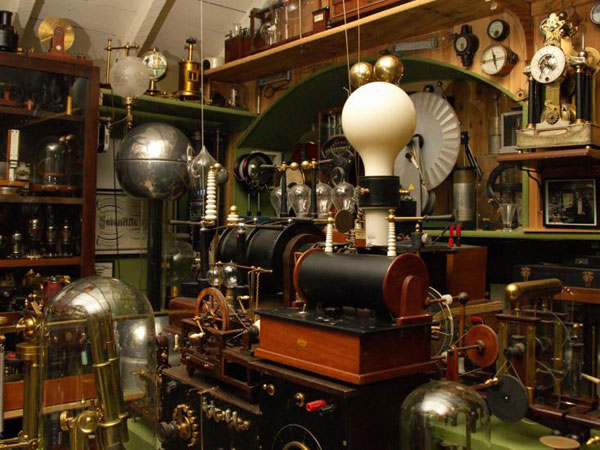
As I examined the Invisible Empire of Romantia, one of my readers mentioned that he was a steam-punk fan. This seemed odd for a serious kind of fellow concerned for conservative and anti-liberal ideas. I always thought that punk was something I saw in London in the 1980’s with horrible “music” and outlandish hairstyles and body mutilation. Now, with my discoveries, I discover the word “punk” used as a suffix to various words describing an aspect of artistic culture or technology. For example, we have steam-punk projecting Victorian styles onto modern devices, for example a Victorian style computer screen and keyboard. There is also diesel-punk, characterised by an image of a flying diesel locomotive from the 1930’s. See this article for explanations. This whole tendency of anachronisms in technology and culture came under the heading of retro-futurism.

There are two aspects, seeing the past from the future or anticipating the future from the past (the future’s past or our present). Back to the future or forward to the past… The most obvious use of retro-futurism is in cinema. Examples include Sky Captain and the World of Tomorrow, set in an imaginary 1939, and The Rocketeer set in 1938, both of which are examples of the genre known as dieselpunk. Both retro-futuristic trends in themselves refer to no specific time. We find fantastic visions of the future or an imagined “other” past – Star Wars exemplifies both characteristics.

Retro-futurism is nothing new as we find in the writings of Jules Verne and H.G. Wells as they projected nineteenth-century technology into the future or an alternative present contemporary with the author. Now it is rationalised and typified, it helps to understand instincts we don’t always understand, because escapism is a psychological reality. Perhaps we find traces of some kind of neo-paganism designed to channel the desire for the Transcendent outside of Christianity considered as no longer being able to convince and transform. Guénonian traditionalists tend to look more towards paganism than Sufi Islam these days.

This form of escapism or neo-mythology is not limited to cinema and art, but is also expressed in the design of devices in the home from computers, television, wireless to washing machines and furniture. Doing out your home in Victorian style would get you characterised as steam-punk. Doing the same thing in 1930’s Art Deco would be diesel-punk. It extends to clothing, but may only stop at externals and popular culture. The more interesting aspect is when it goes inwards, betraying a genuine disillusionment with modernism in culture, technology and philosophy in the minds of those whose goal in life is something other than money and mere pleasure.

How widespread is this manifestation of post-modernism? Is it something that can be used by churches? Am I a retro-futurist because I use the old Sarum liturgy? Perhaps this thing comes in degrees from a neutral and indifferent attitudes to fashion and the way of the crowd to complete enthusiasm. I have always had the impression of using this rite in the same way that a Milanese priest would use the Ambrosian rite as part of his normal ecclesial life. I have avoided being “self-conscious” about it. To misquote Fortescue – You have to celebrate Mass somehow. It doesn’t hurt to follow a rite. One rite is as good as another, but they reflect local cultures. I haven’t been particularly “authentic” with my chapel – I did what I could afford with very limited means – though I had a distinctly Arts & Crafts idea in my mind. Nothing could be less steam-punk than Arts & Crafts, since William Morris and his disciples rejected Victorian industrialism and the desire to build everything on a gigantic scale. Personally, I am little concerned for flitting between past and future as this self-consciousness itself is an aspect of modernity and an idea of the “end of history”.

It seems safe to say that most of us are probably ill at ease with the kind of ultra-modernism that makes us think of dystopian literature and cinema like Orwell’s 1984. Like the generations before us, we begin to fear the future as something we cannot control. We begin to wish the future would be like an idealised vision of the past. It has happened before with the Renaissance and medievalism in the nineteenth century. I can’t remember the quote, but it said something like – first time, great, but second time it is a farce. A Victorian revival in the twenty-first century, when the Victorian era was a romantic revival of the middle-ages combined with modernity? A revival of a revival? In art and music, we are afraid of pastiche, and young composers are only beginning to return to traditional harmony and counterpoint and still come up with something original.

It seems a game not to play in religion, though many of the tendencies will remain with us even if we do not exteriorise them. What should we revive next? Should we continue with ultra-modernism if you want to call it that? Already half a century ago, you had composers making random noises and calling them “music” and so-called artists throwing paint onto a canvas and calling it a masterpiece. The deception can only go on for so long. What we are looking for are not the particular expressions of particular eras but eternal values. I don’t give a damn about a computer keyboard make to look like a Victorian object or a CD player in what looks like a 1930’s wireless set.

What I do care about is grammar and proper use of words in a language, harmony and counterpoint in music, form and colour in painting and sculpture, doctrine and liturgical form in religion. There are eternal laws better observed in some historical periods rather than others. Bringing back these eternal laws and constants would be the greatest contribution to post-modernism.

Posted in Uncategorized | Tagged | 7 Comments