We Will Remember Them

They shall grow not old, as we that are left grow old:
Age shall not weary them, nor the years condemn.
At the going down of the sun and in the morning
We will remember them.

Posted in Uncategorized | Tagged , | Leave a comment

What Justifies our Existence?

What justifies our existence? By this I don’t mean our individual lives as human persons, but our continuing as priests, little sacramental Christian communities, or whatever. We often find ourselves in impossible situations like a boat in rough sea. There is always a way to survive… As priests, what have we to offer? This is a question I have been asking myself for the past couple of years. Will people go to hell without my saving them? I hardly think so. But, I might bring some consolation or happiness in a special or painful moment of life.

I wrote in Sessio and Missio that some Church bodies spend their time justifying their existence by trying to prove their canonical legitimacy in relation to the mainstream church that, in the Continuers’ estimation, lost that legitimacy. It is what some would call institutionalism. I believe we have to move beyond that vision of ecclesial existence to a more sacramental and spiritual basis. We often get so lost in technicalities, theological, liturgical or whatever, that people seeking the basics of Christian living get alienated.

Those of us who are married priests have only to ask our wives what they think!

Why be a priest? One is a priest for others, a pastor of souls. But there is not only the traditional parish ministry. There is also teaching, writing, blogging, taking part in ordinary life and trying to maintain a discreet Christian leaven. There is also the ministry of intercession through the Office and the daily Sacrifice of the Mass. The communal meal aspect of the Eucharist has been neglected in the past, but that doesn’t mean we have to abolish the Mass as a Sacrifice that metaphysically reconciles creation with the Creator. The sacrificial dimension of the Mass is enough to justify daily celebration, even if the priest has no congregation most of the time. The sacrifice and the community meal should be complementary rather than in opposition.

I read a lot about inclusiveness, for example of those some of us might consider marginal, but that alone is not enough. Inclusion has to be for a reason. I am opposed to churches being told they have to include this or that because it is someone’s political agenda. The Church is about spirituality and the common pilgrimage to the Kingdom. I am very concerned about ecology and doing something about the sea being polluted, but church is not the place for that. A part of our sailing club work is bringing people to appreciate the sea for sport, exploration, fishing or whatever – and then to participate in activities to promote environmental friendliness. Yes, it’s good for priests to get out of the sacristy and take part in life through work, play and social connections.

Like the sea for our sailing club, the metaphysical reality of God and our spirituality are for our churches. We can be relevant and justified in doing what we are doing insofar as we offer the spiritual and the transcendent as well as the immanent God. That is what I believe many people are looking for and don’t find in many of the mainstream parishes they look into on their way.

At one time, humanitarian work and the combat for human rights were the work of the Church. Not any longer. The Welfare State, public health services and social security have taken over. The system is highly bureaucratised and wasteful of resources, but it works better than the Church ever did. The churches no longer have the respectability they once had. They are starved of justification on the humanitarian and social front. Speeches about these matters by churchmen sound so hollow and devoid of meaning!

I think that independent sacramental churches have the relevance of being “pre-Constantinian”, relying solely on spirituality and the liturgical / sacramental life. No politics, no support from the secular authority, no way to force people to do or believe anything. One can try offering entertainment, but the TV does it better, and in the comfort of people’s own homes! The only way truth can be believed is by being credible. If this aspiration to the transcendental is not met, then people will not be interested.

If we are justified in continuing as priests outside the official canonical churches, themselves closing down at a rate of knots here in Europe (and I suspect elsewhere too), it is because we offer bread instead of stones, eggs instead of scorpions. If we cannot do that, then we might as well join the hundreds of thousands of laicised RC clergy, bitter souls for the most part. If we welcome the wounded, we have to do more than share their anger, but rather help them and ourselves to turn over a new page.

A fact we have to accept is that lay Christians find it much easier to stay in the mainstream than us clergy. That is why independent sacramental churches have higher numbers of clergy or candidates for ordination than laity. Is our purpose seeking out those who have canonical impediments in the mainstream churches? We have to remember that people can be wrong and justly punished for an offence against the Christian community. Having more open criteria for ordination cannot in itself be a justification for a church, for the obvious reason that some candidates for ordination are truly unsuitable.

One possible justification for the independent sacramental community is being a kind of “palliative ward” for clerics waiting for reconciliation with the mainstream Church they left. It takes a long time to get a response to one’s letter to the Congregation for the Doctrine of the Faith, endless wranglings with canon lawyers to get them to plead mitigating circumstances, and so forth – yada yada. In the end of the day, if being in the official Roman Catholic Church is truly an imperative, you just go as a layman and do what they say (or don’t bother saying). We have indeed to ask ourselves why we got ourselves into the situation we are in. Were we looking for God’s Kingdom or something else? This is how I have been made to think it all out through my experience with Archbishop Hepworth and the TAC.

The experience some of us go through, at least those who resist the temptation to bitterness, brings us to consider that Christianity has diversified over the centuries for a good reason. There are the sacramental Churches and the ecclesial communities of the Reformed tradition in its myriad interpretations. I begin to see this diversity positively. My father is deeply agnostic and critical of religion, but he has befriended a Unitarian minister. My father speaks very highly of their universalism and openness, as well as their sincere spirituality. I have had wonderful conversations with Methodists and with a few of the more open-minded Evangelicals. In the independent sacramental world, I discover a new tendency, the resacramentalisation of the Unitarians, Methodists and Congregationalists. In the contemporary world, there are so-called emerging churches, à la McLaren. I have read McLaren’s Generous Orthodoxy, and find real inspiration and sincerity in it. After all, it is a Catholic movement as happened in the Church of England, the Lutherans and even some of the Swiss Reformed churches.

It is a wider vision of the Oxford Movement, as it reaches beyond the national church and its institutions and embraces the diversity that was born of necessity in different times of history. Some speak of Free Catholicism as a reflection of the free churches of the Reformation. The great figure is this tendency was Ulrich Vernon Herford (1866-1938). He had been a Unitarian minister, and thus brought his experience and theological perspectives into a Catholic vision. I have been writing about Christian Anarchism recently, and this is all part of a new post-modern inspiration.

What I see in this is an aspiration to freedom, freedom of the spirit as Berdyaev put it. The emphasis is shifted from authority and jurisdiction to the shared belief in the sacraments as vehicles of divine grace. It is a spiritual approach of those who are for so many reasons alienated from the mainstream church, which are in the process of closing down though being unable to afford to maintain their infrastructures and institutions.

If a church bases is communion on relationships and friendship rather than laws and official agreements, we go some way to presenting something up to the aspirations of our contemporaries who describe themselves as “spiritual but not religious”.

Many of us have been concerned for church unity and looking to the See of St Peter. What is the nature of this Unity for which Christ prayed. If it is getting people back into the ship, it is a futile exercise. Ecumenical dialogues have been going on for more than a century, and hardly any progress is made. The unity is situated elsewhere – because it already exists. This unity is supernatural, not material or a matter of horse-trading between career bishops. There will never be a united independent sacramental church any more than a single Continuing Anglican jurisdiction. That is one thing we have to accept, and the unity attempts can be more discrediting than the division. I have come to believe that the diversity is the strength of Christianity, not its weakness that impedes its credibility in a sceptical world.

We take our place in this enormous diversity, some of us in utter obscurity and confronted with the frustration of there being little or no demand to correspond with our offer. Indeed, I may be more of a priest at the sailing club than in chapel!

Posted in Uncategorized | Tagged , | 12 Comments

Utterly Beautiful

I have just come across this site of photographs of small waves breaking on a beach. The photos would have been taken with a very high shutter speed to immobilise the water totally. The results are incredibly beautiful. See them for yourself…

Posted in Uncategorized | Tagged | 1 Comment

Three Stephens

We now have a problem of two Stephen K’s! The third Stephen is an “M”, so there is no problem.

Our Stephen K in Australia has been contributing highly enlightening comments for some time, and I greatly esteem his input. I think he should not be asked to change his pseudonym.

Would the “Stephen K” in the USA please choose another pseudonym. Thank you.

I fully understand some readers not wanting their identities known in public, and I respect that right. But, we do need clarity.

Posted in Uncategorized | Tagged , | 1 Comment

Christian Anarchism

I am gathering ideas for this subject that has fascinated me for a long time. For the time being, I leave you with a quote from Nicholas Berdyaev (Slavery and Freedom) and some links.

The religious truth of anarchism consists in this, that power over man is bound up with sin and evil, that a state of perfection is a state where there is no power of man over man, that is to say, anarchy. The Kingdom of God is freedom and the absence of such power… the Kingdom of God is anarchy.

Stating the obvious, practical anarchism is just about impossible because of sinful human nature. It would surely be a question of considering authority as a bene esse and not the esse of society. We tolerate authority until a better alternative becomes available. That seems to be the difference.

Reflections? – that is if we can get away from parodies and caricatures to think about the real issues…

Posted in Uncategorized | Tagged | 7 Comments

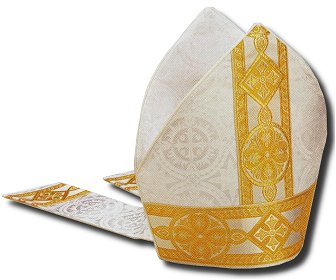
The Desire for the Mitre

It is something I have found in the Continuing Anglican movement as in the independent sacramental movement in general. For those in the mainstream churches, it is difficult to know why everyone seems to want to be a bishop!

There seem to be two issues in question. One is power and authority, a game of dominance of the pack and an expression of man’s baser animal instincts. However, there is another dimension, one of adapting to a situation that is completely different from the Anglican and Roman Catholic institutions. In these mainstream churches, the Episcopate is a clearly defined ministry, most beautifully expounded by the Vatican II decree Christus Dominus.

A malfunction has occurred in late nineteenth century and twentieth century western Christianity in such a way as to necessitate the existence of hundreds of small dissident communities of clergy and lay people who no longer had a place in the mainstream churches. Something was no longer working for all in the mainstream churches, and no longer could one say mainstream = good and heretic/schismatic = bad. Something happened in the twentieth century to make people question authority and unquestioning obedience. I believe I mentioned it a short time ago in connection with the Nuremberg Trials!

In the independent sacramental movement – yes, I’ll be lazy and use the acronym ISP American-style! – the ministry presents itself differently. We are no longer in a situation analogous with the old Church / State alliance which could force people to be the captive audience of the clerical caste. In the ISM, we find ourselves in a situation of total freedom, something like a ship of sailors after a mutiny. Either the men turn against each other, as usually happens, or they assume their freedom and reorganise their life under an acceptable authority figure or by some kind of democratic process and social contract. It is the same with those of us who have found ourselves alienated from the Churches of our origins.

In this article, I will resume ideas given by Bishop John Plummer in his book The Many Paths of the Independent Sacramental Movement. We are aeons away from the folies de grandeur described by men like Peter Anson in his famous book Bishops at Large. These little communities are unknown to the majority of lay Christians, and they find little demand from people whose usual choice is conformity with the Church of their origins or life without religion. The vision is too radical for those who have not studied the underlying questions, and prejudices are created by bishops who succumb to folie de grandeur and the temptation to create a parallel imitation of a mainstream Church.

We thus have churches that are mostly made up from clergy and those aspiring to become clergy, and the occasional lay person who has it all thought out. Plummer makes the observation that the Quakers had abolished the laity, not the clergy. All the members of the Church are raised to a level of full participation in the life of the community. The clergy of these communities are unpaid, and therefore work for their incomes. Being non-stipendiary changes the priest’s entire attitude to his role in the ministry. The life of the community becomes democratic. Many bishops and priests have no congregation but rather live a solitary and contemplative life of differing degrees of authenticity.

Why so many bishops? It is the same question in Continuing Anglicanism and in the more respectable Churches. It seems painfully simple. There just aren’t the resources needed to create large structures with institutions and bureaucracy needed to maintain conformity and coherence. The only way it can work is through the autonomy of the community at “parish” level. Therefore the particular church consists of a bishop, a couple of clergy assisting him and a handful of laity. It is a minimum, but it has the characteristics of something in which the Universal Church can subsist.

The Apostolic Priesthood in these communities is separated from the clerical caste. It is no longer an elite or a power structure. Thus, those who try to imitate the clerical caste of the Roman Catholic Church look ridiculous. Those who accept and embrace this rupture will be forced to embrace a different and more humble vision of the Church.

Such a ministry appeals to a romantic view of the early Church, and fosters a vision of a post-modern church that is no longer a hostage to property, money and men being held by material necessity. The sword is double-edged. Men can be prophetic, fickle or even delinquent. That is the risk of freedom. The future of most ISM communities is still precarious, until a second or third generation begins to take root.

The Episcopate is the basis of all sacramental Christianity, and a bishop makes the episcopal ministry of proximity available. The alternative is bring in a bishop from a distance, and that involves things like travelling expenses. The multiplication of bishops makes things cheaper and more practical in a world where Christianity is rarefying and becoming increasingly distant and invisible. Like it or not, that seems to be the reality.

With the high proportion of clergy, the model that seems to work best is not the diocese or some kind of “personal vicariate” or whatever it is called, but the loose and informal religious order and its secular oblates or tertiaries for those who are married. The bishop-abbot is a powerful archetype and confers a note of authenticity and coherence.

That gives some understanding of why hands can tend to be laid in haste and the episcopate banalised at times. It increases the “wince factor” in those who are used to conventional mainstream ecclesiastical structures. My own reaction is to imagine if we were in a country where the government decided to enter into a concordat with Rome and agree to make people choose between Roman Catholic conformity or being non-religious. Independent churches would be suppressed and put under prohibitive laws. Would that country be spiritually richer – unless the RC Church created an environment in which all its faithful could thrive and find happiness? That surely is the challenge thrown to the mainstream.

If the mainstream Church was wide enough and Catholic enough to embrace all, then surely there would be no further need for “pirate” communities to exist. It all seems rather simple. Make bishops parish priests. Reduce the size of dioceses and above all get rid of the bureaucracy. Until that problem is taken into hand, there will be independent sacramental communities and men and women deciding to take things into their own hands. That is how progress is made.

Posted in Uncategorized | Tagged , , , | 1 Comment

A Promising Independent Sacramental Apostolate

I had often wondered what happened to Brother Stephen Treat who was a monk at Spring Bank Cistercian Abbey and wrote a good number of articles on The Anglo-Catholic blog now in a state of extended hiatus. As far as I have been able to ascertain, this Abbey has been dissolved and the monks dispersed. It was never a large community. We lost touch.

Fr John Treat (Stephen was his monastic name) did not remain a Roman Catholic, accepted ordination from an independent bishop and now runs a blog called St. Rafe’s and a website at St. Rafe’s web site. He has gone the way of spiritual “anarchism” and freedom, aware of the dangers and “flak” he has doubtlessly faced over the past two years.

I have already written about this theme of a Christian ecclesial existence outside all the mainstream churches. One makes of it what one can, with the intention of serving God or swelling up one’s own ego. I like the approach of modern people making a consciously post-modern choice. It is a question of taking religious and liturgical observances out of their convenient category boxes and fostering freedom and a quest for spirituality as people of our time see it.

Their liturgy is of a traditional shape and they practice open Communion, allowing all baptised Christians to receive the Sacraments. I make no secret of the fact I do the same thing. They describe their beliefs as creedally orthodox, joyfully sacramental, radically inclusive, and deeply prayerful. There is definitely a reaction here against sectarian traditionalism and liberalism. They put aside anger caused by past suffering, and turned over a new and fresh page.

This apostolate may be as yet in its infancy, and some things may cause raised eyebrows, but it looks healthy and well-intentioned.

Posted in Uncategorized | Tagged , | 11 Comments

Evil as the Absence of Empathy

Last night for just under three hours, I watched the film made in around 2000 about the Nuremberg Trials of the leading war criminals in 1945-46. I found the acting brilliant, especially the psychopathic manipulation and evil “aura” of Herman Goering.

The American Army appointed a psychologist, Dr Gustav M. Gilbert, to study the minds and motivations of the Nazi defendants. As he was portrayed in the film I saw, Gilbert told the Chief Prosecutor Robert Jackson:

I told you once that I was searching for the nature of evil. I think I’ve come close to defining it: a lack of empathy. It’s the one characteristic that connects all the defendants: a genuine incapacity to feel with their fellow man. Evil, I think, is the absence of empathy.

Empathy is the capacity to recognise and venerate the experience, emotions and aspirations that one is aware of in oneself in other persons. This principle features in all religions and in the works of many philosophers and scientists. Thou shalt love thy neighbour as thyself – as Jesus said.

Empathy implies recognition of human dignity and worth in others that one recognises in oneself. This is often what lacks in comments written, less so in this blog than certain others, by some people otherwise claiming to be Christians.

Empathy is surely the yardstick by which we can judge all morality, goodness or evil.

Posted in Uncategorized | Tagged , , , | 3 Comments

A Lutheran Pastor on Western Orthodoxy

My stats page informed me that my blog had been linked to by a blog run by a Lutheran pastor in the US. The article in question is Must Orthodoxy be Byzantine? He refers to my earlier article – Western Rite Orthodoxy – with my translation of Dr Jean-François Mayer’s article in French (link to the original given).

My reflection on reading this posting is that each Church has its tradition, and does not seem generally to be able to assimilate another tradition with any real completeness for the purpose of receiving “refugees”. Efforts have been made by several Orthodox Churches, notably the Antiochians and the Russians to integrate liturgies of Anglican and Roman Catholic inspiration with a minimum of modifications to conform to eastern theological particularities. Rome has had Byzantine and other oriental rite churches for centuries, and is now developing the Anglican Use among the various Ordinariate communities. Rome has also reintegrated its pre Novus Ordo rite through the various indults and the more recent Papal legislation. The Church of England has tolerated the Roman rite in Latin or English for about the past one hundred years. There is some measure of osmosis, but such limitations are placed on them that some are left disappointed.

To what extent should Churches welcome the widow and the stranger, the exiles from other Churches? These Lutheran reflections are greatly appreciated.

This blog has often been the theatre of disputes concerning the willingness of Orthodox Churches to allow and foster the western tradition. At the same time, Orthodoxy remains a traditional religion like the Latin west before about the fourteenth century. That is rare in our days of globalism and secular humanism / materialism.

I have often read that it is not advisable for people to convert to Orthodoxy because they have been convinced by the sales pitch of a “true church” apologist. If that’s what a reader is considering, go to a parish, quietly attend the Liturgy without receiving any Sacraments, and perhaps after a few months or a year talk quietly with the priest about going further. I no longer allow my blog to be a theatre of disputes or sales pitches of those who compass heaven and earth to make a proselyte to make him twice the child of hell.

Constructive input would be most welcome.

Posted in Uncategorized | Tagged | 23 Comments

Northern Catholicism and Celtic Catholicism

This comment just came in from Stephen K in Australia following my posts

I thought yours a wonderfully concise summary of the differences between Northern and Southern Catholicism, Father. What I want to know now is where, in your opinion, does, for want of a better term, “Celtic Catholicism” fit? As a subset of Northern or of Southern Catholicism, or as a separate cultivar, or as not a distinct variety at all? I am inclined to think it is a distinct cultivar, but I’d be interested to know what you think and why.

I noticed parallels between the movement of St Francis of Assisi and various more radical dissident movements in the thirteenth century. Much as the Celts seemed to eschew institutionalisation and wealth, I don’t see an organic connection between the two. “Southern” Catholicism would seem to represent the work of the Apostles in the Mediterranean Basin, and “Northern” Catholicism would seem to have been influenced by both the Celtic and Roman traditions (and the old Gallicans), but I’m only guessing.

In the absence of time to do any research, I throw the question open to readers and see if anyone can come up with ideas.

Posted in Uncategorized | Tagged , | 1 Comment