An Elegy of the Sea

As we lay up our boats for the winter, we had our end-of-season board meeting of the sailing club. We made our resolutions for next year, in particular having repairs done to the winch and the addition of a light winch for catamarans and dinghies reserved to the club. It’s quite hard to haul a boat up the ramp by hand, and mine is a very light vessel, a little heavier now with its wooden mast, gaff and boom. We discussed getting the boat licence for those who didn’t yet have it – coastal and then offshore. It’s essential for each of us to have the capability of going on a rescue mission with the club’s Zodiac. Of course, some rescues have to be left to the professionals, but I’d be willing to risk my neck to save a life – within reason. I have already done so! The expression – Worse things happen at sea! – is so true… Also, some of us would like to graduate from dinghies and really go to sea! These are good folk. Some of us who go sailing for pleasure, and others go fishing in motor boats, and others are just lovers of the sea.

Just after the meeting, the heavy wooden beams were slotted into their housings in front of the downstairs clubhouse doors facing the sea. That should resist the winter maelstrom and waves of the sea, and the onslaught of shingle from the beach.
On getting home this afternoon, I made the door of our new garden shed, and it still needs varnishing. Otherwise it’ll be rotten before you can say Jack Robinson! The weather here in Normandy is like the south of England – wind and rain – and plenty of it! Then I made a nice cup of tea and looked at my e-mail and web sites. I was moved to find “O dark dark dark. They all go into the dark…” written by Fr Michael Gollop, an Anglican priest in Wales who has a holiday home over in the Vendée, near where I used to live. He was kind enough to link to my previous posting about laying up the boat.

Isn’t it amazing, how we try to keep the sailing season going as long as possible! The dinghies have to be laid up now, unless the more intrepid of us find a day to attempt a river cruise. Eventually, the yachts too have to be laid up for the winter. Fr Gollop quotes a lovely essay by Sir Arthur Quiller-Couch called ‘Laying up the Boat’. So true!

Who knows what next year will bring. This year, the weather was fair enough for a sail before the end of February! The water was cold, but I had my full wetsuit on. That is rare. A la volonté de Dieu!

Posted in Uncategorized | Tagged , | Leave a comment

Saints Simon and Jude

Today is the feast of the holy Apostles Simon and Jude. Here is something Pope Benedict XVI said on them in October 2006. In the Sarum calendar, this feast is celebrated as an Inferior Double like the other Apostles, and has a higher priority than the twenty-first Sunday after Trinity, which is simply commemorated.

Needless to say, the feast of Christ the King in the Roman rite was instituted only in 1925 by Pius XI and celebrated on the last Sunday of October. In the rite of Paul VI, it takes the place of our Sunday next before Advent. One can understand this happening in the 1920’s in the midst of the various emerging totalitarian regimes in Europe, especially Hitler and Mussolini. Paul VI obviously wanted to emphasise the eschatological dimension of this feast rather than relativise the fascination the Dictators had once held over their people in Germany and Italy. This was made possible by the system of per annum Sundays, and in this way Christ the King would not eclipse the first Excita Sunday (which is not in use in the 1969 rite), so-called because of the first word of the Collect.

The notion of a Kingship of Christ is badly understood by some, thinking it confers political power on the hierarchy of the Church, and should therefore bind Church and State in a Throne and Altar alliance. Before Pilate, Christ had said that his kingdom was not of this world. It is an eschatological notion, symbolised by the Christ Pantakrator icon in the apses of medieval western and Byzantine churches.

In my opinion, this notion is adequately re-presented in the feast of Christ’s Epiphany and in the final Sundays after Trinity leading into Advent. As I follow the Sarum calendar, I do not celebrate the feast of Christ the King, or the Sacred Heart for that matter.

Posted in Uncategorized | Leave a comment

Who is Rubricarius?

This is an interesting question that came into my search engine. He is a good friend of mine, but he will need to answer for himself (he is free to send a comment) lest I should break any confidences. Just a small clue – he knows a lot about the liturgy, especially the Roman rite prior to the 1950’s reforms of Holy Week.

Posted in Uncategorized | Tagged | 4 Comments

Another Survey of Search Terms

These search terms are a useful indicator of what readers are interested in. From yesterday, six combinations of my surname and various permutations of “sun” and “orb” were obviously intended to find this blog by those who didn’t have the site address.

Some are keeping an eye open about what I say about the Union of Scranton in Europe: the union of scranton in france, jean bernard de cazenave which is the name of a priest here in France under Bishop Flemestad.

A couple are from people interested in sailing: mirror dinghy drawing, aigle glenan which shows confusion between the Dufour 34 on which I crewed last year at a regatta and the famous sailing school where I went on a course back in 2009, “on the weather beam” which would refer to someone’s recollection of a humorous posting I wrote about the cardinal buoy at Paluel nuclear power station.

I am known to be familiar with the subject of independent sacramental churches. Some look for Archbishop Jerome Lloyd of the Old Roman Catholic Church in Europe who has his own blog. Others look for Archbishop Pierre Martin Ngô Đình Thục, an exiled Vietnamese RC prelate who consecrated a number of independent bishops, notably for the sedevacantists.

english movement towards full union with catholic church seems to fall into a class of its own, and has not been a particular concern for me.

Those interested in “tat” look for the warham surplice or the anglican surplice. They obviously recollect my posting on Anglican choir dress after a request from someone asking me to suggest that Anglican clergy should wear English choir dress rather than the Italian baroque style.

The obvious one is john hepworth.

There has been one search for each of the following:

  • “the heart of the teaching on the liturgy in the conciliar constitution is also the heart of dom casel’s teaching”
  • dogmatic traditionalism
  • spiritual
  • father scott hurd
  • perfectly possessed
  • does a priest say mass on vacation

I suggest reading Sacrosanctum Concilium, in which some lovely theology of the liturgy and the Sacramental Mystery is explained.

As for “dogmatic” traditionalism, the term seems emotionally loaded. Dogma simply means teaching and is roughly a synonym for doctrine. It does not mean bullying or dominating. The idea of a “non-dogmatic” church is an oxymoron, since all churches teach something, even if they don’t agree on what they teach or believe. I supposed I’m old-fashioned and pedantic about my use of words according to their meanings. My Thomist training tends to place reason over emotion!

I never discuss Fr Scott Hurd or the Ordinariates.

Enough seems to have been said about priests saying Mass on holiday or in any private circumstances – just as long as it is dignified. Last August, I took a table top and a trestle set at the right height, and was able to say Mass in our tent. This simple arrangement made an altar which would have been little different from the way Scout and Army chaplains set up for Mass in the field.

I wrote a posting some time ago welcoming readers’ suggestions for posts. That invitation is still open.

Posted in Uncategorized | Tagged | Leave a comment

October Snow

We live in a part of the world where the weather is temperate, and we don’t have extremes like hurricanes and tornadoes. It can get rough at sea with force 9 gales and 10-foot waves, but that’s as bad as it gets. The barometer has been dropping at the rate of 1 hPa per hour for the past few days to settle out at 1006.0 hPa right now. We were promised high winds gusting at 35 to 40 knots and cold weather. Well, this morning it snowed in Normandy.

I didn’t have the courage to go outside any further than the yard. There’s my boat covered over and the snow visible on the roofs. I did get one of the garden through the window, but through-the-glass photos never work!

Freak weather or an early winter? We’ll see…

Posted in Uncategorized | Tagged | 3 Comments

Search Engine Terms

I often get interesting requests from my blog’s search engine.

Landing on the sun – Well, sometimes it gets quite hot in summer, and this planet is quite a long way from where the temperature gets into the millions of degrees. Cooked to a turn in no time flat! It would do St Lawrence proud…

Mirror dinghy names – That is quite a challenge. Here is a forum that discusses boat names. Interestingly, someone has called his Mirror dinghy Vagans. Perhaps she is painted in episcopal violet and has a mitre on the mast!

A query came in for the Anglican Catholic Church and Bishop Mead. It is a subject I almost never discuss, though I am impressed with their seriousness and stability. People often look up the Nordic Catholic Church and Bishop Flemestad, but I have nothing to report for the time being. They have their blog and have shown a couple of videos about the Anglican Benedictine convent in Costock in Nottinghamshire.

I am at a loss with europeans (franco-mauritians & coloureds). We are a mixed bunch, just as much as in the US. France has Overseas Territories and Overseas Departments, which used to be parts of the old Empire. Yes, the French had theirs as we Brits had ours. Much as I welcome racial and cultural diversity, I think there are better places to look than my humble blog!

Understanding Celtic Christianity – That is something we all need to try to do.

The one that really tickled me was As the Sun in its Orbit. A century ago, the circumnavigator Joshua Slocum had to be careful when he visited South Africa as he returned to the Atlantic Ocean from the Indian Ocean by the Cape of Good Hope. He had to say that he had crossed the world rather than gone round the world, because the powers that be down there still believed the world was flat! I have always learned that the planets orbit around the sun and the sun doesn’t orbit around anything, so it would be wrong to speak of the sun’s orbit. There is a question of our galaxy, whether it is static or turns, but you would have to ask an astronomer.

The Church of Salisbury shines as the sun in its orb among the Churches of the whole world in its divine service and those who minister it, and by spreading its rays everywhere makes up for the defects of others.

The quote from Bishop Giles de Bridport, or rather its translation from Latin into English, seems to use a poetic device, because the sun is an orb, a sphere. An orb is not an orbit. We sometimes speak of the orb of the sun.

Posted in Uncategorized | Tagged | 6 Comments

A Sad Time of Year

It is late October and the yellow and red leaves on the trees begin to fall. The weather alternates between the first cold winds from the north-east and north-west and the warm and stormy weather from the south-west. The days on which we can go out on the sea get rarer, as bad weather begins to take over from the shreds of the Indian summer and the few sailable days tend to coincide with working commitments and jobs to be done at home.

And so the time comes to “pull” the boat.

A few days ago, I took the trailer to Veules, hoping for a sail, but there was very little wind and a heavy fog over the sea and land. I took the mast down, packed away the rigging and got everything ready to bring home. A young man who works as a fisherman at Veules must have been able to detect the sadness of the occasion, as I must be the club member who has spent the greatest number of hours at sea on a sailing dinghy that year. Men of the sea are incredibly intuitive. He came out of their fish-processing workshop with a plastic bag in his hand, two gutted and skinned rock salmon ready for cooking. My wife and I ate them that very evening in a nice shrimp and garlic sauce.

The skipper of the fishing dory is a wonderful and kind fellow near retiring age, and he nicknamed me Lord Nelson! I just hope I don’t get shot up somewhere and have to be brought home in a barrel of brandy. What an ignominious waste of brandy! As I sit (or whatever) comfortably at home this winter, he and his men will be taking the dory out each day to eke out a living from the fickle sea. Salt of the earth!

So Sophia is now home, lying up on my trailer.

The following day, the fog had just about cleared and there was a light wind of about 10-14 knots from the south-east, fickle and unstable, but better than nothing. I had an English lesson to give in the morning of last Wednesday for an employee of a company near Le Havre, and the light-bulb lit up. I hitched the boat to my van, and after my job for the day was done, my time was my own. I drove on to the great port of Le Havre, and rigged the boat. I launched from the beach, not knowing that there was a launching ramp for dinghies inside the port – but ports can be notorious for blocking the wind! The boat can be paddled or rowed out and then you get wind for the sails.

The sail was uneventful, though the cliffs to the north of the port were quite beautiful in the still hazy air of the Norman autumn. The huge cargo ships are impressive, as long as one stays out of the shipping channel, marked by the usual green starboard and red port buoys. I also had to watch for their wake waves. A small boat can cross the shipping channel, but it needs to be done quickly, and having made sure that nothing is coming in from the sea or out from the port. Mercifully, the shipping channel is quite narrow and can be crossed in about five minutes in a good beam wind, the distance between the port and starboard channel buoys.

Of course, I have not forgotten my little adventure of last April – Seine Estuary – when I sailed from the other side of the estuary to the beach of Le Havre by crossing the port entrance.

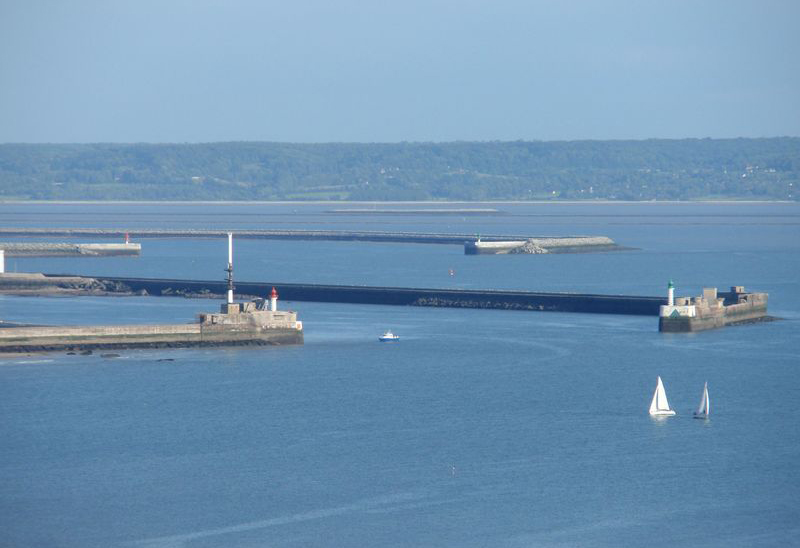
In the foreground is the older and main port, and the entrance behind is the new Port 2000 with the most amazing lifting equipment and facilities for handling incredible volumes of freight. The ferries that go to England are berthed in the old port, and the yacht marina and dinghy ramp are just behind the north port wall. This time, I stayed on the same side of the estuary. The south side of the estuary wasn’t even visible, and I would have been crazy even to consider a crossing in those conditions!

Now the boat is back home, and perhaps I might be able to get a sail on the Seine above the first lock upstream from Rouen. Downstream from Rouen, the Seine is dangerous and there are nasty currents. A boat without an engine is pretty helpless. Upstream on the Seine in the Eure Department, it should be very pleasant if I can find a free and pleasant day with a fresh breeze to go trailer-sailing. There, the Seine is wide enough to tack if the wind is parallel with the river. The advantage of a transportable boat is to find the conditions to suit the boat.

In a couple of weeks, the boat will have to be properly wintered. The hull needs practically no maintenance – just turned upside-down and covered, checked for any weak spots, but the spars will need to be varnished, the sails washed and carefully repaired where any stitches have come out. Then will come the long cold months of sticking out winter and waiting for the first sailing days. Last year, I took the boat out in late February, but in a full wetsuit.

Just a bit of advice – – – don’t capsize when the water is so cold!

We’ll see what next year brings…

Posted in Uncategorized | Tagged , | 2 Comments

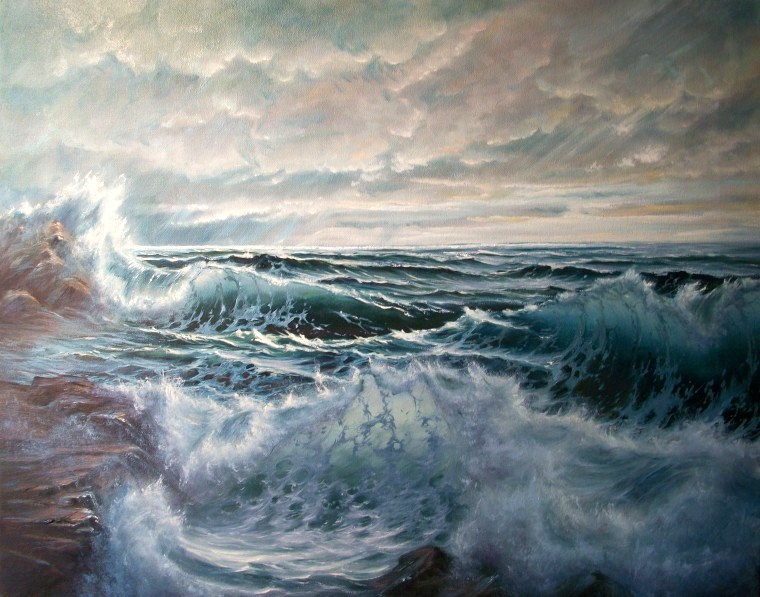
They are carried up to the heaven, and down again to the deep

We have said or sung these words many times…

They that go down to the sea in ships : and occupy their business in great waters;
These men see the works of the Lord : and his wonders in the deep.
For at his word the stormy wind ariseth : which lifteth up the waves thereof.
They are carried up to the heaven, and down again to the deep : their soul melteth away because of the trouble.
They reel to and fro, and stagger like a drunken man : and are at their wits’ end.
So when they cry unto the Lord in their trouble : he delivereth them out of their distress.
For he maketh the storm to cease : so that the waves thereof are still.
Then are they glad, because they are at rest : and so he bringeth them unto the haven where they would be.

But what do they really mean? This is as bad as it can get, as I discovered this video yesterday. Those are highly experienced sailors and top-notch boats. Please remember to pray for those lost at sea and their families.

Posted in Uncategorized | Tagged , | Leave a comment

Sarum at Modern Medievalism

Keep an eye on Modern Medievalism. James Griffin, who runs this blog, has put up some fine posts on the Use of Sarum this month. I celebrate Mass according to this rite each day, and have done so for the past four years, so I must be “taking it for granted”! I have neglected the more academic and historical side of the Sarum Use for some time, and I am thankful to see someone else doing it.

It’s hard work convincing people that we are not a bunch of nutters or museum curators. Sarum is just as much a living rite as the 1962 Roman rite, the Ambrosian rite of Milan or the Dominican Use. It is just a part of the western Church’s patrimony, both in communion with Rome and independent. Admittedly, few priests and parishes use it for fear of doing something “not allowed”. Over here in Normandy, in Rouen, Evreux and Bayeaux, parishes and cathedrals were doing something very similar to Sarum in terms of ceremonies and trappings whilst using the Tridentine missal up to the 1960’s, and in a few places up to the 1990’s when the last of the old priests died.

Keep the flag flying!

Posted in Uncategorized | Tagged , , | 6 Comments

The TAC Tribunal and Archbishop Hepworth

Until now, I have kept silence on this subject as brought up by Fr Smuts in Statement from the The Traditional Anglican Communion College of Bishops Re: John Hepworth, with the exception of writing a comment on that blog asking about the possibility of having the exact wording of the charges of which the Archbishop was accused.

The comments attached to this posting in Fr Smuts blog are of particular interest, especially from the Roman Catholics like Joshua and Mourad. Mourad is a lawyer and wrote this in his comment:

After all, it is not every day in the life of a Church that a Primate or an Archbishop is deprived of office in formal ecclesiastical judicial proceedings. In Anglican terms, it’s a cataclysmic event. How often has a Primate been deposed in the last 500 years? Still, one expects Anglicans to know how these things ought to be done.Not least in this case because the tribunal was composed of (1) The Most Reverend Samuel P. Prakash, Acting Primate of the Traditional Anglican Communion, Metropolitan of the Anglican Church of India, (2) The Rt Reverend Brian D. Marsh, President of the House of Bishops of the Anglican Church in America and (3) the Rt. Rev. Craig R.G. Botterill, Q.C, Acting Metropolitan, Apostolic Administrator (and Lord High Everything Else) of the Anglican Catholic Church of Canada.

Not everyone may know the significance of the letters “Q.C.” after Bishop Botterill’s name. They stand for “Queen’s Counsel” – technically “one of Her Majesty’s Counsel learned in the law”. The then Attorney-General and Justice Minister of Nova Scotia recommended Craig Botterill for the appointment in the 1980′s when Botterill was serving as Senior Crown Attorney in the Public Prosecution Service of Nova Scotia. So with such a distinguished lawyer among its number, this particular Tribunal must be taken to have had the ability to proceed with entire propriety – if it wished to. Perhaps it did. But not visibly so.

The statement on the web site does not exactly fill one with any confidence that it did. There is no mention of who were the 8 episcopal complainants. There are no details of where the Tribunal sat or when. There is no publication of a reasoned decision, still less any publication of the evidence put before the Tribunal.

It seems to me that a canonical trial should be a public procedure. There should at least be a publication of the charges and a reasoned conclusion leading to the court’s sentence. All we read is that the Archbishop was found guilty, with a vague reference to the TAC Concordat, and the sentence. Several have made the same observation that the charges leading to the conviction are missing.

Now, I am not going to take a position in all this or express any personal feelings. I have spent a sufficient time without contact with the Archbishop to verify my own independence from any influence he might have had on me. This was important to me as my intuition told me that many things he said to me just didn’t ring right or were actually false, for example the assurances that Rome was going to grant special dispensations for some canonical irregularities or whether Anglicanorum coetibus was about whole churches or just cherry-picked clergy and communities. The facts as they stand are now clear and there is no further discussion. Only time would verify things, since a priest tends to trust his ordinary – a part of ecclesiastical obedience, I principle I believe in. Yet my critical faculties were unimpaired – but I just had to keep quiet and wait. In a way, he did lead us up the garden path. The only question was why and whether he had a mitigating circumstance for telling untruths and lies.

I don’t know why he wasn’t truthful. Bad personality? Psychological problems because of the sex abuse and / or other reasons? Ambition? Being a common crook? I have my theories, but they will probably never be verified. He was kind to me, gave me something like a canonical mission as a priest, a kind of “regularisation” and appeared to be heading a credible church on two counts: he was in dialogue with Rome and some good serious bishops were following him and trusted him as I did.

The events of September 2011 and the Australian press did not impress me, nor has the Peter Slipper affair. If the Archbishop was in good faith, his judgement was appalling. His appearance in a recent video is bizarre and incongruous. On these counts, I am unable to defend him in any way.

The bishops who have now condemned him once trusted him. Perhaps the Archbishop betrayed that trust by not effectively ensuring a “third way” between the growing anti-Roman Catholic tendency and the Ordinariates. I understand bitterness, but it is a passion to overcome to avoid falling into sin. We are Christians!

Now what has happened is unclear. Some are talking of a kangaroo court, a lynching. I have some knowledge of canon law, and the procedures for penal and contentious processes resemble those of the civil law of most western countries. Firstly, a trial – especially a penal one – is public and the charges are made public. Evidence is weighed and reasoned out, and there is a debate between the prosecution and the defence or at least some kind of “devil’s advocate” to verify the honesty and rigour of the reasoning on the basis of evidence. I suppose the trial was in fact a secret one, something like the medieval Inquisition, and this in my mind makes the whole thing suspect. Perhaps more justifying information is on its way. I hope so.

It now looks to me that the TAC bishops and those responsible for this procedure are going to attract adverse public opinion. Like Mourad, I await clarifications about the charges and correct procedure of this trial together with the evidence on which it arrived at its conclusions.

Posted in Uncategorized | Tagged , , , | 5 Comments